

 作者中心
作者中心 专家审稿
专家审稿 责编办公
责编办公 编辑办公
编辑办公
-
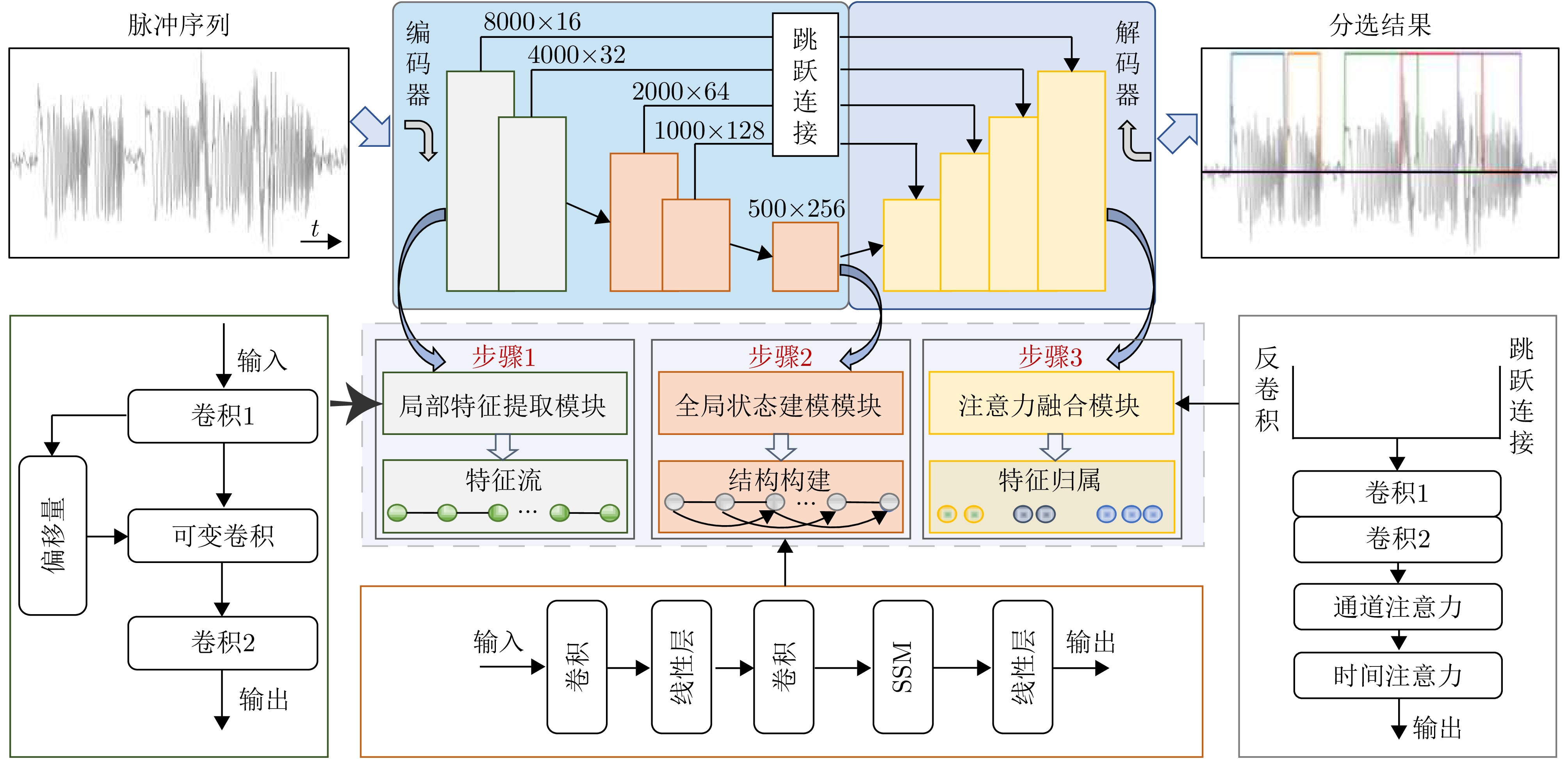
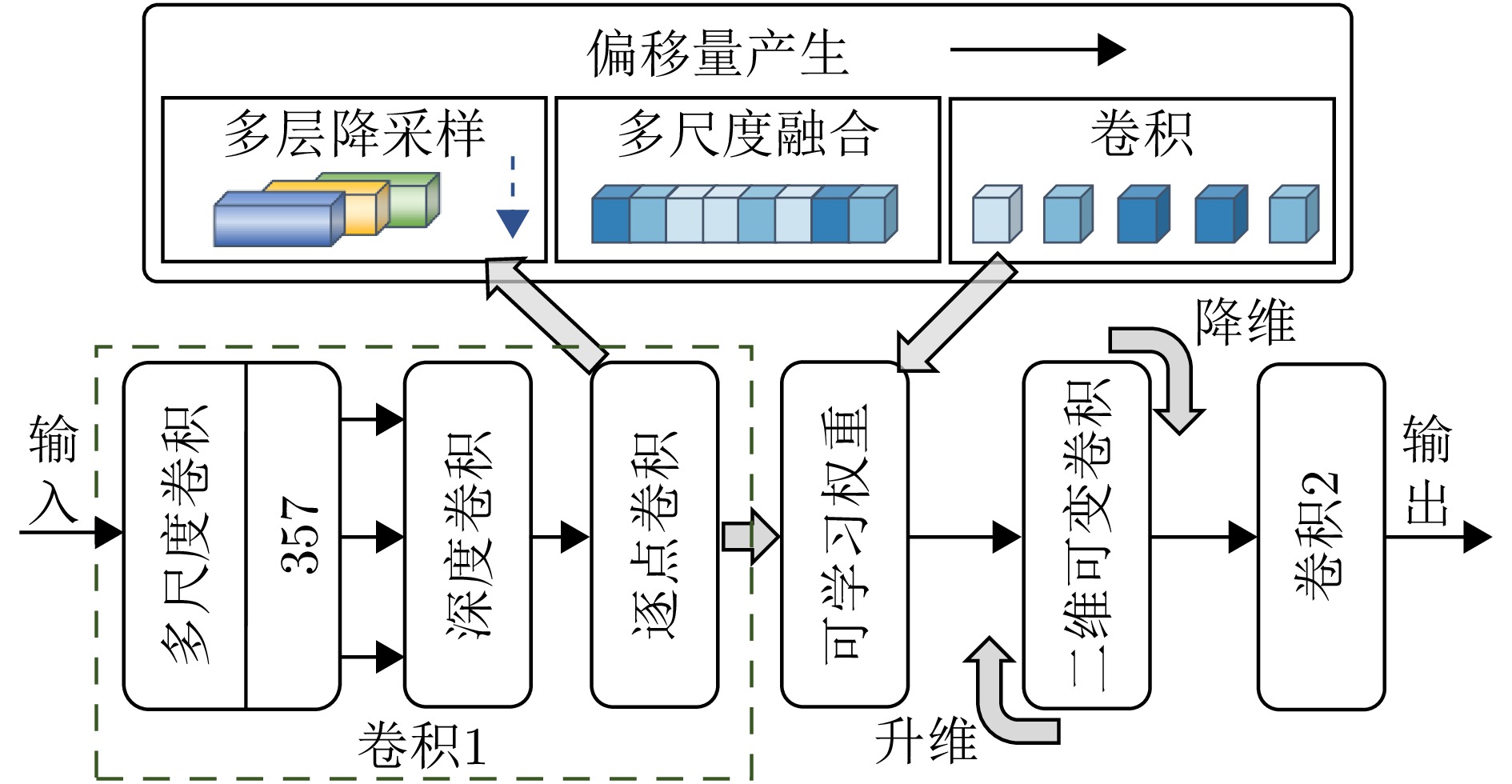
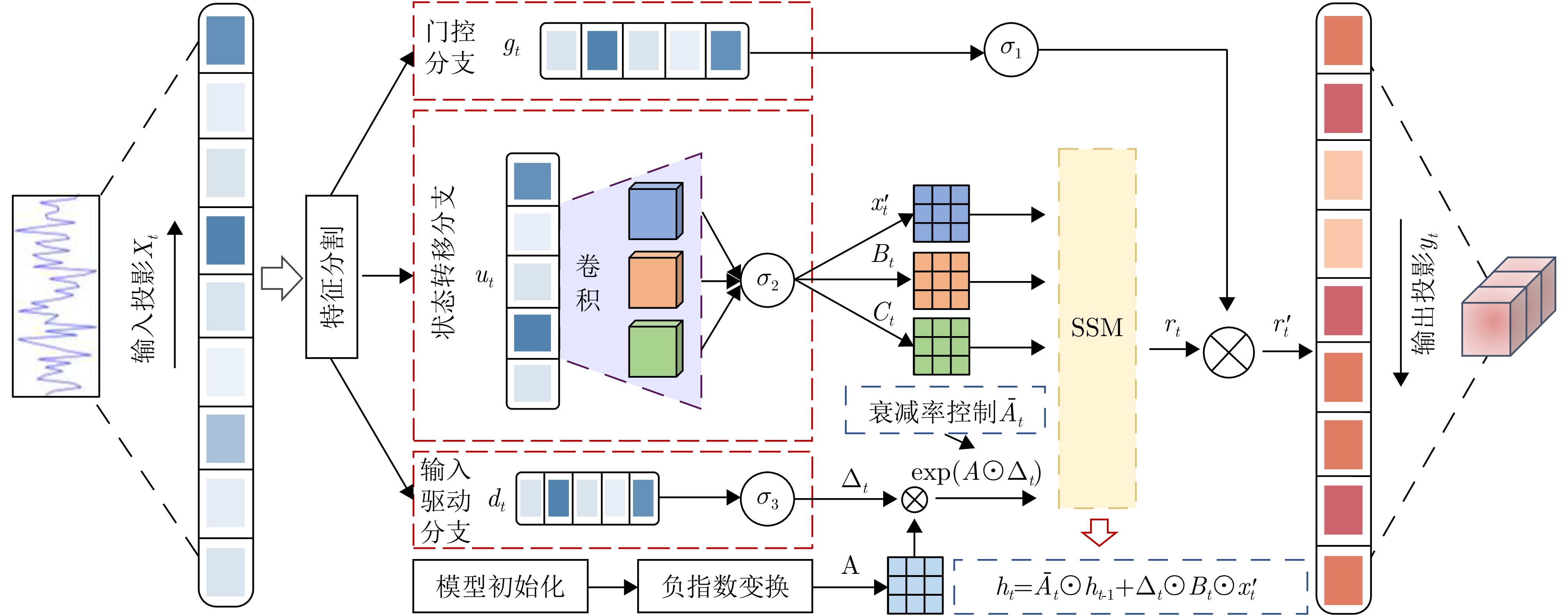
摘要: 雷达辐射源信号分选旨在从交叠的脉冲流中分离出各辐射源对应的脉冲序列,是雷达信号侦察处理的关键环节,其结果将直接影响后续体制识别、行为分析与威胁评估等任务的准确性。现有方法通常以脉冲描述字作为主要特征,并通过不同辐射源脉冲在参数空间中的差异实现归属判别。然而,在复杂电磁环境下,脉冲描述字的估计可靠性极易受噪声、测量误差和波形混叠等因素影响,导致不同辐射源脉冲的特征区分度下降,从而制约了分选性能的进一步提升。针对上述问题,该文提出一种基于结构化状态建模的端到端脉冲流分选网络FSUNet。该网络直接以观测窗口内的脉冲流作为输入,在统一框架下联合建模脉内局部形态特征与脉间时序依赖关系,实现从原始信号到分选结果的端到端映射。具体而言,FSUNet首先利用多尺度自适应偏移机制提取脉冲边界与局部瞬态特征;随后通过结构化状态空间模块对跨脉冲的上下文依赖进行递推建模,以增强长程时序表征能力和分选结果的一致性;最后结合跳跃连接与注意力融合机制,自适应整合局部细节与全局状态信息。实验结果表明,在多种分选场景下,FSUNet能够在保持计算效率的同时取得较高的分选精度和鲁棒性。Abstract: Radar emitter signal deinterleaving separates pulse sequences from individual emitters within overlapping pulse streams. This is a critical step in radar signal intelligence processing, as its performance directly affects the accuracy of subsequent tasks such as waveform recognition, behavior analysis, and threat assessment. Current methods typically use pulse description words as the primary features, assigning pulse attribution based on parameter differences among emitters. However, in complex electromagnetic environments, the reliability of pulse description word estimation is highly susceptible to noise, measurement errors, and waveform overlap. These issues reduce the feature separability of pulses from different emitters, thereby limiting further improvements in deinterleaving performance. To address these challenges, this study proposes FSUNet, an end-to-end pulse stream deinterleaving network based on structured state modeling. FSUNet directly accepts the pulse stream within an observation window as input and jointly models intrapulse local morphological features and interpulse temporal dependencies within a unified framework. This enables an end-to-end mapping from raw signals to deinterleaving results. Specifically, FSUNet first utilizes a multiscale adaptive offset mechanism to extract pulse boundaries and local transient features. It then introduces a structured state space module to recursively model cross-pulse contextual dependencies, enhancing long-range temporal representation and improving the consistency of deinterleaving results. Finally, skip connections are combined with an attention-based fusion mechanism to adaptively integrate local details with global state information. Experimental results show that FSUNet achieves high deinterleaving accuracy and robustness across various scenarios while maintaining computational efficiency.
-
表 1 仿真数据集参数设置
Table 1. Parameter settings for simulated dataset generation
场景设置 参数名称 参数设置 全场景
基础参数带宽B 3 MHz 观测窗口$ {T}_{\text{obs}} $ 3 ms 信噪比$ \text{SNR} $ $ \mathrm{U}(0{,}10) \;\text{dB} $ 脉冲宽度$ {T}_{{\mathrm{p}}} $ $ \mathrm{U}(60{,}150) \;\text{μs} $ 采样率$ {f}_{\text{s}} $ 6 MHz 辐射源数目M $ [2{,}5] $ 幅度缩放$ {A}_{m} $ $ \mathrm{U}(0.2{,}1.0) $ 基准$ \text{PRI}{T}_{0} $ $ \mathrm{U}(400{,}1000) \;\text{μs} $ $ \text{PW} $捷变区间1 $ \mathrm{U}(60{,}100) \;\text{μs} $ $ \text{PW} $捷变区间2 $ \mathrm{U}(100{,}150)\; \text{μs} $
PRI调度
类型固定$ \text{PRI} $ $ {T}_{\text{PRI},n}={T}_{0} $ 随机抖动$ \text{PRI} $ $ {T}_{\text{PRI},n}={T}_{0}(1+{\epsilon }_{n}) $ 滑变$ \text{PRI} $ $ {T}_{\text{PRI},n}={T}_{0}+(n\;\text{mod}\;{L}_{c}){\varDelta }T $ 参差$ \text{PRI} $ $ {T}_{\text{PRI},n}={T}_{0}(1+{\alpha }_{n\;\text{mod}\;{{L}_{s}}}) $ 正弦调制$ \text{PRI} $ $ {T}_{\text{PRI},n} = {T}_{0}\left[1 + \beta \sin \left(\dfrac{{2\text{π}}{\mathrm{TOA}}_n}{{L}_{m}}\right)\right] $ PRI调制
参数随机抖动$ {\epsilon }_{n} $ $ {\epsilon }_{n}\text{~} \text{U}(-\rho ,\rho ) $ 抖动幅度$ \rho $ $ \mathrm{U}(0.05{,}0.25) $ 滑变周期$ {L}_{c} $ $ \{5,6,\cdots ,15\} $ 滑变步进$ {\Delta }T/{T}_{0} $ $ \mathrm{U}(0.02{,}0.08) $ 参差周期$ {L}_{s} $ $ \{2{,}3,4\} $ 参差偏移系数$ \alpha $ $ \mathrm{U}(0.10{,}0.40) $ 正弦调制周期$ {T}_{m} $ $ \mathrm{U}(5{,}25) $ 正弦调制幅度$ \beta $ $ \mathrm{U}(0.10{,}0.40) $ 脉内调制 脉内调制 LFM, CW, NLFM 相位编码 Barker, Frank, P4  下载: 导出CSV
表 2 不同任务场景下的模型性能
Table 2. Model performance under different task scenarios
任务场景 实验设置 IoU Sim Pre Rec F1 脉冲分选 脉冲分选 0.845 0.920 0.902 0.931 0.916 堆叠检测 0.949 0.974 0.974 0.967 0.971 边缘检测 0.827 0.904 0.912 0.905 0.908 脉内结构变化 脉宽变化 0.861 0.926 0.916 0.933 0.925 混合调制 0.803 0.893 0.896 0.886 0.891 混合相位 0.831 0.910 0.898 0.918 0.908 脉间时序变化 PRI变化 0.800 0.892 0.906 0.873 0.889
下载: 导出CSV
表 3 不同SNR下的模型性能指标
Table 3. Performance metrics under different SNR levels
SNR (dB) IoU Sim Pre Rec F1 10 0.893 0.946 0.931 0.956 0.943 8 0.887 0.942 0.923 0.958 0.940 6 0.883 0.940 0.926 0.950 0.938 4 0.888 0.943 0.928 0.954 0.941 2 0.854 0.922 0.912 0.931 0.921 0 0.845 0.920 0.902 0.931 0.916
下载: 导出CSV
表 4 不同模型性能对比
Table 4. Performance comparison of different models
模型 参数量(M) GFLOPs IoU Sim Pre Rec F1 FSUNet 1.54 1.14 0.845 0.920 0.902 0.931 0.916 Dual-Path RNN[24] 1.38 3.48 0.733 0.850 0.831 0.861 0.846 X-TF-GridNet[25] 3.36 1.60 0.707 0.831 0.799 0.859 0.828 CAU-Net[26] 2.76 2.76 0.650 0.792 0.774 0.804 0.788 SepReformer[27] 4.56 16.14 0.840 0.918 0.894 0.925 0.909 U-Net[35] 0.27 2.76 0.477 0.642 0.647 0.633 0.640 U2-Net[36] 14.72 9.22 0.601 0.759 0.735 0.778 0.756 DCN[37] 0.71 4.86 0.512 0.687 0.676 0.689 0.683 VoxResNet[38] 0.22 0.58 0.637 0.784 0.753 0.805 0.778
下载: 导出CSV
表 5 消融实验结果
Table 5. Results of ablation experiments
任务 实验设置 IoU Sim Pre Rec F1 脉冲分选 FSUNet 0.845 0.920 0.902 0.931 0.916 删除可变形卷积模块 0.781 0.880 0.847 0.909 0.877 删除多尺度偏移量预测 0.810 0.897 0.873 0.917 0.895 删除全局状态建模模块 0.604 0.756 0.743 0.763 0.753 用Transformer代替全局建模 0.780 0.881 0.864 0.889 0.877 删除注意力融合模块 0.640 0.786 0.707 0.871 0.780 边缘检测 FSUNet 0.827 0.904 0.912 0.905 0.908 删除可变形卷积模块 0.757 0.851 0.852 0.835 0.843 删除全局状态建模模块 0.817 0.897 0.898 0.881 0.889
下载: 导出CSV
-
[1] 隋金坪, 刘振, 刘丽, 等. 雷达辐射源信号分选研究进展[J]. 雷达学报, 2022, 11(3): 418–433. doi: 10.12000/JR21147.SUI Jinping, LIU Zhen, LIU Li, et al. Progress in radar emitter signal deinterleaving[J]. Journal of Radars, 2022, 11(3): 418–433. doi: 10.12000/JR21147. [2] WEI Shaopeng, HAN Haoyu, WEI Song, et al. ISRJ suppression using joint morphological component analysis and signal reconstruction based on jamming parameters estimation[J]. IEEE Transactions on Aerospace and Electronic Systems, 2026, 62: 3773–3797. doi: 10.1109/TAES.2025.3648973. [3] CHENG Wenhai, ZHANG Qunying, DONG Jiaming, et al. An enhanced algorithm for deinterleaving mixed radar signals[J]. IEEE Transactions on Aerospace and Electronic Systems, 2021, 57(6): 3927–3940. doi: 10.1109/TAES.2021.3087832. [4] LLOYD S. Least squares quantization in PCM[J]. IEEE Transactions on Information Theory, 1982, 28(2): 129–137. doi: 10.1109/TIT.1982.1056489. [5] ESTER M, KRIEGEL H P, SANDER J, et al. A density-based algorithm for discovering clusters in large spatial databases with noise[C]. Second International Conference on Knowledge Discovery and Data Mining, Portland, USA, 1996: 226–231. [6] BEZDEK J C. Pattern Recognition with Fuzzy Objective Function Algorithms[M]. New York, USA: Springer, 1981: 1–272. doi: 10.1007/978-1-4757-0450-1. [7] RODRIGUEZ A and LAIO A. Clustering by fast search and find of density peaks[J]. Science, 2014, 344(6191): 1492–1496. doi: 10.1126/science.1242072. [8] WILKINSON D R and WATSON A W. Use of metric techniques in ESM data processing[J]. IEE Proceedings F (Communications, Radar and Signal Processing), 1985, 132(4): 229–232. doi: 10.1049/ip-f-1.1985.0055. [9] MARDIA H K. New techniques for the deinterleaving of repetitive sequences[J]. IEE Proceedings F (Radar and Signal Processing), 1989, 136(4): 149–154. doi: 10.1049/ip-f-2.1989.0025. [10] MILOJEVIĆ D J and POPOVIĆ B M. Improved algorithm for the deinterleaving of radar pulses[J]. IEE Proceedings F (Radar and Signal Processing), 1992, 139(1): 98–104. doi: 10.1049/ip-f-2.1992.0012. [11] NELSON D. Special purpose correlation functions for improved signal detection and parameter estimation[C]. 1993 IEEE International Conference on Acoustics, Speech, and Signal Processing, Minneapolis, USA, 1993: 73–76. doi: 10.1109/ICASSP.1993.319597. [12] LI Ziying, FU Xiongjun, DONG Jian, et al. Radar signal sorting via graph convolutional network and semi-supervised learning[J]. IEEE Signal Processing Letters, 2025, 32: 421–425. doi: 10.1109/LSP.2024.3519884. [13] LANG Ping, FU Xiongjun, DONG Jian, et al. A novel radar signals sorting method via residual graph convolutional network[J]. IEEE Signal Processing Letters, 2023, 30: 753–757. doi: 10.1109/LSP.2023.3287404. [14] ZHOU Zixiang, FU Xiongjun, DONG Jian, et al. Radar signal sorting with multiple self-attention coupling mechanism based Transformer network[J]. IEEE Signal Processing Letters, 2024, 31: 1765–1769. doi: 10.1109/LSP.2024.3421948. [15] CHEN Hongzhuo, QI Liangang, GUO Qiang, et al. A multi-view attention hypergraph neural network for radar emitter signal sorting[J]. IEEE Signal Processing Letters, 2025, 32: 3754–3758. doi: 10.1109/LSP.2025.3602393. [16] WANG Chao, SUN Liting, LIU Zhangmeng, et al. A radar signal deinterleaving method based on semantic segmentation with neural network[J]. IEEE Transactions on Signal Processing, 2022, 70: 5806–5821. doi: 10.1109/TSP.2022.3229630. [17] LIU Zhangmeng. Pulse deinterleaving for multifunction radars with hierarchical deep neural networks[J]. IEEE Transactions on Aerospace and Electronic Systems, 2021, 57(6): 3585–3599. doi: 10.1109/TAES.2021.3079571. [18] NUHOGLU M A, ALP Y K, ULUSOY M E C, et al. Image segmentation for radar signal deinterleaving using deep learning[J]. IEEE Transactions on Aerospace and Electronic Systems, 2023, 59(1): 541–554. doi: 10.1109/TAES.2022.3188225. [19] GUO Qiang, HUANG Shuai, QI Liangang, et al. A radar signal deinterleaving method based on complex network and Laplacian graph clustering[J]. IEEE Signal Processing Letters, 2024, 31: 2580–2584. doi: 10.1109/LSP.2024.3461656. [20] HE Chao, ZHANG Lei, WEI Song, et al. Multifunction radar working mode recognition with unsupervised hierarchical modeling and functional semantics embedding based LSTM[J]. IEEE Sensors Journal, 2024, 24(14): 22698–22710. doi: 10.1109/JSEN.2024.3406680. [21] HYVÄRINEN A and OJA E. Independent component analysis: Algorithms and applications[J]. Neural Networks, 2000, 13(4/5): 411–430. doi: 10.1016/S0893-6080(00)00026-5. [22] LEE D D and SEUNG H S. Learning the parts of objects by non-negative matrix factorization[J]. Nature, 1999, 401(6755): 788–791. doi: 10.1038/44565. [23] LUO Yi and MESGARANI N. TasNet: Time-domain audio separation network for real-time, single-channel speech separation[C]. 2018 IEEE International Conference on Acoustics, Speech and Signal Processing, Calgary, Canada, 2018: 696–700. doi: 10.1109/ICASSP.2018.8462116. [24] LUO Yi, CHEN Zhuo, and YOSHIOKA T. Dual-path RNN: Efficient long sequence modeling for time-domain single-channel speech separation[C]. 2020 IEEE International Conference on Acoustics, Speech and Signal Processing, Barcelona, Spain, 2020: 46–50. doi: 10.1109/ICASSP40776.2020.9054266. [25] HAO Fengyuan, LI Xiaodong, and ZHENG Chengshi. X-TF-GridNet: A time-frequency domain target speaker extraction network with adaptive speaker embedding fusion[J]. Information Fusion, 2024, 112: 102550. doi: 10.1016/j.inffus.2024.102550. [26] ZHOU Yejian, ZHENG Ye, WEI Shaopeng, et al. CAU-Net: A convolutional attention U-network for radar signal deinterleaving[J]. IEEE Communications Letters, 2024, 28(7): 1569–1573. doi: 10.1109/LCOMM.2024.3404957. [27] SHIN U H, LEE S, KIM T, et al. Separate and reconstruct: Asymmetric encoder-decoder for speech separation[C]. 38th International Conference on Neural Information Processing Systems, Vancouver, Canada, 2024: 1655. doi: 10.52202/079017-1655. [28] LUO Zhenghao, YUAN Shuo, SHANG Wenxiu, et al. Automatic reconstruction of radar pulse repetition pattern based on model learning[J]. Digital Signal Processing, 2024, 152: 104596. doi: 10.1016/j.dsp.2024.104596. [29] 李廉林, 周小阳, 崔铁军. 结构化信号处理理论和方法的研究进展[J]. 雷达学报, 2015, 4(5): 491–502. doi: 10.12000/JR15111.LI Lianlin, ZHOU Xiaoyang, and CUI Tiejun. Perspectives on theories and methods of structural signal processing[J]. Journal of Radars, 2015, 4(5): 491–502. doi: 10.12000/JR15111. [30] BRAND D and ZAFIROPULO P. On communicating finite-state machines[J]. Journal of the ACM (JACM), 1983, 30(2): 323–342. doi: 10.1145/322374.322380. [31] 王俊, 郑彤, 雷鹏, 等. 深度学习在雷达中的研究综述[J]. 雷达学报, 2018, 7(4): 395–411. doi: 10.12000/JR18040.WANG Jun, ZHENG Tong, LEI Peng, et al. Study on deep learning in radar[J]. Journal of Radars, 2018, 7(4): 395–411. doi: 10.12000/JR18040. [32] KALMAN R E. Mathematical description of linear dynamical systems[J]. Journal of the Society for Industrial and Applied Mathematics Series A Control, 1963, 1(2): 152–192. doi: 10.1137/0301010. [33] DAO T and GU A. Transformers are SSMs: Generalized models and efficient algorithms through structured state space duality[C]. 41st International Conference on Machine Learning, Vienna, Austria, 2024: 10041–10071. [34] CHI Kun, SHEN Jihong, LI Yan, et al. Multi-function radar signal sorting based on complex network[J]. IEEE Signal Processing Letters, 2021, 28: 91–95. doi: 10.1109/LSP.2020.3044259. [35] RONNEBERGER O, FISCHER P, and BROX T. U-Net: Convolutional networks for biomedical image segmentation[C]. 18th International Conference on Medical Image Computing and Computer-Assisted Intervention, Munich, Germany, 2015: 234–241. doi: 10.1007/978-3-319-24574-4_28. [36] QIN Xuebin, ZHANG Zichen, HUANG Chenyang, et al. U2-Net: Going deeper with nested U-structure for salient object detection[J]. Pattern Recognition, 2020, 106: 107404. doi: 10.1016/j.patcog.2020.107404. [37] DAI Jifeng, QI Haozhi, XIONG Yuwen, et al. Deformable convolutional networks[C]. 2017 IEEE International Conference on Computer Vision, Venice, Italy, 2017: 764–773. doi: 10.1109/ICCV.2017.89. [38] CHEN Hao, DOU Qi, YU Lequan, et al. VoxResNet: Deep voxelwise residual networks for brain segmentation from 3D MR images[J]. NeuroImage, 2018, 170: 446–455. doi: 10.1016/j.neuroimage.2017.04.041. -


计量
- 文章访问数:
- HTML全文浏览量:
- PDF下载量:
- 被引次数: 0