

 作者中心
作者中心 专家审稿
专家审稿 责编办公
责编办公 编辑办公
编辑办公
Multimodal OAM Projection-focusing Least Squares Imaging Algorithm for Regional Coverage
-
摘要: 基于稀疏恢复模型的多模态OAM成像属于计算成像的范畴,目标重构可建模为一个由成像方程表征的线性逆问题。使用最小二乘法进行求解时,噪声扰动会对目标重构结果带来明显的不利影响,且由于成像方程往往欠定而存在多解,最小二乘法只追求数据拟合度,目标重构结果与真实情况相差较大。考虑到噪声带来的求解误差与参考矩阵的奇异值成反比,该文首先提出了一种基于阵元落差排布的阵列设计方法,相比于传统的均匀圆形阵列设计能增加阵元数量,降低参考矩阵列向量的相关性,减少了小奇异值的数量。在此基础上,提出了基于子空间投影算法的区域聚焦最小二乘算法,通过基本相关法确定目标区域后,将回波向量投影至目标区域线性子空间,在聚焦目标区域将欠定成像方程变成超定成像方程的同时,借助噪声与目标区域线性子空间的低相关性有效降低了噪声功率。最后,利用模拟实验的方法对所提算法进行了验证。
-
关键词:
- 轨道角动量 /
- 多模态OAM关联成像 /
- 圆形阵列 /
- 最小二乘 /
- 子空间投影
Abstract: Multimodal orbital angular momentum imaging, which uses sparse recovery models, is a form of computational imaging where target reconstruction can be formulated as a linear inverse problem defined by an imaging equation. However, solving this problem using the least squares method can lead to substantial degradation in reconstruction quality, even with minor noise perturbations. Moreover, because the imaging equation is often underdetermined and has multiple solutions, the least squares method, which prioritizes data fitting accuracy, frequently produces results that deviate considerably from the actual target. Given that solution errors caused by noise are inversely proportional to the singular values of the reference matrix, this study first introduces an array design method that uses nonuniform element placement. This method, when compared to traditional uniform circular array designs, increases the number of array elements, reduces the correlation among the column vectors of the reference matrix, and decreases the number of small singular values. On this basis, a regional focusing least squares algorithm based on subspace projection is proposed. This algorithm first uses a basic correlation method to identify the target region. The echo vector is then projected onto the linear subspace of this target region. This projection transforms the underdetermined imaging equation into an overdetermined one within the focused target region. Concurrently, it effectively reduces noise power by exploiting the low correlation between noise and the target region’s linear subspace. The proposed algorithm’s effectiveness is subsequently validated through simulation experiments. -
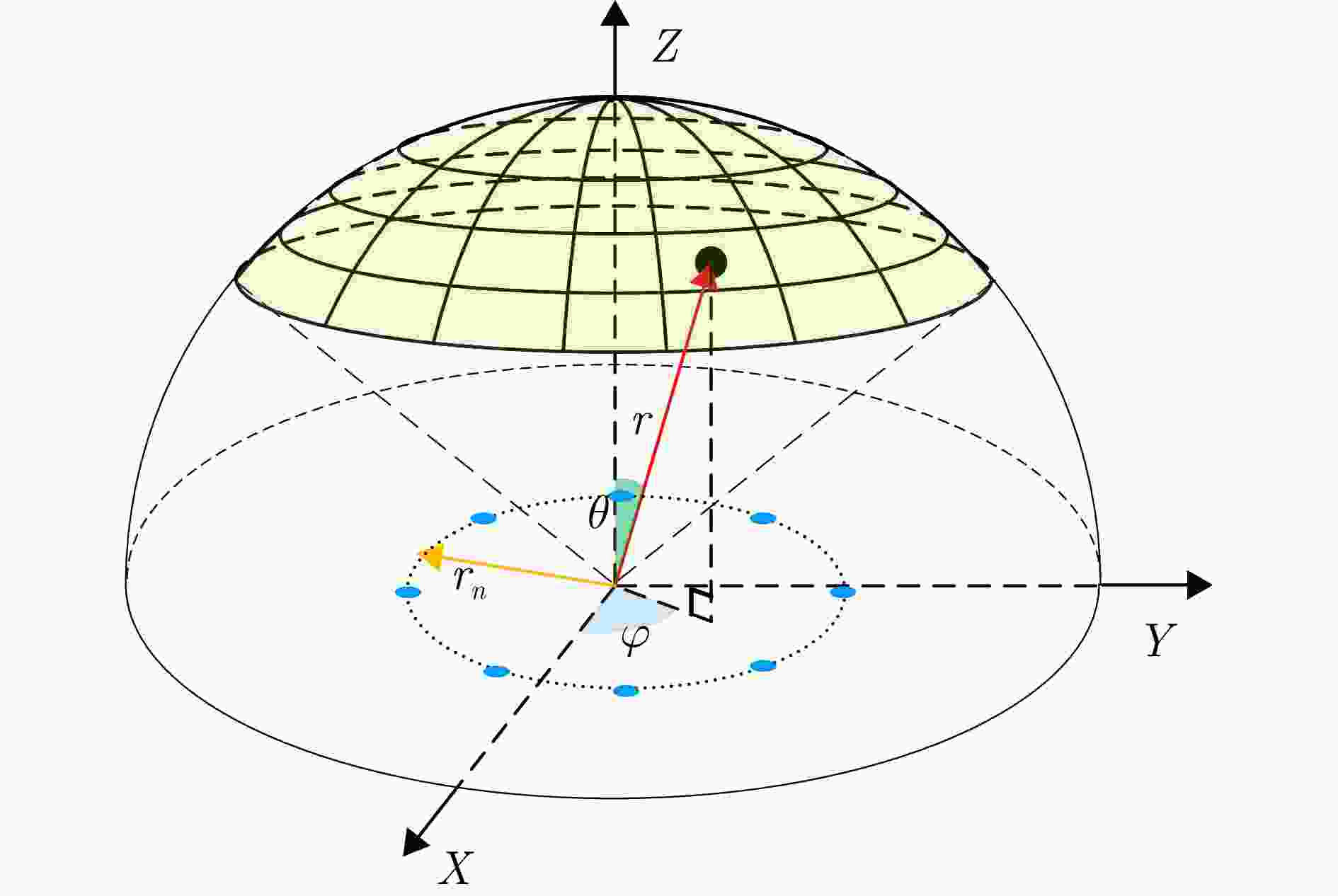
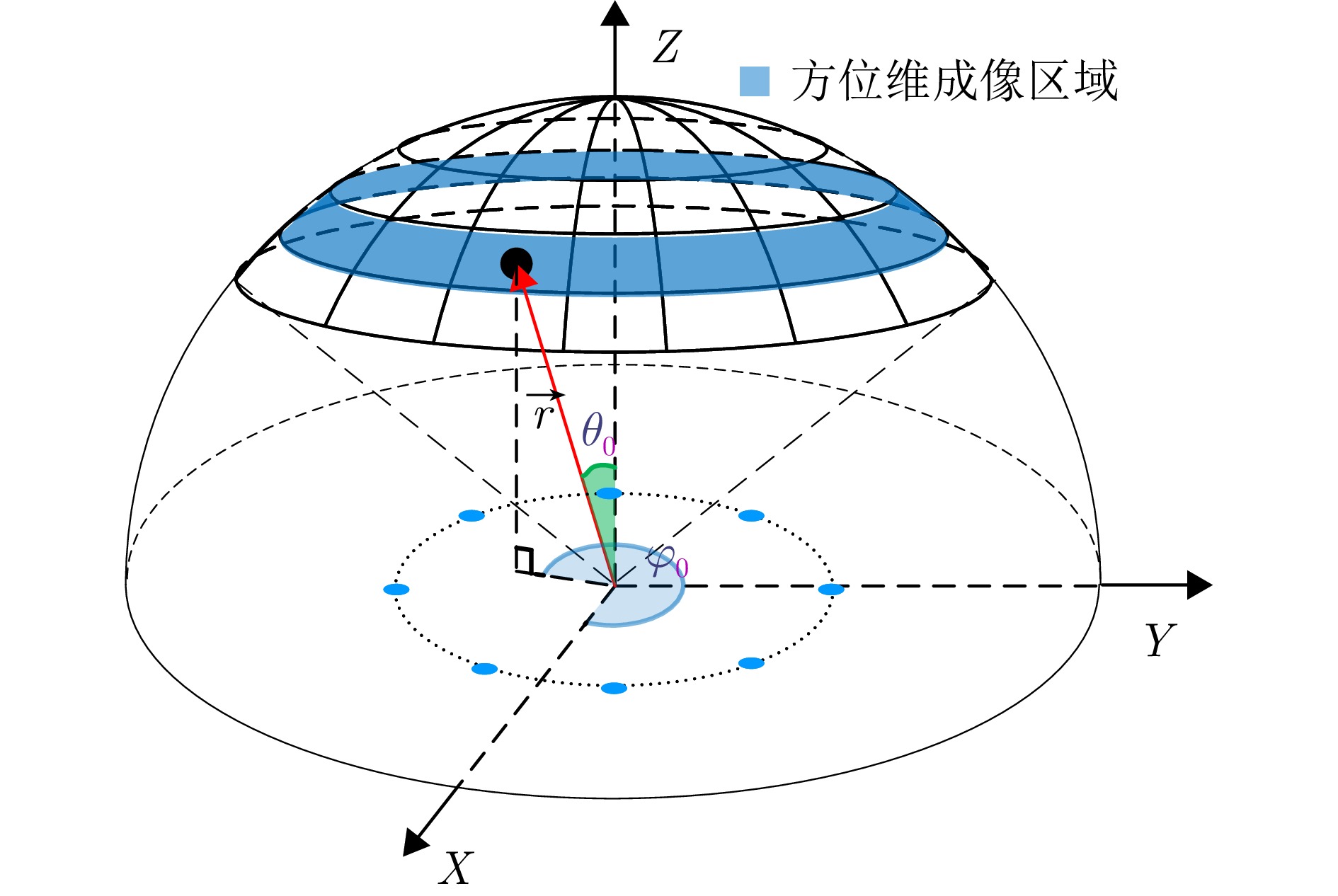
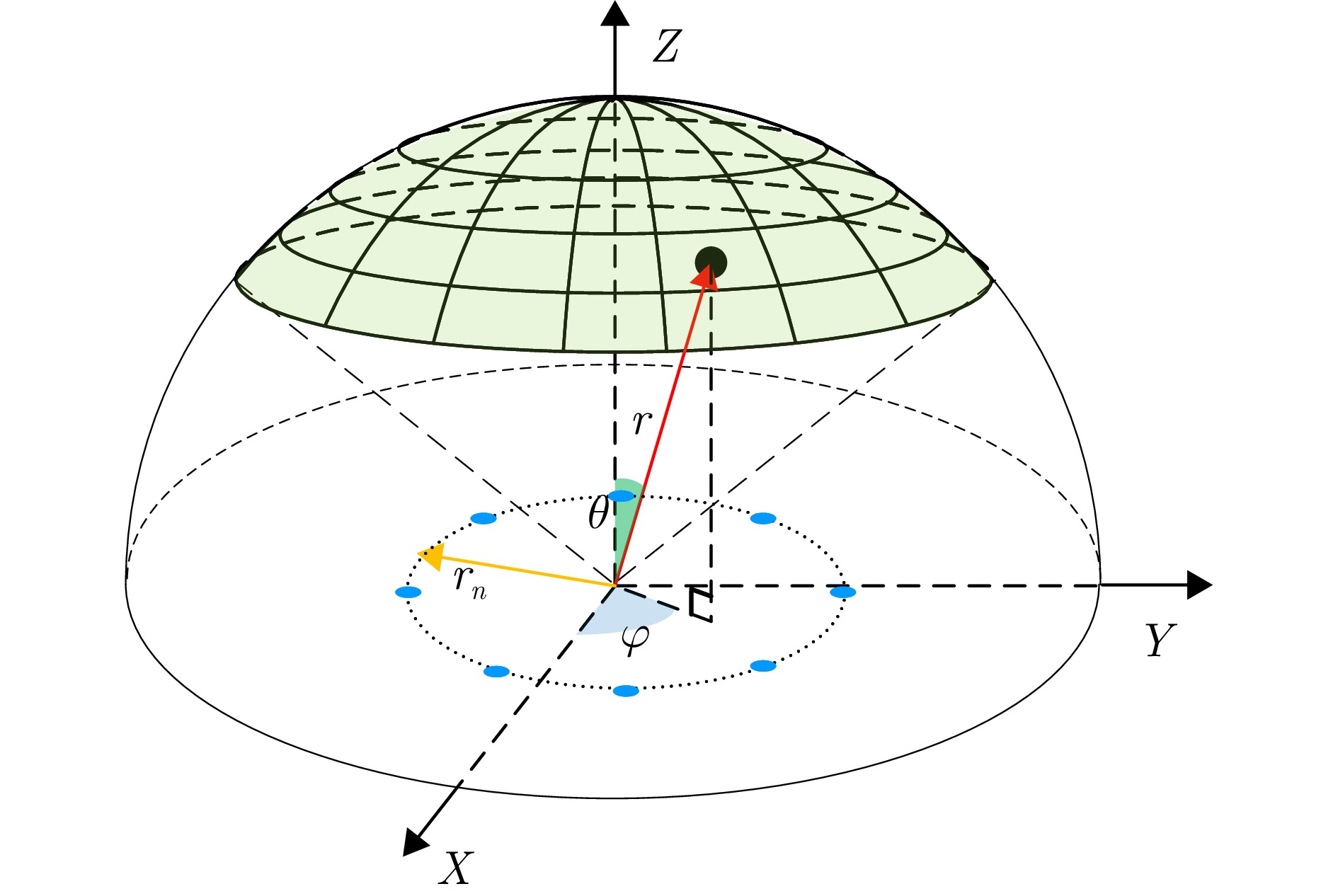
图 1 基于圆形阵列产生OAM波束的场景示意图
Figure 1. Schematic diagram of the scenario for generating OAM beams based on a circular array
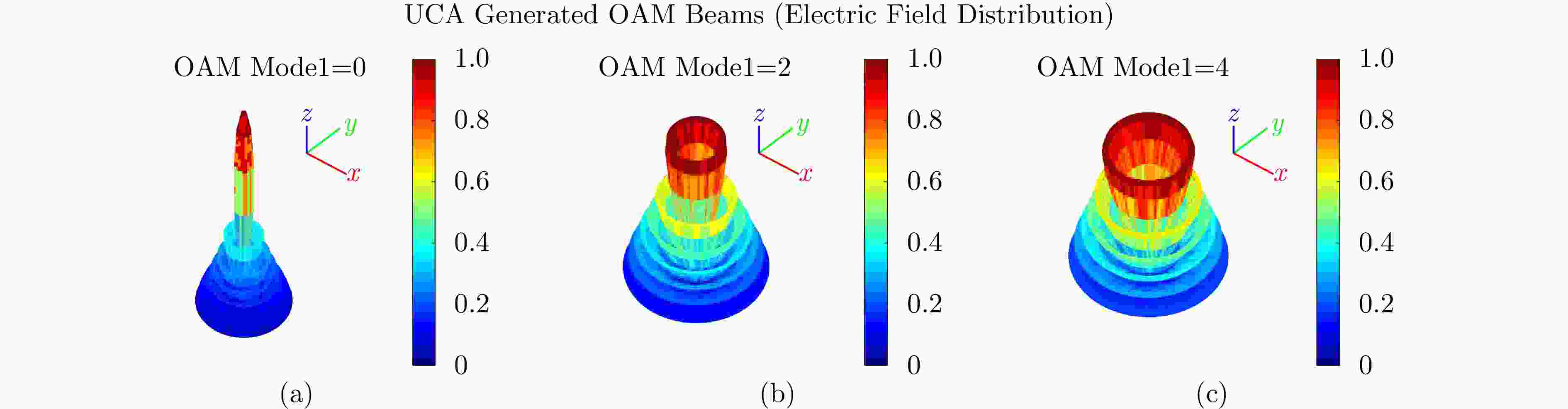
图 2 不同模态OAM波束的电场幅值空间分布理想情况
Figure 2. Ideal spatial distribution of electric field amplitude for OAM beams with different modes
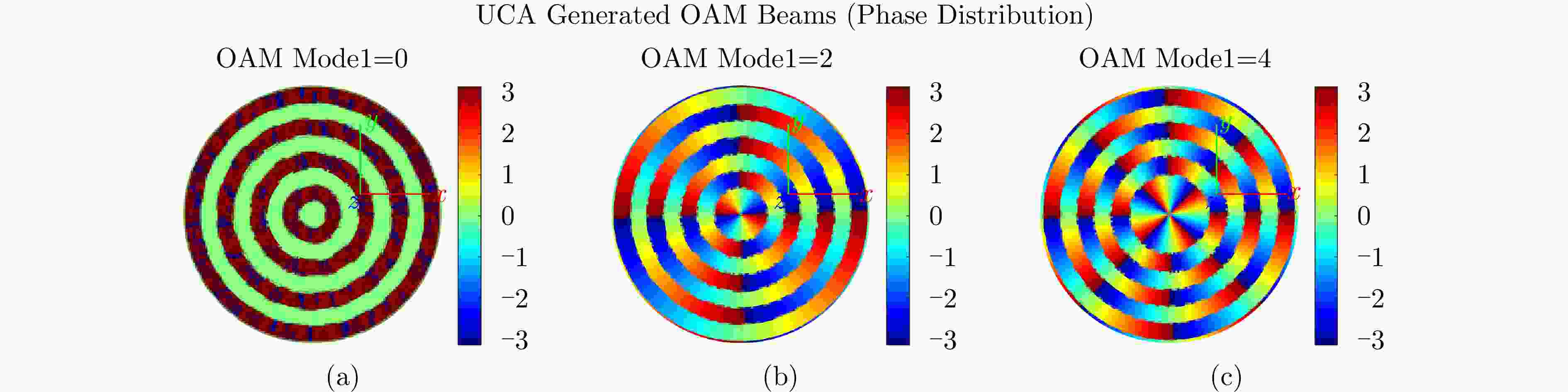
图 3 不同模态OAM波束的电场相位空间分布理想情况
Figure 3. Ideal spatial distribution of electric field phase for OAM beams with different modes
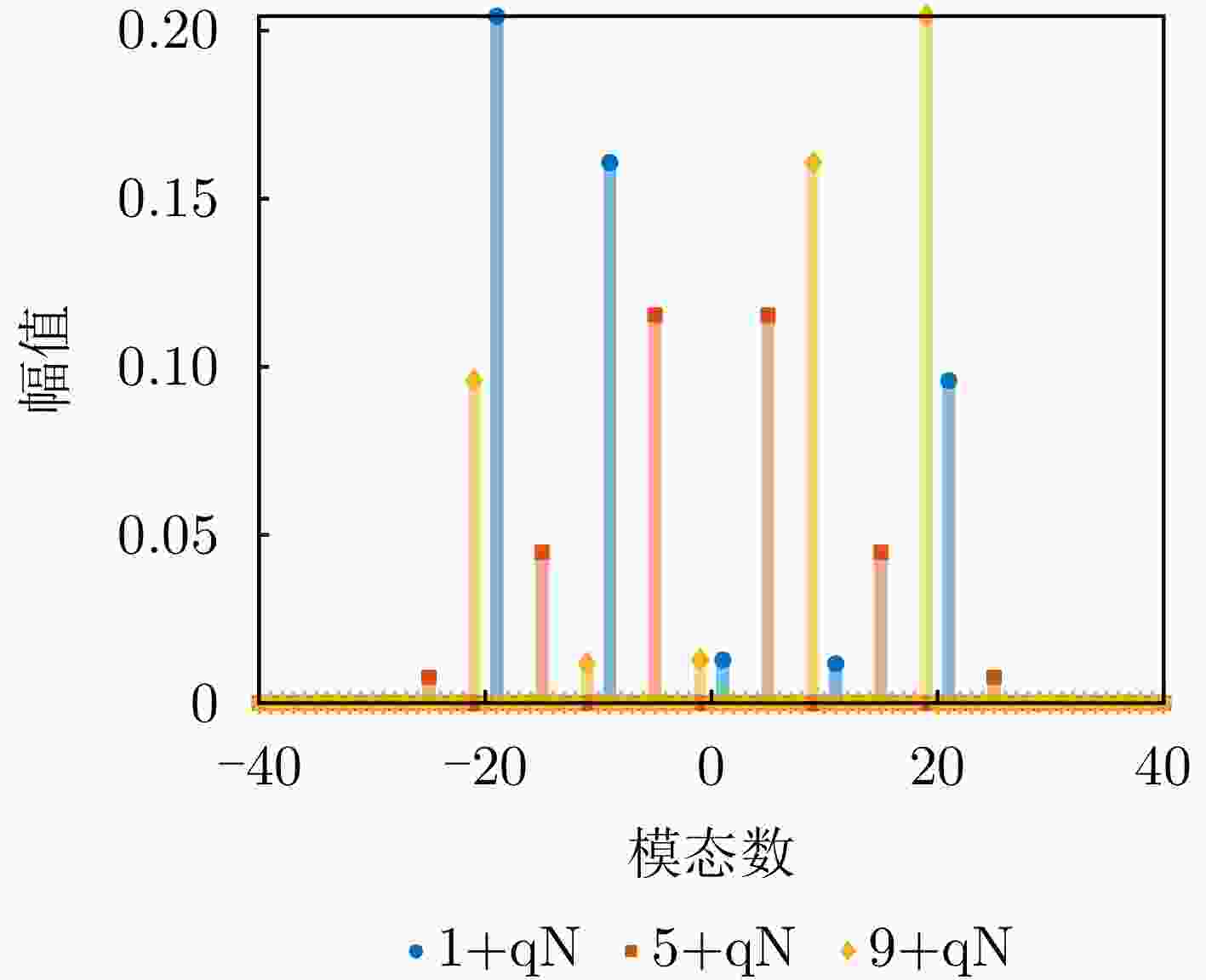
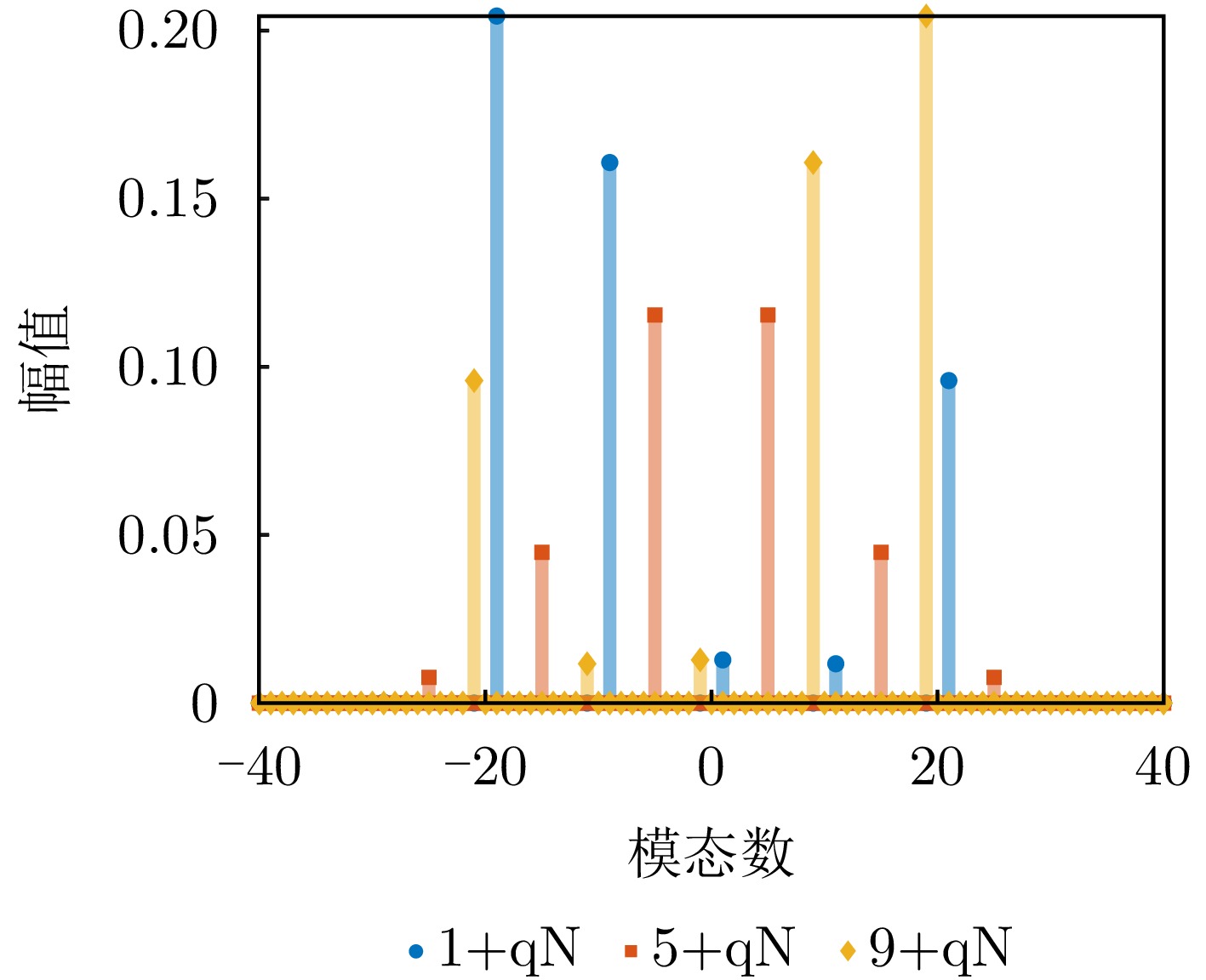
图 4 阵元数量有限时,UCA产生OAM波束的模态混叠现象
Figure 4. Mode aliasing phenomenon of OAM beams generated by a UCA when the number of array elements is limited
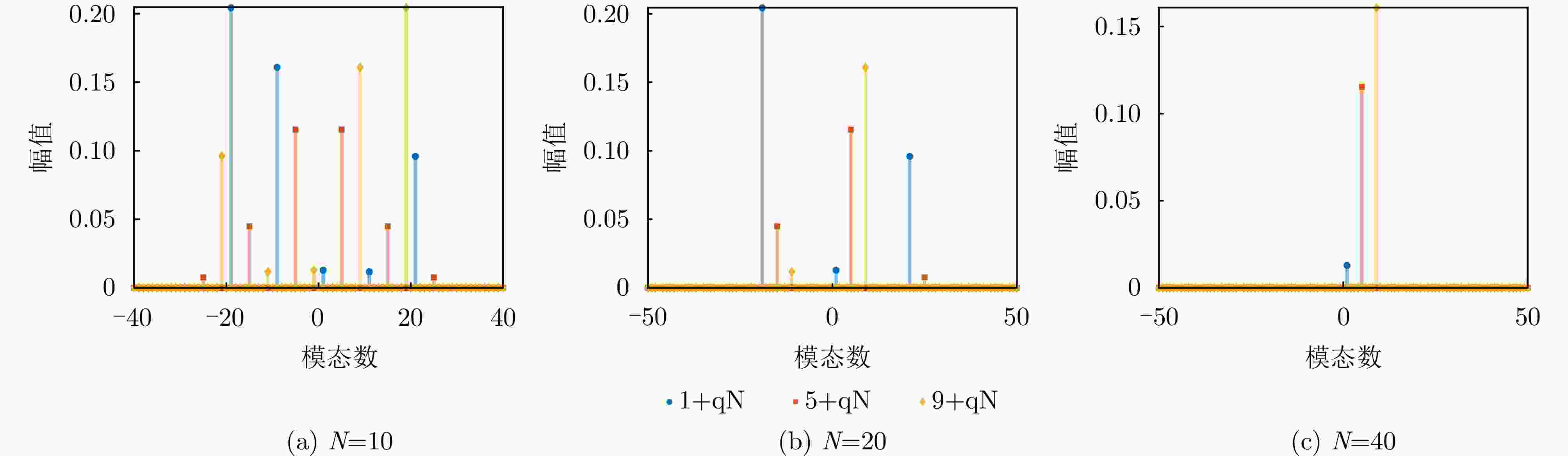
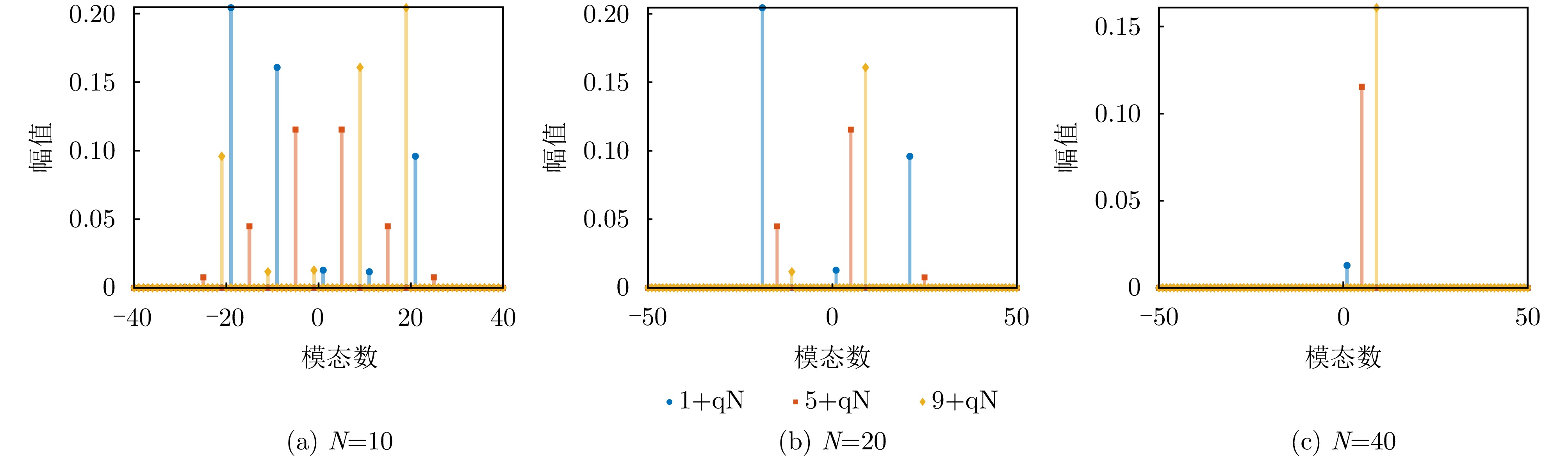
图 6 模态混叠现象随阵元数量增加时的变化
Figure 6. Variation of the mode aliasing phenomenon with an increasing number of array elements
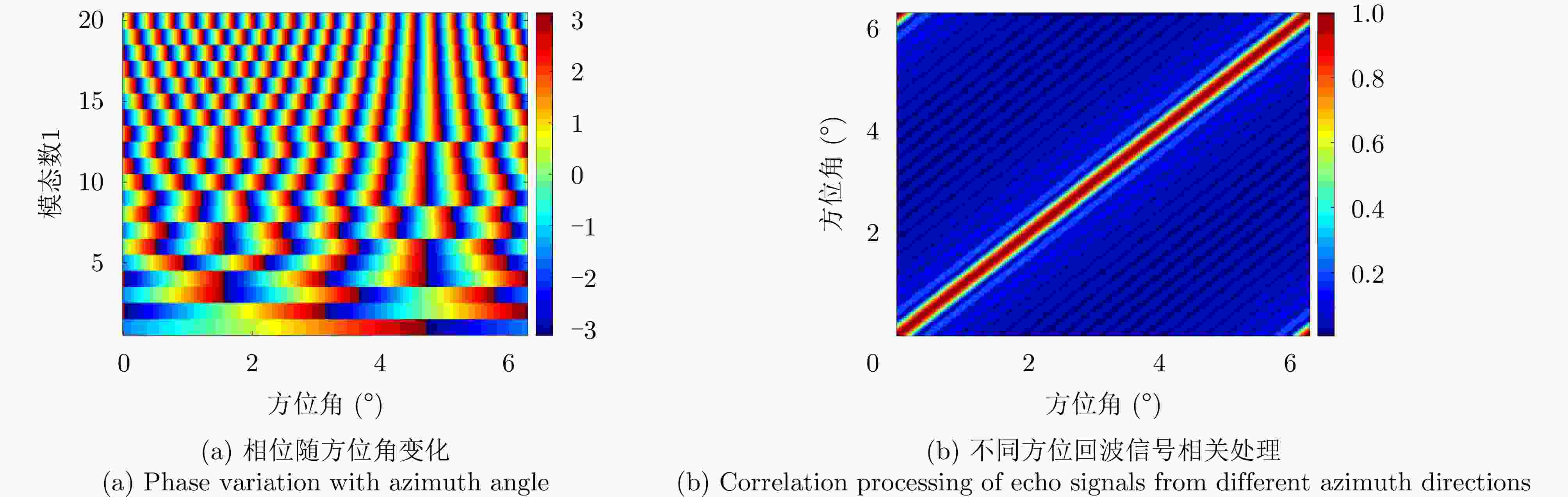
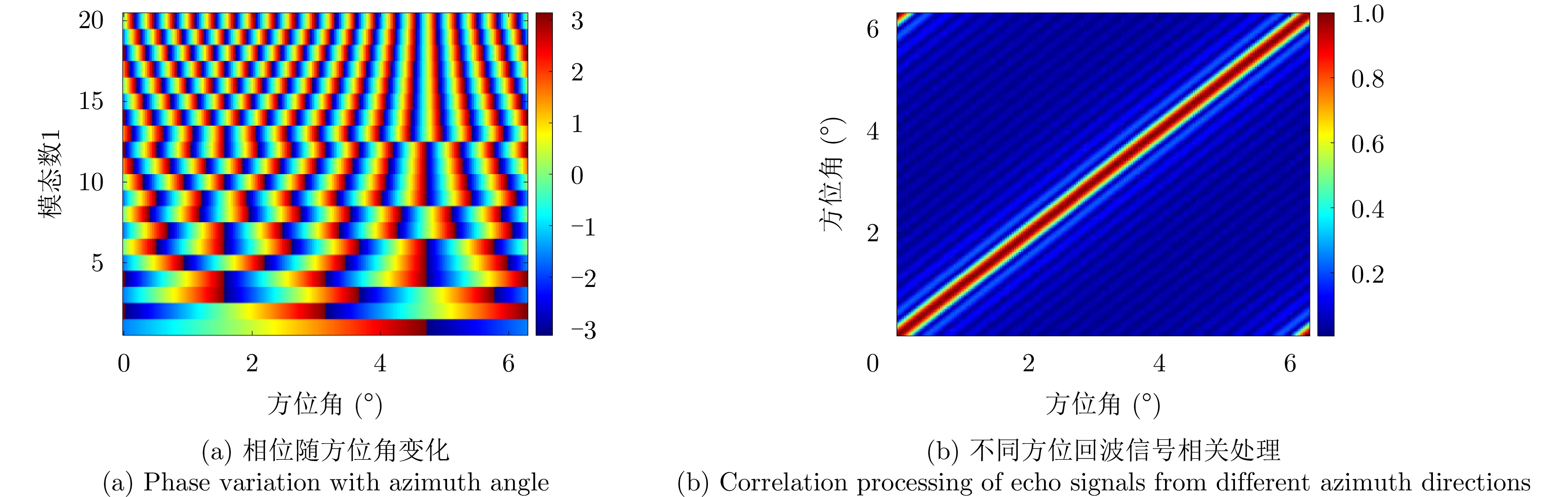
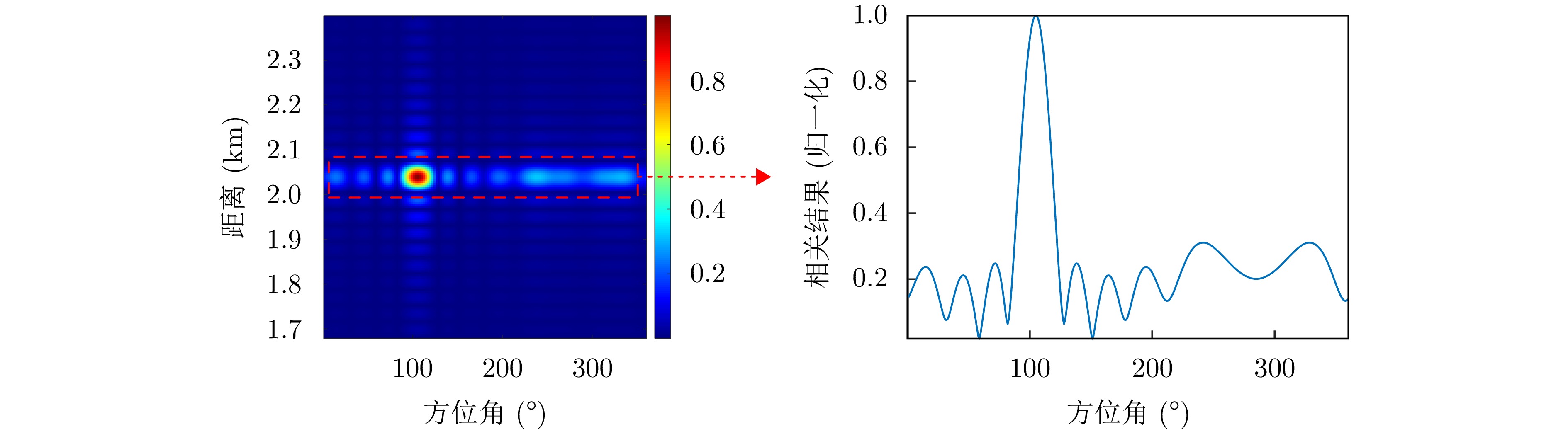
图 8 多模OAM波束探测信号相位随方位角变化特性及不同方位回波信号相关处理结果
Figure 8. Phase variation characteristics of the multimode OAM beam probing signal with azimuth angle and correlation processing results of echo signals from different azimuth directions
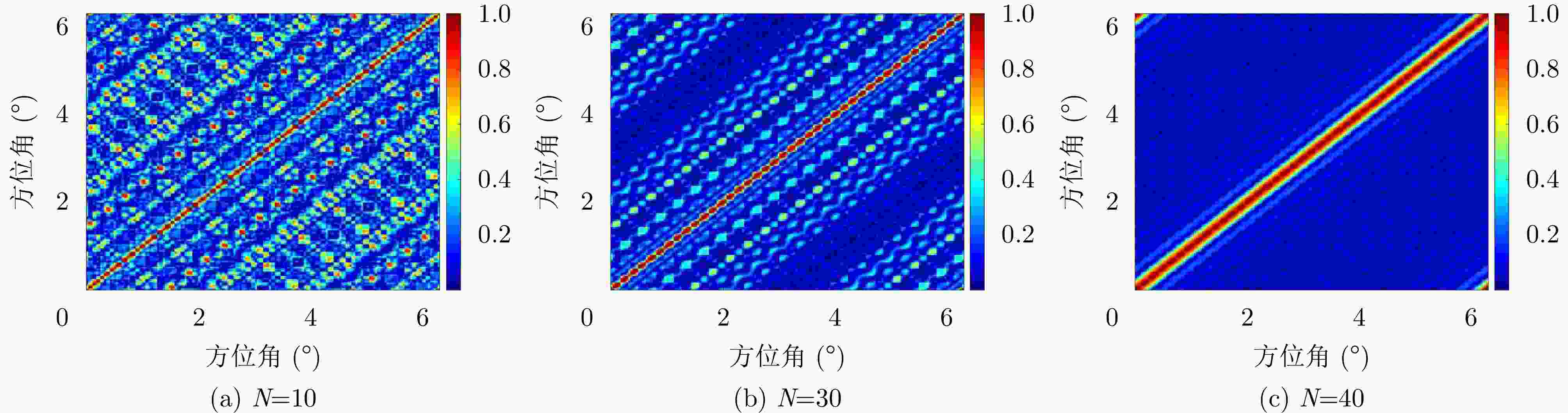
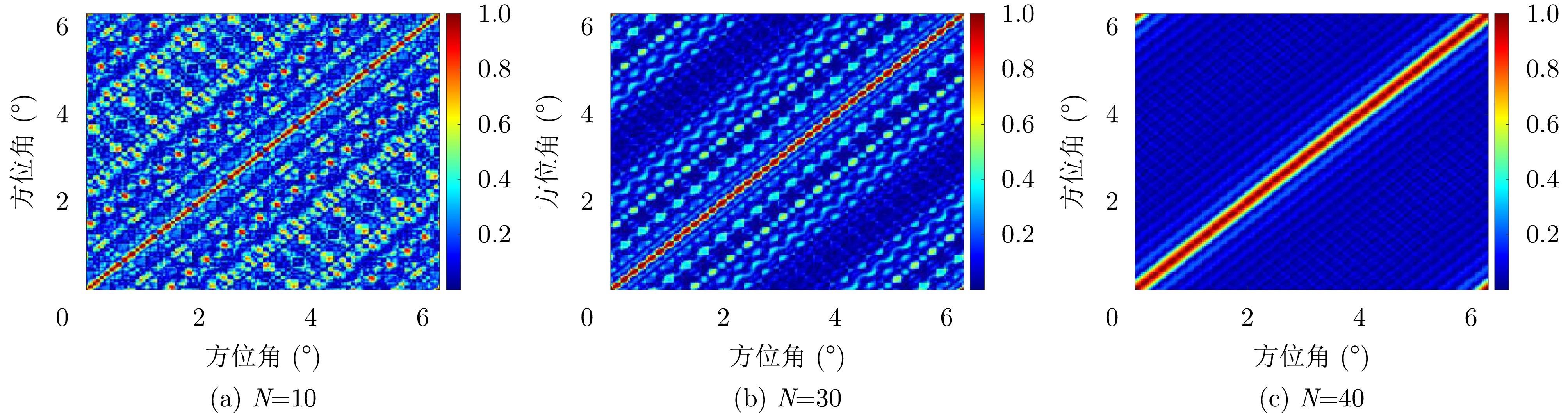
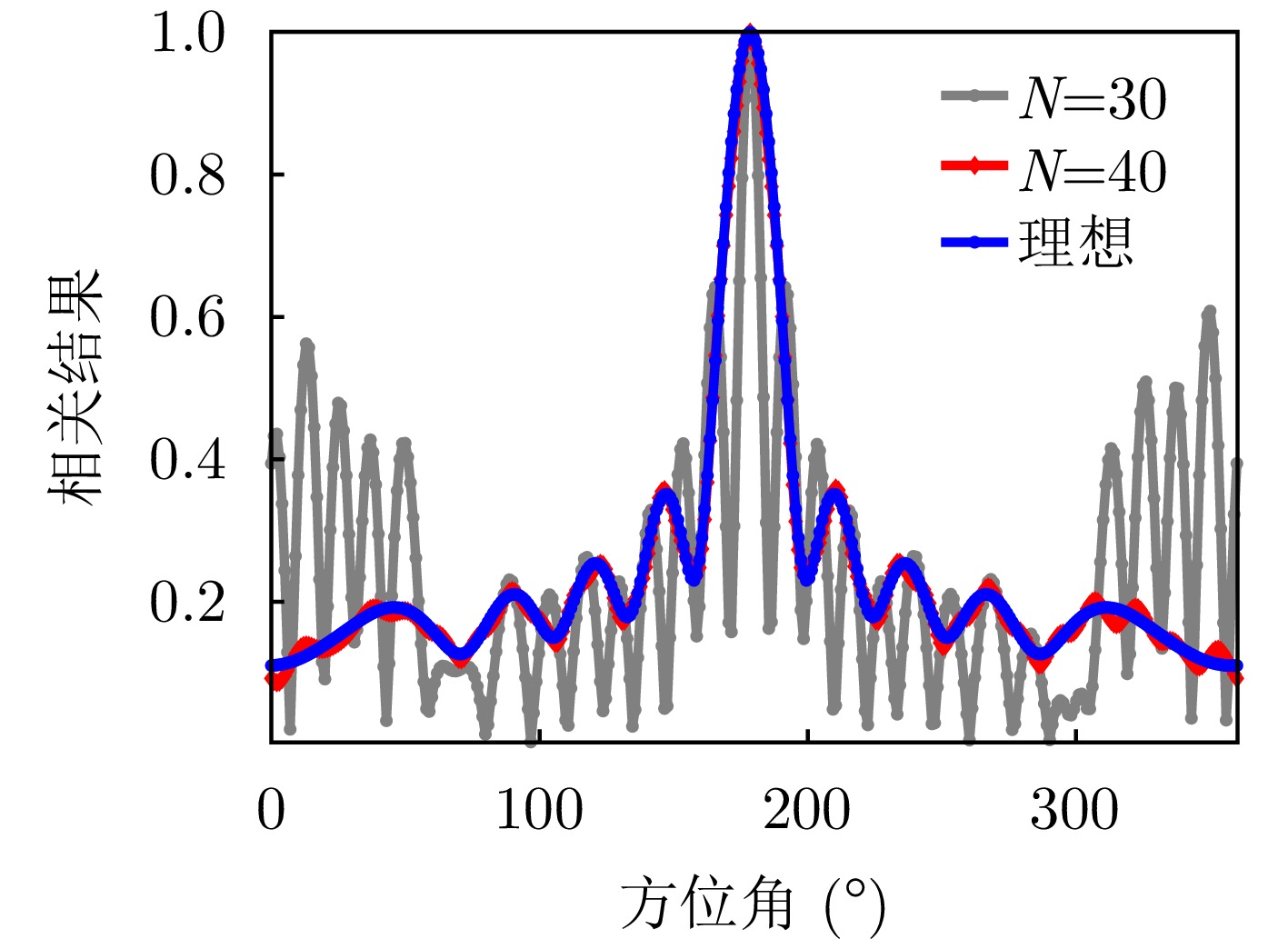
图 9 阵元数量不同时,多模态OAM波束探测时不同方位回波信号相关处理结果
Figure 9. Correlation processing results of echo signals from different azimuth directions for multimode OAM beam probing with different numbers of array elements
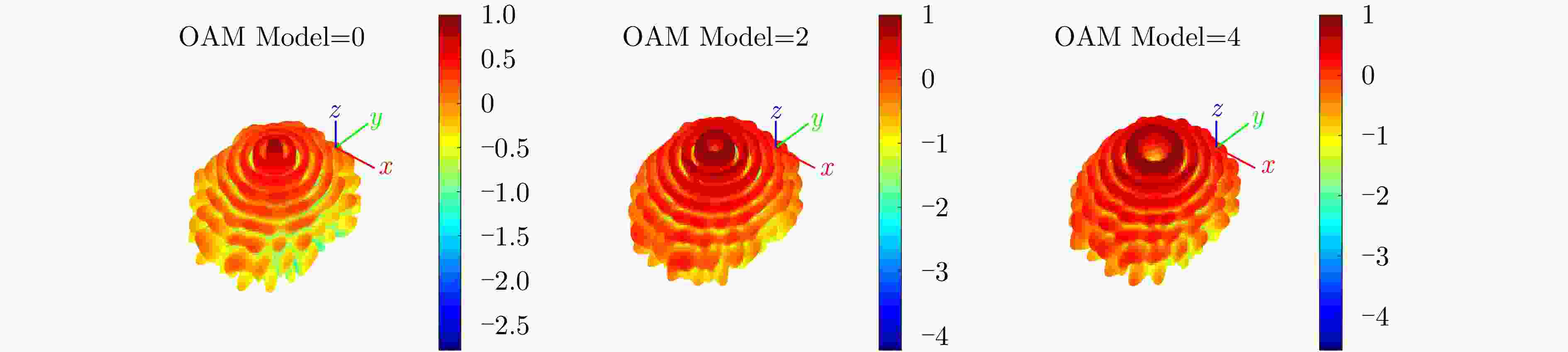
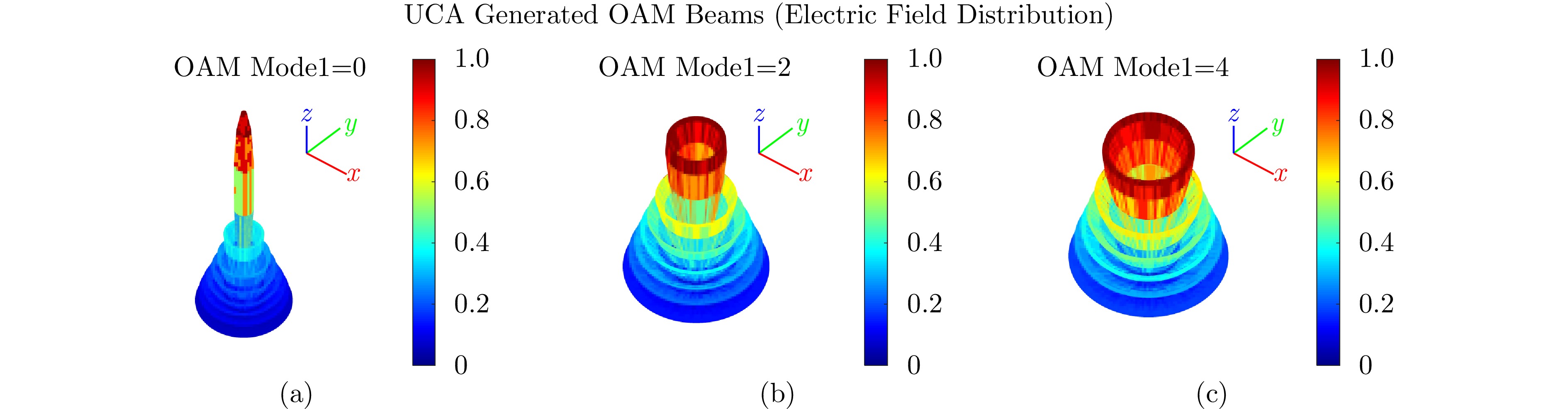
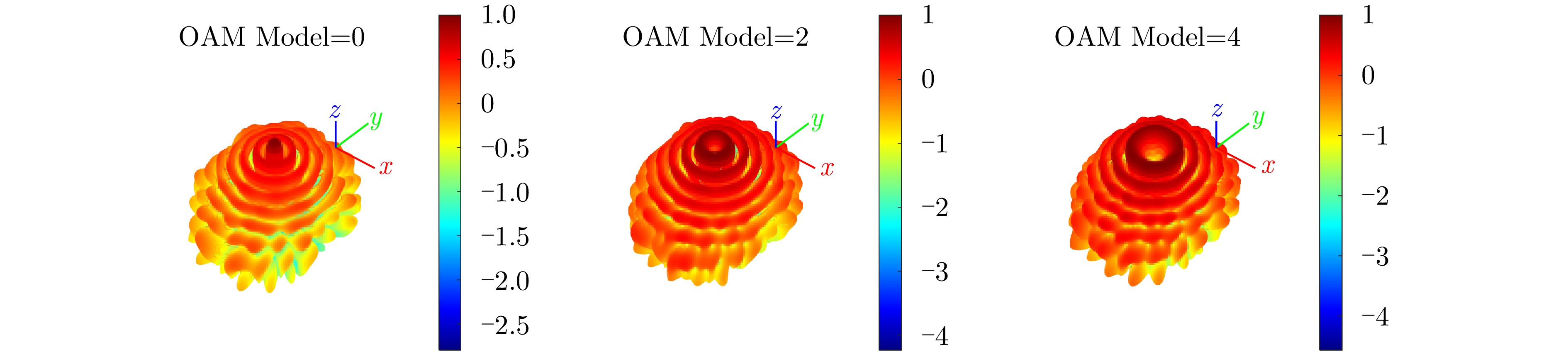
图 11 不同模态OAM波束的电场幅值空间分布全波仿真结果
Figure 11. Full-wave simulation results of the spatial distribution of electric field amplitude for OAM beams with different modes

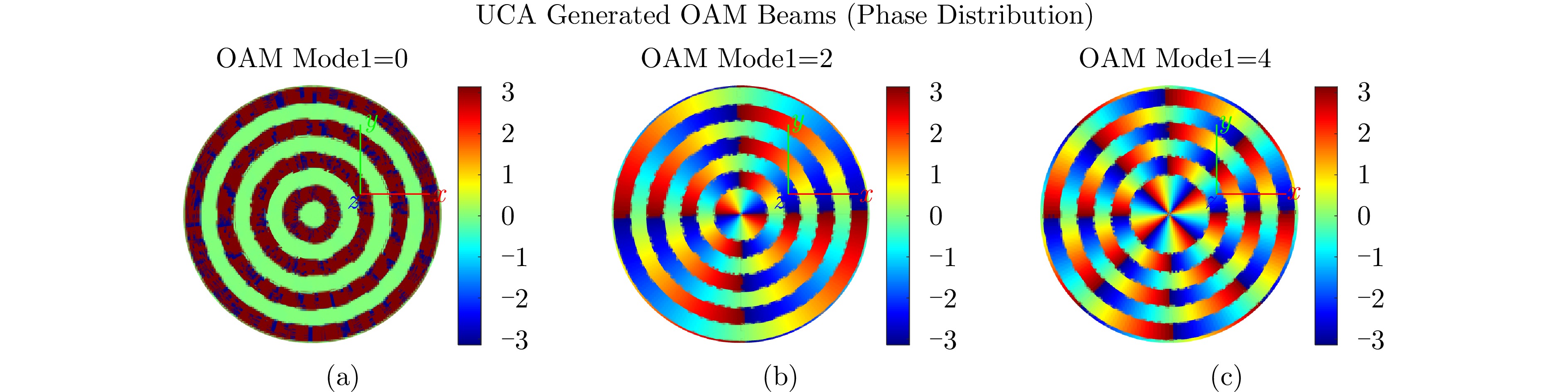
图 12 不同模态OAM波束的电场相位空间分布全波仿真结果
Figure 12. Full-wave simulation results of the spatial distribution of electric field phase for OAM beams with different modes
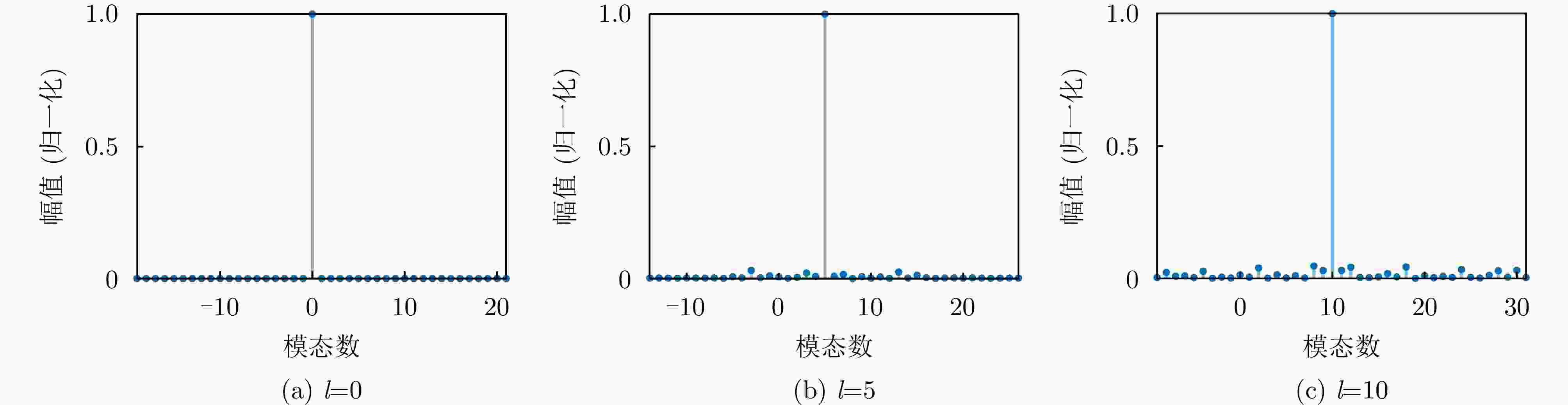
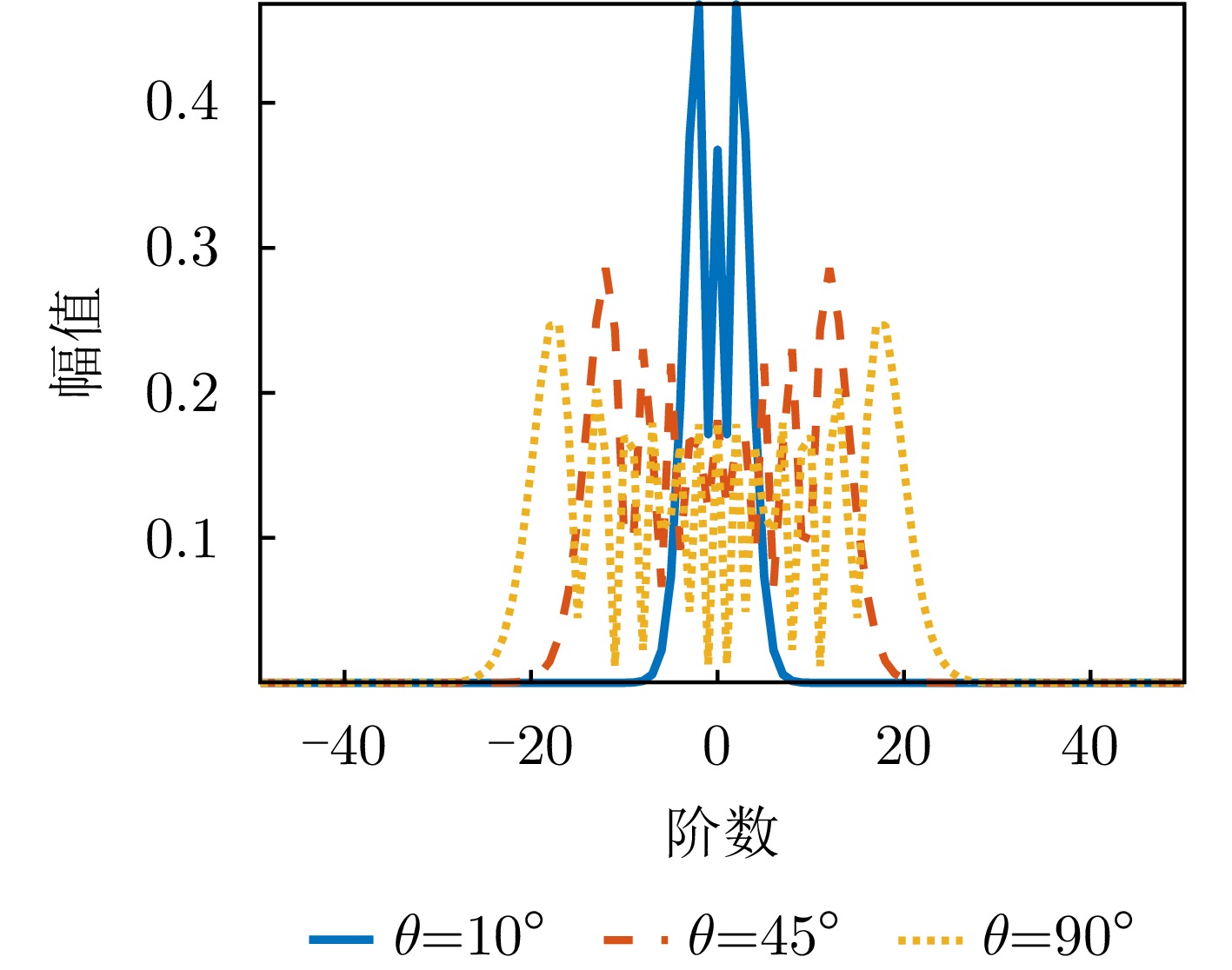
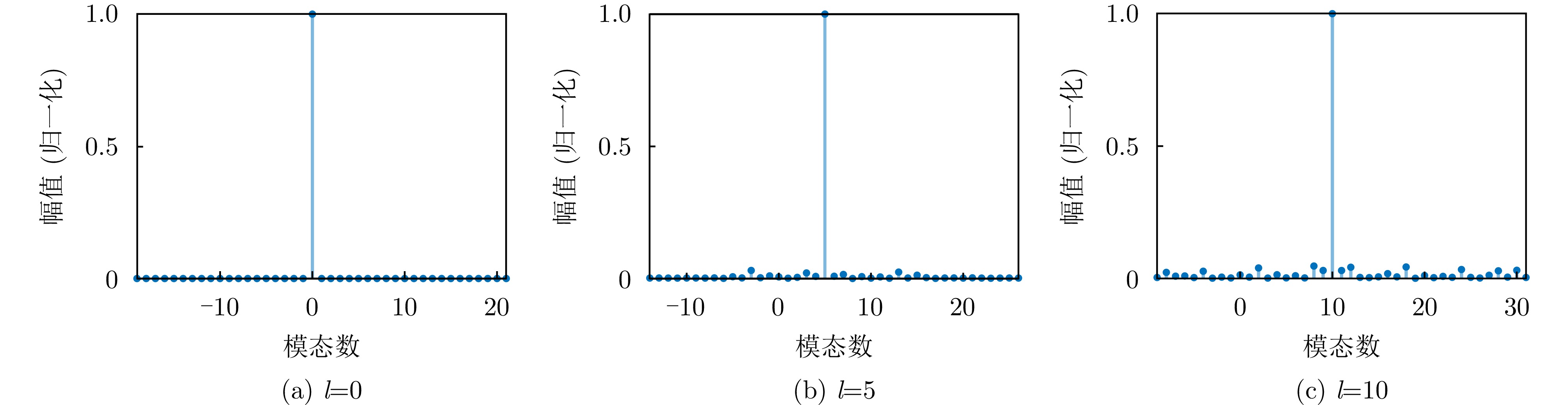
图 13 基于落差排布圆形阵列产生OAM波束的谱分析结果
Figure 13. Spectral analysis results of OAM beams generated by a circular array with staggered element arrangement
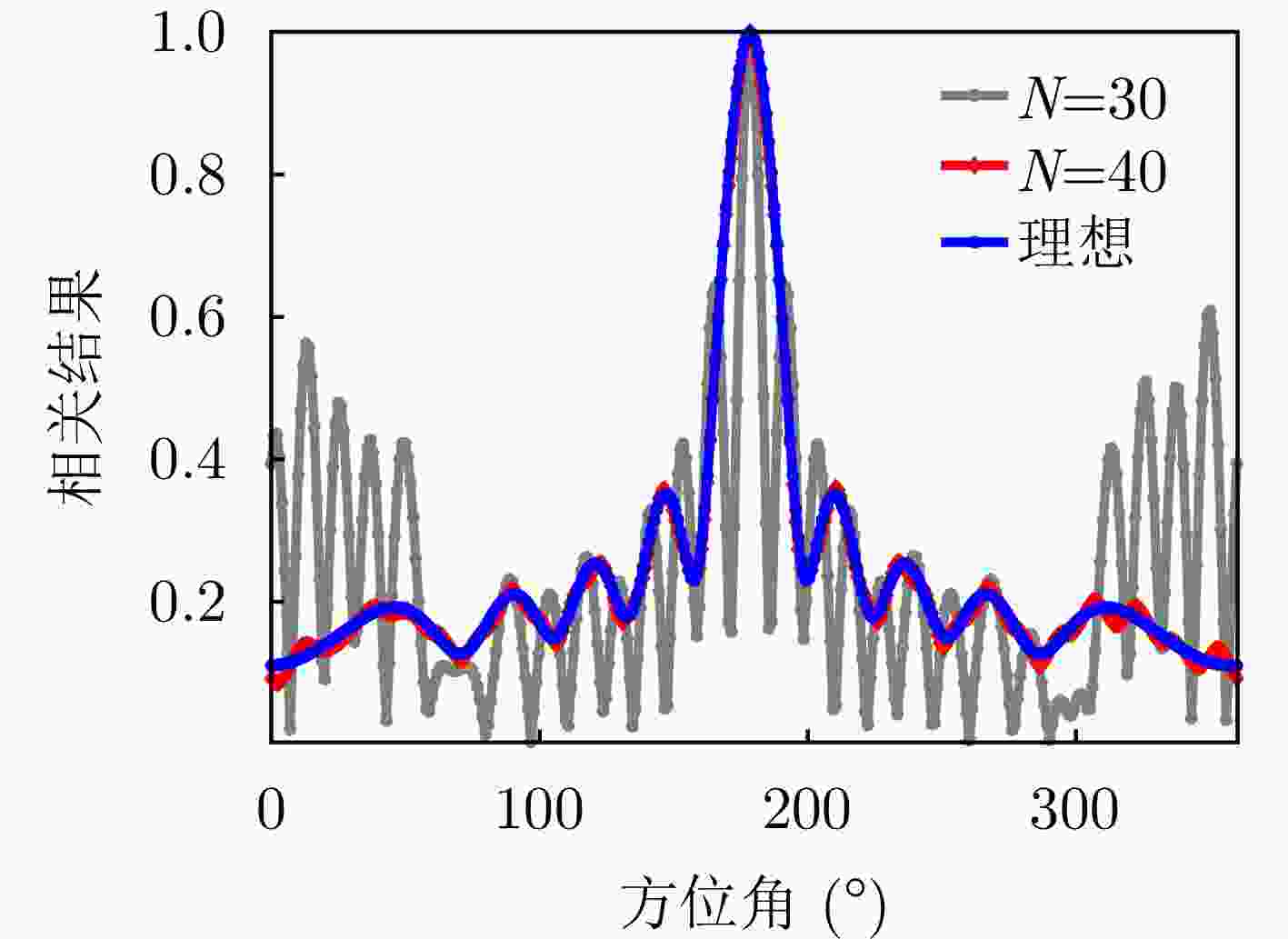
图 14 阵元数量不同时,多模OAM的空间关联结果
Figure 14. Spatial correlation results of multimode OAM with different numbers of array elements
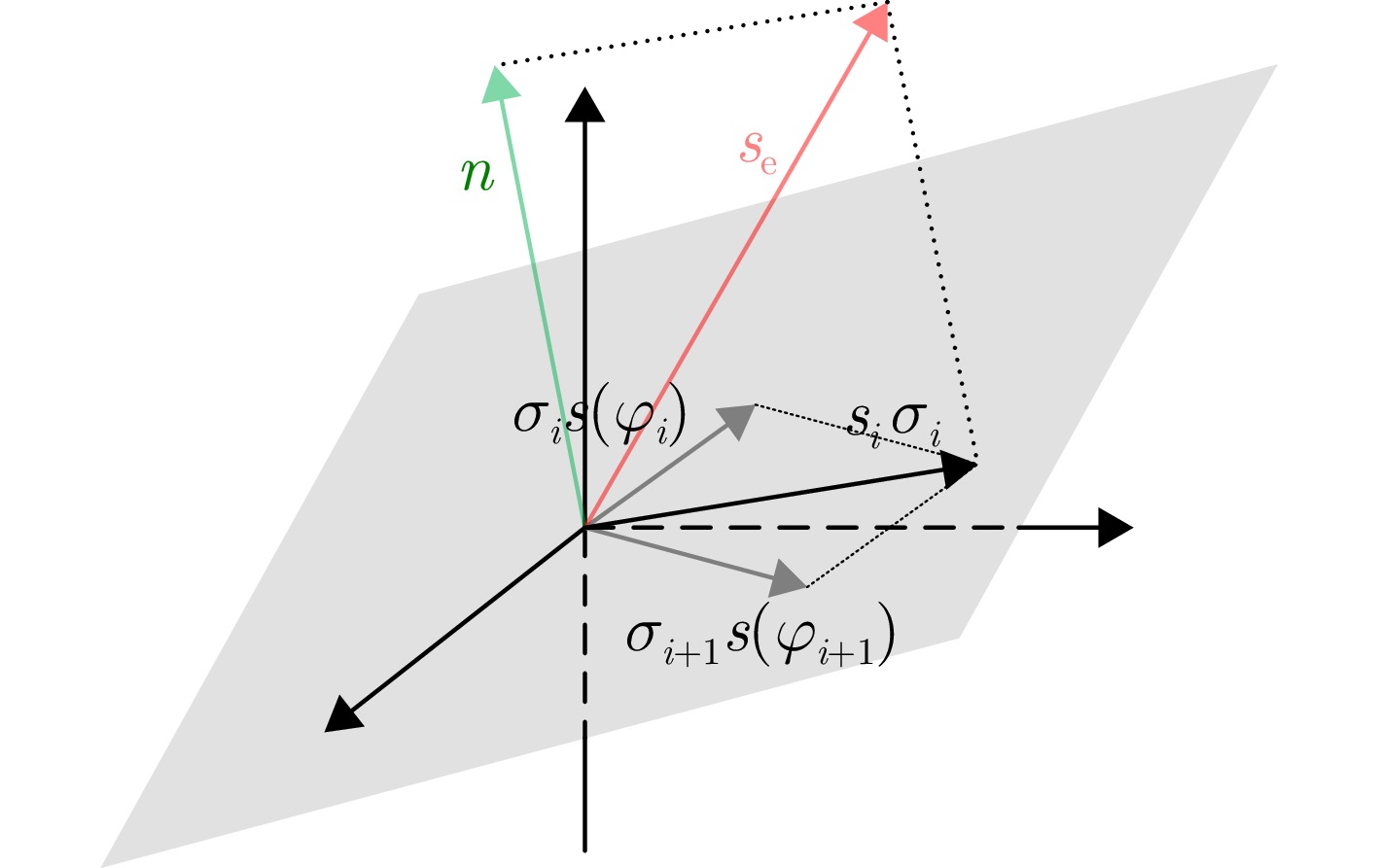
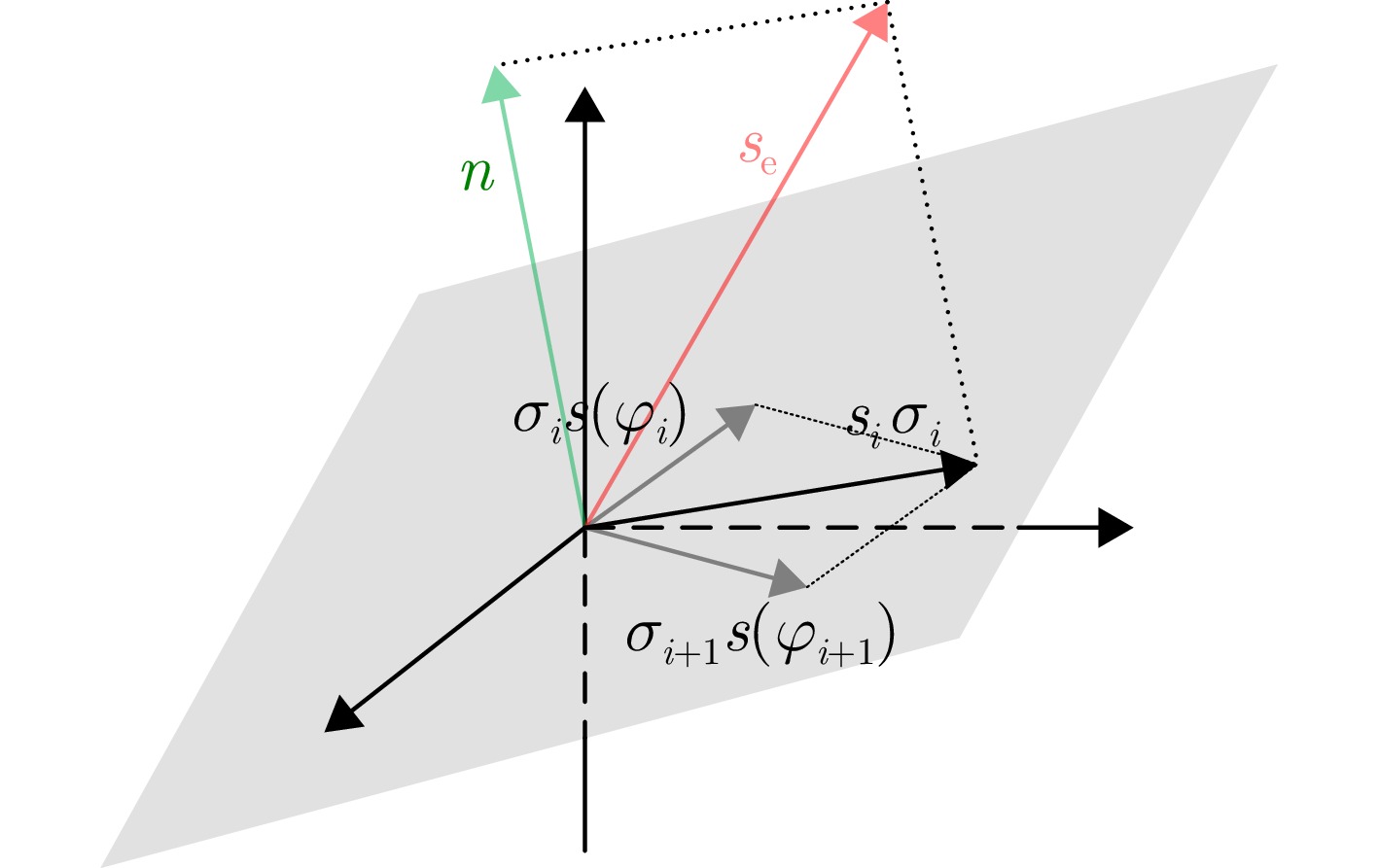
图 16 回波向量、噪声向量与参考矩阵列空间的几何空间关系示意图
Figure 16. Schematic diagram of the geometric spatial relationship among the echo vector, the noise vector, and the column space of the reference matrix
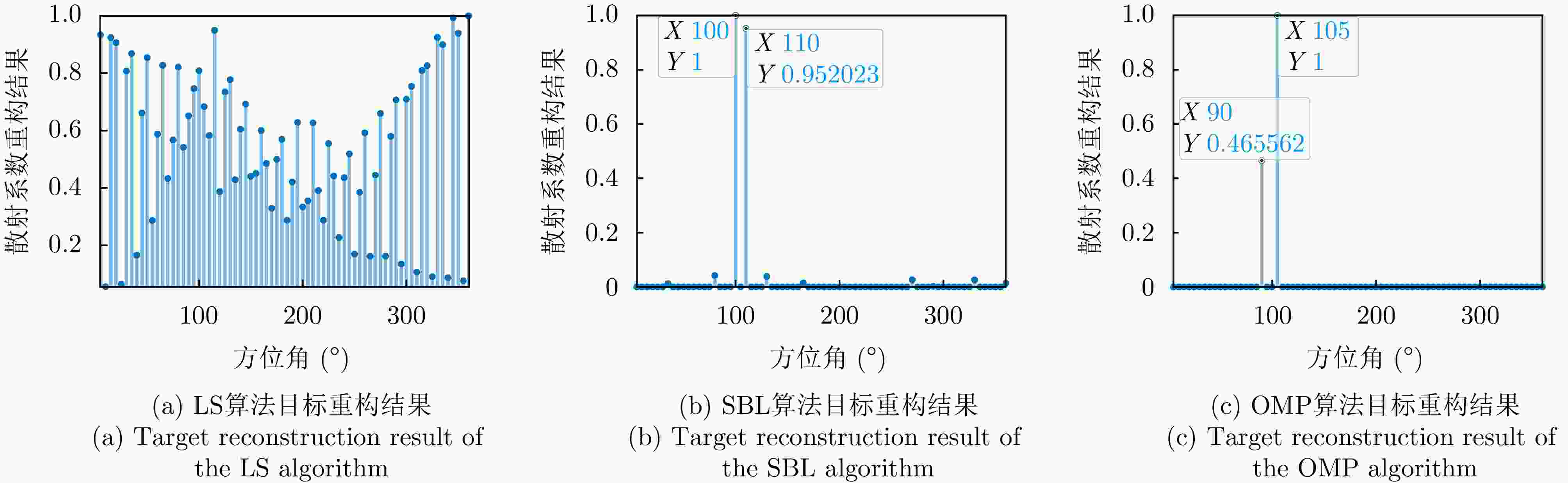
图 18 对整个成像区域进行超分辨的目标重构结果
Figure 18. Target reconstruction result of super-resolution over the entire imaging region
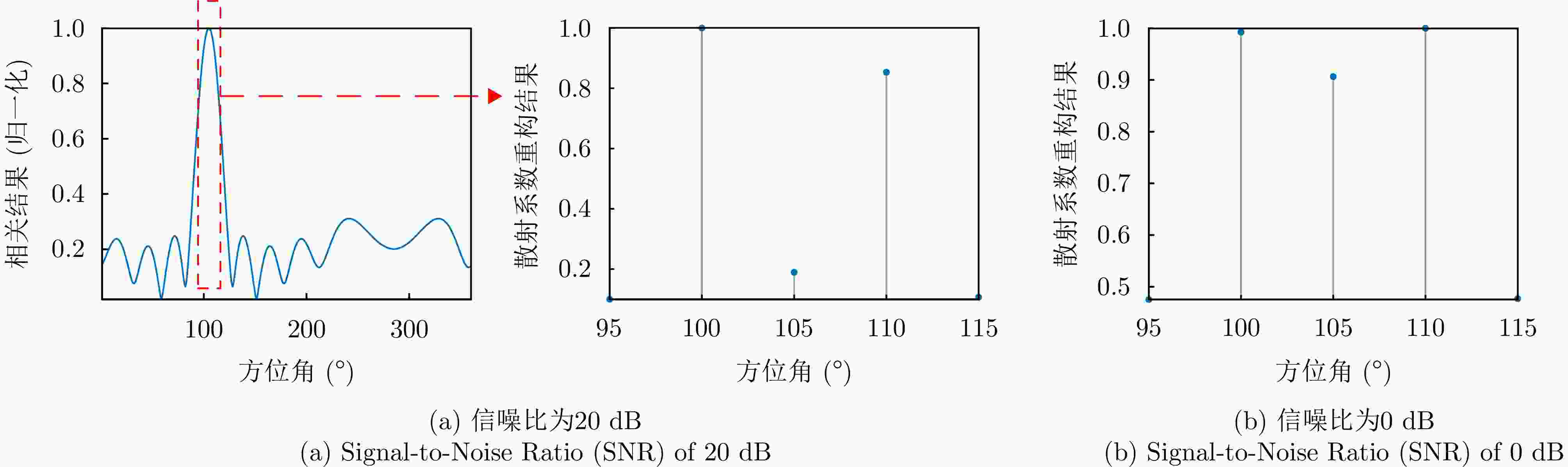
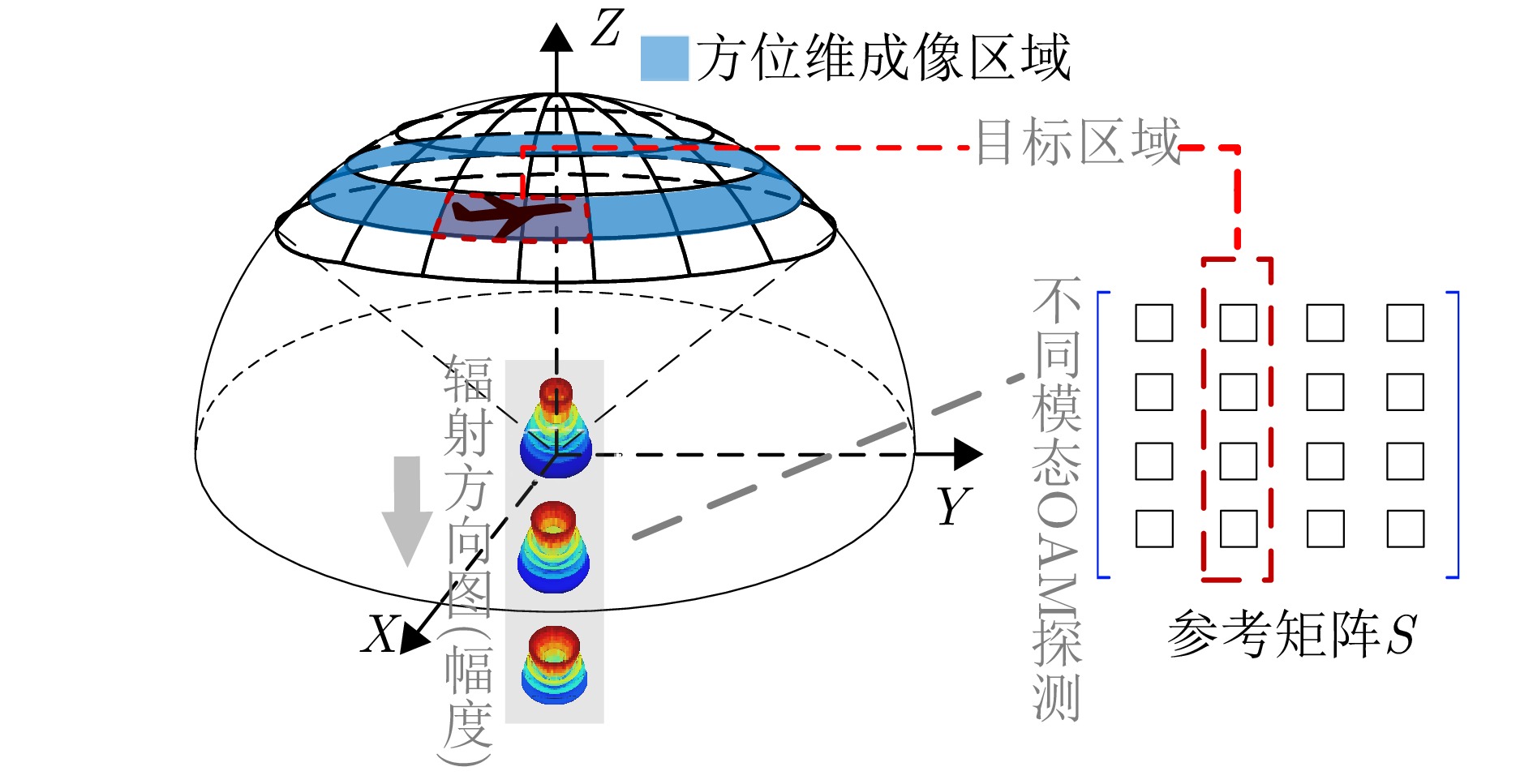
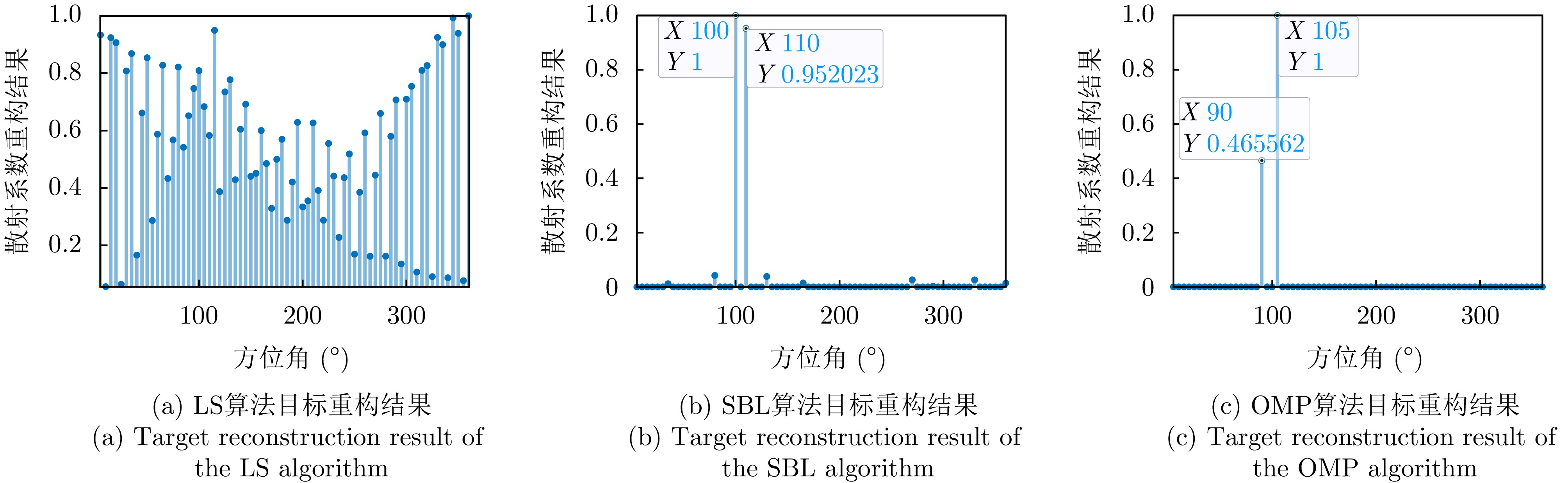
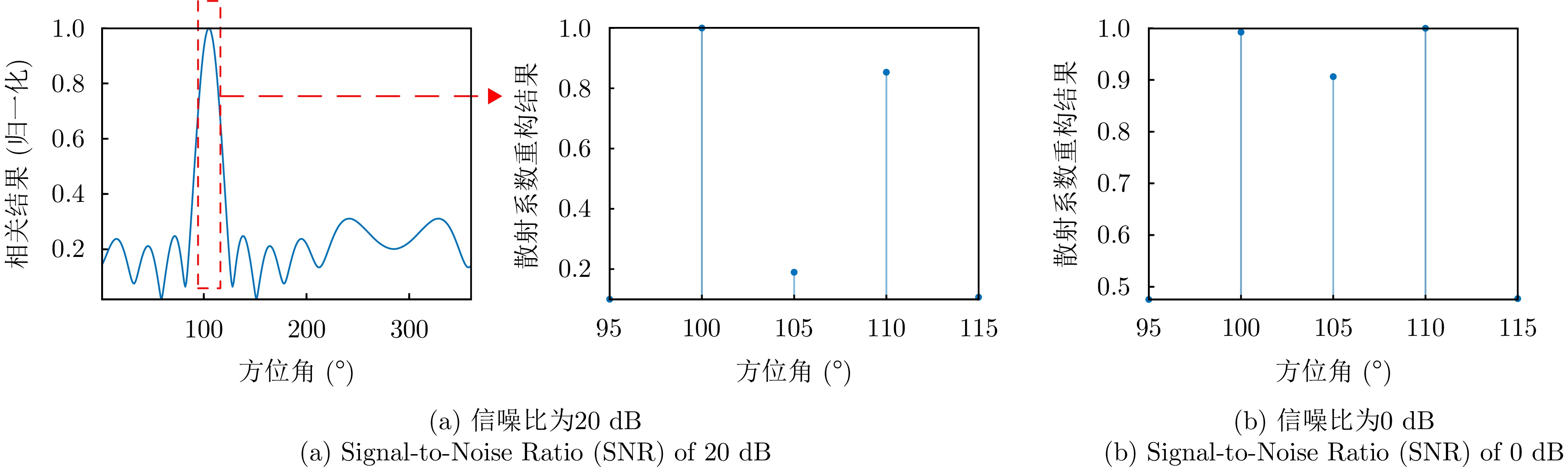
图 19 投影聚焦目标区域后SPLS算法目标重构结果
Figure 19. Target reconstruction result of the SPLS algorithm after projection focusing on the target region
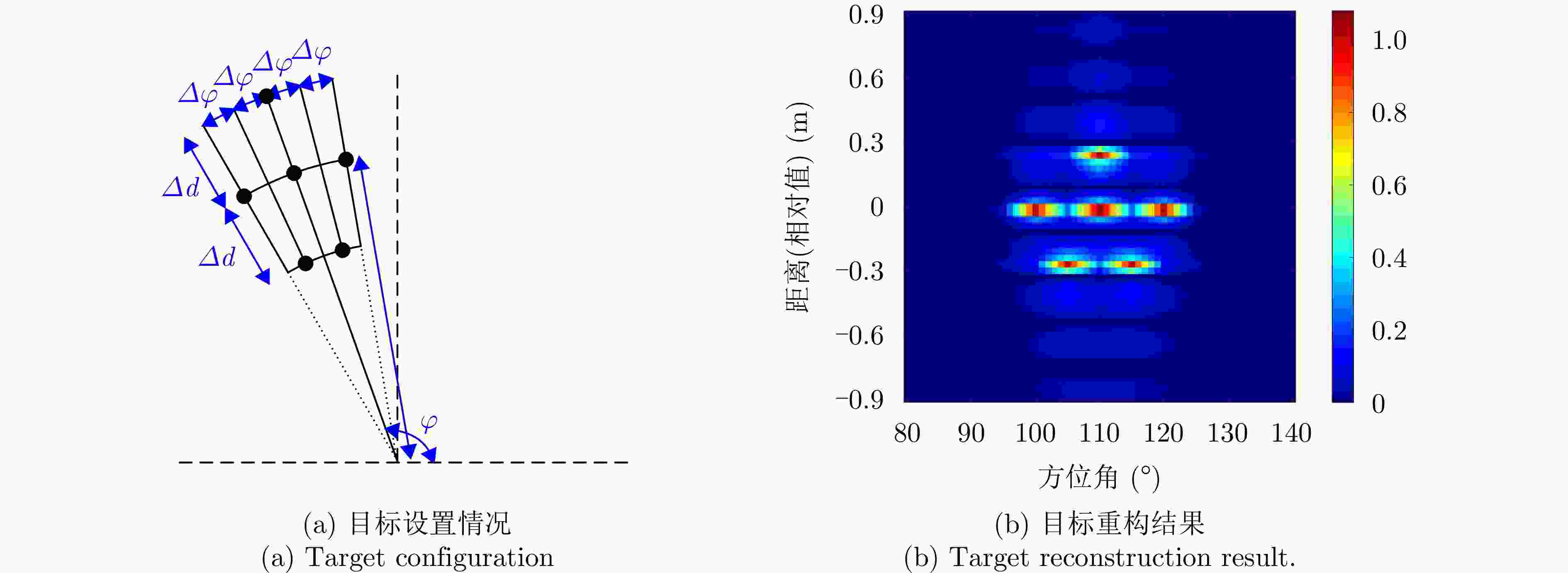
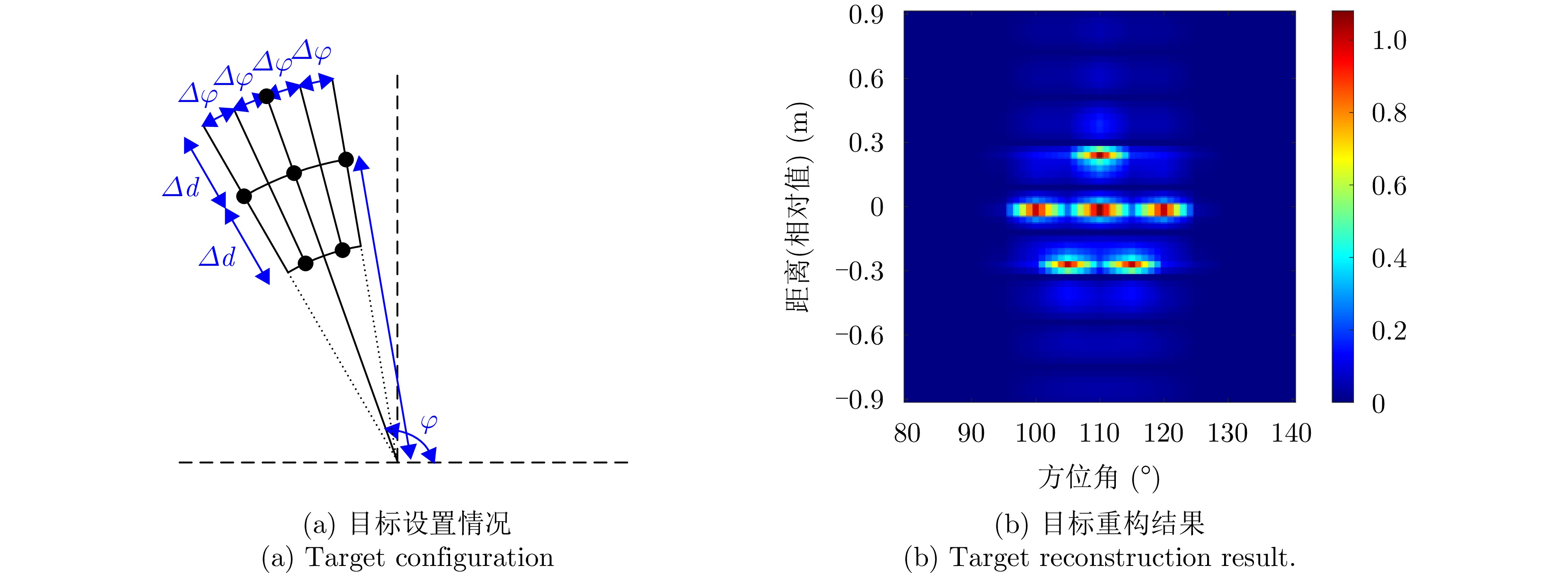
图 20 多点目标基于SPLS算法的二维目标重构结果
Figure 20. Two-dimensional target reconstruction result for multiple point targets based on the SPLS algorithm
1 SPLS算法伪代码
1. Pseudocode of the SPLS algorithm
输入:参考矩阵$ \boldsymbol{S} $、目标回波$ {\boldsymbol{s}}_{\text{e}} $ 输出:目标散射系数的估计$ \hat{\boldsymbol{\sigma }} $ for t=1, 2, ···, N %基本相关法 $ {\boldsymbol{\sigma }}_{{\mathrm{BC}}}\left[t\right]=\left| {{\mathrm{sum}}}\left({\boldsymbol{S}}^{\text{H}}\left[\colon ,t\right]\cdot {{{\boldsymbol{s}}}}_{\text{e}}\right)\right| $ end 根据基本相关法成像结果估计目标子空间$ {\boldsymbol{S}}_{i} $ $ \left[{\boldsymbol{U}}_{r},\sim,\right]=\text{SVD}\left({\boldsymbol{S}}_{i}\right) $ %SVD分解 $ \boldsymbol{P}={\boldsymbol{U}}_{r}\boldsymbol{U}_{r}^{\text{H}} $ %计算投影矩阵 $ {\widetilde{\boldsymbol{s}}}_{\text{e}}=\boldsymbol{P}{\boldsymbol{s}}_{\text{e}} $ %回波向量投影到目标子空间 $ {\boldsymbol{\sigma }}_{\text{LS}}=\text{pinv}\left({\boldsymbol{S}}_{i}\right)\cdot {\widetilde{\boldsymbol{s}}}_{\text{e}} $ %获取最小二乘解 返回:$ \hat{\boldsymbol{\sigma }}={\boldsymbol{\sigma }}_{\text{LS}} $  下载: 导出CSV
表 1 SPLS算法、OMP算法、SBL算法复杂度对比
Table 1. Complexity comparison among the SPLS algorithm, the OMP algorithm, and the SBL algorithm
算法 矩阵求逆次数 矩阵求逆发生环节 单次求逆矩阵规模 SPLS算法 1 正规方程求解 $ N\times N $ OMP算法 K 每轮迭代,在支撑集上求最小二乘解 $ t\times t $ (t=1, 2, ···, K) SBL算法 T 每轮迭代,计算后验方差 $ N\times N $
下载: 导出CSV
-
[1] AUSHERMAN D A, KOZMA A, WALKER J L, et al. Developments in radar imaging[J]. IEEE Transactions on Aerospace and Electronic Systems, 1984, AES-20(4): 363–400. doi: 10.1109/TAES.1984.4502060. [2] ZHANG Huanhuan, YU Guoguo, LIU Ying, et al. Design of low-SAR mobile phone antenna: Theory and applications[J]. IEEE Transactions on Antennas and Propagation, 2021, 69(2): 698–707. doi: 10.1109/TAP.2020.3016420. [3] BI Hui, LU Xingmeng, YIN Yanjie, et al. Sparse SAR imaging based on periodic block sampling data[J]. IEEE Transactions on Geoscience and Remote Sensing, 2022, 60: 5213812. doi: 10.1109/TGRS.2021.3110772. [4] BI Hui, BI Guoan, ZHANG Bingchen, et al. From theory to application: Real-time sparse SAR imaging[J]. IEEE Transactions on Geoscience and Remote Sensing, 2020, 58(4): 2928–2936. doi: 10.1109/TGRS.2019.2958067. [5] PITTMAN T B, SHIH Y H, STREKALOV D V, et al. Optical imaging by means of two-photon quantum entanglement[J]. Physical Review A, 1995, 52(5): R3429–R3432. doi: 10.1103/PhysRevA.52.R3429. [6] GATTI A, BRAMBILLA E, BACHE M, et al. Ghost imaging with thermal light: Comparing entanglement and classical correlation[J]. Physical Review Letters, 2004, 93(9): 093602. doi: 10.1103/PhysRevLett.93.093602. [7] LI Dongze, LI Xiang, QIN Yuliang, et al. Radar coincidence imaging: An instantaneous imaging technique with stochastic signals[J]. IEEE Transactions on Geoscience and Remote Sensing, 2014, 52(4): 2261–2277. doi: 10.1109/TGRS.2013.2258929. [8] ZHOU Xiaoli, FAN Bo, WANG Hongqiang, et al. Sparse Bayesian perspective for radar coincidence imaging with array position error[J]. IEEE Sensors Journal, 2017, 17(16): 5209–5219. doi: 10.1109/JSEN.2017.2723611. [9] HOANG T V, FUSCO V, and YURDUSEVEN O. Ghost image removal using physical layer spatial asymmetry in frequency-diverse computational imaging[C]. 2021 15th European Conference on Antennas and Propagation (EuCAP), Dusseldorf, Germany, 2021: 1–5. doi: 10.23919/EuCAP51087.2021.9410900. [10] MOHAMMADI S M, DALDORFF L K S, BERGMAN J E S, et al. Orbital angular momentum in radio-a system study[J]. IEEE transactions on Antennas and Propagation, 2010, 58(2): 565–572. doi: 10.1109/TAP.2009.2037701. [11] WILLNER A E, HUANG H, YAN Y, et al. Optical communications using orbital angular momentum beams[J]. Advances in Optics and Photonics, 2015, 7(1): 66–106. doi: 10.1364/AOP.7.000066. [12] CHEN Rui, ZHOU Hong, MORETTI M, et al. Orbital angular momentum waves: Generation, detection, and emerging applications[J]. IEEE Communications Surveys & Tutorials, 2020, 22(2): 840–868. doi: 10.1109/COMST.2019.2952453. [13] MA Hui and LIU Hongwei. Waveform diversity-based generation of convergent beam carrying orbital angular momentum[J]. IEEE Transactions on Antennas and Propagation, 2020, 68(7): 5487–5495. doi: 10.1109/TAP.2020.2981724. [14] 马晖, 胡敦法, 师竹雨, 等. 基于涡旋电磁波的雷达应用研究进展[J]. 现代雷达, 2023, 45(5): 27–41. doi: 10.16592/j.cnki.1004-7859.2023.05.003.MA Hui, HU Dunfa, SHI Zhuyu, et al. Research progress of radar applications based on vortex electromagnetic waves[J]. Modern Radar, 2023, 45(5): 27–41. doi: 10.16592/j.cnki.1004-7859.2023.05.003. [15] LIU Yu, DU Yongxing, LI Baoshan, et al. An Omega-K 3-D SAR imaging algorithm based on fractional-order OAM[J]. IEEE Geoscience and Remote Sensing Letters, 2025, 22: 4011705. doi: 10.1109/LGRS.2025.3596158. [16] LI Xiaopeng, XU Liying, MAO Yongfei, et al. High frame rate ViSAR based on OAM beams: Imaging model and imaging algorithm[J]. Remote Sensing, 2026, 18(2): 294. doi: 10.3390/rs18020294. [17] LIU Kang, LIU Hongyan, WANG Hongqiang, et al. Vortex electromagnetic wave imaging with orbital angular momentum and waveform degrees of freedom[J]. Optics Express, 2024, 32(8): 13574–13582. doi: 10.1364/OE.521640. [18] 郭桂蓉, 胡卫东, 杜小勇. 基于电磁涡旋的雷达目标成像[J]. 国防科技大学学报, 2013, 35(6): 71–76. doi: 10.3969/j.issn.1001-2486.2013.06.013.GUO Guirong, HU Weidong, and DU Xiaoyong. Electromagnetic vortex based radar target imaging[J]. Journal of National University of Defense Technology, 2013, 35(6): 71–76. doi: 10.3969/j.issn.1001-2486.2013.06.013. [19] YANG Ting, SHI Hongyin, GUO Jianwen, et al. 3D sparse ISAR imaging with multiple plane spiral OAM electromagnetic waves[J]. IEEE Sensors Journal, 2022, 22(15): 15082–15097. doi: 10.1109/JSEN.2022.3179925. [20] WANG Siyuan, QU Yi, CHEN Yijun, et al. Three-dimensional interferometric imaging with vortex electromagnetic wave radar based on uniform circular array[J]. IEEE Sensors Journal, 2024, 24(20): 32858–32870. doi: 10.1109/JSEN.2024.3453869. [21] ZENG Yanzhi, WANG Yang, CHEN Zhihui, et al. Two-dimensional OAM radar imaging using uniform circular antenna arrays[C]. 2020 14th European Conference on Antennas and Propagation (EuCAP), Copenhagen, Denmark, 2020: 1–4. doi: 10.23919/EuCAP48036.2020.9135917. [22] FU Linrui, YANG Yunxiu, WANG Chang, et al. A low-rank modified imaging method based on gain for electromagnetic vortex radar[J]. Electronics Letters, 2025, 61(1): e70414. doi: 10.1049/ell2.70414. [23] LONG Wenxuan, CHEN Rui, MORETTI M, et al. AoA estimation for OAM communication systems with mode-frequency multi-time ESPRIT method[J]. IEEE Transactions on Vehicular Technology, 2021, 70(5): 5094–5098. doi: 10.1109/TVT.2021.3070358. [24] LIU Kang, LI Xiang, GAO Yue, et al. High-resolution electromagnetic vortex imaging based on sparse Bayesian learning[J]. IEEE Sensors Journal, 2017, 17(21): 6918–6927. doi: 10.1109/JSEN.2017.2754554. [25] GUO Shaoqing, HE Zi, and CHEN Rushan. High resolution 2-D electromagnetic vortex imaging using uniform circular arrays[J]. IEEE Access, 2019, 7: 132430–132437. doi: 10.1109/ACCESS.2019.2941285. [26] YUAN Tiezhu, LIU Hongyan, CHENG Yongqiang, et al. Orbital-angular-momentum-based electromagnetic vortex imaging by least-squares method[C]. 2016 IEEE International Geoscience and Remote Sensing Symposium (IGARSS), Beijing, China, 2016: 6645–6648. doi: 10.1109/IGARSS.2016.7730735. [27] JIANG Ting, HU Jun, LUO Siqi, et al. A fast and super-resolution method of vortex-based imaging[J]. IEEE Antennas and Wireless Propagation Letters, 2023, 22(9): 2225–2229. doi: 10.1109/LAWP.2023.3281617. [28] 张瑞, 全英汇, 朱圣棋, 等. 基于改进OMP算法的稀疏目标微波关联成像方法[J]. 系统工程与电子技术, 2021, 43(7): 1756–1765. doi: 10.12305/j.issn.1001-506X.2021.07.04.ZHANG Rui, QUAN Yinghui, ZHU Shengqi, et al. Microwave correlation imaging method based on improved OMP algorithm for sparse targets[J]. Systems Engineering and Electronics, 2021, 43(7): 1756–1765. doi: 10.12305/j.issn.1001-506X.2021.07.04. [29] WIPF D P and RAO B D. Sparse Bayesian learning for basis selection[J]. IEEE Transactions on Signal Processing, 2004, 52(8): 2153–2164. doi: 10.1109/TSP.2004.831016. [30] TROPP J A and GILBERT A C. Signal recovery from random measurements via orthogonal matching pursuit[J]. IEEE Transactions on Information Theory, 2007, 53(12): 4655–4666. doi: 10.1109/TIT.2007.909108. -


计量
- 文章访问数:
- HTML全文浏览量:
- PDF下载量:
- 被引次数: 0