

 作者中心
作者中心 专家审稿
专家审稿 责编办公
责编办公 编辑办公
编辑办公
Hierarchical Association-based Random Matrix Extended Kalman Filter for Vehicle Tracking
-
摘要: 随着智能交通与自动驾驶技术的快速发展,毫米波雷达因具备全天候工作和高精度感知能力,已广泛应用于道路车辆跟踪领域。传统基于点目标或固定参数的跟踪方法难以刻画车辆的扩展特性及复杂交互行为,易引发目标分裂、漏检及航迹中断等问题。为此,该文提出一种基于分层关联的随机矩阵扩展卡尔曼滤波算法(HARM-EKF)。首先,基于随机矩阵模型对车辆目标的空间扩展特性进行建模,将目标形状表示为逆Wishart分布,并与运动状态进行联合估计;其次,针对不同状态轨迹与不同尺度车辆构建分层关联机制,引入混合高斯模型关联与簇关联,并采用针对小车的滑动窗口量测累积,抑制大型车辆分裂问题并提升小型车辆在稀疏量测条件下的跟踪连续性;进一步地,设计融合运动一致性、方向约束及形状相似性的航迹重关联方法,实现遮挡条件下航迹的恢复与身份保持;同时,在新生目标阶段引入基于尺寸先验的形状筛选策略,提高初始化稳定性。仿真结果表明,在密集交通、多遮挡及多杂波干扰场景下,所提方法能够显著提升多目标跟踪的连续性与稳定性,有效降低目标分裂与误关联现象,在跟踪准确率与鲁棒性方面优于传统方法。Abstract: With the rapid development of intelligent transportation and autonomous driving technologies, millimeter-wave radar has been widely used for road vehicle tracking due to its all-weather operational capability and high-precision sensing performance. Traditional tracking methods based on point targets or fixed parameters are unable to describe the extended characteristics and complex interaction behaviors of vehicles, which may lead to target splitting, missed detection, and track interruption. To deal with these problems, this paper proposes a Hierarchical Association-based Random Matrix Extended Kalman Filter (HARM-EKF) for vehicle tracking. First, the spatial extent of vehicle targets is modeled using a random matrix model, where the target shape is represented by an inverse Wishart distribution and jointly estimated with the kinematic state. Second, a hierarchical association mechanism is designed for tracks of different states and vehicles of different sizes. Third, Gaussian mixture model-based association and cluster-level association are introduced, and a sliding-window measurement accumulation strategy for small vehicles is employed to suppress the splitting of large vehicles and improve tracking continuity of small vehicles under sparse measurements. Fourth, a track re-association method combining motion consistency, directional constraints, and shape similarity is developed to recover the tracks and maintain the target identities under occlusion. Finally, a shape screening method based on size priors is proposed at the new-target initialization stage to improve initialization stability. Simulation results show that in dense traffic scenarios with multiple occlusions and clutter interference, the proposed method greatly improves multi-target tracking continuity and stability, effectively reduces target splitting and incorrect associations, and outperforms traditional methods in tracking accuracy and robustness.
-
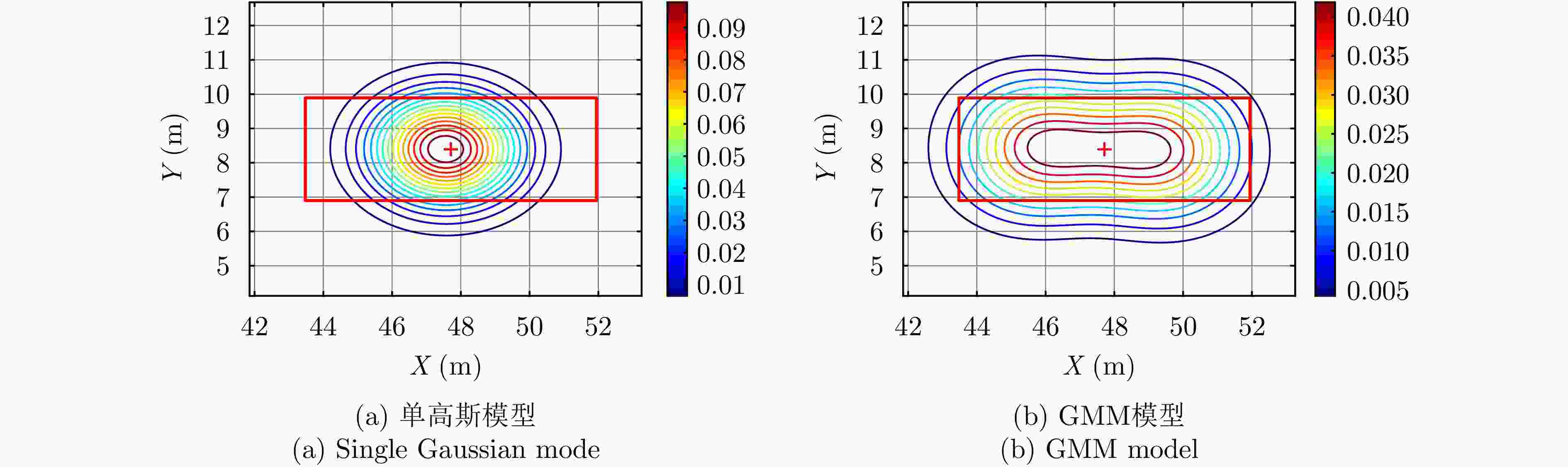
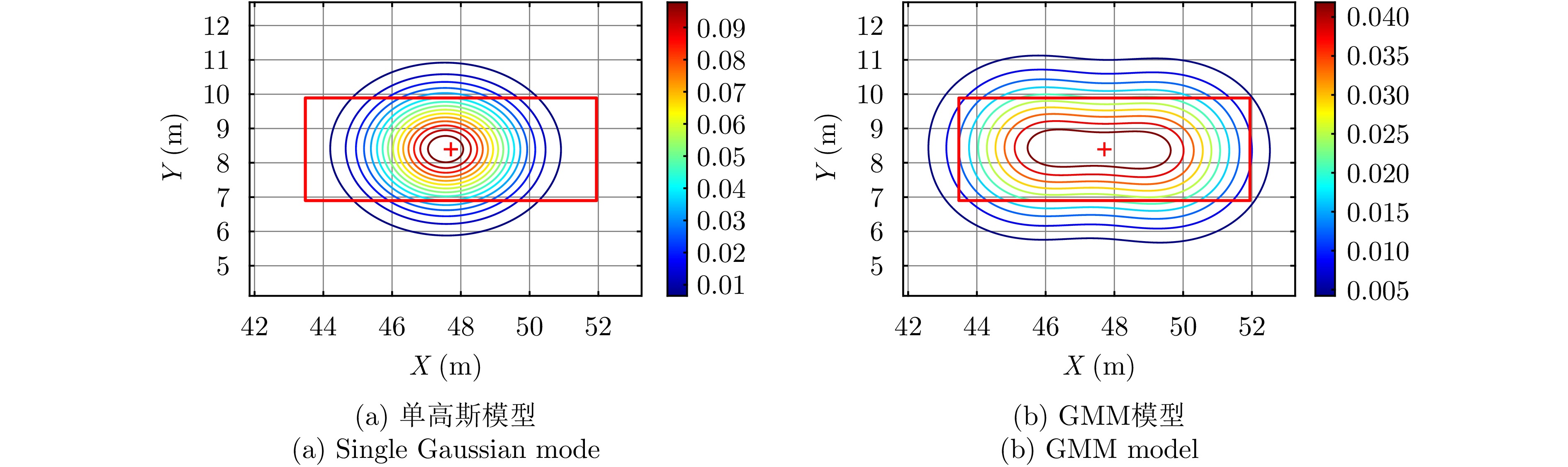
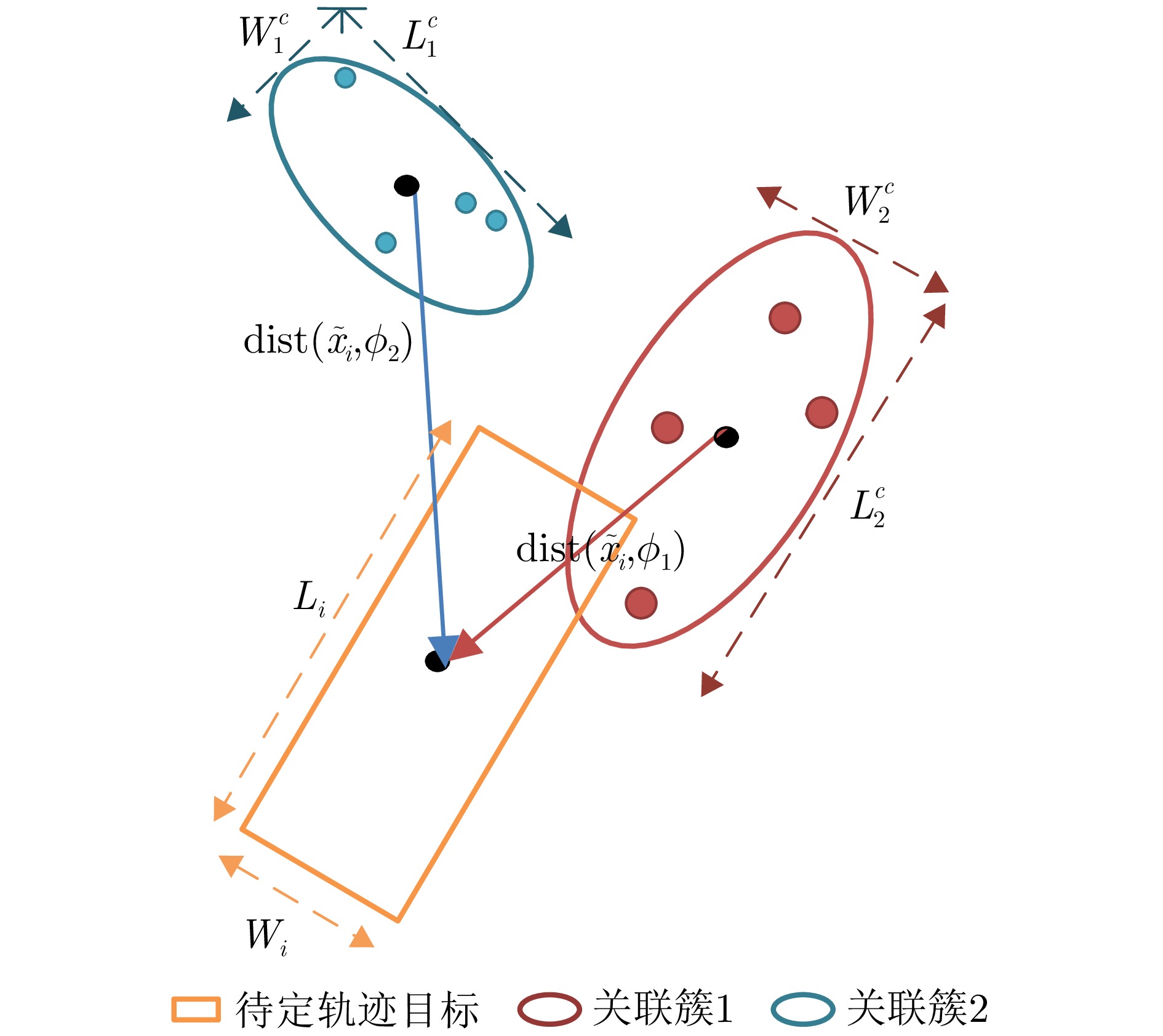
图 2 不同关联模型下车辆量测概率分布示意图
Figure 2. Schematic diagram of vehicle measurement probability distributions under different association models
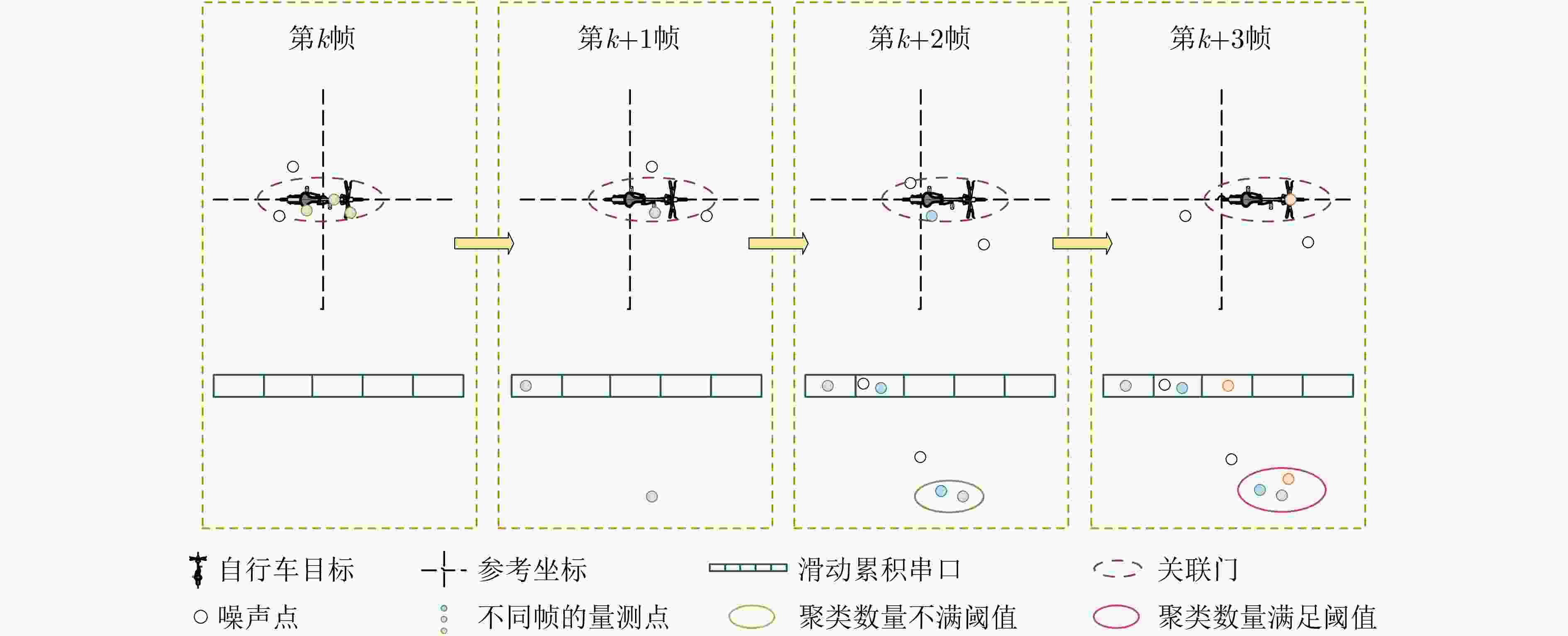
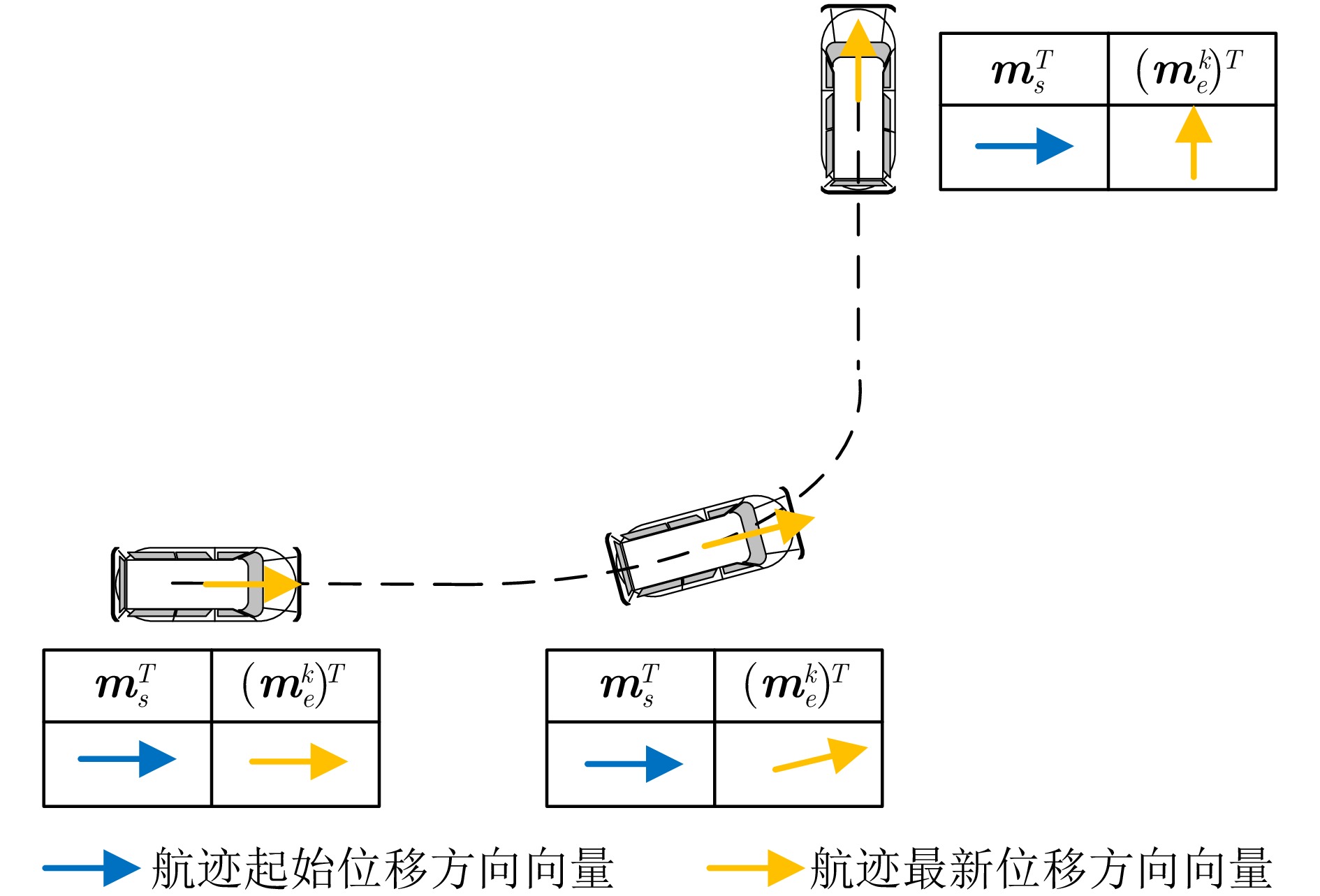
图 4 小型车辆滑动窗口累积示意图
Figure 4. Schematic diagram of sliding-window accumulation for small vehicles
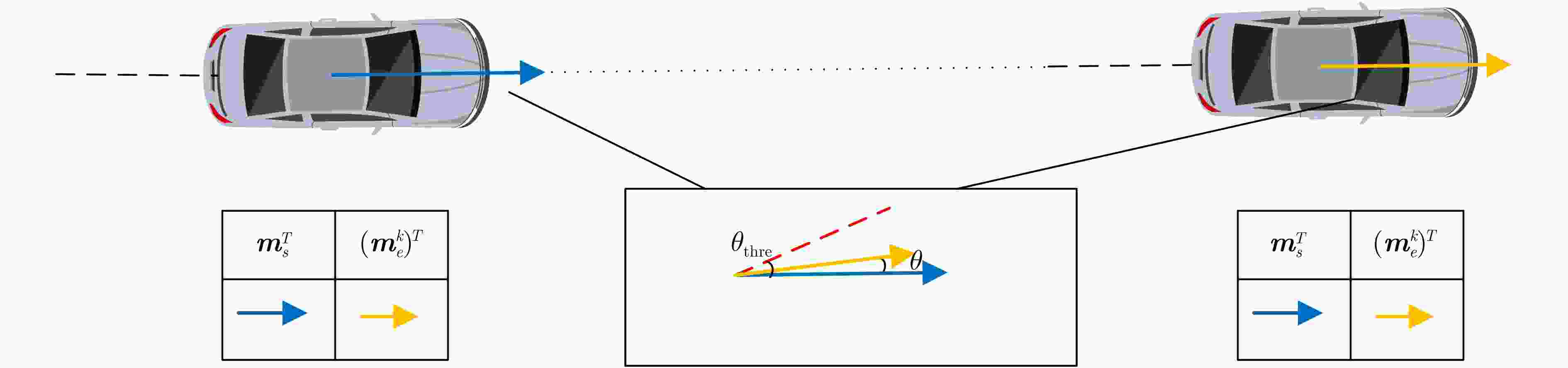
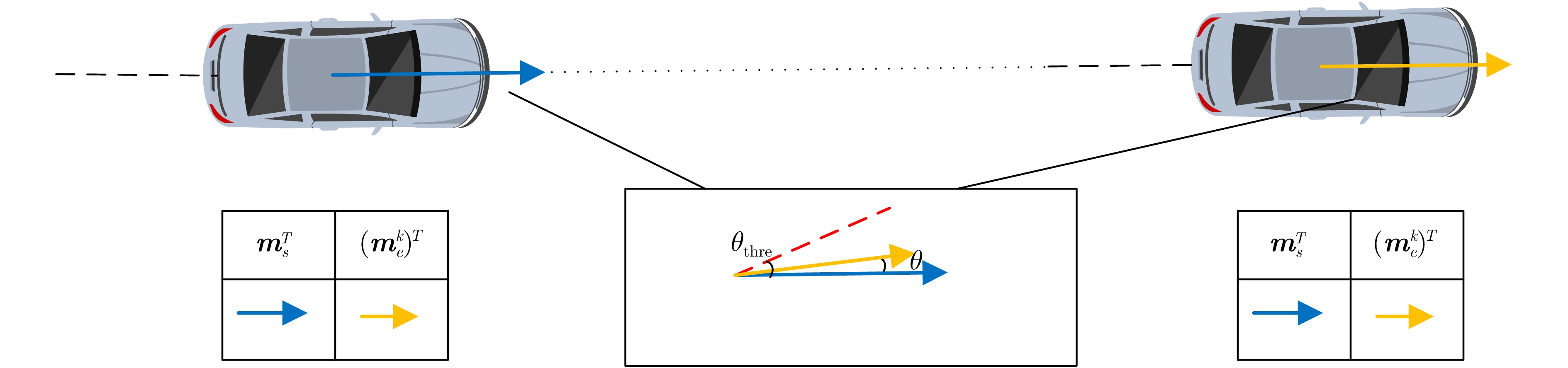
图 7 直行目标重关联示意图
Figure 7. Schematic diagram of re-association for targets traveling straight ahead
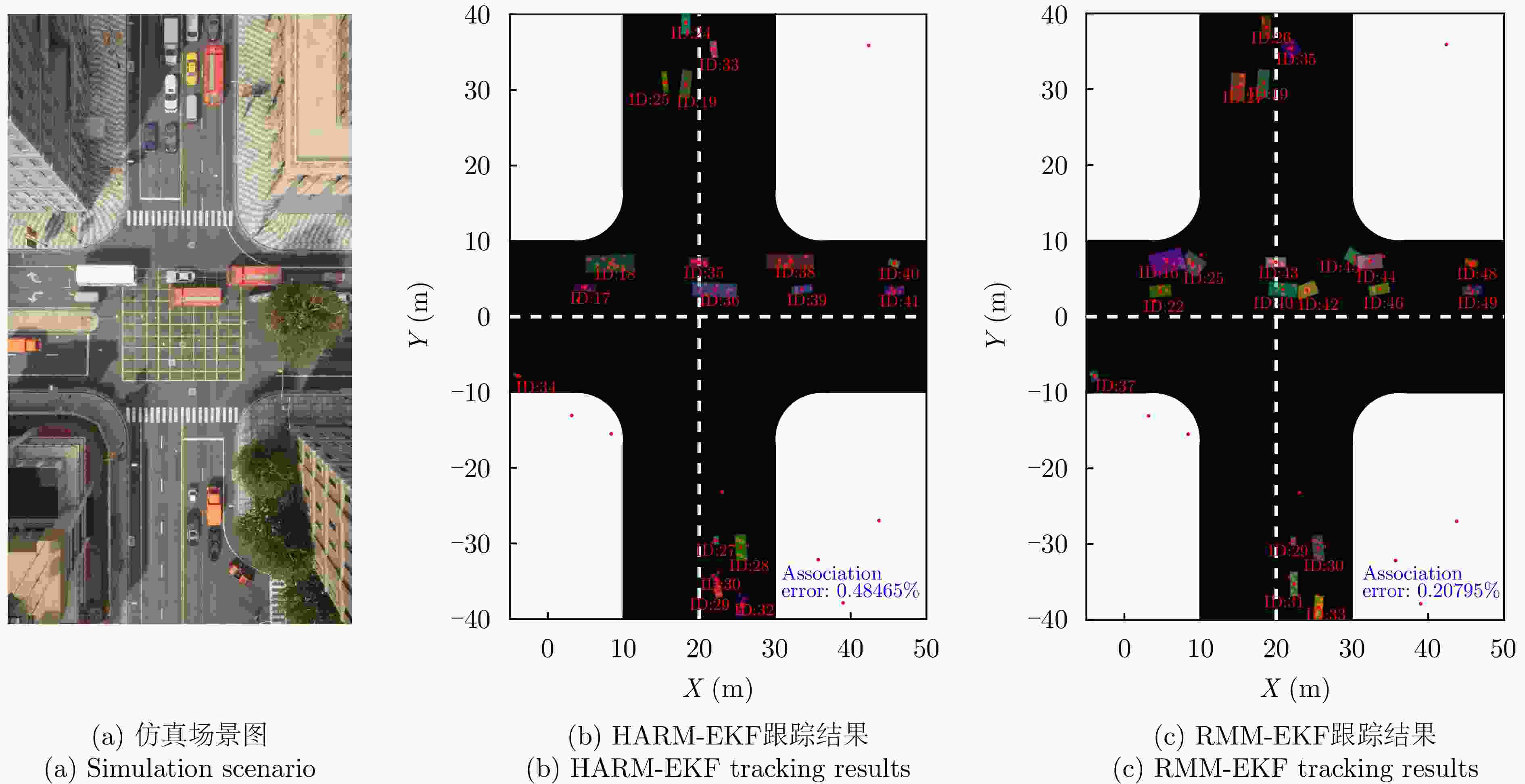
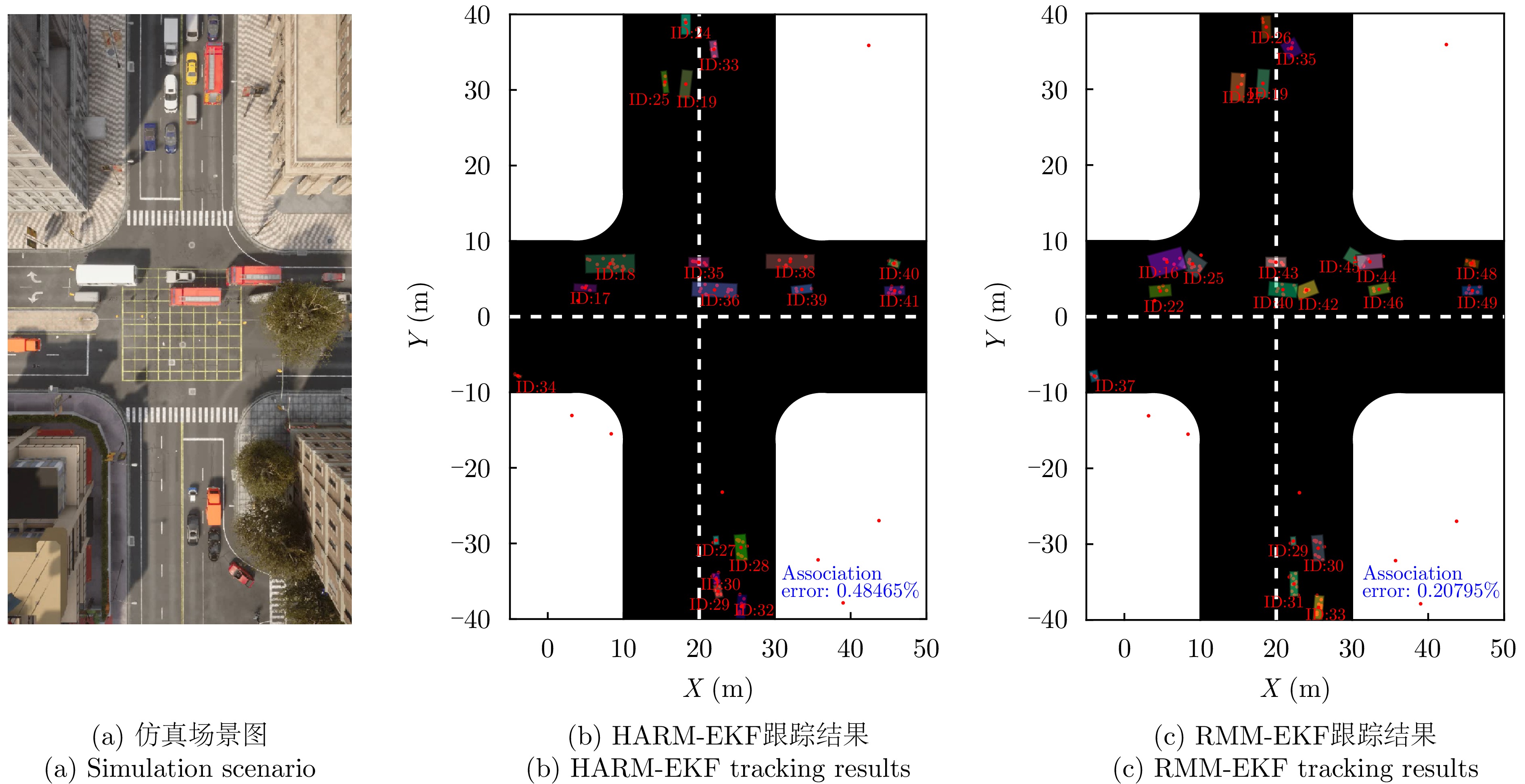
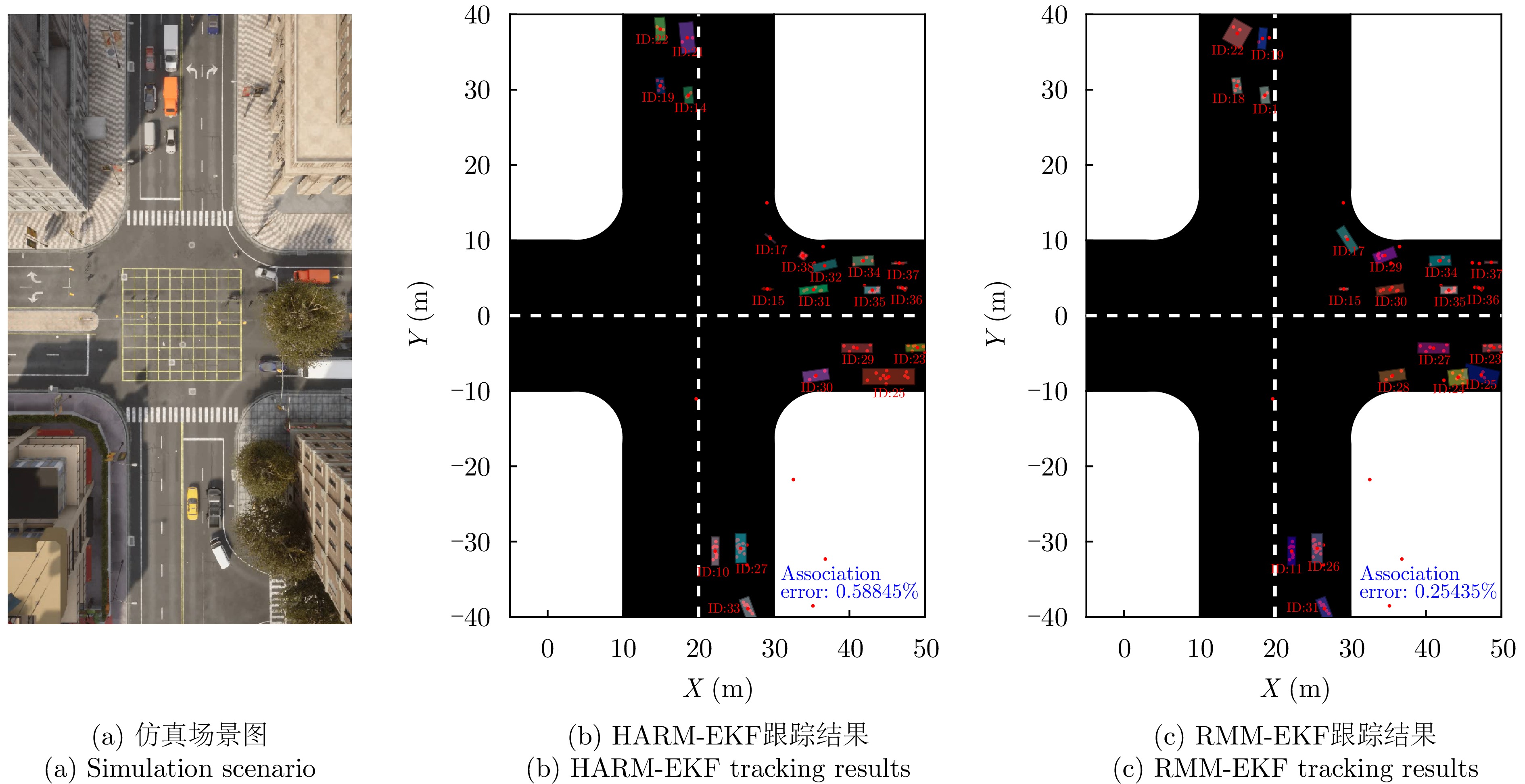
图 11 大车占优仿真场景及跟踪结果
Figure 11. Simulation scenario and tracking results in the large-vehicle-dominant scenario
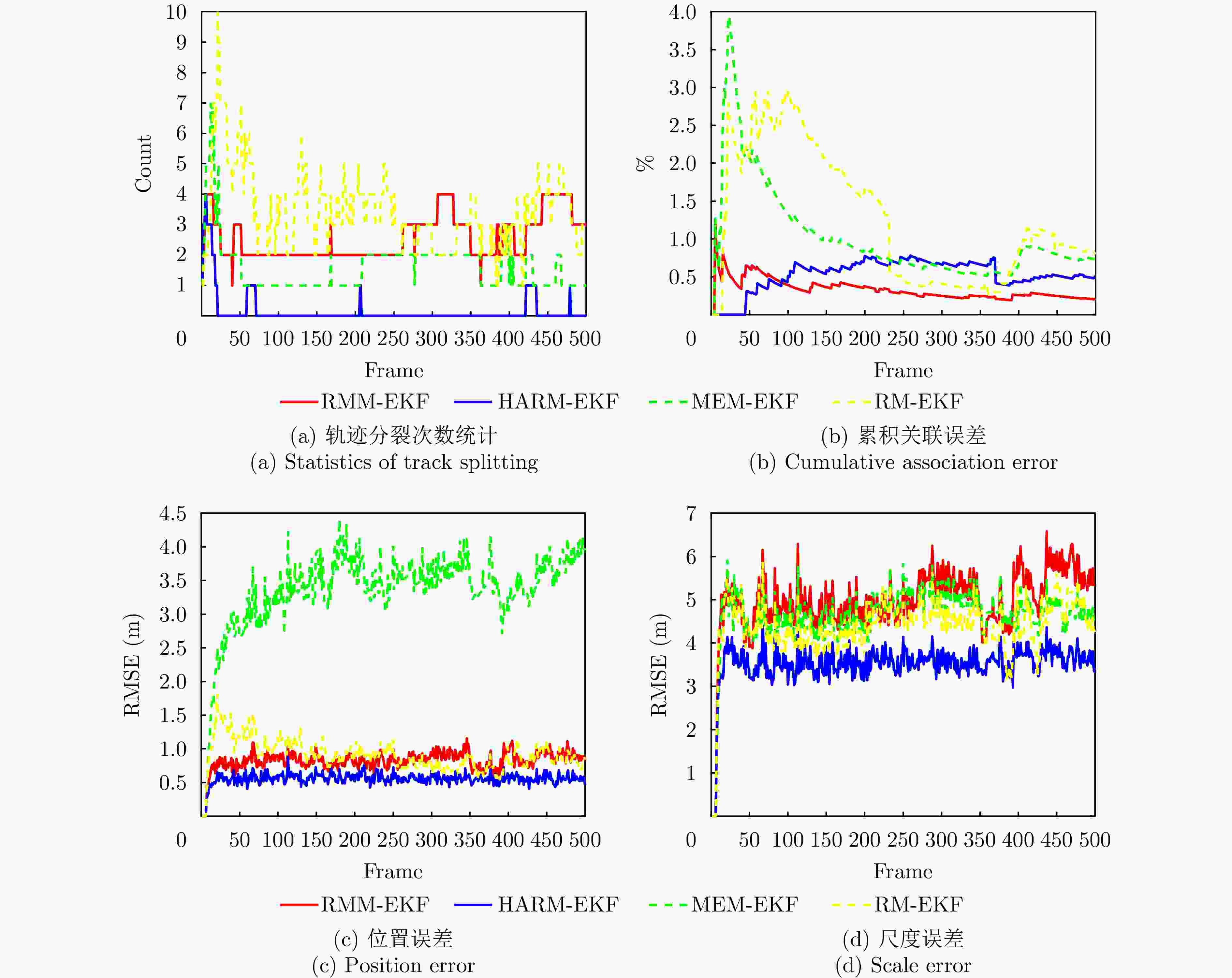
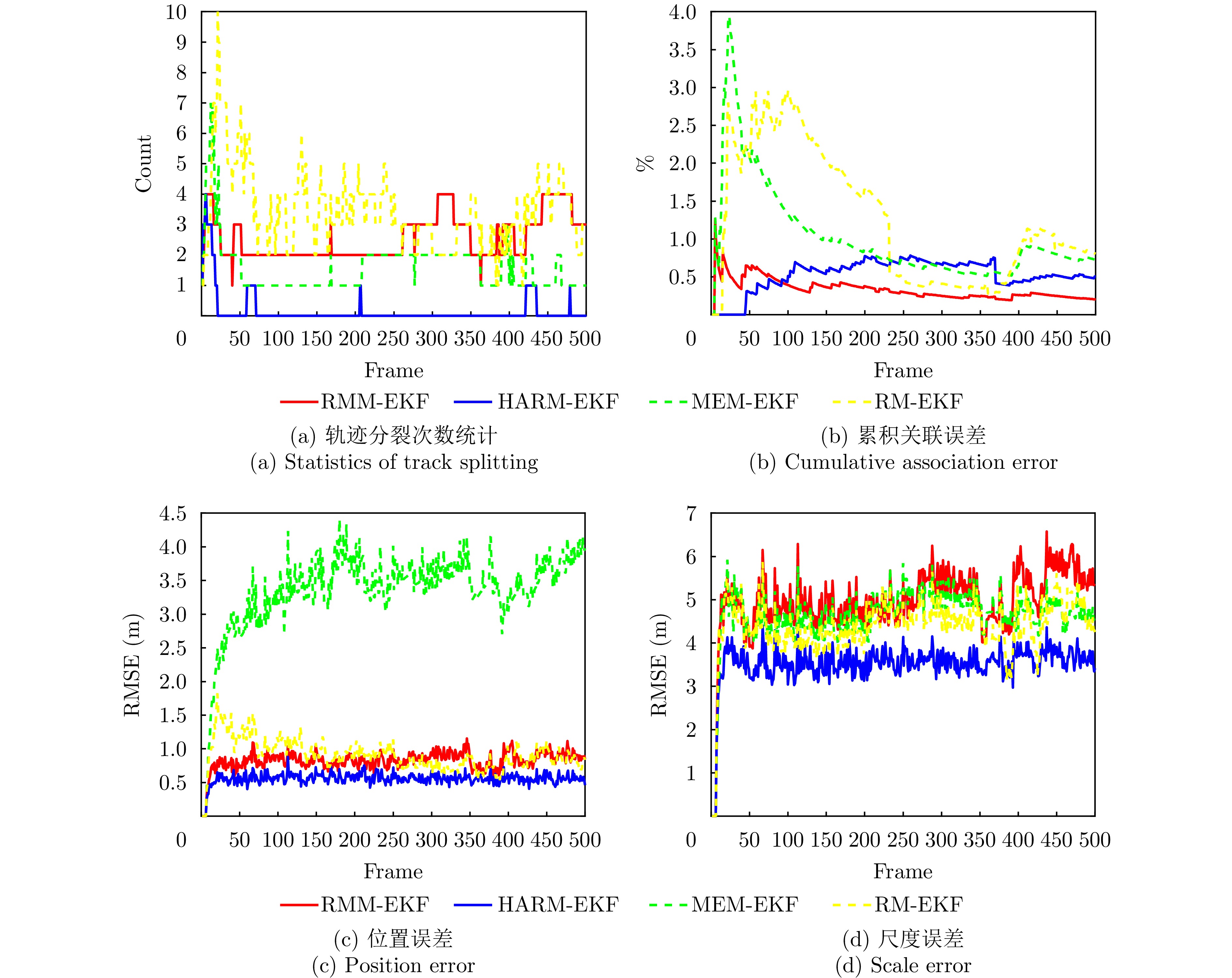
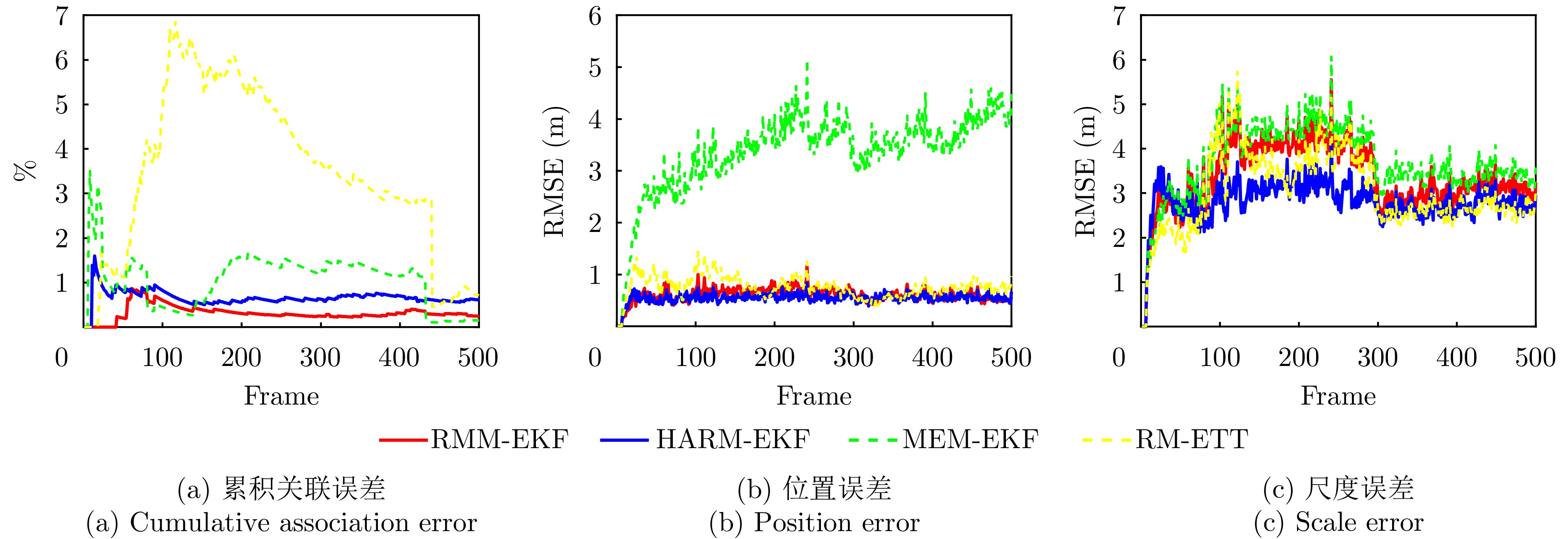
图 12 大车占优场景下的多指标性能评估结果
Figure 12. Multi-metric performance evaluation results in the large-vehicle-dominant scenario
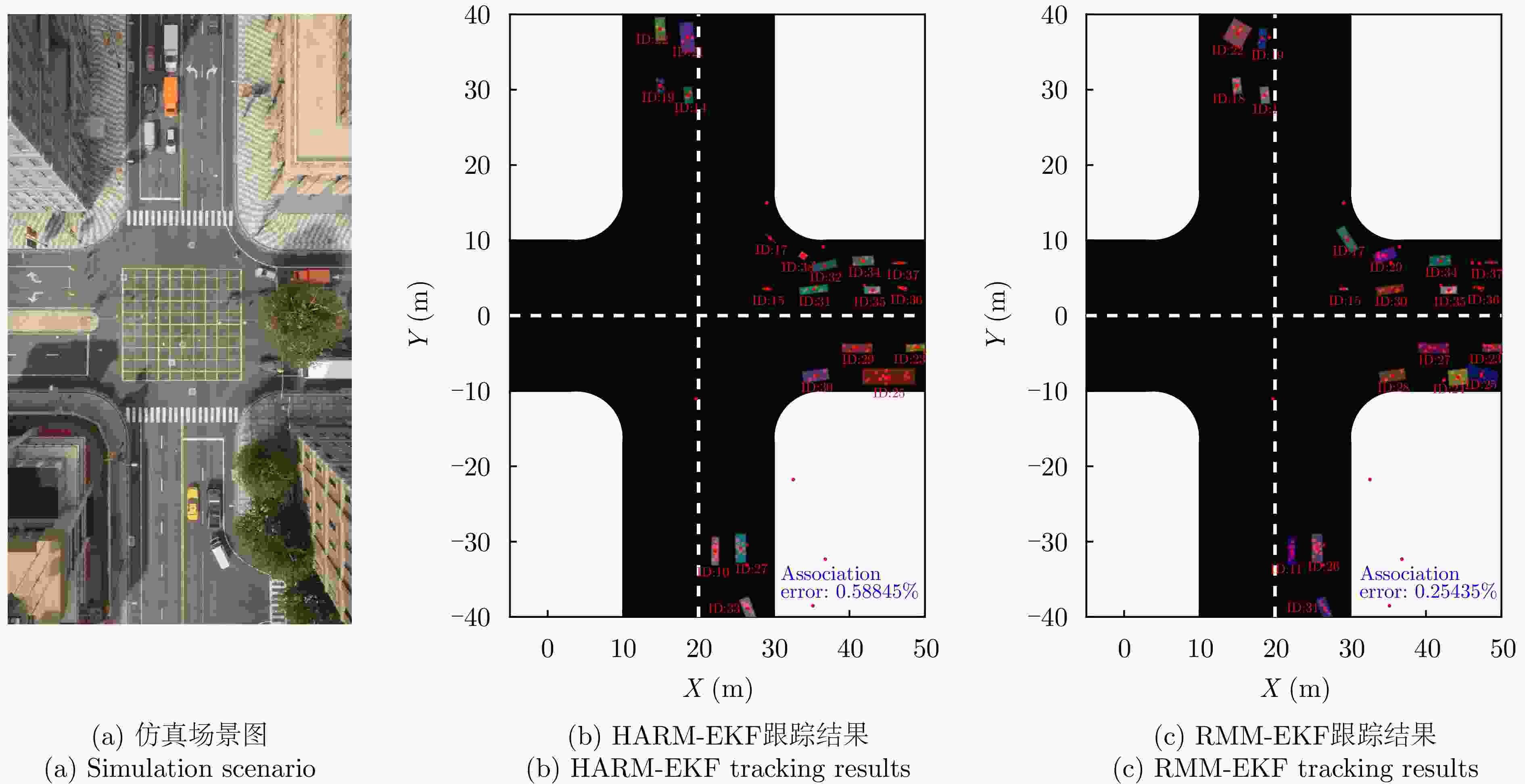
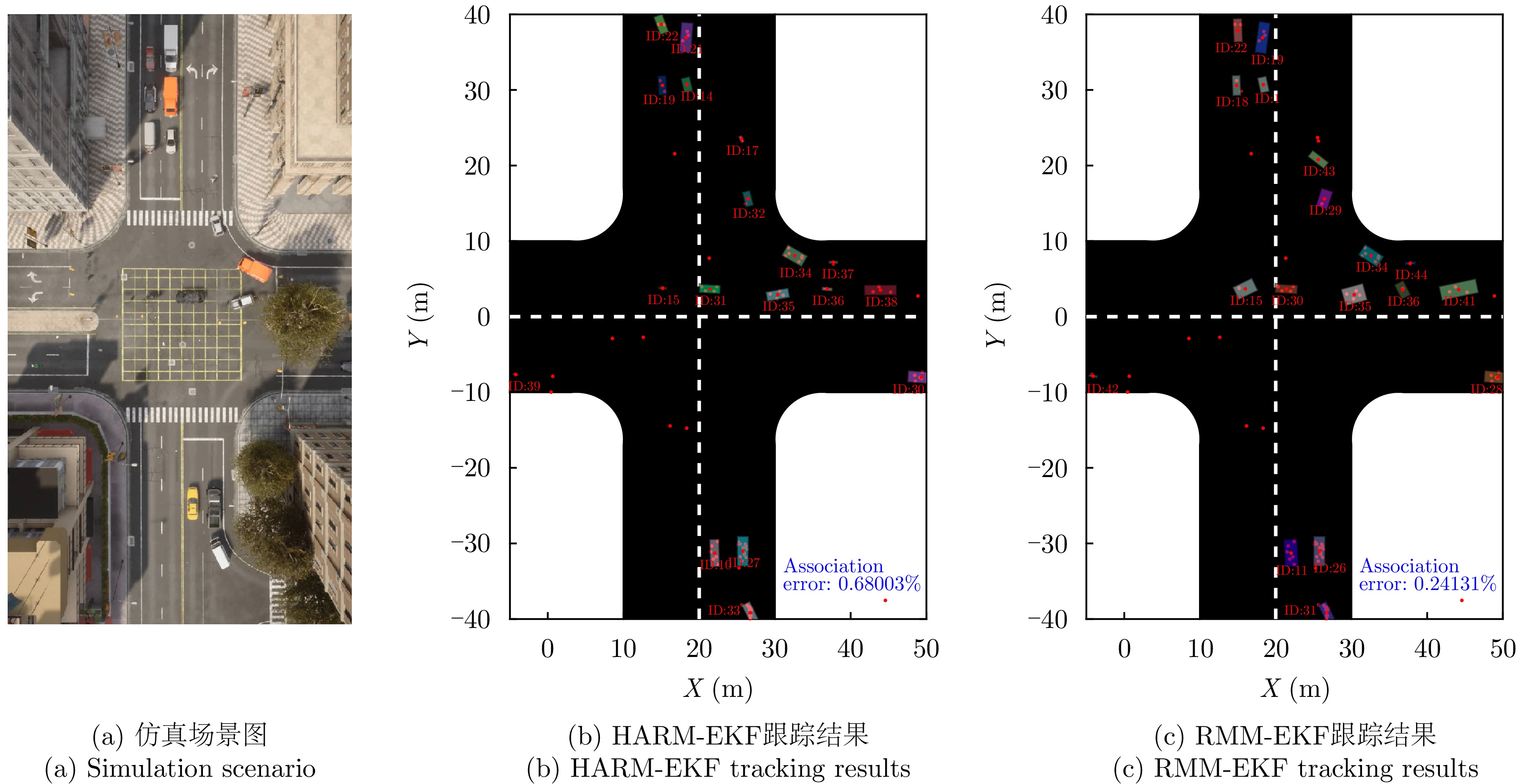
图 13 小车占优仿真场景及跟踪结果(第280帧)
Figure 13. Simulation scenario and tracking results in the small-vehicle-dominant scenario (frame 280)
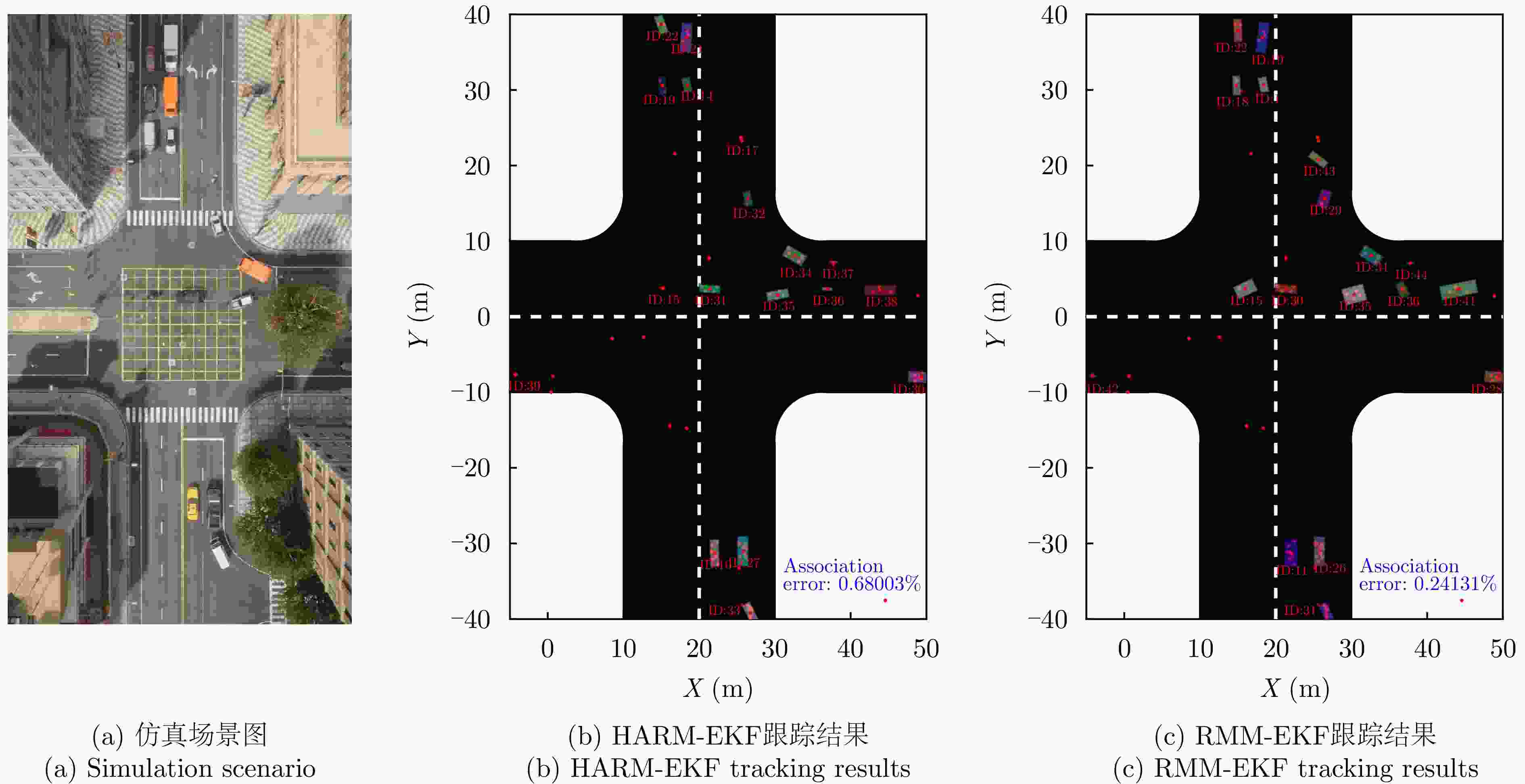
图 14 小车占优仿真场景及跟踪结果(第327帧)
Figure 14. Simulation scenario and tracking results in the small-vehicle-dominant scenario (frame 327)
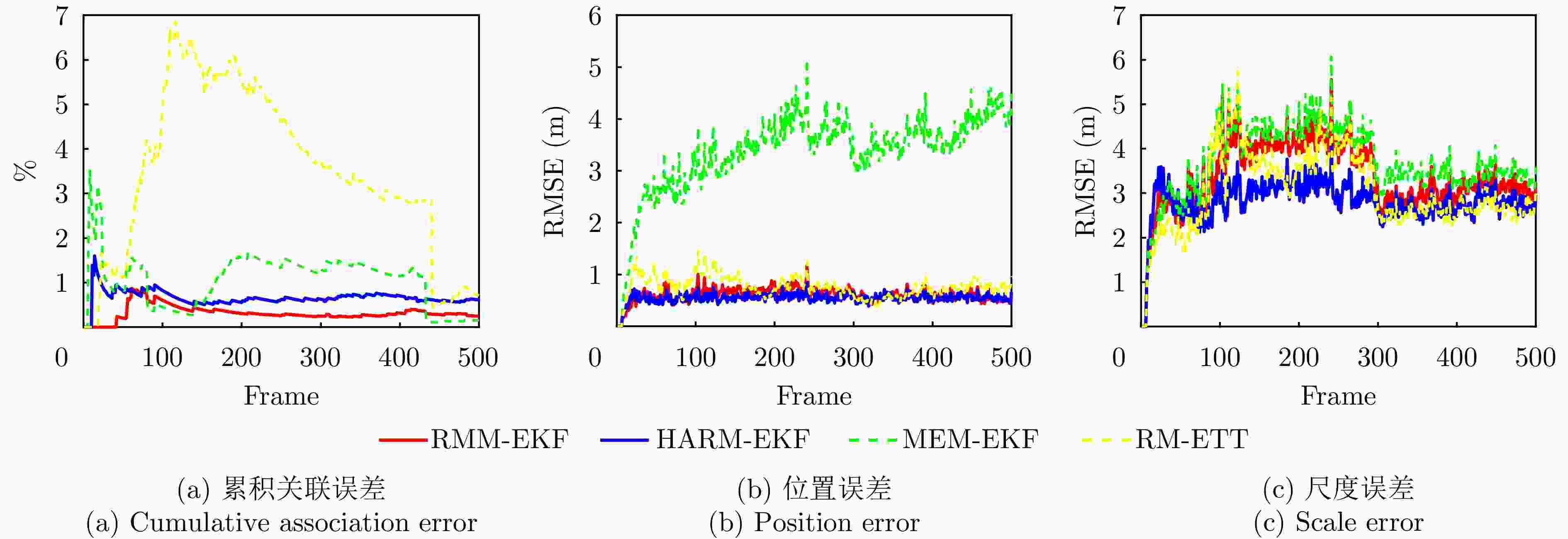
图 15 小车占优场景下的多指标性能评估结果
Figure 15. Multi-metric performance evaluation results in the small-vehicle-dominant scenario
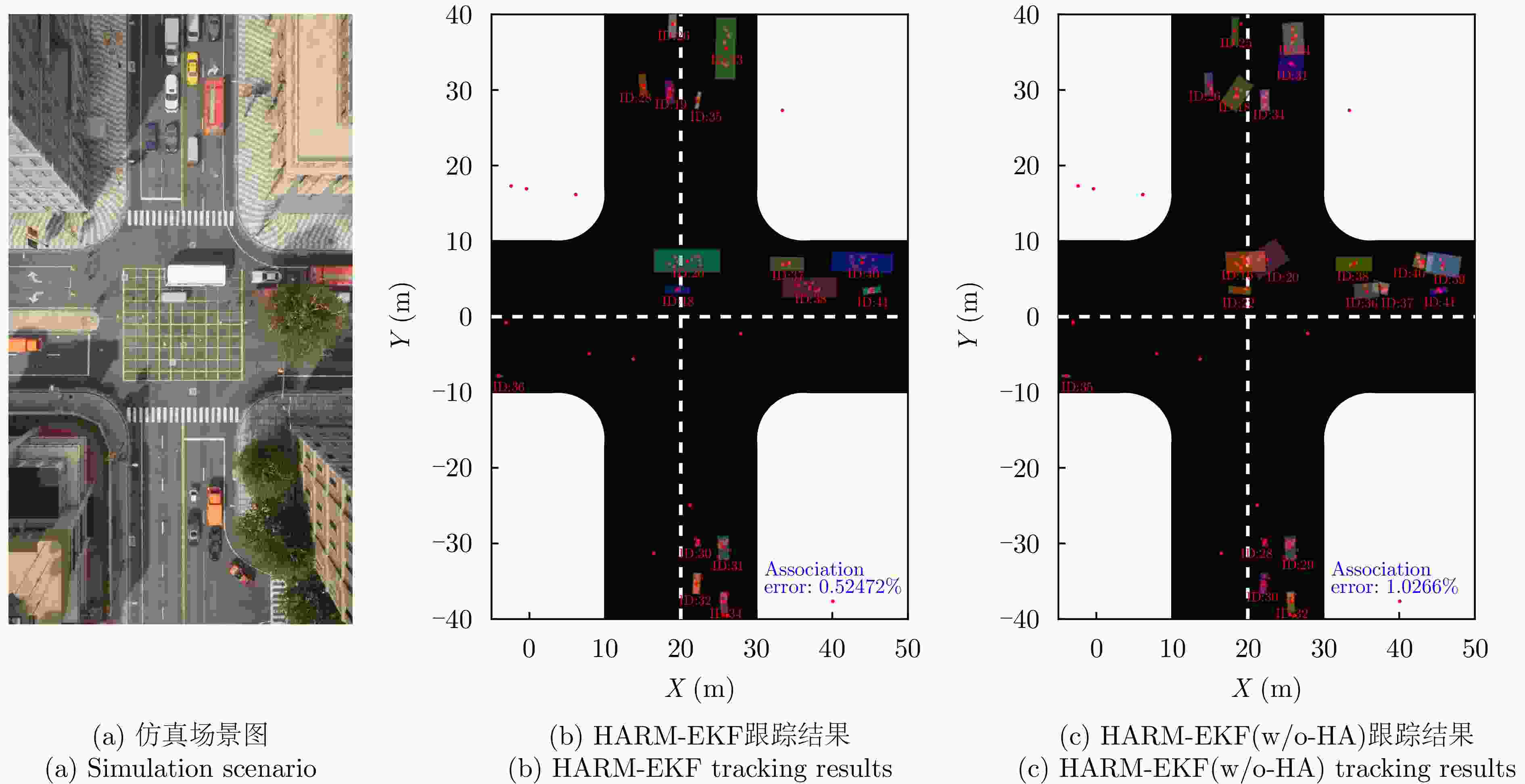
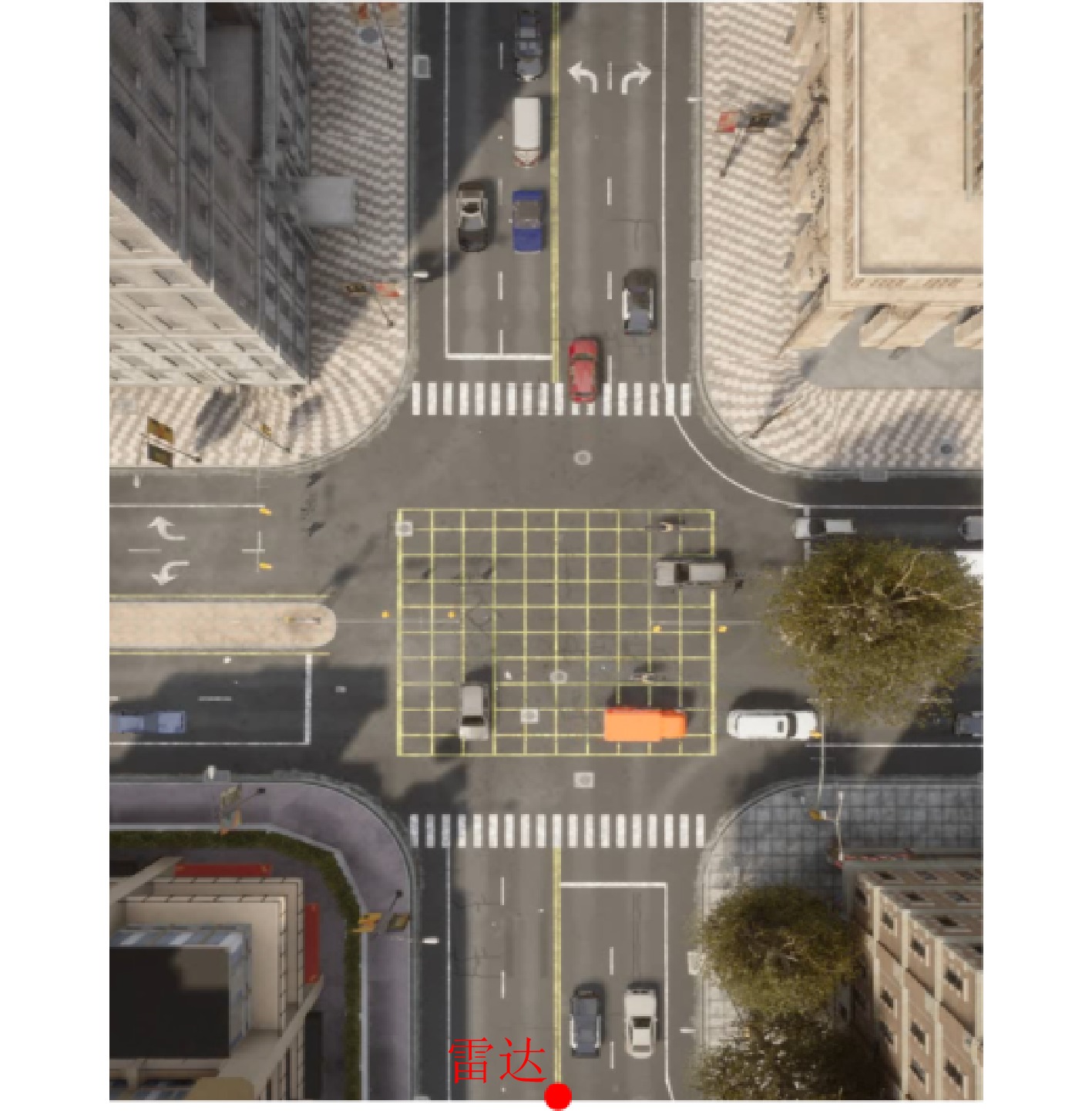
图 16 分层关联消融实验的仿真场景及跟踪结果
Figure 16. Simulation scenario and tracking results of the hierarchical association ablation experiment
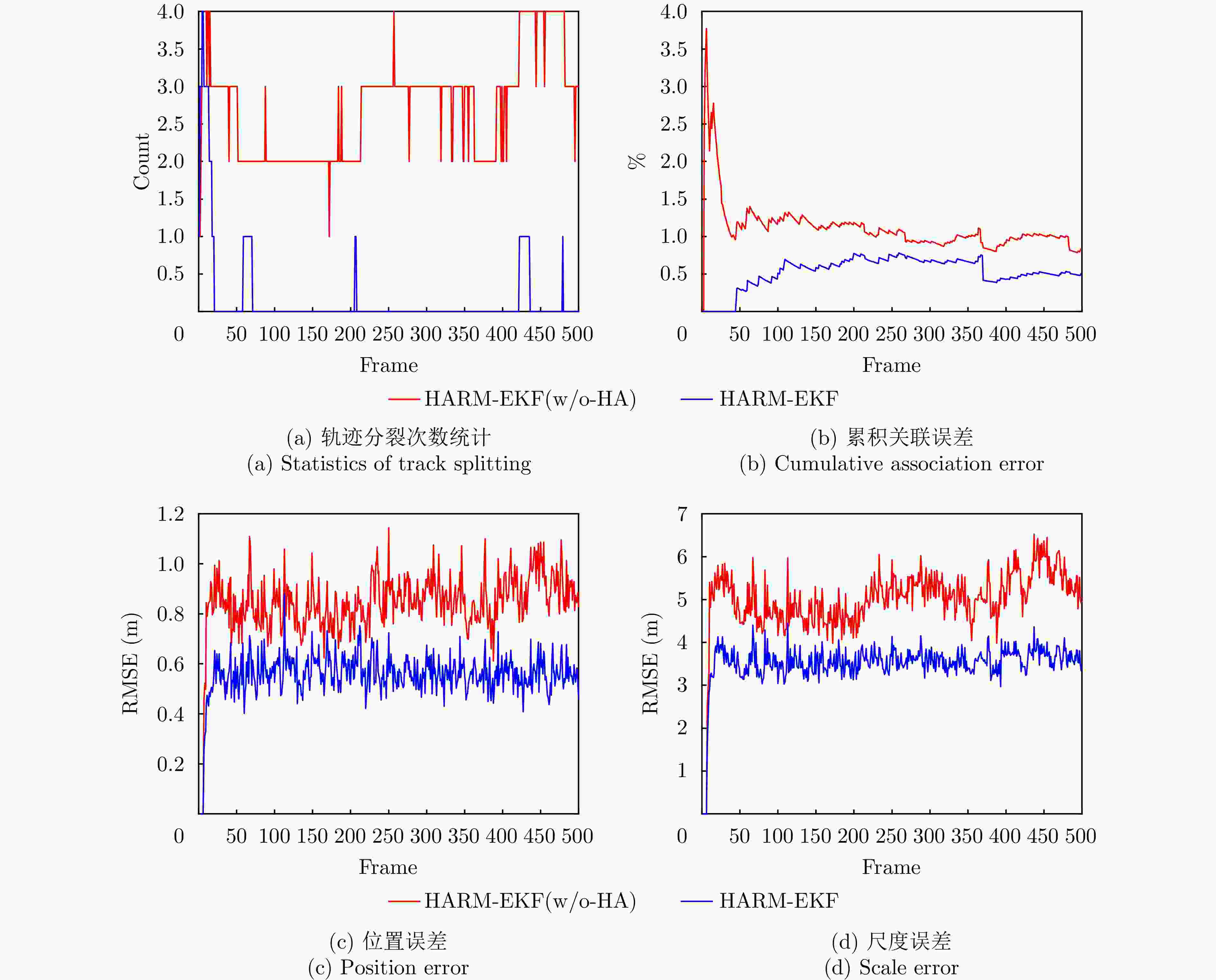
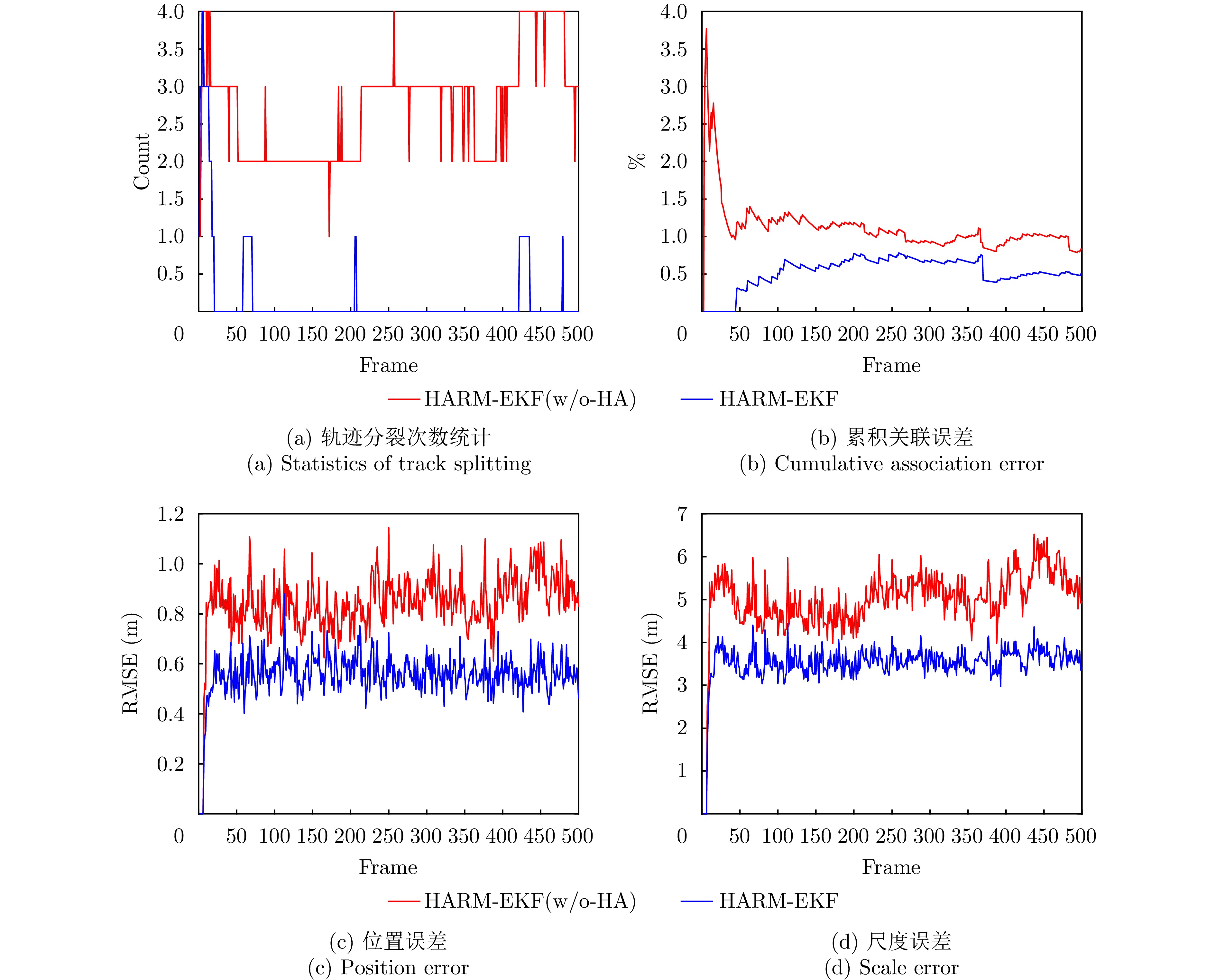
图 17 分层关联消融实验的多指标性能评估结果
Figure 17. Multi-metric performance evaluation results of the hierarchical association ablation experiment
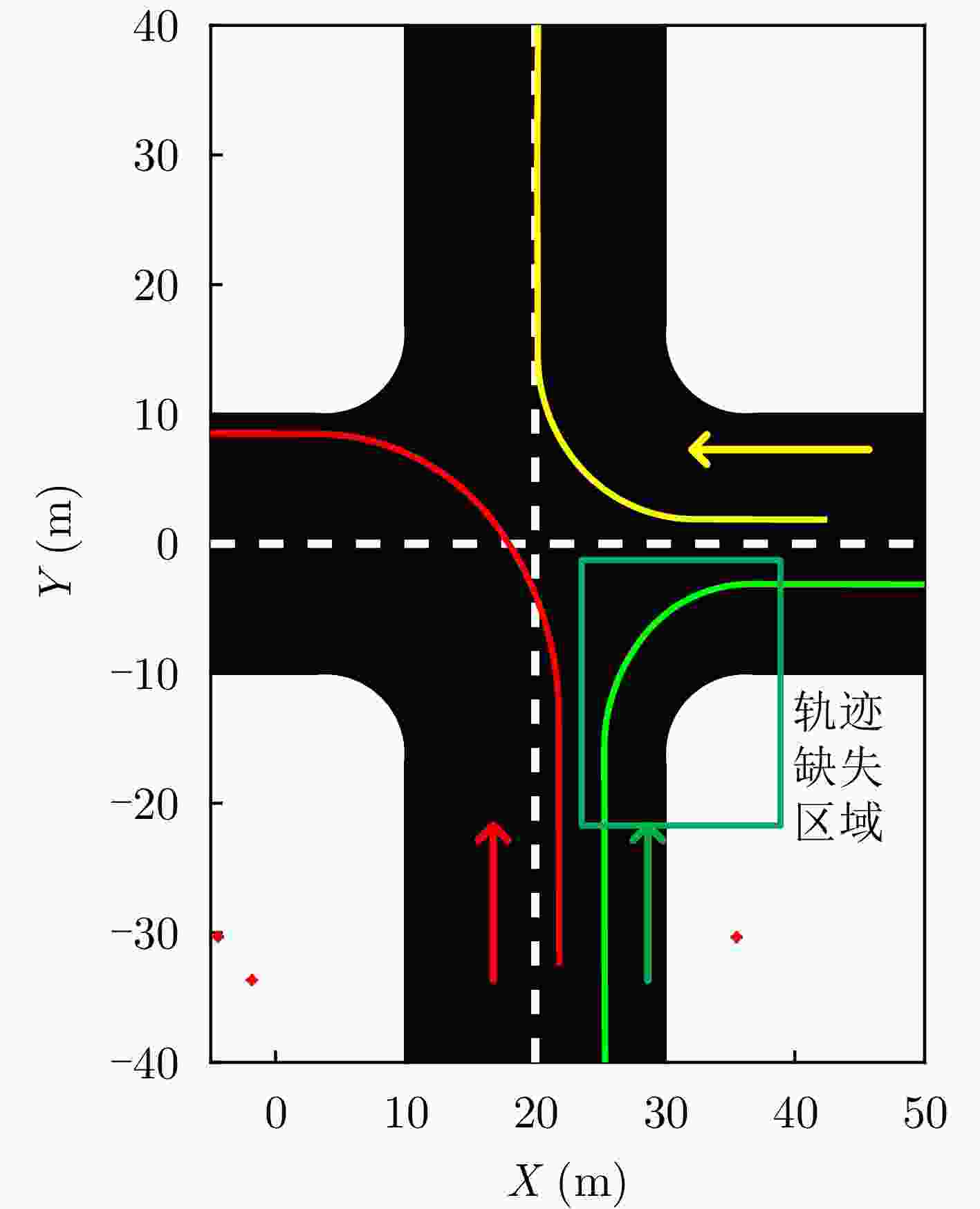
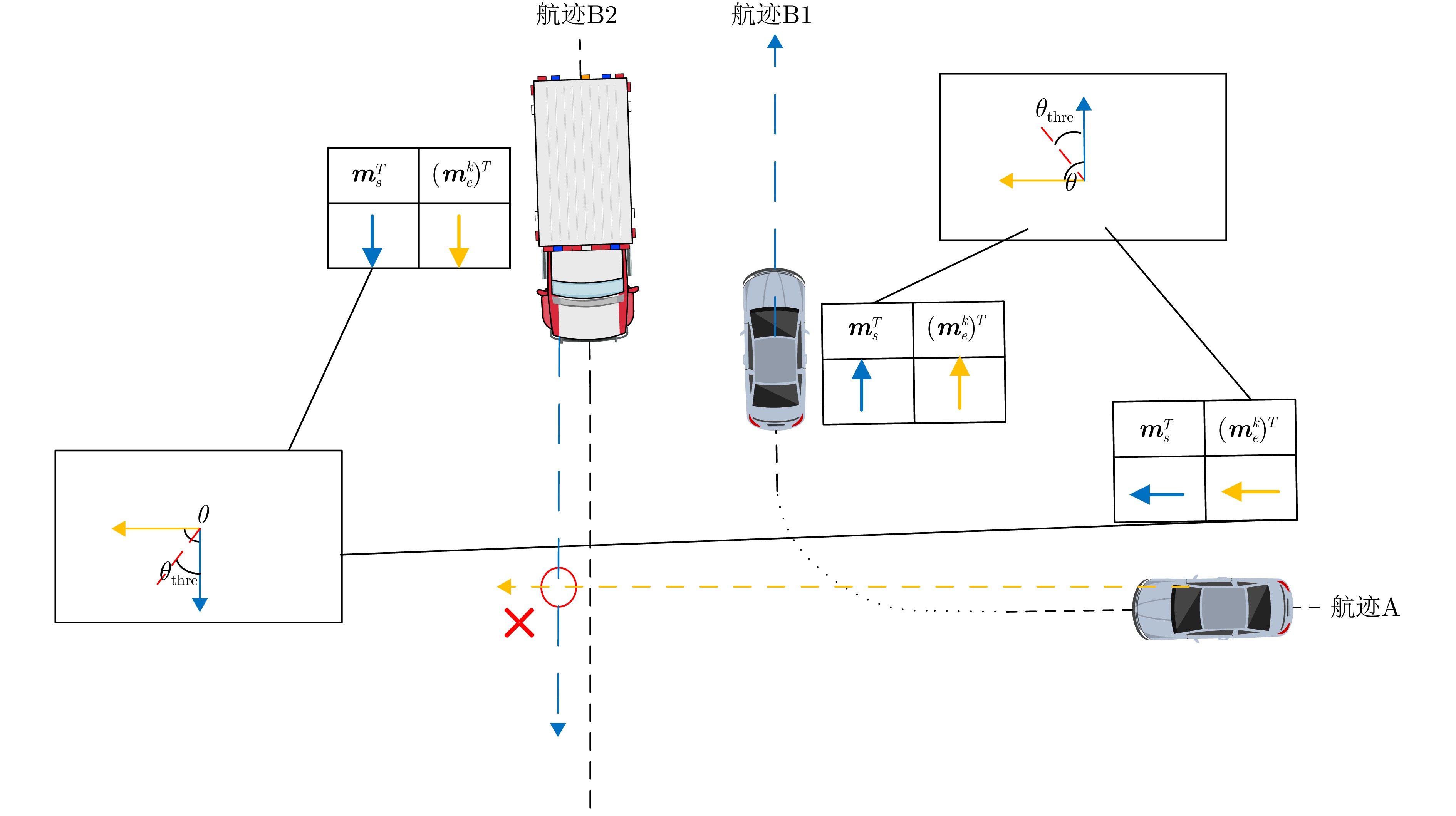
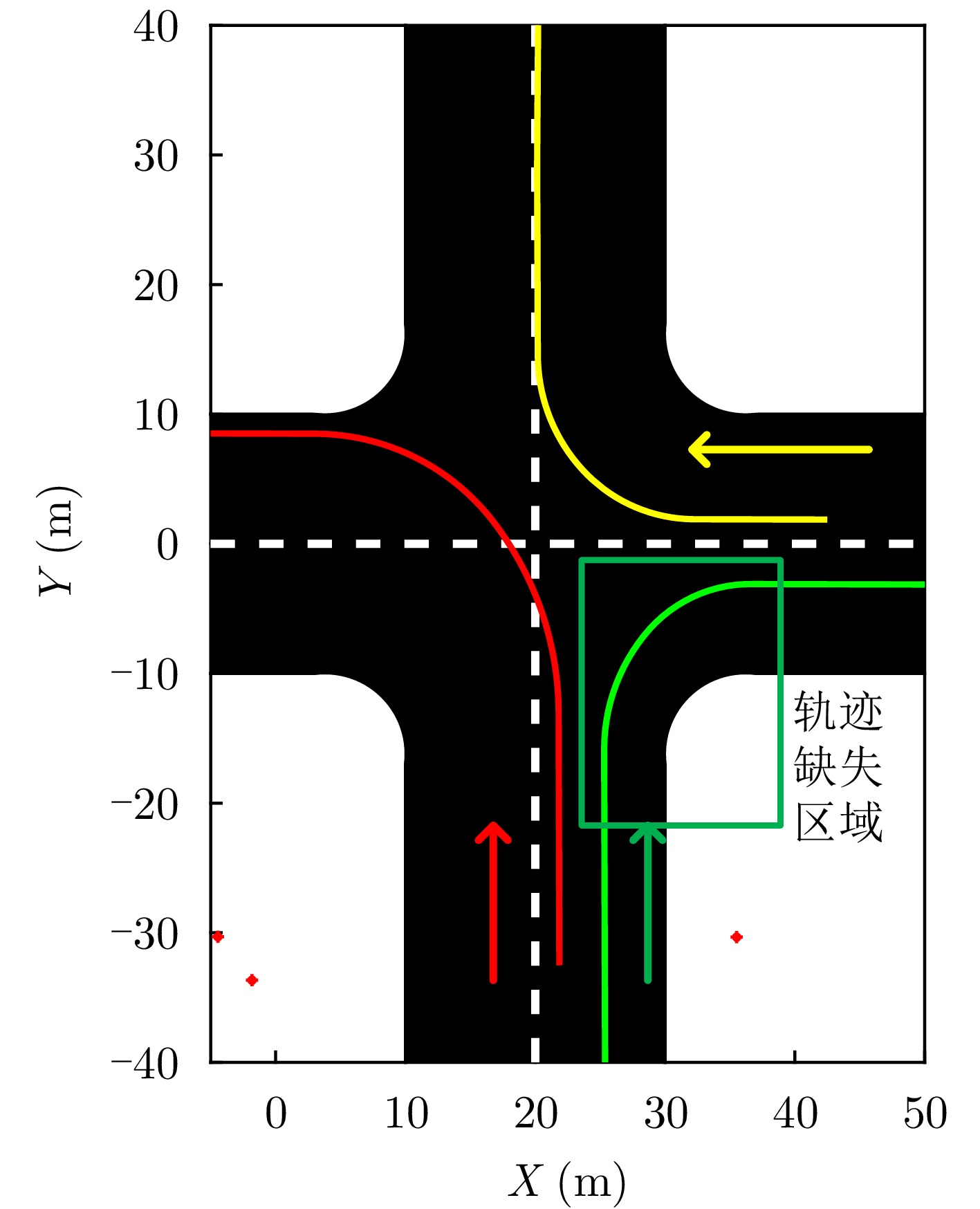
图 18 重关联消融实验场景示意图
Figure 18. Schematic diagram of the re-association ablation experiment scenario
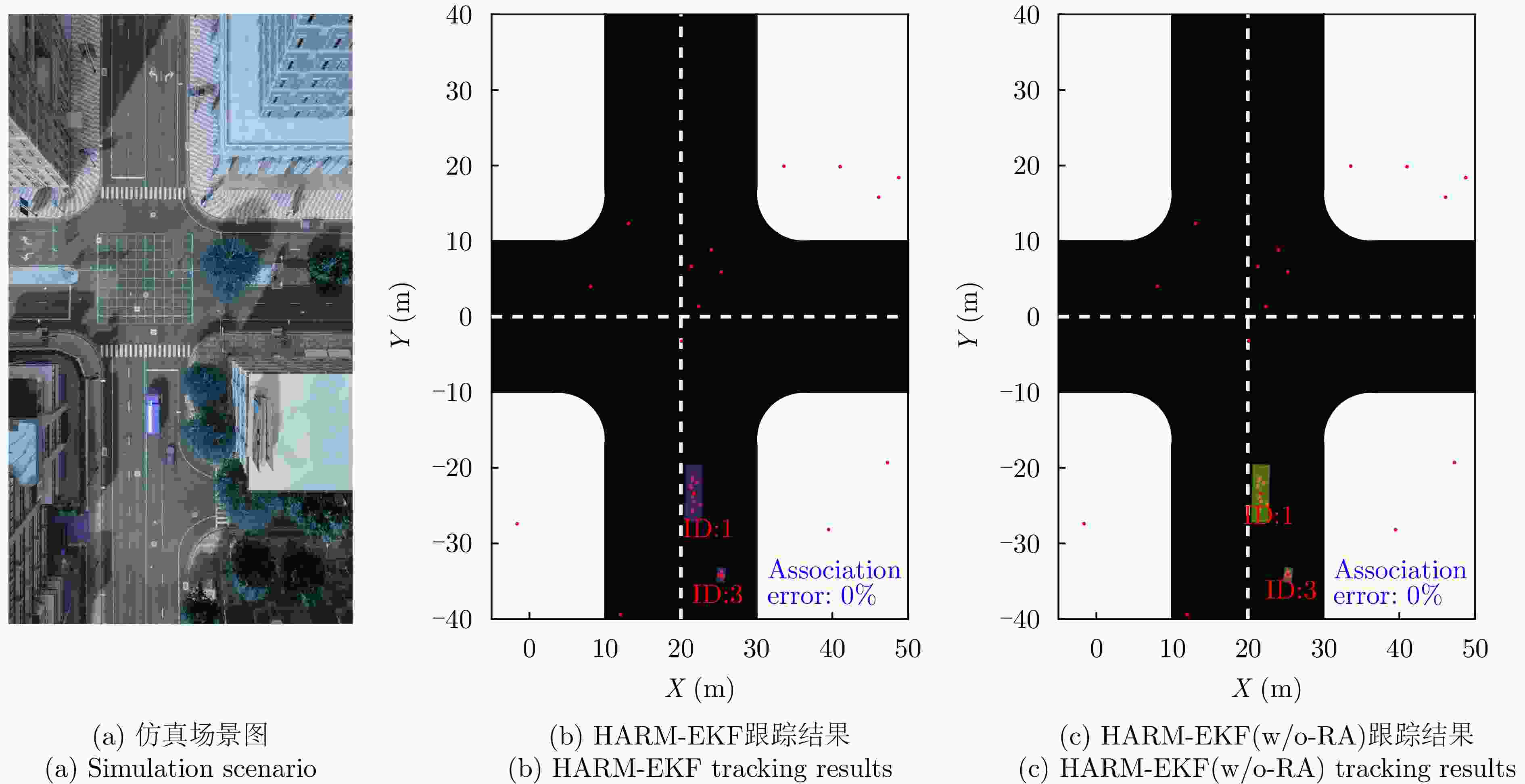
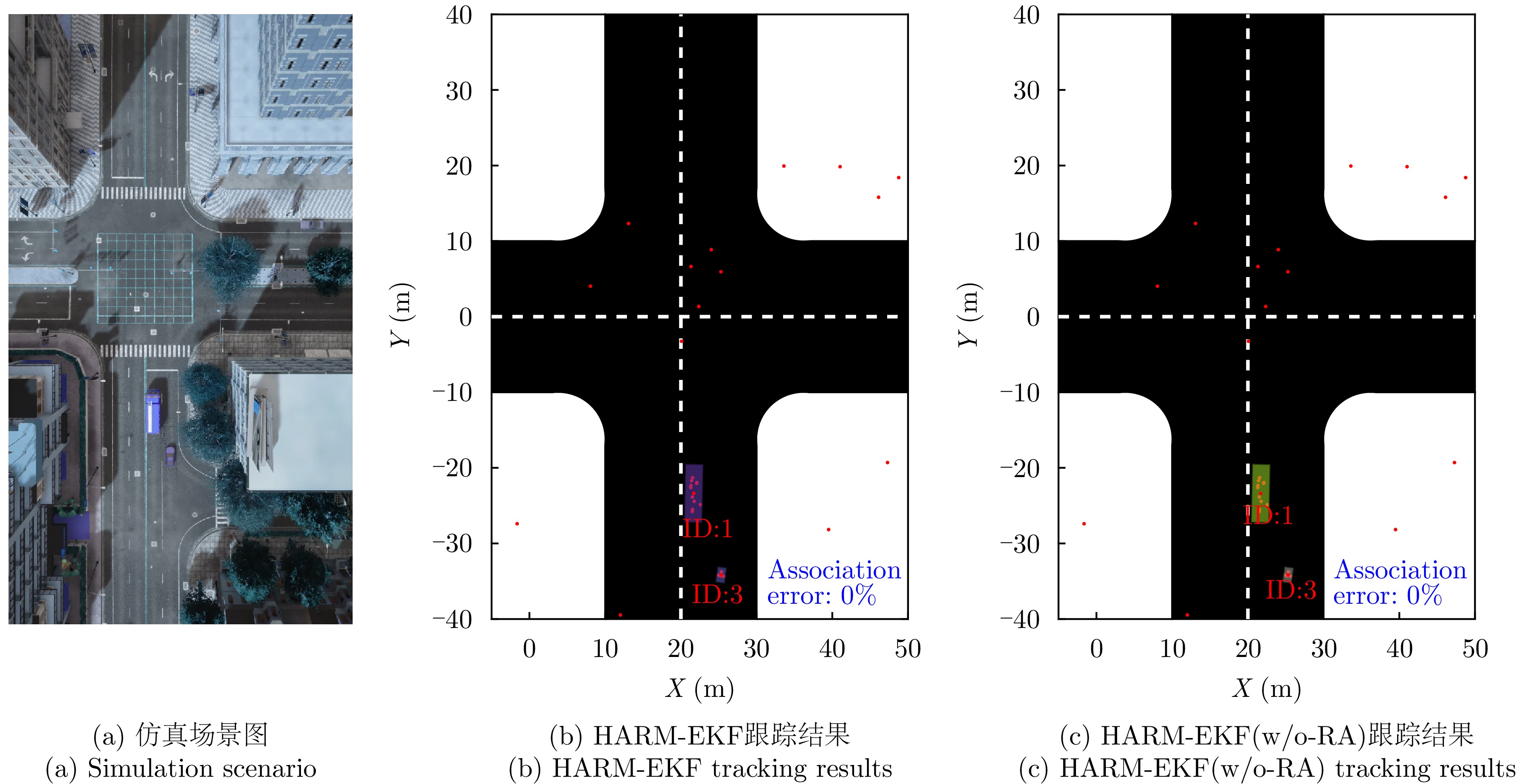
图 19 重关联消融实验仿真场景及跟踪结果(第19帧)
Figure 19. Simulation scenario and tracking results of the re-association ablation experiment (frame 19)
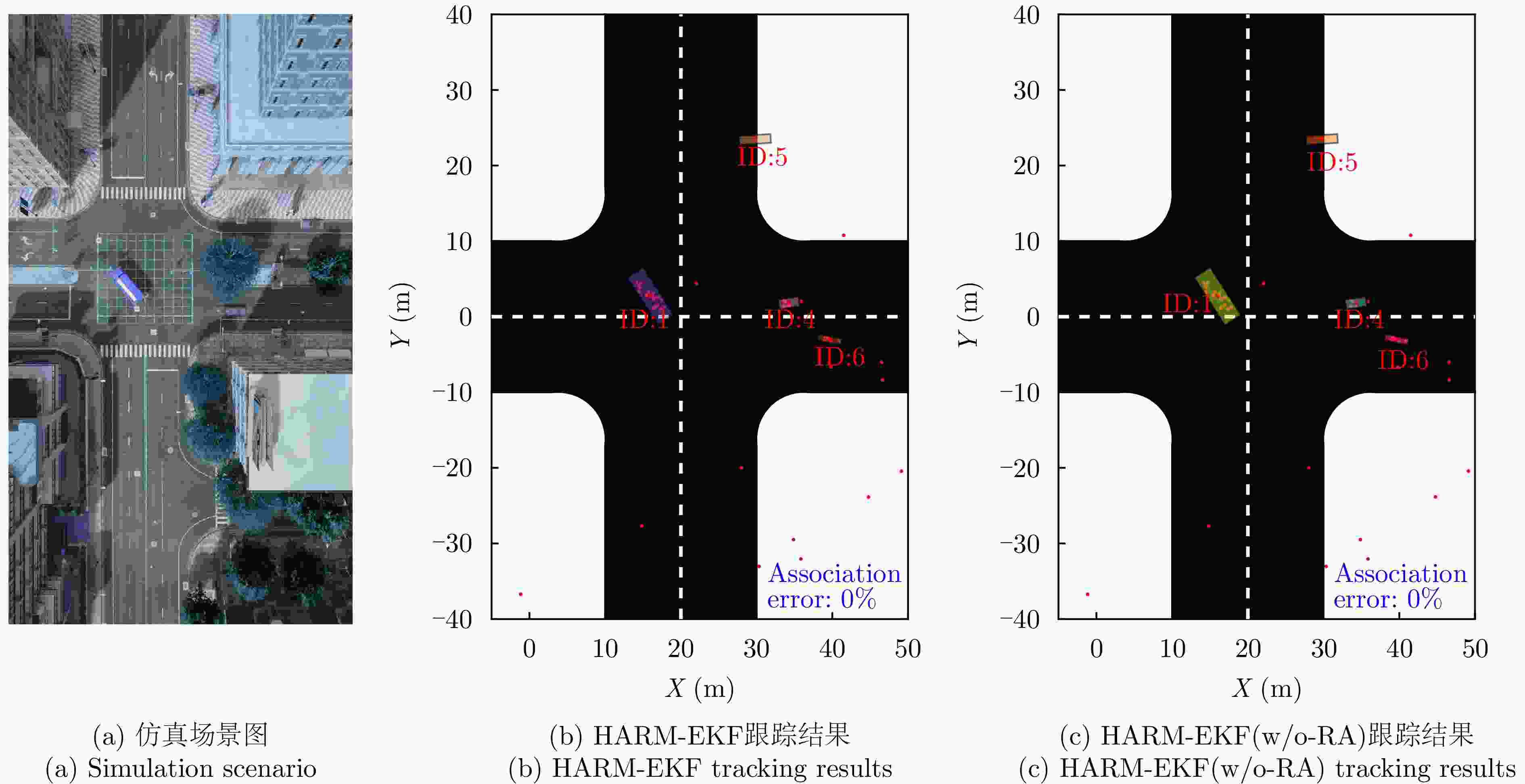
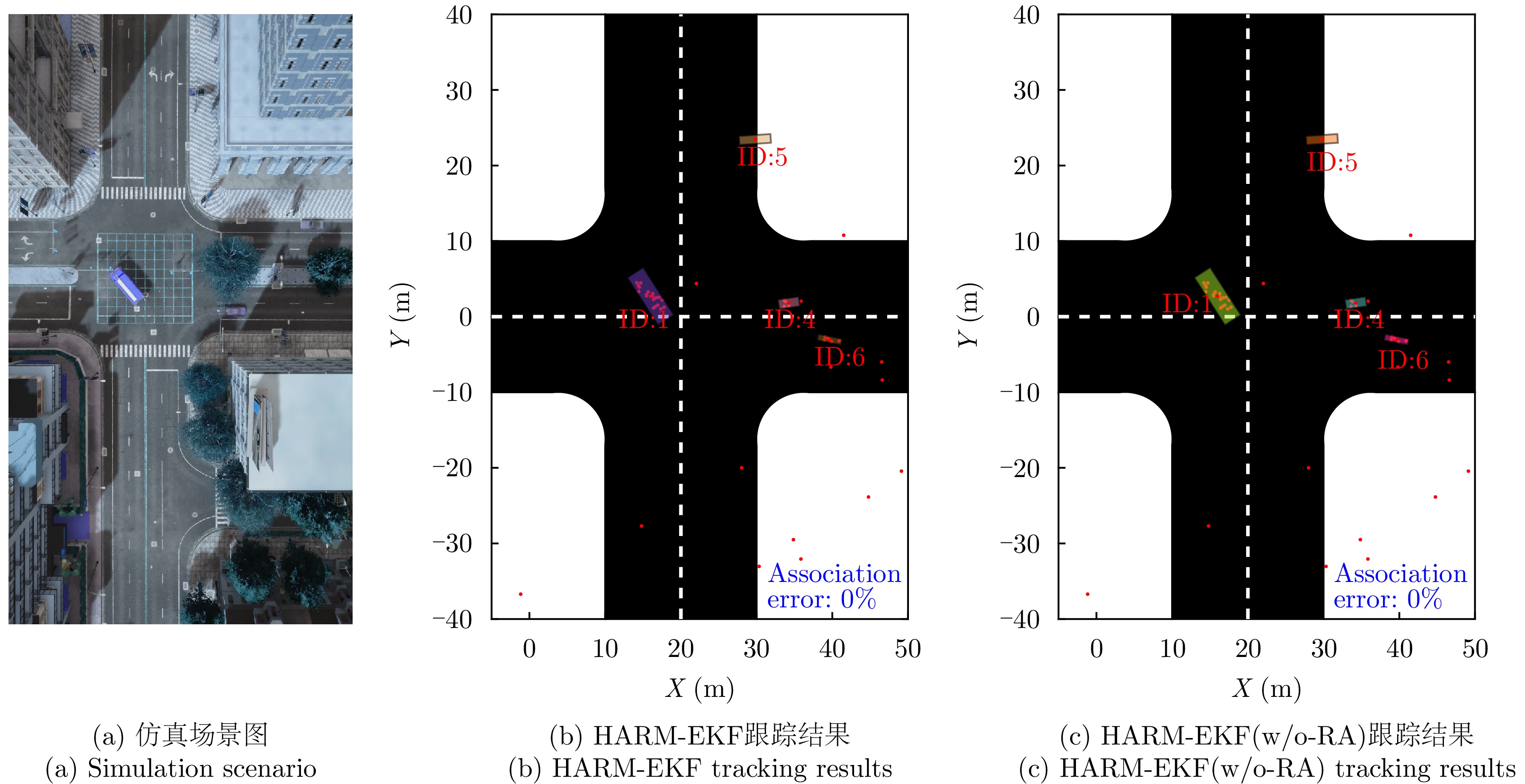
图 20 重关联消融实验仿真场景及跟踪结果(第72帧)
Figure 20. Simulation scenario and tracking results of the re-association ablation experiment (frame 72)
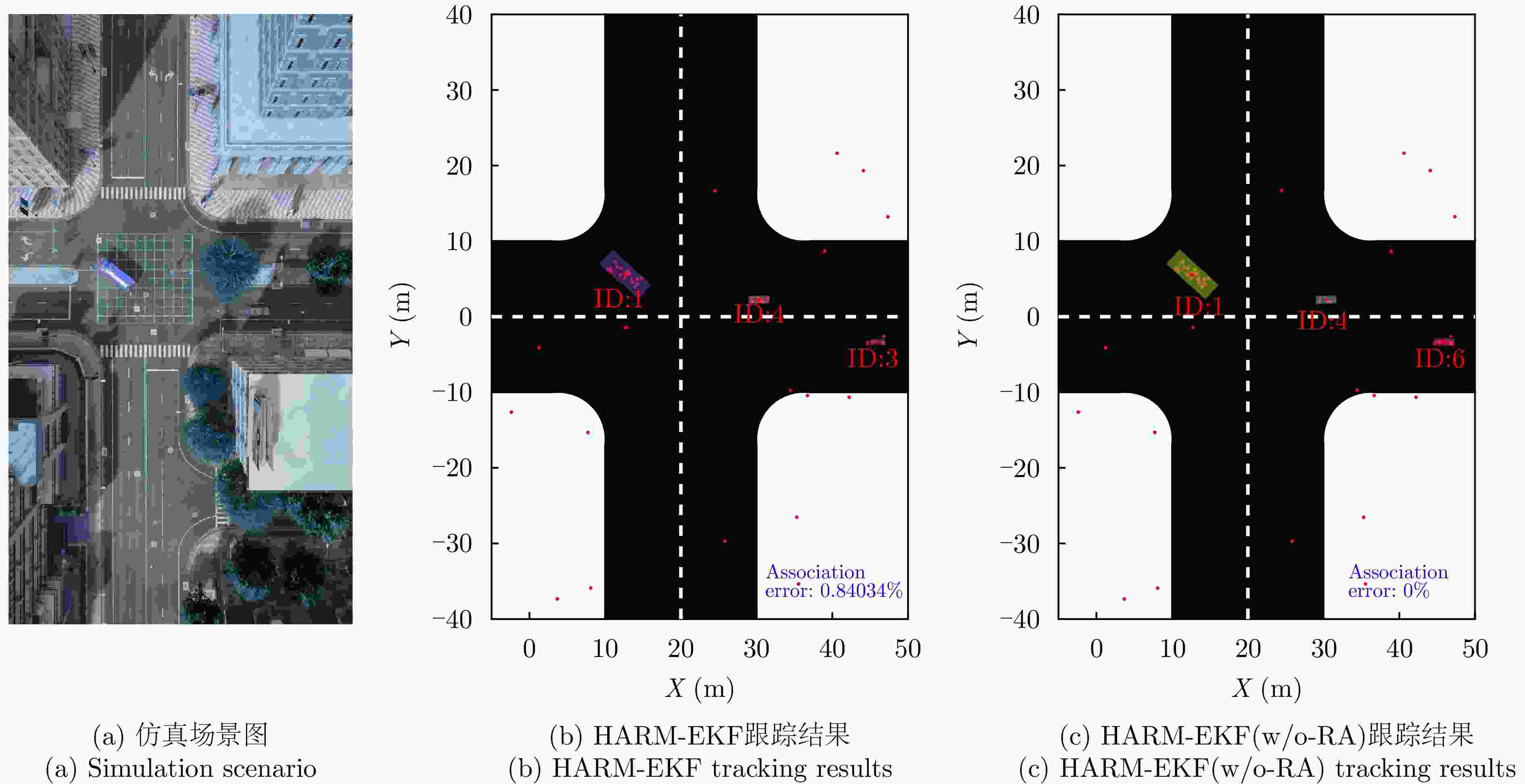
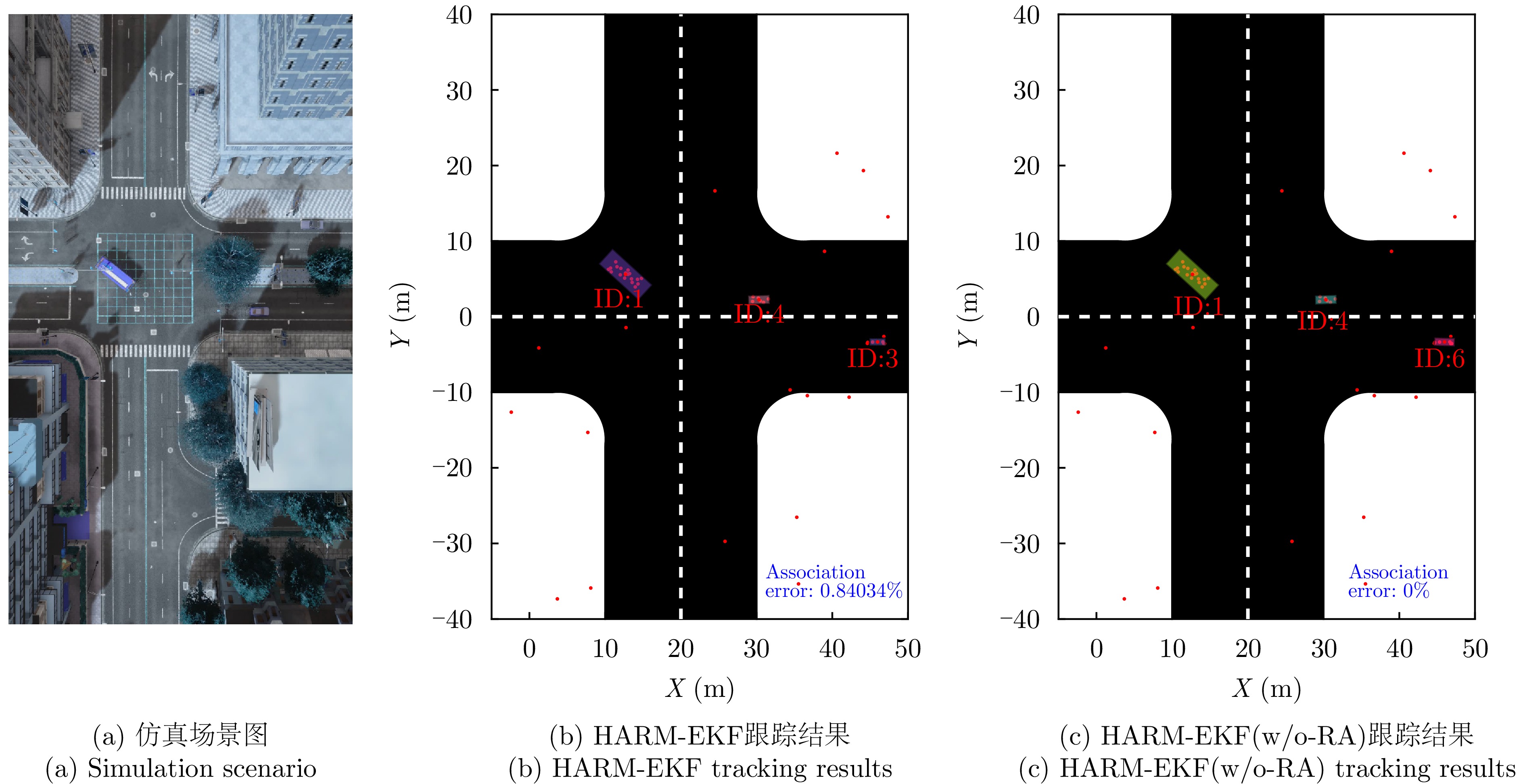
图 21 重关联消融实验仿真场景及跟踪结果(第78帧)
Figure 21. Simulation scenario and tracking results of the re-association ablation experiment (frame 78)
表 1 HARM-EKF各改进模块及其作用
Table 1. Improved modules of HARM-EKF and their functions
模块 解决问题 本文改进内容 分层关联机制 不同状态航迹及不同尺度车辆采用统一关联策略,
易导致误关联和目标分裂根据轨迹状态建立差异化关联策略,
提高车辆关联性能滑动窗口量测累积机制 小型车辆量测稀疏、单帧点云不足,导致状态估计不稳定 面向稀疏量测车辆,通过跨帧量测融合
提高跟踪稳定性航迹重关联机制 遮挡或漏检导致航迹中断、身份切换及重复建轨 利用运动、方向及形状信息恢复
遮挡后的目标航迹 下载: 导出CSV
表 2 仿真场景参数设置
Table 2. Simulation scenario parameter settings
参数 数值 雷达位置 (20, –45) m 经验参数a 10 经验参数b 0.02 杂波泊松均值 5 帧间隔 0.1 s 帧数 500帧
下载: 导出CSV
表 3 仿真参数设置
Table 3. Simulation parameter settings
参数 数值 活跃轨迹关联距离阈值 2 m 活跃轨迹关联概率阈值 0.005 GNN距离阈值 1.2 m 滑动窗口数量 5 小车量测累积点数 2 待定轨迹DBSCAN聚类半径 1.7 m 待定轨迹DBSCAN聚类点数 3
下载: 导出CSV
表 4 分层关联消融实验性能对比
Table 4. Performance comparison of the hierarchical association ablation experiment
方法 位置RMSE(m) 尺度RMSE(m) 关联误差(%) HARM-EKF 0.53962 2.9157 0.47465 HARM-EKF w/o-HA 0.62903 3.57074 1.06235 注:表中加粗数值表示对应指标的最优结果。
下载: 导出CSV
表 5 重关联消融实验性能对比
Table 5. Performance comparison of the re-association ablation experiment
方法 有效跟踪帧数 航迹连续性保持率(%) HARM-EKF 255 96.9582 HARM-EKF w/o-RA 201 76.4259 注:表中加粗数值表示对应指标的最优结果。
下载: 导出CSV
表 6 活跃轨迹关联距离阈值敏感性分析
Table 6. Sensitivity analysis of the active-track association distance threshold
关联距离门限(m) 尺度误差(m) 关联误差(%) OSPA 漏检率(%) 虚警率(%) IDSW 1.5 3.5350 0.4202 1.5244 0.7003 1.3280 7 2 3.5184 0.5239 1.5115 0.8257 1.1332 5 2.5 3.5001 0.6017 1.5141 0.8731 0.9938 8 3 3.4879 0.6560 1.5219 0.9196 1.0292 10 注:表中加粗数值表示对应指标的最优结果。
下载: 导出CSV
表 7 活跃轨迹关联概率阈值敏感性分析
Table 7. Sensitivity analysis of the active-track association probability threshold
关联模型概率门限 尺度误差(m) 关联误差(%) OSPA 漏检率(%) 虚警率(%) IDSW 0.005 3.5184 0.5239 1.5115 0.8257 1.1332 5 0.015 3.4989 0.5516 1.5872 0.8820 1.4301 8 0.025 4.2078 0.5644 3.1974 0.7751 10.5190 22 注:表中加粗数值表示对应指标的最优结果。
下载: 导出CSV
表 8 GNN距离阈值敏感性分析
Table 8. Sensitivity analysis of the GNN distance threshold
GNN距离阈值(m) 尺度误差(m) 关联误差(%) OSPA 漏检率(%) 虚警率(%) IDSW 1.2 3.5184 0.5239 1.5115 0.8257 1.1332 5 2.4 3.5075 0.5608 1.5296 0.8515 1.1619 5 3.6 3.1776 3.8896 2.4656 4.8719 1.3521 12 注:表中加粗数值表示对应指标的最优结果。
下载: 导出CSV
表 9 滑动窗口数量敏感性分析
Table 9. Sensitivity analysis of the number of sliding windows
滑动窗口数量 尺度误差(m) 关联误差(%) OSPA 漏检率(%) 虚警率(%) IDSW 2 3.5177 0.5239 1.5115 0.8257 1.0189 5 3 3.5184 0.5239 1.5115 0.8257 1.1332 5 4 3.5184 0.5239 1.5115 0.8257 1.1332 5 5 3.5184 0.5239 1.5115 0.8257 1.1332 5 注:表中加粗数值表示对应指标的最优结果。
下载: 导出CSV
表 10 滑动窗口累积聚类点数阈值敏感性分析
Table 10. Sensitivity analysis of the clustering point-count threshold for sliding-window accumulation
点数阈值 尺度误差(m) 关联误差(%) OSPA 漏检率(%) 虚警率(%) IDSW 2 3.5184 0.5239 1.5115 0.8257 1.1332 5 3 3.5139 0.5246 1.5316 0.8257 1.0189 5 4 3.5069 0.5592 1.5513 0.8390 1.1046 6 5 3.5048 0.5277 1.5865 0.8257 1.1046 6 注:表中加粗数值表示对应指标的最优结果。
下载: 导出CSV
表 11 待定轨迹关联中DBSCAN聚类半径敏感性分析
Table 11. Sensitivity analysis of the DBSCAN clustering radius in tentative track association
聚类半径(m) 尺度误差(m) 关联误差(%) OSPA 漏检率(%) 虚警率(%) IDSW 1.1 3.5367 0.5398 1.7077 0.8257 3.6898 5 1.7 3.5184 0.5239 1.5115 0.8257 1.1332 5 2.3 3.4935 1.3614 1.5250 1.2701 0.9855 3 2.9 3.4761 1.0301 1.6526 1.4162 0.9958 5 注:表中加粗数值表示对应指标的最优结果。
下载: 导出CSV
表 12 待定轨迹关联中DBSCAN聚类点数阈值敏感性分析
Table 12. Sensitivity analysis of the DBSCAN clustering point-count threshold in tentative track association
点数阈值 尺度误差(m) 关联误差(%) OSPA 漏检率(%) 虚警率(%) IDSW 3 3.4935 1.3614 1.5250 1.2701 0.9855 3 4 3.4992 0.5849 1.6668 0.8257 3.0768 4 5 3.5169 0.5432 1.8827 0.8257 7.1991 6 注:表中加粗数值表示对应指标的最优结果。
下载: 导出CSV
表 13 综合性能对比
Table 13. Comprehensive performance comparison
评价指标 位置RMSE(m) 尺度RMSE(m) 关联误差(%) OSPA 漏检率(%) 虚警率(%) IDSW 运行时间(s) HARM-EKF 0.5396 2.9157 0.4747 1.7354 0.9687 0.3042 4 0.0299 RMM-EKF 0.6532 3.7417 0.2333 2.8530 0.7028 6.2207 8 0.0089 MEM-EKF 3.5974 3.8527 0.7472 2.5092 1.0333 4.4283 7 0.0096 RM-ETT 0.8094 3.0531 1.2984 9.7387 1.4505 12.3450 54 0.0610 注:表中加粗数值表示对应指标的最优结果。
下载: 导出CSV
-
[1] HASCH J, TOPAK E, SCHNABEL R, et al. Millimeter-wave technology for automotive radar sensors in the 77 GHz frequency band[J]. IEEE Transactions on Microwave Theory and Techniques, 2012, 60(3): 845–860. doi: 10.1109/TMTT.2011.2178427. [2] WANG Yifei, CHENG Yayun, TANG Peiwen, et al. Pathway detection using fusion polarization features in passive millimeter-wave imaging[J]. IEEE Transactions on Circuits and Systems for Video Technology, 2026, 36(3): 2685–2696. doi: 10.1109/TCSVT.2025.3613515. [3] FENG Di, HAASE-SCHÜTZ C, ROSENBAUM L, et al. Deep multi-modal object detection and semantic segmentation for autonomous driving: Datasets, methods, and challenges[J]. IEEE Transactions on Intelligent Transportation Systems, 2021, 22(3): 1341–1360. doi: 10.1109/TITS.2020.2972974. [4] GRANSTRÖM K, BAUM M, and REUTER S. Extended object tracking: Introduction, overview, and applications[J]. Journal of Advances in Information Fusion, 2017, 12(2): 139–174. [5] SHAMSFAKHR F, MACII D, PALOPOLI L, et al. A multi-target detection and position tracking algorithm based on mmWave-FMCW radar data[J]. Measurement, 2024, 234: 114797. doi: 10.1016/j.measurement.2024.114797. [6] YURTSEVER E, LAMBERT J, CARBALLO A, et al. A survey of autonomous driving: Common practices and emerging technologies[J]. IEEE Access, 2020, 8: 58443–58469. doi: 10.1109/ACCESS.2020.2983149. [7] KALMAN R E. A new approach to linear filtering and prediction problems[J]. Journal of Basic Engineering, 1960, 82(1): 35–45. doi: 10.1115/1.3662552. [8] JULIER S J and UHLMANN J K. New extension of the Kalman filter to nonlinear systems[C]. SPIE 3068, Signal Processing, Sensor Fusion, and Target Recognition VI, Orlando, USA, 1997: 182–193. doi: 10.1117/12.280797. [9] JULIER S J and UHLMANN J K. Unscented filtering and nonlinear estimation[J]. Proceedings of the IEEE, 2004, 92(3): 401–422. doi: 10.1109/JPROC.2003.823141. [10] MAHLER R P S. Statistical Multisource-Multitarget Information Fusion[M]. Boston: Artech House, 2007. [11] BLACKMAN S and POPOLI R. Design and Analysis of Modern Tracking Systems[M]. Boston: Artech House, 1999. [12] PATOLE S M, TORLAK M, WANG Dan, et al. Automotive radars: A review of signal processing techniques[J]. IEEE Signal Processing Magazine, 2017, 34(2): 22–35. doi: 10.1109/MSP.2016.2628914. [13] BAR-SHALOM Y and FORTMANN T E. Tracking and Data Association[M]. Boston: Academic Press, 1988. [14] BLACKMAN S S. Multiple hypothesis tracking for multiple target tracking[J]. IEEE Aerospace and Electronic Systems Magazine, 2004, 19(1): 5–18. doi: 10.1109/MAES.2004.1263228. [15] BAR-SHALOM Y, LI X R, and KIRUBARAJAN T. Estimation with Applications to Tracking and Navigation: Theory Algorithms and Software[M]. New York: John Wiley & Sons, 2001. [16] BLOM H A P and BAR-SHALOM Y. The interacting multiple model algorithm for systems with Markovian switching coefficients[J]. IEEE Transactions on Automatic Control, 1988, 33(8): 780–783. doi: 10.1109/9.1299. [17] 周浩文, 王奇. 基于变分边缘化粒子滤波的车载雷达扩展目标跟踪[J]. 雷达学报(中英文), 2025, 14(5): 1306–1322. doi: 10.12000/JR25005.ZHOU Haowen and WANG Qi. Extended object tracking based on variational marginalized particle filter for automotive radar[J]. Journal of Radars, 2025, 14(5): 1306–1322. doi: 10.12000/JR25005. [18] 陈辉, 边斌超, 连峰, 等. 基于Transformer复杂运动辨识的机动星凸形扩展目标跟踪方法[J]. 雷达学报(中英文), 2024, 13(3): 629–645. doi: 10.12000/JR24031.CHEN Hui, BIAN Binchao, LIAN Feng, et al. A novel method for tracking complex maneuvering star convex extended targets using Transformer network[J]. Journal of Radars, 2024, 13(3): 629–645. doi: 10.12000/JR24031. [19] 蒋美秋, 罗皓蓝, 郭世盛, 等. 基于多径扩展投影的毫米波雷达室内目标跟踪方法[J]. 雷达学报(中英文), 待出版. doi: 10.12000/JR25245.JIANG Meiqiu, LUO Haolan, GUO Shisheng, et al. Indoor target tracking method for millimeter-wave radar based on multipath extension mapping[J]. Journal of Radars, in press. doi: 10.12000/JR25245. [20] LAN Jian. Extended object tracking using random matrix with extension-dependent measurement numbers[J]. IEEE Transactions on Aerospace and Electronic Systems, 2023, 59(4): 4464–4477. doi: 10.1109/TAES.2023.3241888. [21] HAAG S, DURAISAMY B, GOVAERS F, et al. Extended object tracking assisted adaptive clustering for radar in autonomous driving applications[C]. 2019 Sensor Data Fusion: Trends, Solutions, Applications, Bonn, Germany, 2019: 1–7. doi: 10.1109/SDF.2019.8916658. [22] LAN Jian and LI X R. Tracking of extended object or target group using random matrix—Part I: New model and approach[C]. 2012 15th International Conference on Information Fusion, Singapore, Singapore, 2012: 2177–2184. [23] KOCH J W. Bayesian approach to extended object and cluster tracking using random matrices[J]. IEEE Transactions on Aerospace and Electronic Systems, 2008, 44(3): 1042–1059. doi: 10.1109/TAES.2008.4655362. [24] FELDMANN M, FRÄNKEN D, and KOCH W. Tracking of extended objects and group targets using random matrices[J]. IEEE Transactions on Signal Processing, 2011, 59(4): 1409–1420. doi: 10.1109/TSP.2010.2101064. [25] GRANSTRÖM K and ORGUNER U. A PHD filter for tracking multiple extended targets using random matrices[J]. IEEE Transactions on Signal Processing, 2012, 60(11): 5657–5671. doi: 10.1109/TSP.2012.2212888. [26] YANG Shishan and BAUM M. Tracking the orientation and axes lengths of an elliptical extended object[J]. IEEE Transactions on Signal Processing, 2019, 67(18): 4720–4729. doi: 10.1109/TSP.2019.2929462. [27] FOWDUR J S, BAUM M, and HEYMANN F. Tracking targets with known spatial extent using experimental marine radar data[C]. 2019 22nd International Conference on Information Fusion, Ottawa, Canada, 2019: 1–8. doi: 10.23919/FUSION43075.2019.9011244. [28] CAO Xiaomeng, LAN Jian, LI X R, et al. Automotive radar-based vehicle tracking using data-region association[J]. IEEE Transactions on Intelligent Transportation Systems, 2022, 23(7): 8997–9010. doi: 10.1109/TITS.2021.3089676. [29] BAUM M and HANEBECK U D. Shape tracking of extended objects and group targets with star-convex RHMs[C]. The 14th International Conference on Information Fusion, Chicago, USA, 2011: 1–8. [30] STEINBRING J, BAUM M, ZEA A, et al. A closed-form likelihood for Particle Filters to track extended objects with star-convex RHMs[C]. 2015 IEEE International Conference on Multisensor Fusion and Integration for Intelligent Systems, San Diego, USA, 2015: 25–30. doi: 10.1109/MFI.2015.7295740. [31] GUPTA A K and NAGAR D K. Matrix Variate Distributions[M]. New York: Chapman and Hall/CRC, 2018: 384. doi: 10.1201/9780203749289. [32] ESTER M, KRIEGEL H P, SANDER J, et al. A density-based algorithm for discovering clusters in large spatial databases with noise[C]. The 2nd International Conference on Knowledge Discovery and Data Mining, Portland, Oregon, 1996: 226–231. [33] JIANG Meiqiu, LUO Haolan, GUO Shisheng, et al. Indoor human tracking with 3-D expansion estimation based on mmWave radar[J]. IEEE Transactions on Aerospace and Electronic Systems, 2025, 61(6): 16647–16665. doi: 10.1109/taes.2025.3595827. [34] ŞAHIN K K, BALCI A E and ÖZKAN E. Random matrix extended target tracking for trajectory‐aligned and drifting targets[J]. IET Radar, Sonar & Navigation, 2024, 18(11): 2247–2263. doi: 10.1049/rsn2.12628. -



计量
- 文章访问数:
- HTML全文浏览量:
- PDF下载量:
- 被引次数: 0