

 作者中心
作者中心 专家审稿
专家审稿 责编办公
责编办公 编辑办公
编辑办公
A Few-shot SAR Fine-grained Aircraft Detection and Recognition Method Guided by Strong Scattering Dynamic Prototypes
-
摘要: 合成孔径雷达(SAR)图像解译应用场景广泛,SAR飞机检测识别是其中的一个重要分支。由于SAR飞机样本采集与标注难度大,可用训练样本稀缺,亟须发展小样本条件下的SAR飞机检测识别方法。然而,SAR复杂成像环境导致目标特征表达不稳定,检测网络难以自适应应对SAR复杂背景的扰动,限制了小样本条件下飞机检测识别的精度。为此,该文提出了一种基于强散射动态原型引导的小样本SAR飞机细粒度检测识别方法,其关键在于将SAR强散射物理先验融入元度量学习框架,从目标特征增强与网络的自适应适配两个层面协同提升检测识别性能。通过动态原型生成模块提取SAR图像强散射点并构建物理注意力掩码,将高层语义特征锚定在目标的物理几何结构上以提取鲁棒的特征表示,并将其与原型自适应融合生成动态原型;进一步设计动态原型引导模块,基于动态原型实现从语义空间到参数空间的映射,分别对网络权重更新、特征输入和预测输出进行自适应调整,提升模型对新类别的快速适应能力。该文方法有效增强了SAR目标特征表征的稳定性并抑制了背景杂波的干扰,在CSAR-AC数据集上的实验结果表明,该文方法在1-shot和5-shot设置下的检测精度均优于主流小样本目标检测算法,显著提升了复杂场景下的小样本SAR飞机目标检测识别性能。Abstract: Synthetic Aperture Radar (SAR) image interpretation has a wide range of applications, with SAR aircraft detection and recognition being a significant branch. However, collecting and annotating SAR aircraft samples is inherently difficult, leading to a scarcity of training data. Thus, developing few-shot methods for SAR aircraft detection and recognition is urgently needed. The complex SAR imaging environment results in unstable target feature representation, making it difficult for detection networks to adaptively manage disturbances from intricate SAR backgrounds. These factors limit the accuracy of aircraft detection and recognition under few-shot conditions. To address these challenges, this study proposes a few-shot SAR fine-grained aircraft detection and recognition method guided by strong scattering dynamic prototypes. This approach integrates strong scattering physical priors into a meta-metric learning framework. Detection and recognition performance are enhanced through two key aspects: Target feature enhancement and task-adaptive network adjustment. A dynamic prototype generation module is introduced to extract strong scattering points from SAR images and create physical attention masks. High-level semantic features are anchored to the physical geometric structure of targets, enabling robust feature representation. These features are then adaptively fused with prototypes to produce dynamic prototypes. A dynamic prototype guidance module, which maps dynamic prototypes from semantic space to parameter space, is also proposed. This enables adaptive adjustments to network weight updates, feature inputs, and prediction outputs, thereby improving the model’s rapid adaptation capability for novel categories. The proposed method enhances the stability of SAR target feature representation and reduces background clutter interference. Experiments conducted on the CSAR-AC dataset demonstrate that the proposed method outperforms mainstream few-shot object detection algorithms under both 1- and 5-shot settings, significantly improving few-shot SAR aircraft detection and recognition performance in complex scenes.
-
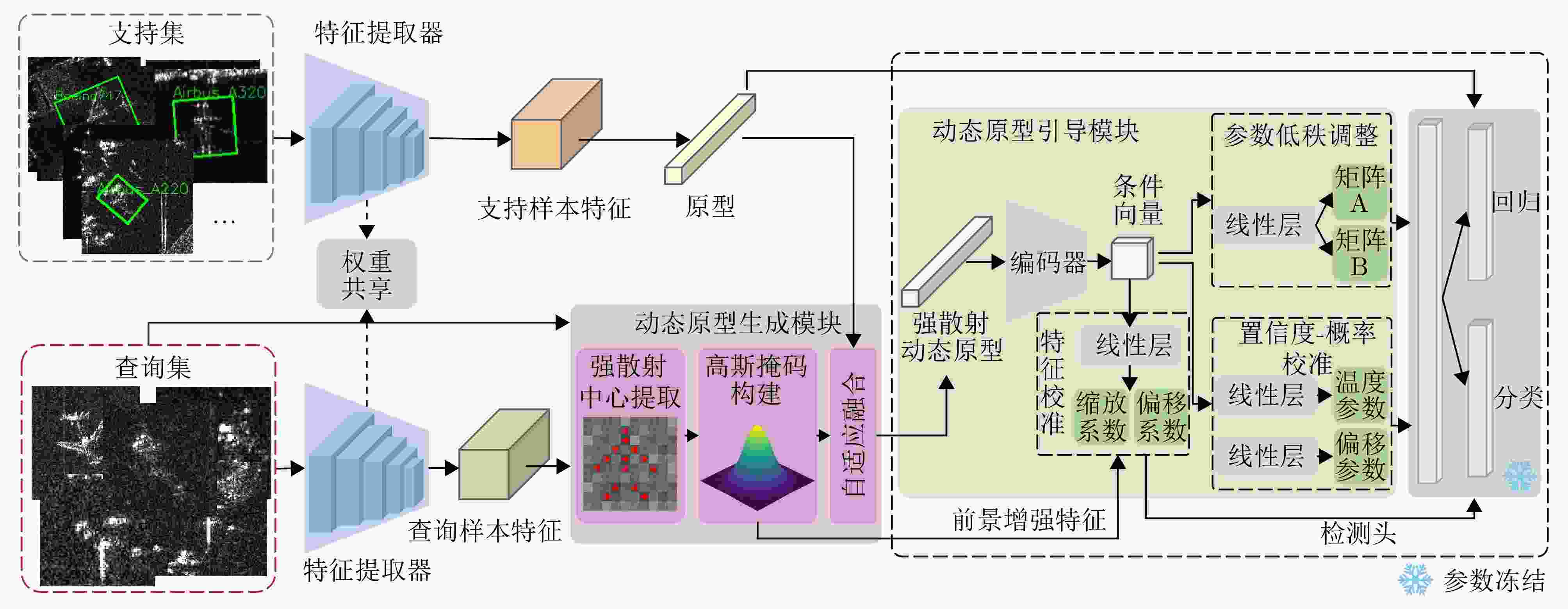
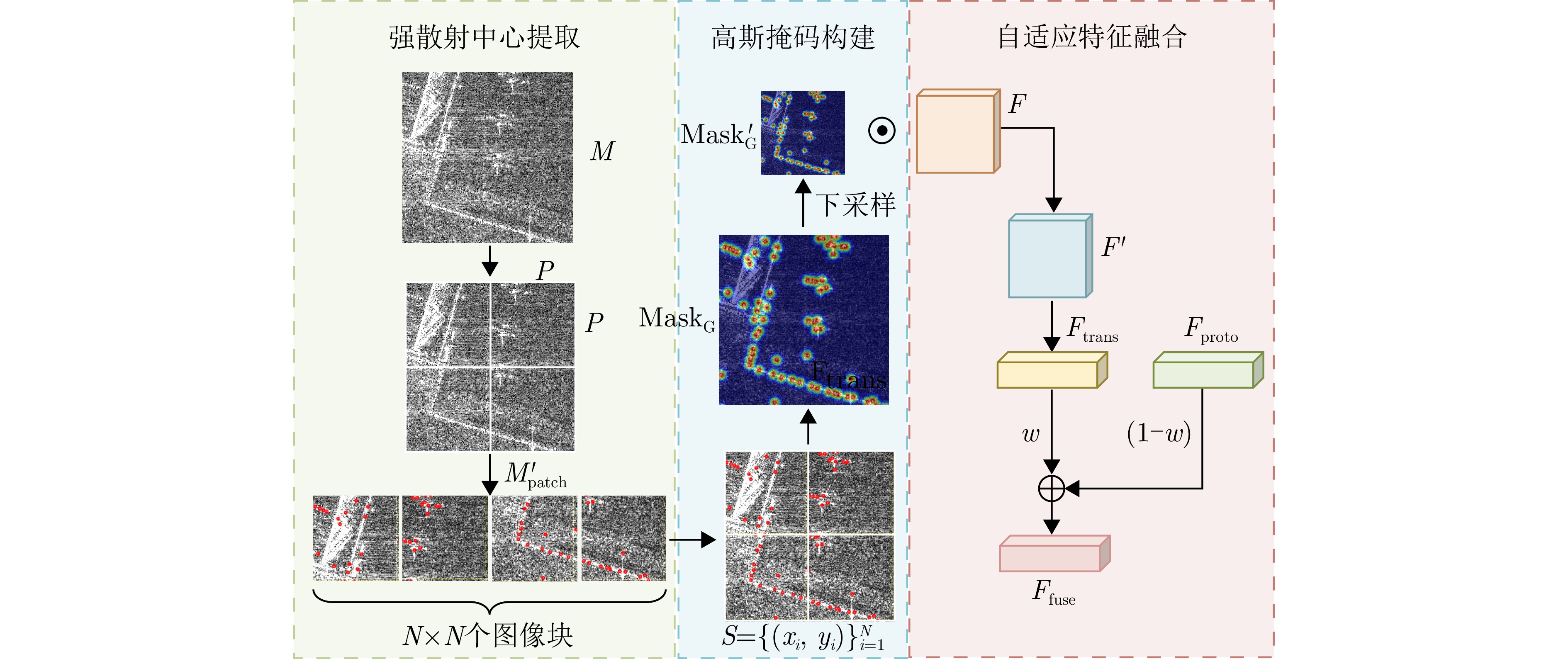
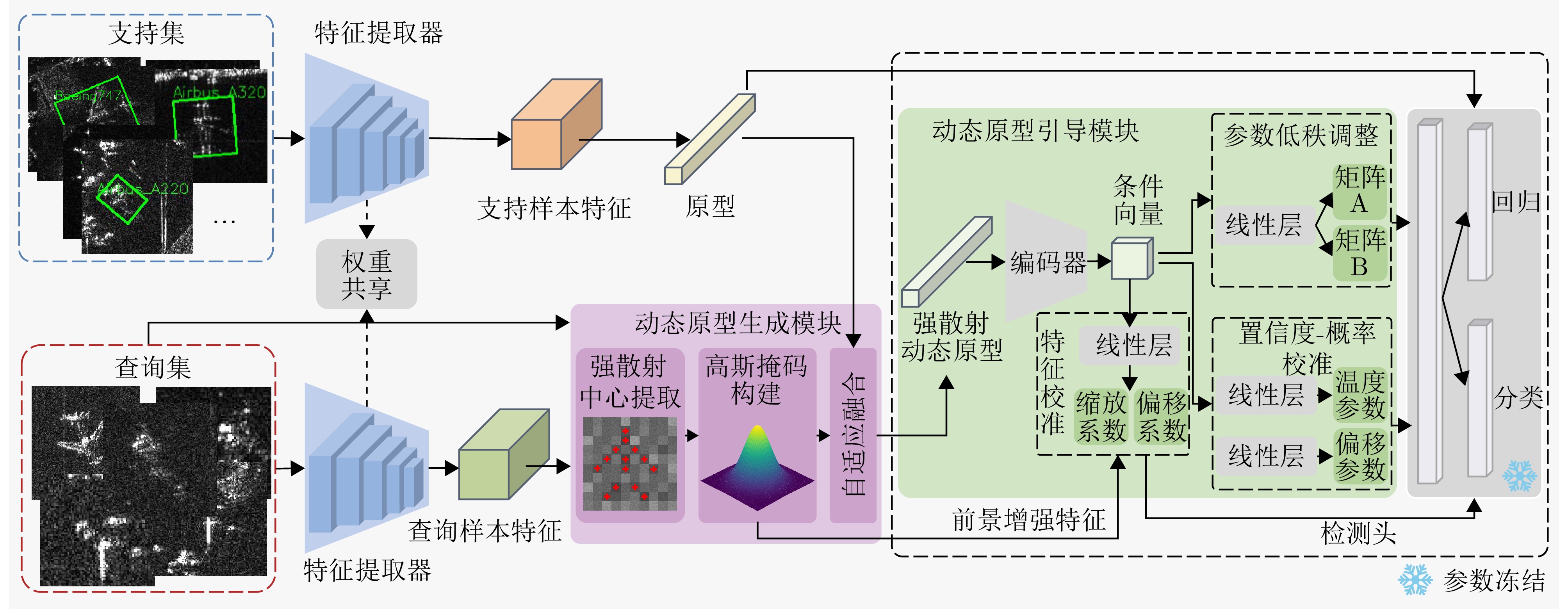
图 1 基于强散射动态原型引导的小样本SAR飞机细粒度目标检测方法整体框架
Figure 1. Overall framework of few-shot SAR fine-grained aircraft detection and recognition method guided by strong scattering dynamic prototypes
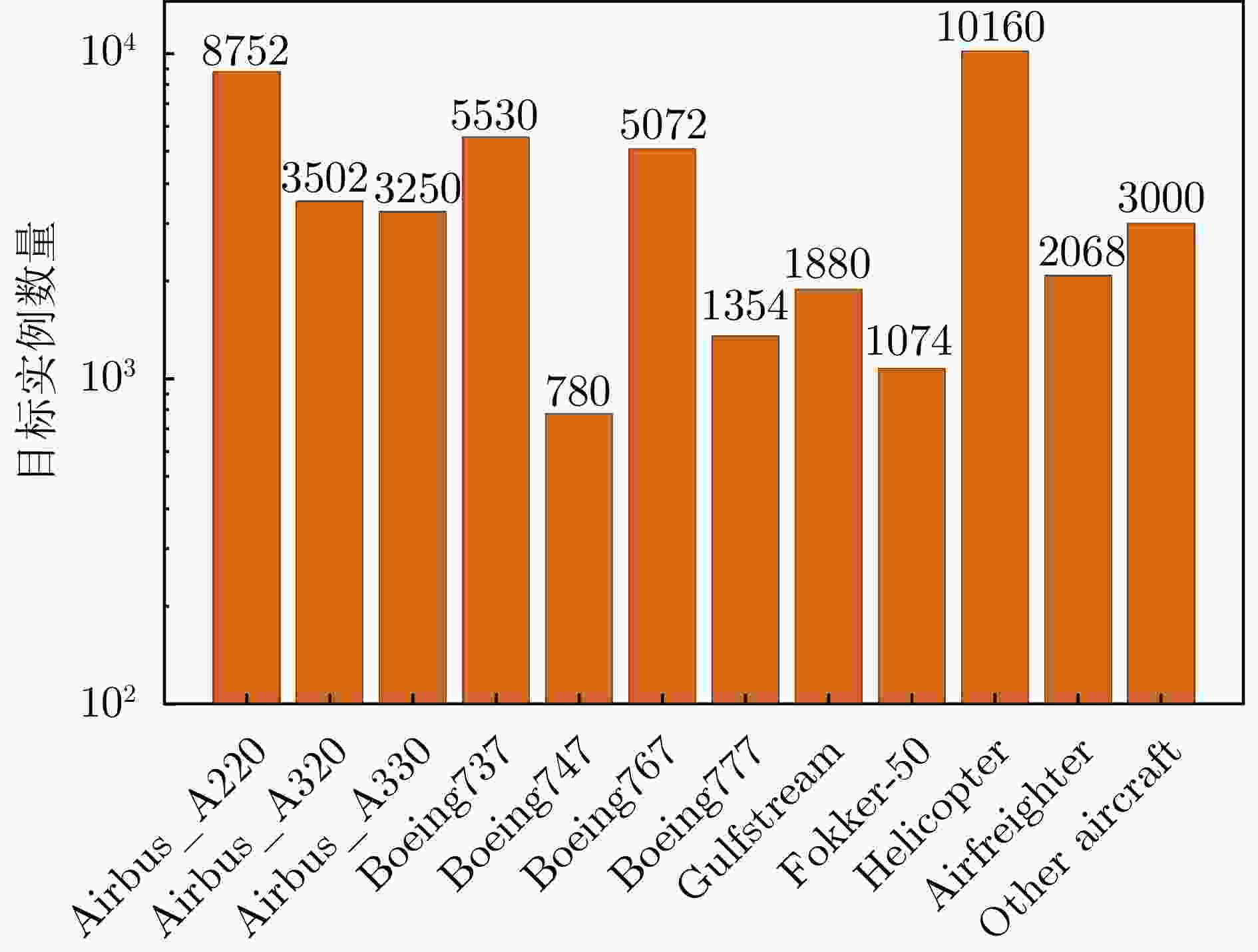
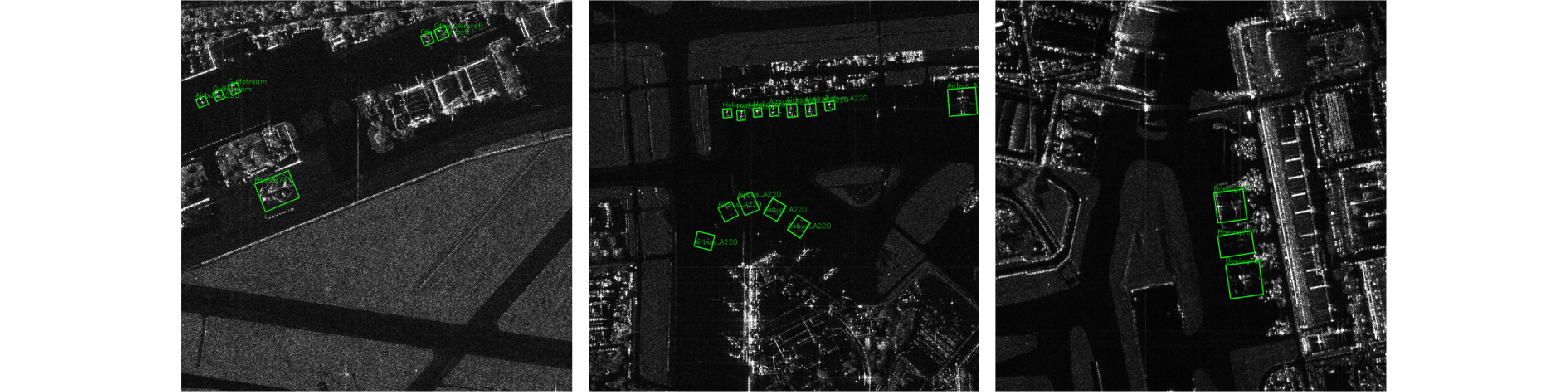
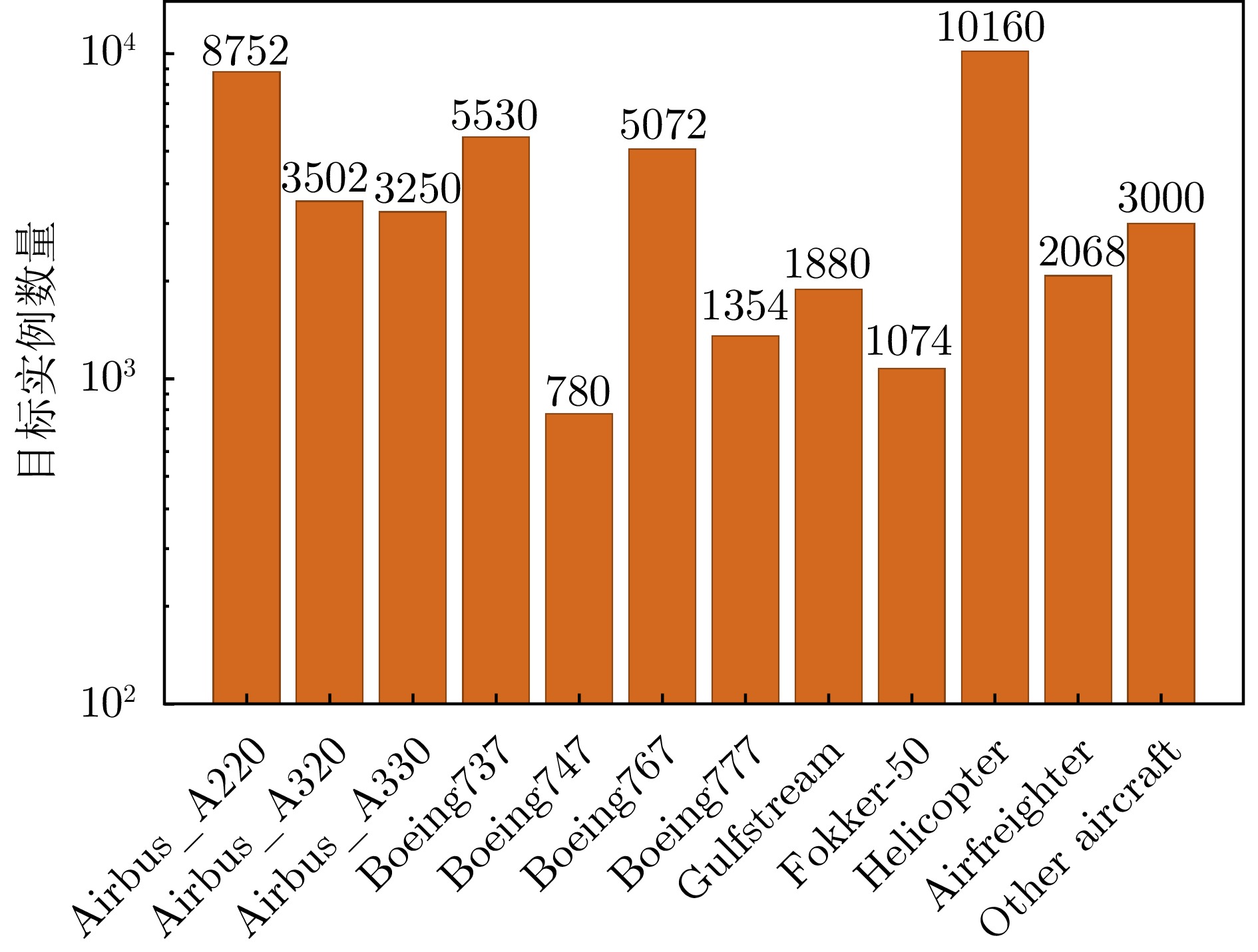
图 6 CSAR-AC中飞机实例数量统计
Figure 6. Statistics on the number of aircraft instances in the CSAR-AC
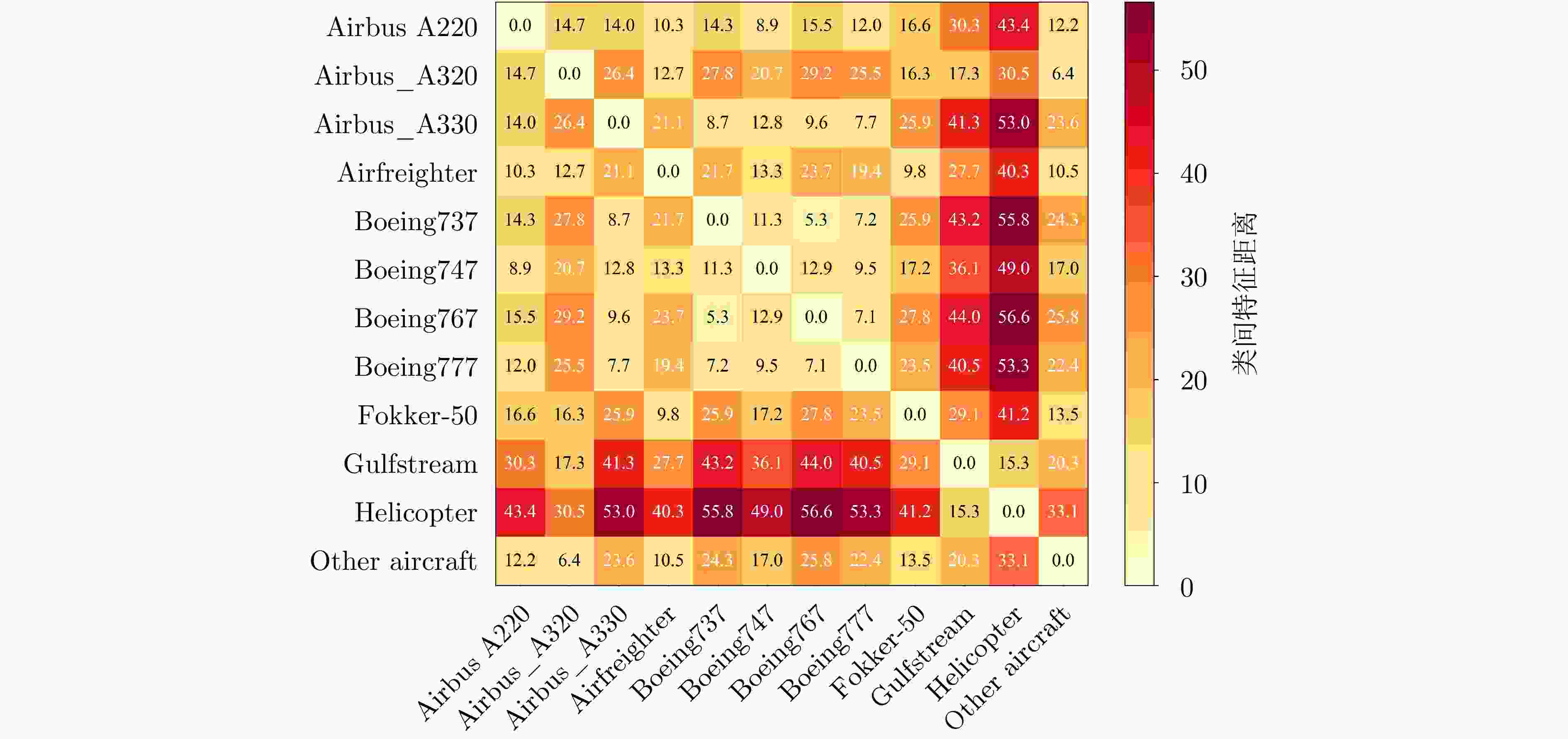
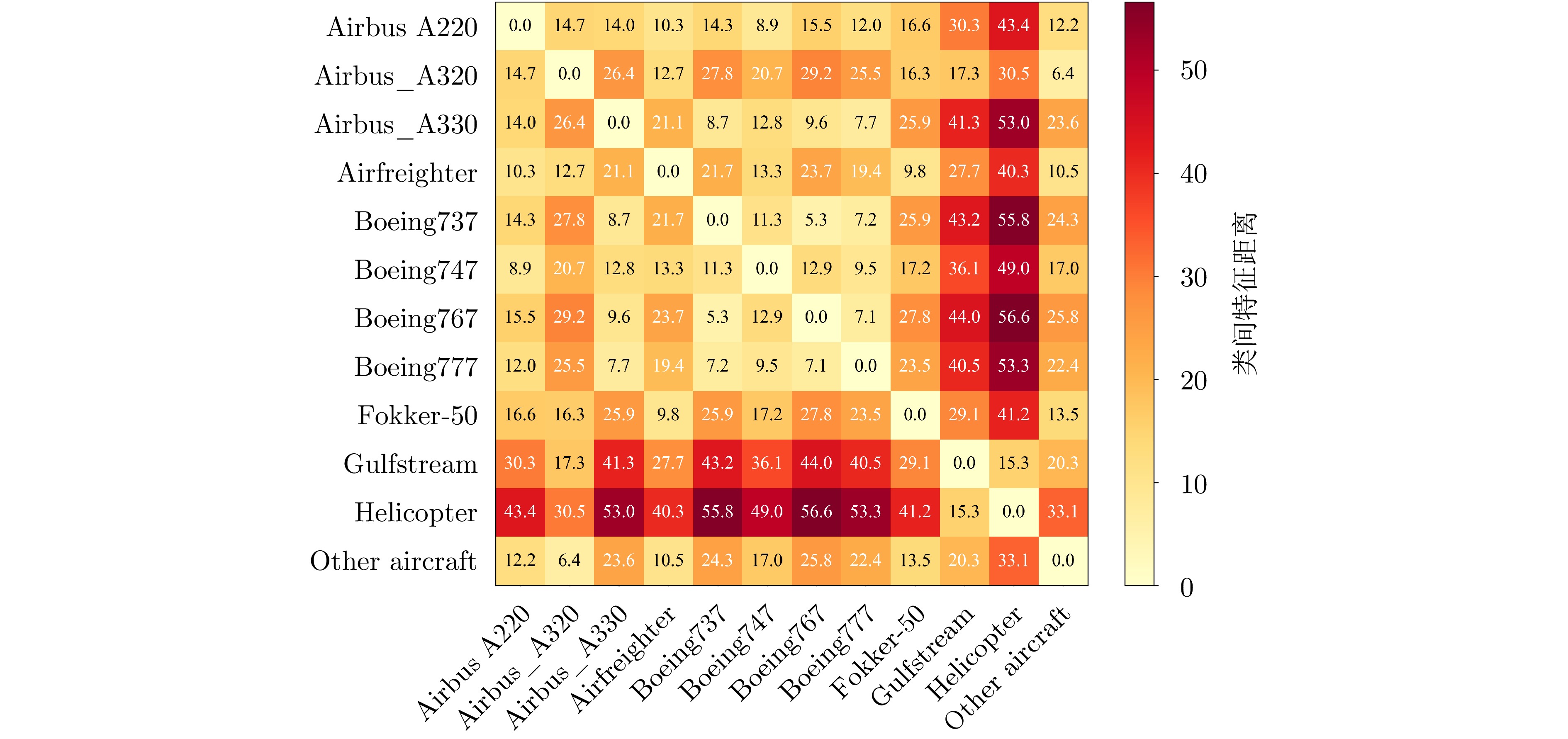
图 7 CSAR-AC中类间特征距离统计
Figure 7. Statistics on the interclass feature distances in the CSAR-AC
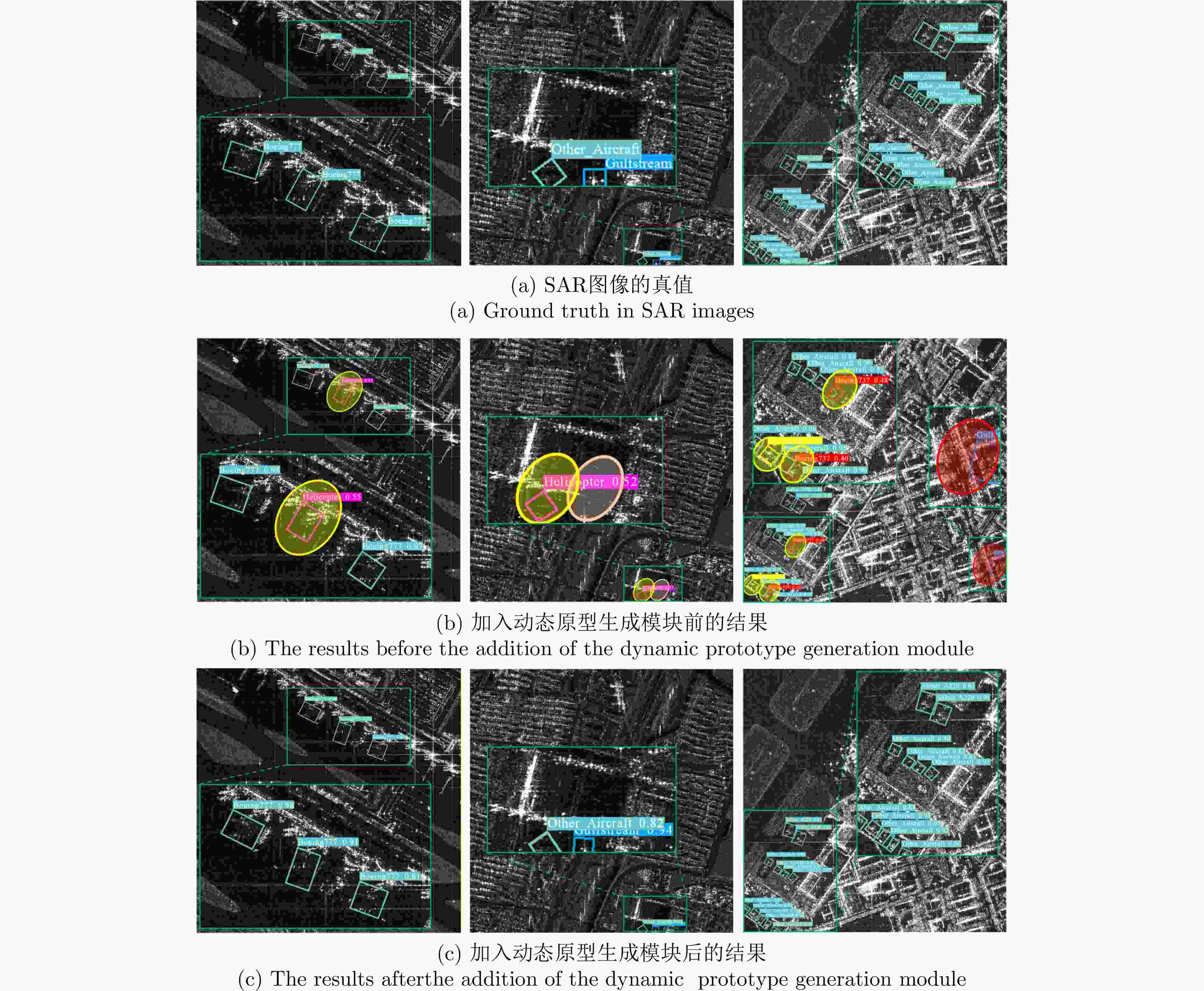
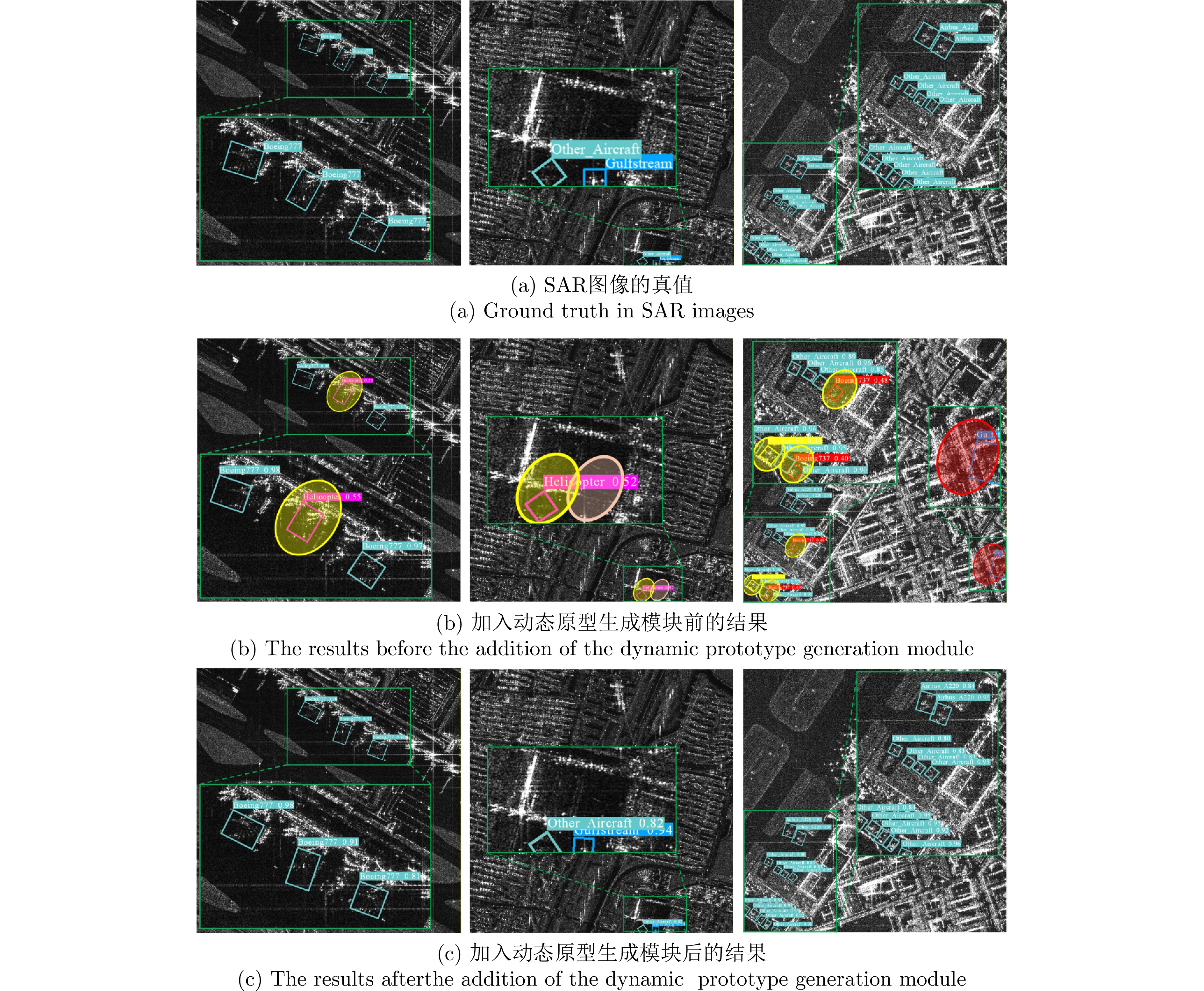
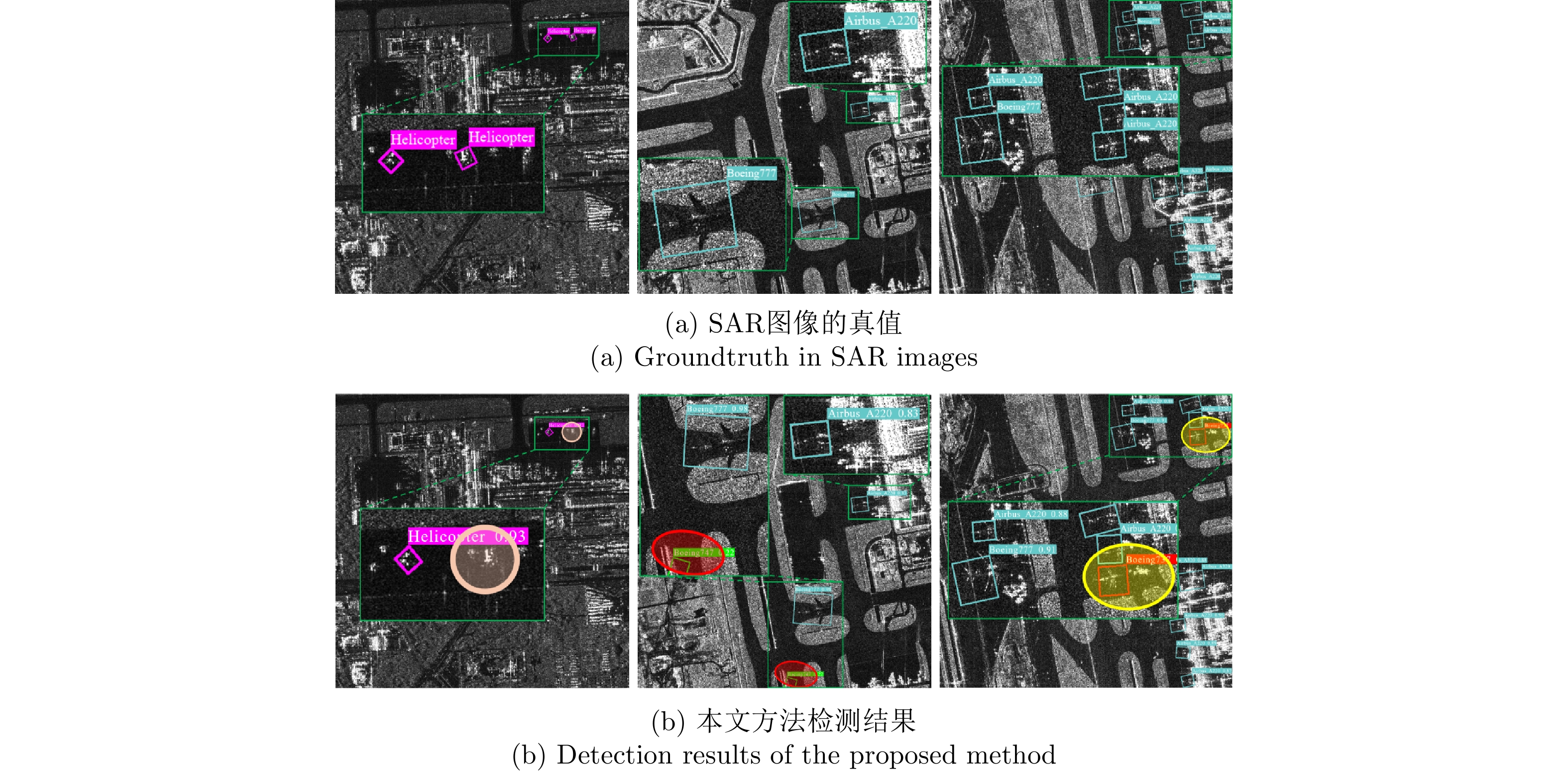
图 8 动态原型生成模块消融实验检测结果可视化
Figure 8. The visualization of the detection results from the dynamic prototype generation module ablation experiment
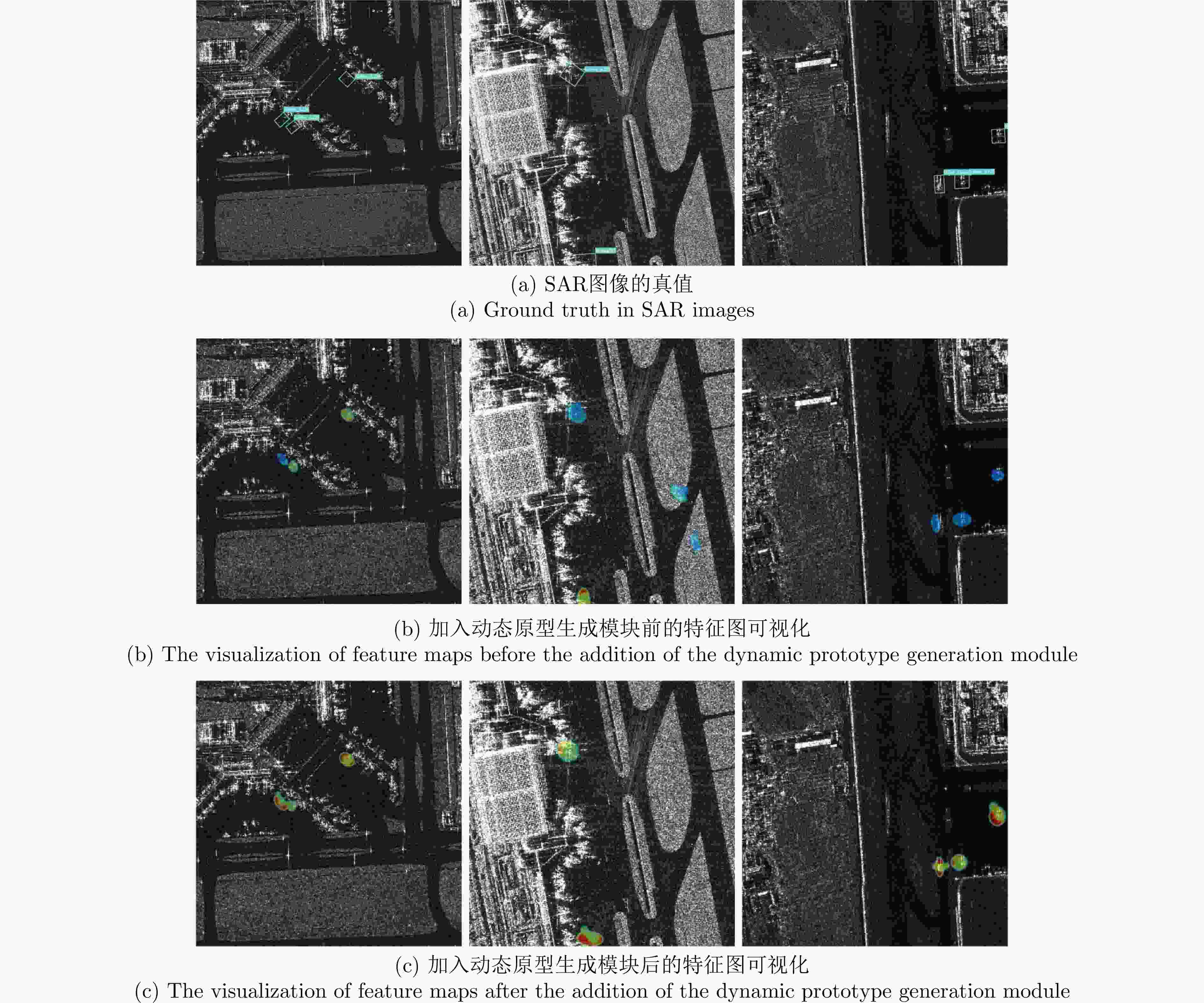
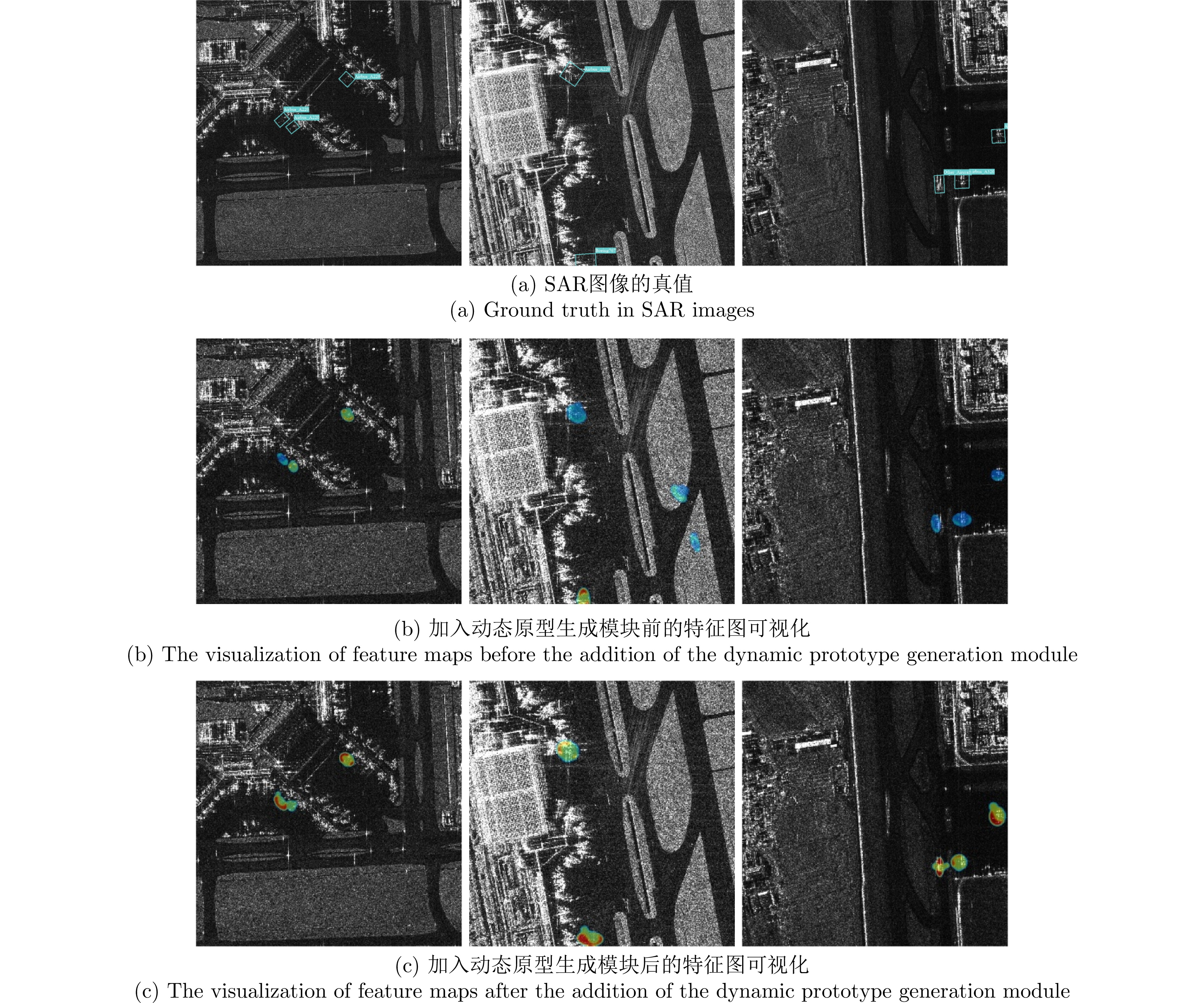
图 9 动态原型生成模块消融实验特征图可视化
Figure 9. The visualization of feature maps for dynamic prototype generation module ablation experiments
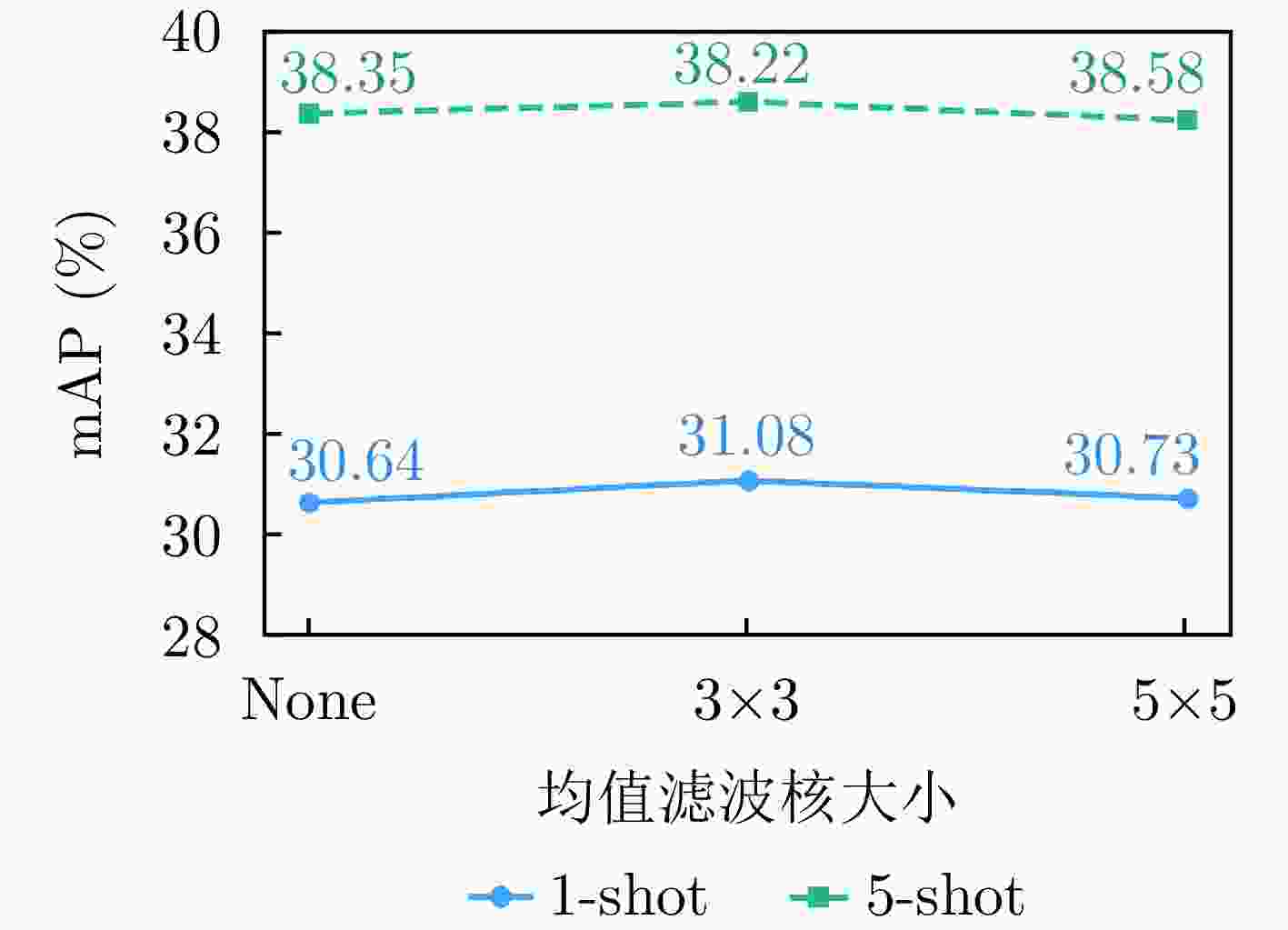
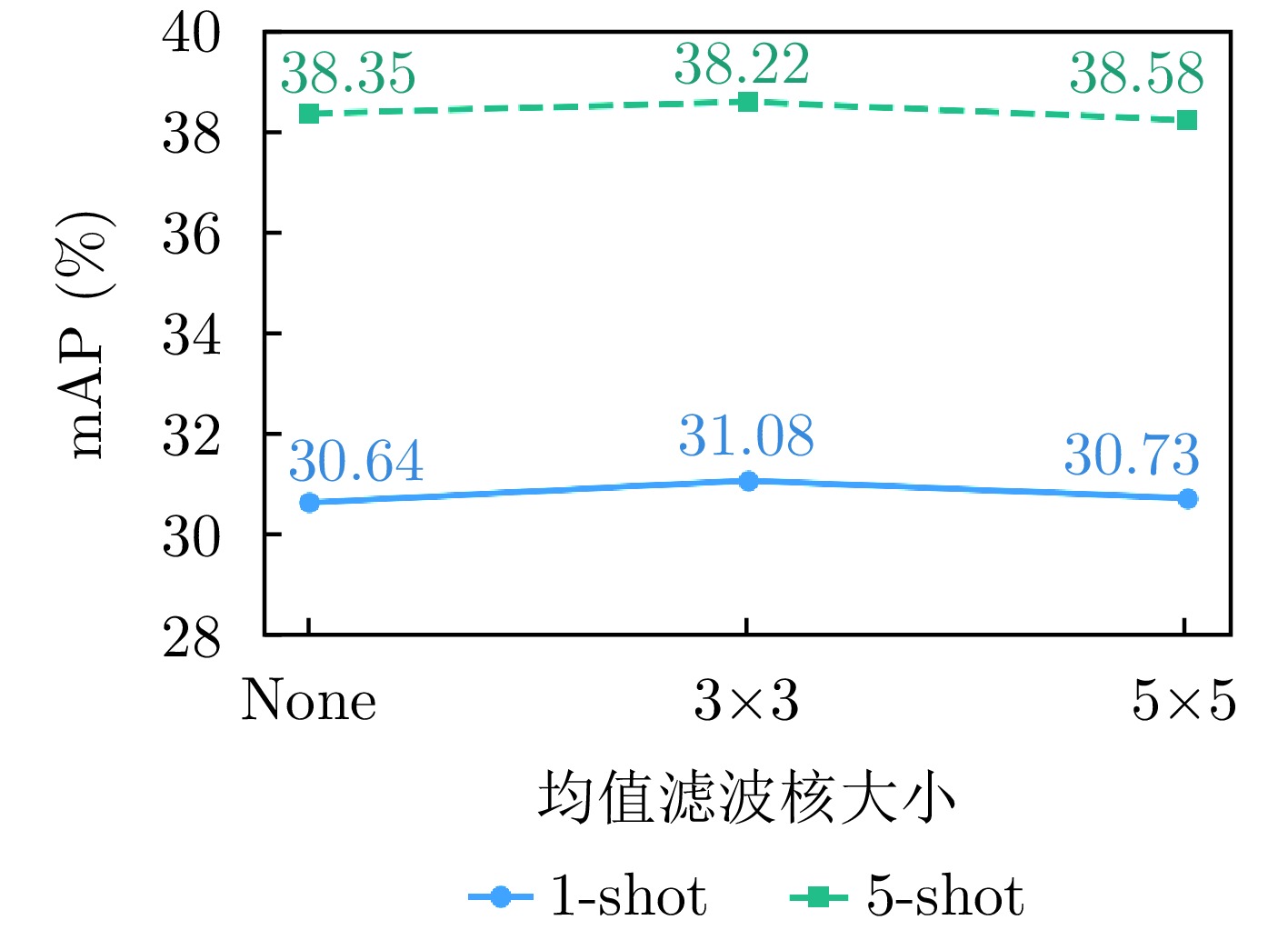
图 10 不同均值滤波核大小下的所有类别mAP结果
Figure 10. The mAP results for all categories under different mean filter kernel sizes
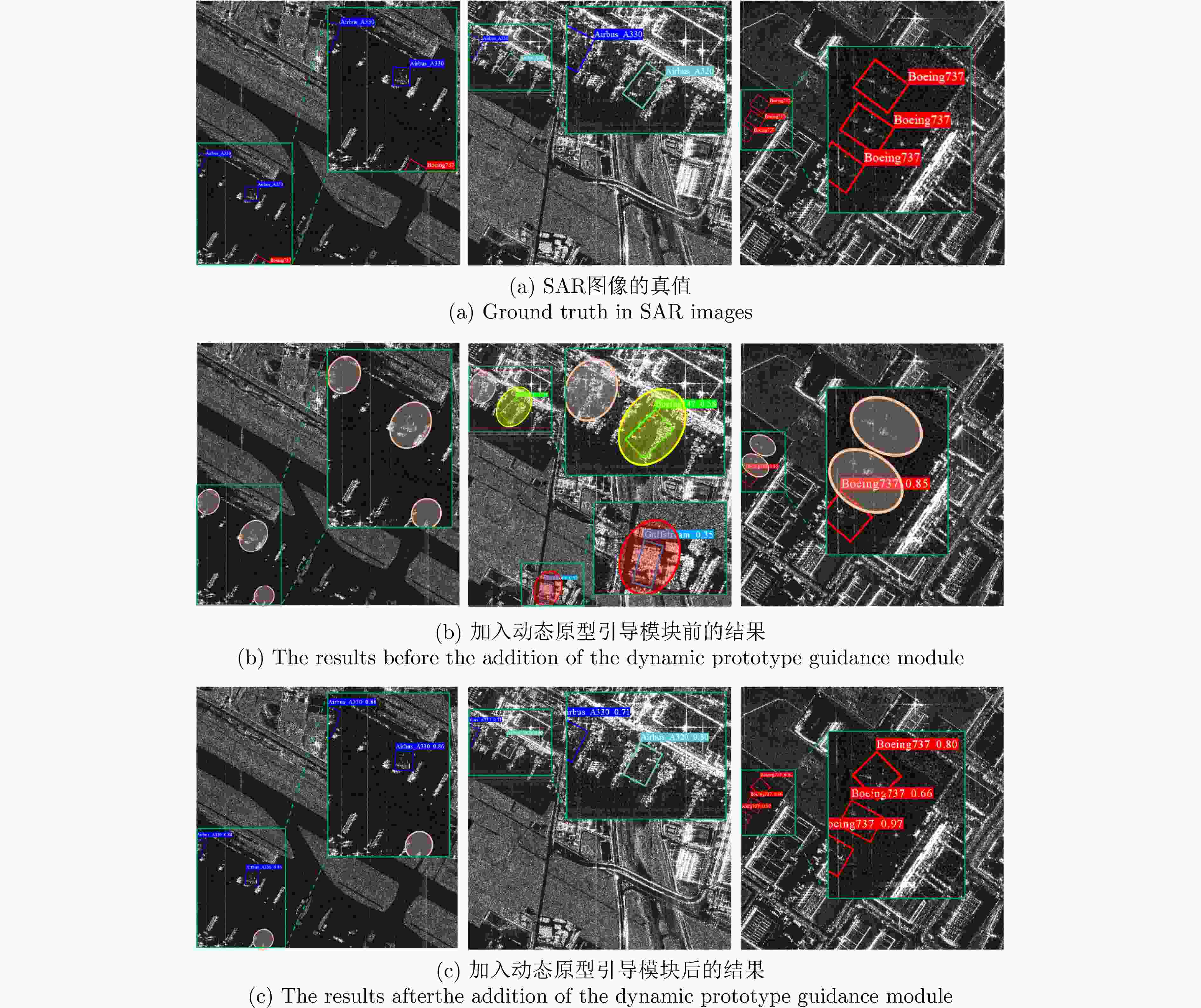
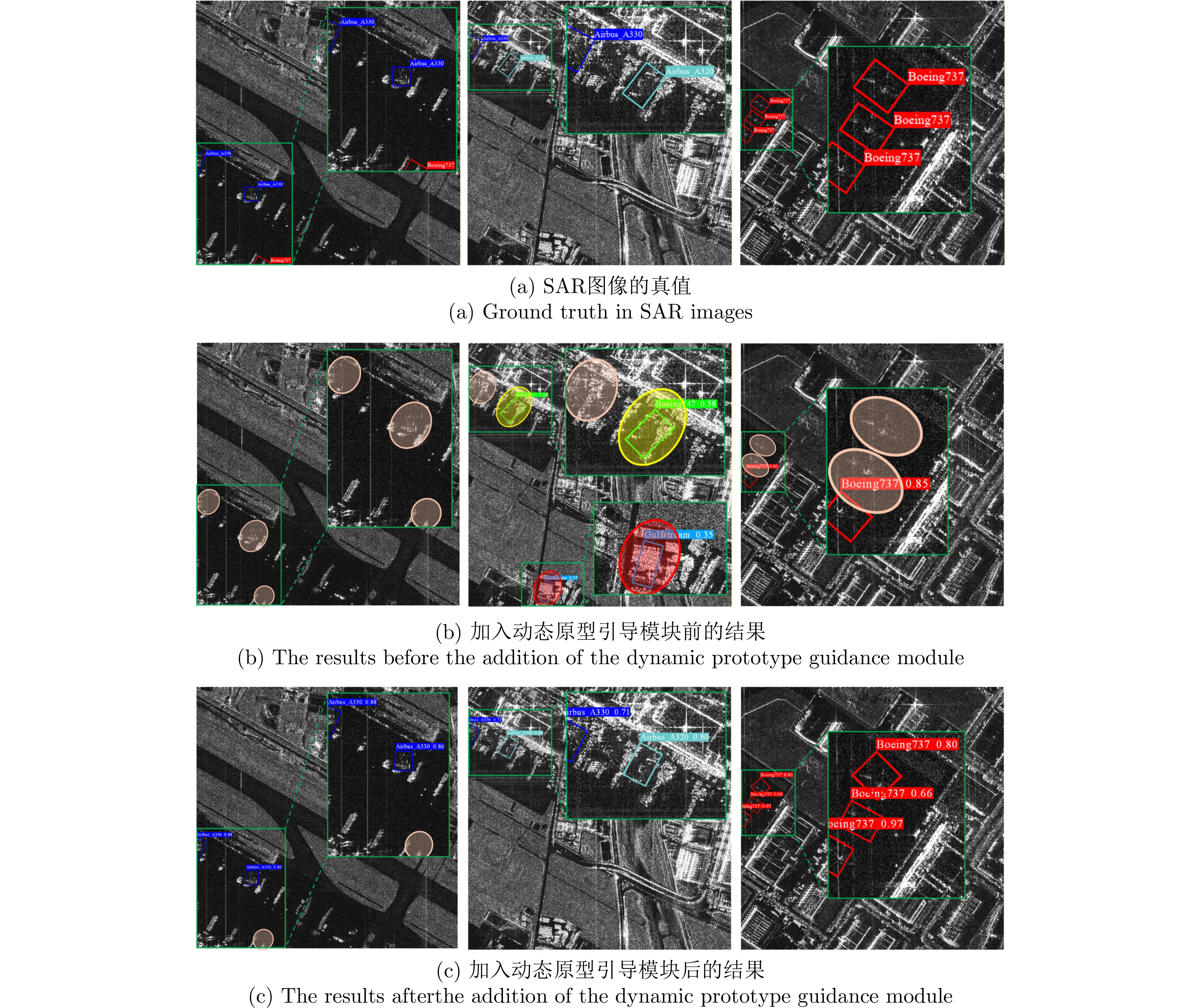
图 11 动态原型引导模块消融实验检测结果可视化
Figure 11. The visualization of the detection results from the dynamic prototype guidance module ablation experiment
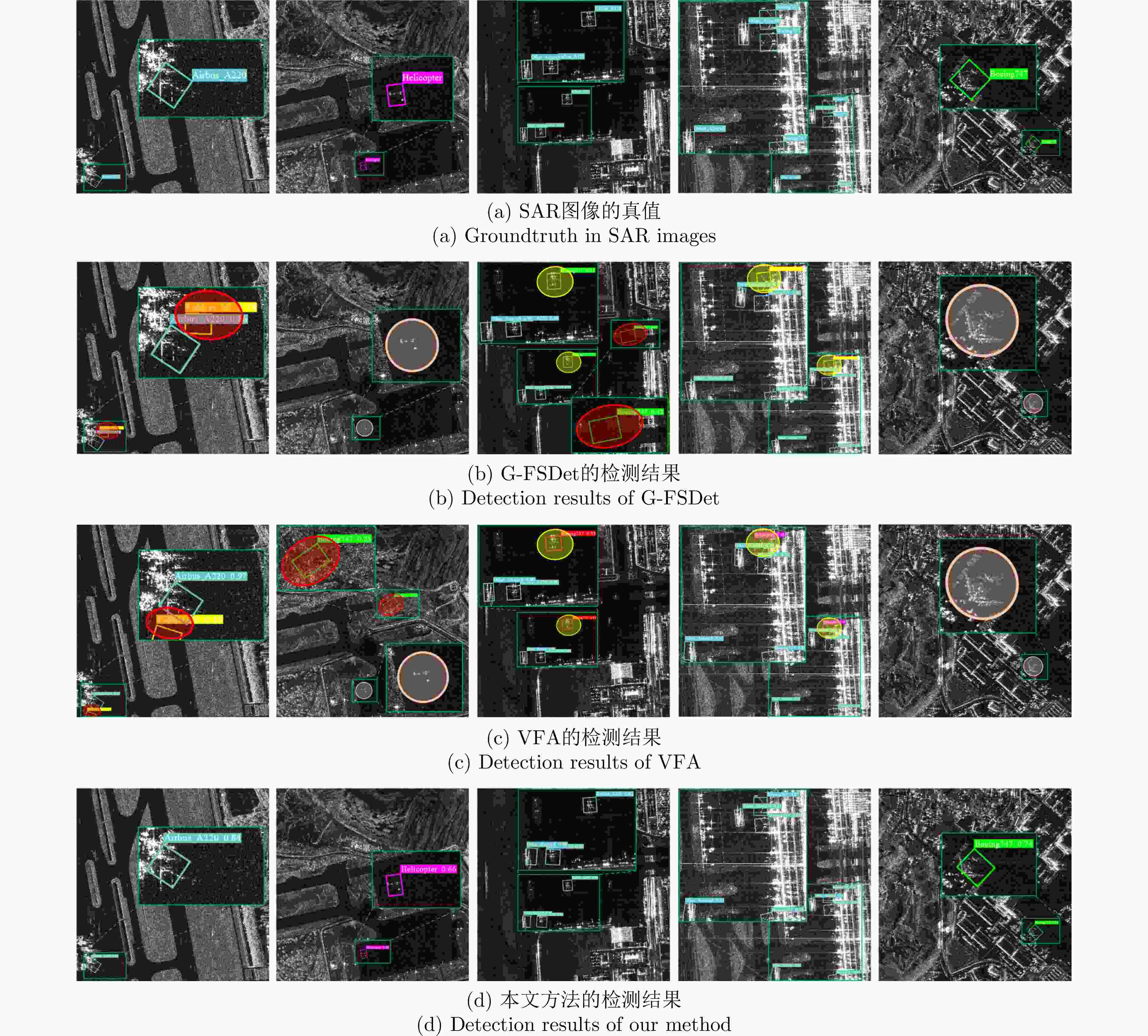
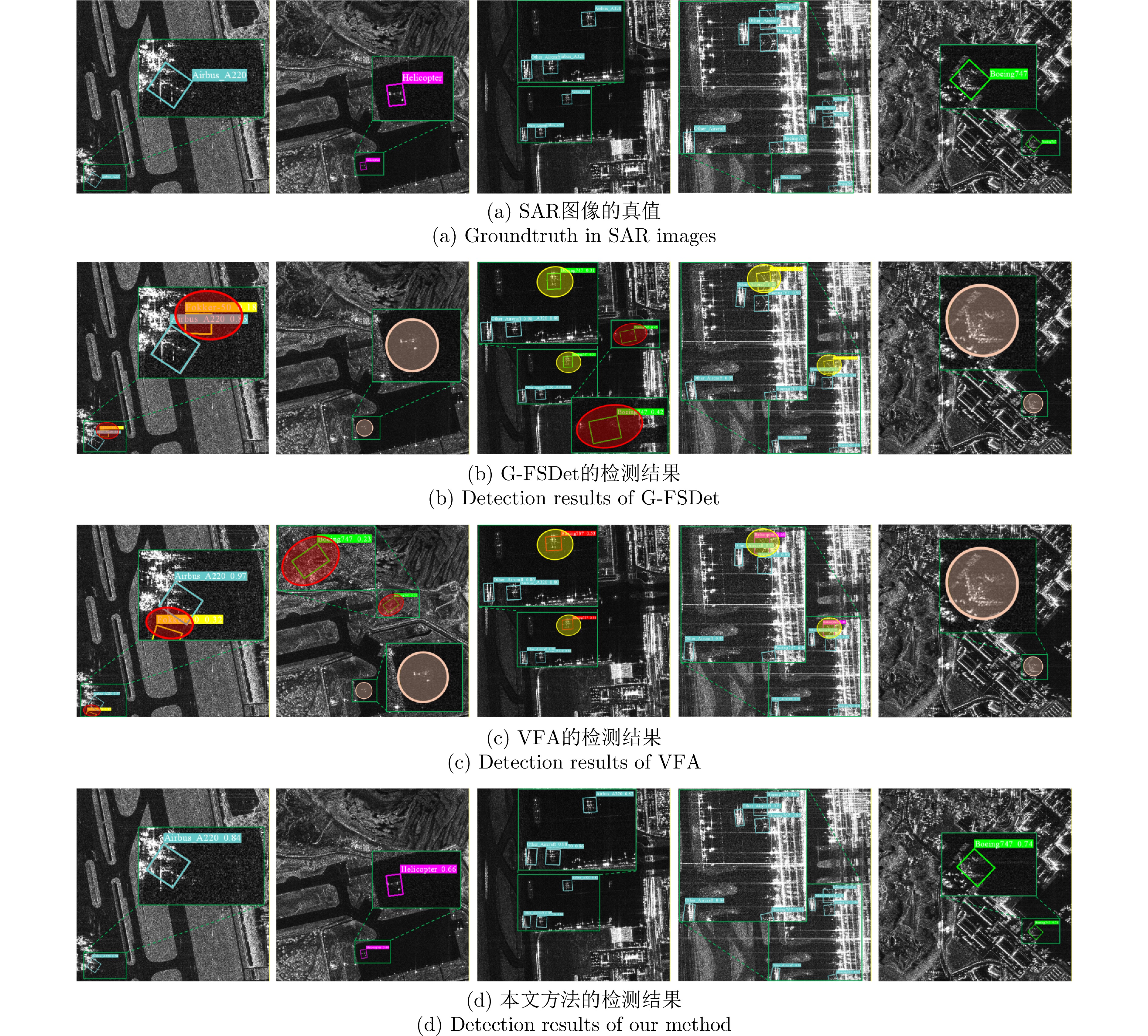
图 12 对比实验检测结果可视化
Figure 12. The visualization of the results from the comparative experiment
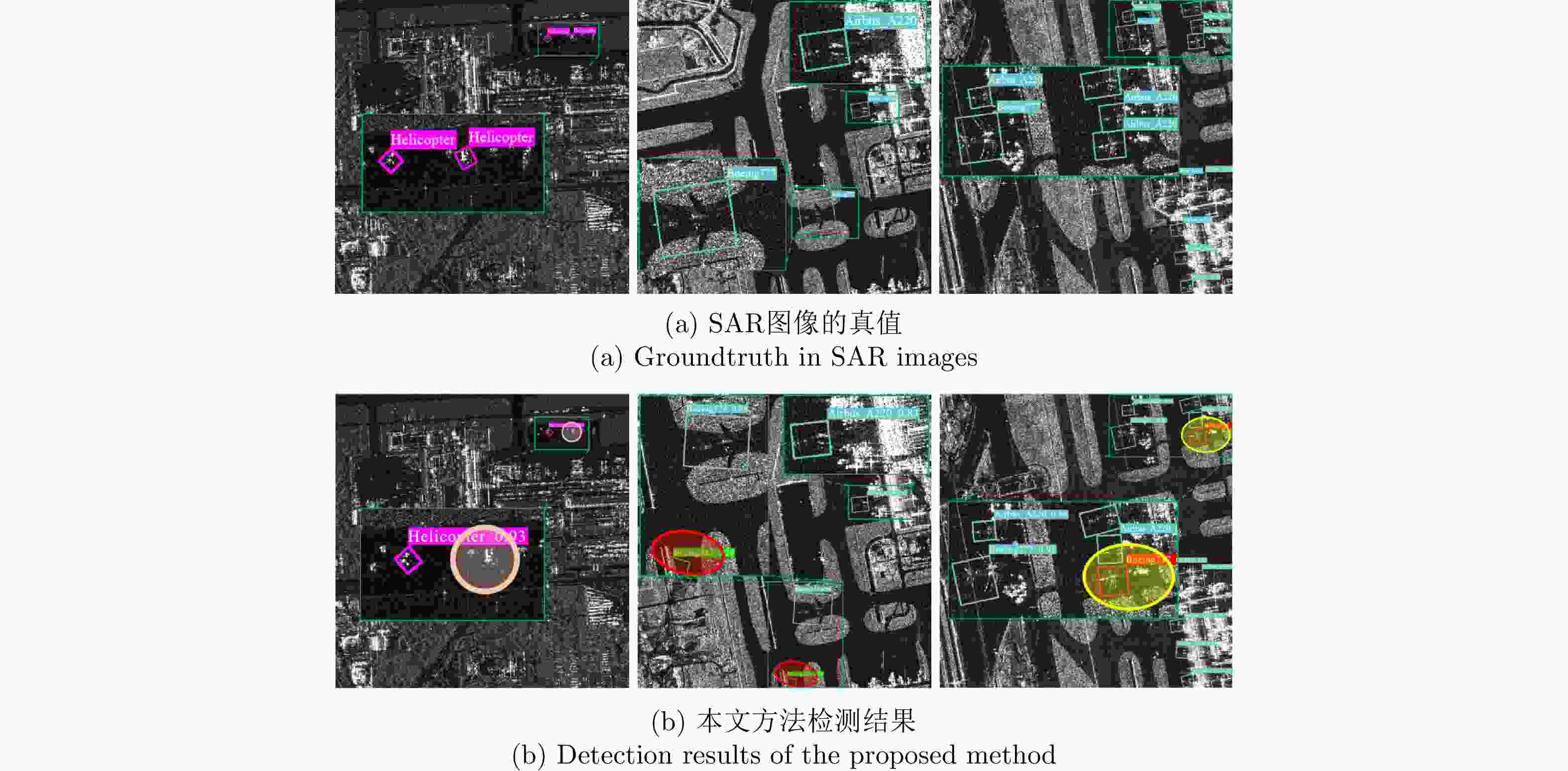
图 13 漏检、虚警与错误识别典型情况可视化
Figure 13. Visualization of typical cases of missed detection, false alarm and incorrect recognition
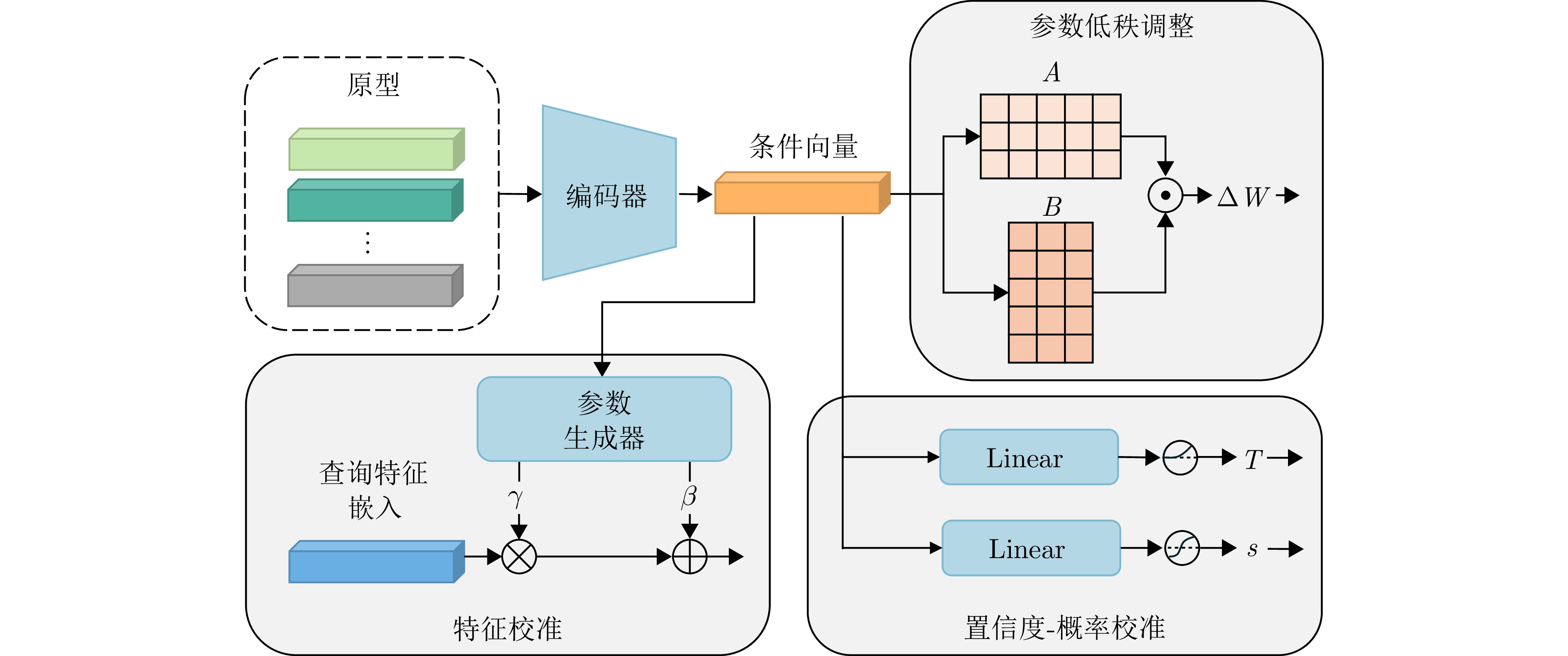
表 1 动态原型引导模块网络配置参数汇总
Table 1. Summary of network configuration parameters of the dynamic prototype guidance module
组件 结构 输入维度 输出维度 激活函数 语义条件编码器 Linear→Linear $ {C}^{\prime} $ $ {D}_{\text{cond}} $ ReLU 缩放系数γ生成 Linear $ {D}_{\text{cond}} $ $ {C}^{\prime} $ – 偏移系数β生成 Linear $ {D}_{\text{cond}} $ $ {C}^{\prime} $ – 低秩矩阵生成 Linear $ {D}_{\text{cond}} $ $ \left({d}_{\text{in}}+{d}_{\text{out}}\right)\cdot r $ – 温度缩放参数T生成 Linear $ {D}_{\text{cond}} $ 1 – 偏移参数s生成 Linear $ {D}_{\text{cond}} $ 1 –  下载: 导出CSV
表 2 CSAR-AC中类内与类间特征距离统计
Table 2. Statistics on the intraclass and interclass feature distances in the CSAR-AC
类别 类内方差 类内平均
距离最近邻类 与最近邻
类距离Airbus_A220 2608.0251 45.2209 Boeing747 8.8569 Airbus_A320 2634.7268 47.4453 Other_Aircraft 6.4297 Airbus_A330 3772.3589 50.6457 Boeing777 7.6809 Airfreighter 2805.2874 45.9796 Fokker-50 9.7756 Boeing737 2687.2690 42.3567 Boeing767 5.2874 Boeing747 4079.0830 52.5342 Airbus_A220 8.8569 Boeing767 3311.6389 46.1467 Boeing737 5.2874 Boeing777 3853.6699 50.4538 Boeing767 7.0816 Fokker-50 2807.6753 48.5371 Airfreighter 9.7756 Gulfstream 2371.5244 46.7167 Helicopter 15.3461 Helicopter 2981.2732 50.2474 Gulfstream 15.3461 Other_Aircraft 3301.9314 49.7304 Airbus_A320 6.4297
下载: 导出CSV
表 3 CSAR-AC数据集各类别在不同姿态角度差区间下的同类平均特征距离
Table 3. The average feature distances of the same category in the CSAR-AC under different attitude angle difference intervals for each category
类别 0~30° 30°~60° 60°~90° 90°~120° 120°~150° 150°~180° Airbus_A220 61.78 65.07 67.45 68.25 66.50 64.91 Airbus_A320 66.57 69.24 64.01 64.62 70.72 68.44 Airbus_A330 72.30 79.87 72.66 79.54 84.00 76.36 Airfreighter 64.19 66.05 66.28 68.25 71.75 65.98 Boeing737 60.42 61.30 62.59 63.25 60.24 64.87 Boeing747 74.64 83.48 78.49 73.70 73.81 79.13 Boeing767 68.07 64.59 66.67 66.20 65.65 71.31 Boeing777 73.79 67.76 75.26 77.19 72.11 79.57 Fokker-50 65.50 70.88 66.63 68.24 70.63 74.03 Gulfstream 64.55 71.55 68.53 66.16 73.22 65.75 Helicopter 67.57 72.01 73.61 73.29 72.09 70.94 Other_Aircraft 70.78 72.89 72.02 72.16 72.09 71.72
下载: 导出CSV
表 4 5-shot设置下新类消融实验mAP结果(%)
Table 4. The mAP results of the novel class ablation experiments under the 5-shot setting (%)
模块 新类 平均值 动态原型生成 动态原型引导 Boeing737 Boeing747 Airbus_A330 Fokker-50 Helicopter Gulfstream × × 3.73 7.12 6.76 9.11 6.66 4.18 6.26 √ × 16.95 16.26 18.99 18.67 14.70 16.62 17.03 × √ 12.91 18.82 12.38 7.70 10.81 10.12 12.12 √ √ 18.57 30.43 21.23 18.00 17.59 18.61 20.74 注:最优和次优结果分别以加粗和下划线突出表示。
下载: 导出CSV
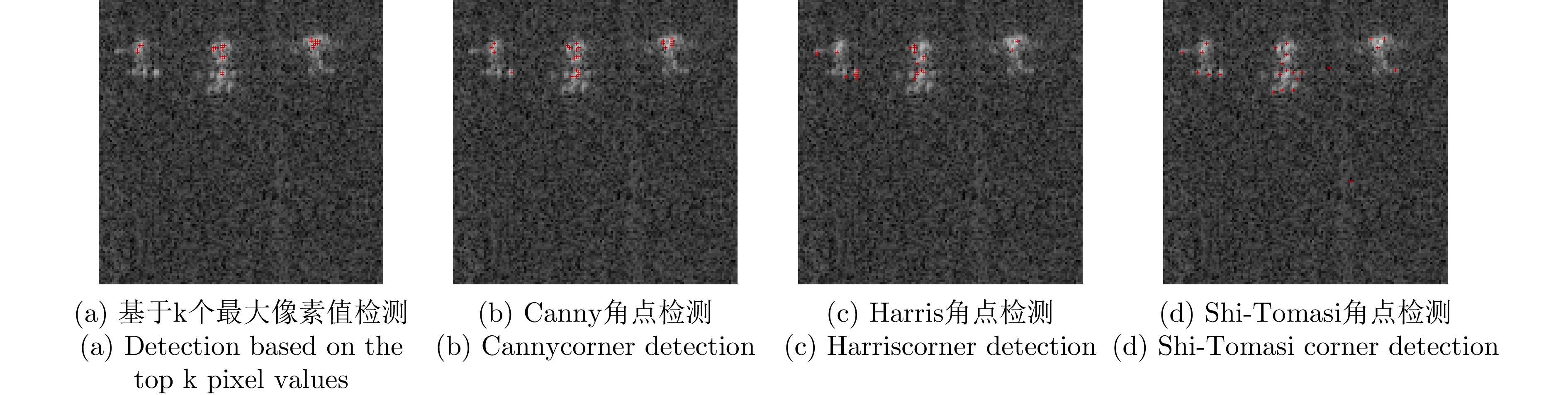
表 6 角点检测方法消融实验的所有类别mAP结果(%)
Table 6. The mAP results for all categories of corner detection methods ablation experiment (%)
设置 Top-k Canny Harris Harris-Laplace Shi-Tomasi 1-shot 28.05 28.53 29.67 30.21 30.64 5-shot 34.40 35.28 36.77 37.50 38.35 注:最优结果以加粗突出表示。
下载: 导出CSV
表 7 高斯核参数消融实验的所有类别mAP结果(%)
Table 7. The mAP results for all categories of the Gaussian kernel parameter ablation experiment (%)
设置 0.5 1.0 2.0 3.0 1-shot 27.41 29.86 30.64 30.45 5-shot 35.97 37.53 38.35 38.01 注:最优结果以加粗突出表示。
下载: 导出CSV
表 8 动态原型引导模块消融实验mAP结果(%)
Table 8. The mAP results of the dynamic prototype guidance module ablation experiment (%)
动态原型引导 新类 基类 全部类别 1-shot 5-shot 平均值 1-shot 5-shot 平均值 1-shot 5-shot 平均值 × 2.88 6.26 4.57 38.85 48.99 43.92 24.11 25.77 24.94 √ 7.45 12.12 9.79 50.53 54.30 52.42 28.94 35.03 31.99 注:最优结果以加粗突出表示。
下载: 导出CSV
表 5 动态原型生成模块消融实验mAP结果(%)
Table 5. The mAP results of the dynamic prototype generation module ablation experiment (%)
动态原型生成 新类 基类 全部类别 1-shot 5-shot 平均值 1-shot 5-shot 平均值 1-shot 5-shot 平均值 × 2.88 6.26 4.57 38.85 48.99 43.92 24.11 25.77 24.94 √ 11.36 17.03 14.20 48.99 58.96 53.98 29.81 36.94 33.38 注:最优结果以加粗突出表示。
下载: 导出CSV
表 9 加入参数低秩调整前后检测头的参数比较
Table 9. Comparison of parameters of detection head with and without parameter low-rank adjustment
参数低秩调整 参数量↓ 回归头 分类头 × 1280 1536 √ 1044 (–18.4%)1048 (–31.8%)
下载: 导出CSV
表 10 各模块计算效率对比
Table 10. Comparison of computational efficiency of each module
模型 参数量(M) 计算复杂度
FLOPs (G)推理速度
(FPS)基线 32.01 165.2 32.7 基线+动态原型
生成模块34.56 180.4 27.5 基线+动态原型
引导模块32.86 168.5 30.2 本文方法 35.41 183.7 25.1
下载: 导出CSV
表 11 对比实验mAP结果(%)
Table 11. The mAP results of comparative experiment (%)
Shot 模型 新类 基类 全部类别 1-shot Meta R-CNN[61] 4.35 45.24 22.79 Attention-RPN[62] 6.25 44.78 25.55 TFA[40] 5.36 42.64 26.78 FSCE[41] 5.39 49.48 26.97 G-FSDet[15] 6.15 46.04 27.72 VFA[63] 6.80 46.97 25.55 FOMC[43] 7.52 47.20 27.35 本文方法 12.13 49.64 30.64 5-shot Meta R-CNN[61] 6.03 48.08 25.77 Attention-RPN[62] 9.34 51.71 29.38 TFA[40] 11.16 47.73 32.18 FSCE[41] 15.91 54.00 33.22 G-FSDet[15] 19.66 54.66 35.04 VFA[63] 16.36 53.57 36.76 FOMC[43] 17.85 52.85 35.05 本文方法 20.74 55.89 38.35 注:最优结果以加粗突出表示。
下载: 导出CSV
-
[1] BERARDINO P, FORNARO G, LANARI R, et al. A new algorithm for surface deformation monitoring based on small baseline differential SAR interferograms[J]. IEEE Transactions on Geoscience and Remote Sensing, 2002, 40(11): 2375–2383. doi: 10.1109/TGRS.2002.803792. [2] CHEN Sizhe, WANG Haipeng, XU Feng, et al. Target classification using the deep convolutional networks for SAR images[J]. IEEE Transactions on Geoscience and Remote Sensing, 2016, 54(8): 4806–4817. doi: 10.1109/TGRS.2016.2551720. [3] FILIPPIDIS A, JAIN L C, and MARTIN N. Fusion of intelligent agents for the detection of aircraft in SAR images[J]. IEEE Transactions on Pattern Analysis and Machine Intelligence, 2000, 22(4): 378–384. doi: 10.1109/34.845380. [4] GUO Qian, WANG Haipeng, and XU Feng. Scattering enhanced attention pyramid network for aircraft detection in SAR images[J]. IEEE Transactions on Geoscience and Remote Sensing, 2021, 59(9): 7570–7587. doi: 10.1109/TGRS.2020.3027762. [5] MENG Qingbiao, WU Youming, SUO Yuxi, et al. STC-Net: Scattering topology cue-based network for aircraft detection in SAR images[J]. IEEE Transactions on Geoscience and Remote Sensing, 2025, 63: 5201816. doi: 10.1109/TGRS.2024.3522186. [6] WANG Jielan, XIAO Hongguang, CHEN Lifu, et al. Integrating weighted feature fusion and the spatial attention module with convolutional neural networks for automatic aircraft detection from SAR images[J]. Remote Sensing, 2021, 13(5): 910. doi: 10.3390/rs13050910. [7] ZHAO Danpei, CHEN Ziqiang, GAO Yue, et al. Classification matters more: Global instance contrast for fine-grained SAR aircraft detection[J]. IEEE Transactions on Geoscience and Remote Sensing, 2023, 61: 5203815. doi: 10.1109/TGRS.2023.3250507. [8] HAN Jiaming, DING Jian, LI Jie, et al. Align deep features for oriented object detection[J]. IEEE Transactions on Geoscience and Remote Sensing, 2022, 60: 5602511. doi: 10.1109/TGRS.2021.3062048. [9] CHEN Dingyuan, ZHONG Yanfei, MA Ailong, et al. Explicable fine-grained aircraft recognition via deep part parsing prior framework for high-resolution remote sensing imagery[J]. IEEE Transactions on Cybernetics, 2024, 54(7): 3968–3979. doi: 10.1109/TCYB.2023.3293033. [10] GUO Zhengxi, HOU Biao, GUO Xianpeng, et al. MSRIP-Net: Addressing interpretability and accuracy challenges in aircraft fine-grained recognition of remote sensing images[J]. IEEE Transactions on Geoscience and Remote Sensing, 2024, 62: 5640217. doi: 10.1109/TGRS.2024.3458408. [11] LI Wei, CHEN Chen, ZHANG Mengmeng, et al. Data augmentation for hyperspectral image classification with deep CNN[J]. IEEE Geoscience and Remote Sensing Letters, 2019, 16(4): 593–597. doi: 10.1109/LGRS.2018.2878773. [12] MALMGREN-HANSEN D, KUSK A, DALL J, et al. Improving SAR automatic target recognition models with transfer learning from simulated data[J]. IEEE Geoscience and Remote Sensing Letters, 2017, 14(9): 1484–1488. doi: 10.1109/LGRS.2017.2717486. [13] TASAR O, HAPPY S L, TARABALKA Y, et al. ColorMapGAN: Unsupervised domain adaptation for semantic segmentation using color mapping generative adversarial networks[J]. IEEE Transactions on Geoscience and Remote Sensing, 2020, 58(10): 7178–7193. doi: 10.1109/TGRS.2020.2980417. [14] SUN Xian, WANG Bing, WANG Zhirui, et al. Research progress on few-shot learning for remote sensing image interpretation[J]. IEEE Journal of Selected Topics in Applied Earth Observations and Remote Sensing, 2021, 14: 2387–2402. doi: 10.1109/JSTARS.2021.3052869. [15] ZHANG Tianyang, ZHANG Xiangrong, ZHU Peng, et al. Generalized few-shot object detection in remote sensing images[J]. ISPRS Journal of Photogrammetry and Remote Sensing, 2023, 195: 353–364. doi: 10.1016/j.isprsjprs.2022.12.004. [16] WANG Yan, XU Chaofei, LIU Cuiwei, et al. Context information refinement for few-shot object detection in remote sensing images[J]. Remote Sensing, 2022, 14(14): 3255. doi: 10.3390/rs14143255. [17] KOCH G, ZEMEL R, and SALAKHUTDINOV R. Siamese neural networks for one-shot image recognition[C]. The 32nd International Conference on Machine Learning, Lille, France, 2015: 125–132. [18] TANG Haojin, LI Yanshan, HAN Xiao, et al. A spatial-spectral prototypical network for hyperspectral remote sensing image[J]. IEEE Geoscience and Remote Sensing Letters, 2020, 17(1): 167–171. doi: 10.1109/LGRS.2019.2916083. [19] HOSPEDALES T, ANTONIOU A, MICAELLI P, et al. Meta-learning in neural networks: A survey[J]. IEEE Transactions on Pattern Analysis and Machine Intelligence, 2022, 44(9): 5149–5169. doi: 10.1109/TPAMI.2021.3079209. [20] SNELL J, SWERSKY K, and ZEMEL R. Prototypical networks for few-shot learning[C]. The 31st International Conference on Neural Information Processing Systems, Long Beach, USA, 2017: 4080–4090. [21] VINYALS O, BLUNDELL C, LILLICRAP T, et al. Matching networks for one shot learning[C]. The 30th International Conference on Neural Information Processing Systems, Barcelona, Spain, 2016: 3637–3645. [22] GUO Manke, YOU Yanan, and LIU Fang. Discriminative prototype learning for few-shot object detection in remote-sensing images[J]. IEEE Transactions on Geoscience and Remote Sensing, 2023, 61: 5624313. doi: 10.1109/TGRS.2023.3326992. [23] HE Zhenwei, LIAO Xinye, and FENG Xin. Conditional prototype learning for few-shot object detection[C]. The 36th British Machine Vision Conference, Sheffield, UK, 2025: 1–14. [24] SUNG F, YANG Yongxin, ZHANG Li, et al. Learning to compare: Relation network for few-shot learning[C]. 2018 IEEE/CVF Conference on Computer Vision and Pattern Recognition, Salt Lake City, USA, 2018: 1199–1208. doi: 10.1109/CVPR.2018.00131. [25] ROSS T D, BRADLEY J J, HUDSON L J, et al. SAR ATR: So what’s the problem? An MSTAR perspective[C]. SPIE 3721, Algorithms for Synthetic Aperture Radar Imagery VI, Orlando, USA, 1999: 662–672. doi: 10.1117/12.357681. [26] KUANG Chunming, WANG Caijun, WEN Biyang, et al. An improved CA-CFAR method for ship target detection in strong clutter using UHF radar[J]. IEEE Signal Processing Letters, 2020, 27: 1445–1449. doi: 10.1109/LSP.2020.3015682. [27] LIU Tao, YANG Ziyuan, MARINO A, et al. Robust CFAR detector based on truncated statistics for polarimetric synthetic aperture radar[J]. IEEE Transactions on Geoscience and Remote Sensing, 2020, 58(9): 6731–6747. doi: 10.1109/TGRS.2020.2979252. [28] AN Wentao, XIE Chunhua, and YUAN Xinzhe. An improved iterative censoring scheme for CFAR ship detection with SAR imagery[J]. IEEE Transactions on Geoscience and Remote Sensing, 2014, 52(8): 4585–4595. doi: 10.1109/TGRS.2013.2282820. [29] YU Wenyi, WANG Yinghua, LIU Hongwei, et al. Superpixel-based CFAR target detection for high-resolution SAR images[J]. IEEE Geoscience and Remote Sensing Letters, 2016, 13(5): 730–734. doi: 10.1109/LGRS.2016.2540809. [30] POURMOTTAGHI A, TABAN M R, and GAZOR S. A CFAR detector in a nonhomogenous weibull clutter[J]. IEEE Transactions on Aerospace and Electronic Systems, 2012, 48(2): 1747–1758. doi: 10.1109/TAES.2012.6178094. [31] LUO Ru, CHEN Lifu, XING Jin, et al. A fast aircraft detection method for SAR images based on efficient bidirectional path aggregated attention network[J]. Remote Sensing, 2021, 13(15): 2940. doi: 10.3390/rs13152940. [32] KANG Yuzhuo, WANG Zhirui, FU Jiamei, et al. SFR-Net: Scattering feature relation network for aircraft detection in complex SAR images[J]. IEEE Transactions on Geoscience and Remote Sensing, 2022, 60: 5218317. doi: 10.1109/TGRS.2021.3130899. [33] CHEN Lifu, LUO Ru, XING Jin, et al. Geospatial transformer is what you need for aircraft detection in SAR imagery[J]. IEEE Transactions on Geoscience and Remote Sensing, 2022, 60: 5225715. doi: 10.1109/TGRS.2022.3162235. [34] SUO Yuxi, WU Youming, MIAO Tian, et al. Adaptive SAR image enhancement for aircraft detection via speckle suppression and channel combination[J]. IEEE Transactions on Geoscience and Remote Sensing, 2024, 62: 5219415. doi: 10.1109/TGRS.2024.3438560. [35] 罗汝, 赵凌君, 何奇山, 等. SAR图像飞机目标智能检测识别技术研究进展与展望[J]. 雷达学报(中英文), 2024, 13(2): 307–330. doi: 10.12000/JR23056.LUO Ru, ZHAO Lingjun, HE Qishan, et al. Intelligent technology for aircraft detection and recognition through SAR imagery: Advancements and prospects[J]. Journal of Radars, 2024, 13(2): 307–330. doi: 10.12000/JR23056. [36] ZHOU Jie, XIAO Chao, PENG Bo, et al. DiffDet4SAR: Diffusion-based aircraft target detection network for SAR images[J]. IEEE Geoscience and Remote Sensing Letters, 2024, 21: 4007905. doi: 10.1109/LGRS.2024.3386020. [37] 曹婧宜, 张扬, 尤亚楠, 等. 基于图网络与不变性特征感知的SAR图像目标识别方法[J]. 雷达学报(中英文), 2025, 14(2): 366–388. doi: 10.12000/JR24125.CAO Jingyi, ZHANG Yang, YOU Ya’nan, et al. Target recognition method based on graph structure perception of invariant features for SAR images[J]. Journal of Radars, 2025, 14(2): 366–388. doi: 10.12000/JR24125. [38] WU Jiaxi, LIU Songtao, HUANG Di, et al. Multi-scale positive sample refinement for few-shot object detection[C]. The 16th European Conference on Computer Vision, Glasgow, UK, 2020: 456–472. doi: 10.1007/978-3-030-58517-4_27. [39] KAUL P, XIE Weidi, and ZISSERMAN A. Label, verify, correct: A simple few shot object detection method[C]. IEEE/CVF Conference on Computer Vision and Pattern Recognition, New Orleans, USA, 2022: 14217–14227. doi: 10.1109/CVPR52688.2022.01384. [40] WANG Xin, HUANG T E, DARRELL T, et al. Frustratingly simple few-shot object detection[C]. The 37th International Conference on Machine Learning, Vienna, Austria, 2020: 9919–9928. [41] SUN Bo, LI Banghuai, CAI Shengcai, et al. FSCE: Few-shot object detection via contrastive proposal encoding[C]. IEEE/CVF Conference on Computer Vision and Pattern Recognition, Nashville, USA, 2021: 7348–7358. doi: 10.1109/CVPR46437.2021.00727. [42] QIAO Limeng, ZHAO Yuxuan, LI Zhiyuan, et al. DeFRCN: Decoupled faster R-CNN for few-shot object detection[C]. IEEE/CVF International Conference on Computer Vision, Montreal, Canada, 2021: 8661–8670. doi: 10.1109/ICCV48922.2021.00856. [43] ZHOU Jiawei, LI Wuzhou, CAO Yi, et al. Few-shot oriented object detection in remote sensing images via memorable contrastive learning[J]. IEEE Transactions on Geoscience and Remote Sensing, 2025, 63: 5630814. doi: 10.1109/TGRS.2025.3578632. [44] KARLINSKY L, SHTOK J, HARARY S, et al. RepMet: Representative-based metric learning for classification and few-shot object detection[C]. IEEE/CVF Conference on Computer Vision and Pattern Recognition, Long Beach, USA, 2019: 5192–5201. doi: 10.1109/CVPR.2019.00534. [45] MEI Hefei, ZHAO Taijin, TANG Shiyuan, et al. GRSDet: Learning to generate local reverse samples for few-shot object detection[J]. Neurocomputing, 2025, 651: 130903. doi: 10.1016/j.neucom.2025.130903. [46] FINN C, ABBEEL P, and LEVINE S. Model-agnostic meta-learning for fast adaptation of deep networks[C]. The 34th International Conference on Machine Learning, Sydney, Australia, 2017: 1126–1135. [47] ZHANG Gongjie, LUO Zhipeng, CUI Kaiwen, et al. Meta-DETR: Image-level few-shot detection with inter-class correlation exploitation[J]. IEEE Transactions on Pattern Analysis and Machine Intelligence, 2023, 45(11): 12832–12843. doi: 10.1109/TPAMI.2022.3195735. [48] 吕艺璇, 王智睿, 王佩瑾, 等. 基于散射信息和元学习的SAR图像飞机目标识别[J]. 雷达学报, 2022, 11(4): 652–665. doi: 10.12000/JR22044.LYU Yixuan, WANG Zhirui, WANG Peijin, et al. Scattering information and meta-learning based SAR images interpretation for aircraft target recognition[J]. Journal of Radars, 2022, 11(4): 652–665. doi: 10.12000/JR22044. [49] HE Kaiming, ZHANG Xiangyu, REN Shaoqing, et al. Deep residual learning for image recognition[C]. IEEE Conference on Computer Vision and Pattern Recognition, Las Vegas, USA, 2016: 770–778. doi: 10.1109/CVPR.2016.90. [50] BANSAL M, KUMAR M, KUMAR M, et al. An efficient technique for object recognition using Shi-Tomasi corner detection algorithm[J]. Soft Computing, 2021, 25(6): 4423–4432. doi: 10.1007/s00500-020-05453-y. [51] LAW H and DENG Jia. CornerNet: Detecting objects as paired keypoints[C]. The 15th European Conference on Computer Vision, Munich, Germany, 2018: 765–781. doi: 10.1007/978-3-030-01264-9_45. [52] PEREZ E, STRUB F, DE VRIES H, et al. FiLM: Visual reasoning with a general conditioning layer[C]. The 32nd AAAI Conference on Artificial Intelligence, New Orleans, USA, 2018: 3942–3951. doi: 10.1609/aaai.v32i1.11671. [53] HU E J, SHEN Yelong, WALLIS P, et al. LoRA: Low-rank adaptation of large language models[C]. The 10th International Conference on Learning Representations, 2022: 1–13. [54] XUAN Hao, YANG Bokai, and LI Xingyu. Exploring the impact of temperature scaling in softmax for classification and adversarial robustness[EB/OL]. https://arxiv.org/abs/2502.20604, 2025. doi: 10.48550/arXiv.2502.20604. [55] WU Youming, SUO Yuxi, MENG Qingbiao, et al. FAIR-CSAR: A benchmark dataset for fine-grained object detection and recognition based on single-look complex SAR images[J]. IEEE Transactions on Geoscience and Remote Sensing, 2025, 63: 5201022. doi: 10.1109/TGRS.2024.3519891. [56] 吴有明, 刁文辉, 索玉玺, 等. FAIR-CSAR复图像目标数据集V1.0(FAIR-CSAR-V1.0)[J]. 雷达学报, 2025. https://radars.ac.cn/web/data/getData?dataType=FAIR_CSAR.WU Youming, DIAO Wenhui, SUO Yuxi, et al. A Benchmark dataset for fine-grained object detection and recognition based on single-look complex SAR images (FAIR-CSAR-V1.0)[J]. Journal of Radar, 2025. https://radars.ac.cn/web/data/getData?dataType=FAIR_CSAR. [57] JOLLIFFE I T and CADIMA J. Principal component analysis: A review and recent developments[J]. Philosophical Transactions of the Royal Society A: Mathematical, Physical and Engineering Sciences, 2016, 374(2065): 20150202. doi: 10.1098/rsta.2015.0202. [58] VASWANI N and CHELLAPPA R. Principal components null space analysis for image and video classification[J]. IEEE Transactions on Image Processing, 2006, 15(7): 1816–1830. doi: 10.1109/TIP.2006.873449. [59] ZHANG Suzhi, CHEN Xiaoni, LI Penghui, et al. Data dimensionality reduction method combining intra-class and inter-class distance[C]. International Conference on Artificial Intelligence and Advanced Manufacturing, Dublin, Ireland, 2019: 17. doi: 10.1145/3358331.3358348. [60] CUMMING I G and WONG F H. Digital Processing of Synthetic Aperture Radar Data: Algorithms and Implementation[M]. Boston, USA: Artech House, 2005. [61] YAN Xiaopeng, CHEN Ziliang, XU Anni, et al. Meta R-CNN: Towards general solver for instance-level low-shot learning[C]. IEEE/CVF International Conference on Computer Vision, Seoul, Korea (South), 2019: 9576–9585. doi: 10.1109/ICCV.2019.00967. [62] FAN Qi, ZHUO Wei, TANG C K, et al. Few-shot object detection with attention-RPN and multi-relation detector[C]. IEEE/CVF Conference on Computer Vision and Pattern Recognition, Seattle, USA, 2020: 4012–4021. doi: 10.1109/CVPR42600.2020.00407. [63] HAN Jiaming, REN Yuqiang, DING Jian, et al. Few-shot object detection via variational feature aggregation[C]. The 37th AAAI Conference on Artificial Intelligence, Washington, USA, 2023: 755–763. doi: 10.1609/aaai.v37i1.25153. -

计量
- 文章访问数:
- HTML全文浏览量:
- PDF下载量:
- 被引次数: 0