

 作者中心
作者中心 专家审稿
专家审稿 责编办公
责编办公 编辑办公
编辑办公
Radio Frequency Stealth-oriented Energy Management and Beam-position Task Scheduling Algorithm for Regional Search in Constellation Radar
-
摘要: 该文针对星座雷达执行区域搜索任务场景,提出一种面向射频隐身的星座雷达区域搜索能量管控与波位任务调度算法。首先,将区域搜索空域按波位递推生成方式离散为波位集合,将各波位的检测概率信息融合为区域复合检测信息,结合该复合检测信息,推导包含波位先验威胁、几何链路系数与辐射能量分配等参数的区域加权检测概率解析表达式,并将其作为区域搜索任务性能的衡量指标。在此基础上,构建面向射频隐身的星座雷达区域搜索能量管控优化模型,即以最小化星座雷达的总辐射能量为优化目标,以满足预先设定的加权检测概率阈值与波位全覆盖性能要求为约束条件,对波位辐射能量进行优化分配;进一步结合配额感知轮询与补盲调度策略,将波位搜索任务调度至具体天基雷达执行,形成可执行的波位任务调度方案。针对上述优化问题,构造固定总辐射能量下的区域搜索性能函数,并结合外层单调二分搜索与内层Karush-Kuhn-Tucker (KKT)条件求解,形成两步分解求解算法。仿真结果表明,与对比算法相比,所提算法能够有效降低星座雷达系统在区域搜索任务中的总辐射能量,从而降低系统射频暴露风险。Abstract: This study proposes an algorithm focused on Radio Frequency (RF) stealth-oriented energy management and beam-position task scheduling for regional search in constellation radar systems. First, the search airspace is discretized into a set of beam positions using a recursive beam-position generation method. The detection data from individual beam positions are then combined to create regional composite detection information. Based on prior target threat distribution, geometric link gains, and radiation energy allocation, an analytical expression for the regional weighted detection probability is derived to serve as the performance metric for the regional search. On this basis, an RF stealth-oriented energy management optimization model is established, in which the total radiation energy of the constellation radar system is minimized while adhering to a specified threshold for the regional weighted detection probability and ensuring full coverage of all beam positions. In this model, the radiation energy for each beam position is treated as a continuous decision variable. The optimized beam-position search tasks are then assigned to specific space-based radars using a quota-aware polling and blind-compensation strategy to form a practical task scheduling scheme. To solve the formulated problem, a regional search performance function based on a fixed total radiation energy is constructed, and a two-step decomposition algorithm is developed. This algorithm combines an outer monotonic bisection search with an inner marginal-gain allocation based on the Karush-Kuhn-Tucker theorem. Simulation results show that the proposed algorithm effectively reduces the total radiation energy of the constellation radar system compared to benchmark methods, thereby lowering the cumulative RF exposure level.
-
Key words:
- Constellation radar /
- RF stealth /
- Energy management /
- Beam-position task scheduling /
- Regional search
-
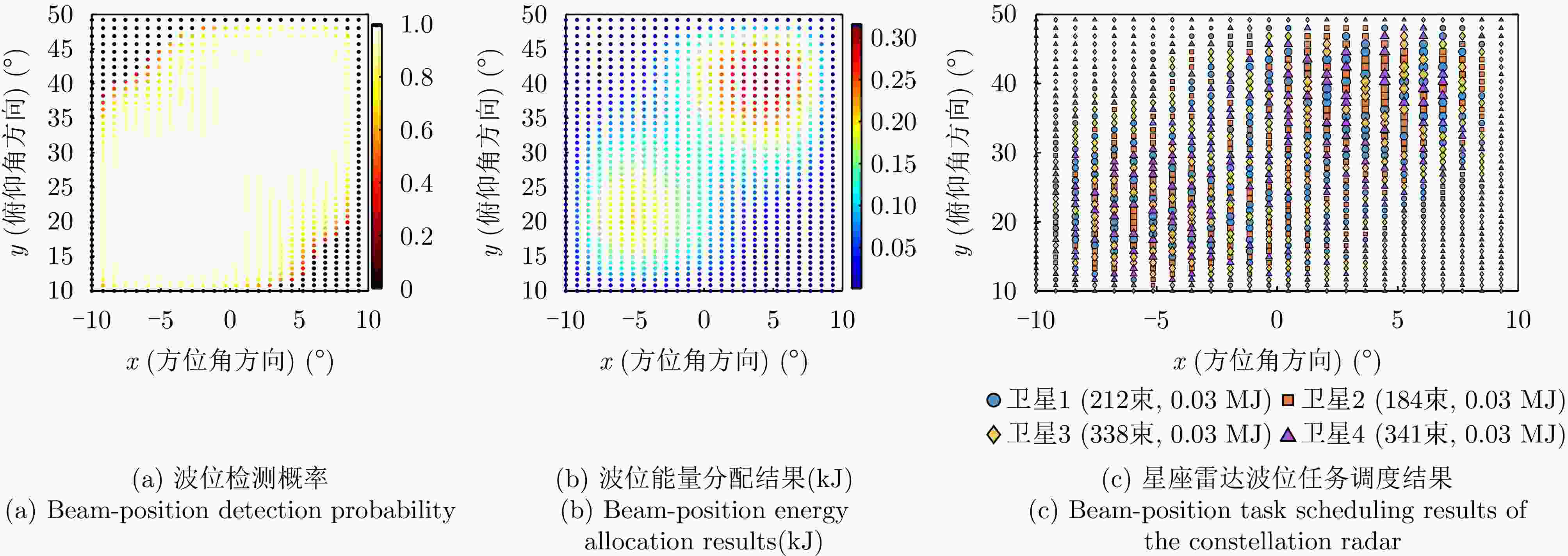
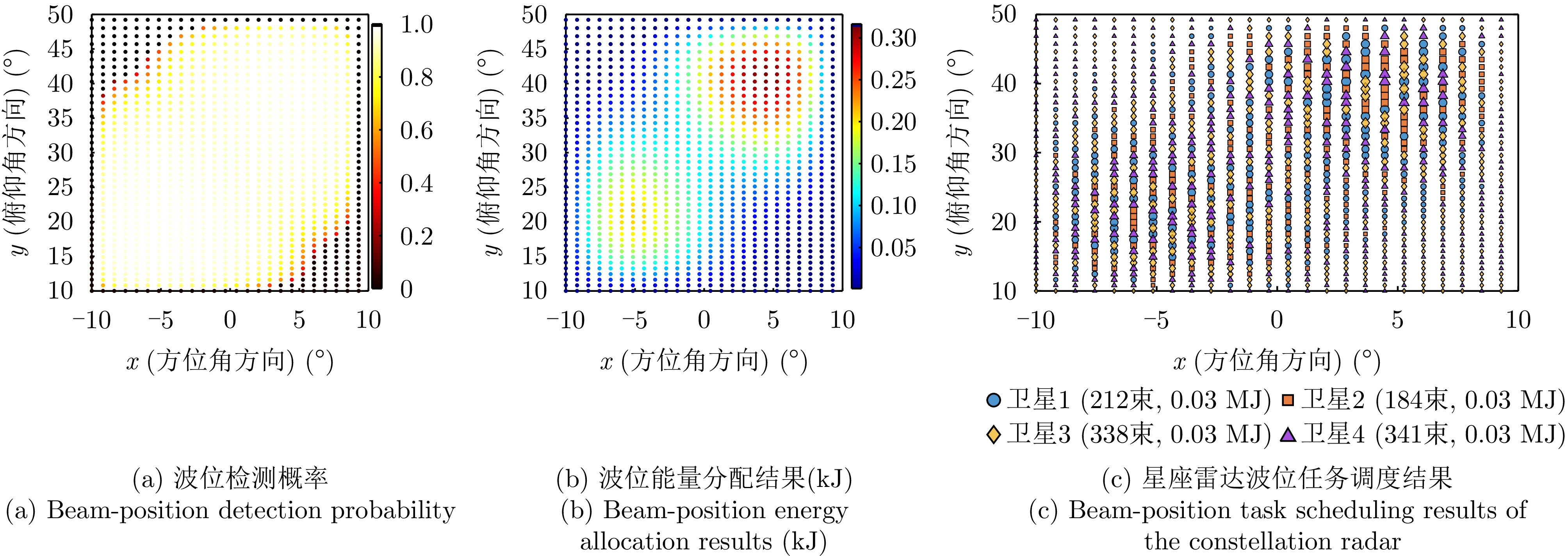
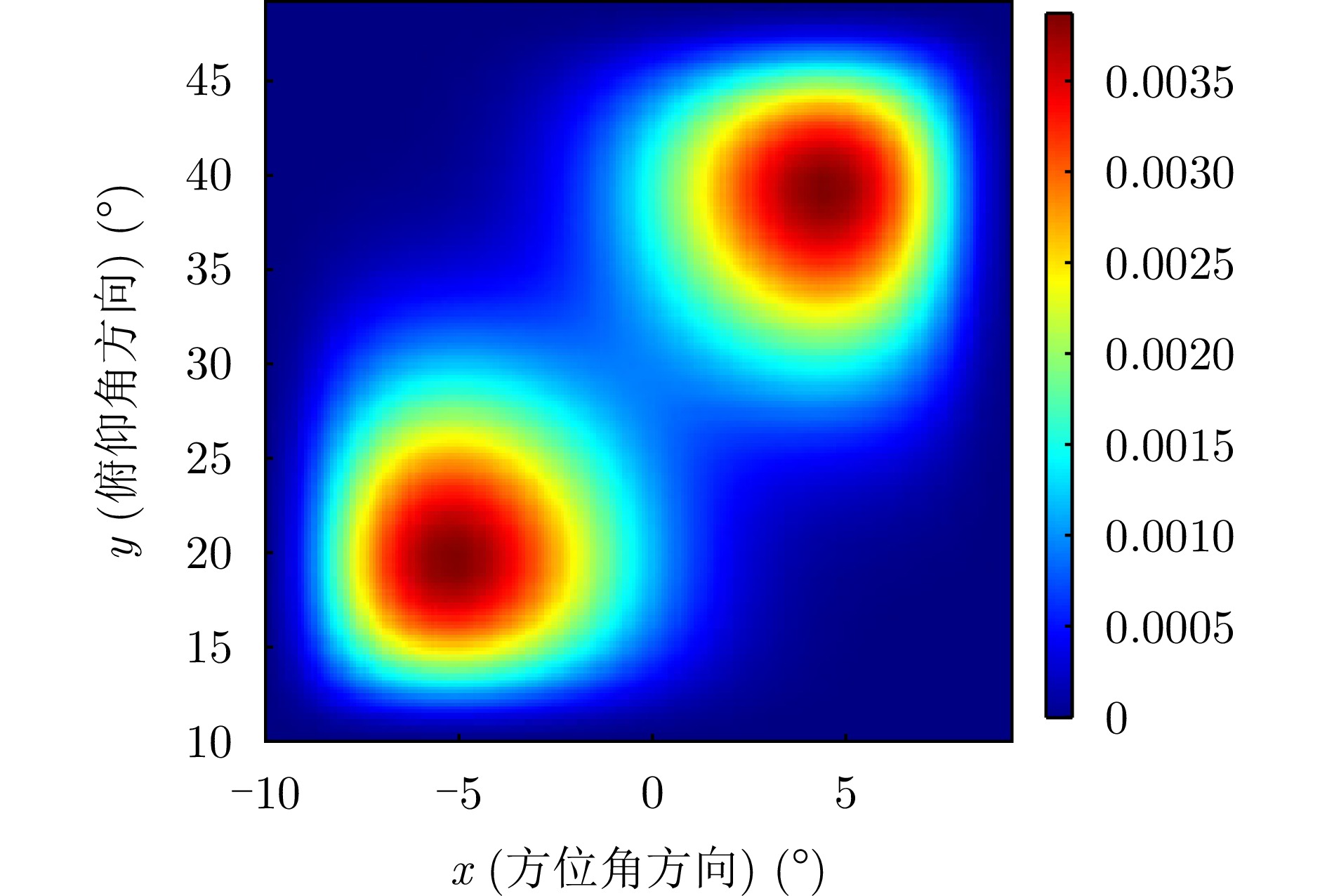
图 2 星座雷达波位检测概率、能量分配及波位任务调度结果
Figure 2. Beam-position detection probability, energy allocation, and beam-position task scheduling results of the constellation radar
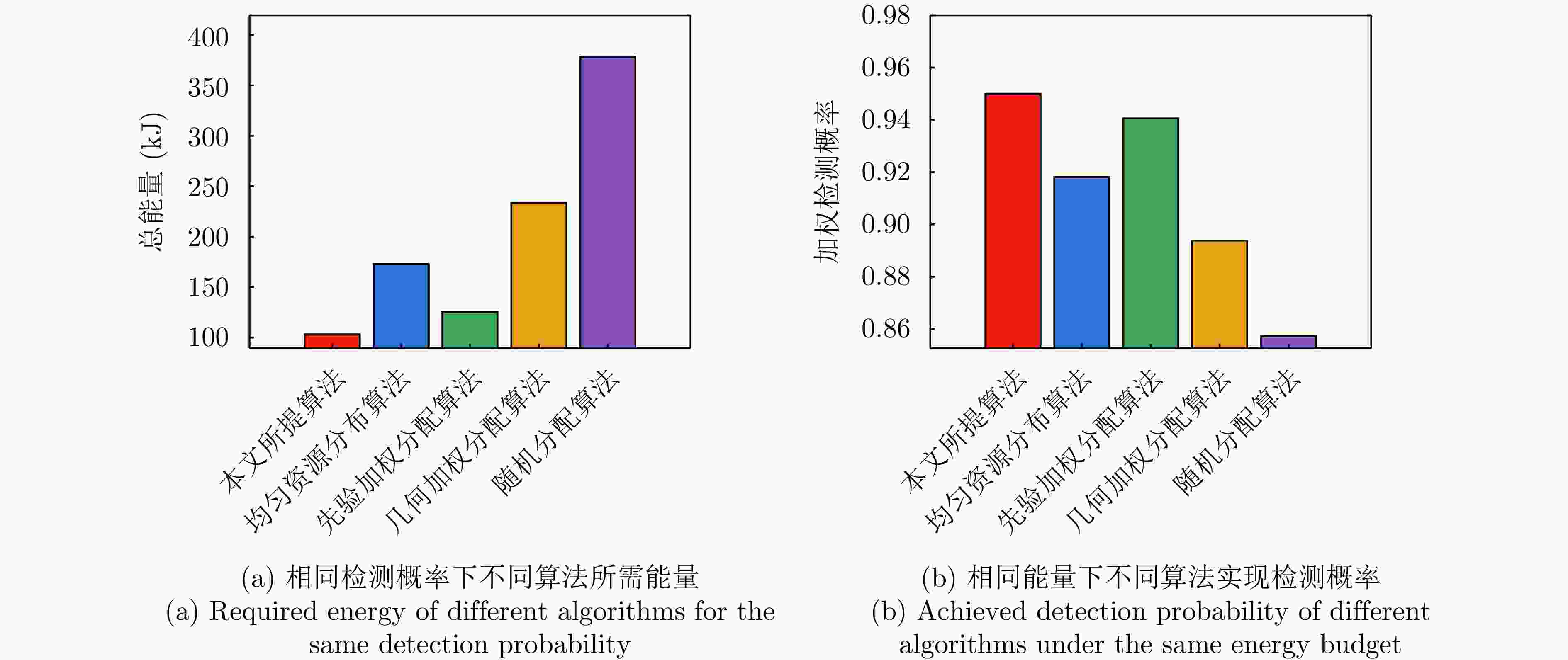
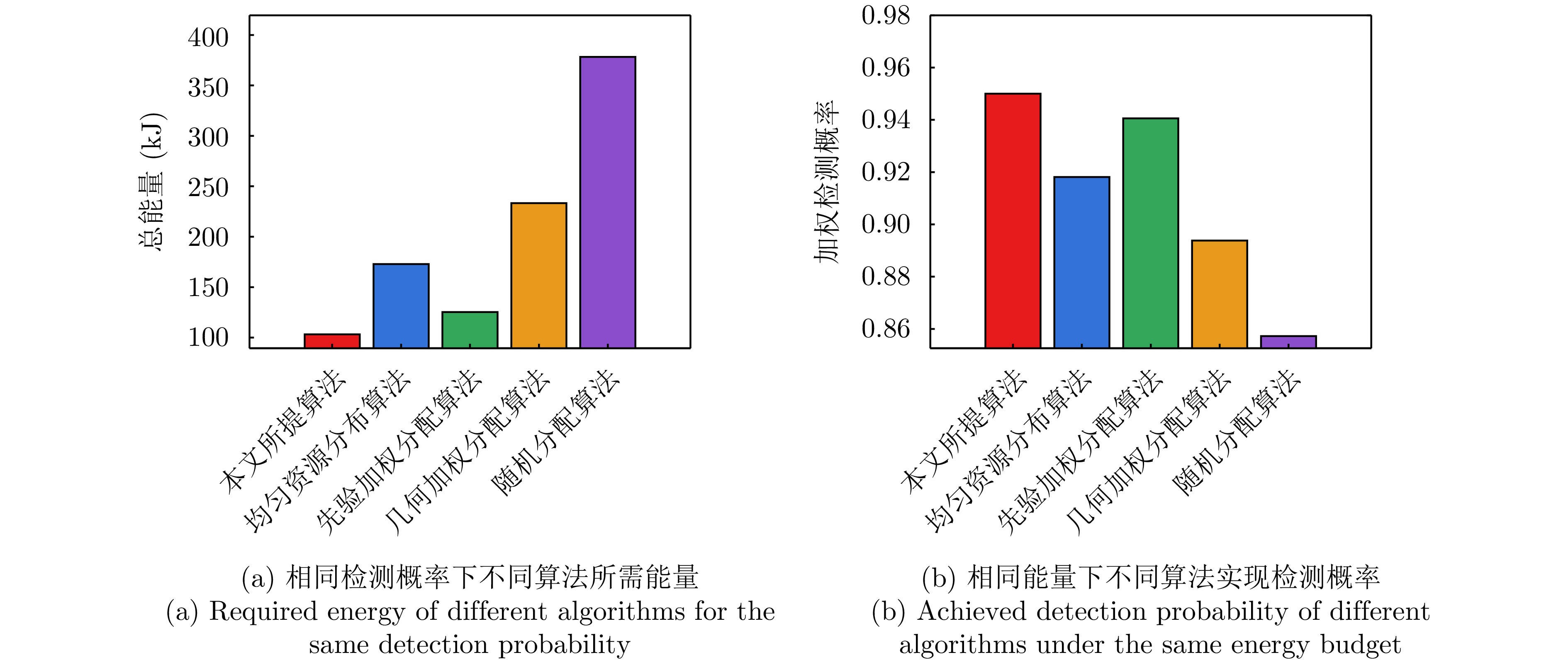
图 3 不同算法能量消耗与检测性能对比
Figure 3. Comparison of energy consumption and detection performance under different algorithms
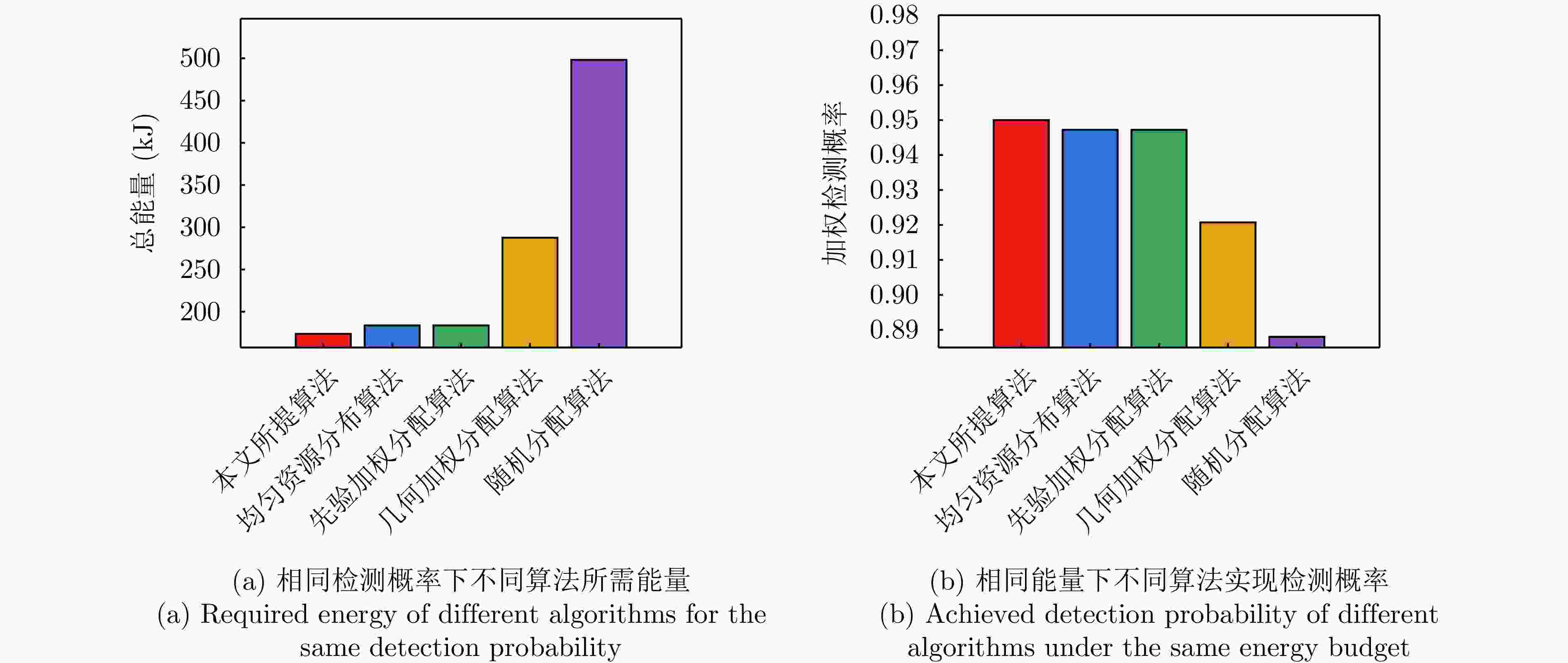
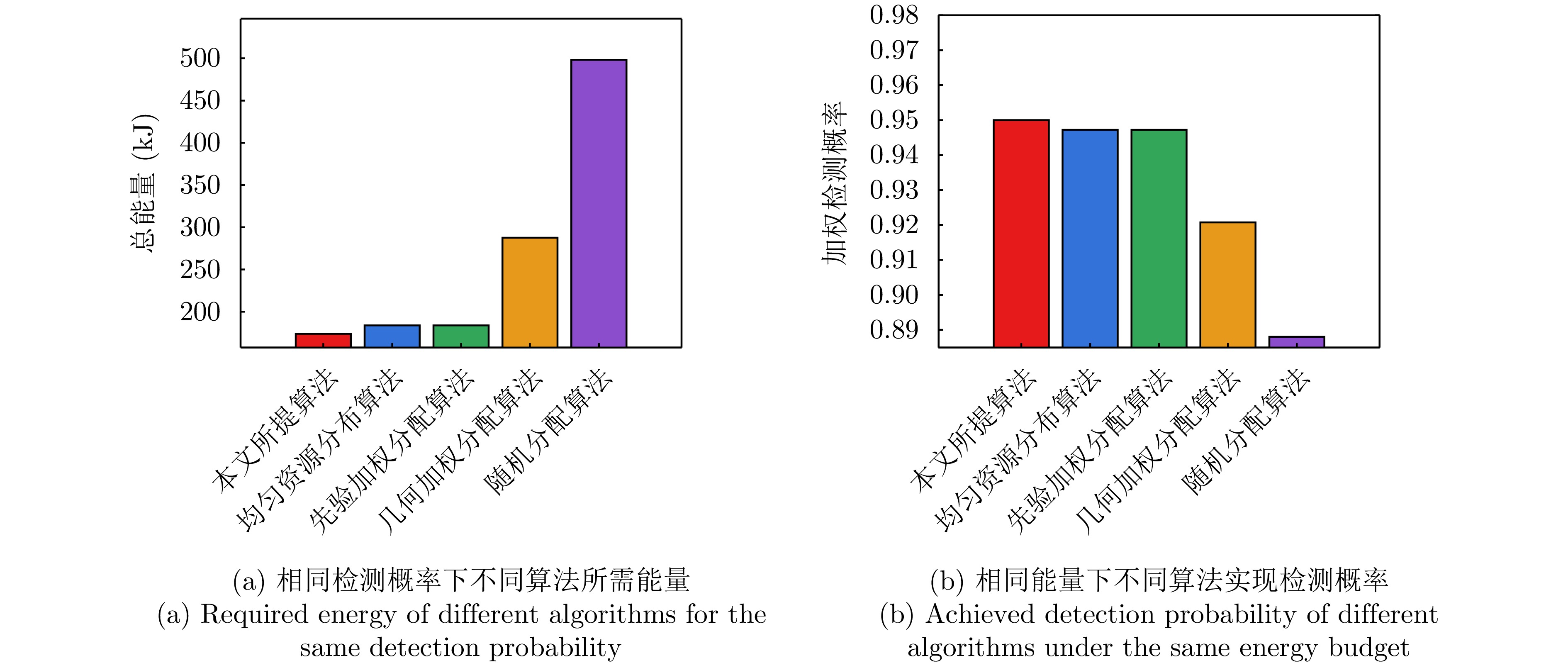
图 4 均匀先验场景下不同算法的能量消耗与检测性能对比
Figure 4. Comparison of energy consumption and detection performance of different algorithms in the uniform-prior scenario
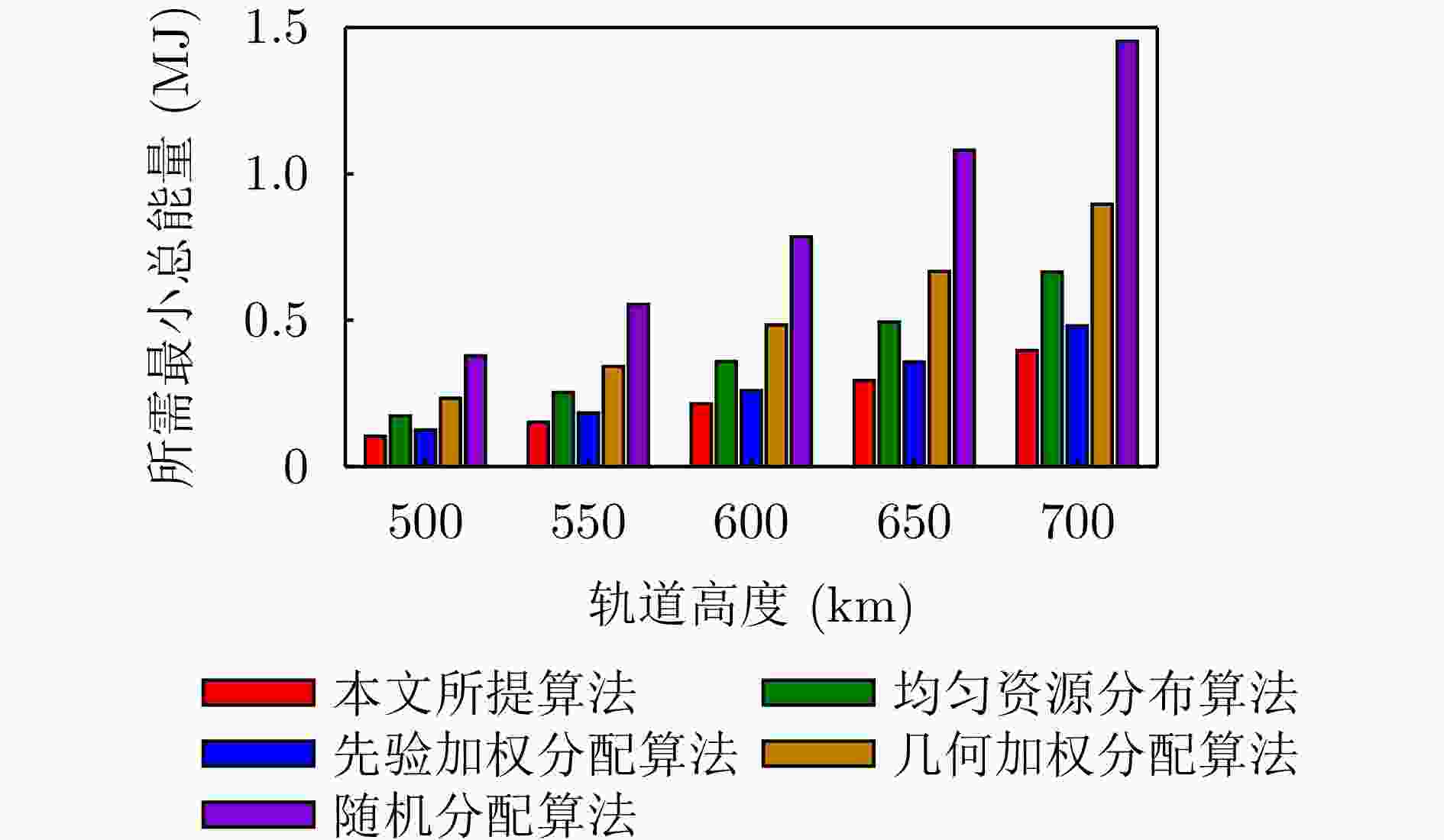
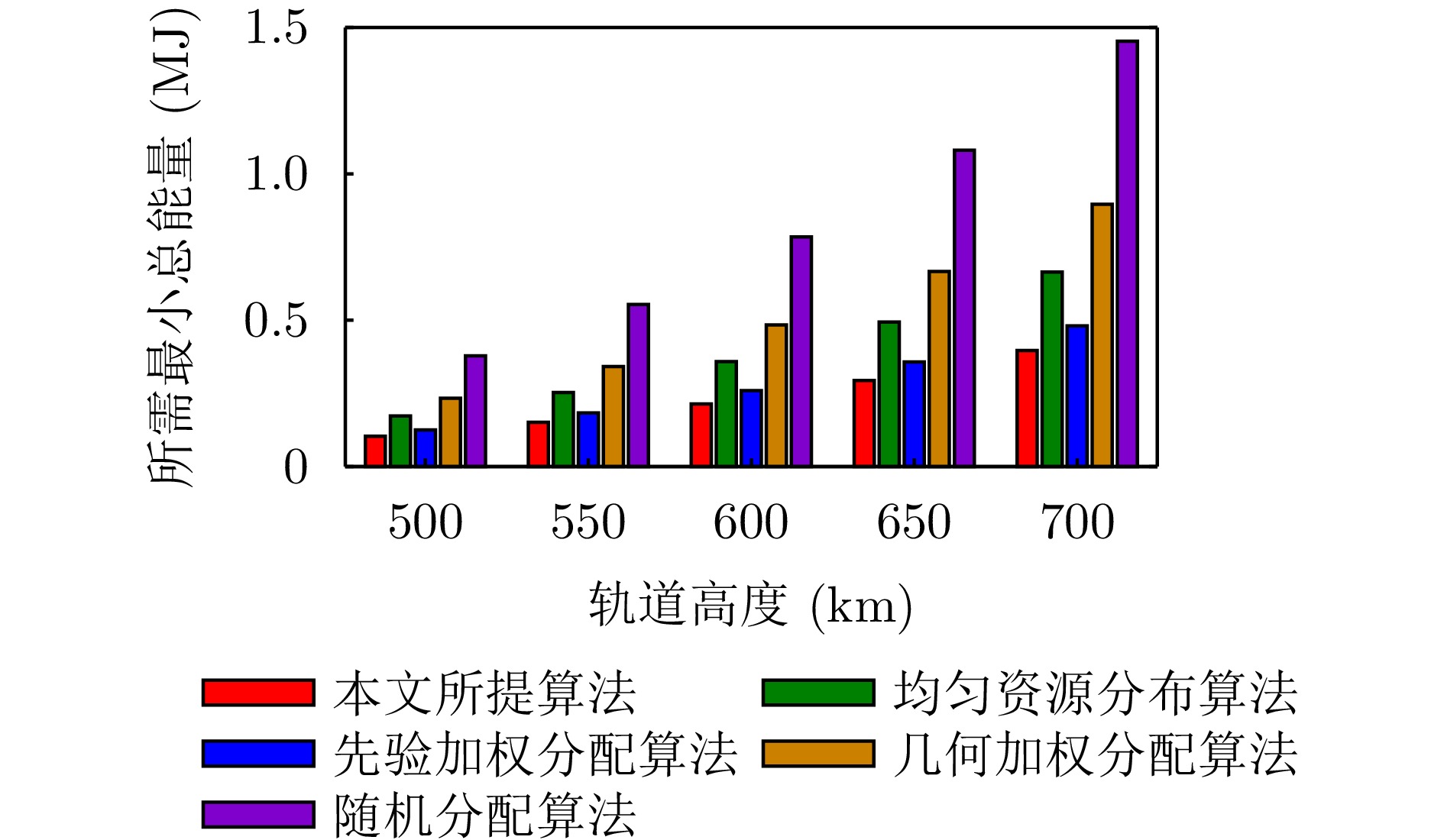
图 5 不同轨道高度下不同算法达到检测门限所需能量
Figure 5. Required energy of different algorithms to achieve the detection threshold at different orbital heights
1 面向射频隐身的星座雷达区域搜索能量管控与波位任务调度算法
1. RF Stealth-oriented energy management and beam-position task scheduling algorithm for regional search in constellation radar
输入:预生成波位集合、区域检测性能门限、单波位能量上/下
界、波位先验威胁信息、几何链路信息及搜索终止阈值。步骤1 根据单波位能量约束初始化星座雷达总辐射能量搜索
区间;步骤2 在当前总能量预算下,构造固定总能量约束下的波位能
量优化子问题;步骤3 求解内层波位能量优化问题,得到当前总能量预算对应
的波位能量分配结果,并计算相应的区域加权检测概率;步骤4 判断当前检测性能是否满足预设门限;若满足,则收缩
总能量搜索上界,否则收缩搜索下界,并重复步骤2和步骤3,
直至满足终止条件;步骤5 根据最优波位能量分配结果和波位优先级,采用配额感
知轮询与补盲调度策略,将波位搜索任务分派至各天基雷达,并
按调度序列依次执行;输出:波位能量分配结果及多星波位任务调度结果。  下载: 导出CSV
表 1 星座雷达仿真参数设置
Table 1. Simulation parameters of the constellation radar
参数 数值 参数 数值 $ {G}_{\text{t}} $ 46 dB $ {L}_{\text{s}} $ 3 dB $ \lambda $ 0.03 m $ {k}_{\text{B}} $ $ 1.38\times {10}^{-23}\;{\mathrm{J}}/{\mathrm{K}} $ $ {T}_{\text{e}} $ 290 K $ \sigma $ $ 1\;{{\mathrm{m}}}^{2} $ $ {A}_{\text{e}} $ $ 4\;{{\mathrm{m}}}^{2} $ $ {P}_{\text{fa}} $ $ 1{\mathrm{E}}-6 $
下载: 导出CSV
表 2 不同算法策略下的能量消耗与探测性能对比
Table 2. Comparison of energy consumption and detection performance under different algorithms
算法策略 资源分配机制 总辐射能量消耗(MJ) 能量节约比(%) 覆盖完备性(%) 本文所提算法 拉格朗日解 0.105 – 100 均匀资源分布算法 均匀能量分布 0.175 40.0 100 先验加权分配算法 仅依据威胁度分配 0.125 16.0 100 几何加权分配算法 仅补偿距离损耗 0.230 54.3 100 随机分配算法 随机资源调度 0.380 72.4 100
下载: 导出CSV
-
[1] 贲德, 林幼权. 天基监视雷达[J]. 现代雷达, 2005, 27(4): 1–4. doi: 10.3969/j.issn.1004-7859.2005.04.001.BEN De and LIN Youquan. Space-based surveillance radar[J]. Modern Radar, 2005, 27(4): 1–4. doi: 10.3969/j.issn.1004-7859.2005.04.001. [2] 贲德, 龙伟军. 天基雷达的关键技术[J]. 数据采集与处理, 2013, 28(4): 391–396. doi: 10.3969/j.issn.1004-9037.2013.04.001.BEN De and LONG Weijun. Key technology of space-based radar[J]. Journal of Data Acquisition and Processing, 2013, 28(4): 391–396. doi: 10.3969/j.issn.1004-9037.2013.04.001. [3] XIAO Peng, LIU Bo, and GUO Wei. ConGaLSAR: A constellation of geostationary and low Earth orbit synthetic aperture radar[J]. IEEE Geoscience and Remote Sensing Letters, 2020, 17(12): 2085–2089. doi: 10.1109/LGRS.2019.2962574. [4] XIAO Peng, LIU Bo, WU Youming, et al. A comprehensive method of ambiguity suppression for constellation of geostationary and low Earth orbit SAR[J]. IEEE Journal of Selected Topics in Applied Earth Observations and Remote Sensing, 2020, 13: 3327–3335. doi: 10.1109/JSTARS.2020.3002392. [5] SCHLEHER D C. LPI radar: Fact or fiction[J]. IEEE Aerospace and Electronic Systems Magazine, 2006, 21(5): 3–6. doi: 10.1109/MAES.2006.1635166. [6] 时晨光, 董璟, 周建江, 等. 飞行器射频隐身技术研究综述[J]. 系统工程与电子技术, 2021, 43(6): 1452–1467. doi: 10.12305/j.issn.1001-506X.2021.06.02.SHI Chenguang, DONG Jing, ZHOU Jianjiang, et al. Overview of aircraft radio frequency stealth technology[J]. Systems Engineering and Electronics, 2021, 43(6): 1452–1467. doi: 10.12305/j.issn.1001-506X.2021.06.02. [7] LYNCH JR D, 沈玉芳, 译. 射频隐身导论[M]. 西安: 西北工业大学出版社, 2009: 1–17.LYNCH JR D, SHEN Yufang, translation. Introduction to RF Stealth[M]. Xi’an: Northwestern Polytechnical University Press, 2009: 1–17. [8] 陈荣. 美国天基预警雷达系统发展[J]. 国防科技, 2014, 35(2): 76–83. doi: 10.3969/j.issn.1671-4547.2014.02.019.CHEN Rong. Study of American space-based warning radar system development[J]. National Defense Science & Technology, 2014, 35(2): 76–83. doi: 10.3969/j.issn.1671-4547.2014.02.019. [9] 林幼权, 武楠. 天基预警雷达[M]. 北京: 国防工业出版社, 2017: 15–18.LIN Youquan and WU Nan. Space Based Early Warning Radar[M]. Beijing: National Defense Industry Press, 2017: 15–18. [10] ZHANG Biao, MOUCHE A A, and PERRIE W. First quasi-synchronous hurricane quad-polarization observations by C-band radar constellation mission and RADARSAT-2[J]. IEEE Transactions on Geoscience and Remote Sensing, 2022, 60: 4206510. doi: 10.1109/TGRS.2022.3161002. [11] 郑舒予, 杨庆伟, 蒋李兵, 等. 面向预警监视任务的天基雷达研究进展[J]. 系统工程与电子技术, 2025, 47(10): 3199–3217. doi: 10.12305/j.issn.1001-506X.2025.10.08.ZHENG Shuyu, YANG Qingwei, JIANG Libing, et al. Research progress on space-based radar for early warning and surveillance task[J]. Systems Engineering and Electronics, 2025, 47(10): 3199–3217. doi: 10.12305/j.issn.1001-506X.2025.10.08. [12] 易伟, 袁野, 刘光宏, 等. 多雷达协同探测技术研究进展: 认知跟踪与资源调度算法[J]. 雷达学报, 2023, 12(3): 471–499. doi: 10.12000/JR23036.YI Wei, YUAN Ye, LIU Guanghong, et al. Recent advances in multi-radar collaborative surveillance: Cognitive tracking and resource scheduling algorithms[J]. Journal of Radars, 2023, 12(3): 471–499. doi: 10.12000/JR23036. [13] YAN Junkun, JIAO Hong, PU Wenqiang, et al. Radar sensor network resource allocation for fused target tracking: A brief review[J]. Information Fusion, 2022, 86/87: 104–115. doi: 10.1016/j.inffus.2022.06.009. [14] DAI Jinhui, YAN Junkun, WANG Penghui, et al. Optimal resource allocation for multiple target tracking in phased array radar network[C]. 2019 International Conference on Control, Automation and Information Sciences (ICCAIS), Chengdu, China, 2019: 1–4. doi: 10.1109/ICCAIS46528.2019.9074602. [15] 时晨光, 周建江, 汪飞, 等. 机载雷达组网射频隐身技术[M]. 北京: 国防工业出版社, 2019: 1–23.SHI Chenguang, ZHOU Jianjiang, WANG Fei, et al. Radio Frequency Stealth Technology for Airborne Radar Network[M]. Beijing: National Defense Industry Press, 2019: 1–23. [16] 时晨光, 丁琳涛, 汪飞, 等. 面向射频隐身的组网雷达多目标跟踪下射频辐射资源优化分配算法[J]. 电子与信息学报, 2021, 43(3): 539–546. doi: 10.11999/JEIT200636.SHI Chenguang, DING Lintao, WANG Fei, et al. Radio frequency stealth-based optimal radio frequency resource allocation algorithm for multiple-target tracking in radar network[J]. Journal of Electronics & Information Technology, 2021, 43(3): 539–546. doi: 10.11999/JEIT200636. [17] 卢秀娟. 低截获约束下针对目标跟踪的雷达资源调度方法研究[D]. [博士论文], 电子科技大学, 2023: 55–68. doi: 10.27005/d.cnki.gdzku.2023.005499.LU Xiujuan. Research on radar resource scheduling method for target tracking under LPI constraints[D]. [Ph.D. dissertation], University of Electronic Science and Technology of China, 2023: 55–68. doi: 10.27005/d.cnki.gdzku.2023.005499. [18] SHI Chenguang, DING Lintao, WANG Fei, et al. Joint target assignment and resource optimization framework for multitarget tracking in phased array radar network[J]. IEEE Systems Journal, 2021, 15(3): 4379–4390. doi: 10.1109/JSYST.2020.3025867. [19] YAN Junkun, PU Wenqiang, ZHOU Shenghua, et al. Optimal resource allocation for asynchronous multiple targets tracking in heterogeneous radar networks[J]. IEEE Transactions on Signal Processing, 2020, 68: 4055–4068. doi: 10.1109/TSP.2020.3007313. [20] 张巍巍. 面向目标定位的组网雷达射频隐身资源管理技术研究[D]. [博士论文], 南京航空航天大学, 2022: 29–37. doi: 10.27239/d.cnki.gnhhu.2022.002414.ZHANG Weiwei. Research on resource management technology for RF stealth in radar network for target localization[D]. [Ph.D. dissertation], Nanjing University of Aeronautics and Astronautics, 2022: 29–37. doi: 10.27239/d.cnki.gnhhu.2022.002414. [21] SHI Chenguang, WANG Fei, SELLATHURAI M, et al. Low probability of intercept-based optimal power allocation scheme for an integrated multistatic radar and communication system[J]. IEEE Systems Journal, 2020, 14(1): 983–994. doi: 10.1109/JSYST.2019.2931754. [22] HUANG Jieyu, XIE Junwei, YANG Ziqing, et al. Joint resource allocation strategy for multiple target tracking in networked collocated MIMO radar system[J]. IEEE Transactions on Vehicular Technology, 2025, 74(5): 7201–7211. doi: 10.1109/TVT.2025.3525642. [23] 鲁彦希. 网络化雷达协同探测与资源管理研究[D]. [博士论文], 电子科技大学, 2020: 25–47. doi: 10.27005/d.cnki.gdzku.2020.000589.LU Yanxi. Research on cooperative sensing and resource management for networked radar[D]. [Ph.D. dissertation], University of Electronic Science and Technology of China, 2020: 25–47. doi: 10.27005/d.cnki.gdzku.2020.000589. [24] YI Wei, YUAN Ye, HOSEINNEZHAD R, et al. Resource scheduling for distributed multi-target tracking in netted colocated MIMO radar systems[J]. IEEE Transactions on Signal Processing, 2020, 68: 1602–1617. doi: 10.1109/TSP.2020.2976587. [25] YAN Junkun, DAI Jinhui, PU Wenqiang, et al. Target capacity based resource optimization for multiple target tracking in radar network[J]. IEEE Transactions on Signal Processing, 2021, 69: 2410–2421. doi: 10.1109/TSP.2021.3071173. [26] SHI Chenguang, WANG Yijie, SALOUS S, et al. Joint transmit resource management and waveform selection strategy for target tracking in distributed phased array radar network[J]. IEEE Transactions on Aerospace and Electronic Systems, 2022, 58(4): 2762–2778. doi: 10.1109/TAES.2021.3138869. [27] WANG Wenqin. Moving-target tracking by cognitive RF stealth radar using frequency diverse array antenna[J]. IEEE Transactions on Geoscience and Remote Sensing, 2016, 54(7): 3764–3773. doi: 10.1109/TGRS.2016.2527057. [28] 刘辛雨. 低截获概率雷达信号设计方法研究[D]. [博士论文], 电子科技大学, 2023: 35–48. doi: 10.27005/d.cnki.gdzku.2023.005917.LIU Xinyu. Research on signal design methods for low probability of intercept radar[D]. [Ph.D. dissertation], University of Electronic Science and Technology of China, 2023: 35–48. doi: 10.27005/d.cnki.gdzku.2023.005917. [29] DING Lintao, SHI Chenguang, and ZHOU Jianjiang. Joint beampattern design and online route planning for multitarget tracking in airborne radar system[J]. IEEE Transactions on Aerospace and Electronic Systems, 2024, 60(1): 774–788. doi: 10.1109/TAES.2023.3328799. [30] YAN Junkun, PU Wenqiang, LIU Hongwei, et al. Robust chance constrained power allocation scheme for multiple target localization in colocated MIMO radar system[J]. IEEE Transactions on Signal Processing, 2018, 66(15): 3946–3957. doi: 10.1109/TSP.2018.2841865. [31] 时晨光, 唐志诚, 周建江, 等. 非理想检测下多雷达网络节点选择与辐射资源联合优化分配算法[J]. 雷达学报(中英文), 2024, 13(3): 565–583. doi: 10.12000/JR23081.SHI Chenguang, TANG Zhicheng, ZHOU Jianjiang, et al. Joint collaborative radar selection and transmit resource allocation in multiple distributed radar networks with imperfect detection performance[J]. Journal of Radars, 2024, 13(3): 565–583. doi: 10.12000/JR23081. [32] XU Haicheng, SUN Jun, YUAN Ye, et al. Beam pattern-aware resource allocation for phased array radar network under suppression jamming[J]. IEEE Sensors Journal, 2024, 24(15): 24825–24840. doi: 10.1109/JSEN.2024.3414429. [33] 王增福, 杨广宇, 金术玲. 考虑综合性能最优的非短视快速天基雷达多目标跟踪资源调度算法[J]. 雷达学报(中英文), 2024, 13(1): 253–269. doi: 10.12000/JR23162.WANG Zengfu, YANG Guangyu, and JIN Shuling. A non-myopic and fast resource scheduling algorithm for multi-target tracking of space-based radar considering optimal integrated performance[J]. Journal of Radars, 2024, 13(1): 253–269. doi: 10.12000/JR23162. [34] 杨迪, 李振瑜, 郭帅, 等. 天基低轨海上移动目标成像搜索任务调度[J]. 航空学报, 2023, 44(15): 528752. doi: 10.7527/S1000-6893.2023.28752.YANG Di, LI Zhenyu, GUO Shuai, et al. Space-based LEO-observation search planning for maritime moving targets[J]. Acta Aeronautica et Astronautica Sinica, 2023, 44(15): 528752. doi: 10.7527/S1000-6893.2023.28752. [35] 潘越, 郭继光. 预警卫星与地基雷达协同引导计算及效能分析[J]. 中国电子科学研究院学报, 2018, 13(4): 421–426. doi: 10.3969/j.issn.1673-5692.2018.04.011.PAN Yue and GUO Jiguang. Calculation and efficiency analysis of coordinated detecting for early-warning satellite and radar[J]. Journal of China Academy of Electronics and Information Technology, 2018, 13(4): 421–426. doi: 10.3969/j.issn.1673-5692.2018.04.011. [36] 柳超, 王月基. 对海探测雷达多目标跟踪技术综述[J]. 雷达学报, 2021, 10(1): 100–115. doi: 10.12000/JR20081.LIU Chao and WANG Yueji. Review of multi-target tracking technology for marine radar[J]. Journal of Radars, 2021, 10(1): 100–115. doi: 10.12000/JR20081. [37] CHEN Jiangyuan, HUANG Penghui, XI Peili, et al. Approach for along-track baseline distribution design in a multi-satellite distributed space-based radar system[C]. IGARSS 2023 - 2023 IEEE International Geoscience and Remote Sensing Symposium, Pasadena, USA, 2023: 6125–6128. doi: 10.1109/IGARSS52108.2023.10282407. [38] 王阳. 一种低截获概率的波位编排方法[J]. 电讯技术, 2020, 60(9): 1064–1068. doi: 10.3969/j.issn.1001-893x.2020.09.010.WANG Yang. A beam position arrangement method with low probability of intercept[J]. Telecommunication Engineering, 2020, 60(9): 1064–1068. doi: 10.3969/j.issn.1001-893x.2020.09.010. [39] CHEN Jiangyuan, HUANG Penghui, XIA Xianggen, et al. Multichannel signal modeling and AMTI performance analysis for distributed space-based radar systems[J]. IEEE Transactions on Geoscience and Remote Sensing, 2022, 60: 5117724. doi: 10.1109/TGRS.2022.3202567. [40] 陈建平, 刘志中, 尤立志. 相控阵雷达最优波位编排策略仿真算法[J]. 科学技术与工程, 2019, 19(33): 244–250. doi: 10.3969/j.issn.1671-1815.2019.33.036.CHEN Jianping, LIU Zhizhong, and YOU Lizhi. Simulation algorithm of optimal beam position arrangement strategy for phased array radar[J]. Science Technology and Engineering, 2019, 19(33): 244–250. doi: 10.3969/j.issn.1671-1815.2019.33.036. [41] KOSURU R, ZHEN Qu, ZHEN Ding, et al. A modified reinforcement Q-learning method for multi-function phased array radar beam scheduling[C]. 2022 IEEE 21st International Conference on Cognitive Informatics & Cognitive Computing (ICCI*CC), Toronto, Canada, 2022: 16–21. doi: 10.1109/ICCICC57084.2022.10101623. [42] DENG Anbang, PEKTAS F, KUMRU F, et al. Adaptive beam scheduling for cooperative phased array radars with high-precision pencil-beam[J]. IEEE Transactions on Aerospace and Electronic Systems, 2023, 59(6): 8475–8488. doi: 10.1109/TAES.2023.3308549. [43] 刘晏池, 江涛, 林幼权, 等. 天基预警雷达扇区建立与波位编排方法分析[J]. 现代雷达, 2025, 47(1): 39–45. doi: 10.16592/j.cnki.1004-7859.2025.01.007.LIU Yanchi, JIANG Tao, LIN Youquan, et al. Analysis of the sector division and beam position arrangement for spaced-based early warning radar[J]. Modern Radar, 2025, 47(1): 39–45. doi: 10.16592/j.cnki.1004-7859.2025.01.007. [44] BOYD S and VANDENBERGHE L. Convex Optimization[M]. Cambridge: Cambridge University Press, 2004: 50–62. -

计量
- 文章访问数:
- HTML全文浏览量:
- PDF下载量:
- 被引次数: 0