

 作者中心
作者中心 专家审稿
专家审稿 责编办公
责编办公 编辑办公
编辑办公
Fast Structured Sparse Millimeter-wave 3D SAR Imaging Based on Low-rank and Smooth Matrix Completion
-
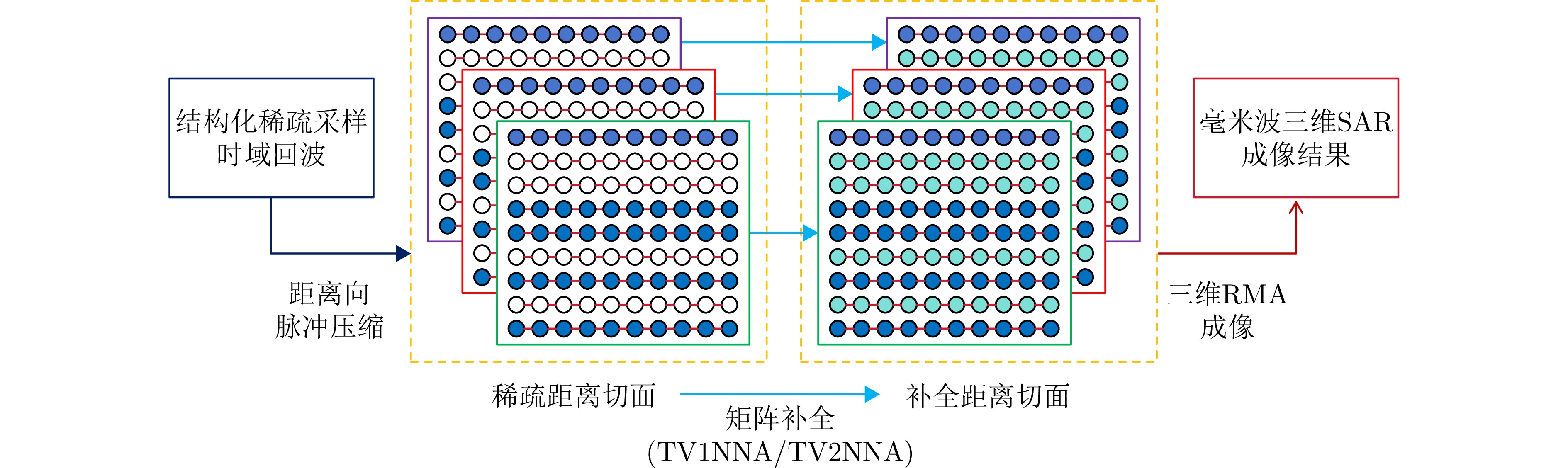
摘要: 毫米波雷达因其体积小、分辨率高、穿透能力强等优势,在安全检查、无损检测与穿墙成像等领域得到了广泛应用。高分辨率的毫米波雷达成像需要模拟合成孔径,即利用机械平台的结构化扫描实现二维空间密集采样,该过程在实际应用中耗时较长,因此已有许多研究在稀疏采样条件下对回波数据进行重建并用于成像。然而,现有稀疏恢复方法多依赖均匀随机采样假设,或计算复杂度较高,难以在合成孔径雷达(SAR)成像系统中实际应用。为解决此问题,该文提出一种基于低秩平滑矩阵补全的快速结构化稀疏毫米波三维SAR成像方法。首先,基于近场毫米波SAR成像原理,分析了回波数据所具有的全局低秩性质与局部平滑先验,论证了实际扫描采样中整行或整列缺失导致的结构化稀疏SAR数据具备可恢复性。在此基础上,构建了一种融合低秩与平滑约束的矩阵补全模型,该模型通过核范数与全变差正则化进行联合建模,并在交替方向乘子法(ADMM)框架下实现快速求解。最后,通过多组仿真与实测实验对所提出方法的性能进行验证,实验结果表明,在仅使用20%~30%随机稀疏采样的行或列回波数据下,该文方法即可在数十秒内实现快速数据恢复与高分辨率三维成像。Abstract: The millimeter-Wave (mmWave) radar is widely used in security screening, nondestructive testing, and through-the-wall imaging due to its compact size, high resolution, and strong penetration capability. High-resolution mmWave radar imaging typically requires synthetic aperture emulation, which involves dense two-dimensional spatial sampling via structured scanning on a mechanical platform. However, this process is time-consuming in practical applications. Therefore, many existing studies have focused on reconstructing echo data under sparse sampling conditions for imaging. However, most existing sparse recovery methods assume uniformly random sparse sampling or involve high computational complexity, making them difficult to apply in practical Synthetic Aperture Radar (SAR) imaging systems. This paper proposes a fast, structured sparse, mmWave three-Dimensional (3D) SAR imaging algorithm based on low-rank and smooth Matrix Completion (MC) to address this problem. First, the global low-rank property and local smoothness prior of echo data are analyzed within the framework of near-field mmWave SAR imaging theory. Our analysis demonstrated that structured sparse SAR data arising from missing entire rows or columns in practical scanning can be recovered. Building on this, an MC model incorporating low-rank and smoothness constraints was constructed. This MC model jointly regularizes with nuclear norm and total variation and can be solved efficiently using the Alternating Direction Method of Multipliers (ADMM). Finally, the performance of the proposed algorithm was validated through multiple simulation runs and real-world experiments. Experimental results showed that, using only 20%–30% of randomly sampled rows or columns of echo data, the proposed algorithm can achieve fast data recovery and high-resolution 3D imaging within tens of seconds.
-
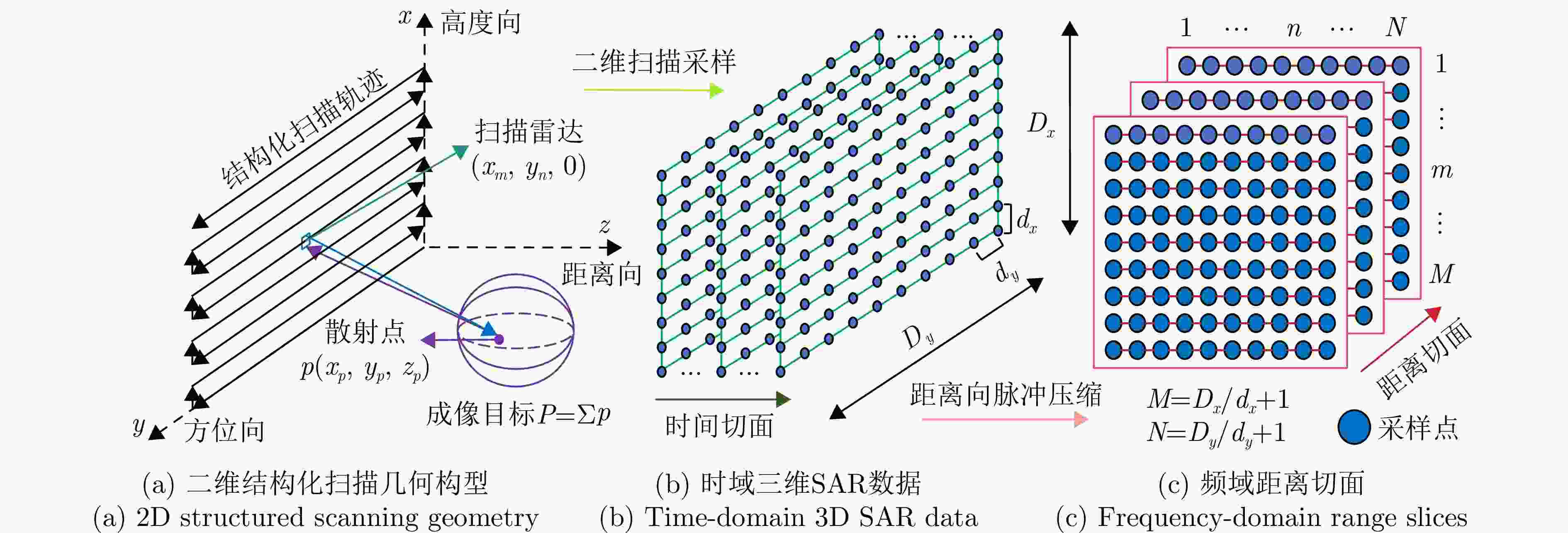
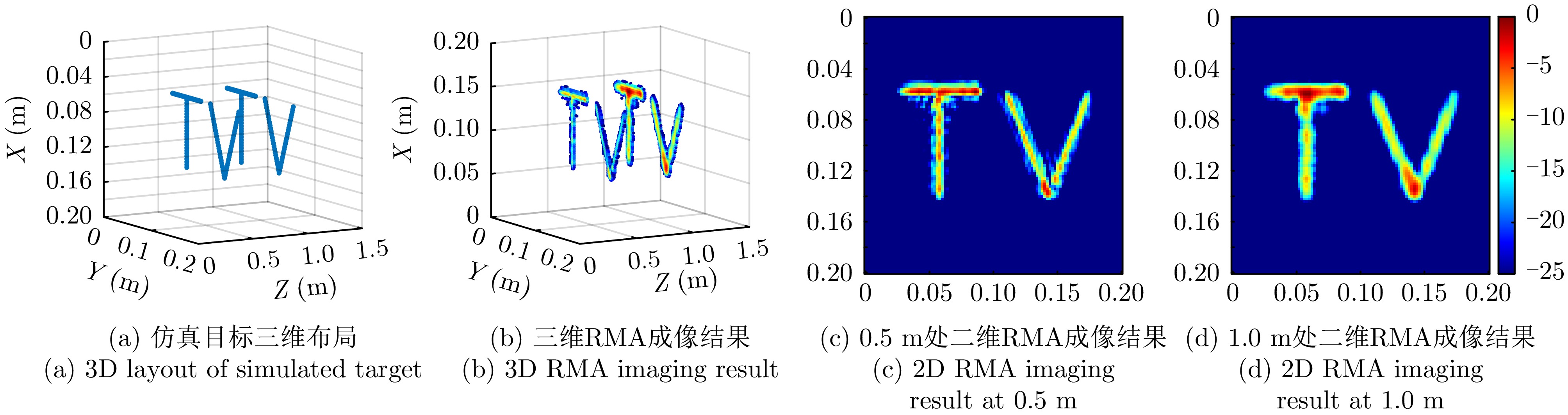
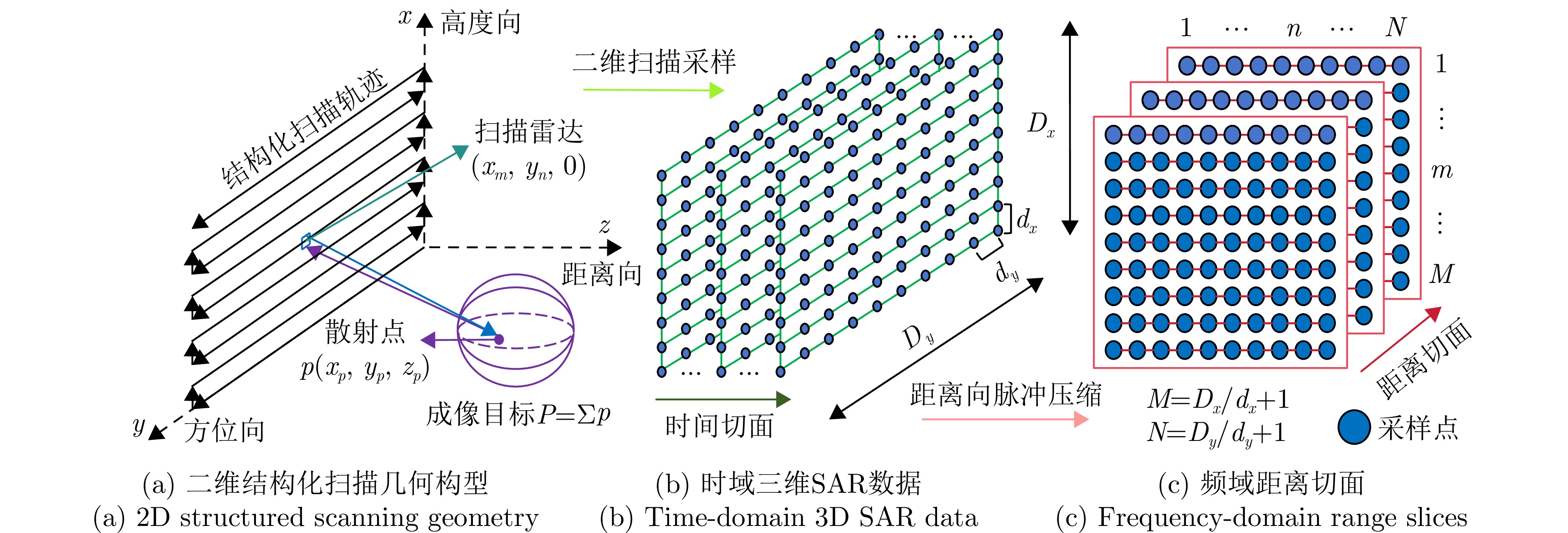
图 1 毫米波SAR成像几何构型与信号切面示意图
Figure 1. Schematic diagram of mmWave SAR imaging geometry and signal slices
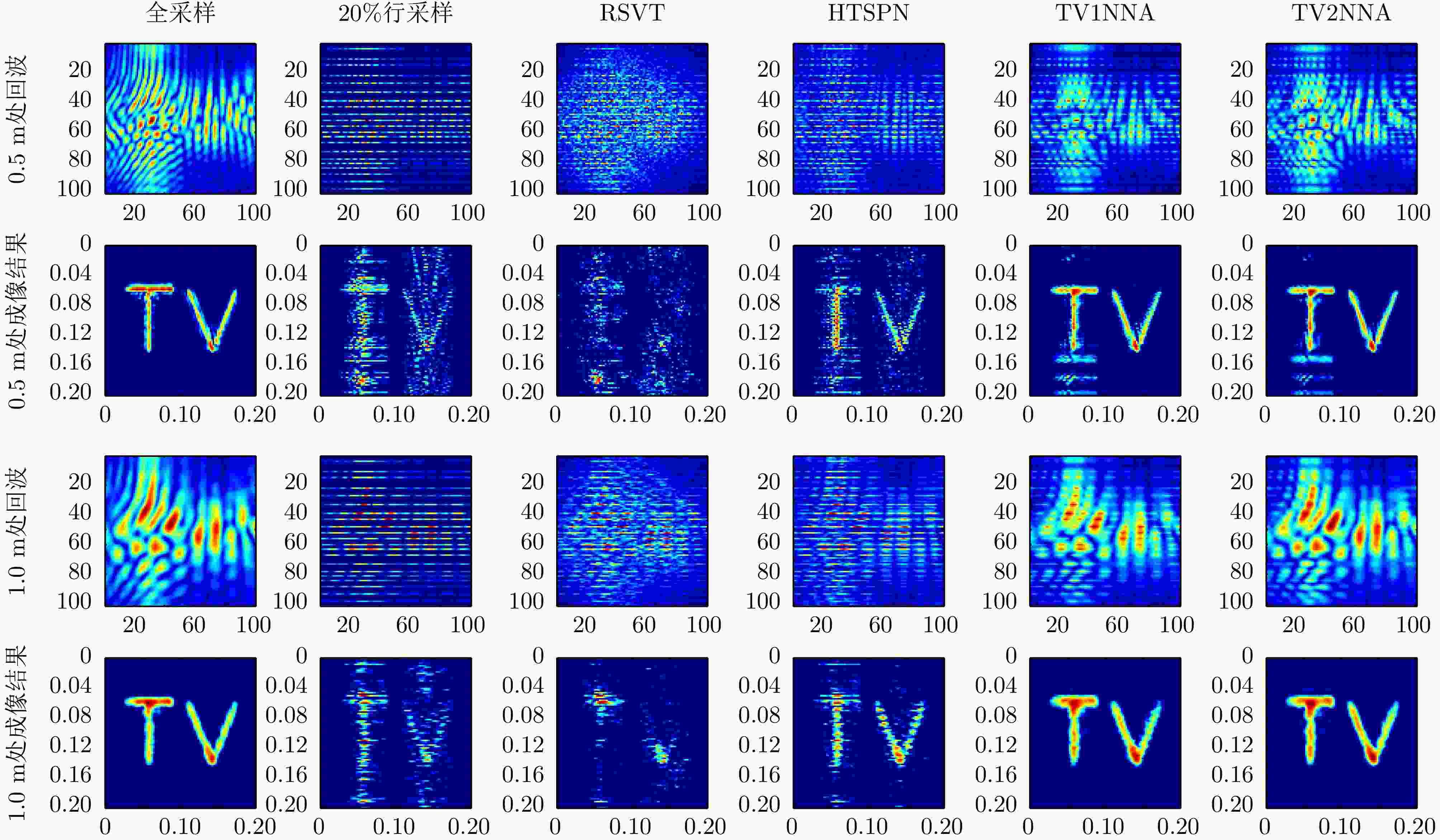
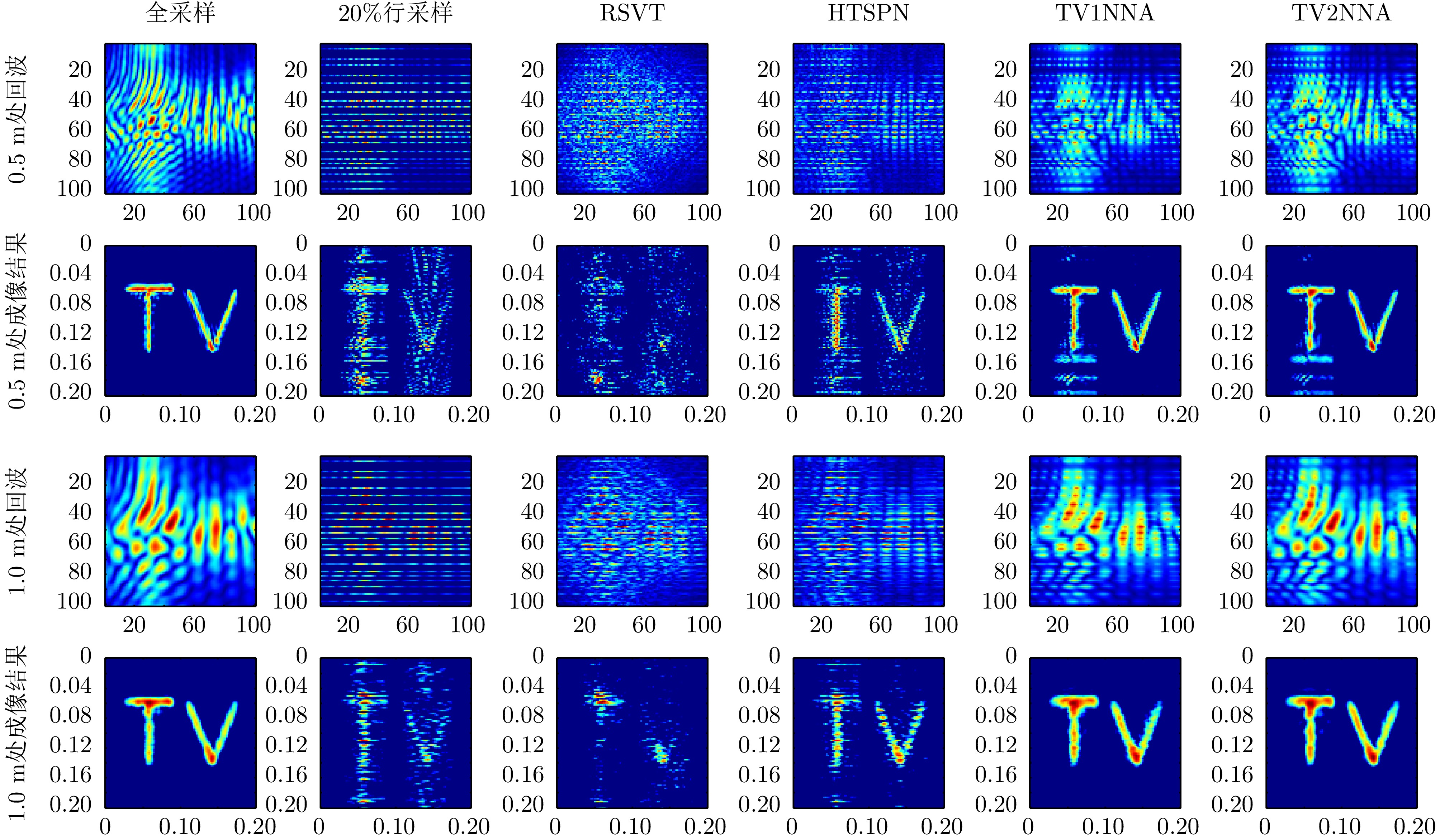
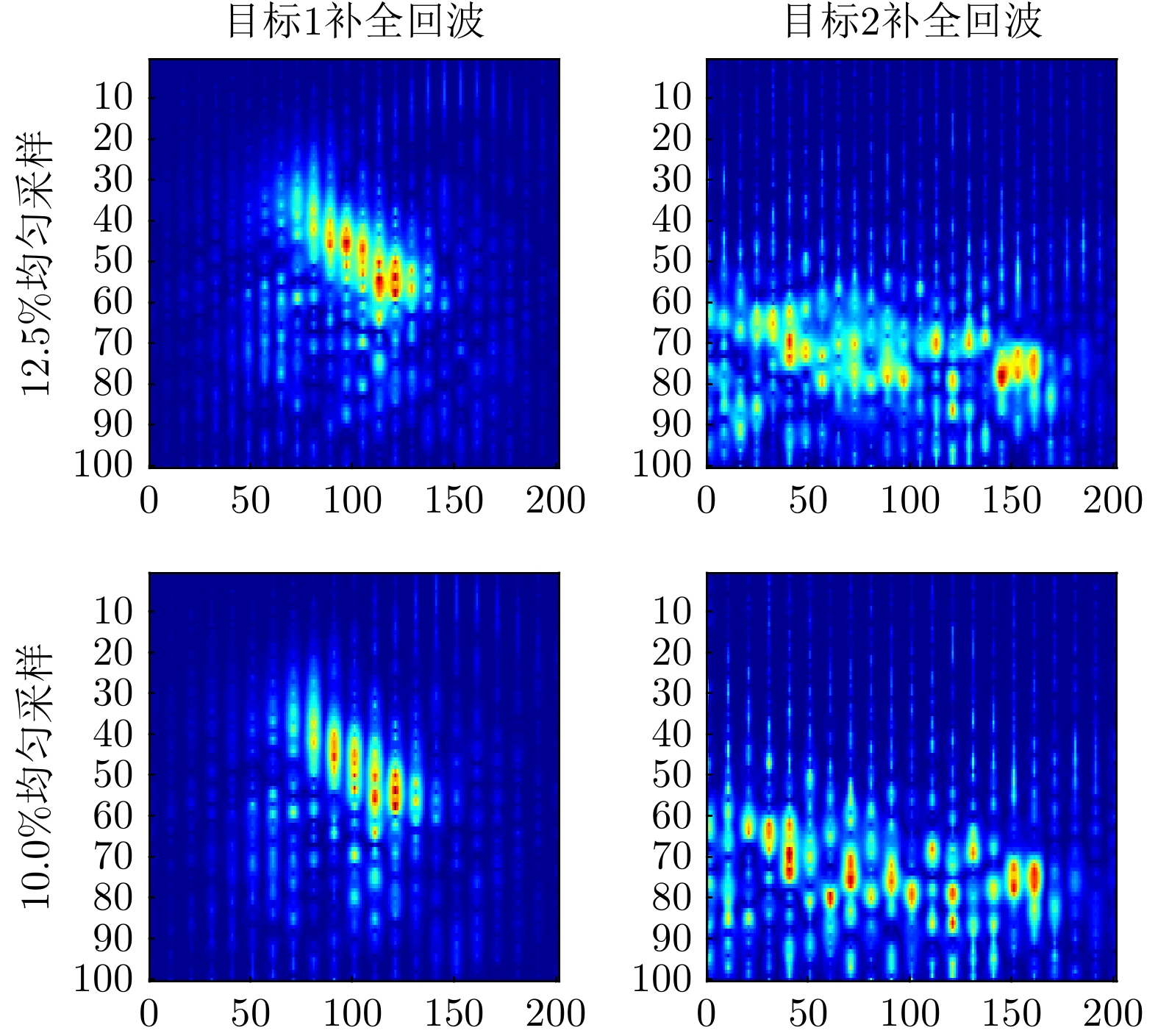
图 6 不同算法在20%行稀疏采样下的回波补全与成像结果对比
Figure 6. Comparison of echo completion and imaging results by different algorithms under 20% row sparse sampling
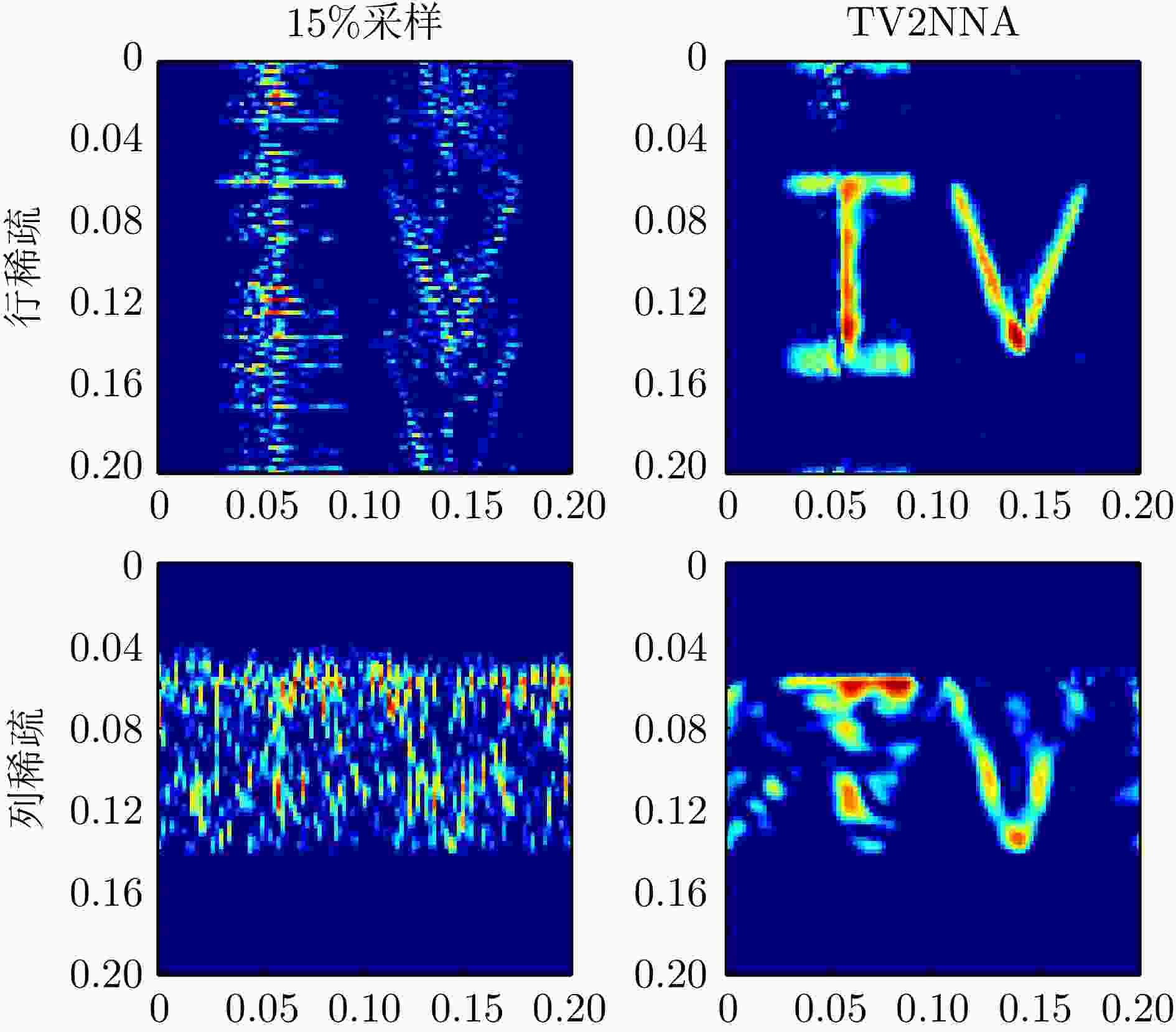
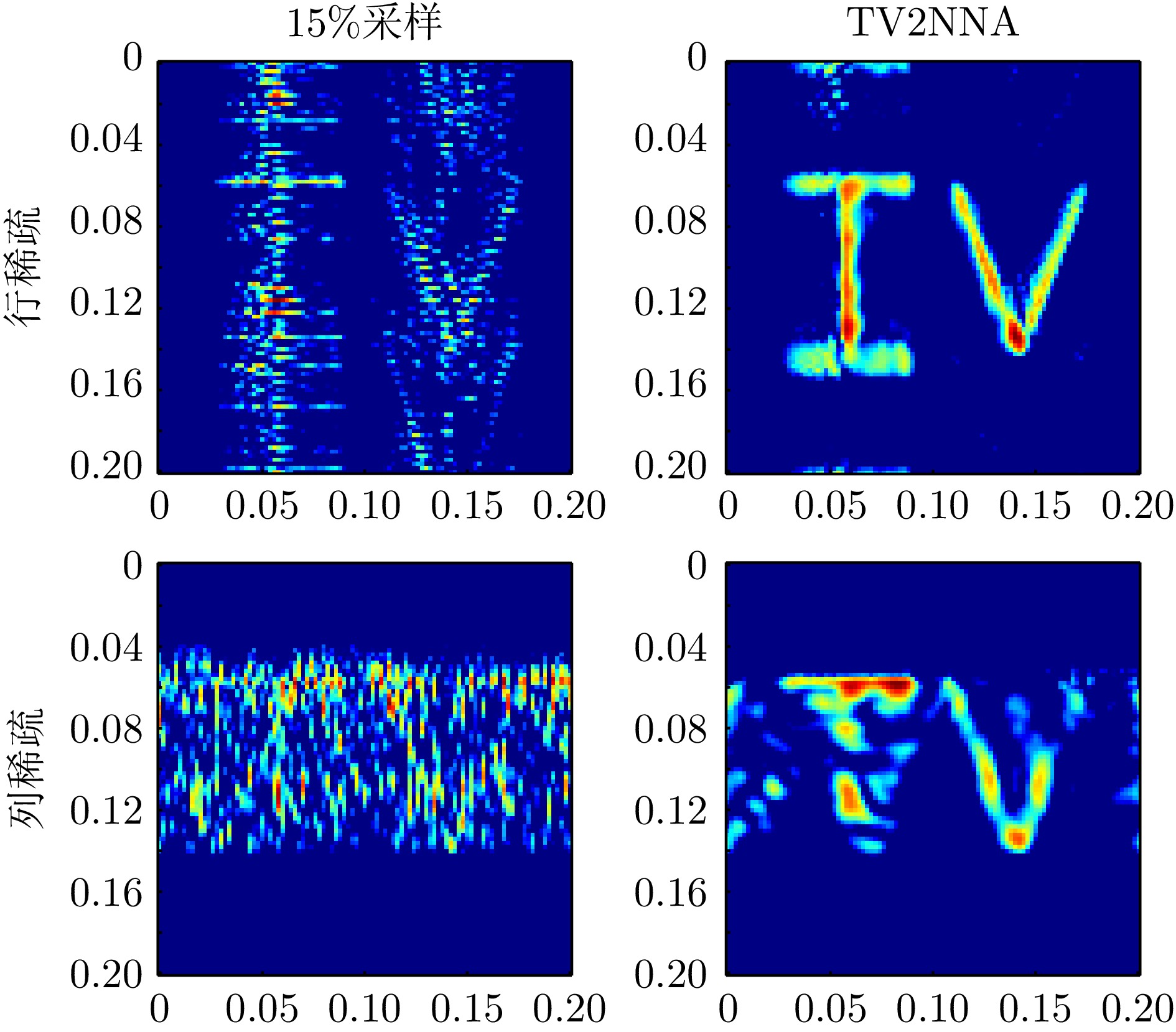
图 7 15%行稀疏与列稀疏采样下TV2NNA的成像结果
Figure 7. Imaging results by TV2NNA under 15% row and column sparse sampling
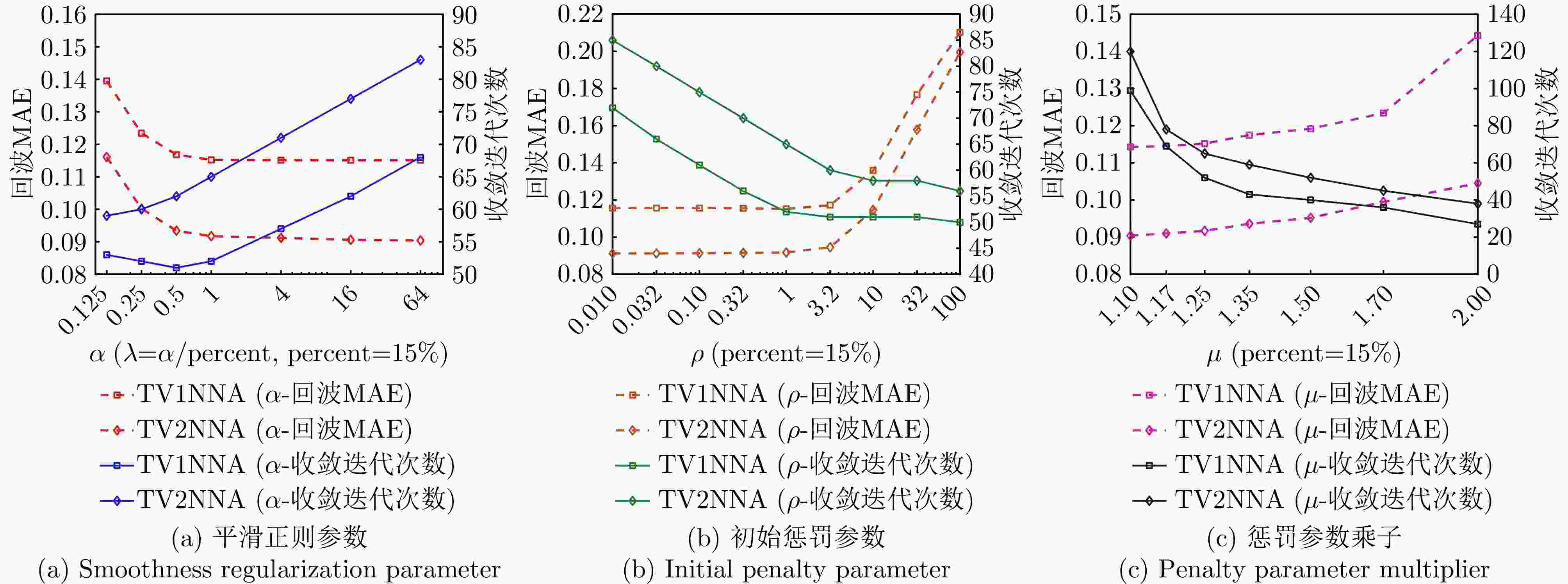
图 8 参数变化对算法性能与收敛速度的影响
Figure 8. Effect of parameter variations on algorithm performance and convergence speed
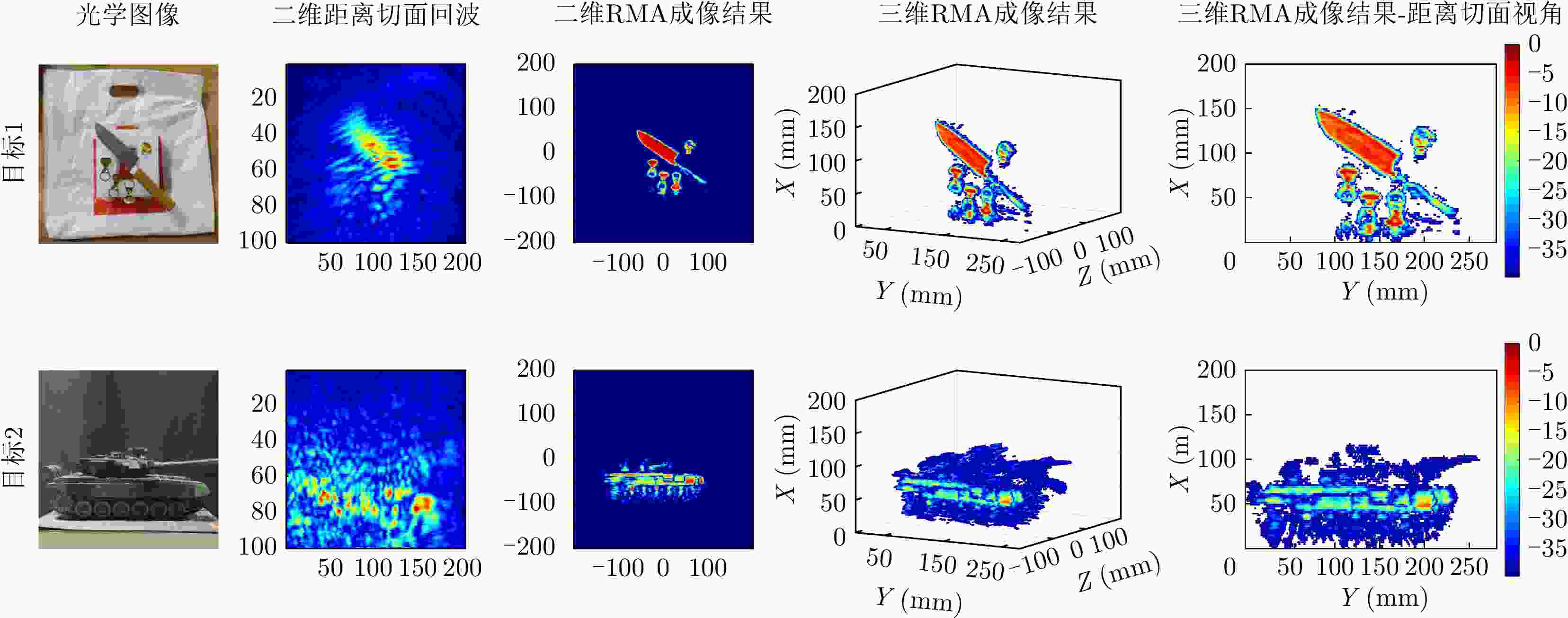
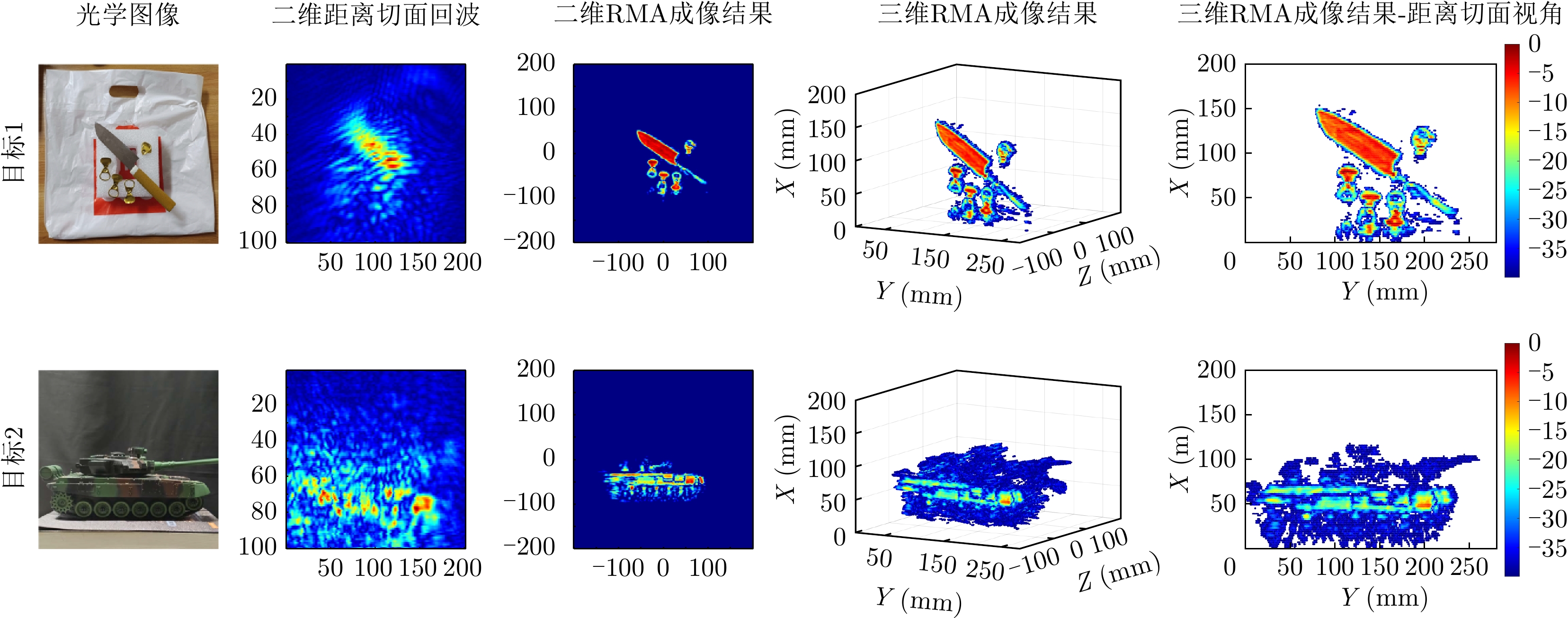
图 9 目标1与目标2的回波与RMA成像结果
Figure 9. Echoes and RMA imaging results of target 1 and target 2
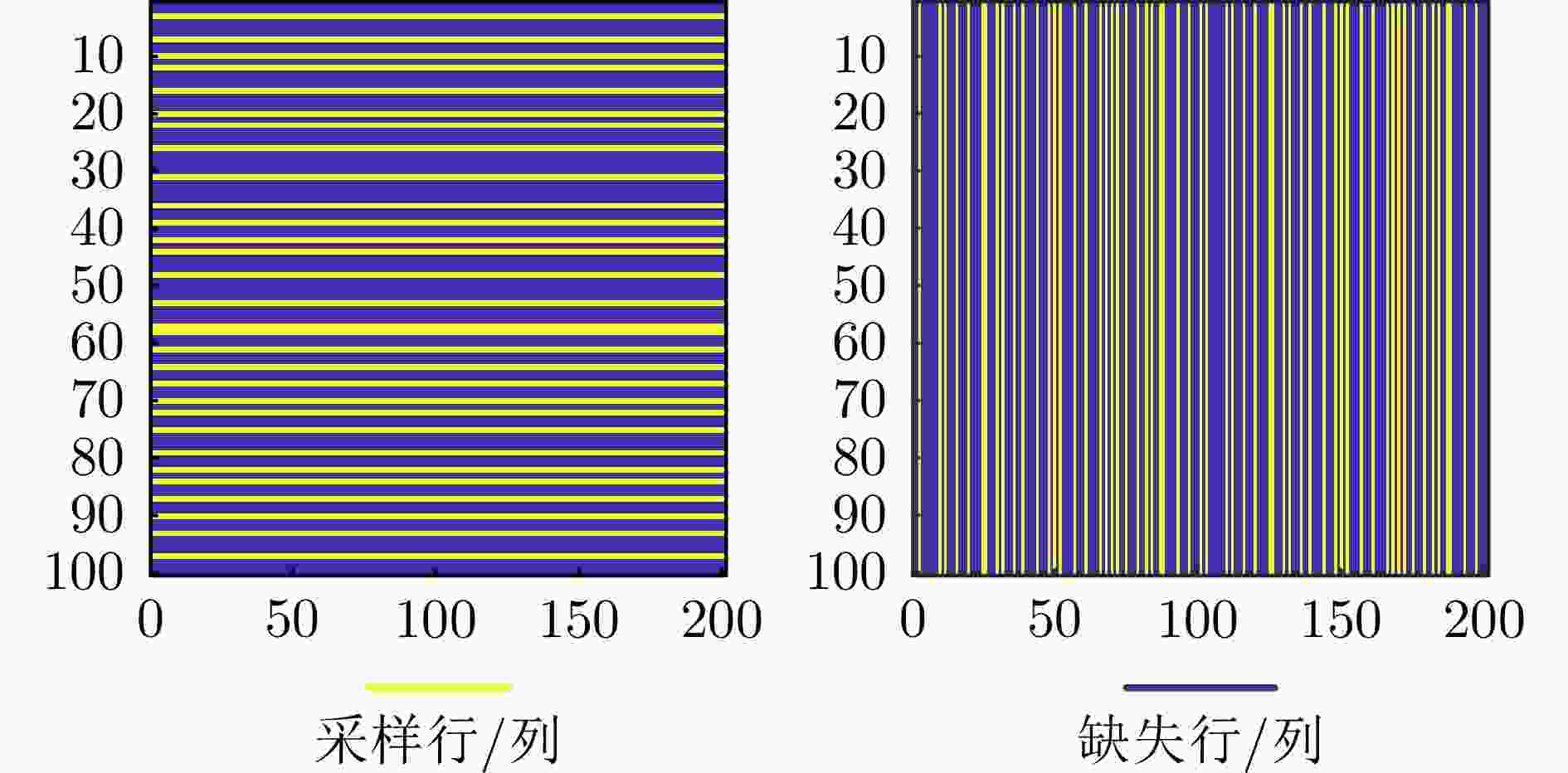
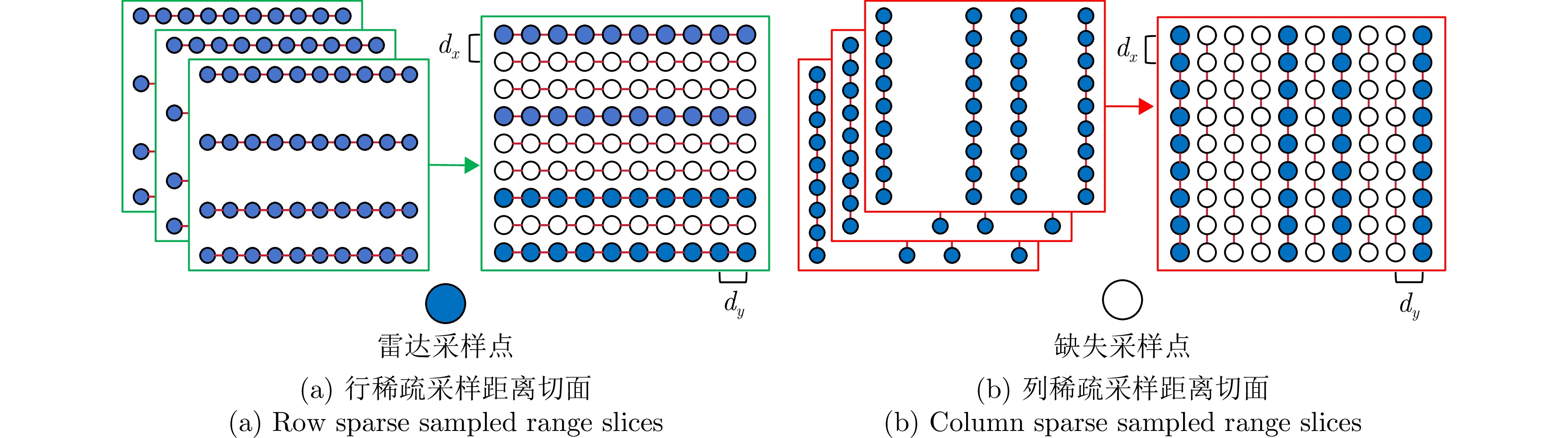
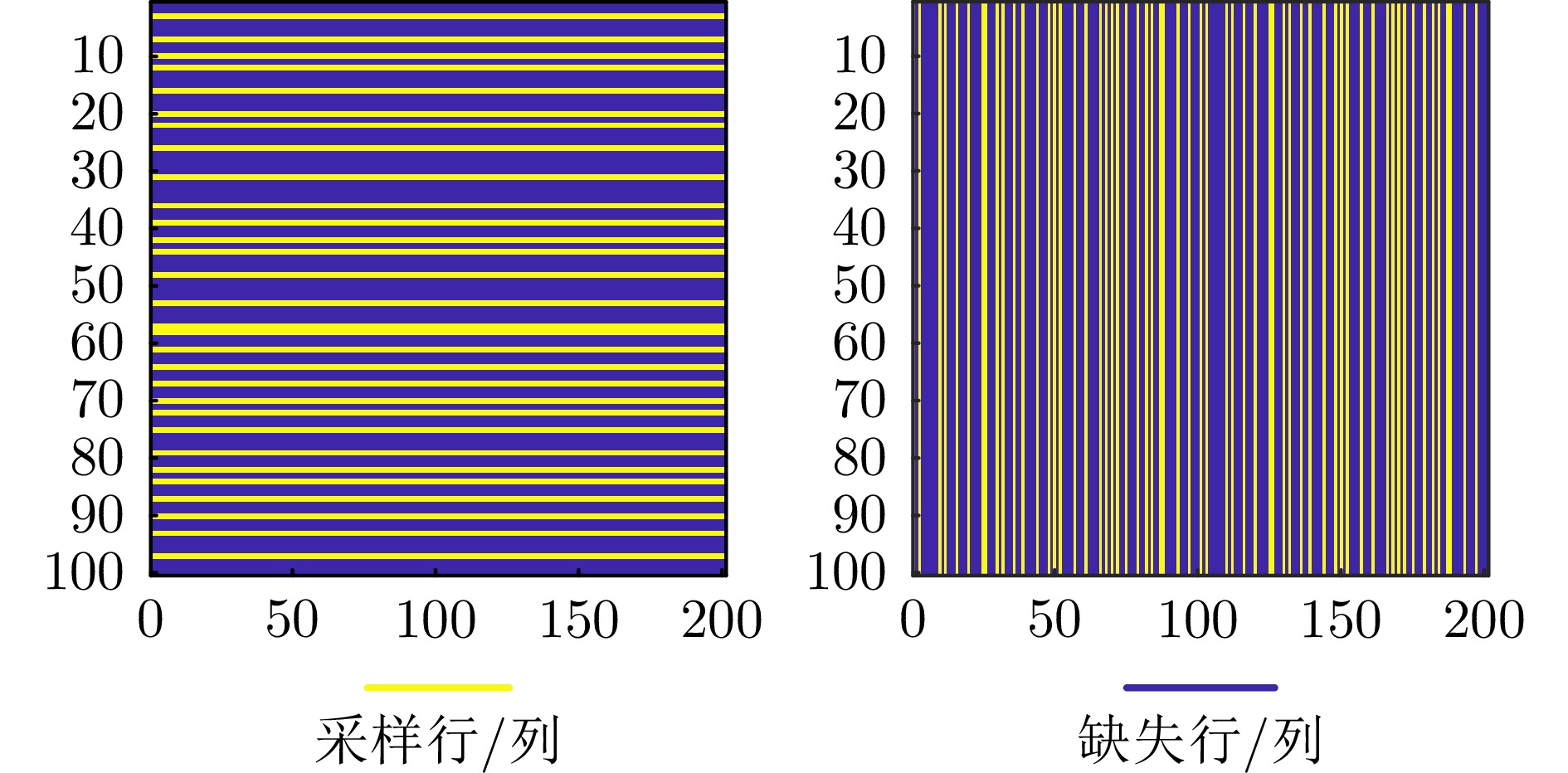
图 10 目标1与目标2的30%行稀疏与列稀疏采样模式
Figure 10. 30% row and column sparse sampling pattern for target 1 and target 2
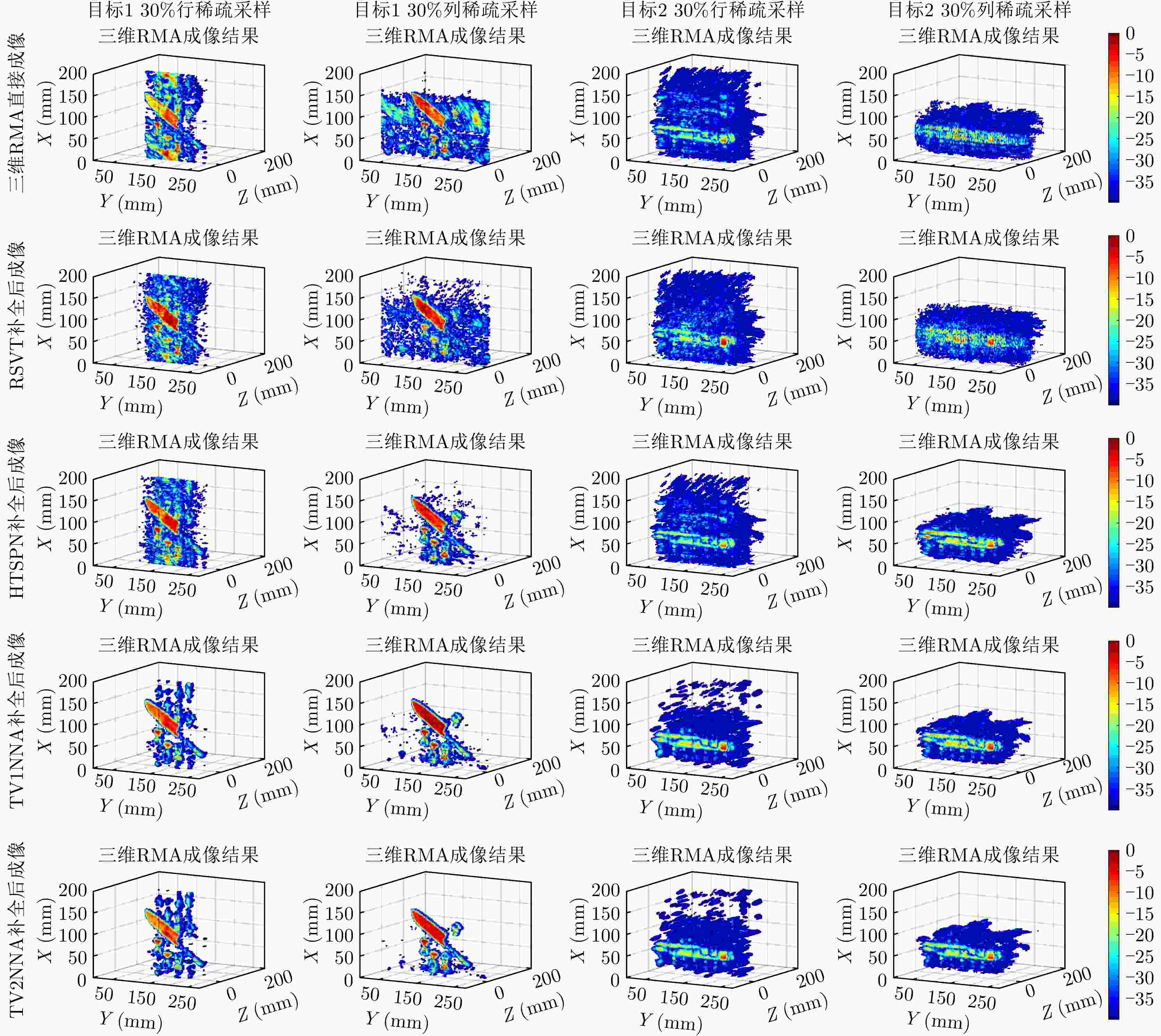
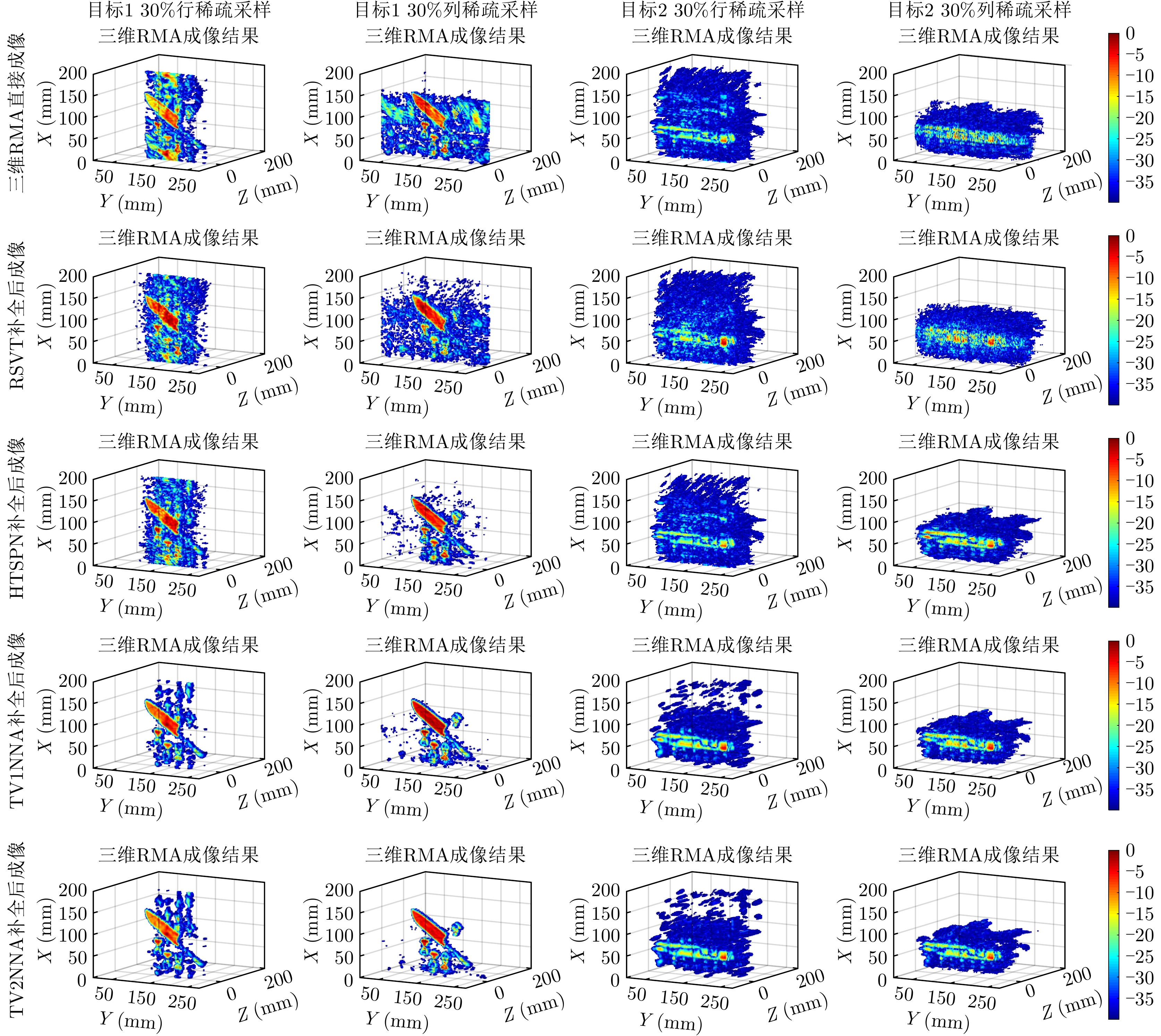
图 11 不同算法在30%行稀疏与列稀疏采样下的三维SAR成像结果对比
Figure 11. Comparison of 3D SAR imaging results by different algorithms under 30% row and column sparse sampling
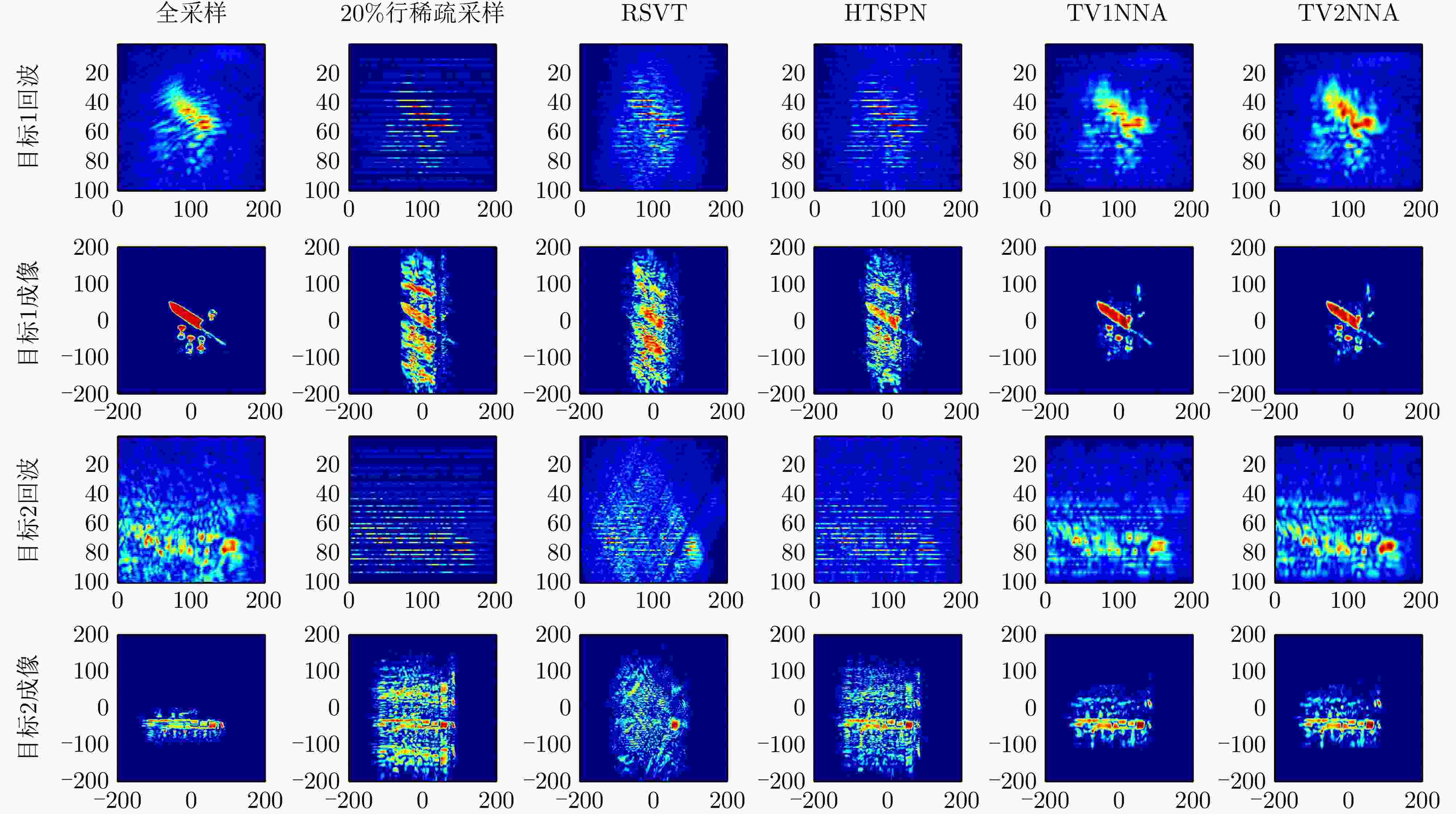
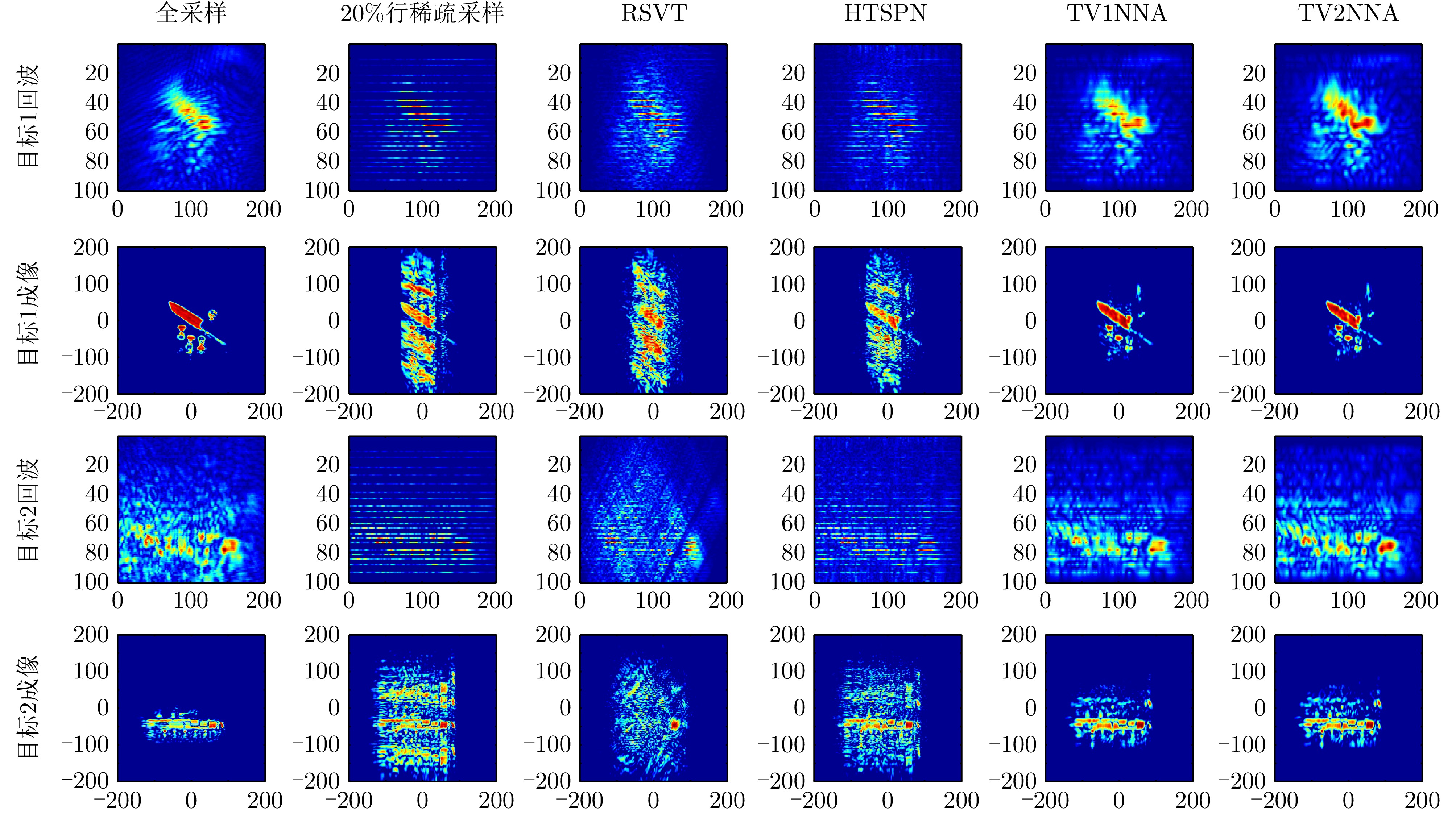
图 12 不同算法在20%行稀疏采样下的回波补全与成像结果对比
Figure 12. Comparison of echo completion and imaging results by different algorithms under 20% row sparse sampling
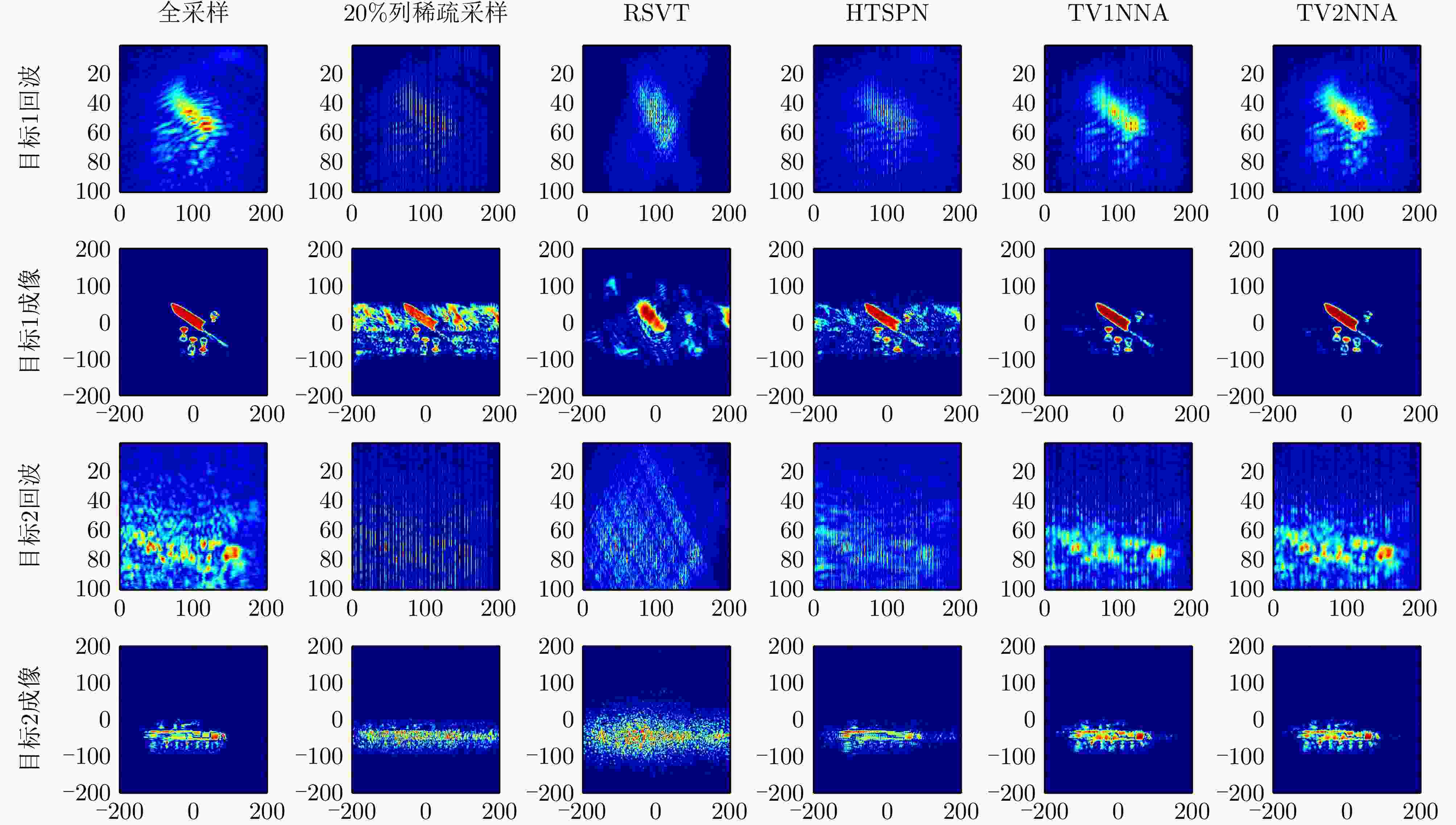
图 13 不同算法在20%列稀疏采样下的回波补全与成像结果对比
Figure 13. Comparison of echo completion and imaging results by different algorithms under 20% column sparse sampling
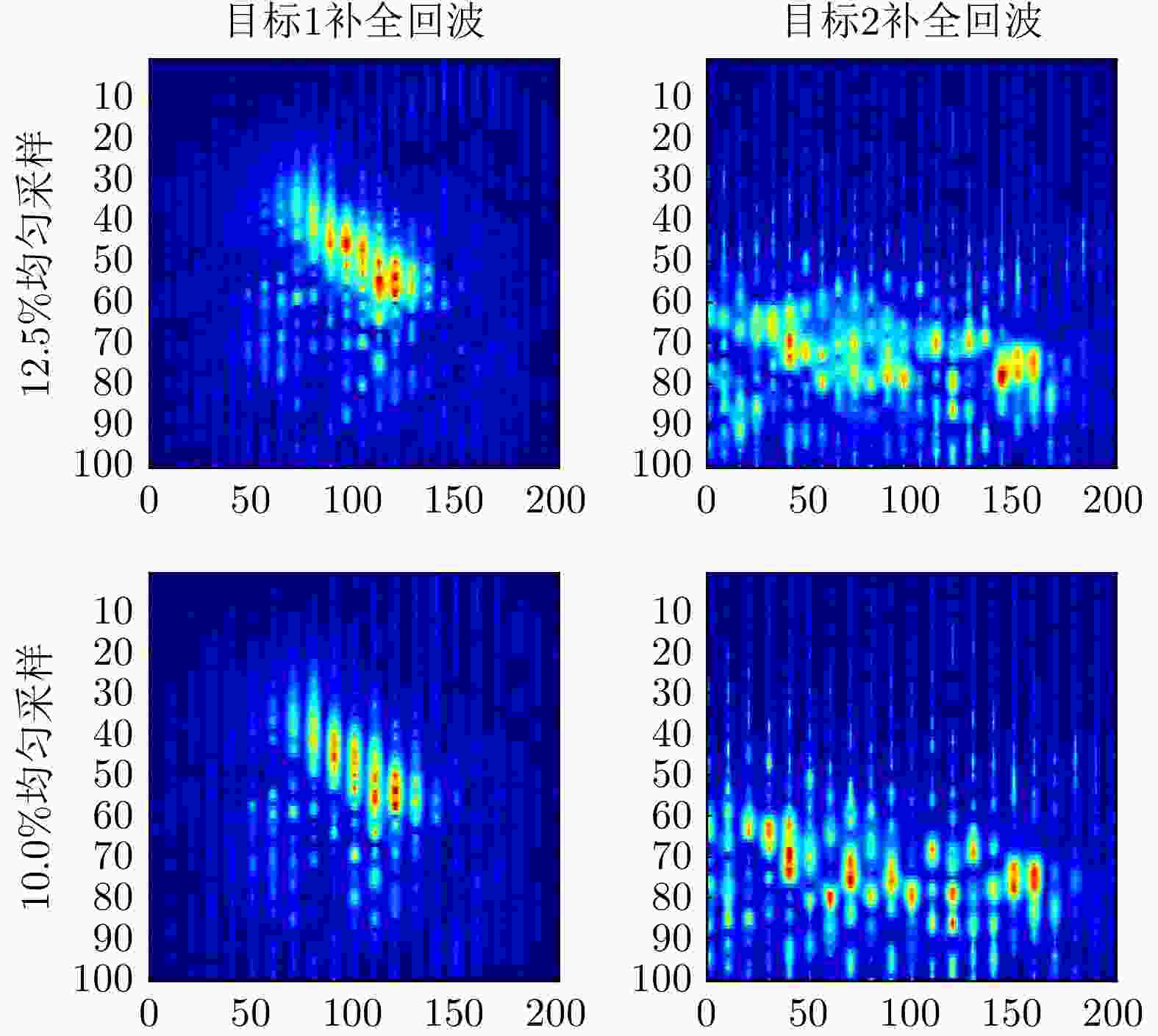
图 16 极端均匀列稀疏采样下的回波补全结果
Figure 16. Echo completion under extremely uniform column sparse sampling
1 融合TV正则化与核范数的低秩平滑矩阵补全算法(TV1NNA/TV2NNA)
1. Low-rank and smooth matrix completion algorithm incorporating TV regularization and nuclear norm (TV1NNA/TV2NNA)
输入:距离压缩后的结构化稀疏距离切面矩阵:$ \boldsymbol{S}\in {\mathbb{C}}^{M\times N} $ 输出:补全后的距离切面:$ {\boldsymbol{S}}_{c}\in {\mathbb{C}}^{M\times N} $ 1:初始化: 若使用1阶TV(TV1NNA),则$ \boldsymbol{L}={\boldsymbol{L}}_{1},\boldsymbol{R}={\boldsymbol{R}}_{1}, $ 若使用2阶TV(TV2NNA),则$ \boldsymbol{L}={\boldsymbol{L}}_{2},\boldsymbol{R}={\boldsymbol{R}}_{2}, $ $ \lambda \gt 0,\mu \gt 1,k=1,{\mathrm{iter}},{\mathrm{tol}},{\rho }^{k} \gt 0, $ $ {\boldsymbol{A}}^{k}=\boldsymbol{L}\boldsymbol{S},{\boldsymbol{B}}^{k}=\boldsymbol{S}\boldsymbol{R},{\boldsymbol{C}}^{k}=\boldsymbol{S}_{c}^{k}=\boldsymbol{S}, $ $ \boldsymbol{Y}_{1}^{k}=\boldsymbol{Y}_{2}^{k}=\boldsymbol{Y}_{3}^{k}=0. $ 2:while $ k \lt {\mathrm{iter}} $ do 1) 更新$ {\boldsymbol{A}}^{k+1} $:$ {\boldsymbol{A}}^{k+1}=\dfrac{{\rho }^{k}}{{\rho }^{k}+2\lambda }\left(\boldsymbol{L}{\boldsymbol{S}}_{c}^{k}-\dfrac{\boldsymbol{Y}_{1}^{k}}{{\rho }^{k}}\right); $ 2) 更新$ {\boldsymbol{B}}^{k+1} $:$ {\boldsymbol{B}}^{k+1}=\dfrac{{\rho }^{k}}{{\rho }^{k}+2\lambda }\left({\boldsymbol{S}}_{c}^{k}\boldsymbol{R}-\dfrac{\boldsymbol{Y}_{2}^{k}}{{\rho }^{k}}\right); $ 3) 更新$ {\boldsymbol{C}}^{k+1} $:$ \begin{aligned}&(\boldsymbol{U},{\boldsymbol{\varLambda }},\boldsymbol{V})=\text{svd}\left({\boldsymbol{S}}_{\mathrm{c}}{}^{k}-\frac{\boldsymbol{Y}_{3}^{k}}{{\rho }^{k}}\right),\\&{\boldsymbol{C}}^{k+1}={{P}}_{\varOmega }(\boldsymbol{S})+{{P}}_{{{\varOmega }^{\textit{c}}}}\left(\boldsymbol{U}{S}_{1/{{\rho }^{k}}}( {\boldsymbol{\varLambda }}){\boldsymbol{V}}^{\text{H}}\right);\end{aligned} $ 4) 更新$ \boldsymbol{S}_{c}^{k+1} $:解式(24)Sylvester方程; 5) 更新$ \boldsymbol{Y}_{1}^{k+1} $:$ \boldsymbol{Y}_{1}^{k+1}=\boldsymbol{Y}_{1}^{k}+{\rho }^{k}({\boldsymbol{A}}^{k+1}-\boldsymbol{L}\boldsymbol{S}_{c}^{k+1}); $ 6) 更新$ \boldsymbol{Y}_{2}^{k+1} $:$ \boldsymbol{Y}_{2}^{k+1}=\boldsymbol{Y}_{2}^{k}+{\rho }^{k}({\boldsymbol{B}}^{k+1}-\boldsymbol{S}_{c}^{k+1}\boldsymbol{R}); $ 7) 更新$ \boldsymbol{Y}_{3}^{k+1} $:$ \boldsymbol{Y}_{3}^{k+1}=\boldsymbol{Y}_{3}^{k}+{\rho }^{k}({\boldsymbol{C}}^{k+1}-\boldsymbol{S}_{c}^{k+1}); $ 8) 更新$ {\rho }^{k+1} $:$ {\rho }^{k+1}=\mu {\rho }^{k}; $ 9) 计算$ ||\boldsymbol{S}_{c}^{k}-\boldsymbol{S}_{c}^{k+1}||_{\text{F}}^{2}/||\boldsymbol{S}_{c}^{k}||_{\text{F}}^{2} $,若小于tol则终止迭代; 10) $ k=k+1 $。 3:end while  下载: 导出CSV
表 1 不同算法的计算复杂度
Table 1. Computational complexity of different algorithms
算法 计算复杂度 基于旋转增广的SVT (RSVT) $ O({I}_{2}{(M+N)}^{3}) $ 基于Hankel变换的TSPN (HTSPN) $ O({I}_{1}({M}^{3}+{M}^{2}{\text{log}}_{2}({M}^{2}))N) $(行稀疏)
$ O({I}_{1}({N}^{3}+{N}^{2}{\text{log}}_{2}({N}^{2}))M) $(列稀疏)本文算法(TV1NNA/TV2NNA) $ O({I}_{1}(M{N}^{2}+{M}^{3}+{N}^{3})) $
下载: 导出CSV
表 2 仿真实验参数设置
Table 2. Parameter settings of simulation experiments
参数 数值 载波频率 80 GHz 调频斜率 60 MHz/μs 信号带宽 3 GHz 高度-方位向合成孔径$ ({D}_{x}\times {D}_{y}) $ 200 mm×200 mm 高度-方位向采样间隔$ ({d}_{x}\times {d}_{y}) $ 2 mm×2 mm 高度-方位向采样点数目$ (M\times N) $ 101×101
下载: 导出CSV
表 3 物理成像系统参数设置
Table 3. Parameter settings of physical imaging system
参数 数值 中心频率 79 GHz 信号带宽 4 GHz 调频斜率 63.343 MHz/μs 采样率 5.12 MHz ADC采样数 256 脉冲重复频率 20 Hz 雷达移动速度 28 mm/s 高度-方位向合成孔径$ ({D}_{x}\times {D}_{y}) $ 198 mm×280 mm 高度-方位向采样间隔$ ({d}_{x}\times {d}_{y}) $ 2.0 mm×1.4 mm 高度-方位向采样点数目$ (M\times N) $ 100×201
下载: 导出CSV
表 4 20%行稀疏采样下不同算法成像结果的MAE
Table 4. MAE of imaging results from different algorithms under 20% row sparse sampling
算法 距离0.5 m 距离1.0 m 全采样 0 0 20%采样 1.5809 1.3855 RSVT 1.3629 1.1740 HTSPN 0.9939 0.8022 TV1NNA 0.6197 0.3023 TV2NNA 0.5685 0.2001 注:加粗数值表示最优指标。
下载: 导出CSV
表 5 不同算法的三维SAR成像时间对比
Table 5. Comparison of 3D SAR imaging time for different algorithms
算法 目标1平均成像时间(s) 目标2平均成像时间(s) RMA 1.2 2.1 RSVT 132.7 793.1 HTSPN 383.4 (行稀疏)
485.5 (列稀疏)2253.7 (行稀疏)2820.9 (列稀疏)TV1NNA 7.5 45.2 TV2NNA 12.3 75.8
下载: 导出CSV
表 6 不同算法在20%行稀疏采样下的回波补全效果及成像结果指标
Table 6. Performance metrics of echo completion and imaging results for different algorithms under 20% row sparse sampling
指标 目标1 目标2 回波SSIM↑ 成像RMSE↓ 回波SSIM↑ 成像RMSE↓ 全采样 1 0 1 0 20%行稀疏采样 0.2246 7.2565 0.1164 7.8305 RSVT 0.3825 7.5225 0.2209 6.3229 HTSPN 0.4579 5.8128 0.3180 5.6064 TV1NNA 0.5985 2.2920 0.5298 3.0671 TV2NNA 0.6129 2.2819 0.5607 3.2106
下载: 导出CSV
表 7 不同算法在20%列稀疏采样下的回波补全效果及成像结果指标
Table 7. Performance metrics of echo completion and imaging results for different algorithms under 20% column sparse sampling
指标 目标1 目标2 回波SSIM↑ 成像RMSE↓ 回波SSIM↑ 成像RMSE↓ 全采样 1 0 1 0 20%列稀疏采样 0.2321 7.2976 0.1310 3.8607 RSVT 0.2497 4.9940 0.2172 6.2336 HTSPN 0.5376 3.9217 0.4448 2.1061 TV1NNA 0.6359 1.4105 0.4573 1.8559 TV2NNA 0.7456 1.2480 0.5268 1.6287
下载: 导出CSV
-
[1] 温鑫, 黄培康, 年丰, 等. 主动式毫米波近距离圆柱扫描三维成像系统[J]. 系统工程与电子技术, 2014, 36(6): 1044–1049. doi: 10.3969/j.issn.1001-506X.2014.06.05.WEN Xin, HUANG Peikang, NIAN Feng, et al. Active millimeter-wave near-field cylindrical scanning three-dimensional imaging system[J]. Systems Engineering and Electronics, 2014, 36(6): 1044–1049. doi: 10.3969/j.issn.1001-506X.2014.06.05. [2] 谢朋飞, 张磊, 吴振华. 融合ω-K和BP算法的圆柱扫描毫米波三维成像算法[J]. 雷达学报, 2018, 7(3): 387–394. doi: 10.12000/JR17112.XIE Pengfei, ZHANG Lei, and WU Zhenhua. A three-dimensional imaging algorithm fusion with ω-K and BP algorithm for millimeter-wave cylindrical scanning[J]. Journal of Radars, 2018, 7(3): 387–394. doi: 10.12000/JR17112. [3] WINGREN N and SJÖBERG D. Nondestructive testing using mm-wave sparse imaging verified for singly curved composite panels[J]. IEEE Transactions on Antennas and Propagation, 2023, 71(1): 1185–1189. doi: 10.1109/TAP.2022.3211341. [4] GAO Yuan and ZOUGHI R. Millimeter wave reflectometry and imaging for noninvasive diagnosis of skin burn injuries[J]. IEEE Transactions on Instrumentation and Measurement, 2017, 66(1): 77–84. doi: 10.1109/TIM.2016.2620778. [5] LIAO Jiancheng, ZENG Xiaolu, YANG Xiaopeng, et al. MIMO through-the-wall radar 3-D imaging using propagation compensation and coherence factor[J]. IEEE Transactions on Aerospace and Electronic Systems, 2025, 61(6): 17213–17226. doi: 10.1109/TAES.2025.3602758. [6] YANIK M E and TORLAK M. Near-field 2-D SAR imaging by millimeter-wave radar for concealed item detection[C]. 2019 IEEE Radio and Wireless Symposium, Orlando, USA, 2019: 1–4. doi: 10.1109/RWS.2019.8714552. [7] 刘可, 朱泽政, 于军, 等. 基于互质阵列孔洞分析的稀疏阵列设计方法[J]. 电子与信息学报, 2022, 44(1): 372–379. doi: 10.11999/JEIT201024.LIU Ke, ZHU Zezheng, YU Jun, et al. Sparse array design methods based on hole analysis of the coprime array[J]. Journal of Electronics & Information Technology, 2022, 44(1): 372–379. doi: 10.11999/JEIT201024. [8] 邢孟道, 马鹏辉, 楼屹杉, 等. 合成孔径雷达快速后向投影算法综述[J]. 雷达学报(中英文), 2024, 13(1): 1–22. doi: 10.12000/JR23183.XING Mengdao, MA Penghui, LOU Yishan, et al. Review of fast back projection algorithms in synthetic aperture radar[J]. Journal of Radars, 2024, 13(1): 1–22. doi: 10.12000/JR23183. [9] SHEEN D M, MCMAKIN D L, and HALL T E. Three-dimensional millimeter-wave imaging for concealed weapon detection[J]. IEEE Transactions on Microwave Theory and Techniques, 2001, 49(9): 1581–1592. doi: 10.1109/22.942570. [10] DONOHO D L. Compressed sensing[J]. IEEE Transactions on Information Theory, 2006, 52(4): 1289–1306. doi: 10.1109/TIT.2006.871582. [11] ZHOU Zichen, WEI Shunjun, WANG Mou, et al. Comparison of MF and CS algorithm in 3-D near-field SAR imaging[C]. 2021 7th Asia-Pacific Conference on Synthetic Aperture Radar, Bali, Indonesia, 2021: 1–5. doi: 10.1109/APSAR52370.2021.9688546. [12] WANG Mou, WEI Shunjun, LIANG Jiadian, et al. RMIST-Net: Joint range migration and sparse reconstruction network for 3-D mmW imaging[J]. IEEE Transactions on Geoscience and Remote Sensing, 2022, 60: 5205117. doi: 10.1109/TGRS.2021.3068405. [13] CANDES E J and TAO T. The power of convex relaxation: Near-optimal matrix completion[J]. IEEE Transactions on Information Theory, 2010, 56(5): 2053–2080. doi: 10.1109/TIT.2010.2044061. [14] KESHAVAN R H, MONTANARI A, and OH S. Matrix completion from a few entries[J]. IEEE Transactions on Information Theory, 2010, 56(6): 2980–2998. doi: 10.1109/TIT.2010.2046205. [15] ZHANG Siqian, DONG Ganggang, and KUANG Gangyao. Matrix completion for downward-looking 3-D SAR imaging with a random sparse linear array[J]. IEEE Transactions on Geoscience and Remote Sensing, 2018, 56(4): 1994–2006. doi: 10.1109/TGRS.2017.2771826. [16] PENG Yechao, SHENG Zhichao, and HE Guoqiang. Near-field low-storage SAR imaging with spatio-temporal sub-Nyquist samples[J]. IEEE Sensors Journal, 2024, 24(12): 19442–19453. doi: 10.1109/JSEN.2024.3393761. [17] MA Yuxin, HAI Yu, YANG Jianyu, et al. A near-field 3-D SAR imaging method with non-uniform sparse linear array based on matrix completion[C]. 2022 IEEE International Geoscience and Remote Sensing Symposium, Kuala Lumpur, Malaysia, 2022: 1664–1667. doi: 10.1109/IGARSS46834.2022.9883674. [18] CAI Jianfeng, CANDÈS E J, and SHEN Zuowei. A singular value thresholding algorithm for matrix completion[J]. SIAM Journal on Optimization, 2010, 20(4): 1956–1982. doi: 10.1137/080738970. [19] 马宇欣, 海宇, 李中余, 等. 稀疏轨迹毫米波雷达三维高分辨成像算法[J]. 雷达学报, 2023, 12(5): 1000–1013. doi: 10.12000/JR23001.MA Yuxin, HAI Yu, LI Zhongyu, et al. 3D high-resolution imaging algorithm with sparse trajectory for millimeter-wave radar[J]. Journal of Radars, 2023, 12(5): 1000–1013. doi: 10.12000/JR23001. [20] CHEN Yuxin and CHI Yuejie. Robust spectral compressed sensing via structured matrix completion[J]. IEEE Transactions on Information Theory, 2014, 60(10): 6576–6601. doi: 10.1109/TIT.2014.2343623. [21] 胡循勇, 杨晓梅, 李昊怡, 等. 融合低秩和稀疏先验的结构性缺失图像修复[J]. 北京航空航天大学学报, 2022, 48(5): 855–862. doi: 10.13700/j.bh.1001-5965.2020.0663.HU Xunyong, YANG Xiaomei, LI Haoyi, et al. Structural missing image inpainting based on low rank and sparse prior[J]. Journal of Beijing University of Aeronautics and Astronautics, 2022, 48(5): 855–862. doi: 10.13700/j.bh.1001-5965.2020.0663. [22] ZHENG Hang, SHI Zhiguo, ZHOU Chengwei, et al. Coarray tensor completion for DOA estimation[J]. IEEE Transactions on Aerospace and Electronic Systems, 2023, 59(5): 5472–5486. doi: 10.1109/TAES.2023.3263153. [23] BOYD S, PARIKH N, CHU E, et al. Distributed optimization and statistical learning via the alternating direction method of multipliers[J]. Foundations and Trends® in Machine Learning, 2011, 3(1): 1–122. doi: 10.1561/2200000016. [24] SHENG Haonan, WANG Zhiyong, SO H C, et al. Multi-matrix completion: A novel framework for structurally missing elements[J]. IEEE Transactions on Pattern Analysis and Machine Intelligence, 2026, 48(2): 1626–1640. doi: 10.1109/TPAMI.2025.3616607. [25] PAPAFITSOROS K, SCHÖNLIEB C B, and SENGUL B. Combined first and second order total variation inpainting using split Bregman[J]. Image Processing on Line, 2013, 3: 112–136. doi: 10.5201/ipol.2013.40. [26] BARTELS R H and STEWART G W. Algorithm 432[C2]: Solution of the matrix equation AX+XB=C [F4][J]. Communications of the ACM, 1972, 15(9): 820–826. doi: 10.1145/361573.361582. -




计量
- 文章访问数:
- HTML全文浏览量:
- PDF下载量:
- 被引次数: 0