

 作者中心
作者中心 专家审稿
专家审稿 责编办公
责编办公 编辑办公
编辑办公
-
摘要: 火山时期由流动熔岩冷却凝固形成的月球熔岩管,因其坚硬外壳能够为管内提供稳定、安全的内部环境,被视为未来月球基地建立的理想地点之一。然而熔岩管埋藏地下数百米至数公里,难以直接探测。目前主要依赖雷达与重力异常探测技术,但轨道雷达探测的分辨率不足以分辨相似形态的地下结构,原位探地雷达存在探测范围有限、易受到近场干扰等问题。重力异常探测则难以精准识别南北走向或亚公里级规模的熔岩管。天窗是识别熔岩管的关键标志,可通过光学影像和红外辐射探测热异常进行识别。但光学影像受光照条件制约,难以完整获取天窗的三维几何结构;红外辐射数据受探测深度与分辨率限制(320 m×160 m),难以捕捉深层热异常及约束坑底物质成分。针对天窗探测方法的技术难点,该文探讨了被动微波探测天窗热异常的可行性,利用其穿透性强、对介电性质敏感的优势,能够深入探测次表层热特征并有效约束坑底物质成分。然而,现有被动微波遥感数据在分辨率(公里级)上难以满足对百米级天窗热异常的精准探测。如何提升微波对百米级天窗的识别能力成为当前技术亟须突破的瓶颈之一。Abstract: Formed by the cooling and solidification of flowing lava during volcanic activity, lunar lava tubes are considered promising candidates for future lunar bases due to their stable and protective roofs. However, these tubes are typically buried hundreds of meters to kilometers beneath the surface, making direct detection extremely difficult. Current detection methods mainly rely on radar and gravity anomaly analysis. However, the resolution of orbital radar is insufficient to distinguish similar subsurface structures, whereas in situ lunar penetrating radar is limited by a small detection range and vulnerability to near-field interference. Gravity anomaly detection also performs poorly when identifying tubes oriented north-south or with roofs narrower than a kilometer. Skylights serve as critical indicators for locating subsurface tubes and can be identified through optical imagery and infrared radiation thermal anomalies. However, optical images are constrained by illumination conditions, making full three-dimensional reconstruction of skylights difficult. Infrared data are further limited by penetration depth and spatial resolution (320 m×160 m), which hinders the detection of subsurface thermal anomalies and the assessment of the thermophysical properties of materials at the pit floor. To address these challenges, this paper explores the feasibility of detecting skylight thermal anomalies using microwave radiation. Owing to its penetration capability and sensitivity to dielectric properties, this approach can probe subsurface thermal features and effectively determine the material composition of the pit floor. However, a significant scale disparity exists between the kilometer-scale resolution of current data and the relatively small size of skylights. Therefore, enhancing the detection capability of passive microwave methods for 100-m-scale skylights remains a critical issue that requires immediate attention.
-
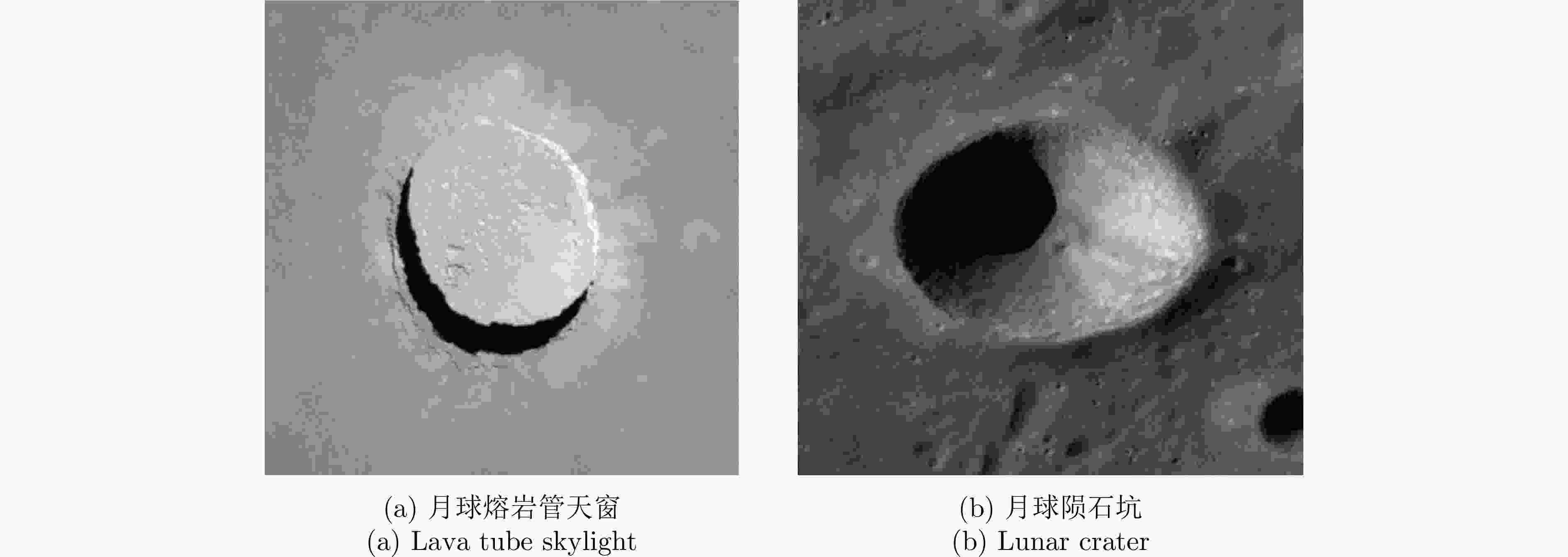
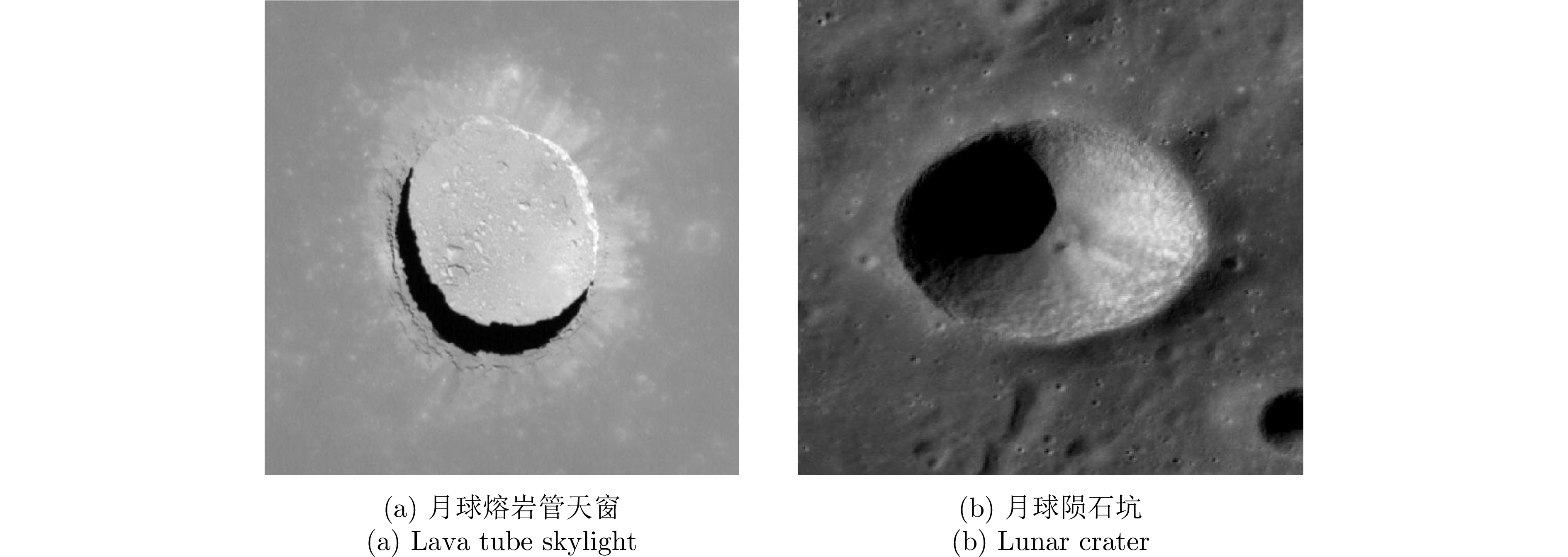
图 3 月球熔岩管天窗与月球陨石坑的形态对比图
Figure 3. Morphological comparison between lava tube skylight and lunar crater
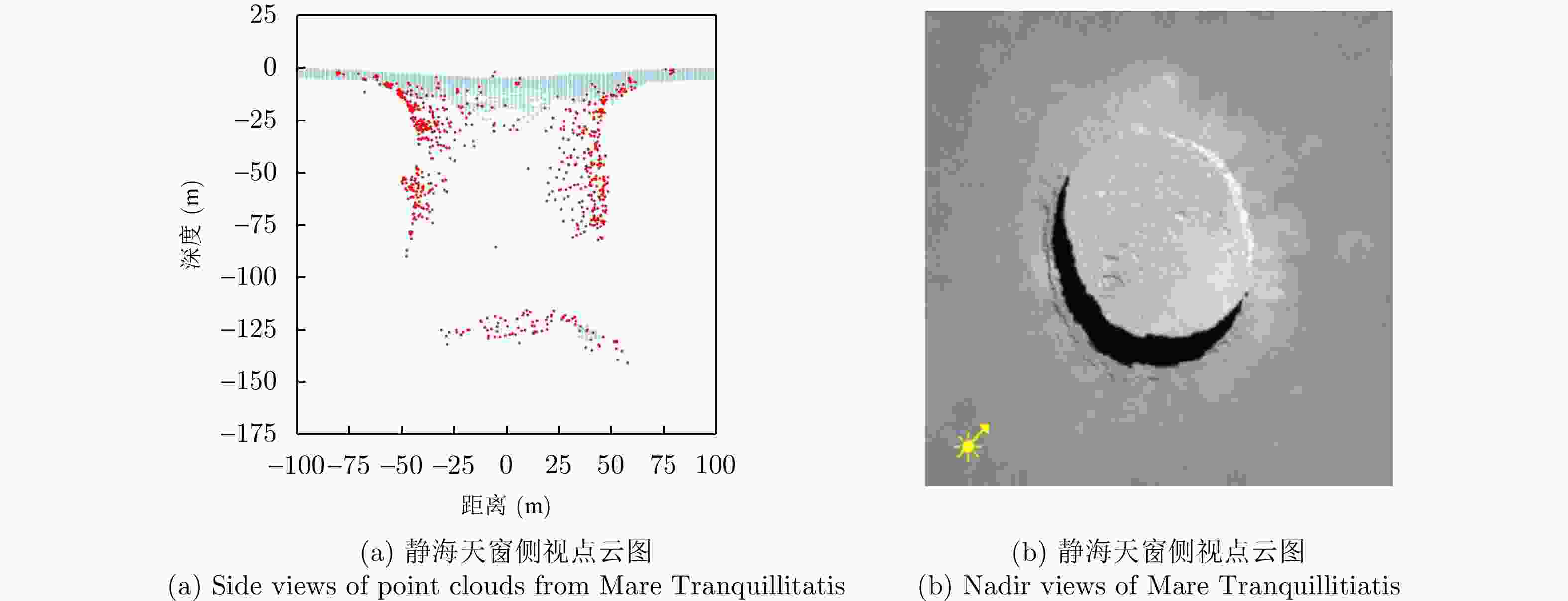
图 4 静海天窗的三维点云侧视图与俯视图
Figure 4. Side view of the full 3D point cloud and nadir view of the Mare Tranquillitatis
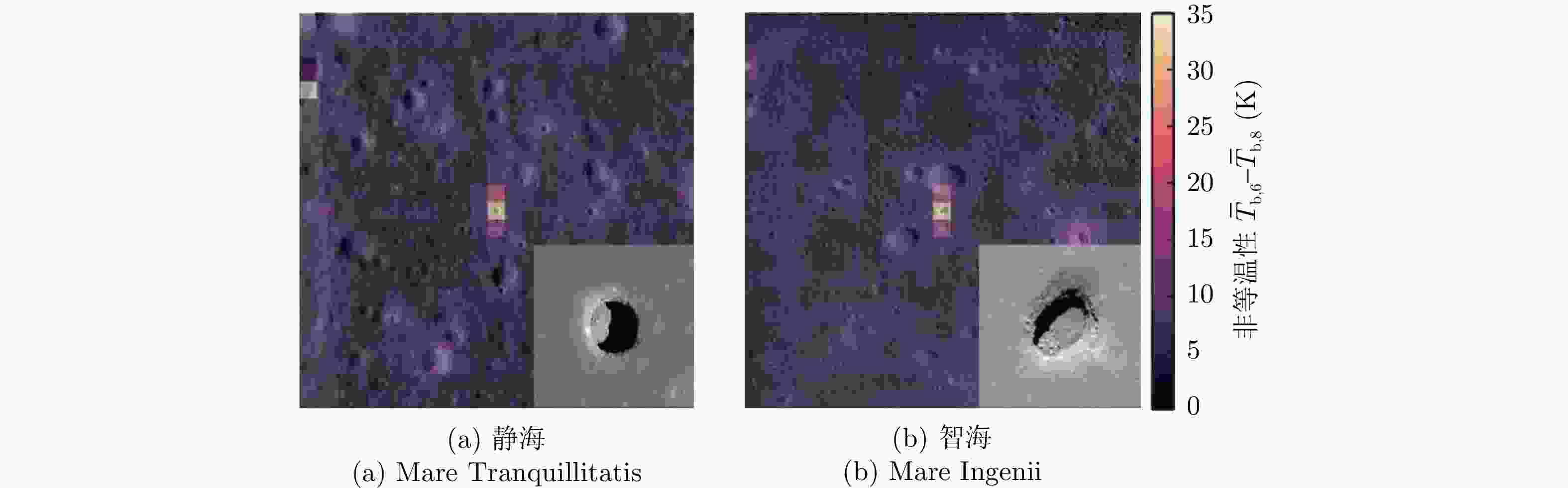
图 5 静海和智海21:00–04:00点(当地太阳时间)通道6与通道8的温度变化平均值差值
Figure 5. The average temperature change difference between channel 6 and channel 8 of Mare Tranquillitatis and Mare Ingenii from 9 pm to 4 am (Local Solar Time, LST)
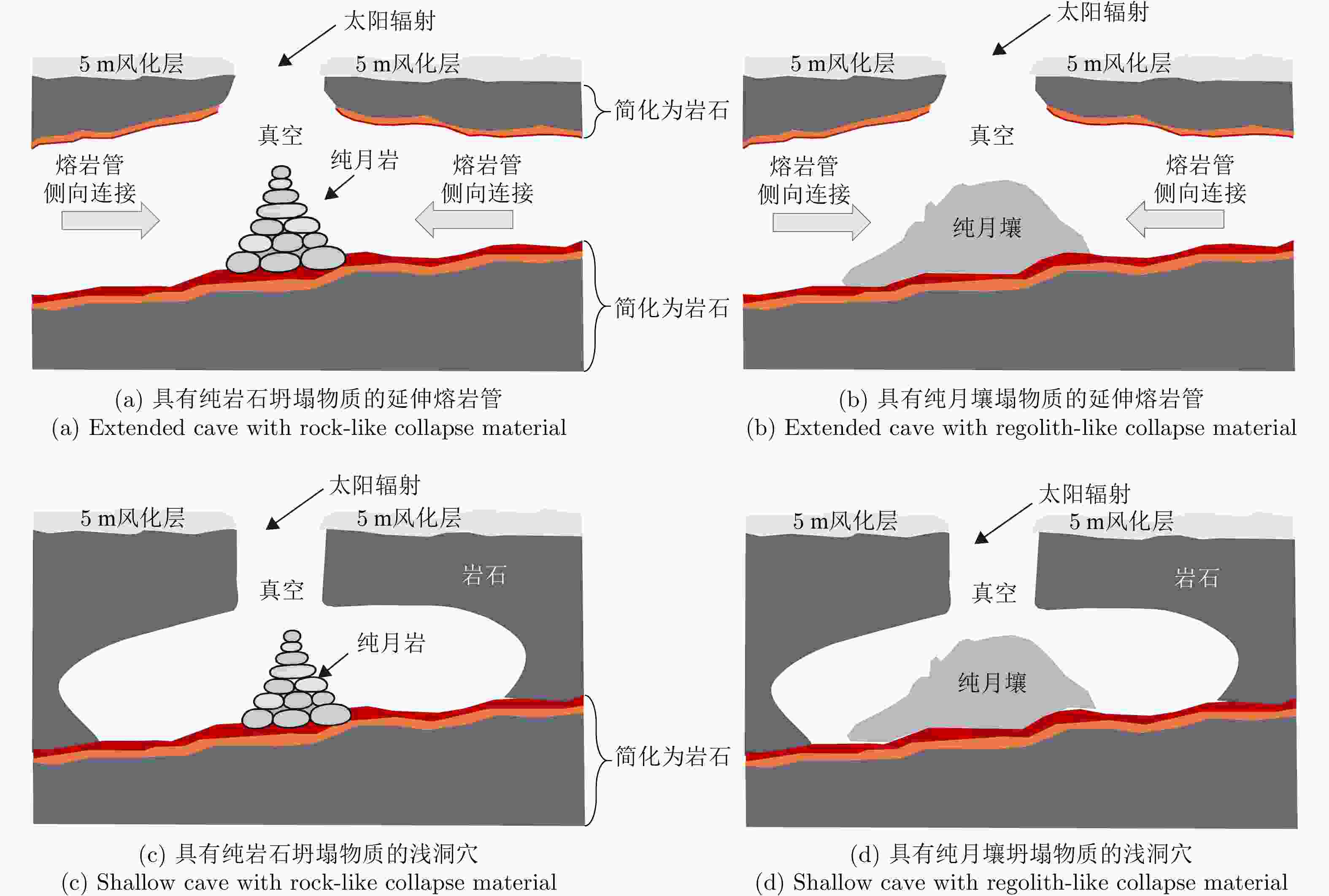
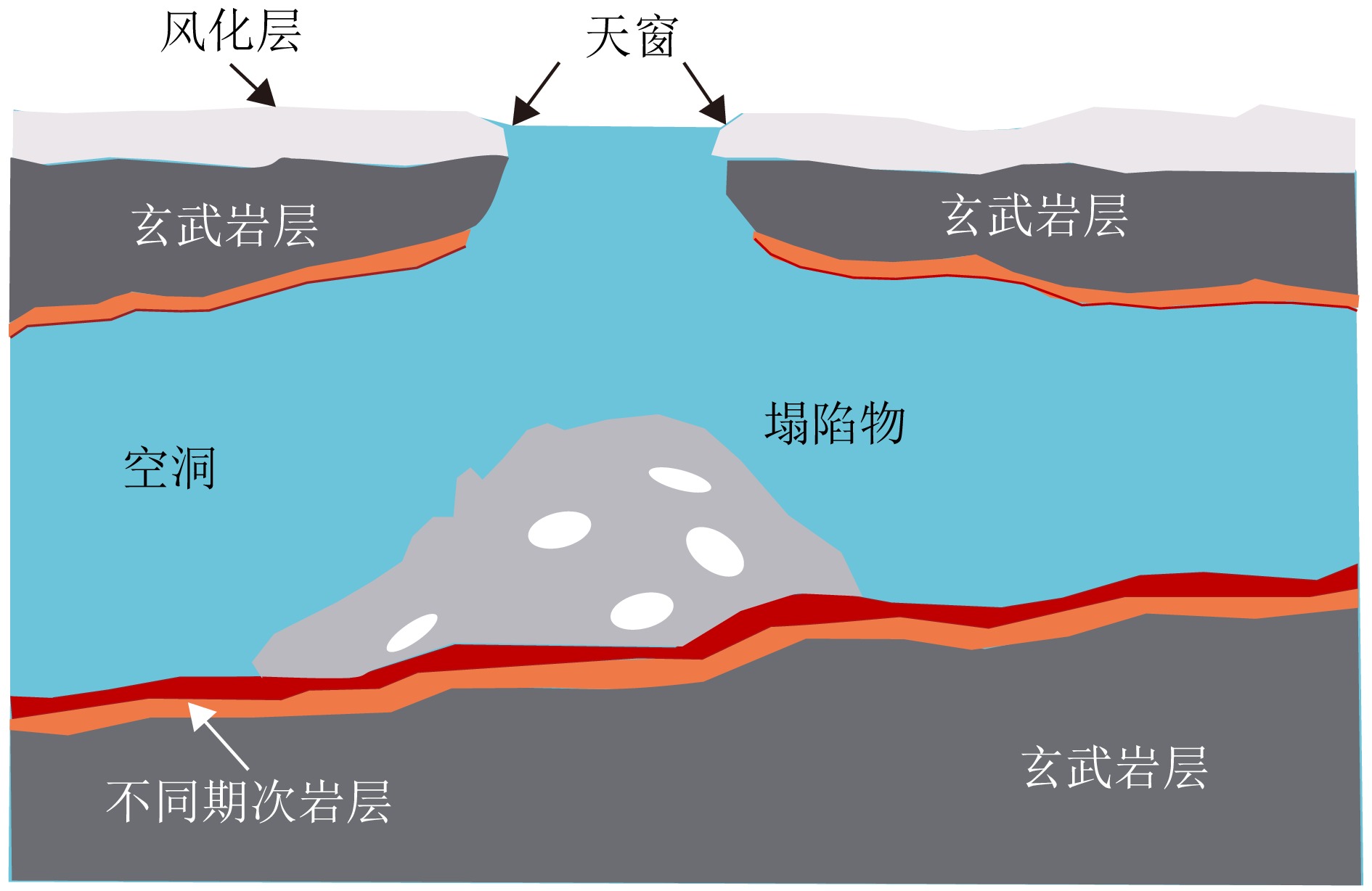
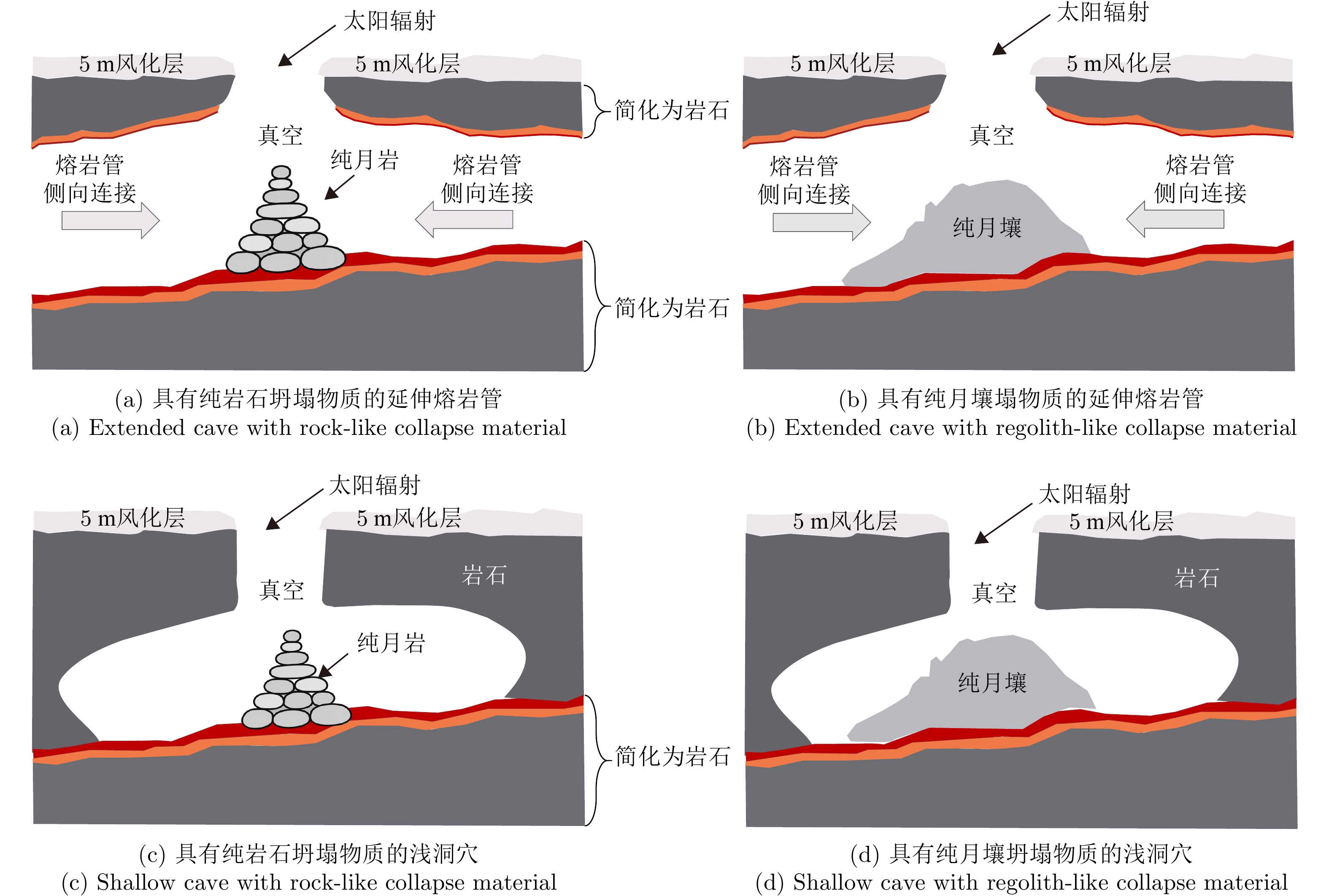
图 6 具有不同坍塌物质成分的延伸熔岩管与浅洞穴几何模型
Figure 6. Geometric models of extended lava tubes and shallow caves with different collapse materials
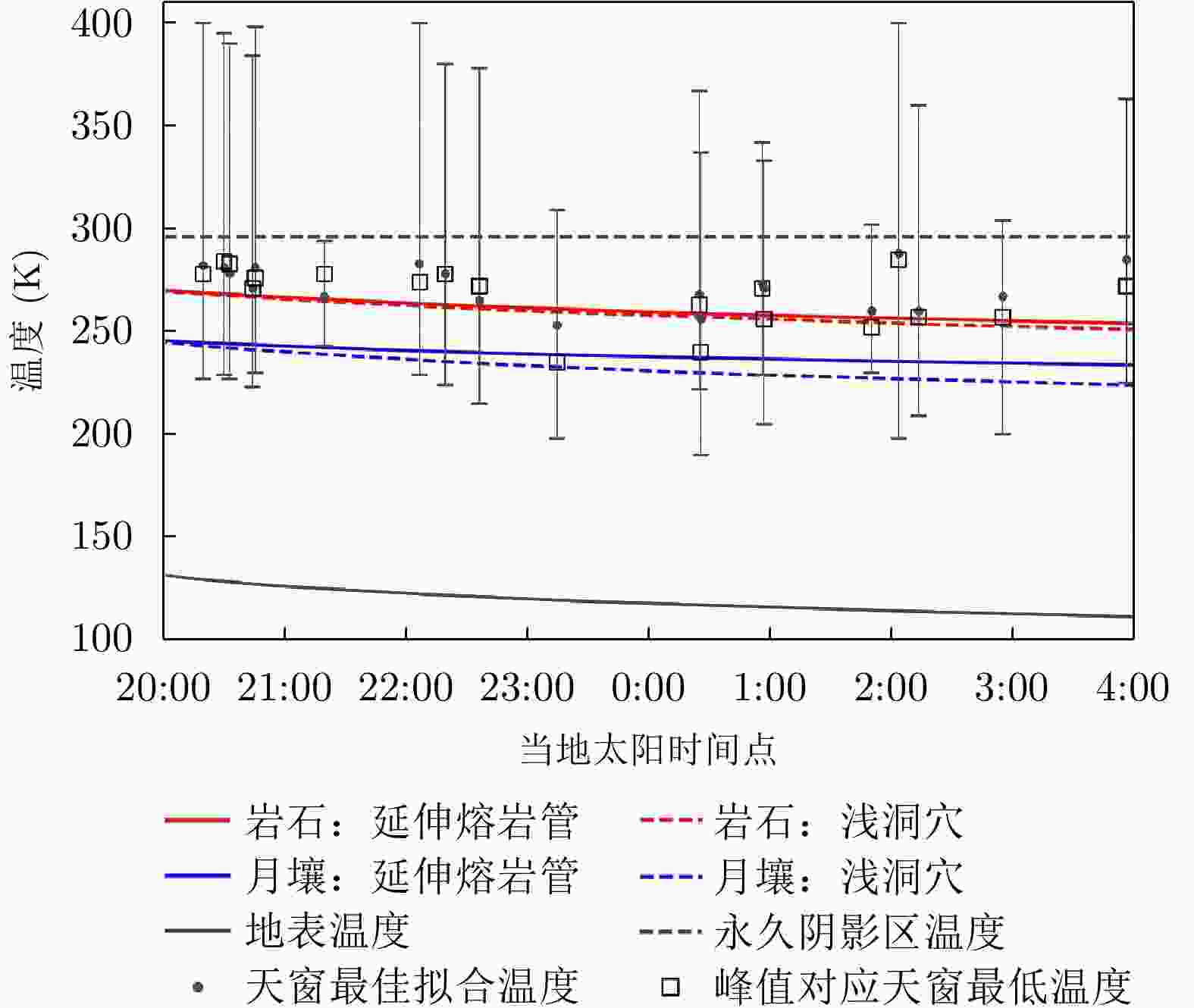
图 7 2D热模型(线)与静海天窗夜间最佳拟合温度(点)
Figure 7. 2D thermal models (lines) compared to Tranquillitatis pit temperatures derived from night-time Diviner Data (points)
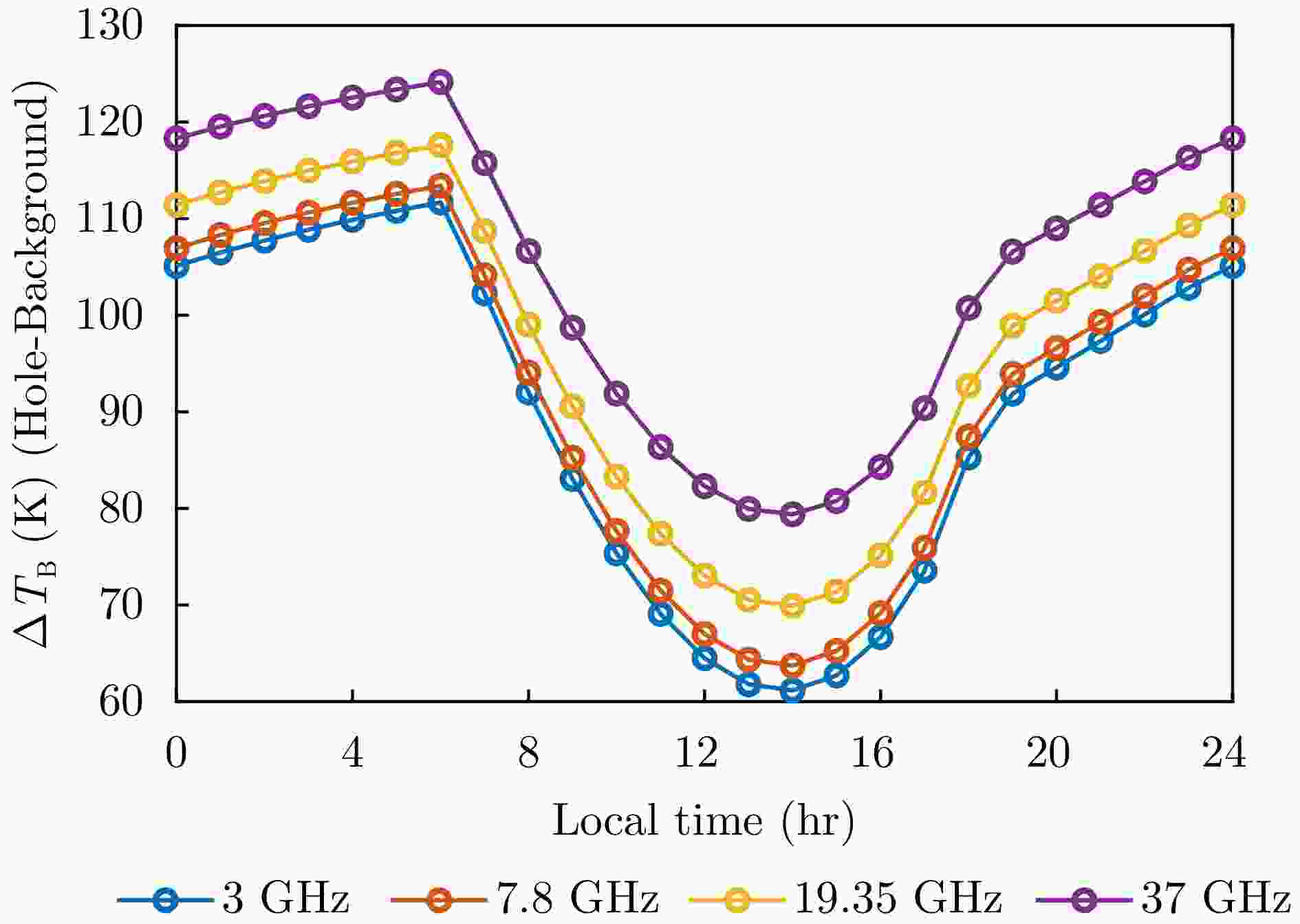
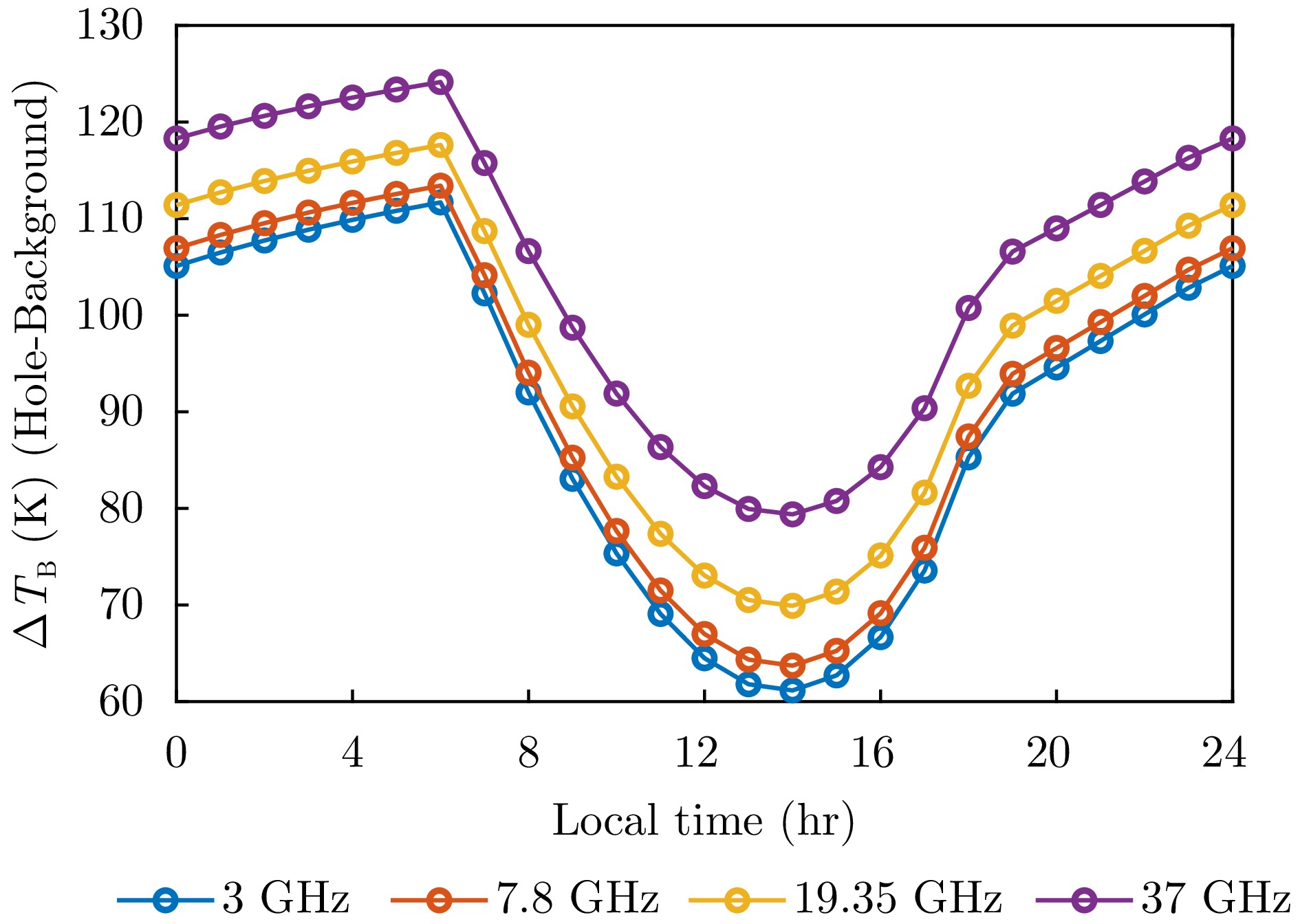
图 8 天窗与背景月壤微波亮度温度差变化图
Figure 8. Microwave brightness temperature difference between skylight and surrounding regolith
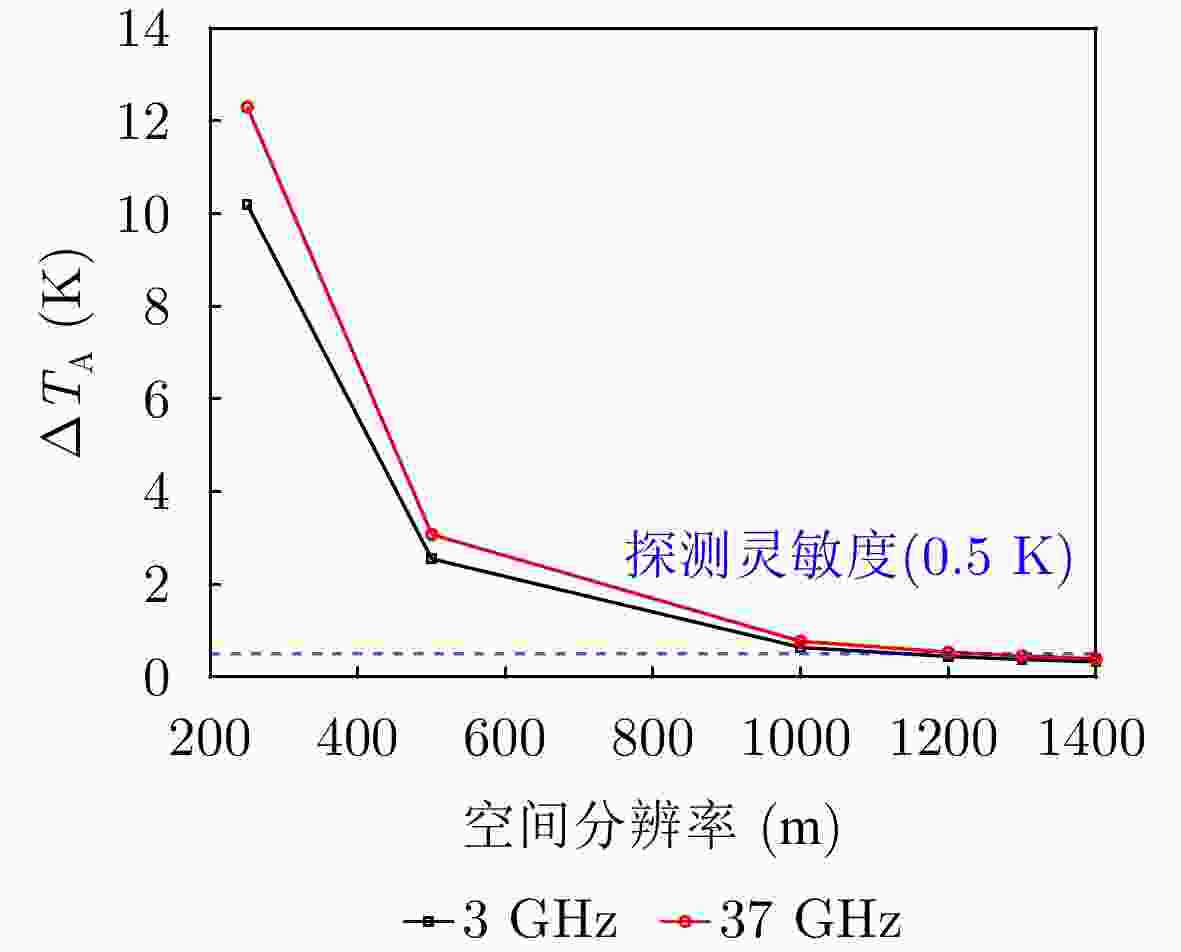
图 9 不同空间分辨率下的天线温度差
Figure 9. Antenna temperature difference under different spatial resolutions
地点 纬度 经度 几何参数(m) 深度(m) 马利厄斯丘陵(Marius Hills) 14.2°N 303.3°E 最小宽度:370 - 13.00°N~15.00°N 301.85°E~304.01°E - - 13.096°N 57.056°W - - 13.603°N 58.047°W - - 14°N 302°E 宽度:400
长度:$ 6\times {10}^{4} $200~300 14.3°N 57.5°W 宽度:$ 9\times {10}^{3} $
长度:$ 6\times {10}^{4} $
高度:55605 夏普月溪(Rima Sharp) 35°N~40°N 311°E~316°E 宽度:$ 2\times {10}^{3} $
长度:$ 7.5\times {10}^{4} $600 麦兰月溪(Rima Mairan) 36°N 314°E 宽度:$ 3.5\times {10}^{3} $
长度: $ 1.7\times {10}^{5} $
高度:5507500 麦兰-吕姆克(Mairan-Rumker) 41°N 309°W 长度:$ 9\times {10}^{4} $ - 41°N 306°W 长度:$ 1.8\times {10}^{5} $ - 阿里斯塔克月溪(Rimae Aristarchus) 27°N 313°E 宽度:$ 3.75\times {10}^{3} $
长度:$ 6\times {10}^{4} $
高度:600- 施勒特尔延伸(Schröter Extension) 24°N 306°W 长度:$ 6\times {10}^{4} $ - 渥拉斯顿陨石坑(Wollaston D) 35°N 311°W 长度:$ 8\times {10}^{4} $ - 赫歇尔E坑(Hershel E) 33.5°N 324.5°W 长度:$ 2\times {10}^{4} $ -  下载: 导出CSV
名称 纬度 经度 深度(m) 直径(m) 静海(Mare Tranquillitatis) 8.3355 °N33.2220 °E105 100×88 马利厄斯丘陵(Marius Hills) 14.0917 °N303.2299 °E40 55×49 智海(Mare Ingenii) 35.9494 °S166.0559 °E55 104×71 北风暴洋-1 (Northern Oceanus Procellarum-1) 35.4097 °N314.3602 °E54 157×108 死湖(Lacus Mortis) 44.9608 °N25.6119 °E60 >165×110 西南丰富海(Southwest Mare Fecunditatis) 6.7521 °S42.7595 °E51 19×15 西南静海(Southwest Mare Tranquillitatis) 4.1438 °N24.6871 °E25 32×26 施吕特陨石坑(Schlüter Crater) 5.8395 °S276.9500 °E57 37×23 高地-1 (Highland-1) 43.9662 °N23.0836 °E27 41×37 高地-2 (Highland-2) 41.1563 °N18.8206 °E>24 34×27 高地-3 (Highland-3) 42.3941 °N320.3076 °E27 45×41
下载: 导出CSV
表 3 探测方法对比表
Table 3. Comparison of detection methods
方法 探测方式 原理 优势 局限性 轨道雷达 直接探测 介电常数差异界面
产生反射回波探测范围大 深度分辨率较低;
存在多解性探地雷达 直接探测 介电常数差异界面
产生反射回波高精度探测;
局部/小型熔岩管探测范围有限;
易受近场干扰重力异常探测 直接探测 质量亏损检测 能探测到深埋于大型熔岩管(公里级)
可估算熔岩管的几何参数不适用于探测南北走向及小型
(百米级)的熔岩管光学影像识别 探测天窗间接探测 几何形态特征判别 数据分辨率高;
特征直观清晰受光照条件影响,无法提供
完整的天窗内部的形态结构红外辐射热异常探测 探测天窗间接探测 温度异常识别 突破光照限制;
可间接揭示熔岩管的存在无法甄别坑底热物理特性
探测深度有限被动微波探测 探测天窗间接探测 次表层温度梯度与介电识别 穿透数米月壤次表层;
区分天窗坑底物质成分空间分辨率极低(公里级)
下载: 导出CSV
表 4 典型熔岩管及天窗探测仪器主要参数
Table 4. Main parameters of typical instruments for lava tube and skylight detection
仪器名称 频段/波段 分辨率 月球雷达测深仪(LRS) 5 MHz 深度分辨率:75 m (真空)
深度分辨率:150 m (经旁瓣压缩)嫦娥三号/四号测月雷达 低频通道:60 MHz
高频通道:500 MHz低频通道深度分辨率:米级
高频通道深度分辨率:优于0.3 m重力重建与内部结构实验室(GRAIL) Ka波段 1200 阶次(4.5 km×4.5 km)月球勘测轨道器窄角相机
(LRO NAC)全色(可见光波段) 0.5 m/像素 红外滤波辐射仪(Diviner) 热红外波段 沿轨道方向320 m
垂直轨道方向160 m
(轨道高度50 km)微波辐射计 3.00, 7.80, 19.35, 37.00 GHz 3 GHz 的空间分辨率约为25 km
其他频率约为17.5 km
下载: 导出CSV
-
[1] CRAWFORD I A, ANAND M, COCKELL C S, et al. Back to the moon: The scientific rationale for resuming lunar surface exploration[J]. Planetary and Space Science, 2012, 74(1): 3–14. doi: 10.1016/j.pss.2012.06.002. [2] LIU Jianjun, ZENG Xingguo, LI Chunlai, et al. Landing site selection and overview of China’s lunar landing missions[J]. Space Science Reviews, 2021, 217(1): 6. doi: 10.1007/s11214-020-00781-9. [3] XU Lin and OUYANG Ziyuan. Scientific progress in China’s lunar exploration program[J]. Chinese Journal of Space Science, 2014, 34(5): 525–534. doi: 10.11728/cjss2014.05.525. [4] SMITH M, CRAIG D, HERRMANN N, et al. The Artemis program: An overview of NASA’s activities to return humans to the moon[C]. 2020 IEEE Aerospace Conference, Big Sky, USA, 2020: 1–10. doi: 10.1109/AERO47225.2020.9172323. [5] CESARETTI G, DINI E, DE KESTELIER X, et al. Building components for an outpost on the lunar soil by means of a novel 3D printing technology[J]. Acta Astronautica, 2014, 93: 430–450. doi: 10.1016/j.actaastro.2013.07.034. [6] NAITO M, HASEBE N, SHIKISHIMA M, et al. Radiation dose and its protection in the Moon from galactic cosmic rays and solar energetic particles: At the lunar surface and in a lava tube[J]. Journal of Radiological Protection, 2020, 40(4): 947–961. doi: 10.1088/1361-6498/abb120. [7] DOBYNDE M I and GUO Jingnan. Radiation environment at the surface and subsurface of the moon: Model development and validation[J]. Journal of Geophysical Research: Planets, 2021, 126(11): e2021JE006930. doi: 10.1029/2021JE006930. [8] WILLIAMS J P, PAIGE D A, GREENHAGEN B T, et al. The global surface temperatures of the moon as measured by the Diviner lunar radiometer experiment[J]. Icarus, 2017, 283: 300–325. doi: 10.1016/j.icarus.2016.08.012. [9] DURGA PRASAD K. Thermophysical Behavior of the Lunar Surface[M]. CUDNIK B. Encyclopedia of Lunar Science. Cham: Springer, 2023: 1209–1226. doi: 10.1007/978-3-319-14541-9_200. [10] MANDEVILLE J C and BARITEAU M. Cosmic dust and micro-debris measurements on the MIR space station[J]. Advances in Space Research, 2001, 28(9): 1317–1324. doi: 10.1016/S0273-1177(01)00403-3. [11] MALLA R B and Brown K M. Determination of temperature variation on lunar surface and subsurface for habitat analysis and design[J]. Acta Astronautica, 2015, 107: 196–207. doi: 10.1016/j.actaastro.2014.10.038. [12] VOCK A and NILSSON T. Holistic outpost design for lunar lava tubes[OL]. https://doi.org/10.48550/arXiv.2211.17100. 2022. [13] KALITA H, QUINTERO A, WISSING A, et al. Evaluation of Lunar Pits and Lava Tubes for Use as Human Habitats[M]. VAN SUSANTE P J and ROBERTS A D. Earth and Space 2021. Reston: American Society of Civil Engineers, 2021: 944–957. doi: 10.1061/9780784483374.086. [14] DRAGONI M, PIOMBO A, and TALLARICO A. A model for the formation of lava tubes by roofing over a channel[J]. Journal of Geophysical Research: Solid Earth, 1995, 100(B5): 8435–8447. doi: 10.1029/94JB03263. [15] FENG Yujie, PAN Pengzhi, TANG Xuhai, et al. A comprehensive review of lunar lava tube base construction and field research on a potential earth test site[J]. International Journal of Mining Science and Technology, 2024, 34(9): 1201–1216. doi: 10.1016/j.ijmst.2024.06.003. [16] 郑翀, 邓青云, 叶茂, 等. 月球熔岩管探测研究现状与发展方向[J]. 前瞻科技, 2024, 3(1): 100–108. doi: 10.3981/j.issn.2097-0781.2024.01.008.ZHENG Chong, DENG Qingyun, YE Mao, et al. Research status and development direction of lunar lava tube exploration[J]. Science and Technology Foresight, 2024, 3(1): 100–108. doi: 10.3981/j.issn.2097-0781.2024.01.008. [17] THEINAT A K, MODIRIASARI A, BOBET A, et al. Lunar lava tubes: Morphology to structural stability[J]. Icarus, 2020, 338: 113442. doi: 10.1016/j.icarus.2019.113442. [18] SHE Xingyang, WANG Jiang, XU Weiyang, et al. Research on the impact of extraterrestrial lava tube environments on human survival and countermeasures[J]. Space Habitation, 2025, 1(1): 100002. doi: 10.1016/j.spaceh.2024.100002. [19] 肖龙, 黄俊, 赵佳伟, 等. 月面熔岩管洞穴探测的意义与初步设想[J]. 中国科学: 物理学 力学 天文学, 2018, 48(11): 119602. doi: 10.1360/SSPMA2018-00025.XIAO Long, HUANG Jun, ZHAO Jiawei, et al. Significance and preliminary proposal for exploring the lunar lava tubes[J]. Scientia Sinica Physica, Mechanica & Astronomica, 2018, 48(11): 119602. doi: 10.1360/SSPMA2018-00025. [20] BLAIR D M, CHAPPAZ L, SOOD R, et al. The structural stability of lunar lava tubes[J]. Icarus, 2017, 282: 47–55. doi: 10.1016/j.icarus.2016.10.008. [21] HORVATH T, HAYNE P O, and PAIGE D A. Thermal and illumination environments of lunar pits and caves: Models and observations from the Diviner lunar radiometer experiment[J]. Geophysical Research Letters, 2022, 49(14): e2022GL099710. doi: 10.1029/2022GL099710. [22] WYNNE J J, MYLROIE J E, TITUS T N, et al. Planetary caves: A solar system view of processes and products[J]. Journal of Geophysical Research: Planets, 2022, 127(11): e2022JE007303. doi: 10.1029/2022JE007303. [23] WAGNER R V and ROBINSON M S. Occurrence and origin of lunar pits: Observations from a new catalog[C]. 52nd Lunar and Planetary Science Conference, Houston, Texas, USA, 2021: 2530. [24] LEE P. Possible lava tube skylights near the north pole of the moon[C]. 49th Lunar and Planetary Science Conference, Houston, Texas, USA, 2018: 2982. [25] CHAPPAZ L, SOOD R, MELOSH H J, et al. Evidence of large empty lava tubes on the moon using GRAIL gravity[J]. Geophysical Research Letters, 2017, 44(1): 105–112. doi: 10.1002/2016GL071588. [26] SAURO F, POZZOBON R, MASSIRONI M, et al. Lava tubes on earth, moon and mars: A review on their size and morphology revealed by comparative planetology[J]. Earth-Science Reviews, 2020, 209: 103288. doi: 10.1016/j.earscirev.2020.103288. [27] 周昶宇, 周米玉, 徐聿升, 等. 月面形貌勘察重建及其在熔岩管探测中的应用与展望[J]. 前瞻科技, 2024, 3(1): 34–48. doi: 10.3981/j.issn.2097-0781.2024.01.003.ZHOU Changyu, ZHOU Miyu, XU Yusheng, et al. Lunar topographic survey and reconstruction and its application in lava tube exploration[J]. Science and Technology Foresight, 2024, 3(1): 34–48. doi: 10.3981/j.issn.2097-0781.2024.01.003. [28] 丁春雨, 封剑青, 郑磊, 等. 雷达探测技术在探月中的应用[J]. 天文研究与技术, 2015, 12(2): 228–242. doi: 10.14005/j.cnki.issn1672-7673.20141113.005.DING Chunyu, FENG Jianqing, ZHENG Lei, et al. A review of applications of radar-detection techniques in lunar explorations[J]. Astronomical Research and Technology, 2015, 12(2): 228–242. doi: 10.14005/j.cnki.issn1672-7673.20141113.005. [29] KAKU T, HARUYAMA J, MIYAKE W, et al. Detection of intact lava tubes at Marius hills on the moon by SELENE (Kaguya) lunar radar sounder[J]. Geophysical Research Letters, 2017, 44(20): 10155–10161. doi: 10.1002/2017GL074998. [30] DONINI E, CARRER L, GEREKOS C, et al. An unsupervised fuzzy system for the automatic detection of candidate lava tubes in radar sounder data[J]. IEEE Transactions on Geoscience and Remote Sensing, 2022, 60: 4501319. doi: 10.1109/TGRS.2021.3062753. [31] DING Chunyu, XIAO Zhiyong, and SU Yan. A potential subsurface cavity in the continuous ejecta deposits of the Ziwei crater discovered by the Chang’E-3 mission[J]. Earth, Planets and Space, 2021, 73(1): 53. doi: 10.1186/s40623-021-01359-7. [32] ESMAEILI S, KRUSE S, JAZAYERI S, et al. Resolution of lava tubes with ground penetrating radar: The TubeX project[J]. Journal of Geophysical Research: Planets, 2020, 125(5): e2019JE006138. doi: 10.1029/2019JE006138. [33] MIYAMOTO H, HARUYAMA J, KOBAYASHI T, et al. Mapping the structure and depth of lava tubes using ground penetrating radar[J]. Geophysical Research Letters, 2005, 32(21): L21316. doi: 10.1029/2005GL024159. [34] 徐懿, 陈锐, 黄汉钧, 等. 探地雷达对天体熔岩管探测技术类比研究[J]. 深空探测学报(中英文), 2024, 11(4): 365–373. doi: 10.15982/j.issn.2096-9287.2024.20230138.XU Yi, CHEN Rui, WONG Honkuan, et al. Analog study of ground-penetrating radar technology for lava tube detection[J]. Journal of Deep Space Exploration, 2024, 11(4): 365–373. doi: 10.15982/j.issn.2096-9287.2024.20230138. [35] QIU Xiaohang and DING Chunyu. Radar observation of the lava tubes on the moon and mars[J]. Remote Sensing, 2023, 15(11): 2850. doi: 10.3390/rs15112850. [36] WIECZOREK M A, NEUMANN G A, NIMMO F, et al. The crust of the moon as seen by GRAIL[J]. Science, 2013, 339(6120): 671–675. doi: 10.1126/science.1231530. [37] ANDREWS-HANNA J C, ASMAR S W, HEAD III J W, et al. Ancient igneous intrusions and early expansion of the moon revealed by GRAIL gravity gradiometry[J]. Science, 2013, 339(6120): 675–678. doi: 10.1126/science.1231753. [38] CHAPPAZ L, HOWELL K C, and MELOSH H J. Strategies for detection of buried empty lava tubes with GRAIL data[C]. AIAA SPACE 2014 Conference and Exposition, San Diego, USA, 2014: 4371. doi: 10.2514/6.2014-4371. [39] ZHU Ke, YANG Meng, YAN Xingyuan, et al. GRAIL gravity gradients evidence for a potential lava tube at Marius hills on the moon[J]. Icarus, 2024, 408: 115814. doi: 10.1016/j.icarus.2023.115814. [40] 郑翀. 基于重力场的月球典型浅层结构研究[D]. [博士论文], 武汉大学, 2023.ZHENG Chong. A research on lunar shallow typical structure using gravity field[D]. [Ph.D. dissertation], Wuhan University, 2023. [41] 佘星阳, 王江, 黄俊, 等. 太阳系天体熔岩管探测研究现状[J]. 深空探测学报(中英文), 2024, 11(4): 313–327. doi: 10.15982/j.issn.2096-9287.2024.20230163.SHE Xingyang, WANG Jiang, HUANG Jun, et al. Research status of lava tube exploration in the solar system[J]. Journal of Deep Space Exploration, 2024, 11(4): 313–327. doi: 10.15982/j.issn.2096-9287.2024.20230163. [42] HARUYAMA J, HIOKI K, SHIRAO M, et al. Possible lunar lava tube skylight observed by SELENE cameras[J]. Geophysical Research Letters, 2009, 36(21): L21206. doi: 10.1029/2009GL040635. [43] HARUYAMA J, HARA S, HIOKI K, et al. New discoveries of lunar holes in mare tranquillitatis and mare ingenii[C]. 41st Lunar and Planetary Science Conference, Texas, USA, 2010: 1285. [44] WAGNER R V and ROBINSON M S. Distribution, formation mechanisms, and significance of lunar pits[J]. Icarus, 2014, 237: 52–60. doi: 10.1016/j.icarus.2014.04.002. [45] WAGNER R V and ROBINSON M S. PitScan: Computer-assisted feature detection[C]. Planetary Science Informatics and Data Analytics Conference, St. Louis, USA, 2018: 6051. [46] ROBINSON M S, ASHLEY J W, BOYD A K, et al. Confirmation of sublunarean voids and thin layering in mare deposits[J]. Planetary and Space Science, 2012, 69(1): 18–27. doi: 10.1016/j.pss.2012.05.008. [47] WAGNER R V and ROBINSON M S. Lunar pit morphology: Implications for exploration[J]. Journal of Geophysical Research: Planets, 2022, 127(8): e2022JE007328. doi: 10.1029/2022JE007328. [48] NESNAS I A D, KERBER L, SELLAR G, et al. Moon diver: Exploring a pit’s exposed strata to understand lunar volcanism[J]. Acta Astronautica, 2023, 211: 163–176. doi: 10.1016/j.actaastro.2023.05.042. [49] HAYNE P O, BANDFIELD J L, SIEGLER M A, et al. Global regolith thermophysical properties of the moon from the Diviner lunar radiometer experiment[J]. Journal of Geophysical Research: Planets, 2017, 122(12): 2371–2400. doi: 10.1002/2017JE005387. [50] PAIGE D A, SIEGLER M A, ZHANG J A, et al. Diviner lunar radiometer observations of cold traps in the moon’s south polar region[J]. Science, 2010, 330(6003): 479–482. doi: 10.1126/science.1187726. [51] BANDFIELD J L, GHENT R R, VASAVADA A R, et al. Lunar surface rock abundance and regolith fines temperatures derived from LRO Diviner radiometer data[J]. Journal of Geophysical Research: Planets, 2011, 116(E12): E00H02. doi: 10.1029/2011JE003866. [52] PESCAGLIA S, BARBIERI R, BORTOLATO G, et al. Analysis of the thermal environment in the LuNaDrone exploration mission of lunar lava tubes[C]. 2023 IEEE 10th International Workshop on Metrology for AeroSpace, Milan, Italy, 2023: 241–246. doi: 10.1109/MetroAeroSpace57412.2023.10189980. [53] WILCOSKI A X, HAYNE P O, and ELDER C M. Thermal environments and volatile stability within lunar pits and caves[J]. Journal of Geophysical Research: Planets, 2023, 128(7): e2023JE007758. doi: 10.1029/2023JE007758. [54] ZHENG Yongchun, CHAN K L, TSANG K T, et al. Analysis of Chang’E-2 brightness temperature data and production of high spatial resolution microwave maps of the moon[J]. Icarus, 2019, 319: 627–644. doi: 10.1016/j.icarus.2018.09.036. [55] LV Meng, MAO Qianyun, ZHENG Wenchao, et al. Re-evaluation of lunar regolith thickness using relative microwave brightness temperature of Chang’E-2 microwave radiometer[J]. IEEE Geoscience and Remote Sensing Letters, 2025, 22: 4501305. doi: 10.1109/LGRS.2025.3564908. [56] ZOU Chen, HU Guoping, YANG Wei, et al. Near-surface stratigraphic structure of the regolith revealed using Chang’E-2 microwave brightness temperature data[J]. IEEE Journal of Selected Topics in Applied Earth Observations and Remote Sensing, 2025, 18: 8696–8705. doi: 10.1109/JSTARS.2025.3545779. [57] SIEGLER M A, FENG Jianqing, LEHMAN-FRANCO K, et al. Remote detection of a lunar granitic batholith at compton–Belkovich[J]. Nature, 2023, 620(7972): 116–121. doi: 10.1038/s41586-023-06183-5. [58] WEI Guangfei, LI Xiongyao, GAN Hong, et al. Retrieval of lunar polar heat flow from Chang’E-2 microwave radiometer and Diviner observations[J]. Frontiers in Astronomy and Space Sciences, 2023, 10: 1179558. doi: 10.3389/fspas.2023.1179558. [59] FENG Jianqing and SIEGLER M A. Reconciling the infrared and microwave observations of the lunar south pole: A study on subsurface temperature and regolith density[J]. Journal of Geophysical Research: Planets, 2021, 126(9): e2020JE006623. doi: 10.1029/2020JE006623. [60] ZHENG Wenchao, WANG Xin, LV Meng, et al. Inversion of the vertical temperature profile and the density of the lunar PSR using Chang’E-2 microwave radiometer data and Diviner data[J]. IEEE Transactions on Geoscience and Remote Sensing, 2025, 63: 5300212. doi: 10.1109/TGRS.2024.3524792. [61] WEI Guangfei, LI Xiongyao, GAN Hong, et al. A new method for simulation of lunar microwave brightness temperatures and evaluation of Chang’E-2 MRM data using thermal constraints from Diviner[J]. Journal of Geophysical Research: Planets, 2019, 124(5): 1433–1450. doi: 10.1029/2018JE005858. [62] MENG Zhiguo, LEI Jietao, XIAO Zhiyong, et al. Re-evaluating influence of rocks on microwave thermal emission of lunar regolith using CE-2 MRM data[J]. IEEE Transactions on Geoscience and Remote Sensing, 2022, 60: 4505112. doi: 10.1109/TGRS.2021.3112673. [63] WEI Guangfei, BYRNE S, LI Xiongyao, et al. Lunar surface and buried rock abundance retrieved from Chang’E-2 microwave and Diviner data[J]. The Planetary Science Journal, 2020, 1(3): 56. doi: 10.3847/PSJ/abb2a8. [64] YANG Wei, HU Guoping, YANG Fan, et al. Inversion of the lunar subsurface rock abundance using CE-2 microwave brightness temperature data[J]. Remote Sensing, 2023, 15(20): 4895. doi: 10.3390/rs15204895. [65] ZUO Wei, LI Chunlai, and ZHANG Zhoubin. Scientific data and their release of Chang’E-1 and Chang’E-2[J]. Chinese Journal of Geochemistry, 2014, 33(1): 24–44. doi: 10.1007/s11631-014-0657-3. [66] ZHU Mingwen, CAI Zhanchuan, WU Sensen, et al. High-resolution lunar brightness temperature model based on Chang’E-2 MRM data and spatially weighted neural network[J]. IEEE Transactions on Geoscience and Remote Sensing, 2025, 63: 5301113. doi: 10.1109/TGRS.2025.3555624. [67] CHI J, PARK J, and KIM H C. Enhancing passive microwave brightness temperature using dual-attention SRGAN[J]. IEEE Journal of Selected Topics in Applied Earth Observations and Remote Sensing, 2025, 18: 22784–22797. doi: 10.1109/JSTARS.2025.3603856. -





计量
- 文章访问数:
- HTML全文浏览量:
- PDF下载量:
- 被引次数: 0