

 作者中心
作者中心 专家审稿
专家审稿 责编办公
责编办公 编辑办公
编辑办公
An InSAR Tropospheric Delay Correction Method Based on a Spatially Adaptive Anchor Network and Local Turbulence Interpolation
-
摘要: 对流层延迟是干涉合成孔径雷达(InSAR)的主要误差源之一,尤其在地形复杂或大气异质性强的区域,严重限制了其获取精确地表位移的能力。现有的校正方法或受限于外部数据的粗分辨率,或在对形变与高程关系建模以及处理复杂的湍流效应时能力不足。为此,该文提出了一种基于空间自适应锚点网络的对流层校正方法。该方法利用融合相位稳定性与时序相干性的综合质量指数(CQI),结合空间迭代筛选策略,构建锚点网络,实现数据质量驱动的空间采样。在每个锚点的邻域内,构建局部联合反演模型,在时空域上稳健地分离形变、地形残差和对流层延迟。此外,引入了局部湍流强度(LTI)因子,抑制插值过程中强湍流区域的误差传播。该团队使用夏威夷和青藏高原的Sentinel-1数据进行的验证表明,所提方法将干涉图相位标准差降低了73%以上,显著优于其他方法。校正后InSAR与GPS测量的时序位移之间的均方根误差(RMSE)从44.4 mm降低至9.3 mm,一致性提高了79%。该文所提方法能够有效且鲁棒地校正对流层延迟,提高InSAR测量精度,增强不同地形条件下形变监测的可靠性。
-
关键词:
- 自适应锚点网络 /
- 干涉合成孔径雷达 (InSAR) /
- 联合反演模型 /
- 空间插值 /
- 对流层延迟校正
Abstract: Tropospheric delay is a major error source in Interferometric Synthetic Aperture Radar (InSAR) and significantly limits its ability to retrieve accurate surface displacements, particularly in regions with complex topography or strong atmospheric heterogeneity. Existing correction methods are constrained by either the coarse resolution of external data or their inability to model deformation-elevation coupling and complex turbulent effects. To address these challenges, this paper proposes a tropospheric correction method based on a spatially adaptive anchor network. A Comprehensive Quality Index (CQI), combining phase stability and temporal coherence, is used along with an iterative spatial selection strategy to construct a quality-driven anchor network. Within each anchor neighborhood, a local joint inversion model is developed to effectively separate deformation, topographic residuals, and tropospheric delay. Additionally, a Local Turbulence Intensity (LTI) factor is introduced to suppress error propagation from high-turbulence regions during interpolation. Validation using Sentinel-1 data from Hawaii and the Qinghai-Tibet Plateau demonstrates that the proposed method reduces the interferogram phase standard deviation by more than 73%, outperforming conventional methods. The root mean square error between InSAR and GPS time-series displacements decreases from 44.4 to 9.3 mm after correction, representing a 79% improvement in consistency. The proposed method effectively mitigates tropospheric delay, enhances the accuracy of InSAR measurements, and improves the reliability of deformation monitoring across diverse terrain conditions. -
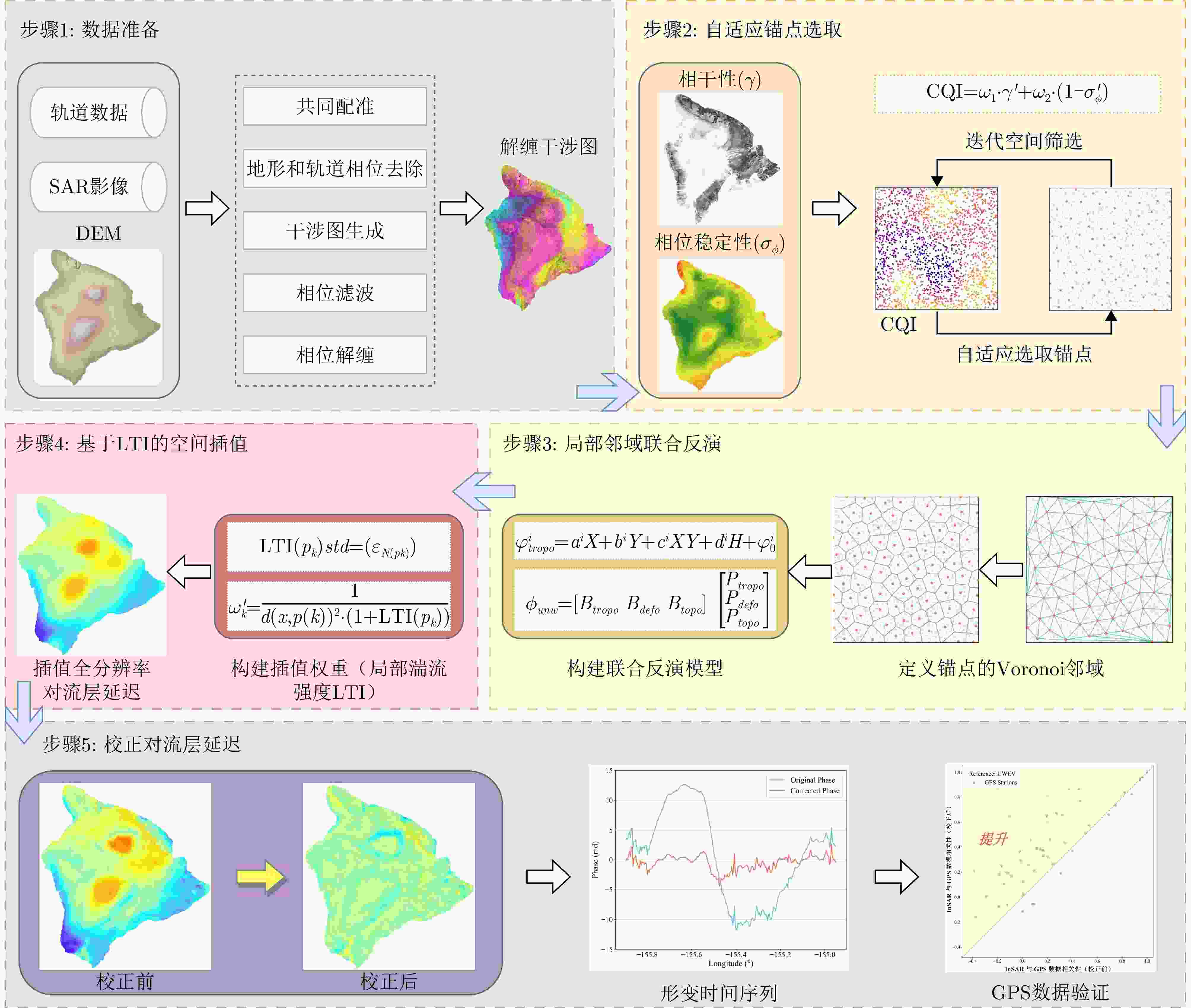
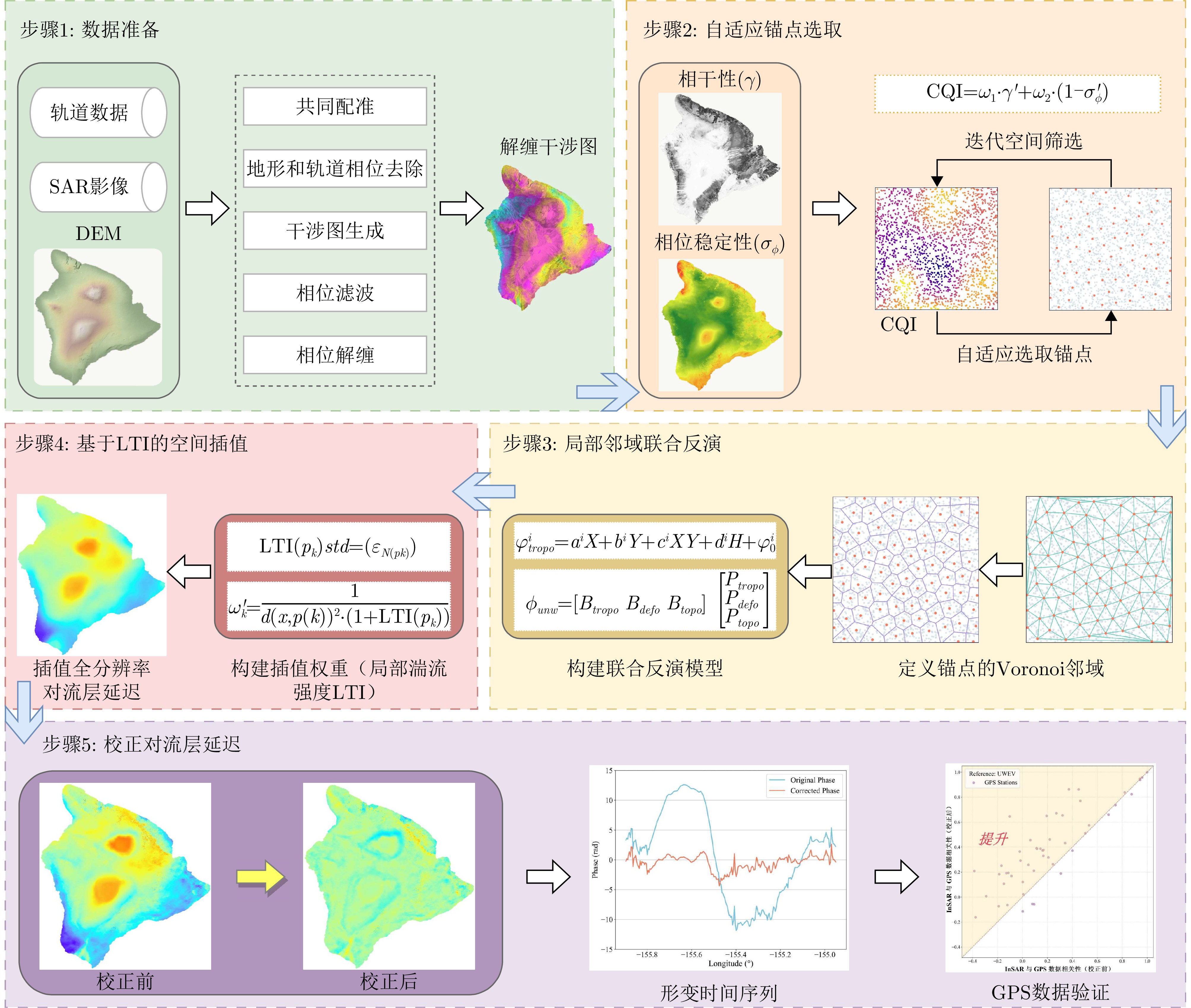
图 1 对流层延迟校正方法流程图
Figure 1. The workflow chart of the tropospheric delay correction method
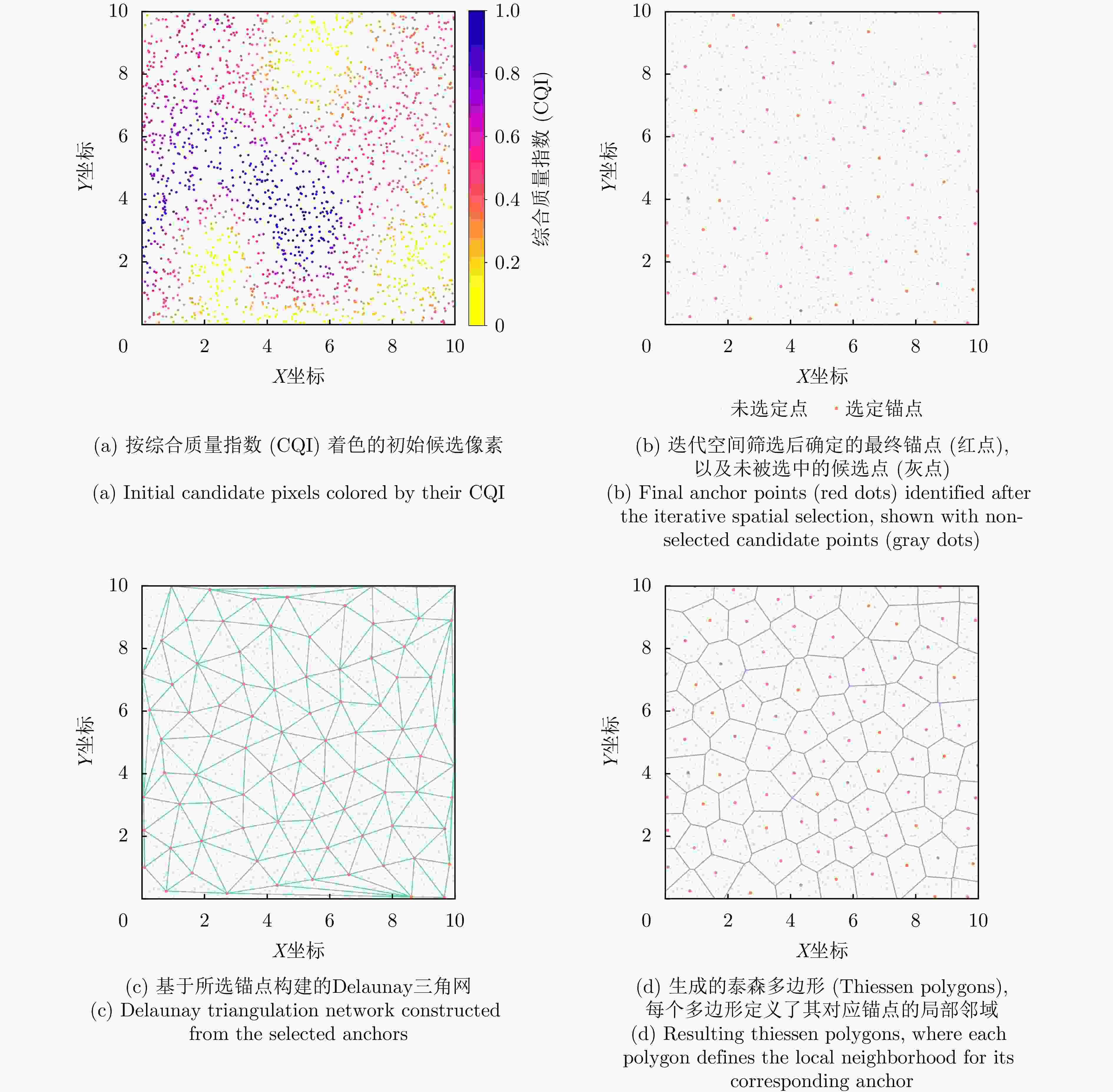
图 2 自适应锚点选取与Voronoi邻域定义示意图
Figure 2. Illustration of the adaptive anchor point selection and Voronoi neighborhood definition
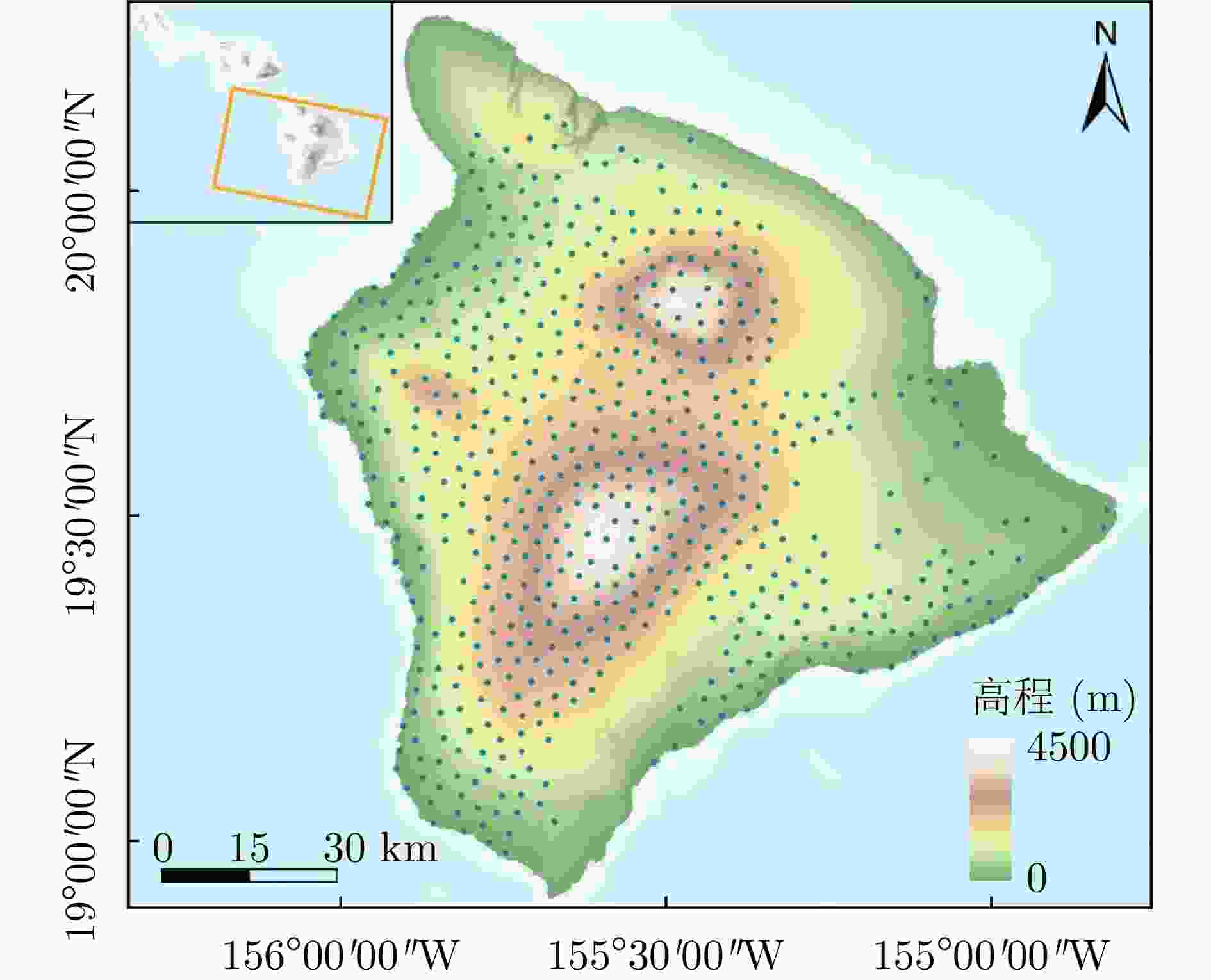
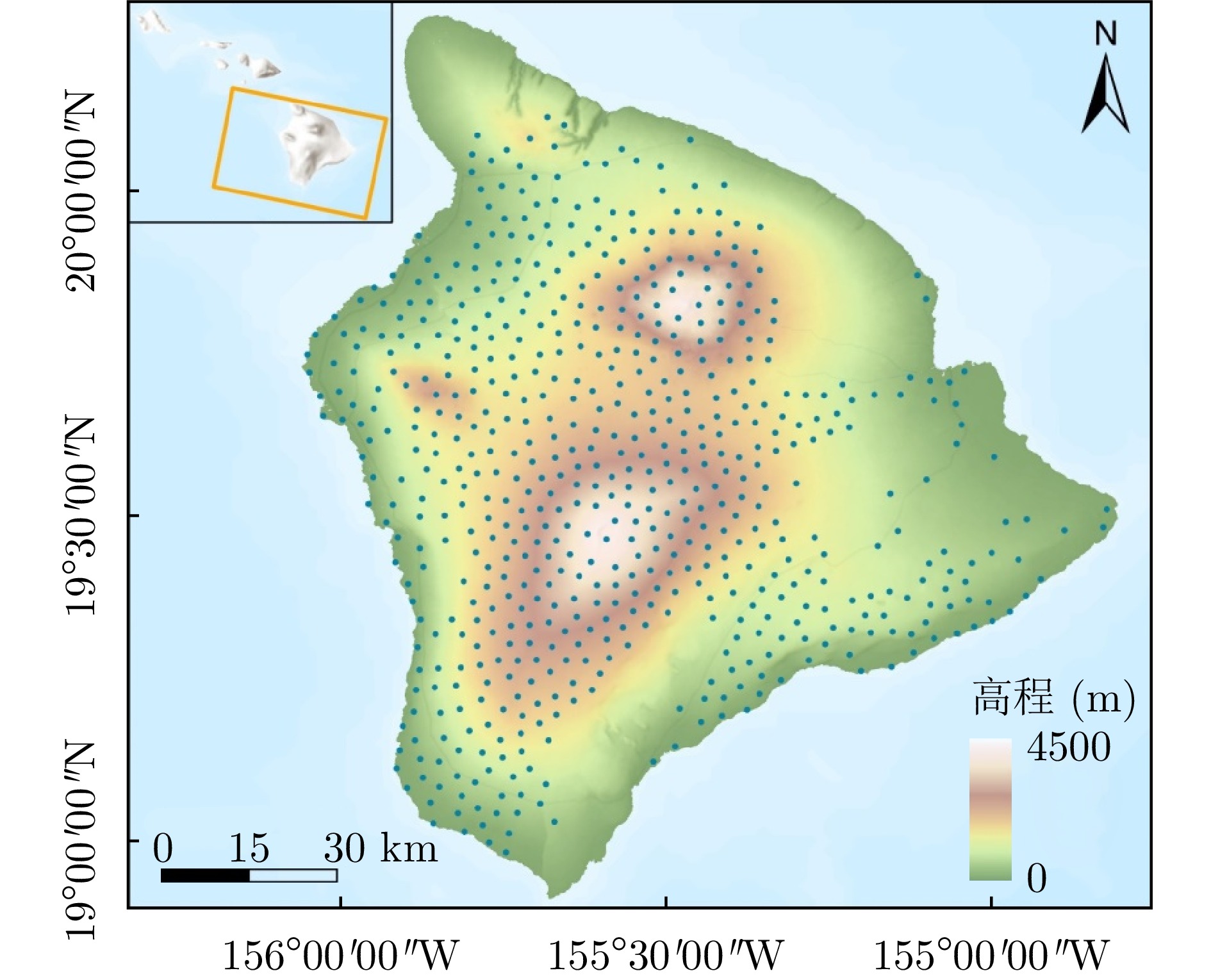
图 3 夏威夷研究区概况及所提方法选择的锚点(蓝点)分布图
Figure 3. Overview of the Hawaii study area and the distribution of the anchors (blue dots) selected by the proposed method
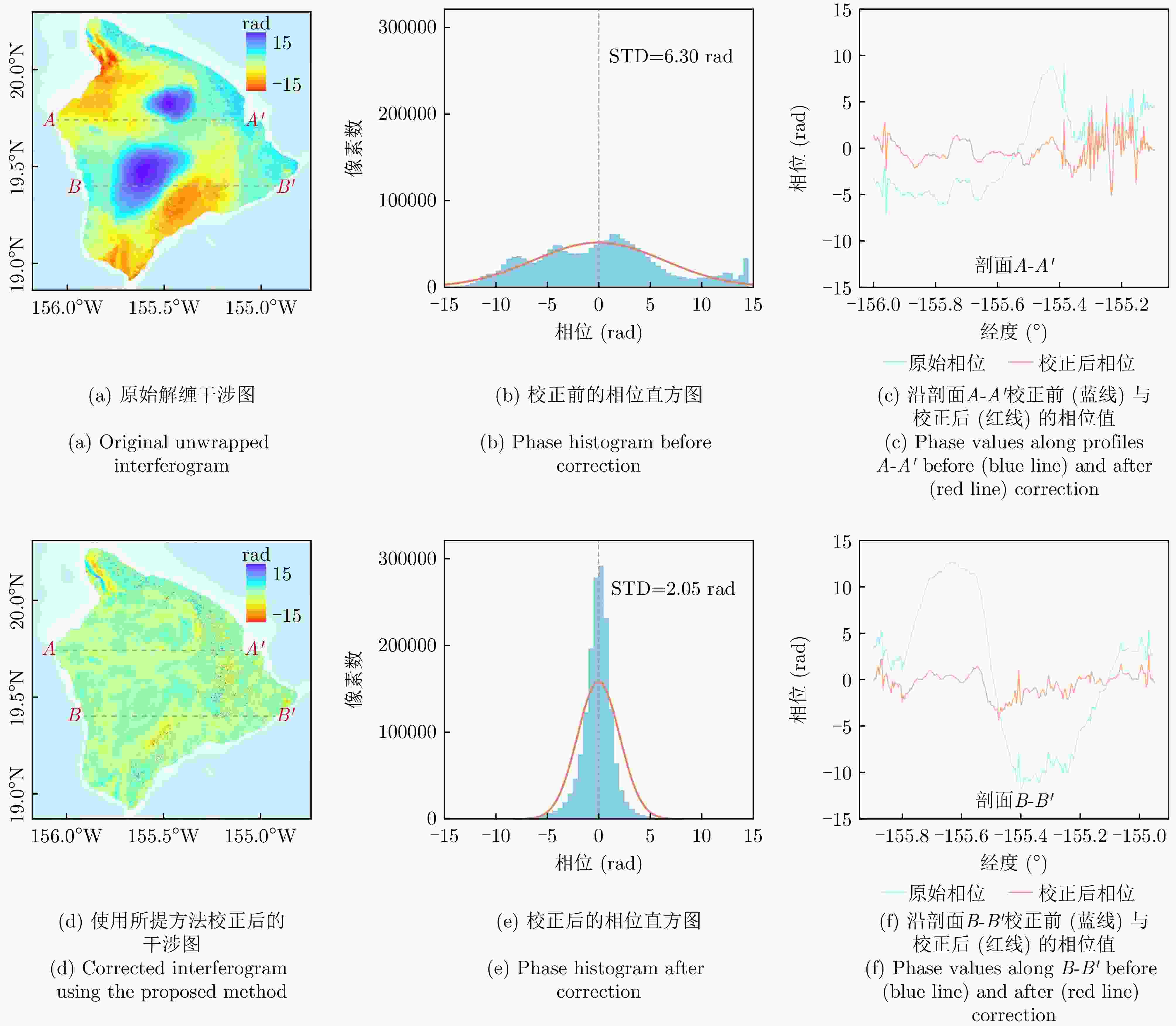
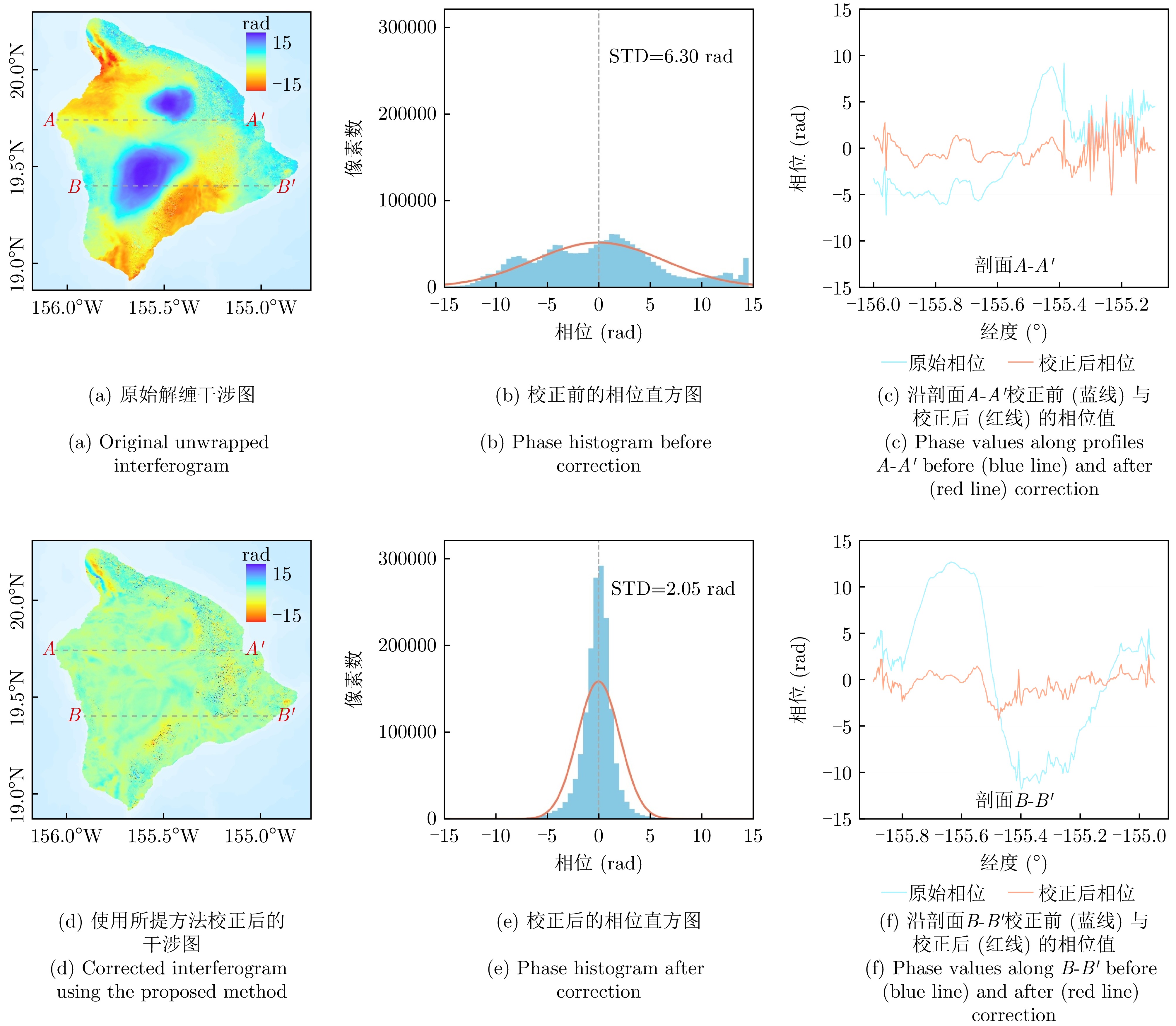
图 4 夏威夷单幅干涉图(
20170615 —20170627 )的对流层延迟校正示例Figure 4. Example of tropospheric delay correction for an interferogram (
20170615 -20170627 ) in Hawaii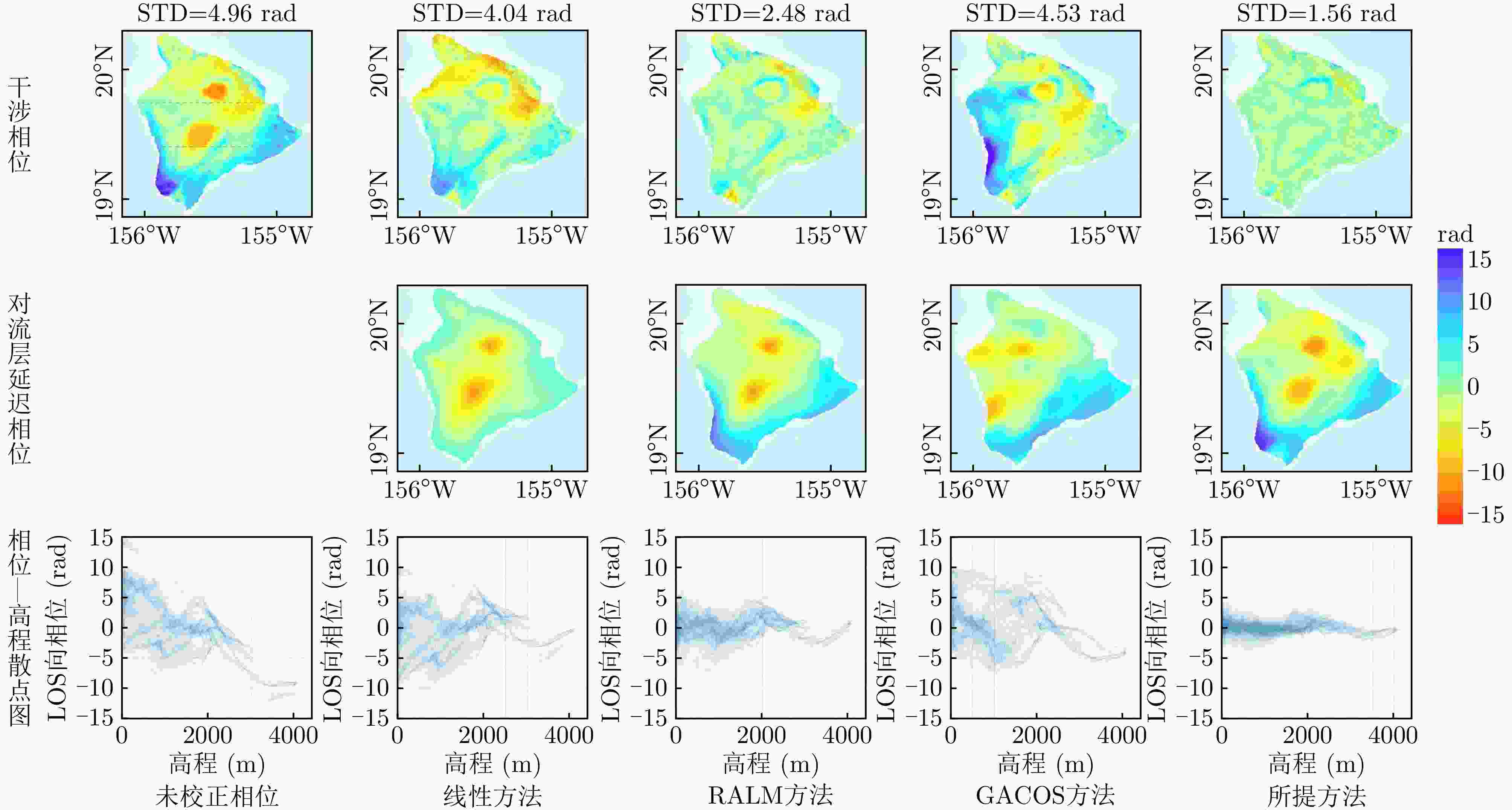
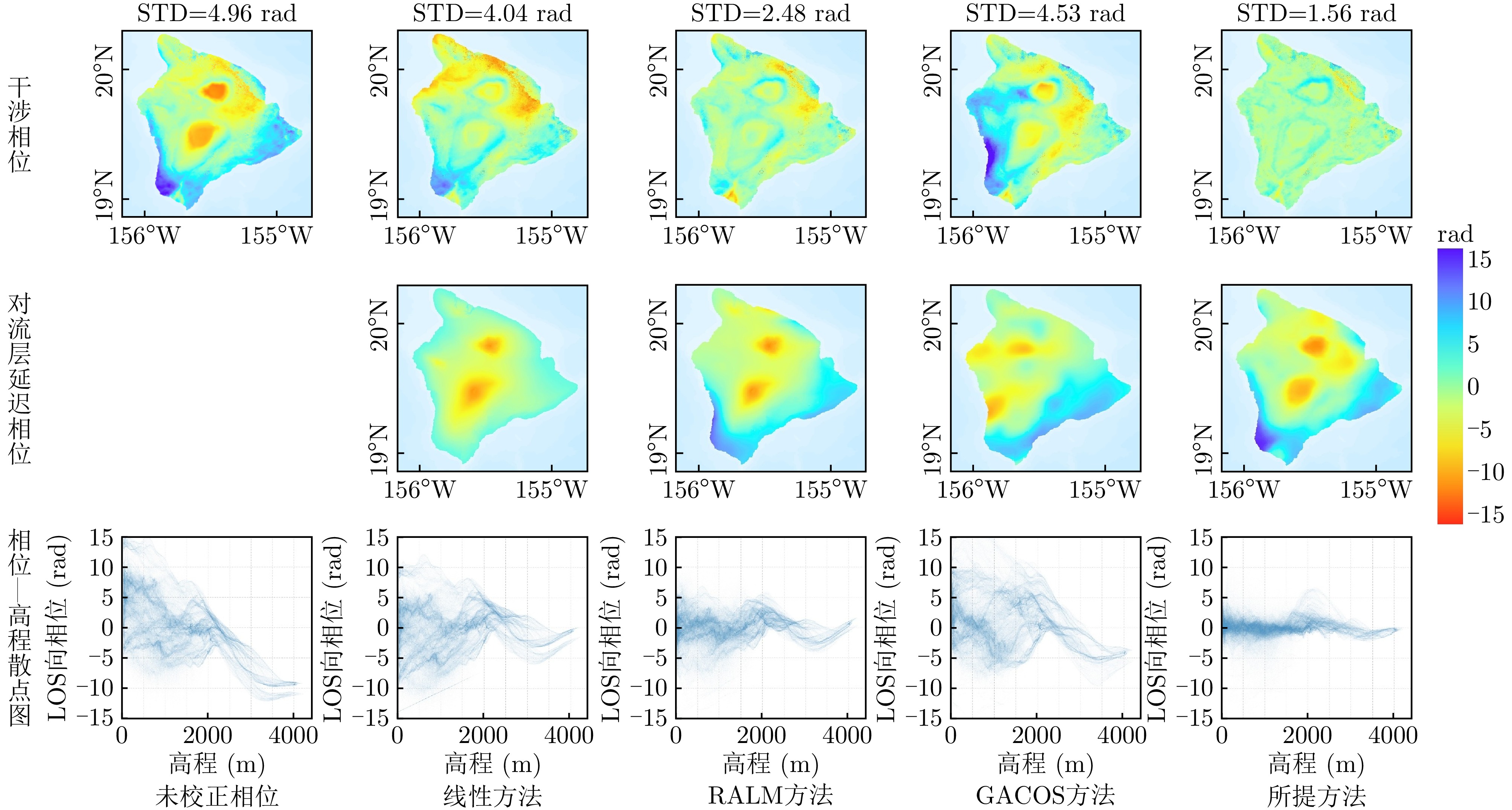
图 5 夏威夷单幅干涉图(
20170826 —20170907 )不同对流层延迟校正方法结果对比Figure 5. Comparison of tropospheric delay correction results for a single interferogram (
20170826 -20170907 ) in Hawaii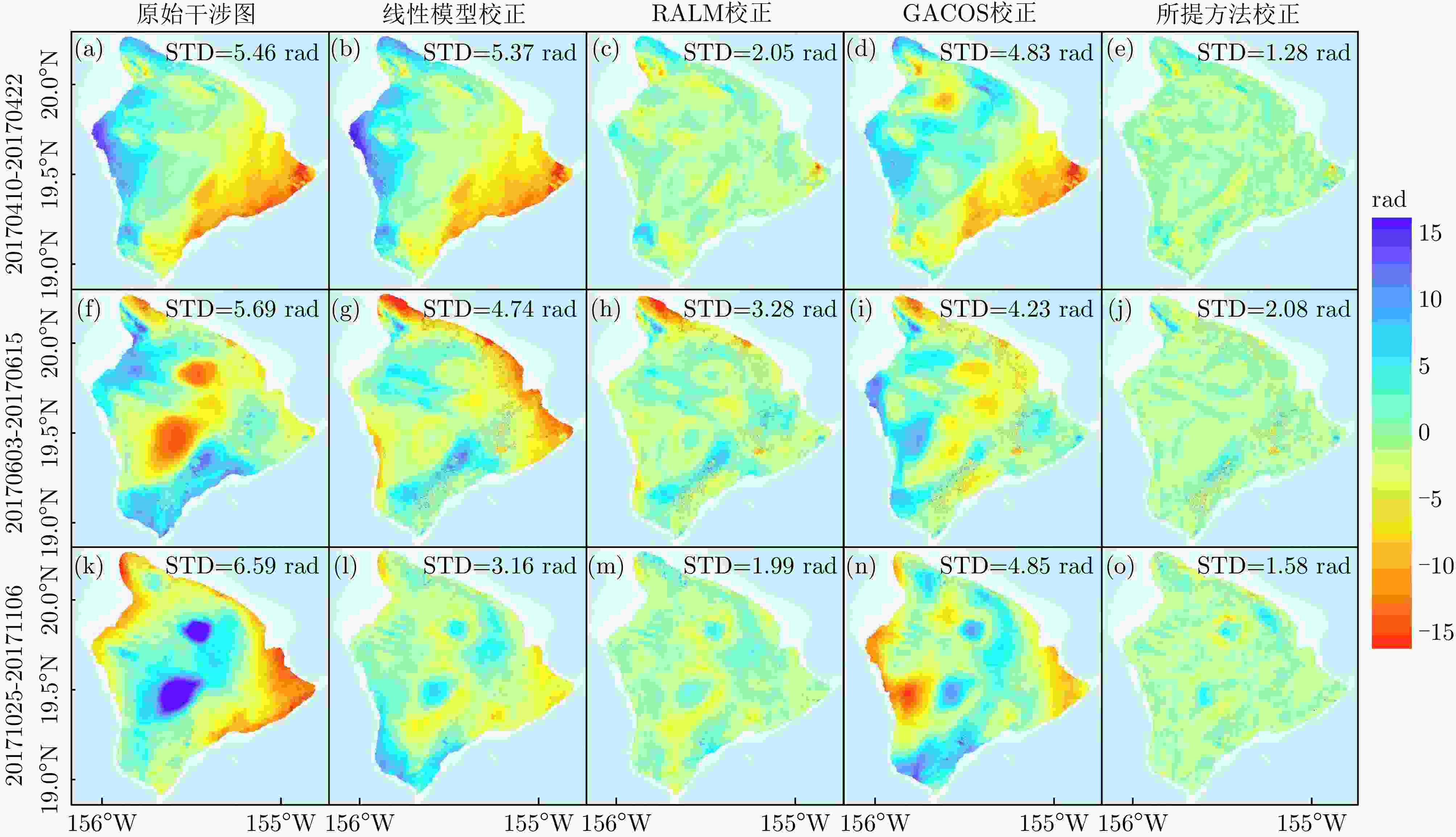
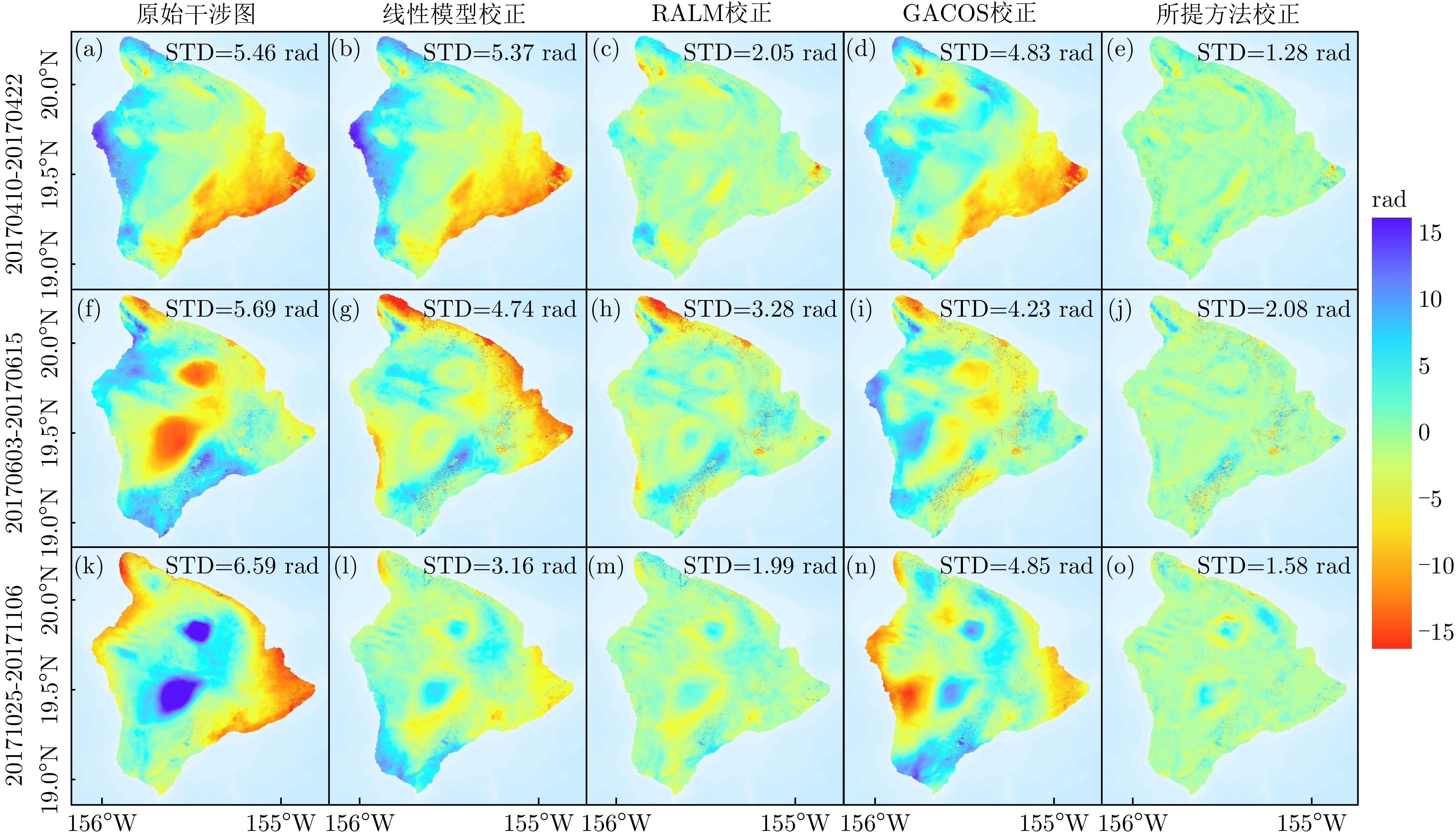
图 6 夏威夷另外三幅干涉图的对流层延迟校正结果对比
Figure 6. Comparison of tropospheric delay correction results for three additional interferograms in Hawaii
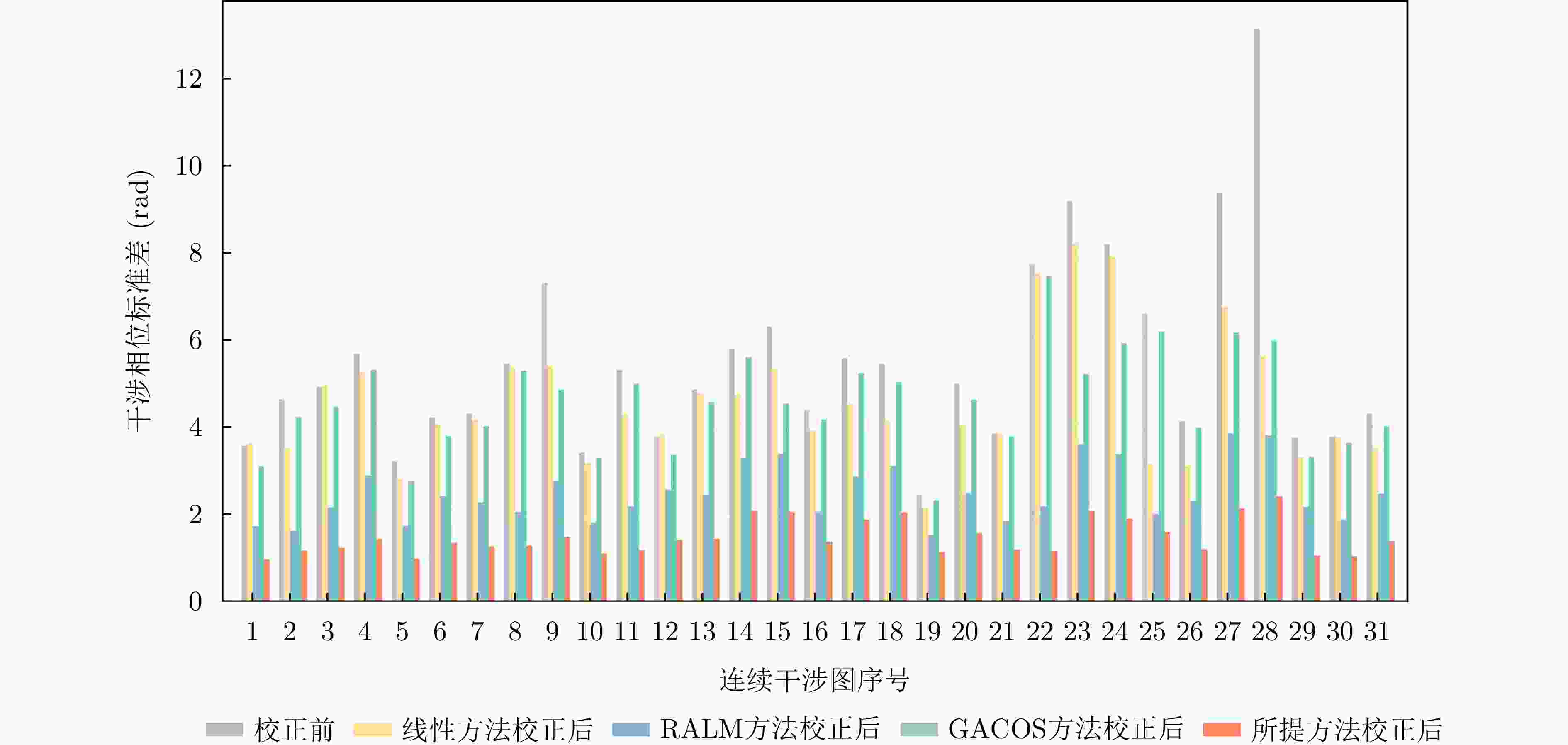
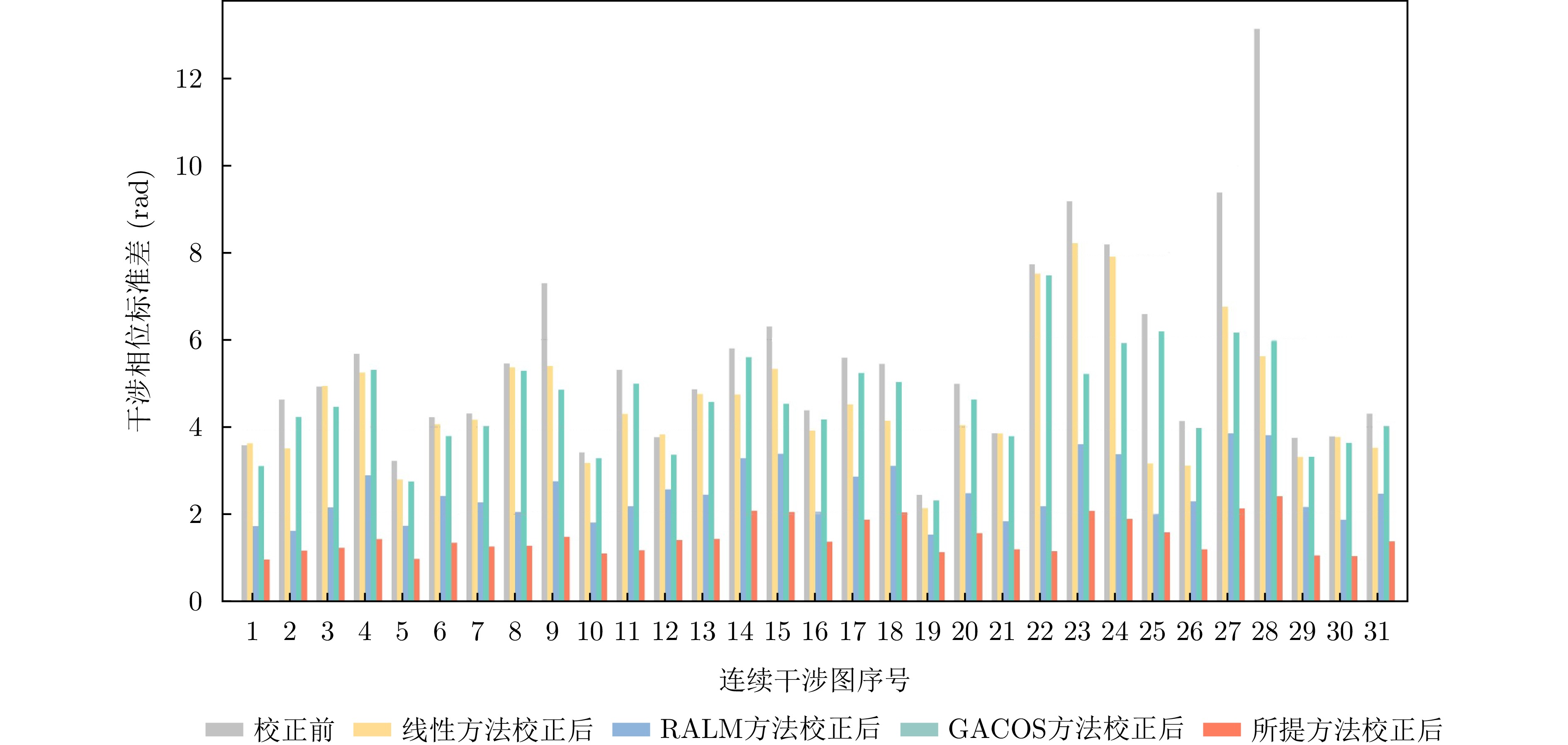
图 7 夏威夷所有干涉图在使用不同校正方法后的标准差对比图
Figure 7. Comparison of standard deviation for all interferograms in the Hawaii using different correction methods
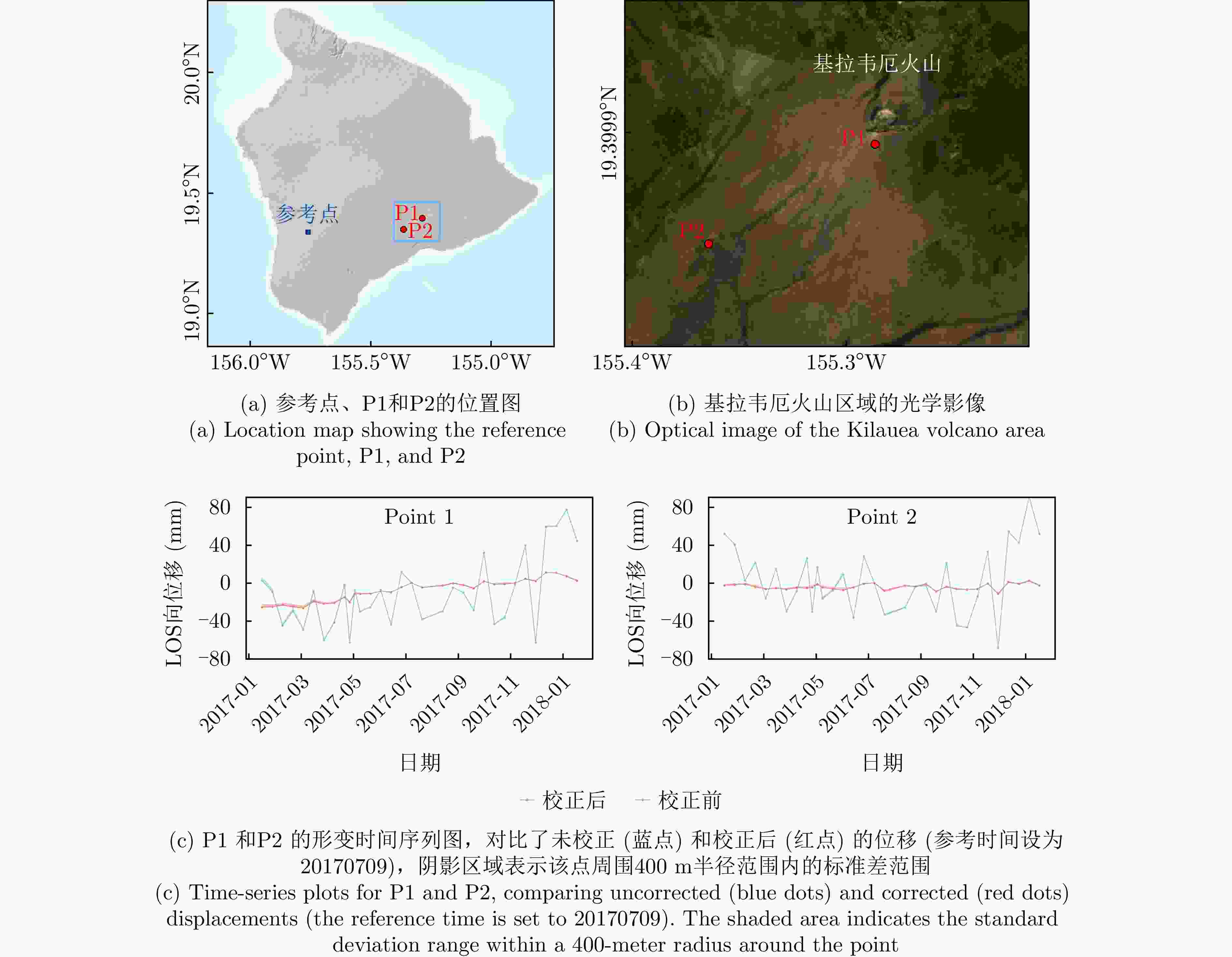
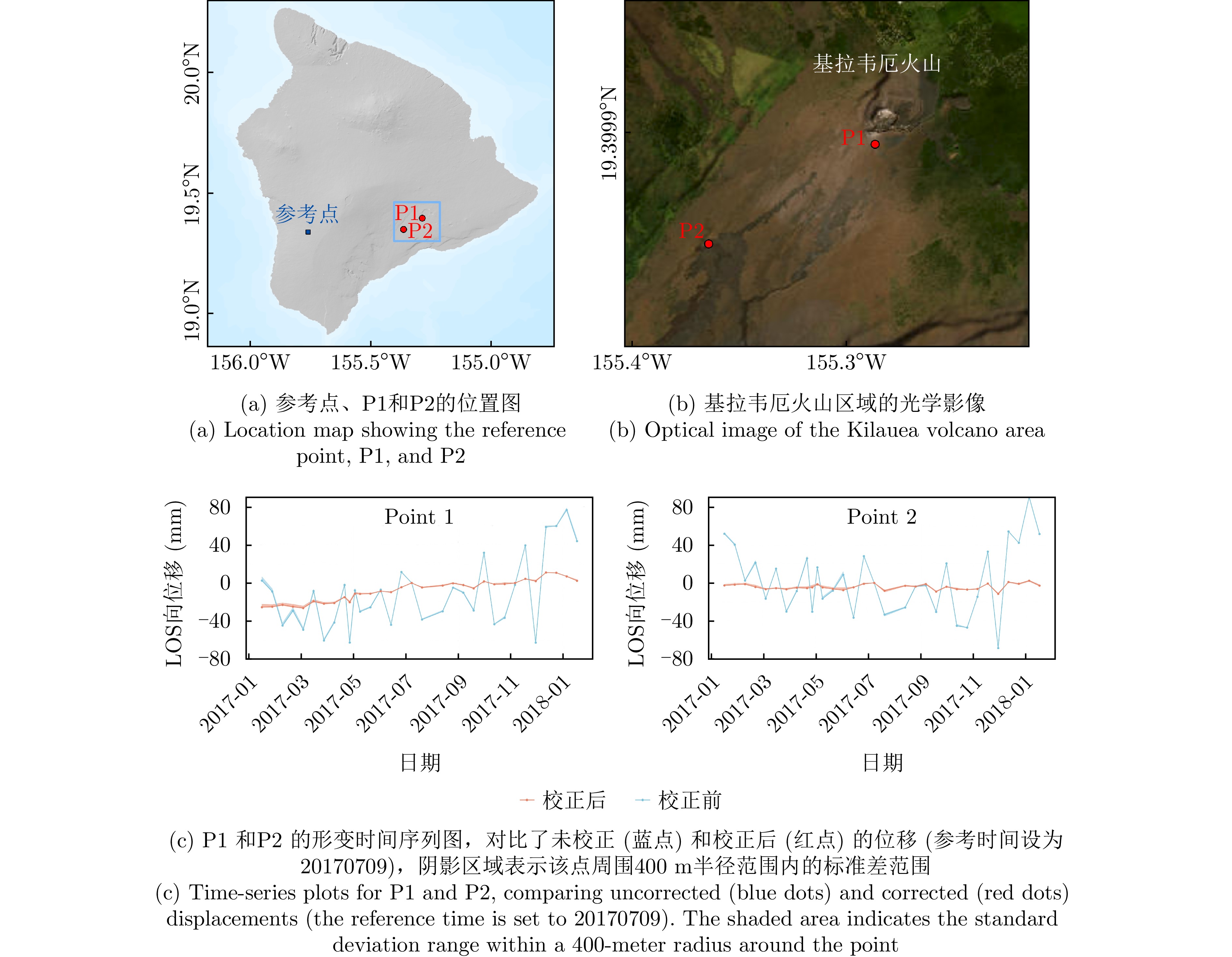
图 8 基拉韦厄火山附近两点(P1和P2)校正前后的视线方向(LOS)形变时间序列对比
Figure 8. Comparison of LOS deformation time-series before and after correction at two points (P1 and P2) near the Kilauea volcano
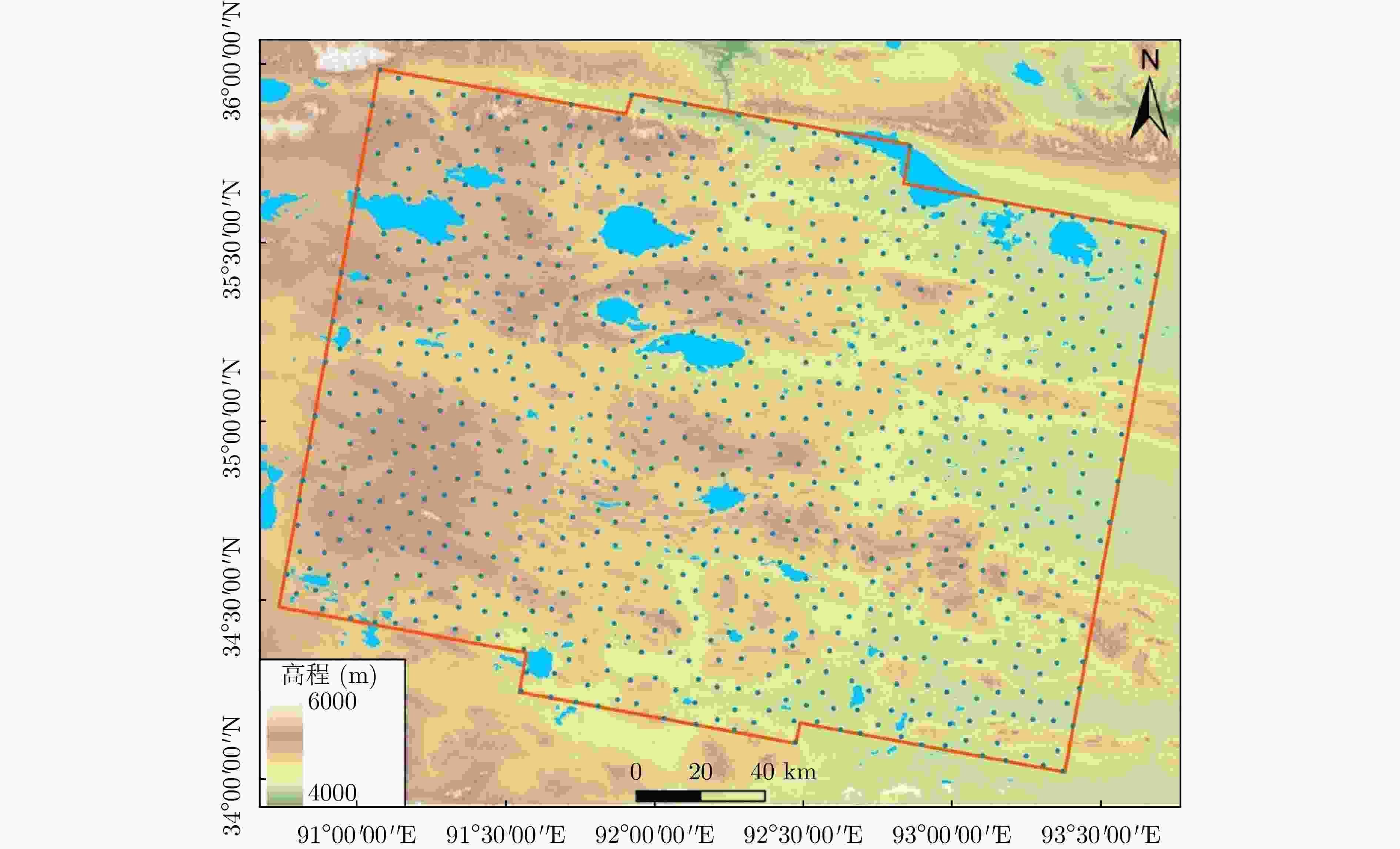
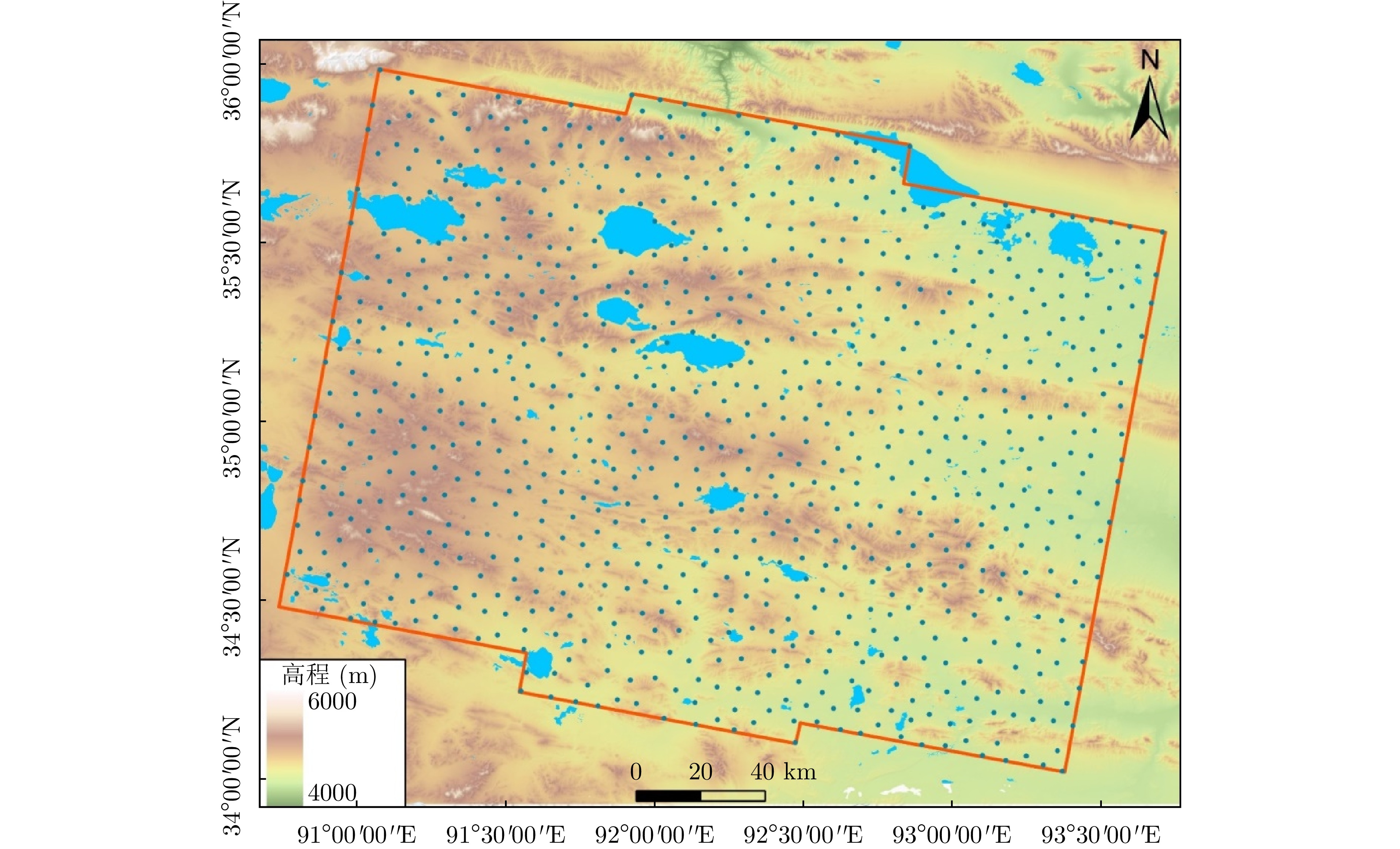
图 9 青藏高原北麓河冻土研究区概况及所提方法选择的锚点(蓝点)分布图
Figure 9. Overview of the Beiluhe permafrost study area in the QTP and the distribution of the anchors (blue dots) selected by the proposed method
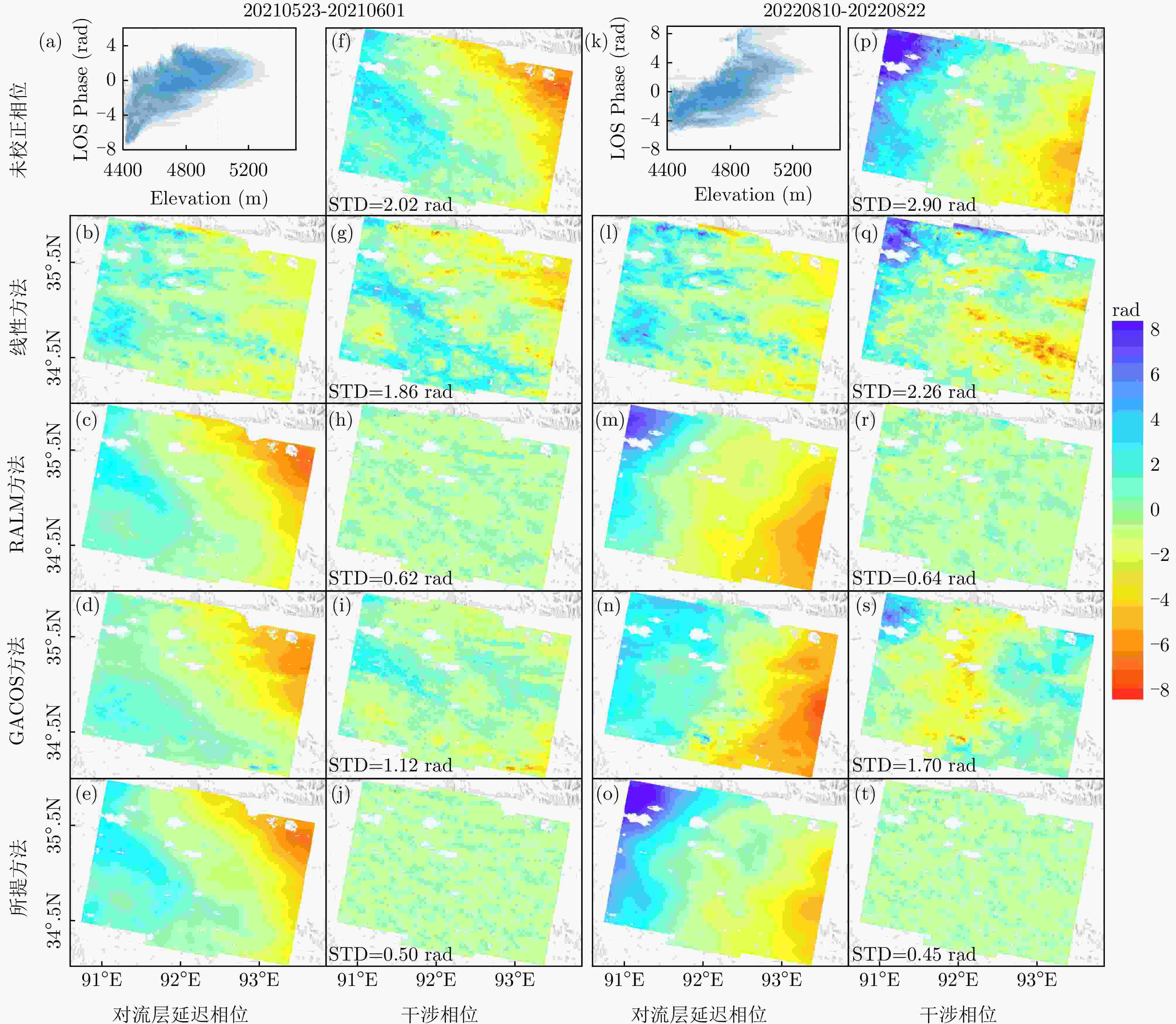
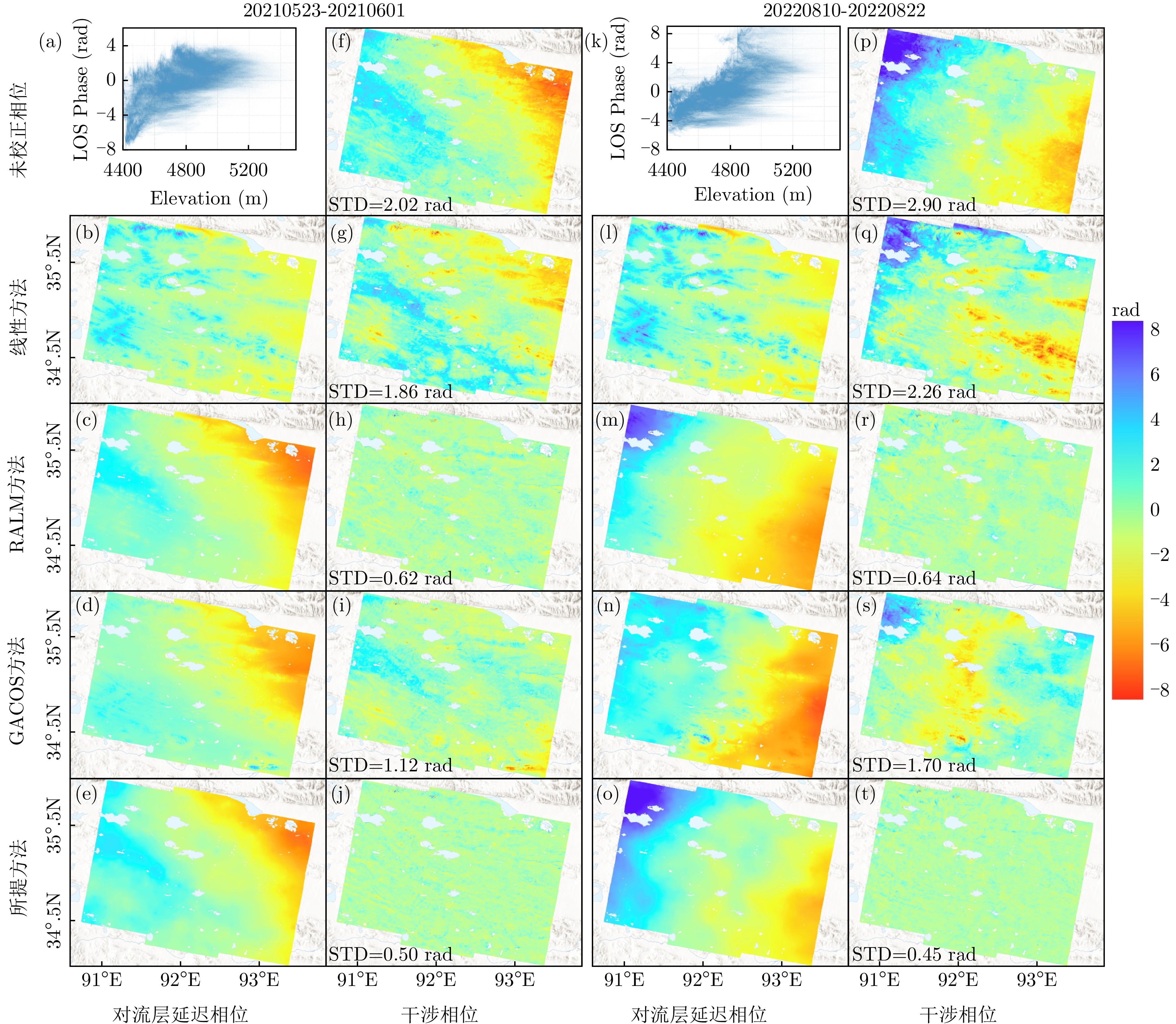
图 10 北麓河地区两幅干涉图的对流层延迟校正结果对比
Figure 10. Comparison of tropospheric delay correction results for two interferograms in the Beiluhe region
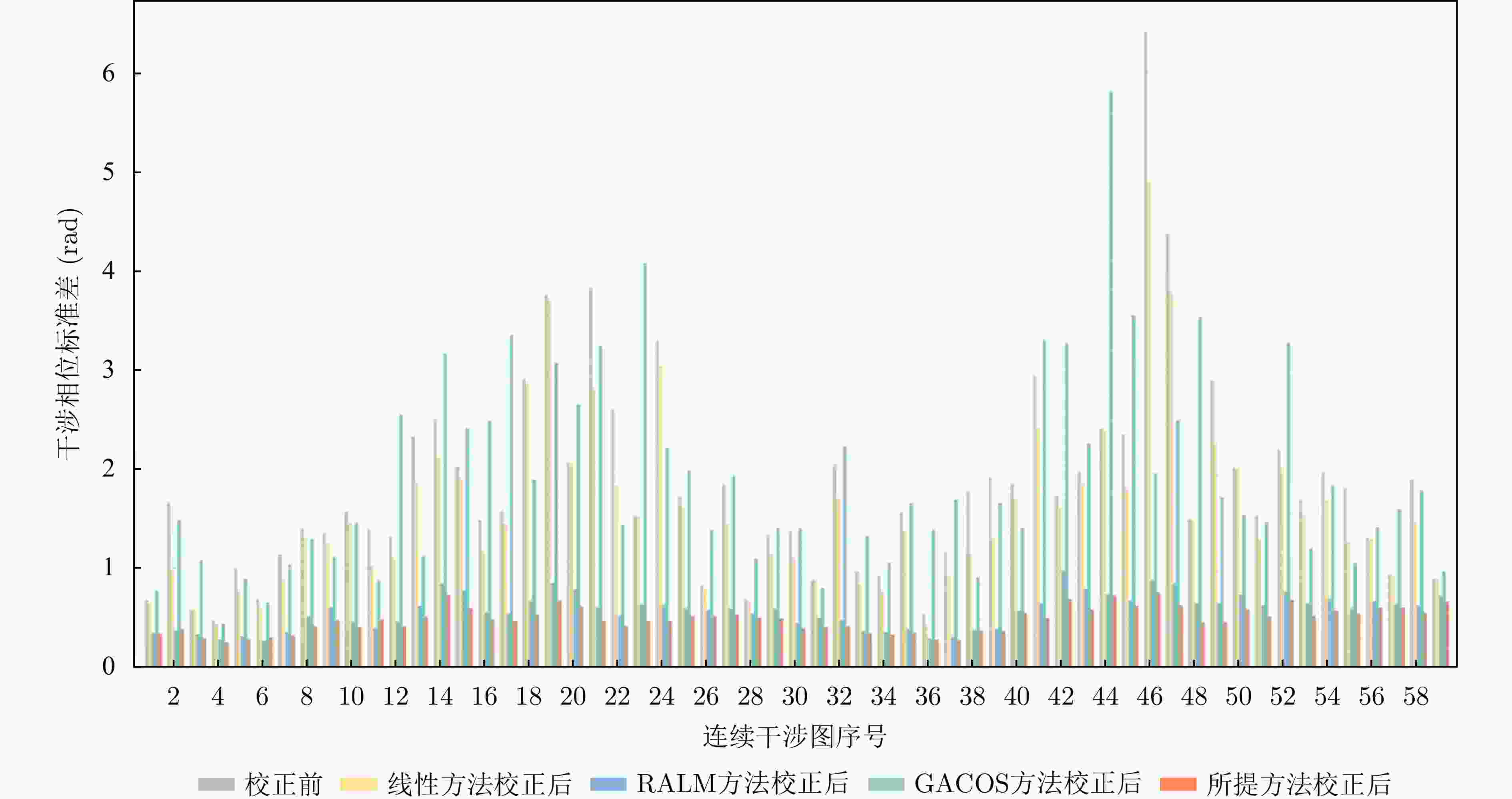
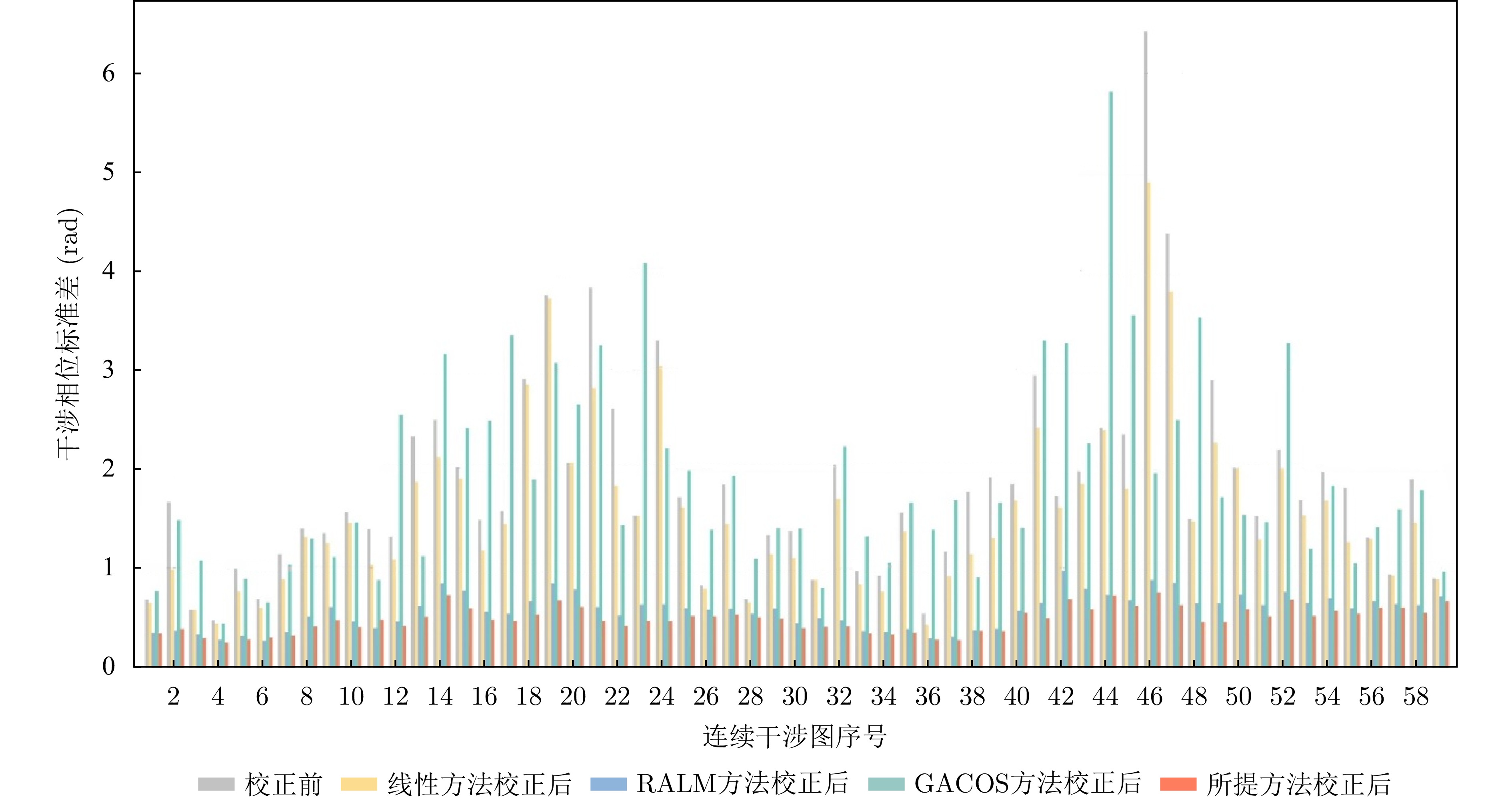
图 11 北麓河研究区所有59幅连续干涉图的相位标准差对比
Figure 11. Comparison of phase standard deviation for all 59 sequential interferograms in the Beiluhe study area
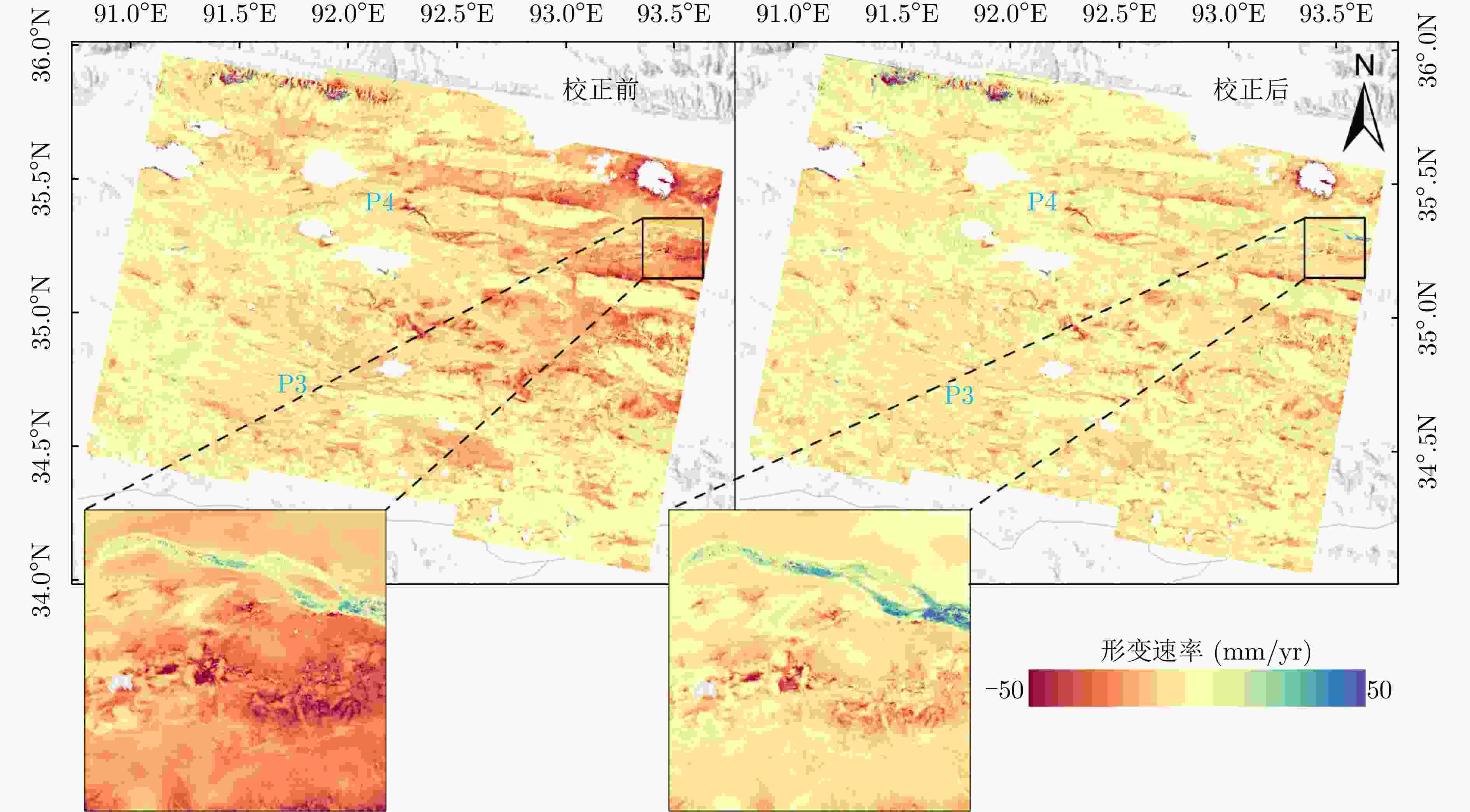
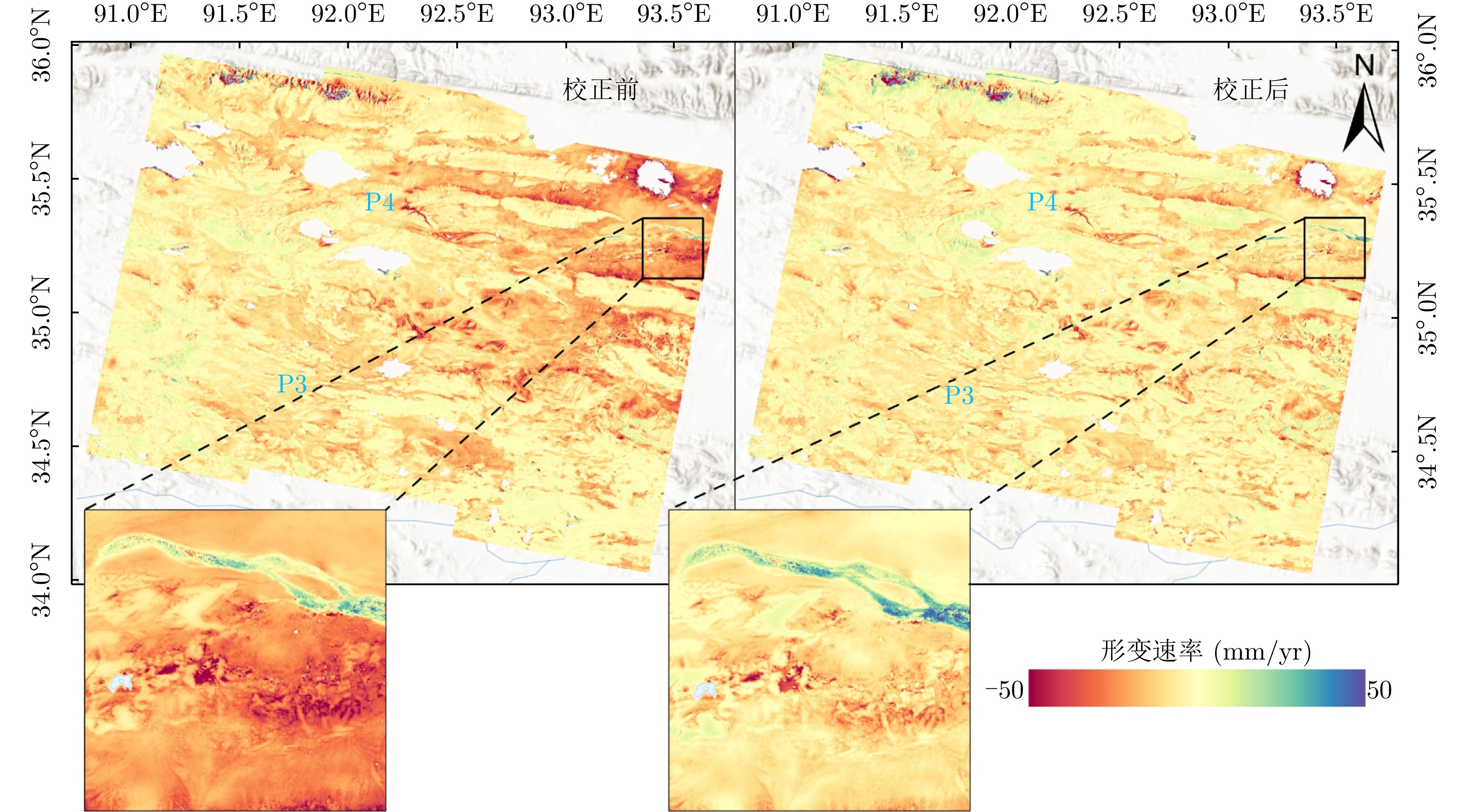
图 12 北麓河研究区校正前(左)与校正后(右)的视线方向(LOS)年平均形变速率图
Figure 12. Mean annual LOS deformation velocity maps for the Beiluhe study area before (left) and after (right) correction
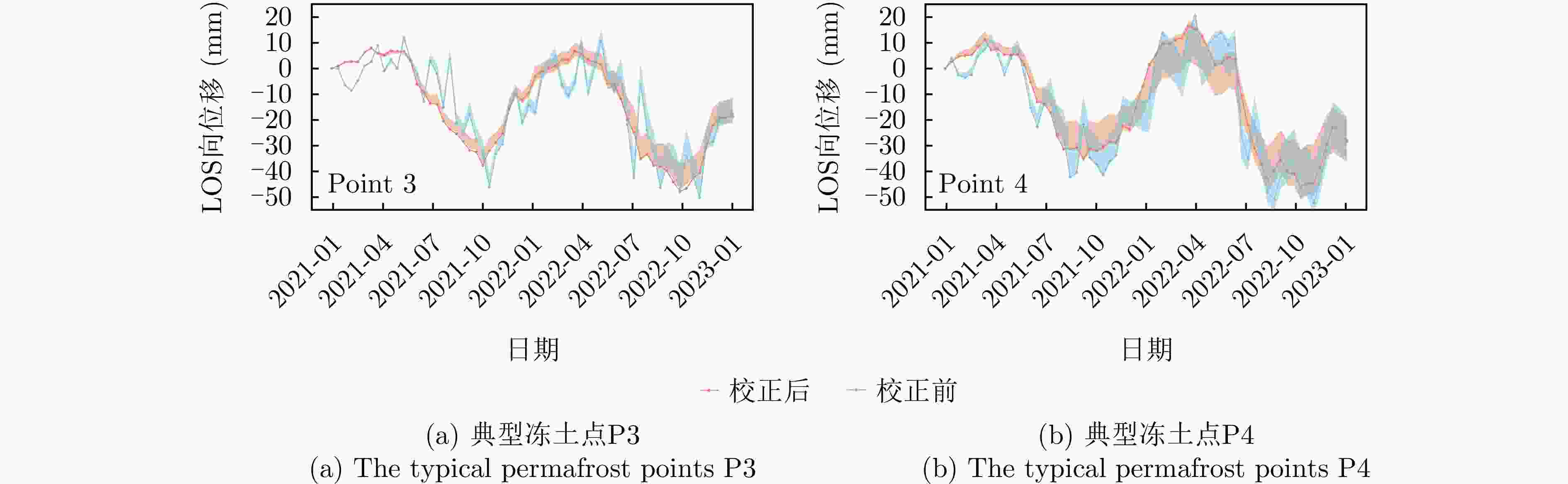
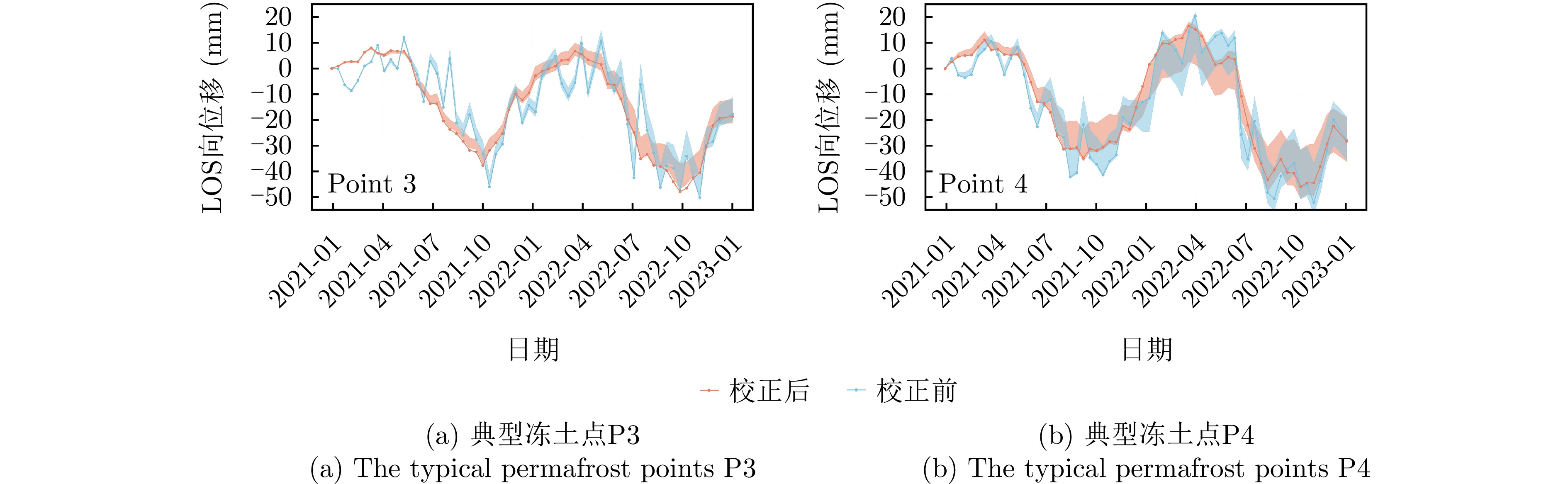
图 13 两个典型冻土点校正前(蓝色阴影线)与校正后(红色实线)的视线方向(LOS)形变时间序列对比。阴影区域表示该点周围400 m半径范围内的标准差范围
Figure 13. Comparison of LOS deformation time-series before (blue shaded line) and after (red solid line) correction for two typical permafrost points (the shaded area indicates the standard deviation range within a 400-meter radius around the point)
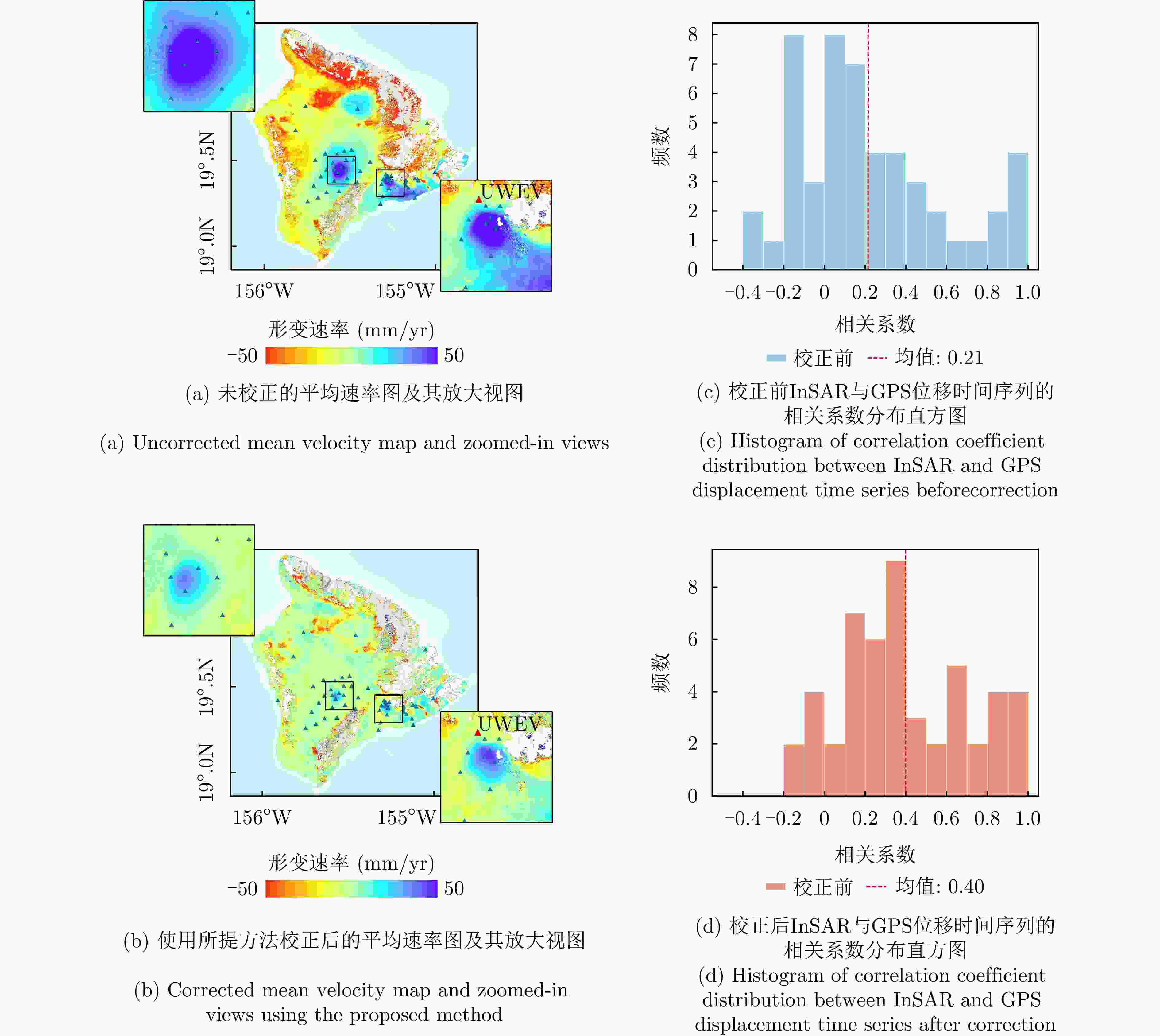
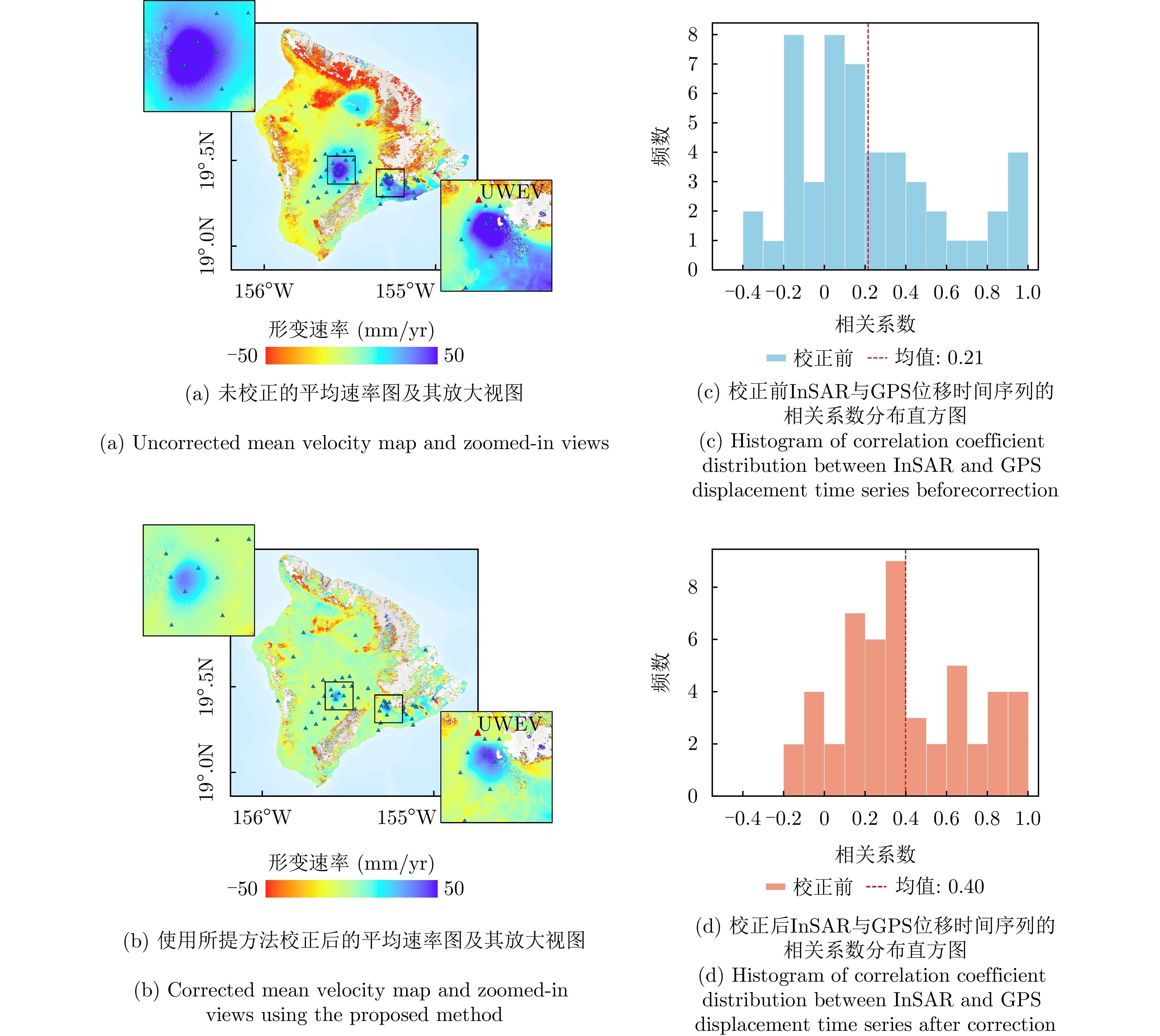
图 14 夏威夷InSAR结果与GPS数据的验证(GPS站点位置用三角形表示)
Figure 14. Validation of InSAR results with GPS data in Hawaii (locations of GPS stations are represented by triangles)
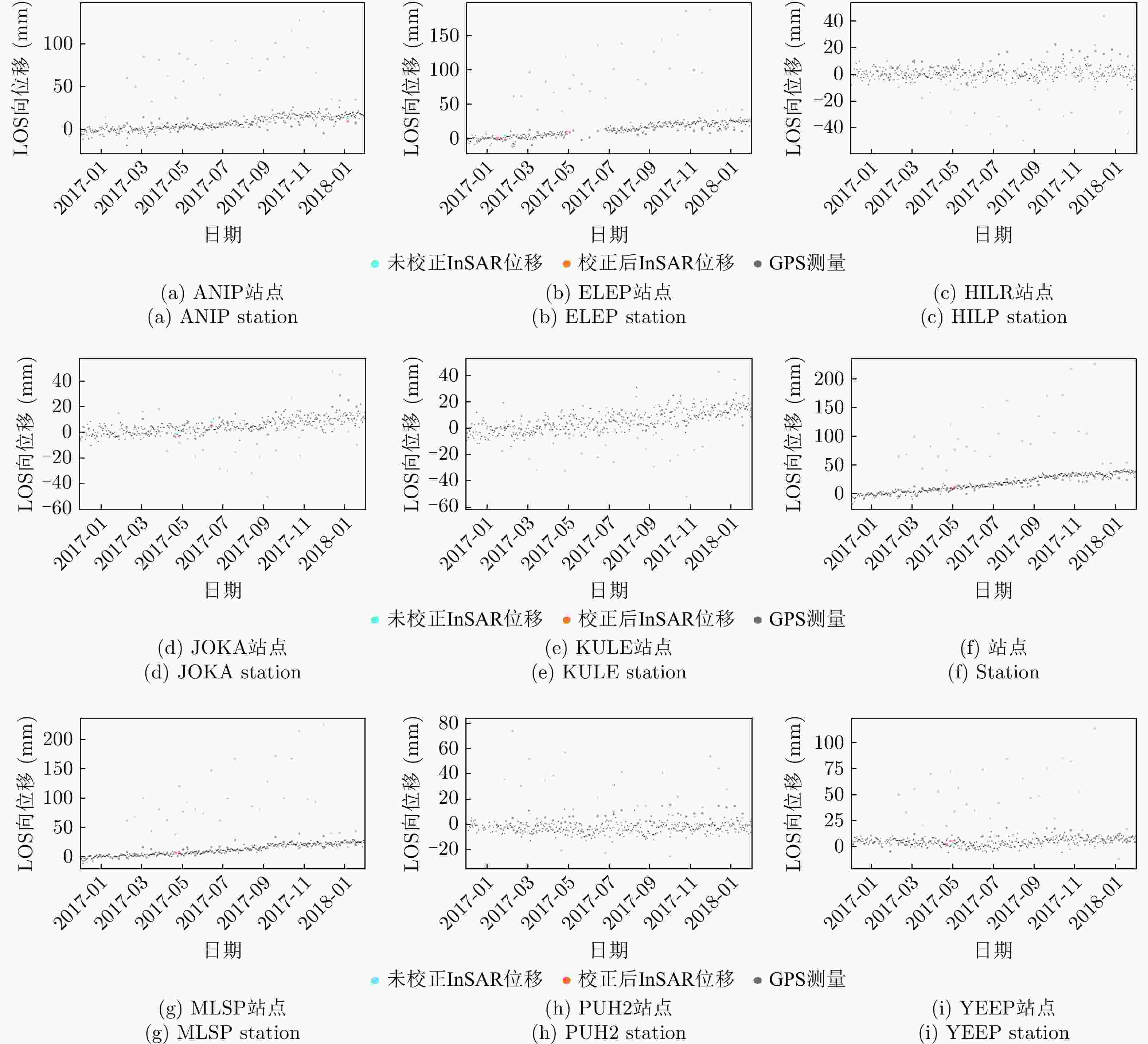
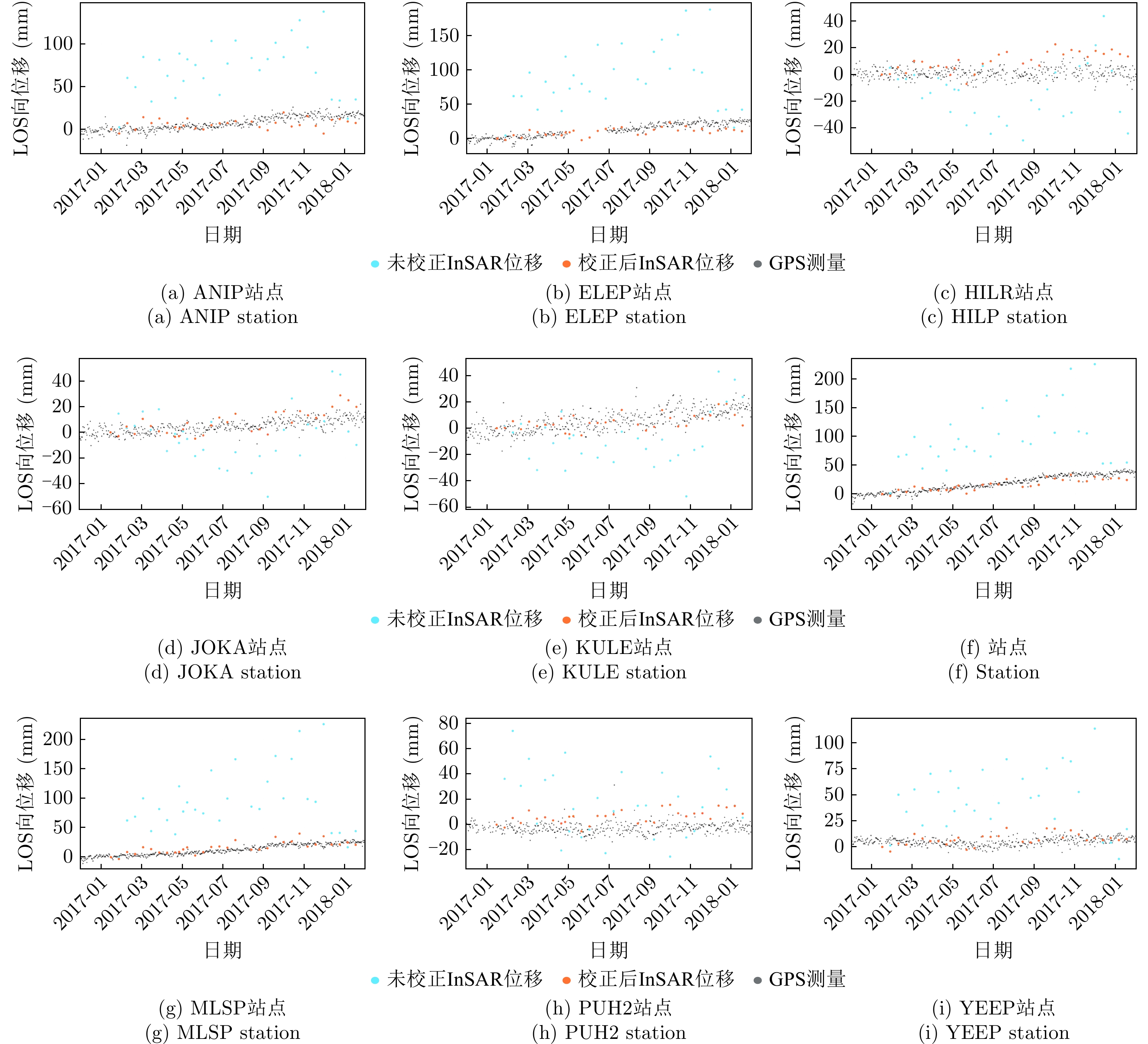
图 15 选定9个GPS站点的InSAR与GPS时间序列位移对比
Figure 15. Comparison of InSAR and GPS time-series displacements at 9 selected GPS stations
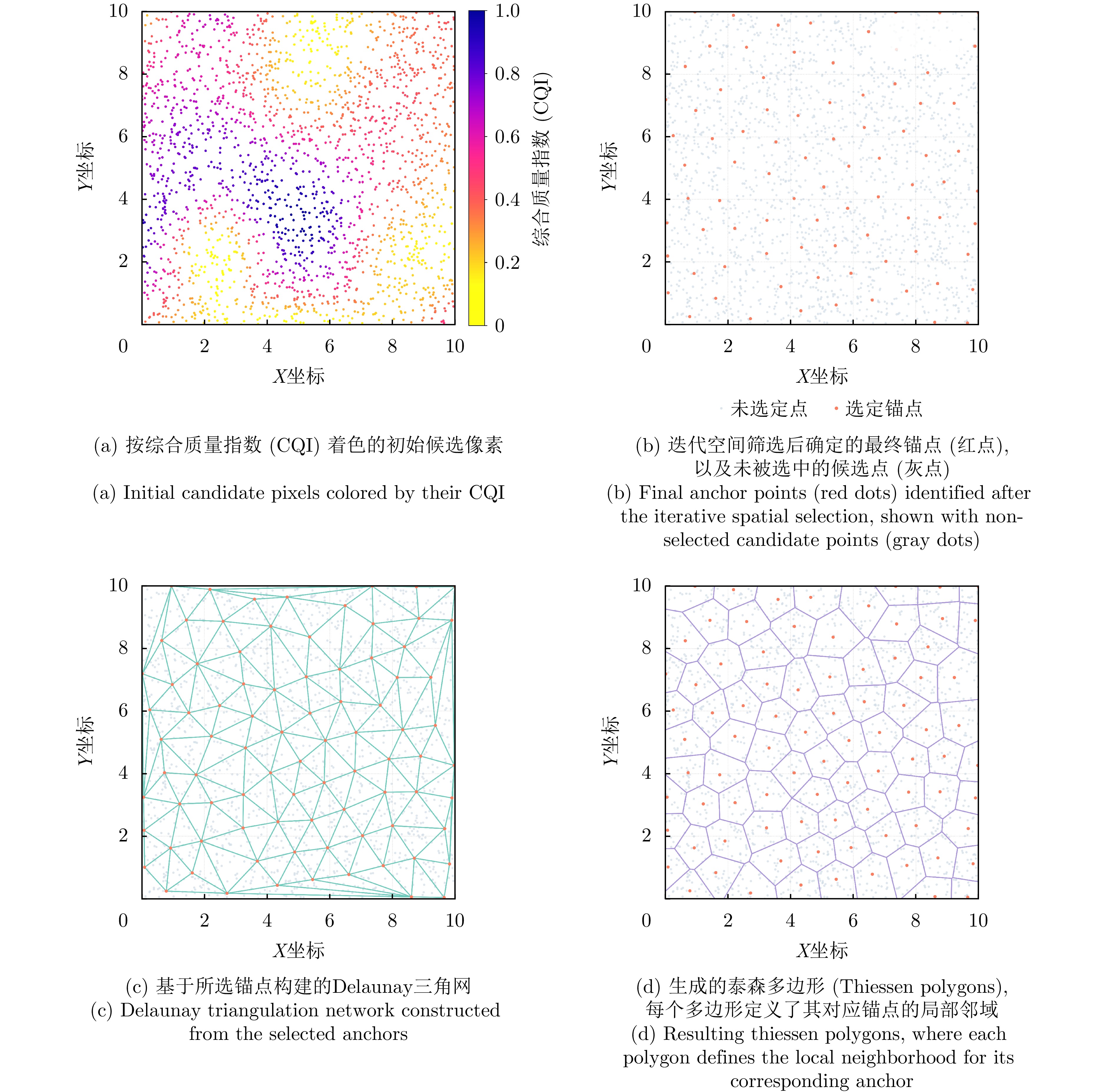
1 锚点迭代空间筛选算法
1. Anchor point iterative space selection algorithm
输入:按CQI降序排列的候选像素集$ {S}_{C} $,预定义的最小间距
$ {d}_{\min } $。输出:最终确定的锚点集合$ {S}_{A} $。 1: 初始化锚点集合$ {S}_{A} $。 2: 初始化与图像尺寸一致的布尔型掩膜$ {\text{Mask}}_{\text{locked}}({r}_{i},{c}_{i}) $,所有
像素设为False (未锁定)。3: 对于候选像素集$ {S}_{C} $中的每个像素$ {p}_{i} $执行: 4: 获取像素$ {p}_{i} $的空间坐标$ ({r}_{i},{c}_{i}) $。 5: 如果$ {\text{Mask}}_{\text{locked}}({r}_{i},{c}_{i}) $的值为False,则: 6: 将像素$ {p}_{i} $加入最终锚点集合$ {S}_{A} $。 7: 以坐标$ ({r}_{i},{c}_{i}) $为圆心,$ {d}_{\min } $为半径,定义一个圆形排他
区域$ {\varOmega }_{i} $。8: 将$ {\text{Mask}}_{\text{locked}}({r}_{i},{c}_{i}) $中位于圆形区域$ {\varOmega }_{i} $内的所有像素值更
新为True (锁定)。9: 结束如果 10: 结束循环 11: 返回最终锚点集合$ {S}_{A} $。  下载: 导出CSV
表 1 夏威夷不同校正方法的相位标准差统计对比
Table 1. Statistical comparison of phase standard deviation for different correction methods in Hawaii
方法 相位标准差均值(rad) 相位标准差中值(rad) 相位标准差最小值(rad) 相位标准差最大值(rad) 相位标准差降低比例 未校正 5.47 4.93 2.44 13.13 N/A 线性 4.54 4.14 2.14 8.22 17.0% RALM 2.48 2.29 1.53 3.85 54.8% GACOS 4.43 4.23 2.19 7.23 18.8% 所提方法 1.46 1.37 0.96 2.41 73.2%
下载: 导出CSV
表 2 北麓河不同校正方法的相位标准差统计对比
Table 2. Statistical comparison of phase standard deviation for different correction methods in Beilushe
方法 相位标准差均值(rad) 相位标准差中值(rad) 相位标准差最小值(rad) 相位标准差最大值(rad) 相位标准差降低比例 未校正 1.82 1.66 0.47 6.43 N/A 线性 1.56 1.45 0.42 4.90 14.4% RALM 0.57 0.59 0.27 0.97 68.7% GACOS 1.90 1.60 0.44 5.82 –4.4% 所提方法 0.48 0.47 0.24 0.74 73.8%
下载: 导出CSV
-
[1] WANG Chao, TANG Yixian, ZHANG Hong, et al. First mapping of China surface movement using supercomputing interferometric SAR technique[J]. Science Bulletin, 2021, 66(16): 1608–1610. doi: 10.1016/j.scib.2021.04.026. [2] AO Zurui, HU Xiaomei, TAO Shengli, et al. A national-scale assessment of land subsidence in China’s major cities[J]. Science, 2024, 384(6693): 301–306. doi: 10.1126/science.adl4366. [3] TAY C, LINDSEY E O, CHIN Shitong, et al. Sea-level rise from land subsidence in major coastal cities[J]. Nature Sustainability, 2022, 5(12): 1049–1057. doi: 10.1038/s41893-022-00947-z. [4] 云烨, 吕孝雷, 付希凯, 等. 星载InSAR技术在地质灾害监测领域的应用[J]. 雷达学报, 2020, 9(1): 73–85. doi: 10.12000/JR20007.YUN Ye, LÜ Xiaolei, FU Xikai, et al. Application of spaceborne interferometric synthetic aperture radar to geohazard monitoring[J]. Journal of Radars, 2020, 9(1): 73–85. doi: 10.12000/JR20007. [5] MASSONNET D, FEIGL K, ROSSI M, et al. Radar interferometric mapping of deformation in the year after the Landers earthquake[J]. Nature, 1994, 369(6477): 227–230. doi: 10.1038/369227a0. [6] ZHU Chuanhua, LI Xue, WANG Chisheng, et al. Deep learning-based coseismic deformation estimation from InSAR interferograms[J]. IEEE Transactions on Geoscience and Remote Sensing, 2024, 62: 5203610. doi: 10.1109/TGRS.2024.3357190. [7] LU Zhong and DZURISIN D. InSAR Imaging of Aleutian volcanoes[M]. LU Zhong and DZURISIN D. InSAR Imaging of Aleutian Volcanoes: Monitoring a Volcanic Arc from Space. Berlin, Heidelberg: Springer, 2014: 87–345. doi: 10.1007/978-3-642-00348-6_6. [8] ANANTRASIRICHAI N, BIGGS J, ALBINO F, et al. Application of machine learning to classification of volcanic deformation in routinely generated InSAR data[J]. Journal of Geophysical Research: Solid Earth, 2018, 123(8): 6592–6606. doi: 10.1029/2018JB015911. [9] DELGADO F, SHREVE T, BORGSTROM S, et al. A global assessment of SAOCOM-1 L-band stripmap data for InSAR characterization of volcanic, tectonic, cryospheric, and anthropogenic deformation[J]. IEEE Transactions on Geoscience and Remote Sensing, 2024, 62: 5216821. doi: 10.1109/TGRS.2024.3423792. [10] ZOU Lichuan, WANG Chao, ZHANG Hong, et al. Landslide-prone area retrieval and earthquake-inducing hazard probability assessment based on InSAR analysis[J]. Landslides, 2023, 20(9): 1989–2002. doi: 10.1007/s10346-023-02079-7. [11] ZHOU Chao, CAO Ying, GAN Lulu, et al. A novel framework for landslide displacement prediction using MT-InSAR and machine learning techniques[J]. Engineering Geology, 2024, 334: 107497. doi: 10.1016/j.enggeo.2024.107497. [12] GUAN Shaoyang, WANG Chao, TANG Yixian, et al. North American Circum-arctic permafrost degradation observation using sentinel-1 InSAR data[J]. Remote Sensing, 2024, 16(15): 2809. doi: 10.3390/rs16152809. [13] WANG Chao, ZHANG Zhengjia, ZHANG Hong, et al. Active layer thickness retrieval of Qinghai-Tibet permafrost using the TerraSAR-X InSAR technique[J]. IEEE Journal of Selected Topics in Applied Earth Observations and Remote Sensing, 2018, 11(11): 4403–4413. doi: 10.1109/JSTARS.2018.2873219. [14] ZEBKER H A, ROSEN P A, and HENSLEY S. Atmospheric effects in interferometric synthetic aperture radar surface deformation and topographic maps[J]. Journal of Geophysical Research: Solid Earth, 1997, 102(B4): 7547–7563. doi: 10.1029/96JB03804. [15] LI Zhiwei, CAO Yunmeng, WEI Jianchao, et al. Time-series InSAR ground deformation monitoring: Atmospheric delay modeling and estimating[J]. Earth-Science Reviews, 2019, 192: 258–284. doi: 10.1016/j.earscirev.2019.03.008. [16] MA Peifeng, YU Chang, JIAO Zeyu, et al. Improving time-series InSAR deformation estimation for city clusters by deep learning-based atmospheric delay correction[J]. Remote Sensing of Environment, 2024, 304: 114004. doi: 10.1016/j.rse.2024.114004. [17] HE Xin, LI Zhiwei, MU Minzheng, et al. Refining stacking-InSAR by considering the statistical characteristics of atmospheric turbulence[J]. IEEE Transactions on Geoscience and Remote Sensing, 2024, 62: 5215714. doi: 10.1109/TGRS.2024.3418824. [18] HE Xin, LI Zhiwei, MU Minzheng, et al. Advanced tropospheric delay mitigation method using InSAR-based iterative decomposition by considering the statistical characteristics of atmospheric turbulence[J]. IEEE Transactions on Geoscience and Remote Sensing, 2024, 62: 5204710. doi: 10.1109/TGRS.2024.3353778. [19] CAO Yunmeng, JÓNSSON S, and LI Zhiwei. Advanced InSAR tropospheric corrections from global atmospheric models that incorporate spatial stochastic properties of the troposphere[J]. Journal of Geophysical Research: Solid Earth, 2021, 126(5): e2020JB020952. doi: 10.1029/2020JB020952. [20] MULDER G, VAN LEIJEN F J, and HANSSEN R F. A generic approach to parameterize the turbulent energy of single-epoch atmospheric delays from InSAR time series[J]. IEEE Transactions on Geoscience and Remote Sensing, 2023, 61: 5212413. doi: 10.1109/TGRS.2023.3295898. [21] ONN F and ZEBKER H A. Correction for interferometric synthetic aperture radar atmospheric phase artifacts using time series of zenith wet delay observations from a GPS network[J]. Journal of Geophysical Research: Solid Earth, 2006, 111(B9): B09102. doi: 10.1029/2005JB004012. [22] LI Zhenhong, MULLER J P, CROSS P, et al. Interferometric Synthetic Aperture Radar (InSAR) atmospheric correction: GPS, moderate resolution imaging spectroradiometer (MODIS), and InSAR integration[J]. Journal of Geophysical Research: Solid Earth, 2005, 110(B3): B03410. doi: 10.1029/2004JB003446. [23] DOIN M P, LASSERRE C, PELTZER G, et al. Corrections of stratified tropospheric delays in SAR interferometry: Validation with global atmospheric models[J]. Journal of Applied Geophysics, 2009, 69(1): 35–50. doi: 10.1016/j.jappgeo.2009.03.010. [24] ZHANG Xuesong, LI Zhenhong, and LIU Zhenjiang. Reduction of atmospheric effects on InSAR observations through incorporation of GACOS and PCA into small baseline subset InSAR[J]. IEEE Transactions on Geoscience and Remote Sensing, 2023, 61: 5209115. doi: 10.1109/TGRS.2023.3281783. [25] LIU Qinghua, ZENG Qiming, and ZHANG Zhiliang. Evaluation of InSAR tropospheric correction by using efficient WRF simulation with ERA5 for initialization[J]. Remote Sensing, 2023, 15(1): 273. doi: 10.3390/rs15010273. [26] MURRAY K D, BEKAERT D P S, and LOHMAN R B. Tropospheric corrections for InSAR: Statistical assessments and applications to the central united states and Mexico[J]. Remote Sensing of Environment, 2019, 232: 111326. doi: 10.1016/j.rse.2019.111326. [27] MA Yongchao, LIU Tong, YU Zhibin, et al. Assessment of numerical weather models with different spatial resolutions on tropospheric delay correction for InSAR[J]. IEEE Journal of Selected Topics in Applied Earth Observations and Remote Sensing, 2024, 17: 14133–14144. doi: 10.1109/JSTARS.2024.3440648. [28] OLIVER-CABRERA T, JONES C E, SIMARD M, et al. Identifying wet troposphere delay in L-band InSAR using weather radar reflectivity[J]. Earth and Space Science, 2025, 12(7): e2025EA004382. doi: 10.1029/2025EA004382. [29] HOOPER A, ZEBKER H, SEGALL P, et al. A new method for measuring deformation on volcanoes and other natural terrains using InSAR persistent scatterers[J]. Geophysical Research Letters, 2004, 31(23): L23611. doi: 10.1029/2004GL021737. [30] BERARDINO P, FORNARO G, LANARI R, et al. A new algorithm for surface deformation monitoring based on small baseline differential SAR interferograms[J]. IEEE Transactions on Geoscience and Remote Sensing, 2002, 40(11): 2375–2383. doi: 10.1109/TGRS.2002.803792. [31] ZHANG Zhichao, FENG Wanpeng, XU Xiaohua, et al. Performance of common scene stacking atmospheric correction on nonlinear InSAR deformation retrieval[J]. Remote Sensing, 2023, 15(22): 5399. doi: 10.3390/rs15225399. [32] GUO Shipeng, ZUO Xiaoqing, ZHANG Jihong, et al. Mountain landslide monitoring using a DS-InSAR method incorporating a spatio-temporal atmospheric phase screen correction model[J]. Remote Sensing, 2024, 16(22): 4228. doi: 10.3390/rs16224228. [33] BEKAERT D P S, HOOPER A, and WRIGHT T J. A spatially variable power law tropospheric correction technique for InSAR data[J]. Journal of Geophysical Research: Solid Earth, 2015, 120(2): 1345–1356. doi: 10.1002/2014JB011558. [34] LEE J C and SHIRZAEI M. Novel algorithms for pair and pixel selection and atmospheric error correction in multitemporal InSAR[J]. Remote Sensing of Environment, 2023, 286: 113447. doi: 10.1016/j.rse.2022.113447. [35] ZHOU Hao, DAI Keren, PIRASTEH S, et al. InSAR spatial-heterogeneity tropospheric delay correction in steep mountainous areas based on deep learning for landslides monitoring[J]. IEEE Transactions on Geoscience and Remote Sensing, 2023, 61: 5215014. doi: 10.1109/TGRS.2023.3307477. [36] FALABELLA F, PERRONE A, STABILE T A, et al. Atmospheric phase screen compensation on wrapped ground-based SAR interferograms[J]. IEEE Transactions on Geoscience and Remote Sensing, 2022, 60: 5202115. doi: 10.1109/TGRS.2021.3055648. [37] WANG Yian, DONG Jie, ZHANG Lu, et al. Refined InSAR tropospheric delay correction for wide-area landslide identification and monitoring[J]. Remote Sensing of Environment, 2022, 275: 113013. doi: 10.1016/j.rse.2022.113013. [38] WU Kefu, ZHU Jianjun, FU Haiqiang, et al. InSAR Dem block adjustment considering atmospheric effects[C]. 2024 IEEE International Geoscience and Remote Sensing Symposium, Athens, Greece, 2024: 4570–4573. doi: 10.1109/IGARSS53475.2024.10641753. [39] DENG Yunkai, HU Cheng, TIAN Weiming, et al. A grid partition method for atmospheric phase compensation in GB-SAR[J]. IEEE Transactions on Geoscience and Remote Sensing, 2022, 60: 5206713. doi: 10.1109/TGRS.2021.3074161. [40] MURRAY K D, LOHMAN R B, and BEKAERT D P S. Cluster-based empirical tropospheric corrections applied to InSAR time series analysis[J]. IEEE Transactions on Geoscience and Remote Sensing, 2021, 59(3): 2204–2212. doi: 10.1109/TGRS.2020.3003271. [41] LIANG Hongyu, ZHANG Lei, DING Xiaoli, et al. Toward mitigating stratified tropospheric delays in multitemporal InSAR: A quadtree aided joint model[J]. IEEE Transactions on Geoscience and Remote Sensing, 2019, 57(1): 291–303. doi: 10.1109/TGRS.2018.2853706. [42] LIANG Hongyu, ZHANG Lei, LU Zhong, et al. Correction of spatially varying stratified atmospheric delays in multitemporal InSAR[J]. Remote Sensing of Environment, 2023, 285: 113382. doi: 10.1016/j.rse.2022.113382. [43] 占文俊, 李志伟, 韦建超, 等. 一种InSAR大气相位建模与估计方法[J]. 地球物理学报, 2015, 58(7): 2320–2329. doi: 10.6038/cjg20150710.ZHAN Wenjun, LI Zhiwei, WEI Jianchao, et al. A strategy for modeling and estimating atmospheric phase of SAR interferogram[J]. Chinese Journal of Geophysics, 2015, 58(7): 2320–2329. doi: 10.6038/cjg20150710. [44] LI Menghua, HUANG Dongxu, YANG Mengshi, et al. Improving InSAR tropospheric delay correction in deep canyon regions with a DEM watershed-based segmented linear model[J]. IEEE Journal of Selected Topics in Applied Earth Observations and Remote Sensing, 2025, 18: 16868–16878. doi: 10.1109/JSTARS.2025.3584821. [45] BRENCHER G, HENDERSON S T, and SHEAN D E. Removing atmospheric noise from InSAR interferograms in mountainous regions with a convolutional neural network[J]. Computers & Geosciences, 2025, 194: 105771. doi: 10.1016/j.cageo.2024.105771. [46] YU Chen, LI Zhenhong, PENNA N T, et al. Generic atmospheric correction model for interferometric synthetic aperture radar observations[J]. Journal of Geophysical Research: Solid Earth, 2018, 123(10): 9202–9222. doi: 10.1029/2017JB015305. [47] AURENHAMMER F. Voronoi diagrams—a survey of a fundamental geometric data structure[J]. ACM Computing Surveys (CSUR), 1991, 23(3): 345–405. doi: 10.1145/116873.116880. [48] LIESEN J, ROZLOZNÍK M, and STRAKOS Z. Least squares residuals and minimal residual methods[J]. SIAM Journal on Scientific Computing, 2002, 23(5): 1503–1525. doi: 10.1137/S1064827500377988. [49] REFICE A, BOVENGA F, and NUTRICATO R. MST-based stepwise connection strategies for multipass radar data, with application to coregistration and equalization[J]. IEEE Transactions on Geoscience and Remote Sensing, 2006, 44(8): 2029–2040. doi: 10.1109/TGRS.2006.872907. [50] ZHANG Yunjun, FATTAHI H, and AMELUNG F. Small baseline InSAR time series analysis: Unwrapping error correction and noise reduction[J]. Computers & Geosciences, 2019, 133: 104331. doi: 10.1016/j.cageo.2019.104331. [51] HOGENSON K, ARKO S A, BUECHLER B, et al. Hybrid pluggable processing pipeline (HyP3): A cloud-based infrastructure for generic processing of SAR data[C]. American Geophysical Union, Fall Meeting 2016, 2016: IN21B-1740. [52] VERNIER J P, KALNAJS L, DIAZ J A, et al. VolKilau: Volcano rapid response balloon campaign during the 2018 kilauea eruption[J]. Bulletin of the American Meteorological Society, 2020, 101(10): E1602–E1618. doi: 10.1175/BAMS-D-19-0011.1. [53] ZOU Lichuan, WANG Chao, TANG Yixian, et al. Interferometric SAR observation of permafrost status in the northern Qinghai-Tibet Plateau by ALOS, ALOS-2 and Sentinel-1 between 2007 and 2021[J]. Remote Sensing, 2022, 14(8): 1870. doi: 10.3390/rs14081870. [54] LIU Jihong, HU Jun, XU Wenbin, et al. Complete three-dimensional coseismic deformation field of the 2016 central Tottori earthquake by integrating left- and right-looking InSAR observations with the improved SM-VCE method[J]. Journal of Geophysical Research: Solid Earth, 2019, 124(11): 12099–12115. doi: 10.1029/2018JB017159. -

计量
- 文章访问数:
- HTML全文浏览量:
- PDF下载量:
- 被引次数: 0