

 作者中心
 专家审稿
 责编办公
 编辑办公

PhysUM-InSARNet: An InSAR Phase Denoising Network Based on Physically Guided Uncertainty Modeling
-
摘要: 干涉合成孔径雷达(Interferometric Synthetic Aperture Radar, InSAR)相位质量直接影响相位解缠及地表形变反演精度。然而,受时空失相关、地物散射空间异质性及大气相位延迟等因素影响,干涉相位中常存在噪声增强、条纹退化及局部解缠失效等问题。针对复杂场景下传统方法难以兼顾噪声抑制与结构保持的问题,提出一种基于物理引导不确定性建模InSAR相位去噪网络(Physically Guided Uncertainty Modeling InSAR Network, PhysUM-InSARNet)。该方法利用相干性的物理可解释性及其与相位噪声强度之间的统计关联性,为空间非均匀噪声的不确定性建模提供先验约束。在此基础上,设计物理引导不确定性调制模块(Physics-Guided Uncertainty Modulator, PGUM),利用学习得到的空间不确定性表征对网络特征响应进行自适应调制,以增强网络对空间非均匀噪声的自适应表征能力。进一步采用双分支去噪与融合架构,使网络在低相干区域强化噪声抑制,在高相干区域保留相位结构细节。实验基于Sentinel-1与数字高程模型构建的半真实数据及基于数学模型生成的模拟数据开展,并与多种传统滤波方法和深度学习模型进行对比。结果表明,该方法在低、中、高条纹密度场景下的梯度幅值相似度均取得最优结果,分别达到
0.7526 ,0.7604 和0.7681 ,平均推理时间仅为1.008 ms。在真实复杂场景中,该方法能够有效抑制相位噪声并较好地保持局部相位结构,表现出良好的复杂场景适应性。Abstract: The phase quality of interferometric synthetic aperture radar (InSAR) data directly affects the accuracy of phase unwrapping and surface deformation inversion. Interferometric phases often suffer from enhanced noise, fringe degradation, and local unwrapping failures due to factors such as spatiotemporal decorrelation, spatial heterogeneity in ground object scattering, and atmospheric phase delay. However, traditional methods fail to balance noise suppression and structure preservation in complex scenarios. To address this challenge, we propose an InSAR phase denoising network based on physically guided uncertainty modeling, termed the Physically Guided Uncertainty Modeling InSAR Network (PhysUM-InSARNet). This method utilizes the physical interpretability of coherence and its statistical correlation with phase noise intensity to provide prior constraints for modeling spatially nonuniform noise uncertainty. To incorporate the learned spatial uncertainty into feature refinement, we designed a Physics-Guided Uncertainty Modulator (PGUM) to adaptively modulate network feature responses using the learned spatial uncertainty representation, thereby enhancing the network’s ability to characterize spatially nonuniform noise. The network also employs a dual-branch denoising and fusion architecture to enhance noise suppression in low-coherence regions while preserving phase structure details in high-coherence regions. Validation experiments were conducted using semirealistic data constructed from Sentinel-1 observations, a digital elevation model, and simulated data generated using mathematical models. Compared with various traditional filtering methods and deep learning models, the proposed method achieved the highest Gradient Magnitude Similarity values of0.7526 ,0.7604 , and0.7681 in low-, medium-, and high-fringe-density scenarios, respectively, with an average inference time of only 1.008 ms. In real-world complex scenarios, the proposed method effectively suppressed phase noise while preserving local phase structures, demonstrating its adaptability to complex environments. -
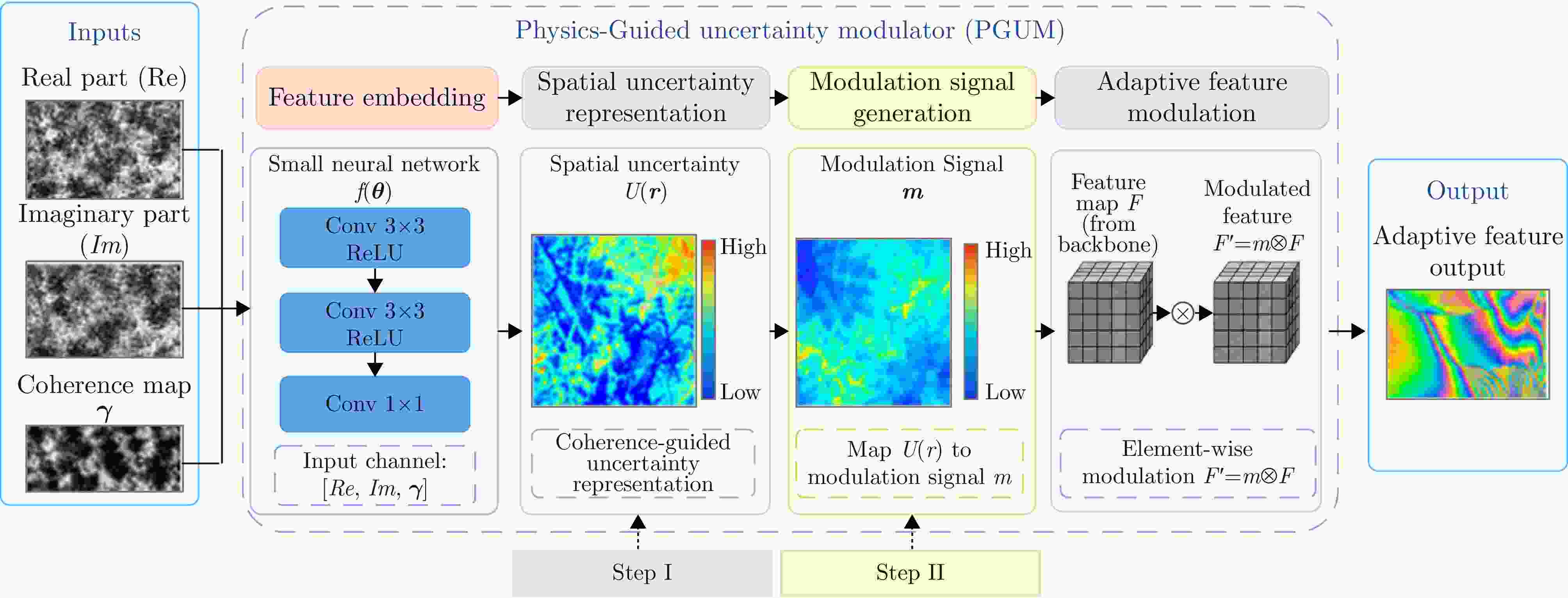
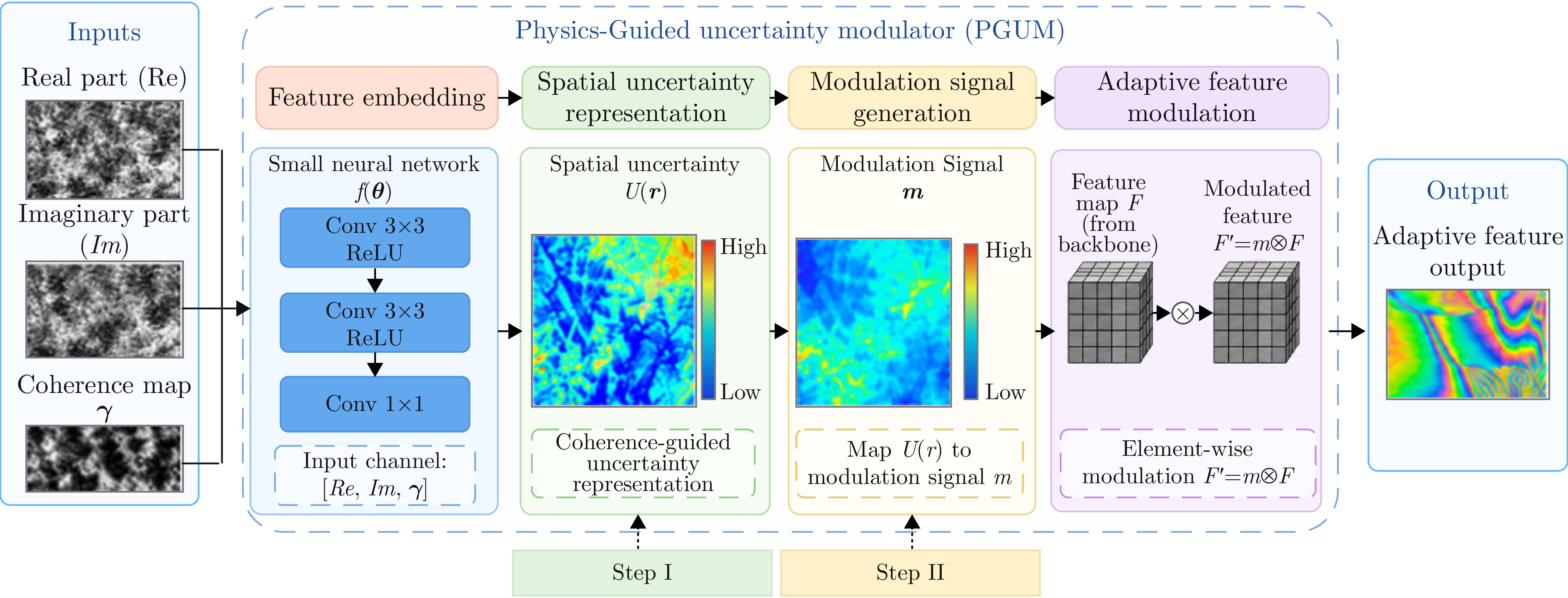
图 1 Physics-Guided Uncertainty Modulator示意图
Figure 1. Schematic diagram of physics-guided uncertainty modulator

图 3 强噪声条件下不同方法的模拟相位恢复结果(a)及相位残差分布图(b)
Figure 3. Simulated phase restoration results (a) and phase residual distributions (b) of different methods under strong-noise conditions

图 5 典型样本区域及其干涉相位分布
Figure 5. Interferometric phase distributions in representative sample regions
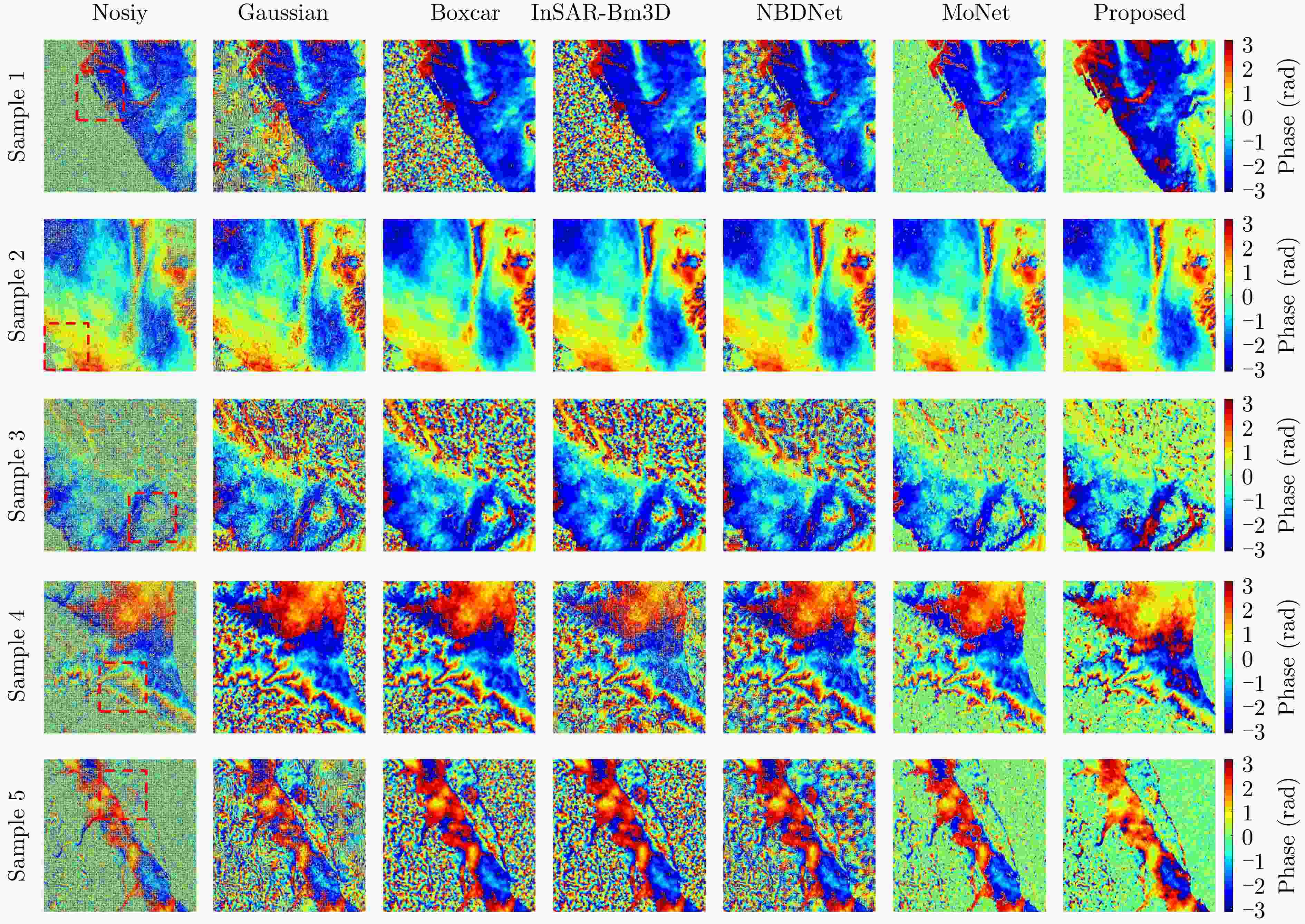
图 6 不同方法在典型样本区域的包裹相位结果
Figure 6. Wrapped phase results of different methods in a typical sample region.

图 7 不同方法在典型样本区域的残差点分布图
Figure 7. Phase residue distributions of different methods in representative sample regions

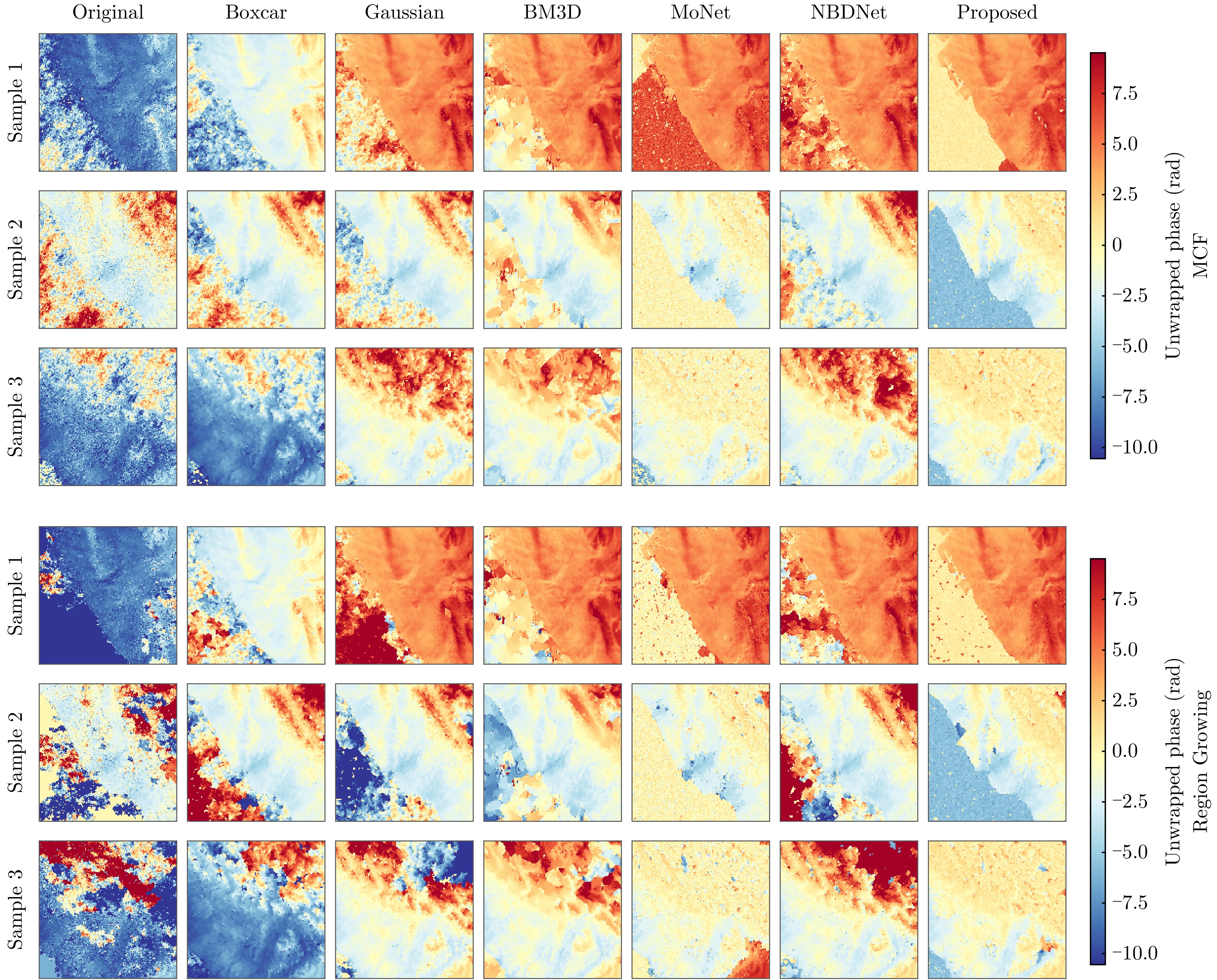
图 8 不同滤波方法在MCF与区域生长算法下的解缠相位对比结果
Figure 8. Comparison of unwrapped phase results obtained by different filtering methods using MCF and region-growing algorithms.

图 9 Sample1样本不同方法的梯度对比结果
Figure 9. Gradient comparison results of different methods for Sample 1.
表 1 典型算法对比实验结果
Table 1. Comparison of experimental results of typical algorithms
场景 方法 GMS↑ Phase MAE↓(rad) SSIM↑ RD(%)↓ Low Gaussian 0.7297 0.4104 0.3319 0.2014 Boxcar 0.7370 0.4421 0.2525 0.5203 InSAR-BM3D 0.6103 0.3524 0.2623 0.0534 MoNet 0.6719 0.8350 0.1800 1.9791 NBDNet 0.6431 0.5948 0.2663 6.1676 Proposed 0.7526 0.5048 0.3238 0.8865 Medium Gaussian 0.7362 0.4486 0.3974 0.3906 Boxcar 0.7377 0.4916 0.3213 0.7050 InSAR-BM3D 0.6550 0.4356 0.3271 0.1617 MoNet 0.6950 0.7149 0.2854 1.3412 NBDNet 0.6932 0.5848 0.3548 5.6671 Proposed 0.7604 0.5047 0.4007 0.8545 High Gaussian 0.7143 0.6587 0.2741 1.0208 Boxcar 0.7414 0.8424 0.1932 2.0889 InSAR-BM3D 0.7306 0.4413 0.3647 0.6775 MoNet 0.7224 0.7942 0.1942 2.5635 NBDNet 0.7192 0.6093 0.3199 6.3828 Proposed 0.7681 0.6233 0.2972 1.6235 Processing Time (ms) Gaussian Boxcar InSAR-BM3D MoNet NBDNet Proposed 1.203 1.733 2729.91 265.18 372.51 1.008  下载: 导出CSV
表 2 消融实验指标对比表
Table 2. Comparison of ablation test indicators
Mode MSE↓ PSNR↑ SSIM↑ Phase MAE↓ Baseline 1.67 7.85 0.49 0.340 DualNet 2.67 5.79 0.23 0.628 UM-Dual 1.65 7.88 0.48 0.339 PhysUM-InSARNet 0.99 10.17 0.73 0.158
下载: 导出CSV
表 3 典型样本区综合定量分析表
Table 3. Comprehensive quantitative analysis of typical sample areas
Method Coherence↑ Residue↓ Grad Std↓ Grad Mean↓ Gaussian 0.772 4879 0.068 0.214 Boxcar 0.767 6523 0.072 0.231 InSAR-BM3D 0.891 2205 0.065 0.297 MoNet 0.882 2756 0.085 0.298 NBDNet 0.868 2531 0.091 0.301 Proposed 0.924 2103 0.052 0.157
下载: 导出CSV
表 4 不同方法的相位一致性与解缠稳定性评价结果
Table 4. Quantitative evaluation of phase consistency and unwrapping stability for different methods
Method RD↓ SDR↓ CUCR↑ Original 20.00% 10.39% 61.78% Boxcar 1.39% 1.53% 78.69% Gaussian 0.69% 1.37% 77.58% InSAR-BM3D 0.42% 0.95% 87.75% MoNet 1.51% 1.68% 86.71% NBDNet 1.83% 1.54% 82.98% Proposed 0.35% 0.52% 97.99%
下载: 导出CSV
-
[1] MASSONNET D and FEIGL K L. Radar interferometry and its application to changes in the Earth’s surface[J]. Reviews of Geophysics, 1998, 36(4): 441–500. doi: 10.1029/97RG03139. [2] LOPEZ-MARTINEZ C and FABREGAS X. Modeling and reduction of SAR interferometric phase noise in the wavelet domain[J]. IEEE Transactions on Geoscience and Remote Sensing, 2002, 40(12): 2553–2566. doi: 10.1109/TGRS.2002.806997. [3] JUST D and BAMLER R. Phase statistics of interferograms with applications to synthetic aperture radar[J]. Applied Optics, 1994, 33(20): 4361–4368. doi: 10.1364/AO.33.004361. [4] HANSSEN R F. Radar Interferometry: Data Interpretation and Error Analysis[M]. Dordrecht, The Netherlands: Springer, 2001. doi: 10.1007/0-306-47633-9. (查阅网上资料,本条文献缺少页码信息,请补充). [5] ZHAO Tianao, FAN Hongdong, TIAN Zeming, et al. A CNN based on multiple attention mechanisms for InSAR phase denoising[J]. IEEE Geoscience and Remote Sensing Letters, 2024, 21: 4011405. doi: 10.1109/LGRS.2024.3407235. [6] MURDACA G, RUCCI A, and PRATI C. Deep learning for InSAR phase filtering: An optimized framework for phase unwrapping[J]. Remote Sensing, 2022, 14(19): 4956. doi: 10.3390/rs14194956. [7] GOLDSTEIN R M and WERNER C L. Radar interferogram filtering for geophysical applications[J]. Geophysical Research Letters, 1998, 25(21): 4035–4038. doi: 10.1029/1998GL900033. [8] XU Gang, XU Fangzheng, XIA Xianggen, et al. A robust nonlocal tensor decomposition method for InSAR phase denoising[J]. IEEE Transactions on Geoscience and Remote Sensing, 2024, 62: 5216511. doi: 10.1109/TGRS.2024.3423384. [9] KANG M S and BAEK J M. Effective denoising of InSAR phase images via compressive sensing[J]. IEEE Journal of Selected Topics in Applied Earth Observations and Remote Sensing, 2024, 17: 17772–17779. doi: 10.1109/JSTARS.2024.3404048. [10] DELEDALLE C A, DENIS L, and TUPIN F. NL-InSAR: Nonlocal interferogram estimation[J]. IEEE Transactions on Geoscience and Remote Sensing, 2011, 49(4): 1441–1452. doi: 10.1109/TGRS.2010.2076376. [11] FEJJARI A, VALENTINO G, BRIFFA J A, et al. Convolutional deep learning network for InSAR phase denoising and unwrapping[C]. SPIE 12733, Image and Signal Processing for Remote Sensing XXIX, Amsterdam, The Netherlands, 2023: 127330S. doi: 10.1117/12.2678684. [12] GAO Yandong, YAO Jiaqi, ZHOU Wei, et al. CBIPDNet: A novel method for InSAR deformation interferometric phase filtering using deep learning network[J]. IEEE Journal of Selected Topics in Applied Earth Observations and Remote Sensing, 2024, 17: 15806–15815. doi: 10.1109/JSTARS.2024.3453071. [13] VITALE S, FERRAIOLI G, and PASCAZIO V. A CNN based solution for InSAR phase denoising[C]. IGARSS 2022 - 2022 IEEE International Geoscience and Remote Sensing Symposium, Kuala Lumpur, Malaysia, 2022: 931–934. doi: 10.1109/IGARSS46834.2022.9883956. [14] SICA F, GOBBI G, RIZZOLI P, et al. Φ-Net: Deep residual learning for InSAR parameters estimation[J]. IEEE Transactions on Geoscience and Remote Sensing, 2021, 59(5): 3917–3941. doi: 10.1109/TGRS.2020.3020427. [15] VITALE S, FERRAIOLI G, PASCAZIO V, et al. InSAR-MONet: Interferometric SAR phase denoising using a multiobjective neural network[J]. IEEE Transactions on Geoscience and Remote Sensing, 2022, 60: 5239814. doi: 10.1109/TGRS.2022.3224303. [16] YU Hanwen, YANG Tianxiang, ZHOU Lifan, et al. PDNet: A lightweight deep convolutional neural network for InSAR phase denoising[J]. IEEE Transactions on Geoscience and Remote Sensing, 2022, 60: 5239309. doi: 10.1109/TGRS.2022.3224030. [17] LI Hongxiang, WANG Jili, AI Chenguang, et al. NBDNet: A self-supervised CNN-based method for InSAR phase and coherence estimation[J]. Remote Sensing, 2025, 17(7): 1181. doi: 10.3390/rs17071181. [18] MUKHERJEE S, ZIMMER A, SUN Xinyao, et al. An unsupervised generative neural approach for InSAR phase filtering and coherence estimation[J]. IEEE Geoscience and Remote Sensing Letters, 2021, 18(11): 1971–1975. doi: 10.1109/LGRS.2020.3010504. [19] LEE J S, HOPPEL K W, MANGO S A, et al. Intensity and phase statistics of multilook polarimetric and interferometric SAR imagery[J]. IEEE Transactions on Geoscience and Remote Sensing, 1994, 32(5): 1017–1028. doi: 10.1109/36.312890. [20] AGRAM P S and SIMONS M. A noise model for InSAR time series[J]. Journal of Geophysical Research: Solid Earth, 2015, 120(4): 2752–2771. doi: 10.1002/2014JB011271. [21] KAIPIO J P and SOMERSALO E. Statistical and Computational Inverse Problems[M]. New York, USA: Springer, 2005. doi: 10.1007/b138659. (查阅网上资料,本条文献缺少页码信息,请补充). [22] WOO S, PARK J, LEE J Y, et al. CBAM: Convolutional block attention module[C]. The 15th European Conference on Computer Vision, Cham, Switzerland, 2018: 3–19. doi: 10.1007/978-3-030-01234-2_1. [23] GOLDSTEIN R M, ZEBKER H A, and WERNER C L. Satellite radar interferometry: Two-dimensional phase unwrapping[J]. Radio Science, 1988, 23(4): 713–720. doi: 10.1029/RS023i004p00713. [24] KINGMA D P and BA J. Adam: A method for stochastic optimization[C]. The 3rd International Conference on Learning Representations, San Diego, USA, 2015. [25] COSTANTINI M. A novel phase unwrapping method based on network programming[J]. IEEE Transactions on Geoscience and Remote Sensing, 1998, 36(3): 813–821. doi: 10.1109/36.673674. [26] XU Wei and CUMMING I G. A region-growing algorithm for InSAR phase unwrapping[J]. IEEE Transactions on Geoscience and Remote Sensing, 1999, 37(1): 124–134. doi: 10.1109/36.739143. [27] LIU Yanfang, LI Shiqiang, ZHANG Heng, et al. Multibaseline interferometric phase denoising based on kurtosis in the NSST domain[J]. Sensors, 2020, 20(2): 551. doi: 10.3390/s20020551. [28] ZHONG Heping, TANG Jinsong, ZHANG Sen, et al. A quality-guided and local minimum discontinuity based phase unwrapping algorithm for InSAR/InSAS interferograms[J]. IEEE Geoscience and Remote Sensing Letters, 2014, 11(1): 215–219. doi: 10.1109/LGRS.2013.2252880. [29] WANG Zhou, BOVIK A C, SHEIKH H R, et al. Image quality assessment: From error visibility to structural similarity[J]. IEEE Transactions on Image Processing, 2004, 13(4): 600–612. doi: 10.1109/TIP.2003.819861. [30] YANG Wang, HE Yi, YAO Sheng, et al. An InSAR interferogram filtering method based on multi-level feature fusion CNN[J]. Sensors, 2022, 22(16): 5956. doi: 10.3390/s22165956. -



计量
- 文章访问数:
- HTML全文浏览量:
- PDF下载量:
- 被引次数: 0