

 作者中心
 专家审稿
 责编办公
 编辑办公

Complex-Domain Self-Supervised Filtering for InSAR Interferometric Phase Based on Adversarial Regularization
-
摘要: 针对干涉合成孔径雷达(InSAR)干涉相位受相干斑噪声影响严重、真实场景中高质量无噪参考数据难以获取,以及现有深度学习方法对PGD对抗扰动敏感、干涉条纹与局部相位结构保持能力不足等问题,该文提出一种融合对抗正则化与复数域约束的自监督InSAR干涉相位去噪网络ACR-Net。该方法以复数干涉图的实部和虚部作为网络输入,利用邻域自监督策略从单幅含噪干涉图中构造训练样本,并通过共享权重的DnCNN完成噪声抑制,从而避免对无噪标签的依赖。在此基础上,提出复数域重建误差引导的对抗正则化策略,在干涉图实虚联合表示空间中构造使复数域重建误差增大的对抗扰动,并通过原始样本与对抗样本的协同优化增强网络对PGD对抗扰动及噪声变化的鲁棒性;同时引入复数域约束,联合约束恢复结果的实部与虚部,以提高干涉相位及局部结构的保持能力。该文在模拟InSAR数据和真实InSAR数据上开展实验,并与多种经典及深度学习InSAR干涉相位滤波方法进行比较。实验结果表明,ACR-Net无需无噪参考数据即可实现InSAR干涉相位恢复,并在相位恢复精度、相干性、残差点数量及抗扰动稳定性等方面表现出良好的综合性能。Abstract: Although the interferometric phase of Interferometric Synthetic Aperture Radar (InSAR) is severely affected by speckle noise, high-quality noise-free reference data are difficult to obtain in real-world scenarios. Moreover, existing deep learning-based techniques are often sensitive to input perturbations and have limited ability to preserve interferometric fringes and local phase structures. To address these issues, we propose a self-supervised InSAR interferometric phase denoising network that integrates adversarial regularization with complex-domain constraints (ACR-Net). The real and imaginary components of a complex interferogram are considered the network inputs, and neighborhood-based self-supervised learning is employed to construct training samples from a single noisy interferogram. Subsequently, a shared-weight DnCNN is used for noise suppression, thereby eliminating the dependence on noise-free labels. On this basis, a complex-domain reconstruction error-guided adversarial regularization strategy is proposed, in which adversarial perturbations that increase the complex-domain reconstruction error are constructed in the joint real–imaginary representation space. The original and adversarial samples are jointly optimized to improve the network’s robustness to input perturbations and noise variations. Meanwhile, a complex-domain constraint is introduced to jointly constrain the recovered real and imaginary components, thereby preserving interferometric phase information and local structures. Experimental results demonstrate that ACR-Net achieves interferometric phase restoration without requiring noise-free reference data and exhibits favorable overall performance in terms of phase reconstruction accuracy, coherence, the number of phase residues, and robustness against perturbations.
-
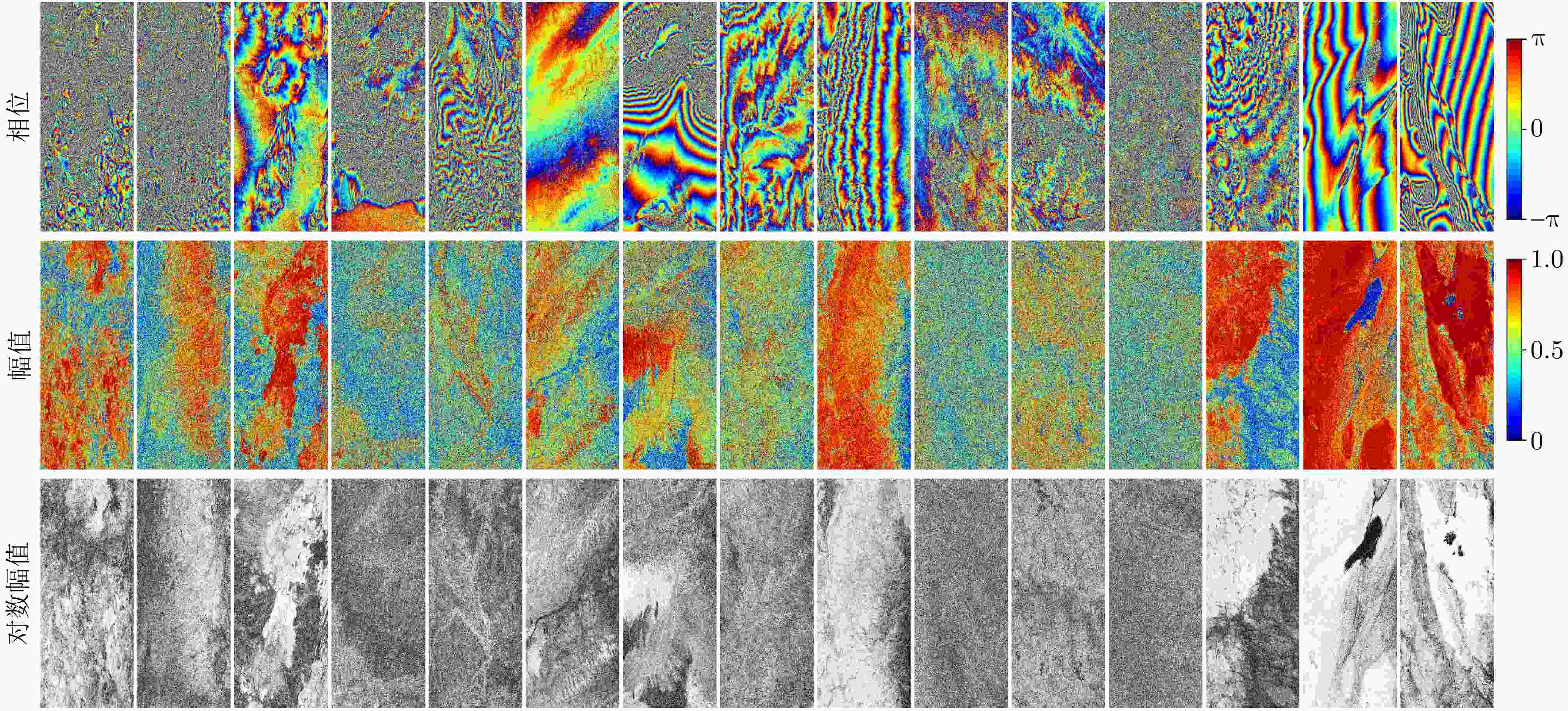
图 2 用于训练ACR-Net的15组典型PALSAR干涉数据
Figure 2. Fifteen representative PALSAR interferometric datasets used for training ACR-Net
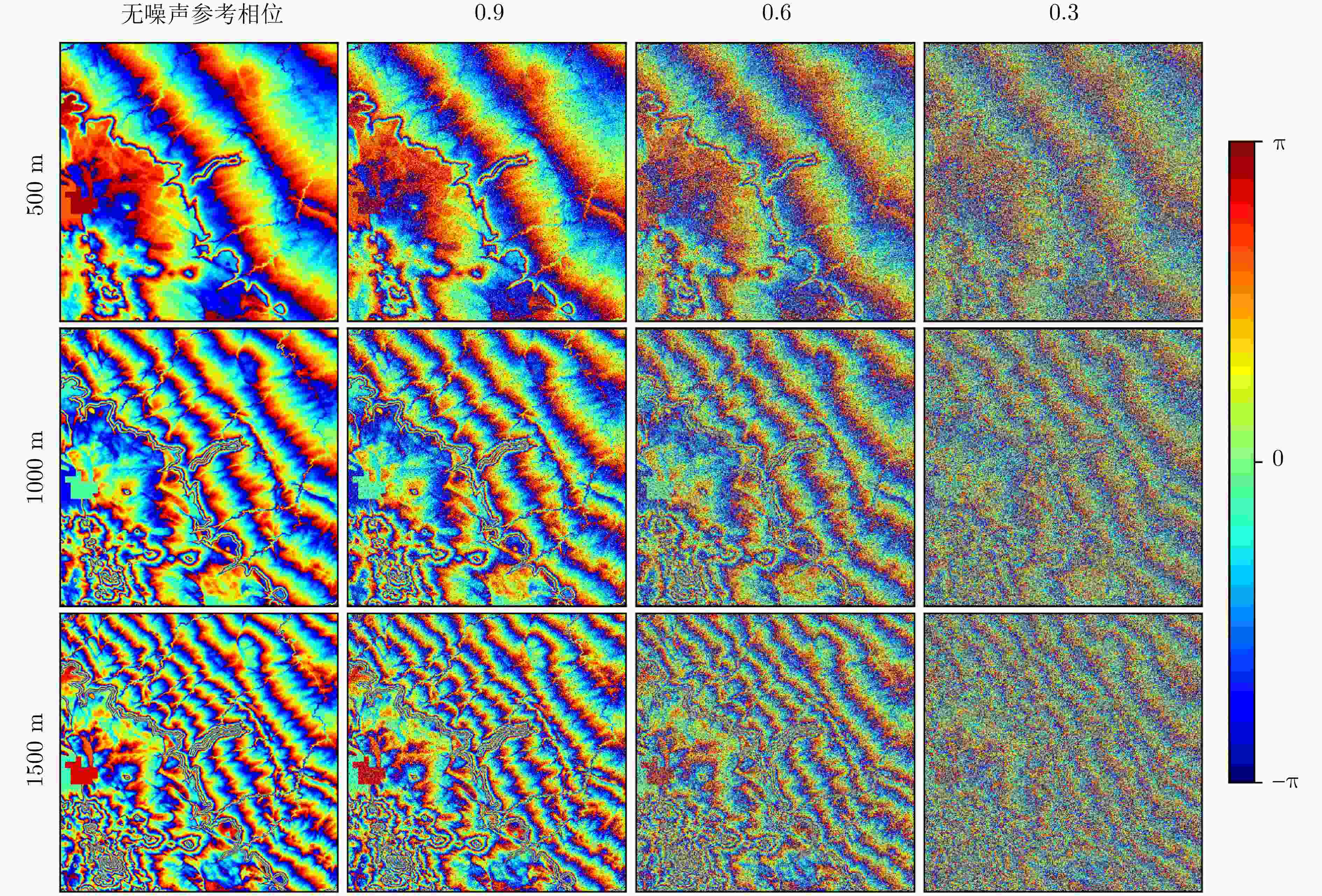
图 3 不同基线长度和相干水平下的模拟InSAR干涉图
Figure 3. Simulated InSAR interferograms under different baseline lengths and coherence levels
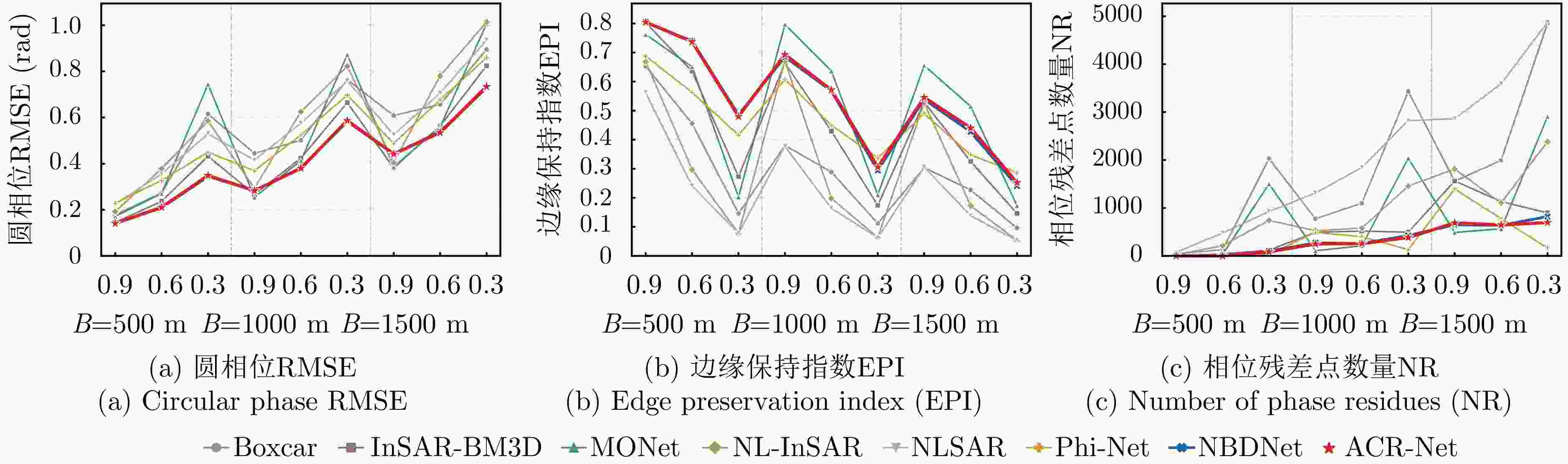
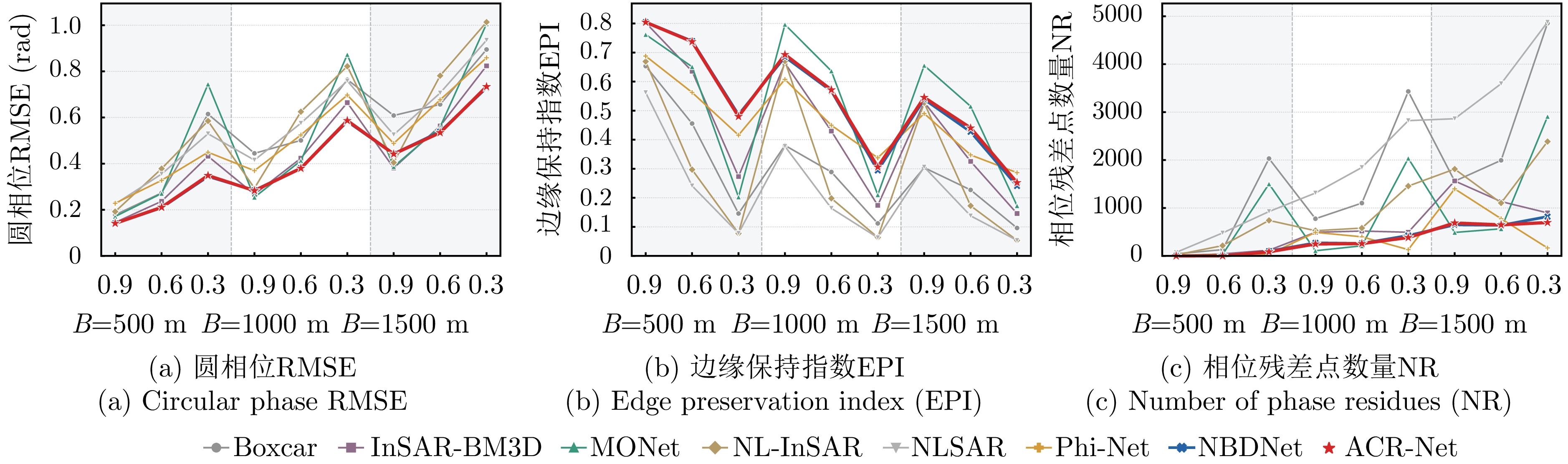
图 4 不同方法在9组模拟场景下的定量比较。
Figure 4. Quantitative comparison of different methods across nine simulated scenarios.

图 6 复数域PGD对抗扰动下不同方法的干涉相位鲁棒性比较($ \varepsilon =0.02 $)
Figure 6. Robustness comparison of interferometric phases obtained by different methods under complex-domain PGD adversarial perturbations ($ \varepsilon =0.02 $)
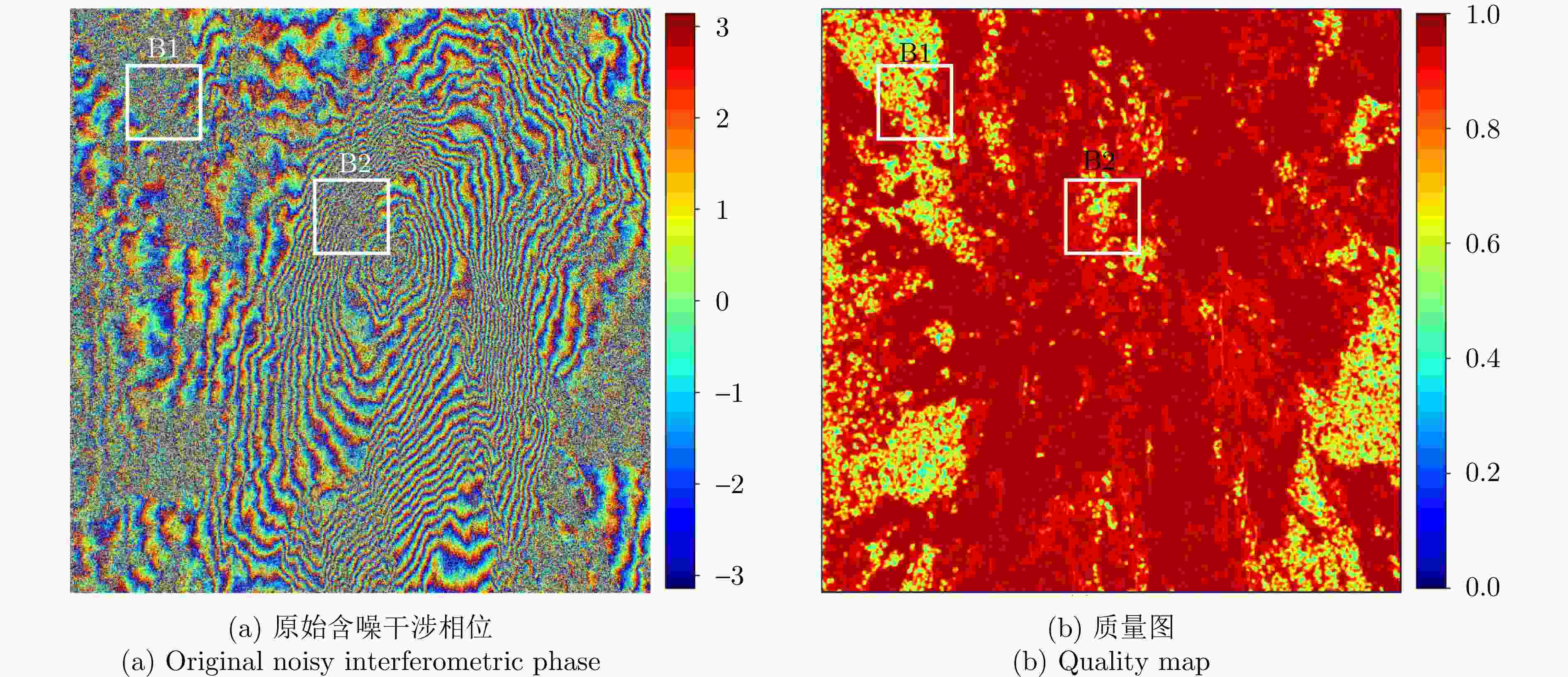
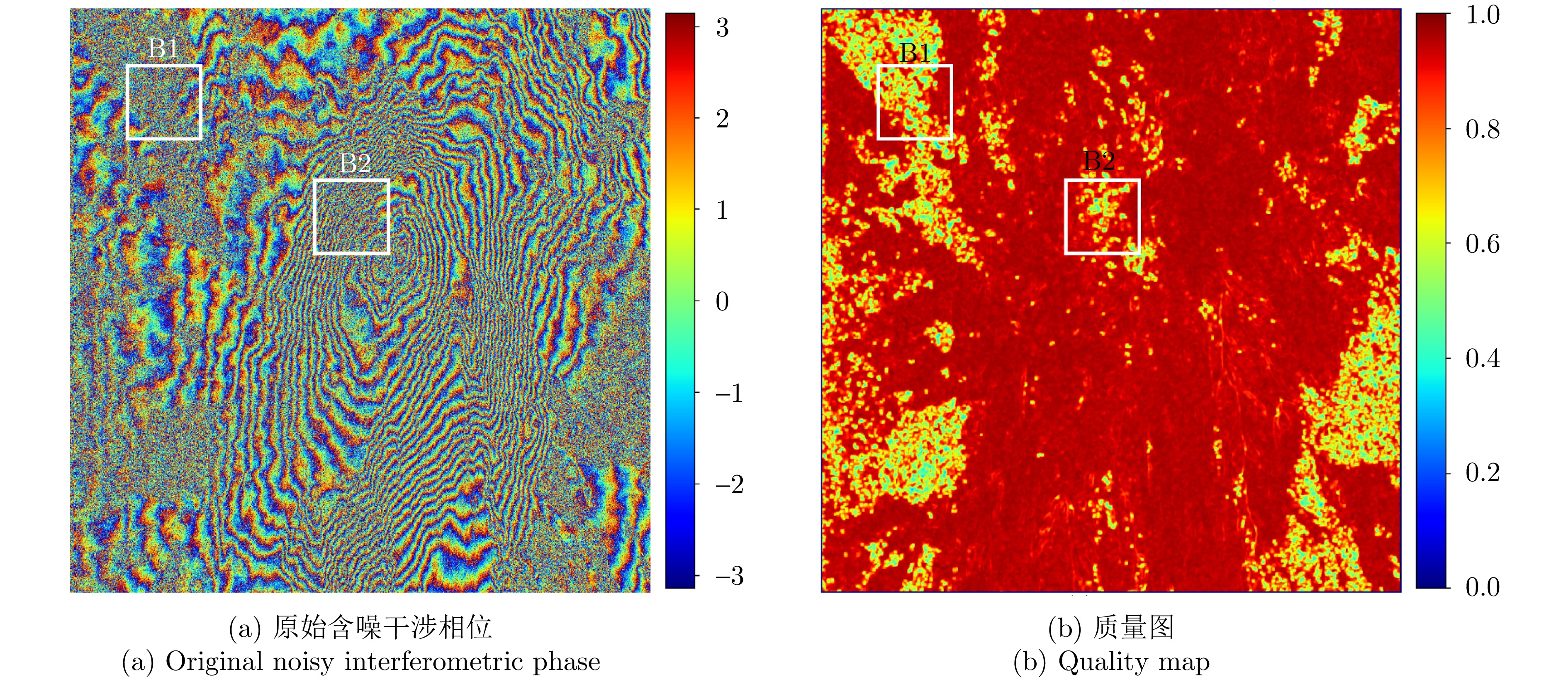
图 7 Etna火山区域的原始含噪干涉相位、质量图及局部分析区域B1和B2的位置。
Figure 7. Original noisy interferometric phase, quality map, and locations of regions B1 and B2 in the Etna volcano area.
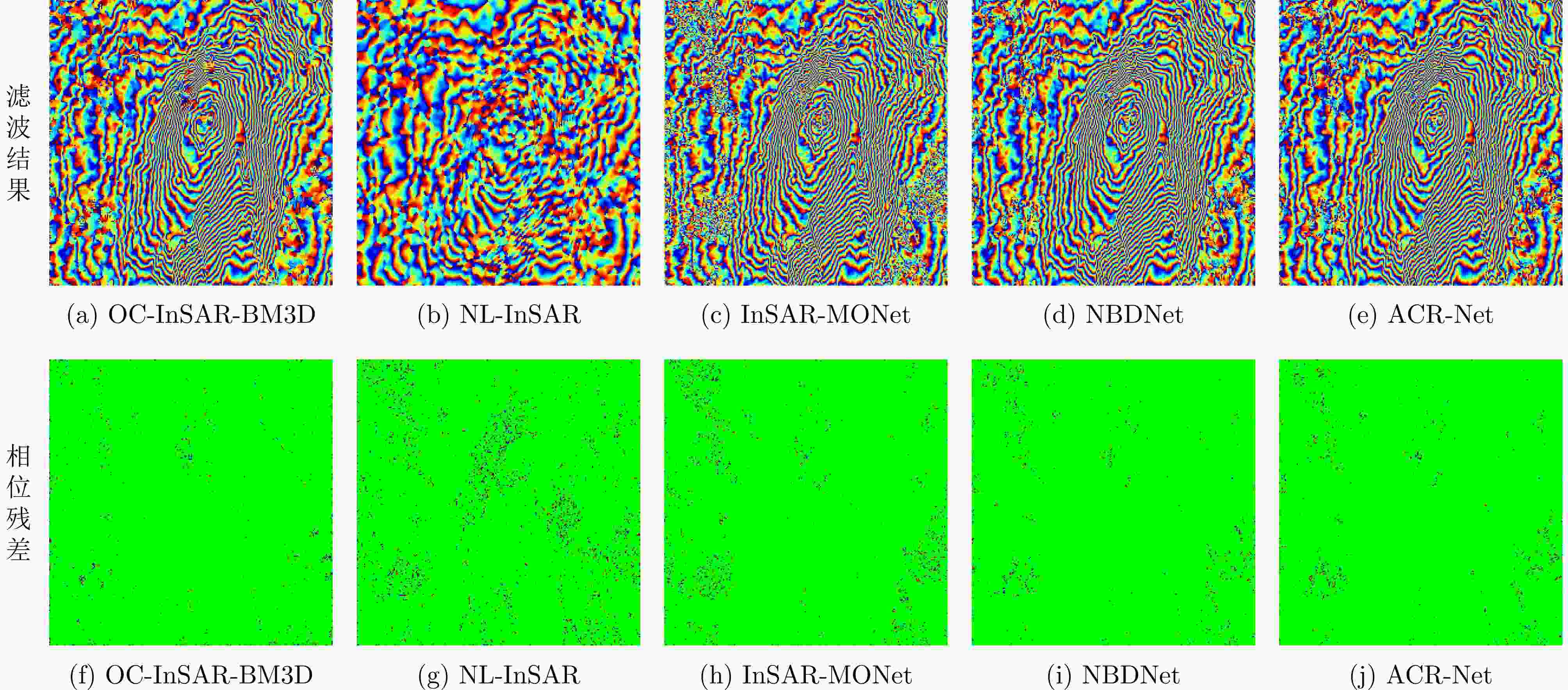
图 8 Etna真实干涉图滤波结果及相位残差图
Figure 8. Filtering results and phase residue maps for the real Etna interferogram
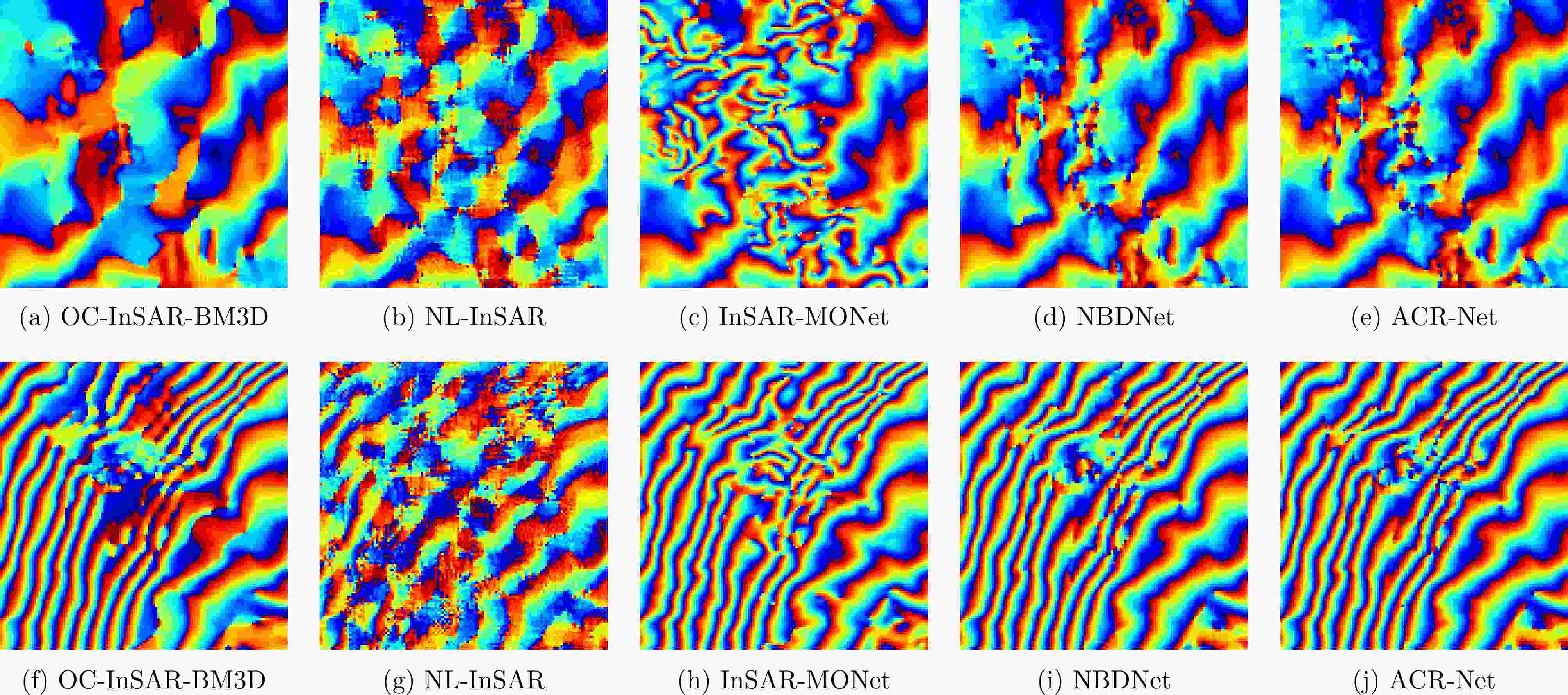
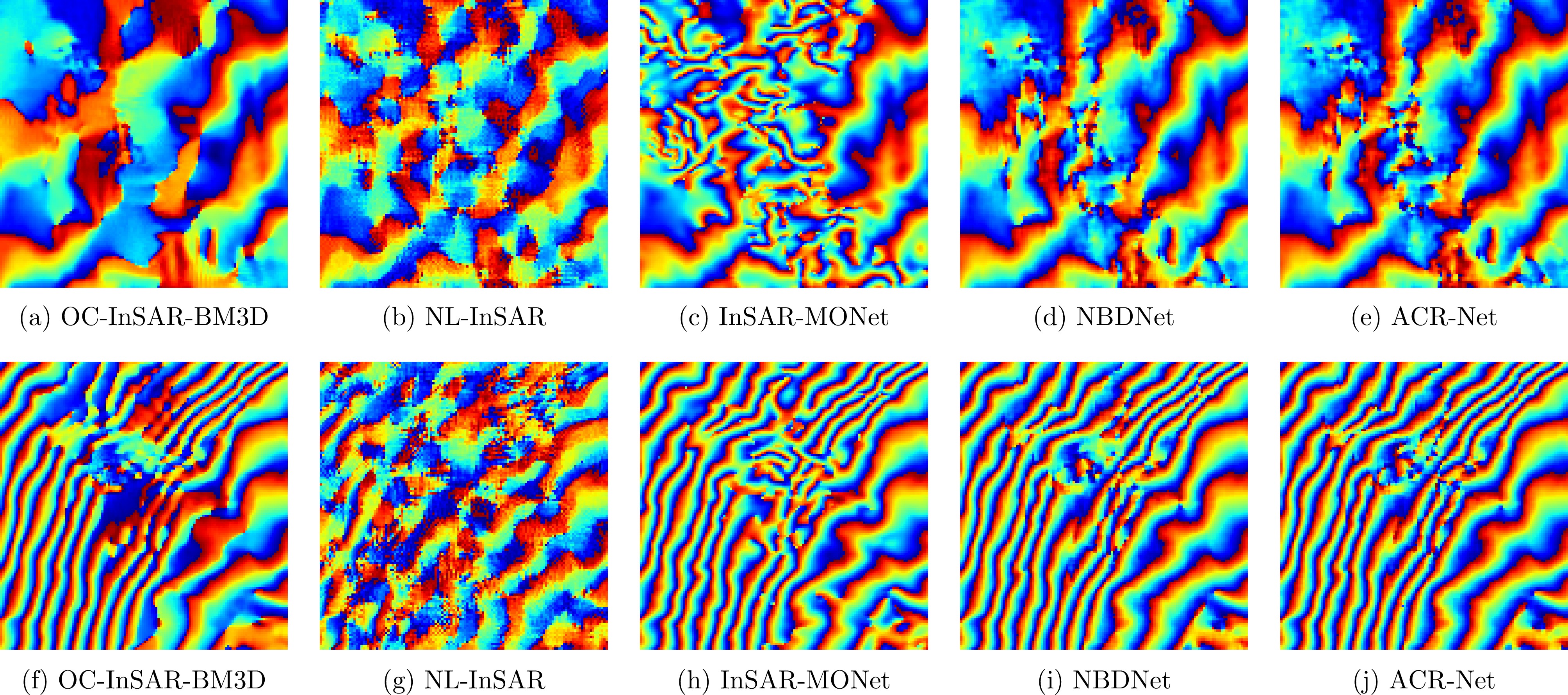
图 9 Etna真实干涉图中B1和B2区域的局部滤波结果。
Figure 9. Local filtering results for regions B1 and B2 of the real Etna interferogram.
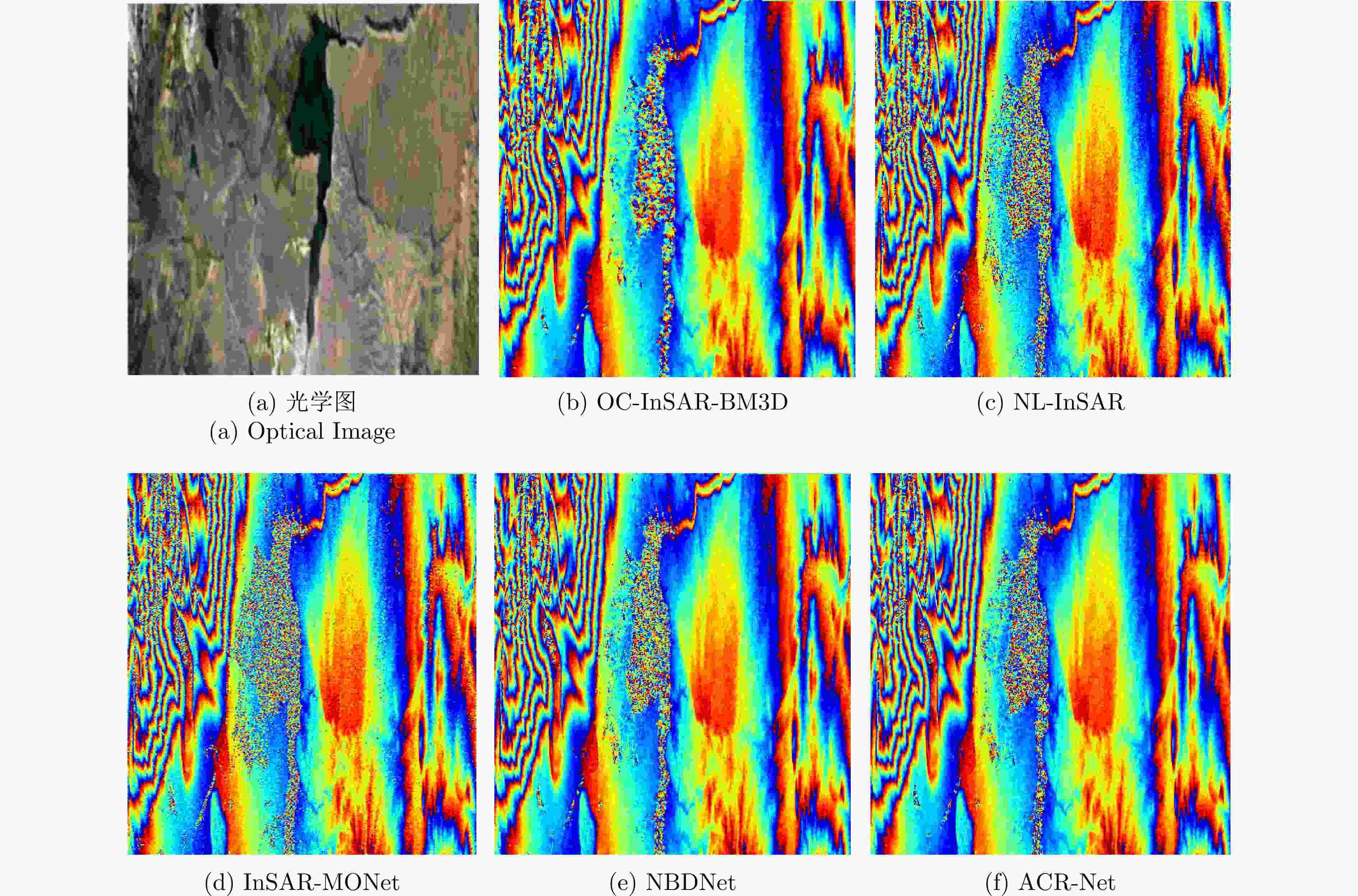
图 10 Crowley Lake的光学影像及不同方法的干涉相位滤波结果
Figure 10. Optical image and interferometric phase filtering results of different methods in the Crowley Lake area
表 1 模拟InSAR系统主要参数
Table 1. Main parameters of the simulated InSAR system
参数 数值 DEM数据 ACE2(30N120W, 3 arc-sec) 图像大小 512×512 载波频率 1.27 GHz 入射角 30 ° 斜距 600 km 相干系数 {0.9, 0.6, 0.3} 基线长度 {500, 1000 ,1500 } m 下载: 导出CSV
表 2 不同方法在9组模拟场景下的平均定量比较
Table 2. Average quantitative comparison of different methods across nine simulated scenarios
方法 RMSE↓ EPI↑ NR↓ ENL↑ Boxcar 0.548 0.296 1769 21.8 NL-InSAR 0.566 0.303 983 68.6 NL-SAR 0.558 0.220 2088 23.6 OC-InSAR-BM3D 0.437 0.442 585 40.6 Φ-Net 0.513 0.465 382 64.0 InSAR-MONet 0.520 0.511 874 212 NBDNet 0.406 0.531* 352* 68.2 ACR-Net 0.407* 0.537 334 69.8* 注:加粗表示最优结果,*表示次优结果。
下载: 导出CSV
表 3 不同复数域PGD对抗扰动强度下各方法的鲁棒性比较
Table 3. Robustness comparison of different methods under complex-domain PGD adversarial perturbations at different perturbation levels
扰动强度 方法 NR Dφ↓ Dγ(×10−3)↓ |$\Delta $NR|↓ ε=0.005 InSAR-MONet 3159 0.0895 7.520 8 NBDNet 51 0.0074 0.864 0 ACR-Net 22 0.0067 0.829 0 ε=0.01 InSAR-MONet 3115 0.1207 10.616 36 NBDNet 56 0.0137 1.744 5 ACR-Net 22 0.0124 1.486 0 ε=0.02 InSAR-MONet 3175 0.1719 14.871 24 NBDNet 52 0.0264 3.399 1 ACR-Net 23 0.0236 2.898 1 注:加粗表示最优结果。
下载: 导出CSV
表 4 真实干涉图的残差点数量对比
Table 4. Comparison of the number of phase residues on the real interferogram
方法 Etna Crowley Lake OC-InSAR-BM3 2156 9822 NL-InSAR 8812 19678 InSAR-MONet 4375 21867 NBDNet 2510 15096 ACR-Net 2618 14152 注:表中加粗数值为最优值和次优。
下载: 导出CSV
表 5 Etna真实干涉图局部区域的定量对比结果
Table 5. Quantitative comparison in local regions of the real Etna interferogram
方法 B1 B2 NR ↓ EPI ↑ NR ↓ EPI ↑ OC-InSAR-BM3D 47 0.07 125 0.11 NL-InSAR 243 0.17 517 0.25 InSAR-MONet 231 0.09 113 0.05 NBDNet 118 0.11 97 0.09 ACR-Net 97 0.12 87 0.09 注:表中加粗数值为最优值和次优。
下载: 导出CSV
表 6 不同模型配置在PGD扰动下的消融实验结果
Table 6. Ablation study results of different model configurations under PGD perturbations
扰动强度 模型 RMSE↓ EPI↑ NR↓ 0 NBDNet 0.6412 0.3894 1115.89 NBDNet+CL 0.6391 0.3952 1101.00 NBDNet+PGD 0.6439 0.3862 1092.67 ACR-Net 0.6402 0.3957 1151.33 0.02 NBDNet 0.6953 0.3578 1007.00 NBDNet+CL 0.6940 0.3650 972.67 NBDNet+PGD 0.6986 0.3540 951.11 ACR-Net 0.6945 0.3614 1016.78 0.05 NBDNet 0.7741 0.3203 953.33 NBDNet+CL 0.7731 0.3261 909.44 NBDNet+PGD 0.7777 0.3158 862.44 ACR-Net 0.7722 0.3262 945.44 0.10 NBDNet 0.9233 0.2672 1106.22 NBDNet+CL 0.9219 0.2697 1033.89 NBDNet+PGD 0.9242 0.2613 959.56 ACR-Net 0.9188 0.2714 1075.33 注:表中加粗数值为最优值
下载: 导出CSV
-
[1] ROSEN P A, HENSLEY S, JOUGHIN I R, et al. Synthetic aperture radar interferometry[J]. Proceedings of the IEEE, 2000, 88(3): 333–382. doi: 10.1109/5.838084. [2] MASSONNET D and FEIGL K L. Radar interferometry and its application to changes in the Earth's surface[J]. Reviews of Geophysics, 1998, 36(4): 441–500. doi: 10.1029/97RG03139. [3] XU Gang, GAO Yandong, LI Jinwei, et al. InSAR phase denoising: A review of current technologies and future directions[J]. IEEE Geoscience and Remote Sensing Magazine, 2020, 8(2): 64–82. doi: 10.1109/MGRS.2019.2955120. [4] YU Hanwen, LAN Yang, YUAN Zhihui, et al. Phase unwrapping in InSAR: A review[J]. IEEE Geoscience and Remote Sensing Magazine, 2019, 7(1): 40–58. doi: 10.1109/MGRS.2018.2873644. [5] LEE J S, HOPPEL K W, MANGO S A, et al. Intensity and phase statistics of multilook polarimetric and interferometric SAR imagery[J]. IEEE Transactions on Geoscience and Remote Sensing, 1994, 32(5): 1017–1028. doi: 10.1109/36.312890. [6] LEE J S, PAPATHANASSIOU K P, AINSWORTH T L, et al. A new technique for noise filtering of SAR interferometric phase images[J]. IEEE Transactions on Geoscience and Remote Sensing, 1998, 36(5): 1456–1465. doi: 10.1109/36.718849. [7] CHAO C F, CHEN Kunshan, and LEE J S. Refined filtering of interferometric phase from InSAR data[J]. IEEE Transactions on Geoscience and Remote Sensing, 2013, 51(12): 5315–5323. doi: 10.1109/TGRS.2012.2234467. [8] GOLDSTEIN R M and WERNER C L. Radar interferogram filtering for geophysical applications[J]. Geophysical Research Letters, 1998, 25(21): 4035–4038. doi: 10.1029/1998GL900033. [9] BARAN I, STEWART M P, KAMPES B M, et al. A modification to the Goldstein radar interferogram filter[J]. IEEE Transactions on Geoscience and Remote Sensing, 2003, 41(9): 2114–2118. doi: 10.1109/TGRS.2003.817212. [10] DELEDALLE C A, DENIS L, and TUPIN F. NL-InSAR: Nonlocal interferogram estimation[J]. IEEE Transactions on Geoscience and Remote Sensing, 2011, 49(4): 1441–1452. doi: 10.1109/TGRS.2010.2076376. [11] DELEDALLE C A, DENIS L, TUPIN F, et al. NL-SAR: A unified nonlocal framework for resolution-preserving (Pol)(In)SAR denoising[J]. IEEE Transactions on Geoscience and Remote Sensing, 2015, 53(4): 2021–2038. doi: 10.1109/TGRS.2014.2352555. [12] ZHU Xiaoxiang, BAIER G, LACHAISE M, et al. Potential and limits of non-local means InSAR filtering for TanDEM-X high-resolution DEM generation[J]. Remote Sensing of Environment, 2018, 218: 148–161. doi: 10.1016/j.rse.2018.09.012. [13] BAIER G, ROSSI C, LACHAISE M, et al. A nonlocal InSAR filter for high-resolution DEM generation from TanDEM-X interferograms[J]. IEEE Transactions on Geoscience and Remote Sensing, 2018, 56(11): 6469–6483. doi: 10.1109/TGRS.2018.2839027. [14] SICA F, COZZOLINO D, ZHU Xiaoxiang, et al. InSAR-BM3D: A nonlocal filter for SAR interferometric phase restoration[J]. IEEE Transactions on Geoscience and Remote Sensing, 2018, 56(6): 3456–3467. doi: 10.1109/TGRS.2018.2800087. [15] SICA F, COZZOLINO D, VERDOLIVA L, et al. The offset-compensated nonlocal filtering of interferometric phase[J]. Remote Sensing, 2018, 10(9): 1359. doi: 10.3390/rs10091359. [16] KANG Jian, HONG Danfeng, LIU Jialin, et al. Learning convolutional sparse coding on complex domain for interferometric phase restoration[J]. IEEE Transactions on Neural Networks and Learning Systems, 2021, 32(2): 826–840. doi: 10.1109/TNNLS.2020.2979546. [17] DING Xiang, KANG Jian, ZHANG Zhe, et al. Coherence-guided complex convolutional sparse coding for interferometric phase restoration[J]. IEEE Transactions on Geoscience and Remote Sensing, 2022, 60: 1–14. doi: 10.1109/TGRS.2022.3228279. [18] SICA F, GOBBI G, RIZZOLI P, et al. Φ-Net: Deep residual learning for InSAR parameters estimation[J]. IEEE Transactions on Geoscience and Remote Sensing, 2021, 59(5): 3917–3941. doi: 10.1109/TGRS.2020.3020427. [19] VITALE S, FERRAIOLI G, PASCAZIO V, et al. InSAR-MONet: Interferometric SAR phase denoising using a multiobjective neural network[J]. IEEE Transactions on Geoscience and Remote Sensing, 2022, 60: 5239814. doi: 10.1109/TGRS.2022.3224303. [20] YU Hanwen, YANG Tianxiang, ZHOU Lifan, et al. PDNet: A lightweight deep convolutional neural network for InSAR phase denoising[J]. IEEE Transactions on Geoscience and Remote Sensing, 2022, 60: 5239309. doi: 10.1109/TGRS.2022.3224030. [21] PU Liming, ZHANG Xiaoling, ZHOU Liming, et al. Nonlocal feature selection encoder–decoder network for accurate InSAR phase filtering[J]. Remote Sensing, 2022, 14(5): 1174. doi: 10.3390/rs14051174. [22] YANG Wang, HE Yi, ZHANG Lifeng, et al. A deep convolutional neural network with multiscale feature dynamic fusion for InSAR phase filtering[J]. IEEE Journal of Selected Topics in Applied Earth Observations and Remote Sensing, 2022, 15: 6687–6710. doi: 10.1109/JSTARS.2022.3199118. [23] ZHAO Tianao, FAN Hongdong, TIAN Zeming, et al. A CNN based on multiple attention mechanisms for InSAR phase denoising[J]. IEEE Geoscience and Remote Sensing Letters, 2024, 21: 4011405. doi: 10.1109/LGRS.2024.3407235. [24] CHEN Yanming, ZHANG Fan, MA Lixiang, et al. A nonlocal filter for SAR interferometric phase based on partial Siamese network[J]. IEEE Journal of Selected Topics in Applied Earth Observations and Remote Sensing, 2024, 17: 17156–17174. doi: 10.1109/JSTARS.2024.3458075. [25] GAO Yandong, YAO Jiaqi, ZHOU Wei, et al. CBIPDNet: A novel method for InSAR deformation interferometric phase filtering using deep learning network[J]. IEEE Journal of Selected Topics in Applied Earth Observations and Remote Sensing, 2024, 17: 15806–15815. doi: 10.1109/JSTARS.2024.3453071. [26] YANG Shuohang, GAO Jian, ZHANG Jiayi, et al. Wrapped phase denoising using denoising diffusion probabilistic models[J]. IEEE Geoscience and Remote Sensing Letters, 2024, 21: 4011305. doi: 10.1109/LGRS.2024.3405000. [27] SICA F and SCHMITT M. On the estimation of InSAR phase and coherence through self-supervised learning[C]. The 15th European Conference on Synthetic Aperture Radar, Munich, Germany, 2024: 736–739. [28] GEARA C, GELAS C, DE VITRY L, et al. InSAR2InSAR: A self-supervised method for InSAR parameters estimation[C]. The 32nd European Signal Processing Conference (EUSIPCO), Lyon, France, 2024: 651–655. doi: 10.23919/EUSIPCO63174.2024.10715155. [29] LI Hongxiang, WANG Jili, AI Chenguang, et al. NBDNet: A self-supervised CNN-based method for InSAR phase and coherence estimation[J]. Remote Sensing, 2025, 17(7): 1181. doi: 10.3390/rs17071181. [30] ZHANG Qi, JIANG Houjun, and WANG Teng. A semi-supervised self-boosting learning method for InSAR phase denoising[J]. IEEE Transactions on Geoscience and Remote Sensing, 2025, 63: 5513916. doi: 10.1109/TGRS.2025.3568932. [31] WANG Shuai, CHEN Yu, DING Kaiwen, et al. MCR-PFNet: A novel InSAR interferometric phase filtering method for complex noise and large gradient deformations[J]. International Journal of Applied Earth Observation and Geoinformation, 2025, 140: 104621. doi: 10.1016/j.jag.2025.104621. [32] ZHANG Qi, JIANG Houjun, and WANG Teng. Multiscale residual denoising network for robust InSAR phase reconstruction[J]. IEEE Journal of Selected Topics in Applied Earth Observations and Remote Sensing, 2026, 19: 15103–15122. doi: 10.1109/JSTARS.2026.3686440. [33] HU Pengcheng, LI Xu, PENG Junhuan, et al. Complex convolutional sparse coding InSAR phase filtering incorporating directional gradients and second-order difference regularization[J]. ISPRS Journal of Photogrammetry and Remote Sensing, 2026, 232: 740–765. doi: 10.1016/j.isprsjprs.2025.12.016. [34] YANG Wang, HE Yi, LOPEZ-SANCHEZ J M, et al. Integrating physical modeling and data-driven learning: A DCNN for InSAR phase filtering and applications[J]. ISPRS Journal of Photogrammetry and Remote Sensing, 2026, 239: 605–631. doi: 10.1016/j.isprsjprs.2026.06.027. [35] HUANG Tao, LI Songjiang, JIA Xu, et al. Neighbor2Neighbor: Self-supervised denoising from single noisy images[C]. The IEEE/CVF Conference on Computer Vision and Pattern Recognition (CVPR), Nashville, USA, 2021: 14781–14780. doi: 10.1109/CVPR46437.2021.01454. [36] MADRY A, MAKELOV A, SCHMIDT L, et al. Towards deep learning models resistant to adversarial attacks[C]. The 6th International Conference on Learning Representations, Vancouver, Canada, 2018,1–23. [37] ZHANG Kai, ZUO Wangmeng, CHEN Yunjin, et al. Beyond a Gaussian denoiser: Residual learning of deep CNN for image denoising[J]. IEEE Transactions on Image Processing, 2017, 26(7): 3142–3155. doi: 10.1109/TIP.2017.2662206. [38] BERRY P A M, SMITH R G, and BENVENISTE J. ACE2: The new global digital elevation model[C]. Gravity, Geoid and Earth Observation, Chania, Greece, 2010: 231–237. doi: 10.1007/978-3-642-10634-7_30. [39] LANARI R, FORNARO G, RICCIO D, et al. Generation of digital elevation models by using SIR-C/X-SAR multifrequency two-pass interferometry: The Etna case study[J]. IEEE Transactions on Geoscience and Remote Sensing, 1996, 34(5): 1097–1114. doi: 10.1109/36.536526. [40] LAN Yang, YU Hanwen, XING Mengdao, et al. A cluster-analysis and convex hull-based fast large-scale phase unwrapping method for single- and multibaseline SAR interferograms[J]. IEEE Journal of Selected Topics in Applied Earth Observations and Remote Sensing, 2023, 16: 5416–5429. doi: 10.1109/JSTARS.2023.3279432. -







计量
- 文章访问数:
- HTML全文浏览量:
- PDF下载量:
- 被引次数: 0