

 作者中心
 专家审稿
 责编办公
 编辑办公

-
摘要: 睡眠监测是评估个体健康的重要手段,但传统多导睡眠监测依赖多种接触式传感器,采集过程复杂,难以满足长期居家监测需求。雷达感知因其非侵入和易部署等优势,为居家睡眠监测提供了低负担感知手段。现有研究通常依赖多个大规模公开睡眠数据集开展预训练,或基于从雷达信号提取的呼吸特征训练睡眠分期与呼吸障碍检测模型。前者涉及跨域预训练,模型构建与训练成本较高,后者对于睡眠状态判读更直接相关的脑电模态知识利用不足,导致睡眠分期性能仍然受限。针对上述问题,该文提出了一种基于脑电信息监督的渐进式非接触睡眠监测方法。该方法基于公开数据集的脑电和呼吸信号,通过知识蒸馏和预训练策略逐步学习可迁移的睡眠判别信息,并将其适配至雷达呼吸表征,从而缓解脑电与雷达之间的模态差异,提升基于雷达的非接触式睡眠监测性能。实验结果表明,所提方法能够有效利用脑电先验知识增强雷达睡眠表征学习能力,在睡眠分期和呼吸障碍检测任务上的准确率分别达到82.6%和82.5%,为非接触式睡眠监测提供了新的技术思路。Abstract: Sleep monitoring is essential for assessing individual health. However, conventional polysomnography relies on multiple contact sensors and complex data acquisition procedures, making it difficult to meet the requirements of long-term, home-based monitoring. Radar sensing enables the contactless acquisition of respiratory and body movement signals during sleep, making it suitable for long-term home-based monitoring. Existing studies typically use large-scale public sleep datasets for pretraining or develop models for sleep staging and respiratory disorder detection based on respiratory features extracted from radar signals. The former requires cross-domain pretraining, resulting in relatively high model development and training costs, whereas the latter does not fully exploit EEG-derived knowledge, which is more directly associated with sleep-state assessment, thereby limiting sleep staging performance. To address these limitations, this paper proposes a progressive EEG-supervised method for contactless sleep monitoring. The proposed method leverages EEG and respiratory signals from a public dataset to progressively learn transferable discriminative representations through knowledge distillation and pretraining, which are then adapted to radar-based respiratory representations. This approach alleviates the modality gap between EEG and radar signals, thereby improving contactless sleep monitoring performance. Experimental results show that the proposed method effectively leverages prior knowledge from EEG to enhance radar-based sleep representation learning, achieving accuracies of 82.6% for sleep staging and 82.5% for respiratory disorder detection. These results provide a new technical perspective on contactless sleep monitoring.
-
Key words:
- Sleep monitoring /
- Sleep staging /
- Respiratory disorders /
- RF sensing /
- Deep learning
-
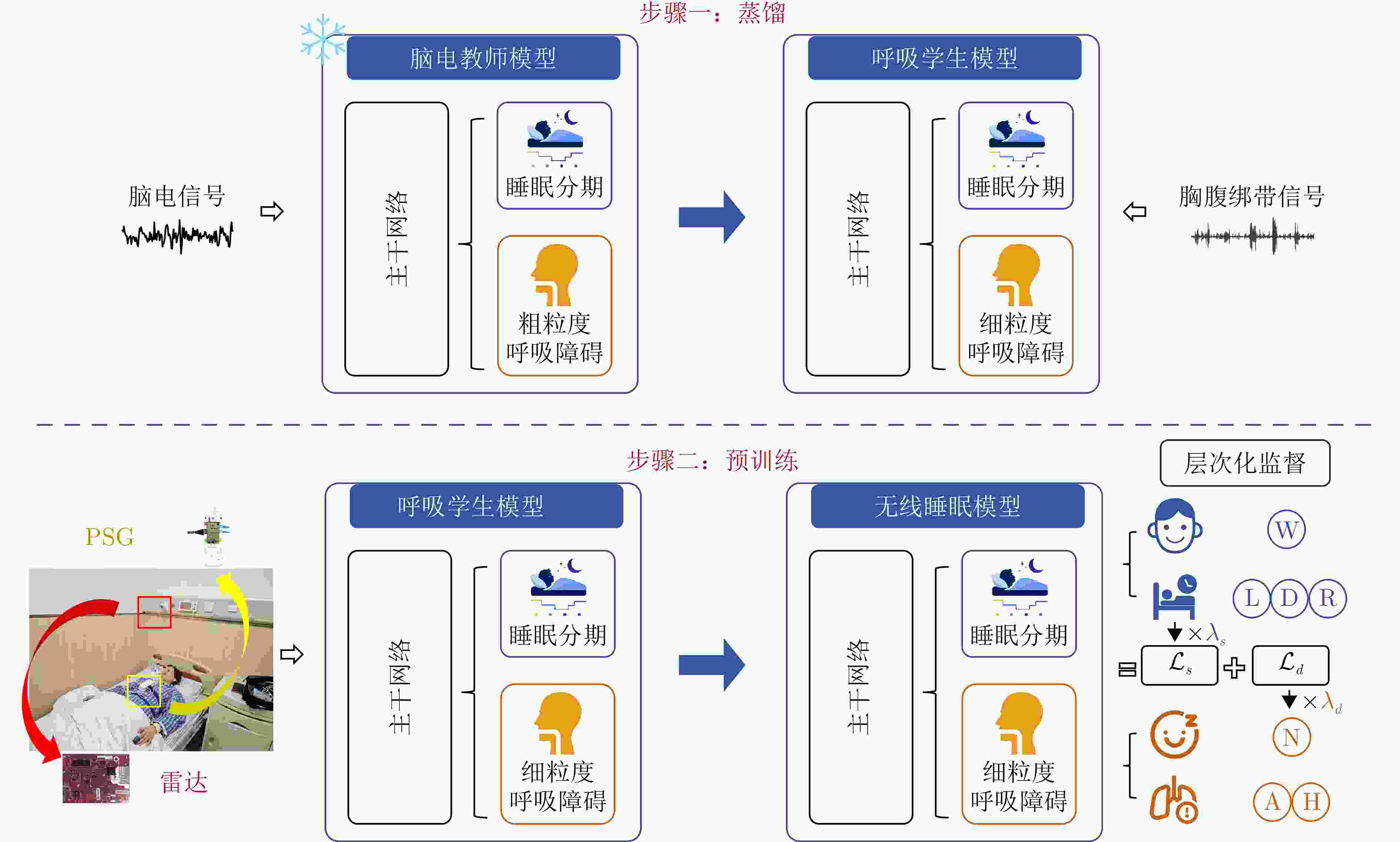
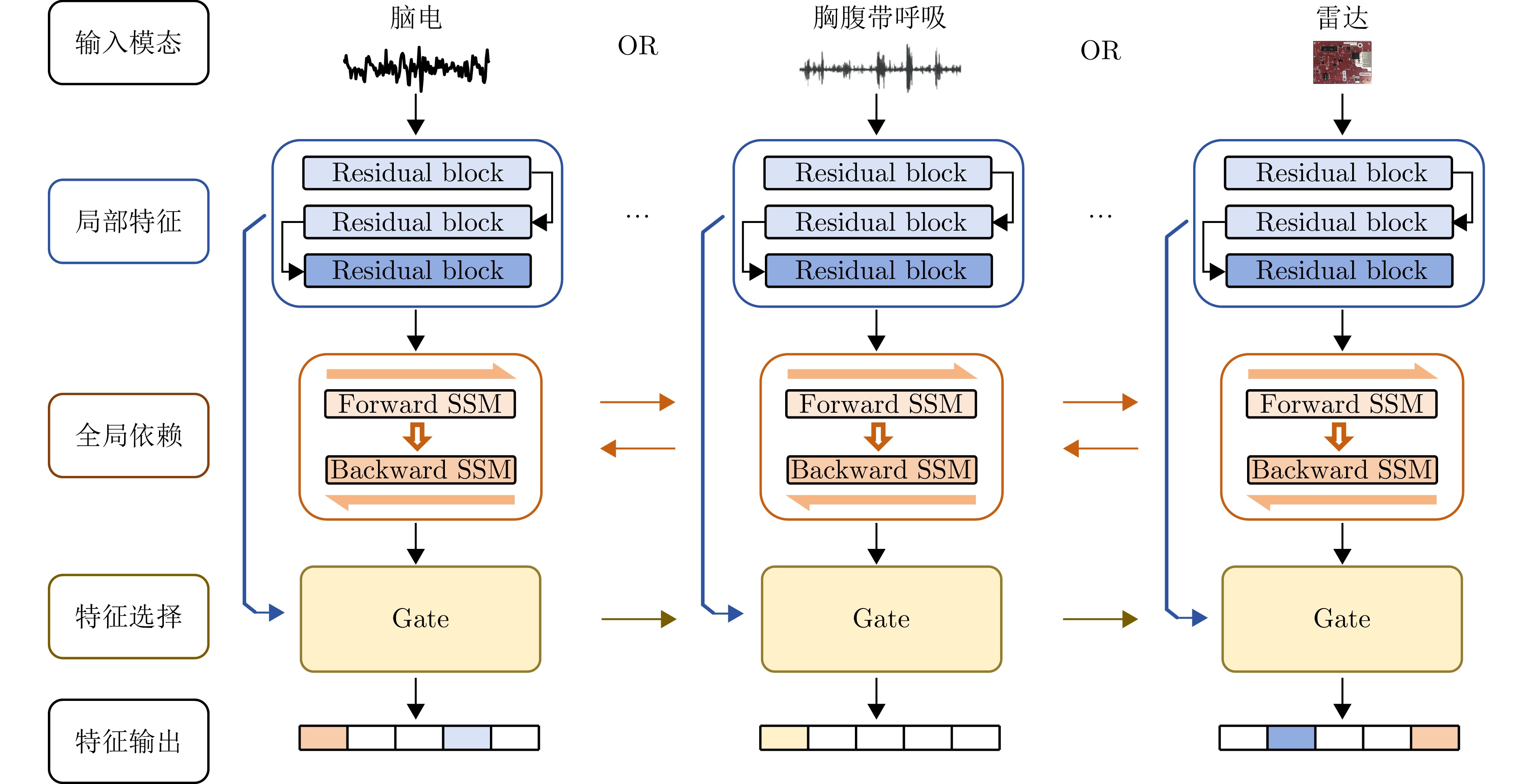
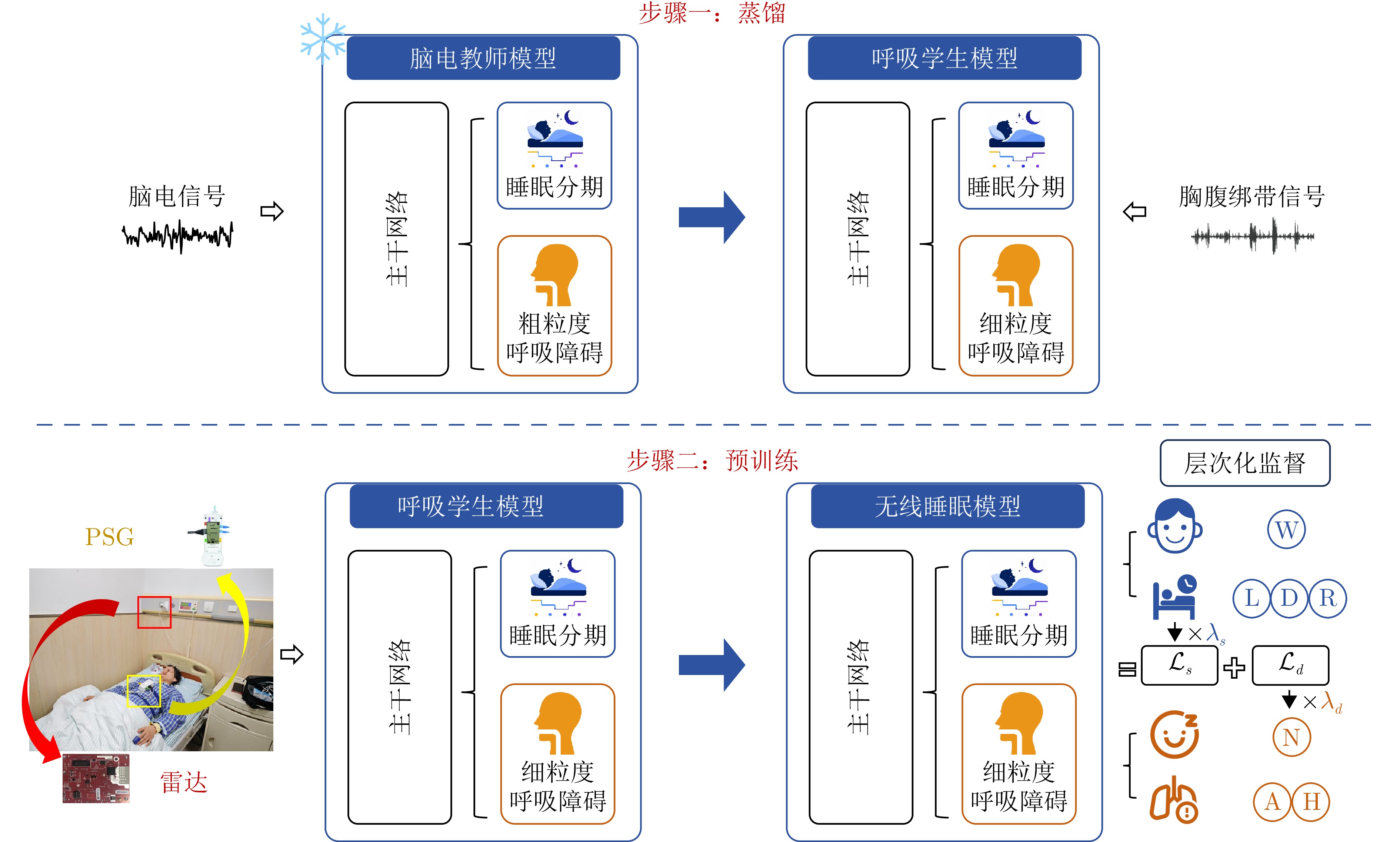
图 1 基于脑电信息监督的渐进式非接触睡眠监测框架
Figure 1. An EEG-supervised progressive framework for contactless sleep monitoring
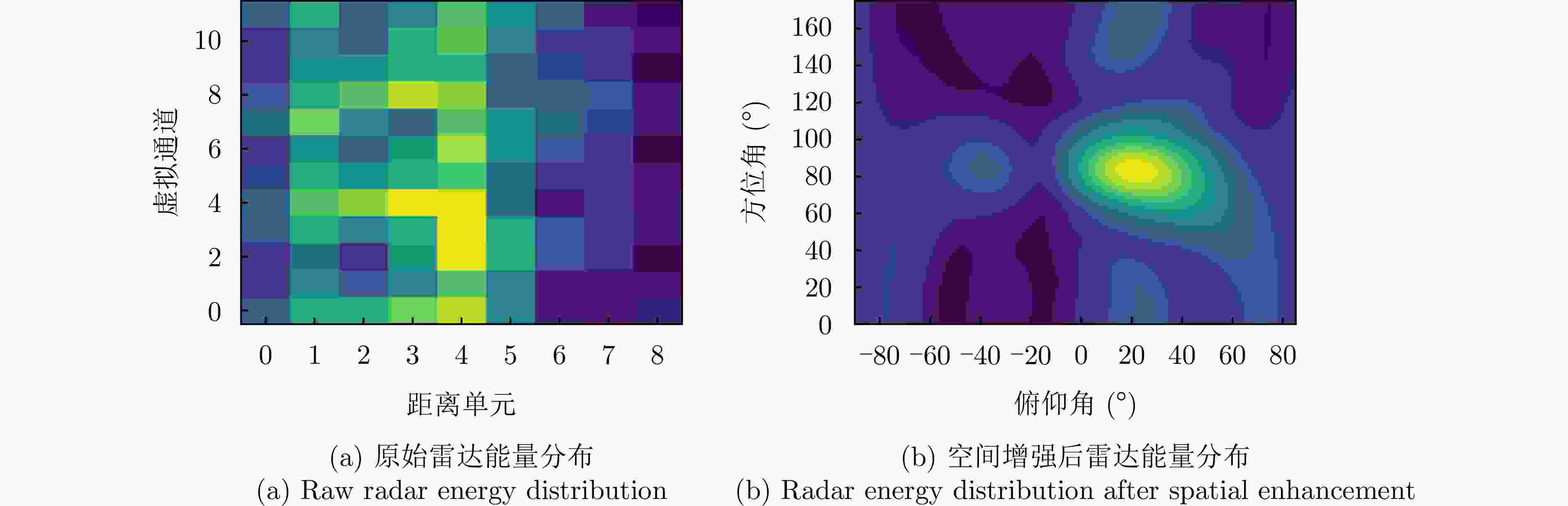
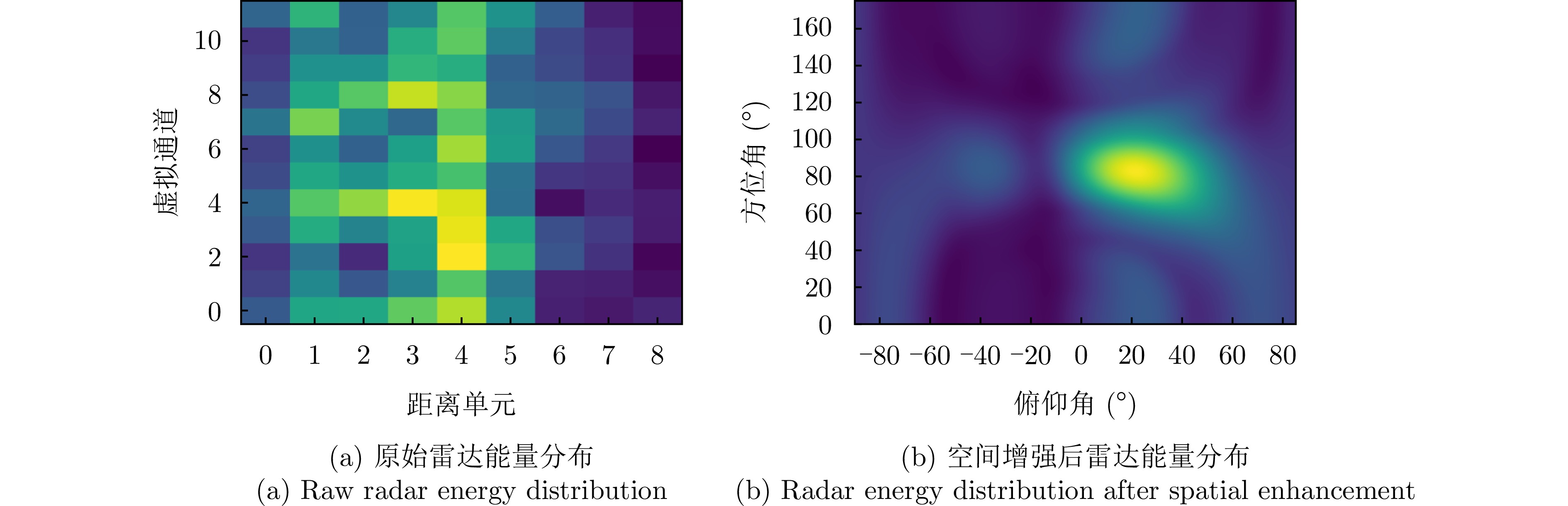
图 4 空间增强前后雷达能量分布对比
Figure 4. Comparison of radar energy distributions before and after spatial enhancement
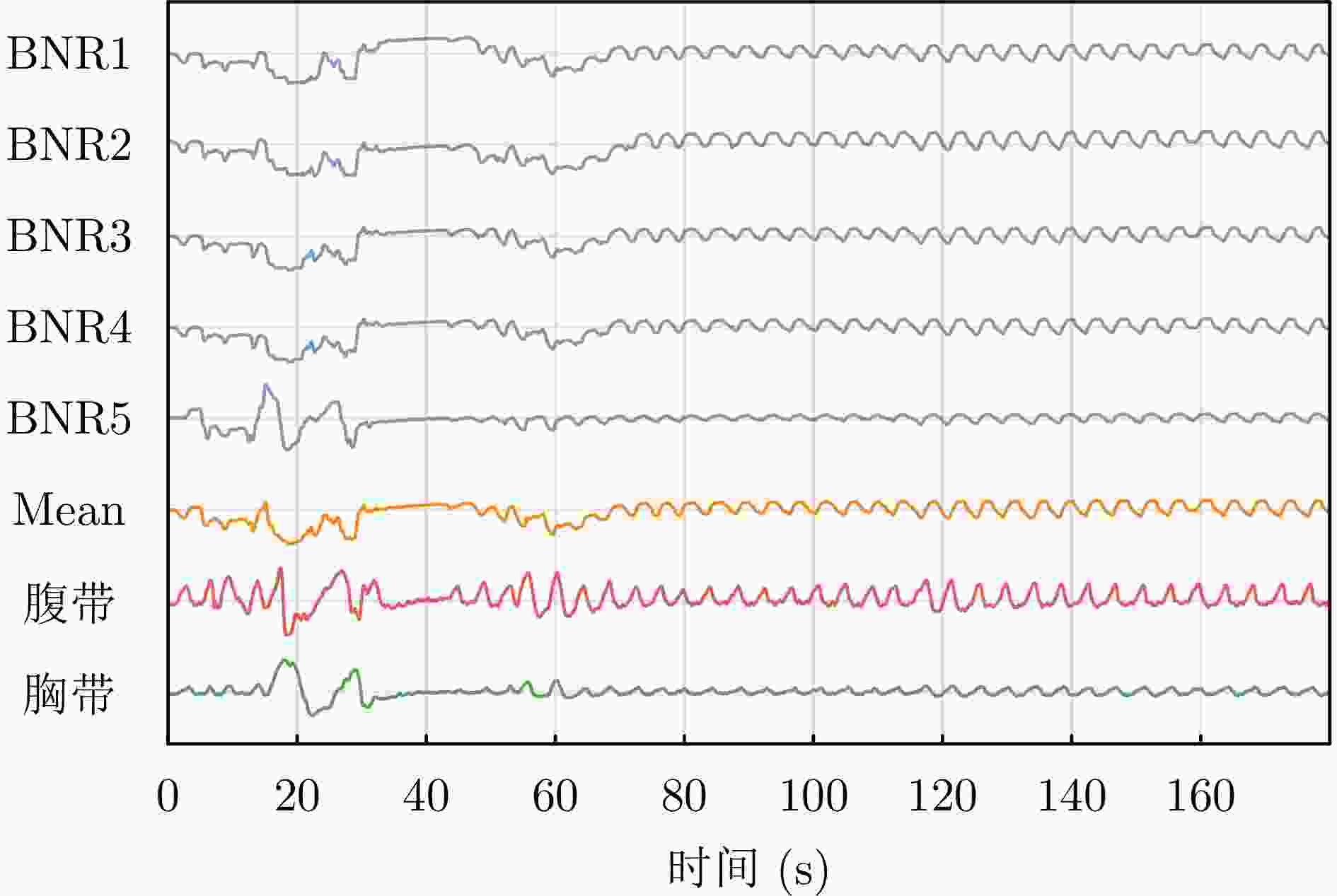
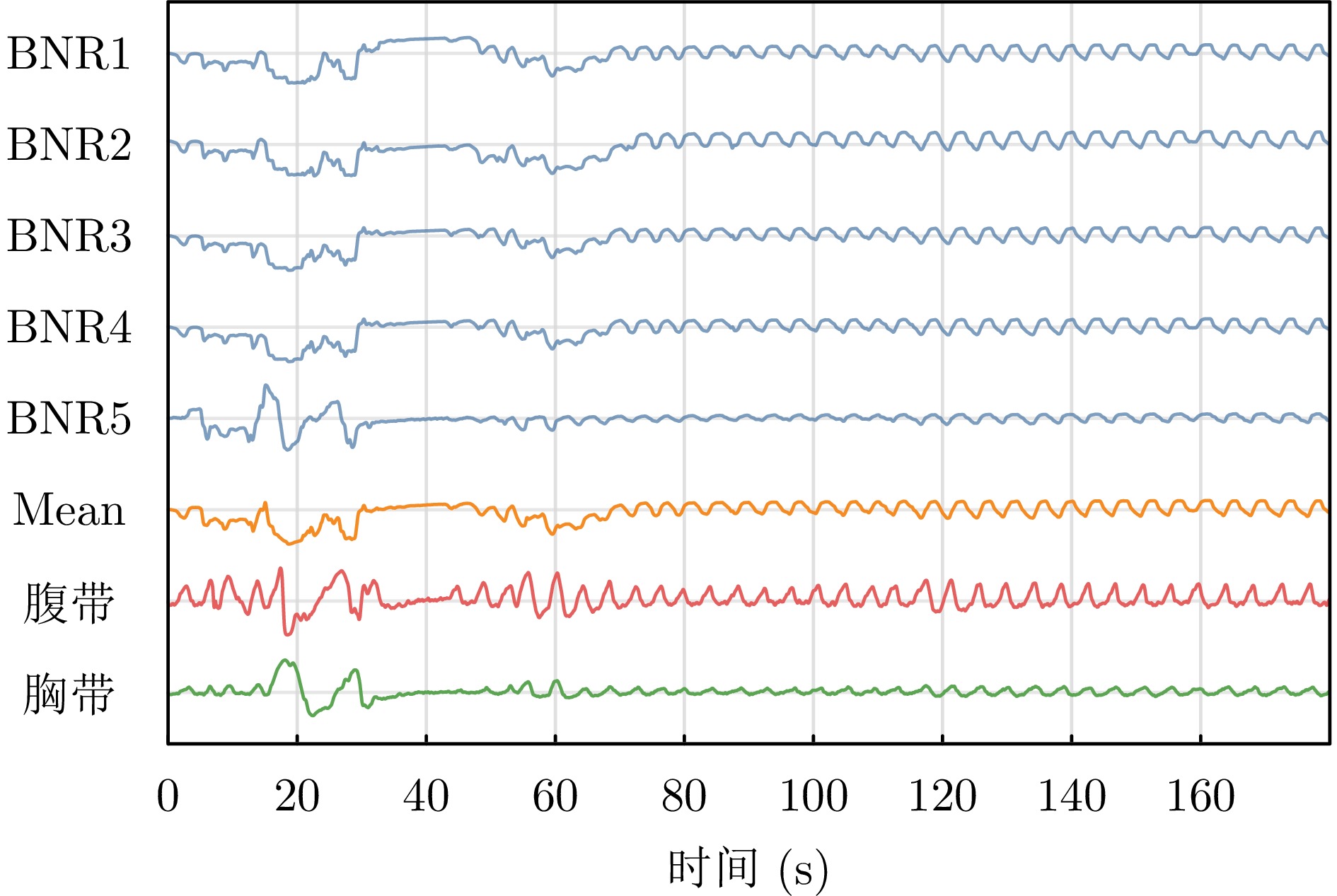
图 5 基于BNR估计的雷达呼吸信号与胸腹带参考呼吸信号的对比
Figure 5. Comparison of radar respiratory signals estimated from BNR and reference respiratory signals from thoracoabdominal belts
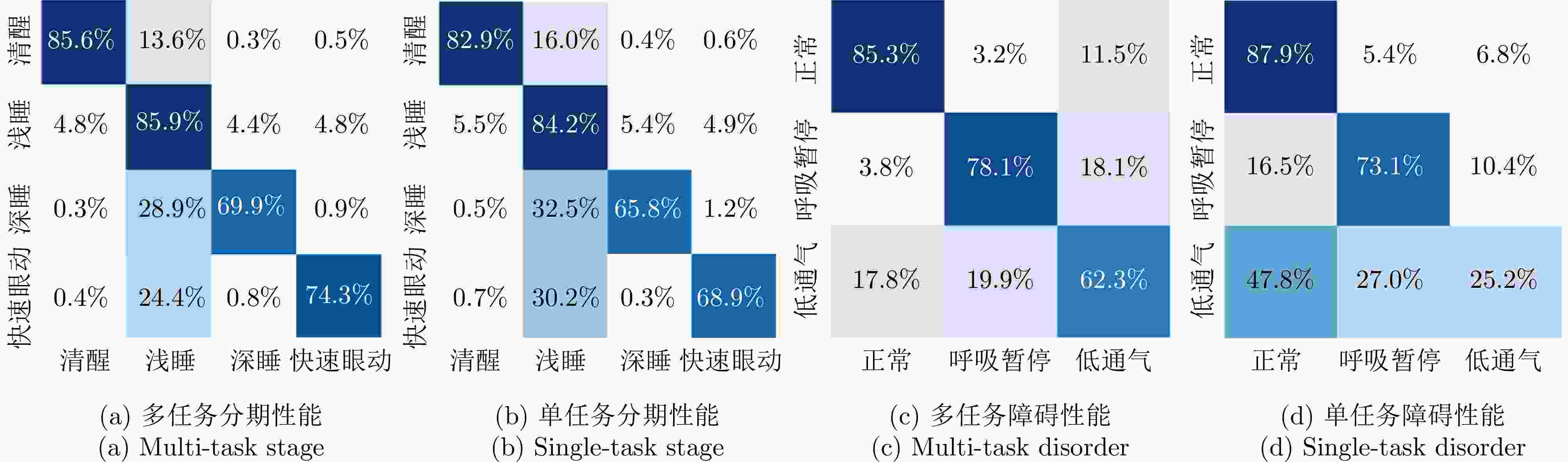
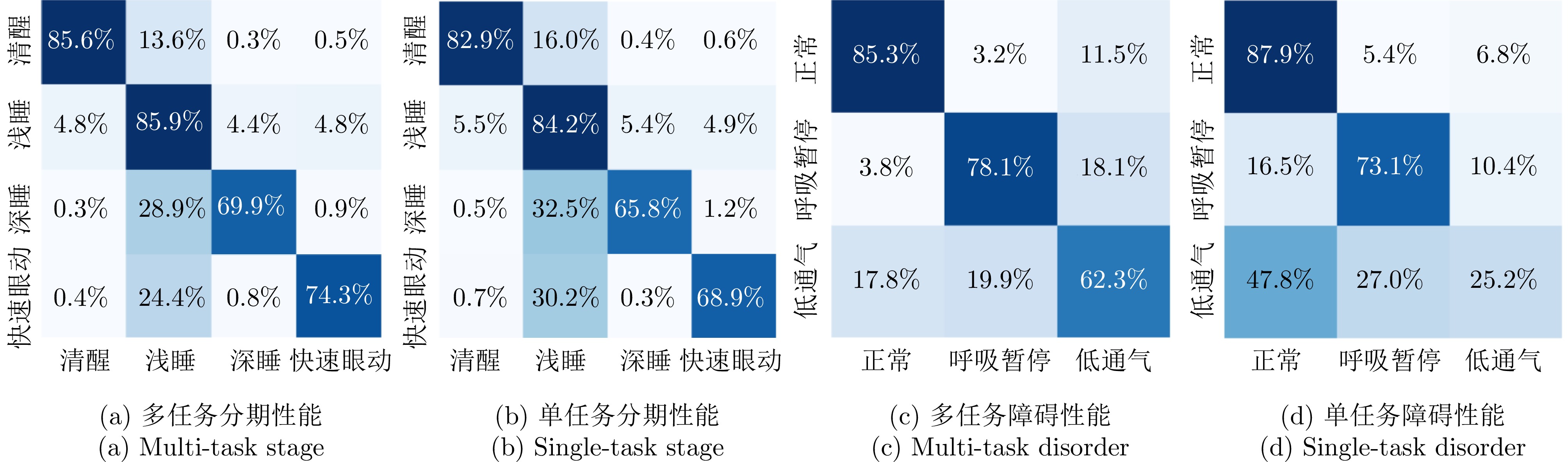
图 7 单任务与多任务学习混淆矩阵比较
Figure 7. Comparison of confusion matrices between single-task and multi-task learning
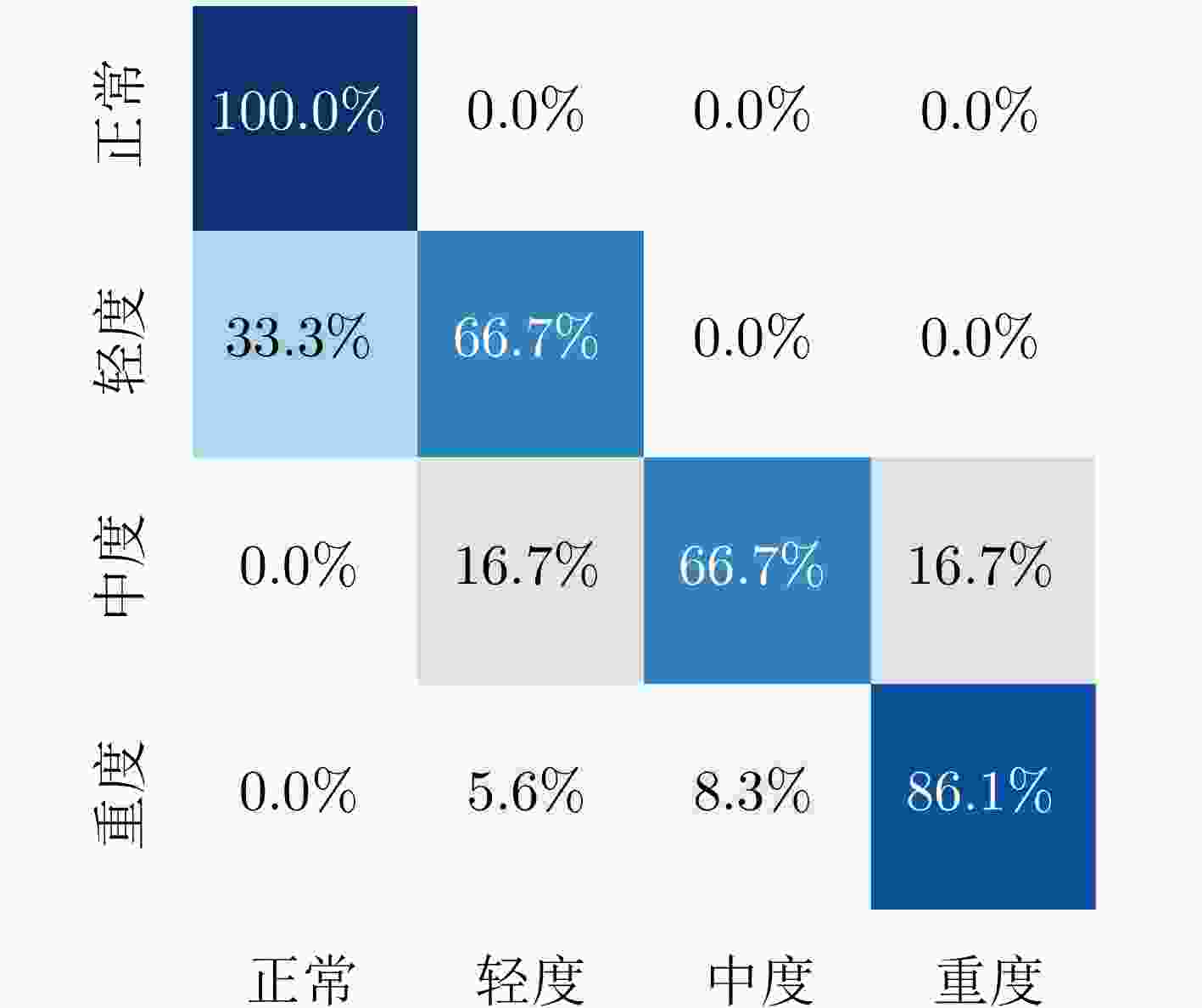
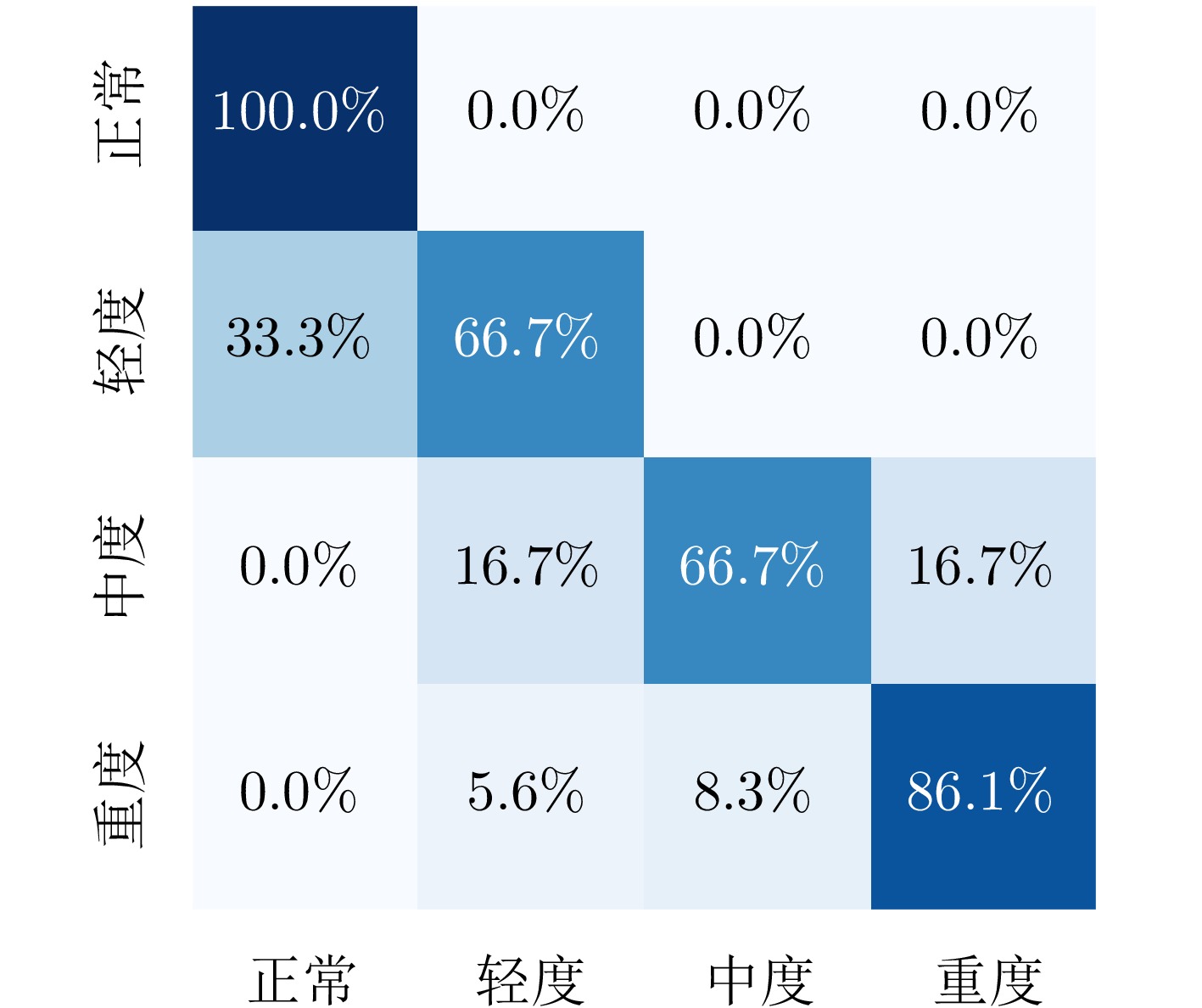
图 8 基于AHI的睡眠呼吸障碍严重程度分类结果
Figure 8. Classification results of sleep-disordered breathing severity based on AHI
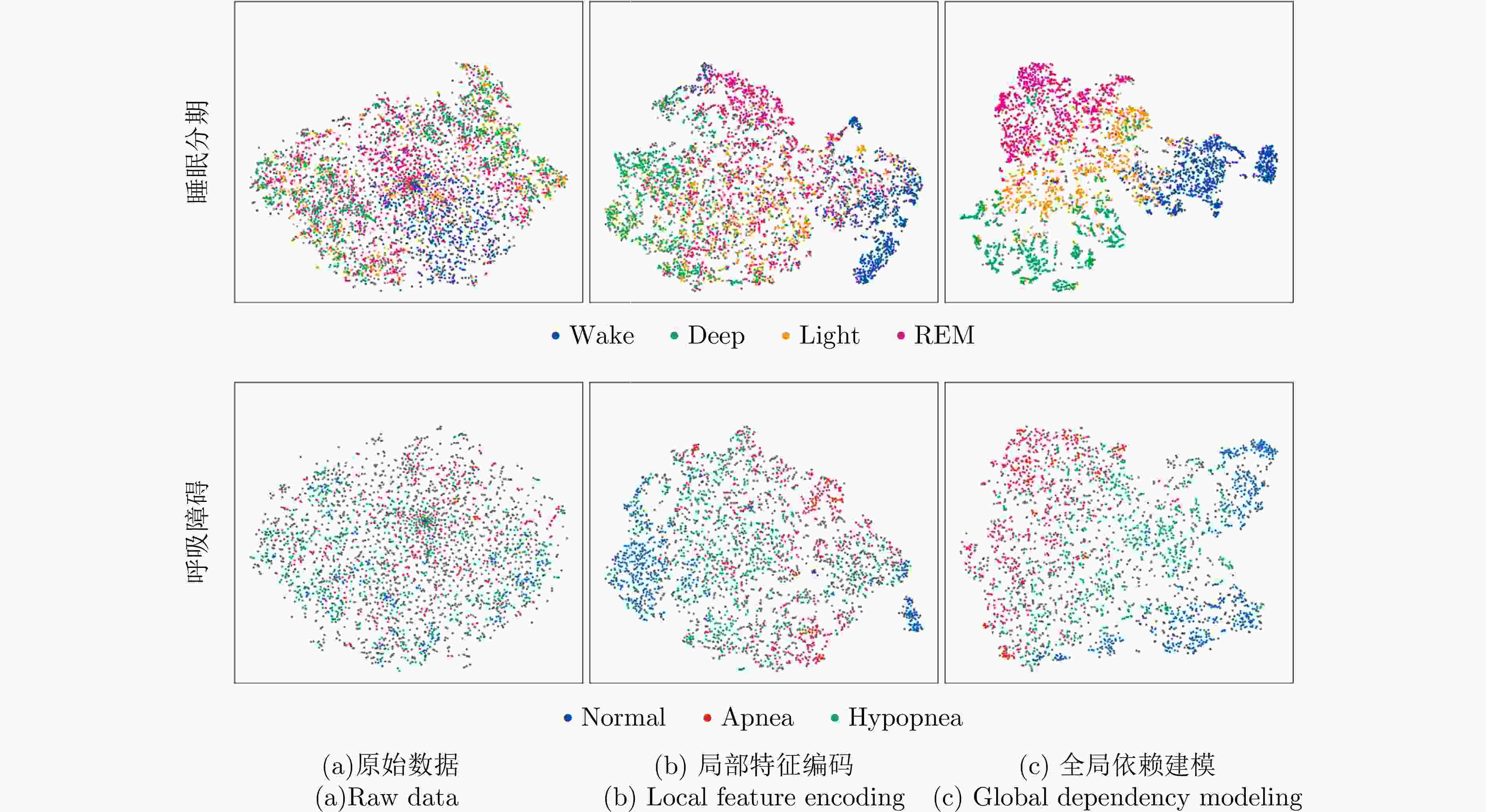
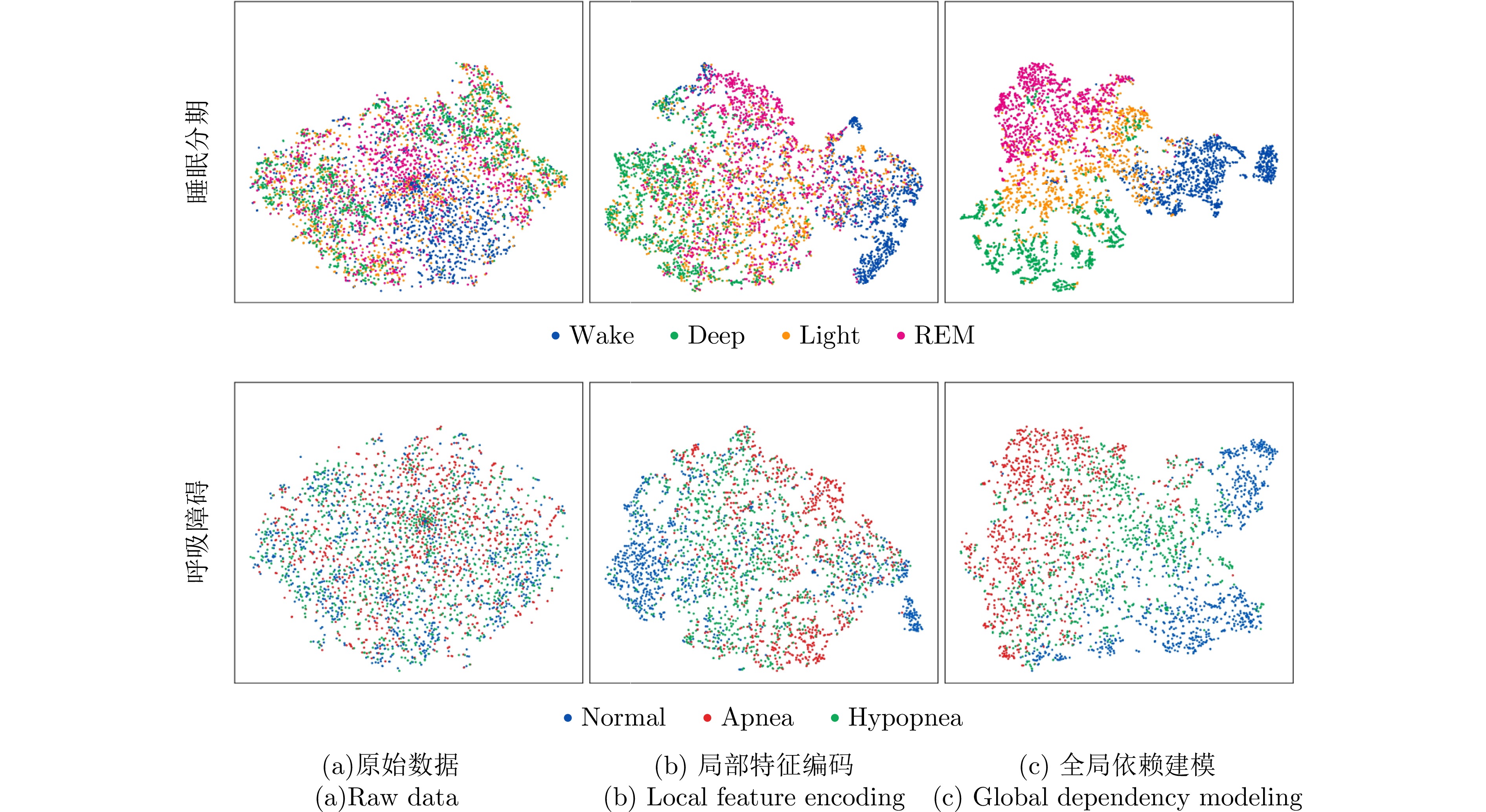
图 9 不同网络阶段的特征分布可视化
Figure 9. Feature distribution visualization at different network stages
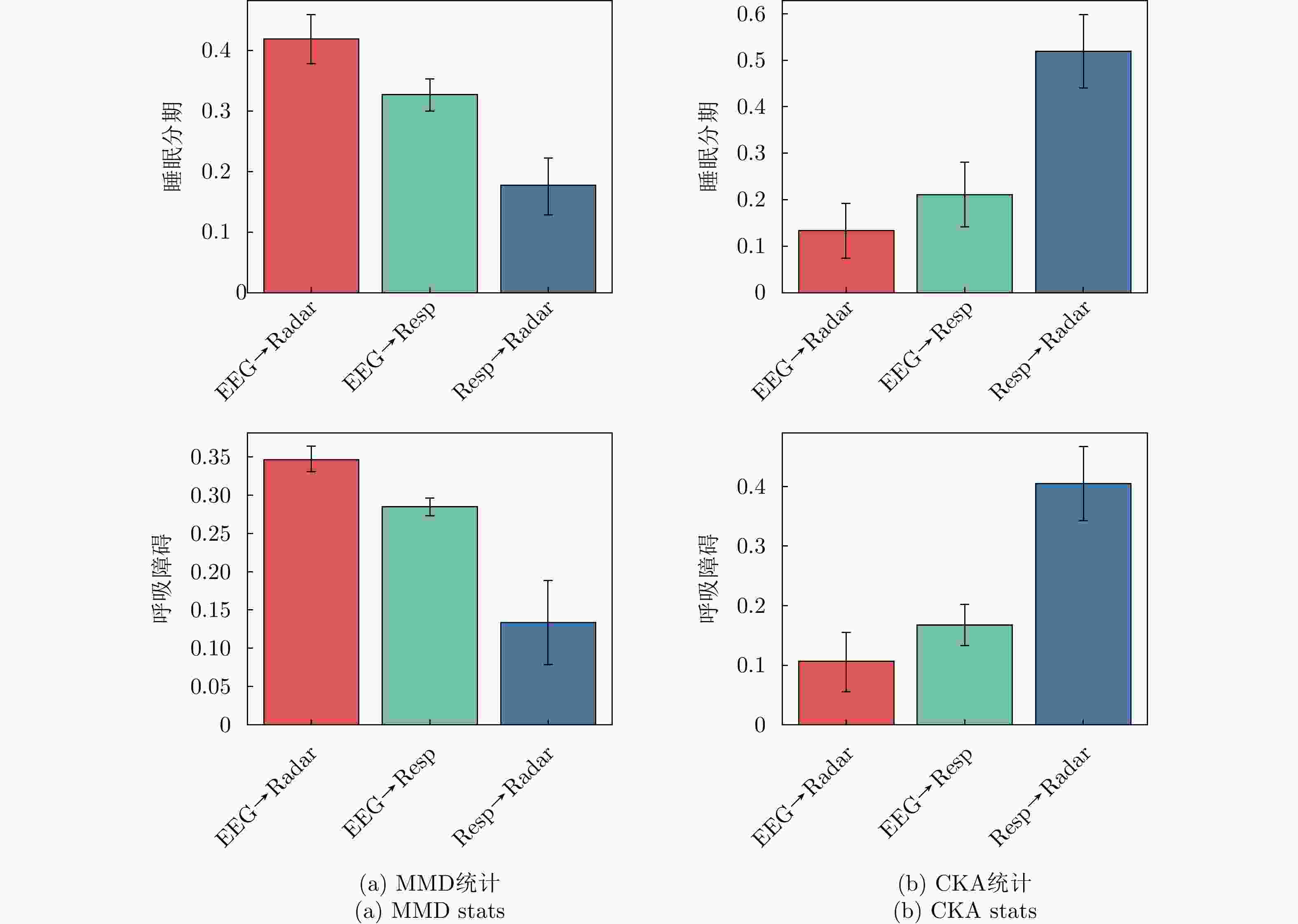
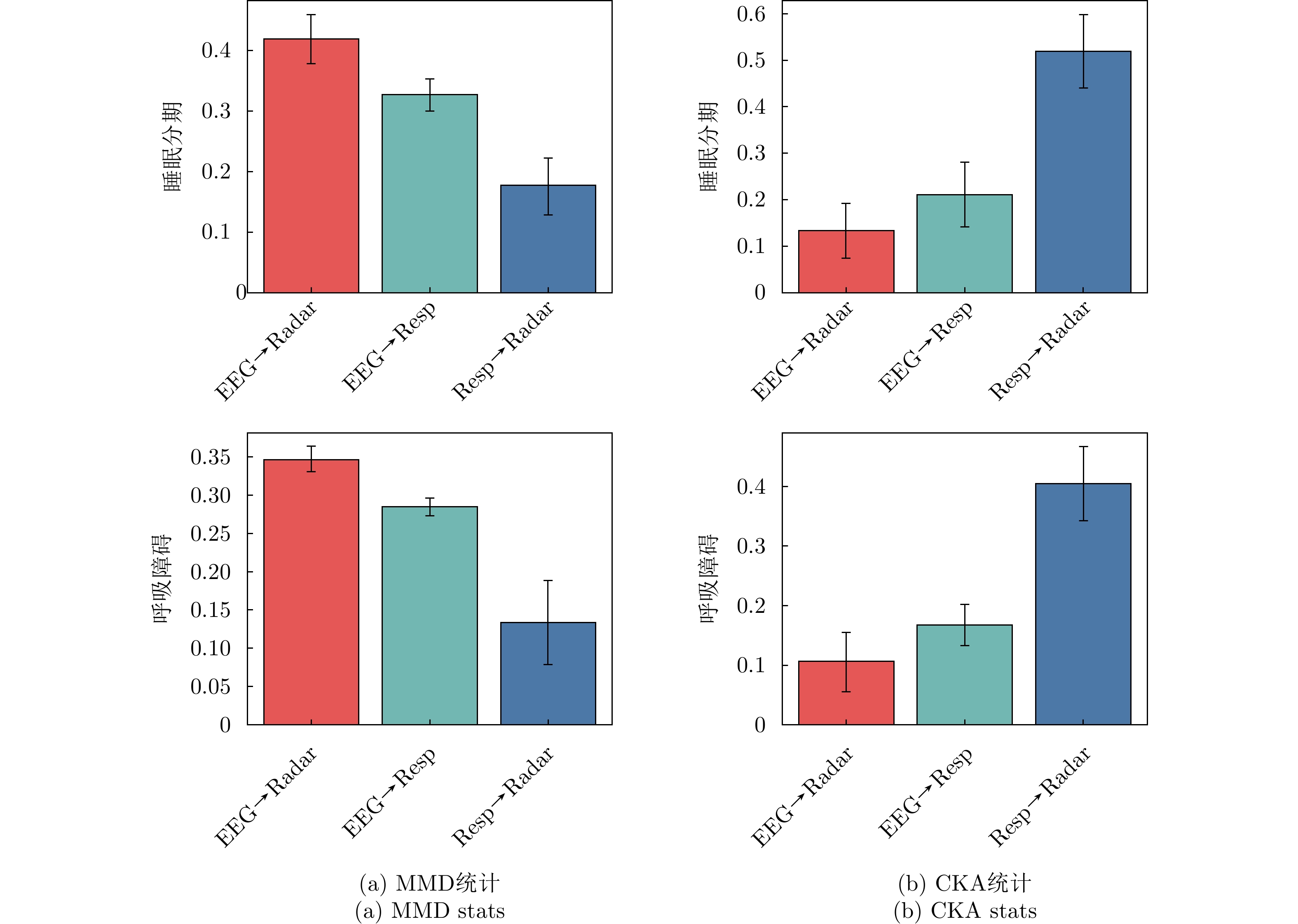
图 10 不同迁移阶段的特征分布差异与表征相似性变化趋势
Figure 10. Trends of feature distribution discrepancy and representation similarity across different transfer stages
表 1 数据集中各任务的类别分布(%)
Table 1. Class distribution of different tasks in the dataset(%)
睡眠分期 呼吸障碍 类别 Wake Light Deep REM Normal Apnea Hypopnea 比例 21.61 55.42 10.87 12.09 78.69 14.47 6.84  下载: 导出CSV
表 2 与代表性基线方法的睡眠分期性能比较
Table 2. Comparison of sleep staging performance with representative baselines
方法 Acc (%) κ MF1 %) Sens (%) Spec (%) Wake (%) Light (%) Deep (%) REM (%) RadioSleep[5], 79.0$ \pm $6.9 0.641$ \pm $0.16 71.6$ \pm $5.9 72.2$ \pm $5.9 90.4$ \pm $4.1 82.4$ \pm $3.4 84.8$ \pm $2.1 67.6$ \pm $7.1 54.2$ \pm $2.3 Hypnos[13] 76.5$ \pm $4.4 0.595$ \pm $0.11 67.1$ \pm $3.2 67.6$ \pm $1.8 89.4$ \pm $3.5 76.3$ \pm $5.3 82.3$ \pm $8.4 53.4$ \pm $4.5 58.3$ \pm $4.1 ResSleepNet[14] 73.1$ \pm $2.9 0.557$ \pm $0.05 66.1$ \pm $4.8 70.9$ \pm $4.8 89.4$ \pm $1.2 72.0$ \pm $5.1 76.3$ \pm $1.9 52.3$ \pm $7.8 63.4$ \pm $9.0 本文方法 82.6$ \pm $2.2 0.711$ \pm $0.04 78.9$ \pm $2.9 78.5$ \pm $3.0 92.4$ \pm $1.1 84.6$ \pm $5.8 86.0$ \pm $2.2 69.9$ \pm $6.3 73.7$ \pm $4.1 注:表内加粗数值表示各项评价指标中的最优结果。
下载: 导出CSV
表 3 与代表性基线方法的呼吸障碍检测性能比较
Table 3. Comparison of respiratory disorder detection performance with representative baselines
方法 Acc (%) κ MF1 (%) Sens (%) Spec (%) N (%) A (%) H (%) Vaquerizo等人[37] 81.1±2.0 0.548±0.05 64.6±3.7 69.1±3.9 88.9±1.4 87.0±2.6 62.6±10.6 57.8±5.3 Choi等人[38] 84.2±1.6 0.587±0.04 66.0±1.8 66.7±2.2 87.8±1.0 90.9±1.5 74.1±9.4 35.2±6.1 本文方法 82.5±4.1 0.593±0.06 68.0±3.9 74.8±3.0 91.5±1.2 85.1±4.0 77.6±7.8 61.8±4.4 注:表内加粗数值表示各项评价指标中的最优结果。
下载: 导出CSV
表 4 脑电知识对睡眠分期性能的影响
Table 4. Effect of EEG knowledge on sleep staging performance
方法 Acc (%) κ MF1 (%) Sens (%) Spec (%) Wake (%) Light (%) Deep (%) REM (%) w/o KD 74.5 0.623 71.1 70.9 90.3 81.7 76.1 43.0 82.6 w/ KD 78.2 0.679 75.6 75.5 91.7 84.4 78.8 52.7 86.0 注:表内加粗数值表示各项评价指标中的最优结果。
下载: 导出CSV
表 5 脑电知识蒸馏对雷达睡眠分期性能的影响
Table 5. Effect of EEG knowledge distillation on radar-based sleep staging performance
方法 Acc (%) κ MF1 (%) Sens (%) Spec (%) Wake (%) Light (%) Deep (%) REM (%) w/o KD 80.1 0.674 76.4 75.2 91.3 80.8 85.1 65.8 69.2 w/ KD 82.7 0.719 79.6 78.9 92.5 85.6 85.9 69.9 74.3 注:表内加粗数值表示各项评价指标中的最优结果。
下载: 导出CSV
表 6 直接知识蒸馏与所提方法的睡眠分期性能比较
Table 6. Sleep staging performance comparison between direct knowledge distillation and ours
方法 Acc (%) κ MF1 (%) Sens (%) Spec (%) Wake (%) Light (%) Deep (%) REM (%) 直接蒸馏 77.2 0.626 72.9 71.8 90.0 76.6 82.9 62.2 65.6 本文方法 82.7 0.719 79.6 78.9 92.5 85.6 85.9 69.9 74.3 注:表内加粗数值表示各项评价指标中的最优结果。
下载: 导出CSV
表 7 直接知识蒸馏与所提方法的呼吸障碍检测性能比较
Table 7. Respiratory disorder detection performance comparison between direct knowledge distillation and ours
方法 Acc (%) κ MF1 (%) Sens (%) Spec (%) N (%) A (%) H (%) 直接蒸馏 78.1 0.500 62.1 68.1 88.7 81.8 70.7 51.9 本文方法 82.7 0.593 68.2 75.2 91.6 85.3 78.1 62.3 注:表内加粗数值表示各项评价指标中的最优结果。
下载: 导出CSV
表 8 层次化监督策略的消融实验结果
Table 8. Ablation results of the hierarchical supervision strategy
任务 方法 Acc(%) κ MF1(%) Sens(%) Spec(%) 睡眠分期 w/o HS 81.4 0.696 78.0 77.2 91.9 w/ HS 82.7 0.719 79.6 78.9 92.5 呼吸障碍 w/o HS 80.4 0.553 66.0 73.4 90.6 w/ HS 82.7 0.593 68.2 75.2 91.6 注:表内加粗数值表示各项评价指标中的最优结果。
下载: 导出CSV
表 9 不同数据集下睡眠分期性能比较
Table 9. Sleep staging performance comparison with different datasets
数据集组合 Acc (%) κ MF1 (%) Sens (%) Spec (%) Wake (%) Light (%) Deep (%) REM (%) S1 82.7 0.719 79.6 78.9 92.5 85.6 85.9 69.9 74.3 S1&S2 81.9 0.705 78.7 78.0 92.1 83.5 85.6 69.3 73.6 S1&S2&M 82.4 0.714 79.4 79.0 92.4 84.6 85.4 70.8 75.0 注:表内加粗数值表示各项评价指标中的最优结果。
下载: 导出CSV
表 10 不同数据集下呼吸障碍检测性能比较
Table 10. Respiratory disorder detection performance comparison with different datasets
数据集组合 Acc (%) κ MF1 (%) Sens (%) Spec (%) N (%) A (%) H (%) S1 82.7 0.593 68.2 75.2 91.6 85.3 78.1 62.3 S1&S2 82.3 0.581 67.4 73.7 91.0 85.4 76.3 59.4 S1&S2&M 82.3 0.586 67.8 74.9 91.4 85.1 76.5 63.1 注:表内加粗数值表示各项评价指标中的最优结果。
下载: 导出CSV
表 11 单任务与多任务学习性能比较
Table 11. Performance comparison between single-task and multi-task learning
睡眠分期 呼吸障碍 方法 Acc (%) κ MF1 (%) Sens (%) Spec (%) Acc (%) κ MF1 (%) Sens (%) Spec (%) 单任务 80.7 0.662 75.8 76.2 91.2 81.5 0.514 60.1 62.0 86.4 多任务 82.7 0.719 79.6 78.9 92.5 82.7 0.593 68.2 75.2 91.6 注:表内加粗数值表示各项评价指标中的最优结果。
下载: 导出CSV
表 12 迁移策略对睡眠分期性能的影响
Table 12. Effect of the transfer strategy on sleep staging performance
方法 Acc
(%)κ MF1
(%)Sens
(%)Spec
(%)Wake
(%)Light
(%)Deep
(%)REM
(%)w/o KD / w/o PT 75.2 0.575 68.2 64.7 88.3 73.5 87.3 57.3 40.6 w/ KD / w/o PT 73.7 0.576 69.1 69.2 89.0 71.0 78.8 59.6 67.4 w/o KD / w/ PT 80.1 0.674 76.4 75.2 91.3 80.8 85.1 65.8 69.2 w/ KD / w/ PT 82.7 0.719 79.6 78.9 92.5 85.6 85.9 69.9 74.3 注:表内加粗数值表示各项评价指标中的最优结果。
下载: 导出CSV
表 13 迁移策略对呼吸障碍检测性能的影响
Table 13. Effect of the transfer strategy on respiratory disorder detection performance
方法 Acc
(%)κ MF1
(%)Sens
(%)Spec
(%)N
(%)A
(%)H
(%)w/o KD / w/o PT 74.0 0.446 58.5 67.6 88.1 72.5 75.5 51.8 w/ KD / w/o PT 82.4 0.517 61.1 61.4 85.9 90.4 63.6 30.2 w/o KD / w/ PT 80.0 0.543 65.7 73.0 90.4 82.8 71.3 64.9 w/ KD / w/ PT 82.7 0.593 68.2 75.2 91.6 85.3 78.1 62.3 注:表内加粗数值表示各项评价指标中的最优结果。
下载: 导出CSV
表 14 预处理流程的消融实验结果
Table 14. Ablation results of the preprocessing pipeline
任务 方法 Acc
(%)κ MF1
(%)Sens
(%)Spec
(%)睡眠分期 w/o Preprocessing 75.3 0.583 68.8 66.3 88.7 w/ Preprocessing 82.7 0.719 79.6 78.9 92.5 呼吸障碍 w/o Preprocessing 76.8 0.478 60.9 66.8 87.7 w/ Preprocessing 82.7 0.593 68.2 75.2 91.6 注:表内加粗数值表示各项评价指标中的最优结果。
下载: 导出CSV
表 15 时序建模层数对睡眠分期性能的影响
Table 15. Effect of temporal modeling depth on sleep staging performance
层数 Acc (%) κ MF1 (%) Sens (%) Spec (%) Wake (%) Light (%) Deep (%) REM (%) 1 80.0 0.670 75.9 74.5 91.1 82.4 85.1 65.8 64.8 2 80.7 0.688 77.4 77.1 91.7 83.9 83.8 71.0 69.6 4 82.7 0.719 79.6 78.9 92.5 85.6 85.9 69.9 74.3 6 82.4 0.713 79.3 78.6 92.3 83.8 86.0 69.2 75.4 注:表内加粗数值表示各项评价指标中的最优结果。
下载: 导出CSV
表 16 时序建模层数对呼吸障碍检测性能的影响
Table 16. Effect of temporal modeling depth on respiratory disorder detection performance
层数 Acc (%) κ MF1 (%) Sens (%) Spec (%) N (%) A (%) H (%) 1 82.4 0.578 66.9 72.8 90.9 86.2 71.5 60.7 2 84.0 0.606 68.6 73.8 91.3 87.8 74.8 58.8 4 82.7 0.593 68.2 75.2 91.6 85.3 78.1 62.3 6 81.9 0.579 67.5 74.6 91.3 84.7 75.7 63.4 注:表内加粗数值表示各项评价指标中的最优结果。
下载: 导出CSV
表 17 不同场景下的睡眠分期性能比较
Table 17. Comparison of sleep staging performance across different scenarios
场景 Acc
(%)κ MF1
(%)Sens
(%)Spec
(%)Wake
(%)Light
(%)Deep
(%)REM
(%)医院 81.3 0.667 75.7 75.3 91.2 78.7 86.0 65.5 70.9 酒店 85.0 0.785 83.5 83.2 94.5 93.4 84.3 69.7 85.5 居家 85.1 0.783 84.1 83.3 94.2 95.0 86.3 75.6 76.2
下载: 导出CSV
表 18 不同迁移阶段的特征分布差异与表征相似性
Table 18. Feature distribution discrepancy and representation similarity across different transfer stages
MMD↓ CKA↑ 任务 EEG→Radar EEG→Resp Resp→Radar EEG→Radar EEG→Resp Resp→Radar 睡眠分期 0.419±0.041 0.326±0.026 0.175±0.047 0.134±0.059 0.210±0.070 0.519±0.079 呼吸障碍 0.346±0.017 0.285±0.012 0.133±0.055 0.105±0.050 0.168±0.034 0.405±0.063
下载: 导出CSV
表 19 模型计算开销统计
Table 19. Computational cost of different models
模型 参数量(M) GFLOPS(30 s) 训练时间 教师模型 16.922 0.283 5小时16分钟 学生模型 16.661 0.058 9小时8分钟 雷达模型 17.021 0.283 2小时45分钟
下载: 导出CSV
-
[1] BERRY R B, BROOKS R, GAMALDO C E, et al. The AASM Manual for the Scoring of Sleep and Associated Events: Rules, Terminology and Technical Specifications[M]. Darien: American Academy of Sleep Medicine, 2012: 7. [2] Grandner M A. Sleep, health, and society[J]. Sleep medicine clinics, 2022, 17(2): 117–139. doi: 10.1016/j.jsmc.2022.03.001. [3] 方震, 简璞, 张浩, 等. 基于FMCW雷达的非接触式医疗健康监测技术综述[J]. 雷达学报, 2022, 11(3): 499–516. doi: 10.12000/JR22019.Fang Zhen, Jian Pu, Zhang Hao, et al. Review of noncontact medical and health monitoring technologies based on FMCW radar[J]. Journal of Radars, 2022, 11(3): 499–516. doi: 10.12000/JR22019. [4] 赵翔, 王威, 李晨洋, 等. 基于毫米波雷达微动信号和脉搏波数据融合的睡眠呼吸暂停低通气综合征筛查技术[J]. 雷达学报(中英文), 2025, 14(1): 102–116. doi: 10.12000/JR24107.Zhao Xiang, Wang Wei, Li Chenyang, et al. Diagnosis of sleep apnea hypopnea syndrome using fusion of micro-motion signals from millimeter-wave radar and pulse wave data[J]. Journal of Radars, 2025, 14(1): 102–116. doi: 10.12000/JR24107. [5] HE Hao, LI Chao, GANGLBERGER W, et al. What radio waves tell us about sleep![J]. Sleep, 2025, 48(1): zsae187. doi: 10.1093/sleep/zsae187. [6] WANG Yaqi, LU Zhi, YUE Aoxiang, et al. Self-supervised learning for contactless cardiac diagnosis with beamformed radar signals[J]. IEEE Internet of Things Journal, 2026. doi: 10.1109/JIOT.2026.3729861. [7] CAI Xinmeng, CHEN Jinbo, XU Guixin, et al. RF-HeartSSL: Self-supervised learning for RF-based cardiac sensing[J]. Proceedings of the ACM on Interactive, Mobile, Wearable and Ubiquitous Technologies, 2026, 10(2): 1–34. doi: 10.1145/3810229. [8] GENG Ruixu, ZHANG Dongheng, LI Yadong, et al. mmGuard: A countermeasure against physical adversarial attacks on mmWave radar sensing[J]. IEEE Transactions on Information Forensics and Security, 2026, 21: 5568–5582. doi: 10.1109/TIFS.2026.3698581. [9] CAI Xinmeng, CHEN Jinbo, WANG Haoyu, et al. Contactless arrhythmia detection via diversity-invariant contrastive mmWave sensing[J]. IEEE Transactions on Mobile Computing, 2026, 25(8): 13324–13339. doi: 10.1109/TMC.2026.3673334. [10] ZHAO Heng, XU Zhi, XUE Biao, et al. Client-personalized federated learning framework with heterogeneous millimeter-wave radars for contactless ECG reconstruction using heart sounds[J]. IEEE Journal of Electromagnetics, RF and Microwaves in Medicine and Biology, 2026. doi: 10.1109/JERM.2026.3727679. [11] YANG Xuan, ZHAO Heng, WANG Shaijun, et al. Accurate near-range displacement sensing in single-channel FMCW radar via CZT-MLE compensation for SL-IQI[J]. IEEE Transactions on Microwave Theory and Techniques, 2026, 74(6): 5644–5657. doi: 10.1109/TMTT.2026.3680086. [12] ZHU Tianyu, ZHANG Lin, DING Chen, et al. Efficiency-based adaptive time-Doppler sparse point clouds of human motion for radar sensing[C]. 2026 IEEE MTT-S International Wireless Symposium (IWS). 2026: 1–3. [13] LI Siheng, JIN Beihong, ZHANG Fusang, et al. Hypnos: A contactless sleep stage monitoring system using UWB signals[J]. Proceedings of the ACM on Interactive, Mobile, Wearable and Ubiquitous Technologies, 2024, 8(3): 114. doi: 10.1145/3678581. [14] ZHUANG Zhongxu, XUE Biao, AN Qiang, et al. Advancing sleep health equity through deep learning on large-scale nocturnal respiratory signals[J]. Nature Communications, 2025, 16(1): 9334. doi: 10.1038/s41467-025-64340-y. [15] ZHAO Mingmin, YUE Shichao, KATABI D, et al. Learning sleep stages from radio signals: A conditional adversarial architecture[C]. The 34th International Conference on Machine Learning, Sydney, Australia, 2017: 4100–4109. [16] CHEN Jinbo, ZHANG Dongheng, WU Zhi, et al. Contactless electrocardiogram monitoring with millimeter wave radar[J]. IEEE Transactions on Mobile Computing, 2024, 23(1): 270–285. doi: 10.1109/TMC.2022.3214721. [17] YUAN Yuqin, CHEN Jinbo, ZHANG Dongheng, et al. Atrial fibrillation detection via contactless radio monitoring and knowledge transfer[J]. Nature Communications, 2025, 16(1): 4317. doi: 10.1038/s41467-025-59482-y. [18] WU Zhi, ZHANG Dongheng, SHANG Zixin, et al. Learning-based tracking-before-detect for unconstrained indoor human tracking using RF signal[J]. IEEE Transactions on Mobile Computing, 2025, 24(6): 4777–4793. doi: 10.1109/TMC.2025.3529501. [19] ZHANG Ganlin, ZHANG Dongheng, DENG Hongyu, et al. SRAL-IRS: Swift, robust, and accurate IRS-aided localization with COTS WiFi[J]. IEEE Transactions on Wireless Communications, 2025, 24(10): 8376–8390. doi: 10.1109/twc.2025.3566158. [20] QUAN S F, HOWARD B V, IBER C, et al. The sleep heart health study: Design, rationale, and methods[J]. Sleep, 1997, 20(12): 1077–1085. doi: 10.1093/sleep/20.12.1077. [21] ZHANG Guoqiang, CUI Licong, MUELLER R, et al. The National Sleep Research Resource: Towards a sleep data commons[J]. Journal of the American Medical Informatics Association, 2018, 25(10): 1351–1358. doi: 10.1093/jamia/ocy064. [22] GOU Jianping, YU Baosheng, MAYBANK S J, et al. Knowledge distillation: A survey[J]. International Journal of Computer Vision, 2021, 129(6): 1789–1819. doi: 10.1007/s11263-021-01453-z. [23] MIN Bonan, ROSS H, SULEM E, et al. Recent advances in natural language processing via large pre-trained language models: A survey[J]. ACM Computing Surveys, 2024, 56(2): 30. doi: 10.1145/3605943. [24] CHEN Xiaoli, WANG Rui, ZEE P, et al. Racial/ethnic differences in sleep disturbances: The multi-ethnic study of atherosclerosis (MESA)[J]. Sleep, 2015, 38(6): 877–888. doi: 10.5665/sleep.4732. [25] AWR6843AOP T I. [OL]. https://www.ti.com.cn/product/cn/AWR6843AOP. [26] LI Yadong, ZHANG Dongheng, GENG Ruixu, et al. IFNet: Deep imaging and focusing for handheld SAR with millimeter-wave signals[J]. IEEE Transactions on Mobile Computing, 2025, 24(3): 2166–2180. doi: 10.1109/TMC.2024.3489641. [27] GENG Ruixu, LI Yadong, ZHANG Dongheng, et al. DREAM-PCD: Deep reconstruction and enhancement of mmWave radar pointcloud[J]. IEEE Transactions on Image Processing, 2024, 33: 6774–6789. doi: 10.1109/TIP.2024.3512356. [28] 丁凌娜, 张宾宾, 王健阳, 等. 基于深度盲源分离的毫米波雷达驾驶员心跳感知方法研究[J/OL]. 雷达学报(中英文). https://doi.org/10.12000/JR26042, 2026. doi: 10.12000/JR26042,2026.DING Lingna, ZHANG Binbin, WANG Jianyang, et al. Driver heartbeat sensing using millimeter-wave radar based on deep blind source separation[J/OL]. Journal of Radars. https://doi.org/10.12000/JR26042, 2026. doi: 10.12000/JR26042,2026. [29] 元志安, 周笑宇, 刘心溥, 等. 基于RDSNet的毫米波雷达人体跌倒检测方法[J]. 雷达学报, 2021, 10(4): 656–664. doi: 10.12000/JR21015.YUAN Zhian, ZHOU Xiaoyu, LIU Xinpu, et al. Human fall detection method using millimeter-wave radar based on RDSNet[J]. Journal of Radars, 2021, 10(4): 656–664. doi: 10.12000/JR21015. [30] XU Qinyi, JIANG Chunxiao, HAN Yi, et al. Waveforming: An overview with beamforming[J]. IEEE Communications Surveys & Tutorials, 2018, 20(1): 132–149. doi: 10.1109/COMST.2017.2750201. [31] YUE Shichao, HE Hao, WANG Hao, et al. Extracting multi-person respiration from entangled RF signals[J]. Proceedings of the ACM on Interactive, Mobile, Wearable and Ubiquitous Technologies, 2018, 2(2): 86. doi: 10.1145/3214289. [32] HE Kaiming, ZHANG Xiangyu, REN Shaoqing, et al. Deep residual learning for image recognition[C]. IEEE Conference on Computer Vision and Pattern Recognition, Las Vegas, USA, 2016: 770–778. doi: 10.1109/CVPR.2016.90. [33] GU A, DAO T, ERMON S, et al. HiPPO: Recurrent memory with optimal polynomial projections[C]. The 34th International Conference on Neural Information Processing Systems, Vancouver, Canada, 2020: 125. [34] GUPTA A, GU A, and BERANT J. Diagonal state spaces are as effective as structured state spaces[C]. The 36th International Conference on Neural Information Processing Systems, New Orleans, USA, 2022: 1670. [35] GU A, GUPTA A, GOEL K, et al. On the parameterization and initialization of diagonal state space models[C]. The 36th International Conference on Neural Information Processing Systems, New Orleans, USA, 2022: 2607. [36] GU Albert, GULCEHRE Caglar, PAINE Thomas, et al. Improving the gating mechanism of recurrent neural networks[C]//Proceedings of the 37th International Conference on Machine Learning. 2020, 119: 3800–3809. [37] VAQUERIZO-VILLAR F, ÁLVAREZ D, GUTIÉRREZ-TOBAL G C, et al. Deep-learning model based on convolutional neural networks to classify apnea–hypopnea events from the oximetry signal[M]. PENZEL T and HORNERO R. Advances in the Diagnosis and Treatment of Sleep Apnea: Filling the Gap Between Physicians and Engineers. Cham: Springer, 2022: 255–264. doi: 10.1007/978-3-031-06413-5_15. [38] Choi J W, Koo D L, Kim D H, et al. A novel deep learning model for obstructive sleep apnea diagnosis: hybrid CNN-Transformer approach for radar-based detection of apnea-hypopnea events[J]. Sleep, 2024, 47(12): zsae184. doi: 10.1093/sleep/zsae184. -

计量
- 文章访问数:
- HTML全文浏览量:
- PDF下载量:
- 被引次数: 0