

 作者中心
作者中心 专家审稿
专家审稿 责编办公
责编办公 编辑办公
编辑办公
-
摘要: 高价值人造目标检测是合成孔径雷达(SAR)的重要应用。现有基于深度学习的检测方法,对模型中的参数化知识的有效复用不足,在不同数据集上常表现出泛化性能弱的问题,导致实际迁移应用困难。针对这一问题,该文从向模型学习(LFM)的角度出发,提出一种基于YOLO模型合并的SAR图像人造目标检测方法。该方法的核心思想是以多个同构模型为知识来源,将源模型中已形成的特征提取、多尺度特征融合和目标判别能力整合到统一检测框架中,实现已有模型知识向检测性能增益的转化。该方法以共享预训练骨干网络为基础,首先将多源模型的颈部网络参数迁移至合并模型。随后,采用多尺度通道拼接并结合点卷积的方式,实现多源模型的多尺度特征融合。同时,在各特征尺度并行拓展检测头分支,以保持每个源模型的判别能力。基于SADD, SSDD和HRSID 3个公开SAR数据集的实验结果表明,所提方法可有效提升SAR图像飞机、舰船等人造目标的检测性能。在Recall, mAP50和mAP50-95指标上均实现了稳定的性能增益,尤其在高交并比阈值和少样本场景下,展现出更优的检测鲁棒性与泛化能力。Abstract: High-value artificial target detection is a critical application of Synthetic Aperture Radar (SAR). Existing deep learning-based detection methods often fail to adequately reuse parameterized knowledge from trained models and demonstrate limited generalization across different datasets. This limitation hinders their practical application in new scenarios. To address this issue, this study proposes a SAR image artificial target detection method based on YOLO model merging, adopting a Learning From Models (LFM) approach. The core idea is to use multiple homogeneous models as knowledge sources. The method integrates the feature extraction, multiscale feature fusion, and target discrimination capabilities developed in these source models into a unified detection framework, thereby transforming existing model knowledge into improved detection performance. Specifically, based on a shared pretrained backbone, the neck network parameters of multiple source models are first transferred to the merged model. Multiscale feature fusion is then achieved through channel concatenation and point-wise convolution. In addition, parallel detection head branches are introduced at each feature scale to preserve the discriminative capabilities of the source models. Experimental results on three public SAR datasets (SADD, SSDD, and HRSID) demonstrate that the proposed method effectively improves the detection performance of man-made targets in SAR images. Consistent improvements are observed in Recall, mAP50, and mAP50-95, particularly under high intersection-over-union thresholds and limited-sample scenarios, where the proposed method exhibits superior robustness and generalization ability.
-
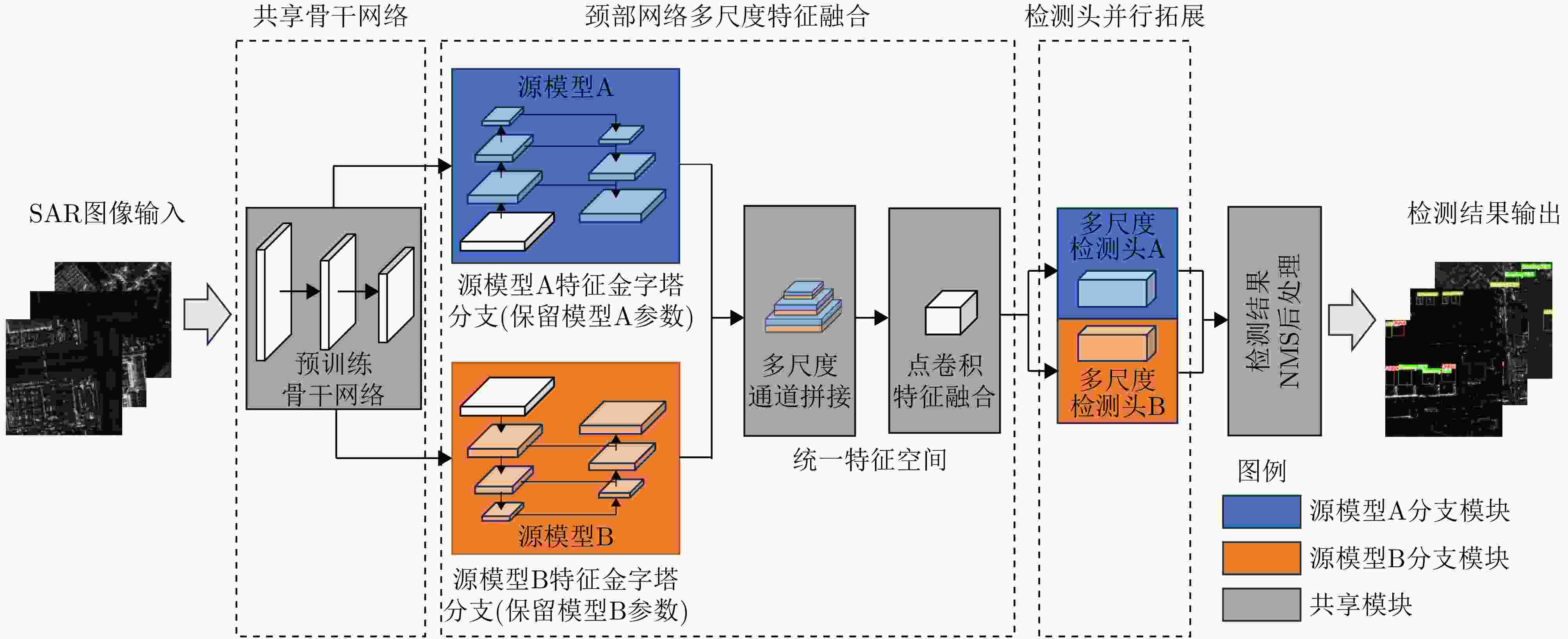
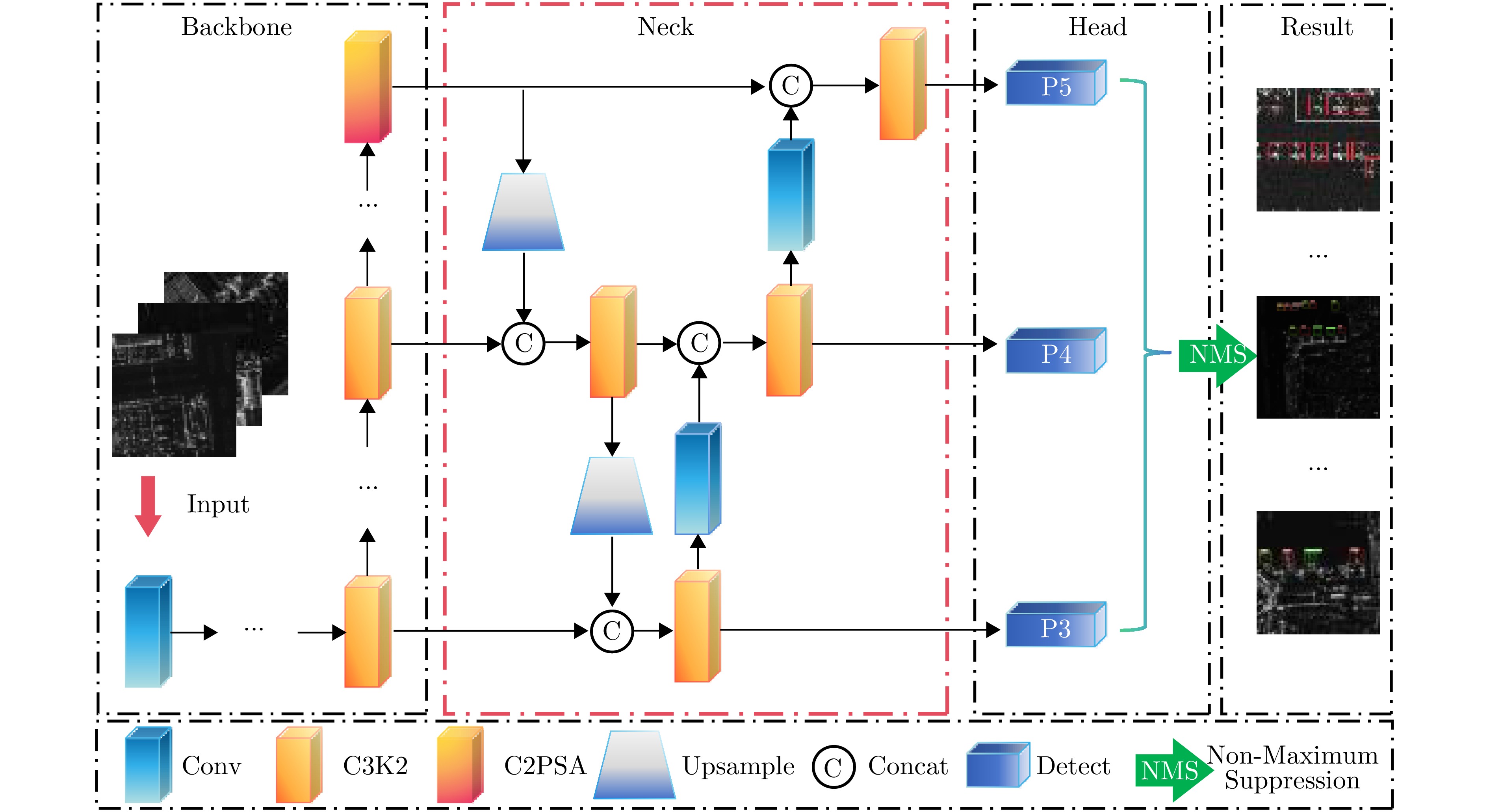
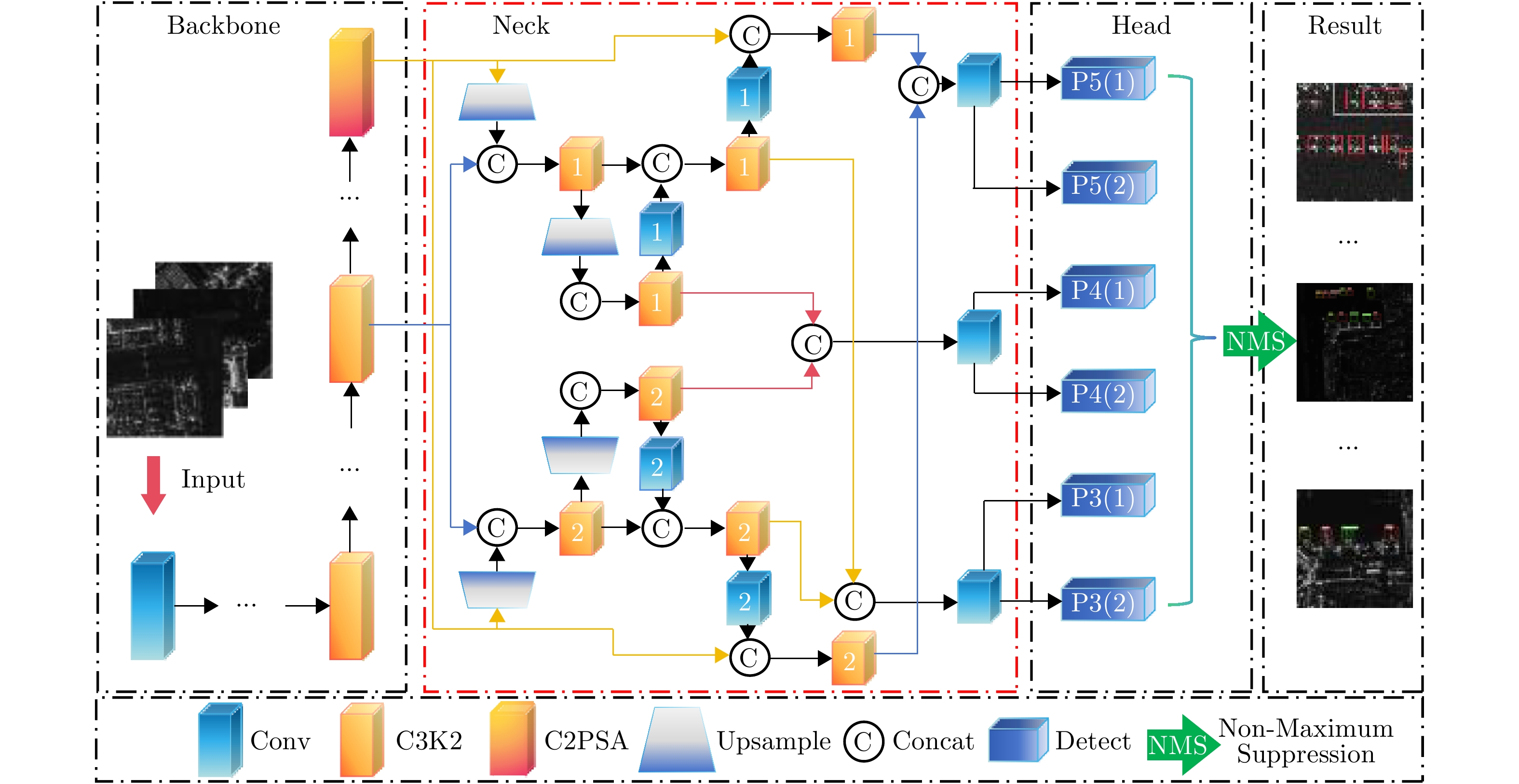
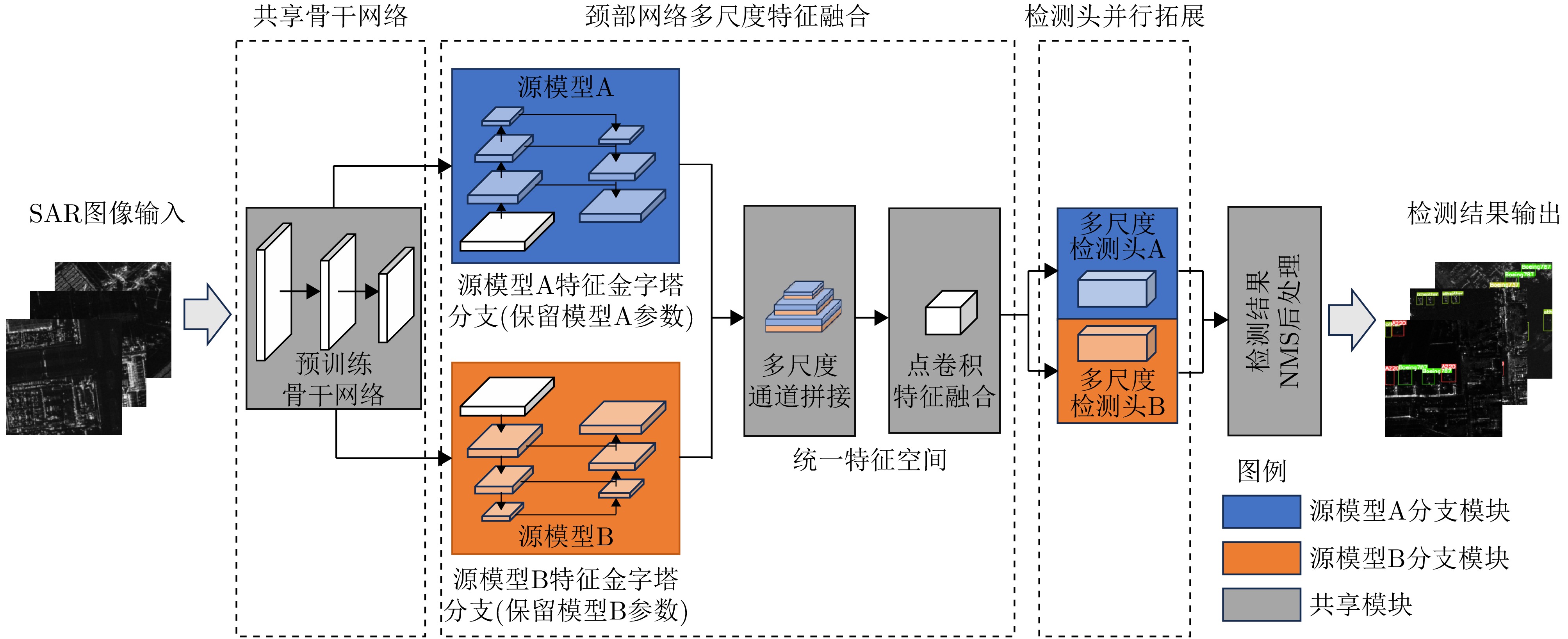
图 1 基于YOLO模型合并的SAR图像人造目标检测方法框图
Figure 1. Block diagram of SAR image artificial target detection method based on YOLO model merging
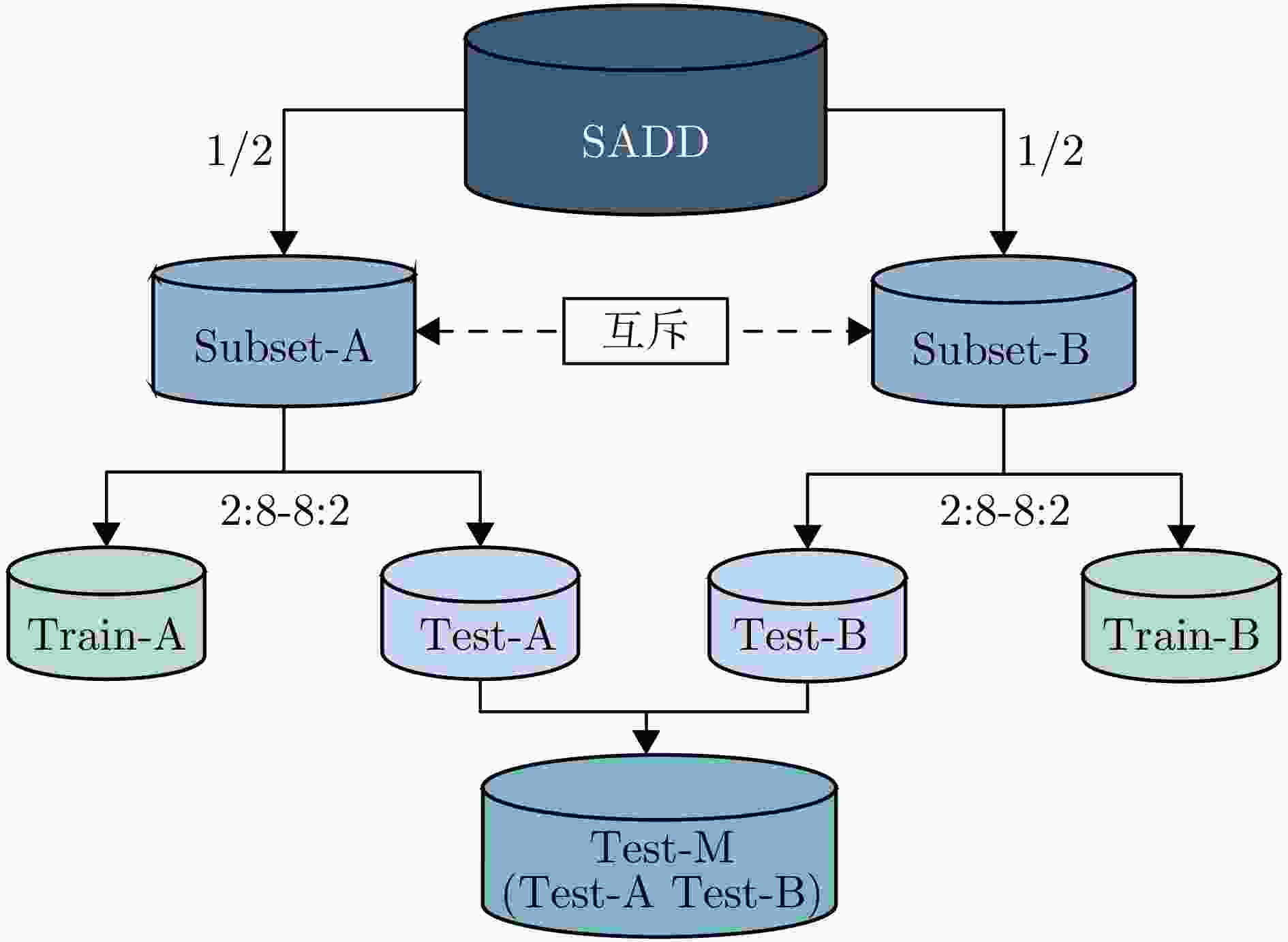
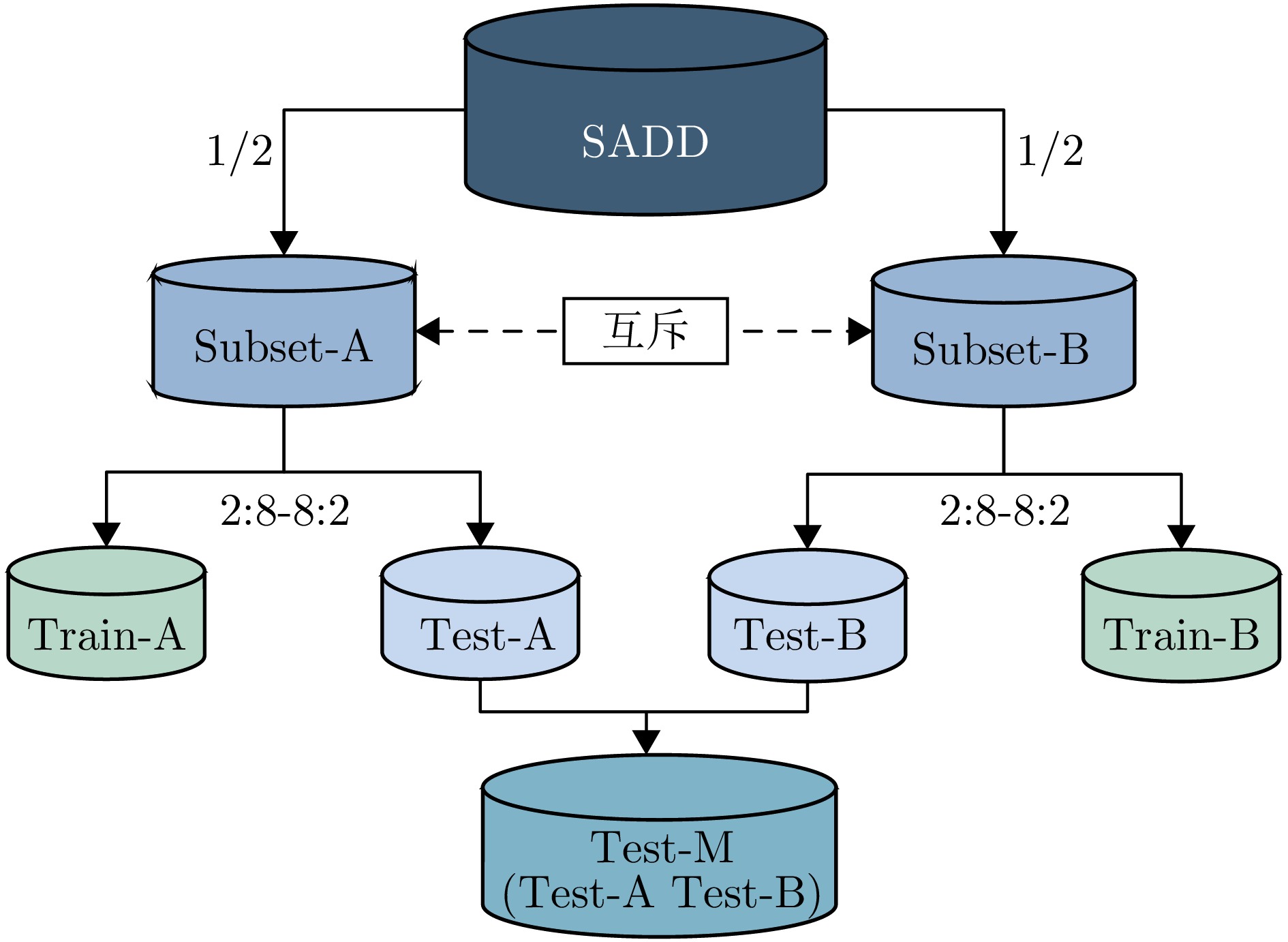
图 4 SADD目标检测实验数据集划分方式
Figure 4. Dataset partitioning strategy for SADD target detection experiments
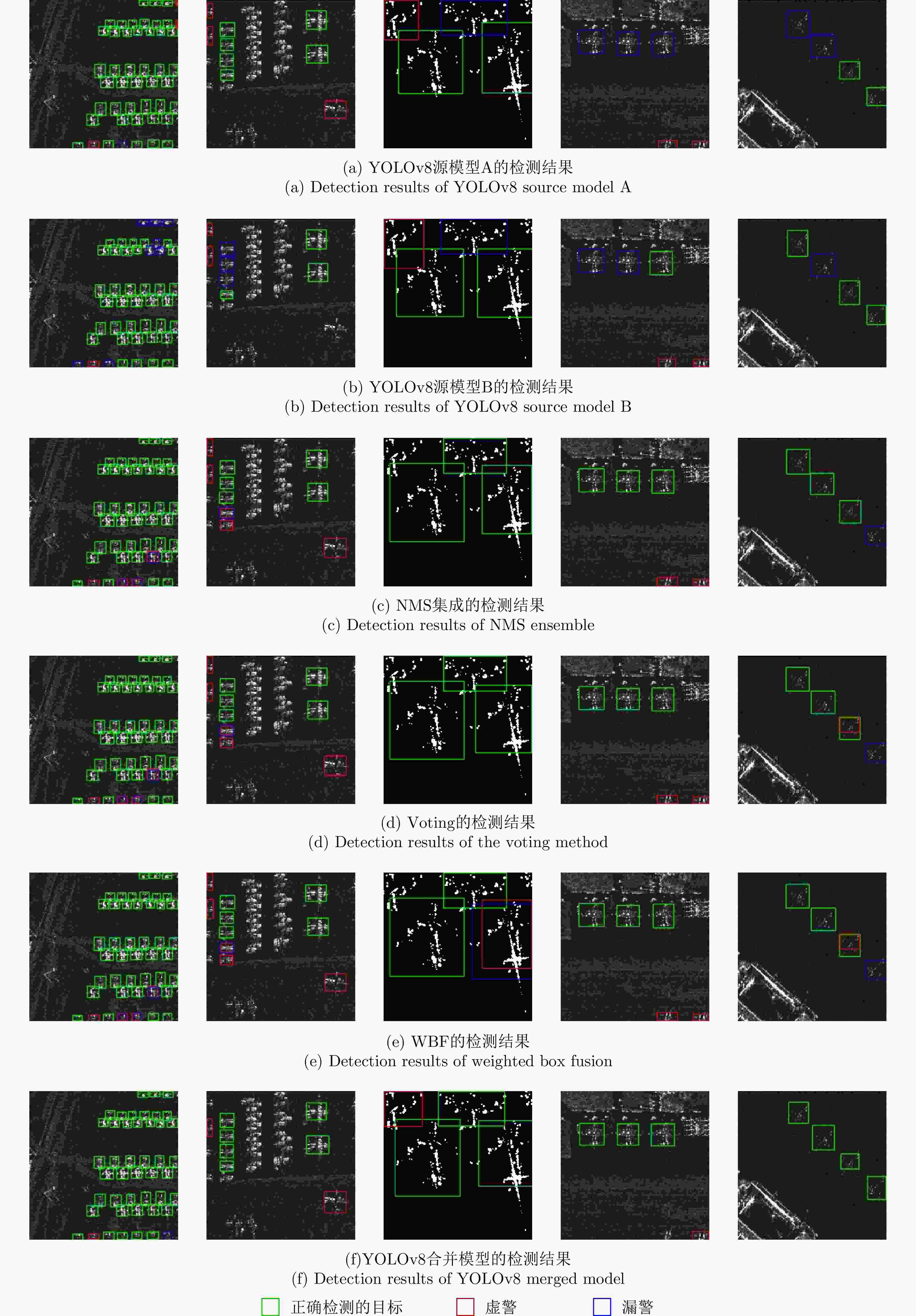
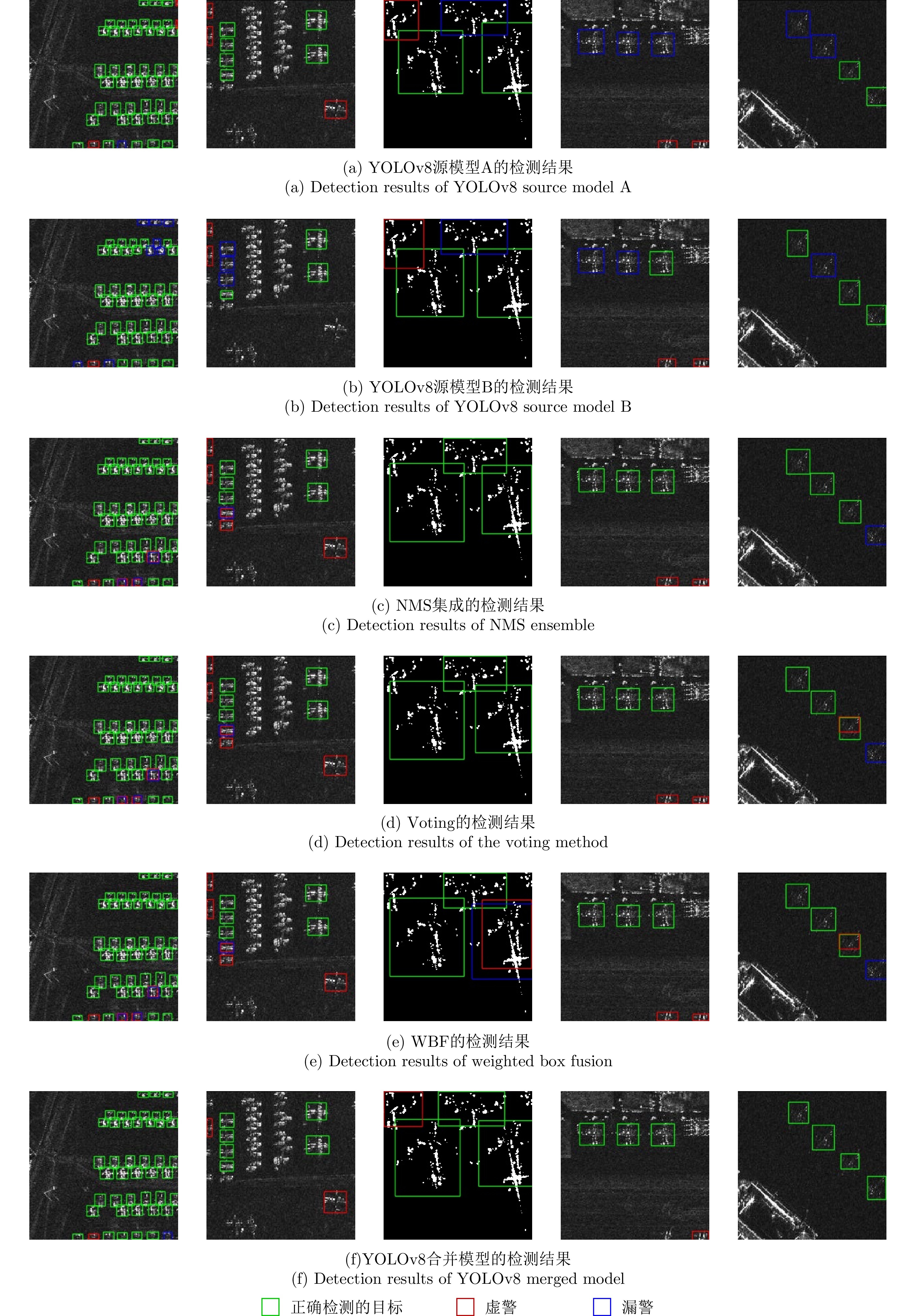
图 5 源模型、集成学习方法与合并模型在SADD数据集上的检测结果对比
Figure 5. Comparison of detection results among source models, ensemble learning methods, and the merged model on the SADD dataset
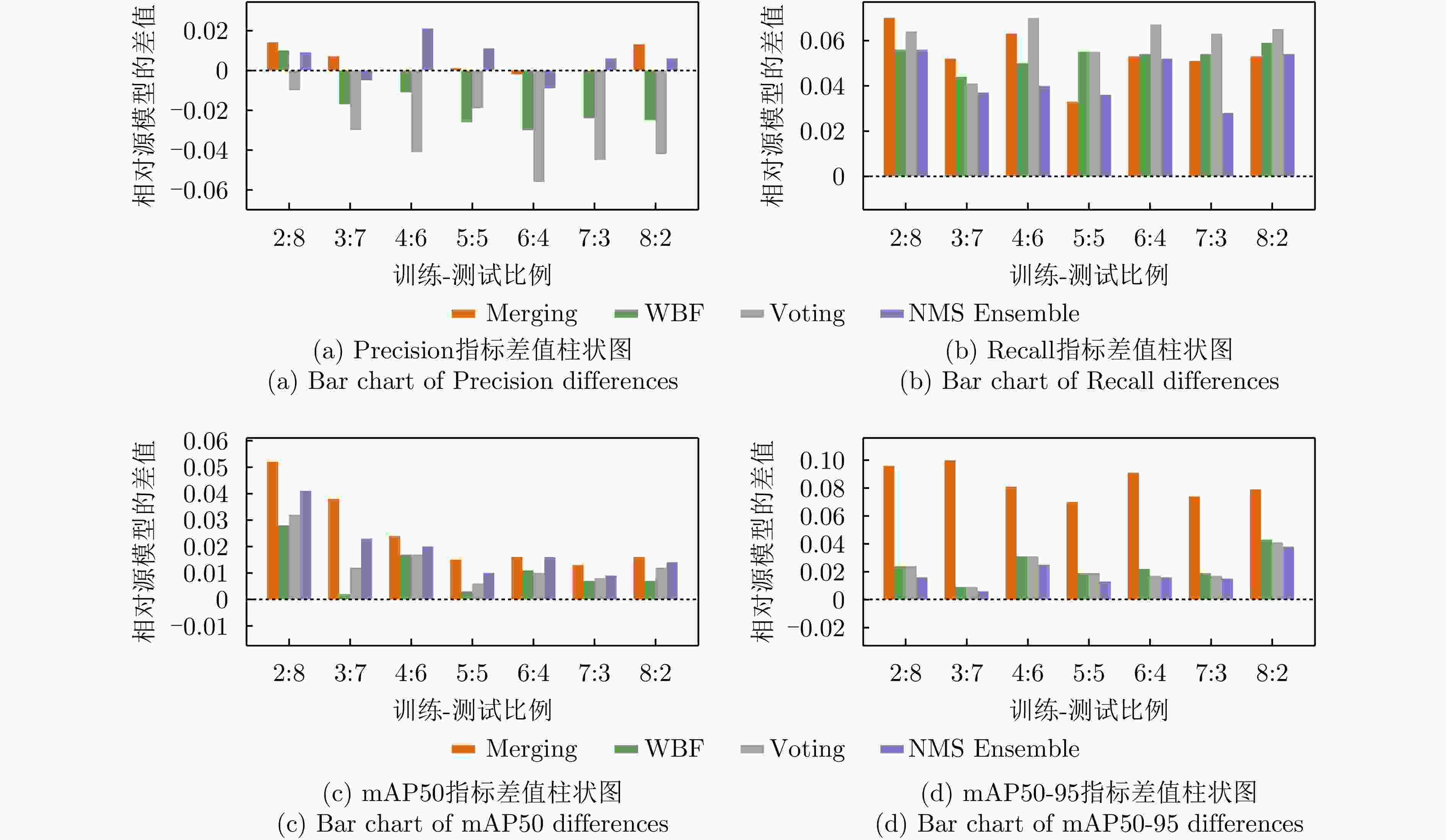
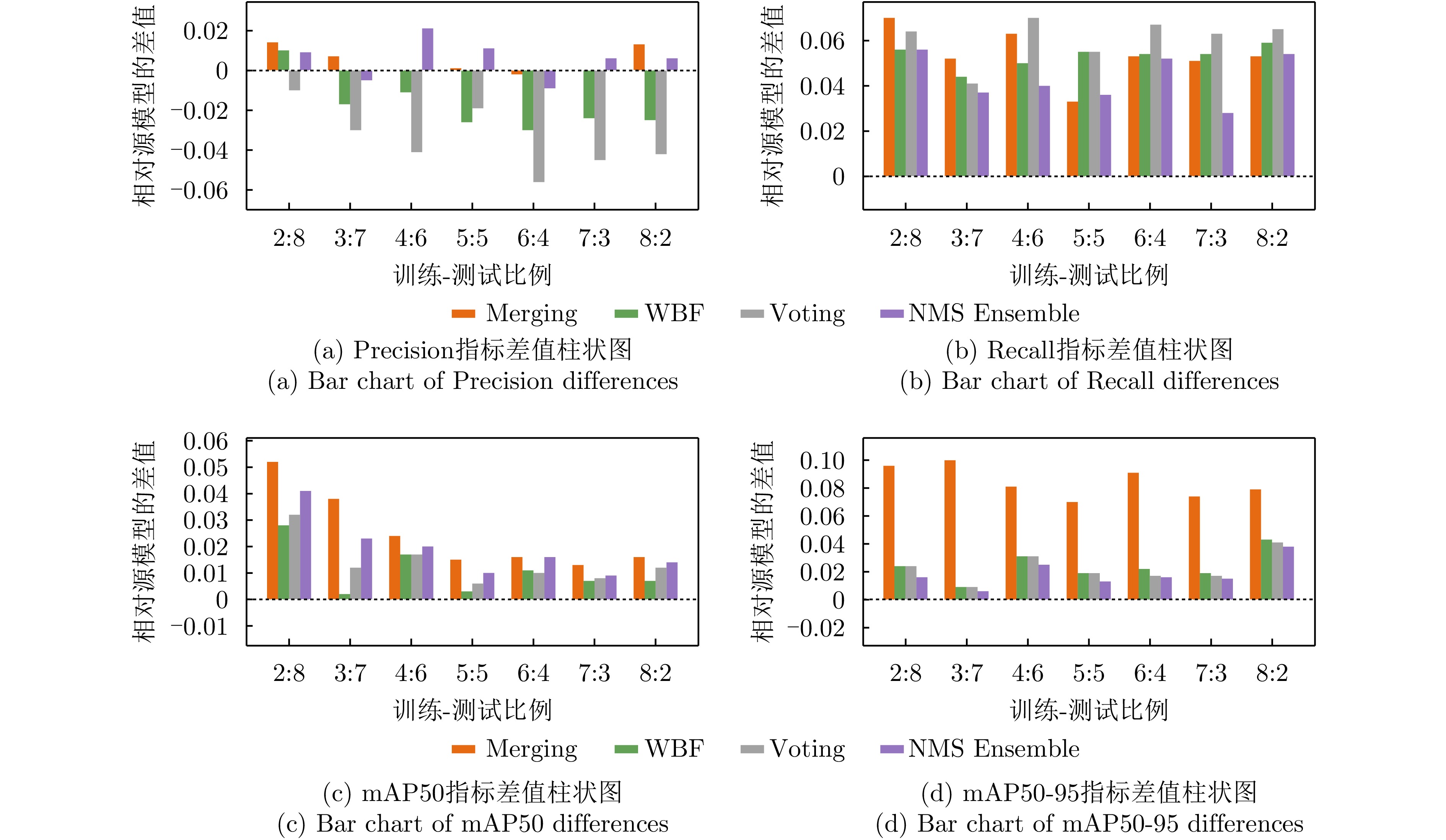
图 6 不同比例训练-测试集下的性能差值柱状图(相对源模型)
Figure 6. Bar chart of performance differences under different train-test split ratios (relative to the source model)
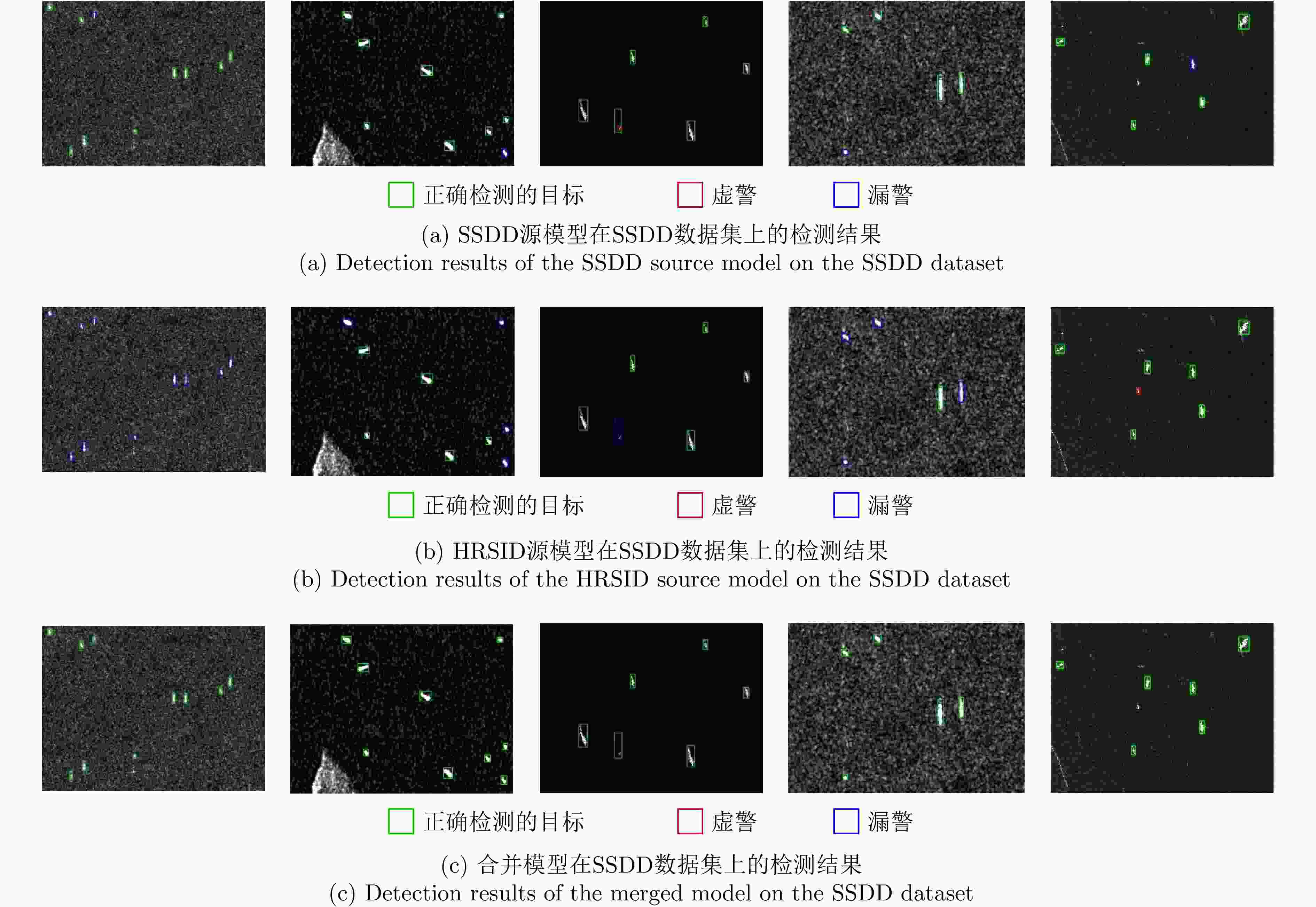
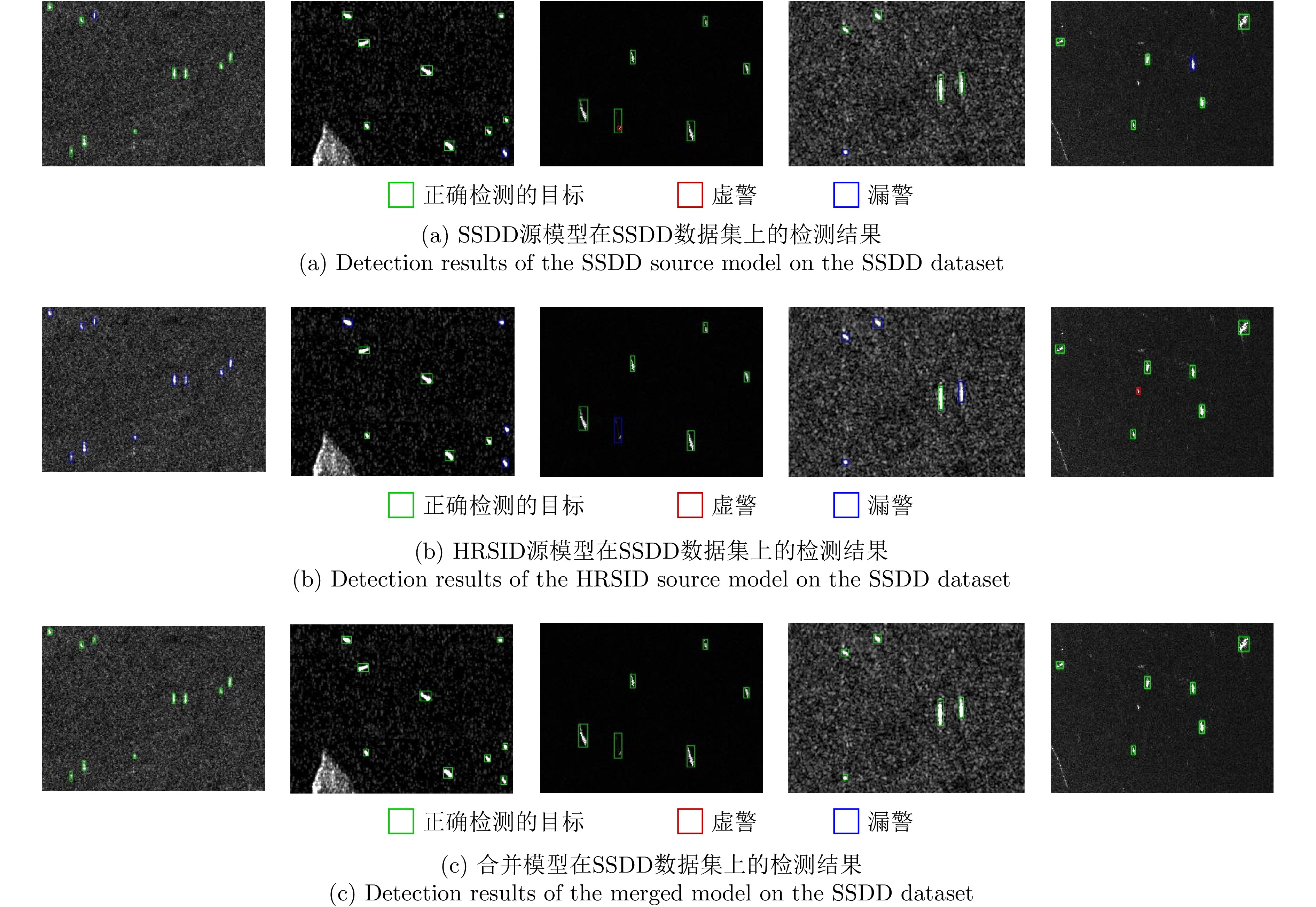
图 7 源模型与合并模型在SSDD数据集上的检测结果对比
Figure 7. Comparison of detection results between the source models and the merged model on the SSDD dataset
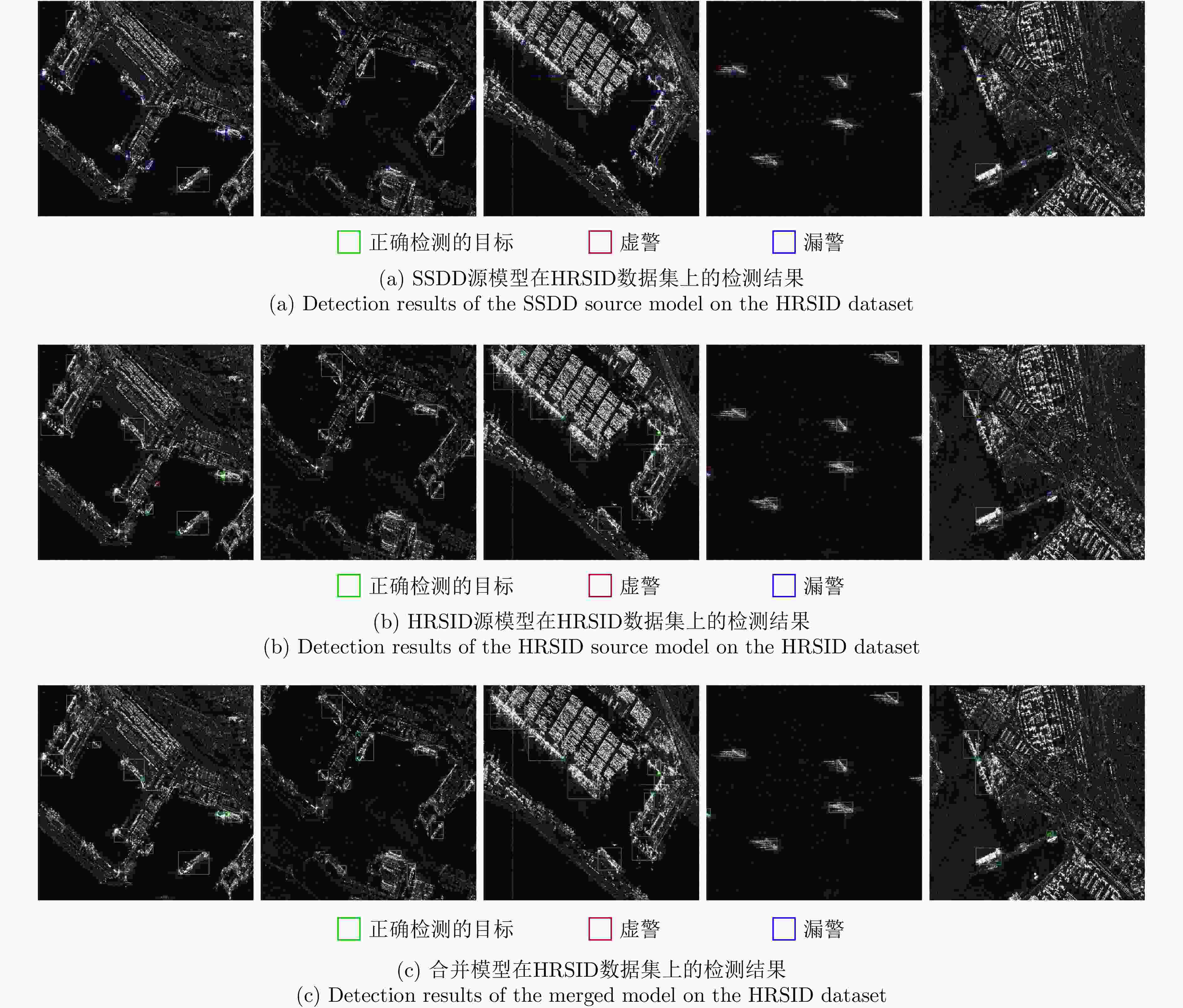
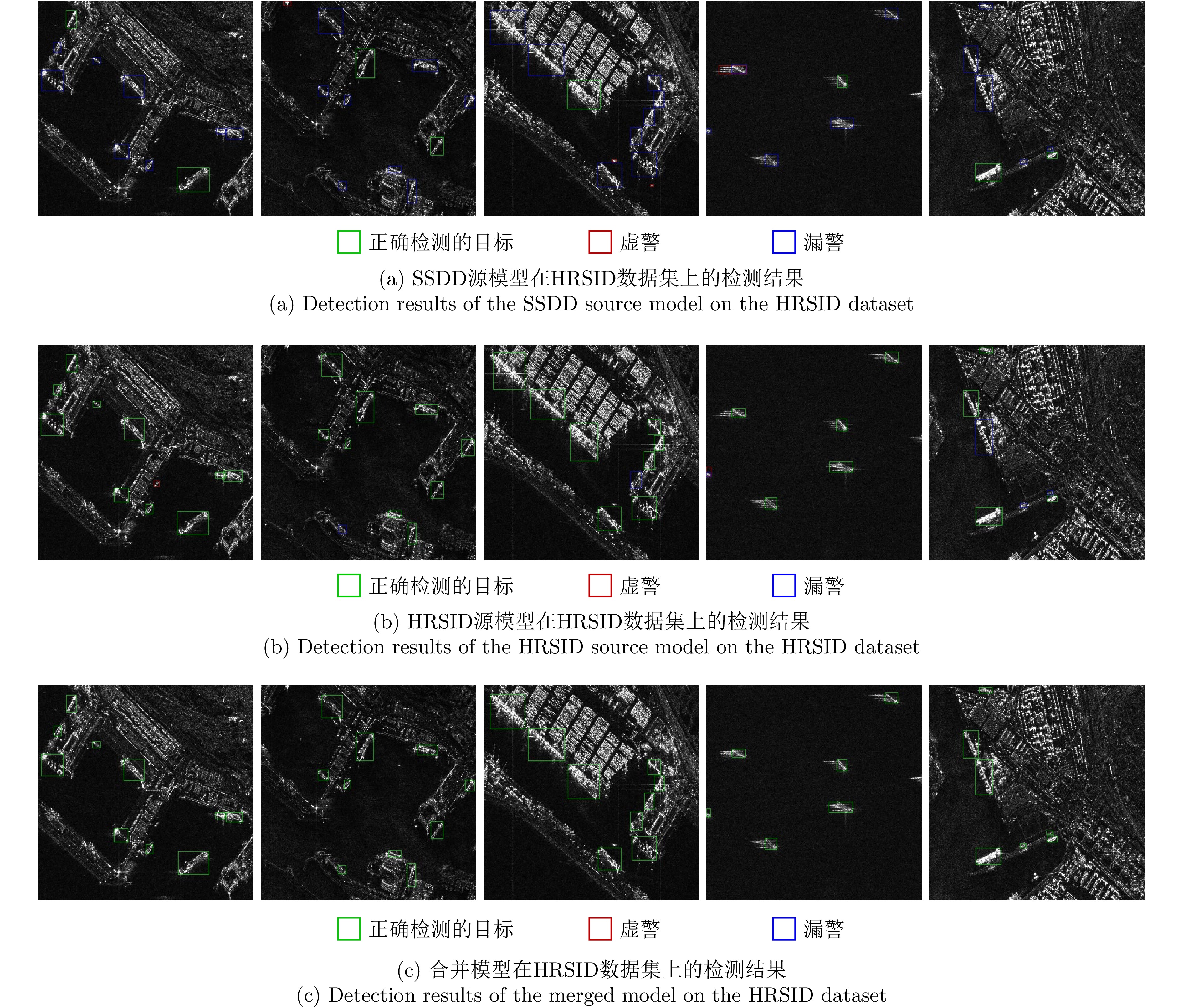
图 8 源模型与合并模型在HRSID数据集上的检测结果对比
Figure 8. Comparison of detection results between the source models and the merged model on the HRSID dataset
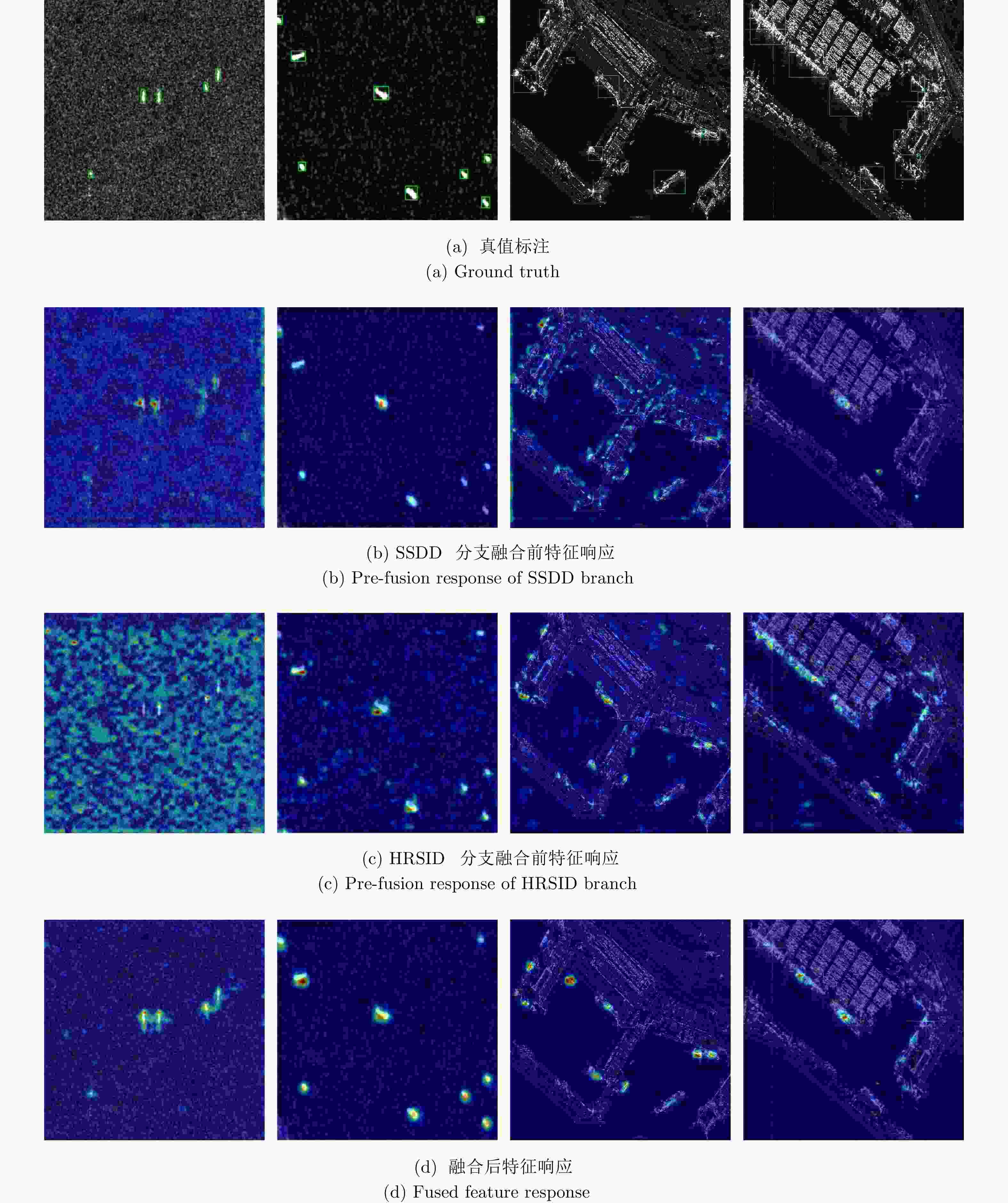
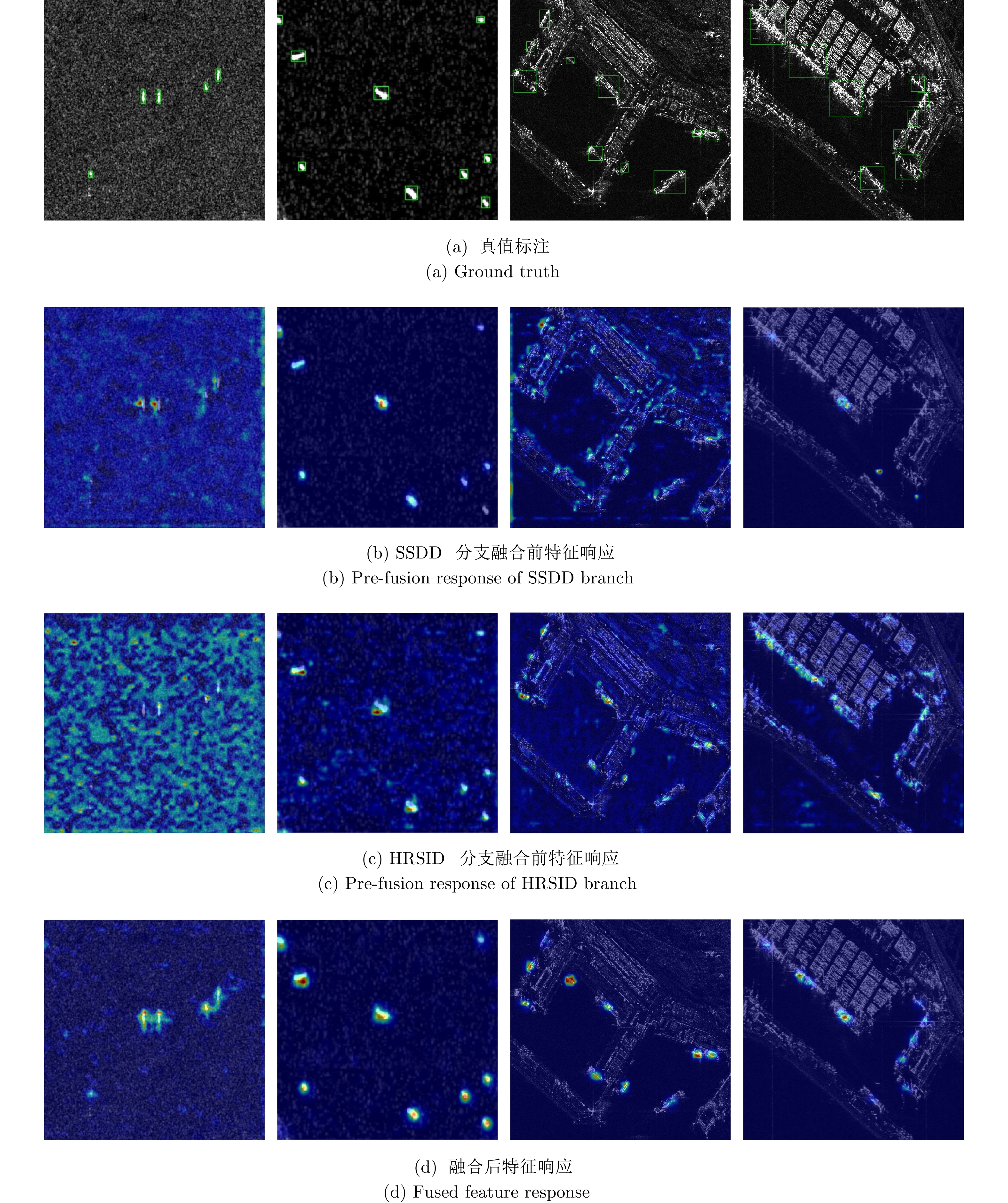
图 9 SSDD-HRSID异源实验中真值标注与融合前后特征响应对比
Figure 9. Comparison of ground-truth annotations and feature responses before and after fusion in the SSDD-HRSID heterogeneous experiment
表 1 目标检测模型参数组成
Table 1. Parameter composition of target detection models
参数类型 参数命名 可学习参数 卷积权重 $* $.conv.weight 是 BN缩放 $* $.bn.weight 是 BN平移 $* $.bn.bias 是 其他权重 $* $.weight 是 其他偏置 $* $.bias 是 BN缓冲区 $* $.bn.running_mean 否 $* $.bn.running_var 否 $* $.bn.num_batches_tracked 否 注:$* $.指参数所属的具体模块。  下载: 导出CSV
表 2 实验数据集数量分布
Table 2. Number distribution of experimental datasets
目标类型 数据集 训练样本数(张) 验证样本数(张) 平均目标数(个/张) 飞机 SADD 2373 593 2.64 舰船 SSDD 928 232 2.12 舰船 HRSID 3643 1961 3.02
下载: 导出CSV
表 3 源模型、集成学习方法及合并模型在SADD数据集上的检测结果
Table 3. Detection results of source models, ensemble learning methods, and the merged model on the SADD dataset
模型版本 方法 Precision Recall mAP50 mAP50-95 v5 avg(基线) 0.933 0.900 0.954 0.576 NMS集成 0.928 0.922 0.967 0.592 Voting 0.869 0.932 0.946 0.567 WBF 0.875 0.931 0.947 0.570 Merging 0.918 0.939 0.968 0.593 v8 avg(基线) 0.925 0.902 0.955 0.609 NMS集成 0.953 0.901 0.960 0.656 Voting 0.872 0.947 0.958 0.661 WBF 0.879 0.953 0.957 0.663 Merging 0.938 0.955 0.971 0.688 v11 avg(基线) 0.937 0.895 0.953 0.604 NMS集成 0.892 0.938 0.960 0.630 Voting 0.885 0.949 0.958 0.638 WBF 0.884 0.945 0.957 0.637 Merging 0.950 0.906 0.968 0.656 注:表中加粗数值表示最优结果。
下载: 导出CSV
表 4 模型参数量、运算量与推理效率统计
Table 4. Model parameter, computational cost, inference efficiency
模型版本 方法 Params
(M)$\Delta $Params
(M)FLOPs
(G)$\Delta $FLOPs
(G)FPS
(fps)v5 avg(基线) 20.8 — 47.9 — 122.1 NMS集成 41.6 +20.8 95.8 +47.9 42.6 Voting 41.6 +20.8 95.8 +47.9 41.5 WBF 41.6 +20.8 95.8 +47.9 41.5 Merging 29.5 +8.7 64.7 +16.8 83.9 v8 avg(基线) 23.2 — 67.4 — 91.2 NMS集成 46.4 +23.2 134.8 +67.4 25.1 Voting 46.4 +23.2 134.8 +67.4 24.9 WBF 46.4 +23.2 134.8 +67.4 29.0 Merging 34.6 +11.4 96.4 +29.0 63.9 v11 avg(基线) 20.0 — 67.6 — 76.4 NMS集成 40.0 +20.0 135.2 +67.6 26.3 Voting 40.0 +20.0 135.2 +67.6 31.6 WBF 40.0 +20.0 135.2 +67.6 25.7 Merging 29.7 +9.7 96.0 +28.4 53.2
下载: 导出CSV
表 5 SSDD与HRSID数据集交叉验证实验
Table 5. Cross-validation experiment between SSDD and HRSID datasets
模型版本 模型
来源SSDD-test HRSID-test Precision Recall mAP50 mAP50-95 Precision Recall mAP50 mAP50-95 v5 SSDD 0.968 0.907 0.978 0.734 0.838 0.575 0.706 0.481 HRSID 0.720 0.560 0.640 0.353 0.899 0.794 0.891 0.634 Merge 0.930 0.951 0.983 0.721 0.901 0.810 0.902 0.662 v8 SSDD 0.942 0.929 0.977 0.705 0.844 0.573 0.699 0.444 HRSID 0.795 0.570 0.697 0.397 0.905 0.773 0.882 0.615 Merge 0.957 0.949 0.981 0.736 0.915 0.822 0.913 0.679 v11 SSDD 0.959 0.912 0.976 0.730 0.811 0.575 0.711 0.482 HRSID 0.819 0.547 0.672 0.365 0.904 0.802 0.899 0.655 Merge 0.929 0.951 0.982 0.718 0.908 0.809 0.901 0.670 注:表中加粗数值表示最优结果。
下载: 导出CSV
表 6 代表性检测方法全量数据对比实验
Table 6. Full-data comparison of representative detection methods
方法 SSDD-test HRSID-test Precision Recall mAP50 mAP50-95 Precision Recall mAP50 mAP50-95 FCOS 0.843 0.923 0.886 0.598 0.843 0.816 0.781 0.573 Faster R-CNN 0.890 0.938 0.955 0.684 0.794 0.833 0.866 0.614 Swin-Transformer 0.889 0.927 0.956 0.680 0.843 0.831 0.850 0.621 YOLOv8 (Union) 0.927 0.894 0.954 0.706 0.895 0.766 0.881 0.676 YOLOv8 (Merge) 0.957 0.949 0.981 0.736 0.915 0.822 0.913 0.679 注:表中加粗数值表示最优结果。
下载: 导出CSV
表 7 代表性检测方法计算复杂度与参数量对比
Table 7. Comparison of FLOPs and Params among representative detection methods
方法 FLOPs (G) Params (M) FCOS 88.6 32.1 Faster R-CNN 112.8 41.4 Swin-Transformer 94.3 27.5 YOLOv8 (Union) 67.4 23.2 YOLOv8 (Merge) 96.4 34.6
下载: 导出CSV
-
[1] 陈思伟. 成像雷达极化旋转域解译: 理论与应用[M]. 北京: 科学出版社, 2024: 1–251.CHEN Siwei. Imaging Radar Polarimetric Rotation Domain Interpretation: Theory and Application[M]. Beijing: Science Press, 2024: 1–251. [2] CHEN Siwei, WANG Xuesong, XIAO Shunping, et al. Target Scattering Mechanism in Polarimetric Synthetic Aperture Radar: Interpretation and Application[M]. Singapore: Springer, 2018: 1–225. doi: 10.1007/978-981-10-7269-7. [3] LI Haoliang, LIU Shenwen, and CHEN Siwei. PolSAR ship characterization and robust detection at different grazing angles with polarimetric roll-invariant features[J]. IEEE Transactions on Geoscience and Remote Sensing, 2024, 62: 5225818. doi: 10.1109/TGRS.2024.3474702. [4] 徐丰, 金亚秋. 微波视觉与SAR图像智能解译[J]. 雷达学报(中英文), 2024, 13(2): 285–306. doi: 10.12000/JR23225.XU Feng and JIN Yaqiu. Microwave vision and intelligent perception of radar imagery[J]. Journal of Radars, 2024, 13(2): 285–306. doi: 10.12000/JR23225. [5] 孙显, 王智睿, 孙元睿, 等. AIR-SARShip-1.0: 高分辨率SAR舰船检测数据集[J]. 雷达学报, 2019, 8(6): 852–862. doi: 10.12000/JR19097.SUN Xian, WANG Zhirui, SUN Yuanrui, et al. AIR-SARShip-1.0: High-resolution SAR ship detection dataset[J]. Journal of Radars, 2019, 8(6): 852–862. doi: 10.12000/JR19097. [6] ZHANG Tianwen, ZHANG Xiaoling, LI Jianwei, et al. SAR Ship Detection Dataset (SSDD): Official release and comprehensive data analysis[J]. Remote Sensing, 2021, 13(18): 3690. doi: 10.3390/rs13183690. [7] 王智睿, 康玉卓, 曾璇, 等. SAR-AIRcraft-1.0: 高分辨率SAR飞机检测识别数据集[J]. 雷达学报, 2023, 12(4): 906–922. doi: 10.12000/JR23043.WANG Zhirui, KANG Yuzhuo, ZENG Xuan, et al. SAR-AIRcraft-1.0: High-resolution SAR aircraft detection and recognition dataset[J]. Journal of Radars, 2023, 12(4): 906–922. doi: 10.12000/JR23043. [8] LANG Ping, FU Xiongjun, DONG Jian, et al. Recent advances in deep-learning-based SAR image target detection and recognition[J]. IEEE Journal of Selected Topics in Applied Earth Observations and Remote Sensing, 2025, 18: 6884–6915. doi: 10.1109/JSTARS.2025.3543531. [9] GUO Yuchen, DU Lan, and LYU Guoxin. SAR target detection based on domain adaptive faster R-CNN with small training data size[J]. Remote Sensing, 2021, 13(21): 4202. doi: 10.3390/rs13214202. [10] SHANG Ronghua, WANG Jiaming, JIAO Licheng, et al. SAR targets classification based on deep memory convolution neural networks and transfer parameters[J]. IEEE Journal of Selected Topics in Applied Earth Observations and Remote Sensing, 2018, 11(8): 2834–2846. doi: 10.1109/JSTARS.2018.2836909. [11] WAGNER S A. SAR ATR by a combination of convolutional neural network and support vector machines[J]. IEEE Transactions on Aerospace and Electronic Systems, 2016, 52(6): 2861–2872. doi: 10.1109/TAES.2016.160061. [12] CHEN Junyi, SHEN Yanyun, LIANG Yinyu, et al. YOLO-SAD: An efficient SAR aircraft detection network[J]. Applied Sciences, 2024, 14(7): 3025. doi: 10.3390/app14073025. [13] LI Haoliang and CHEN Siwei. General polarimetric correlation pattern: A visualization and characterization tool for target joint-domain scattering mechanisms investigation[J]. IEEE Transactions on Geoscience and Remote Sensing, 2026, 64: 5200417. doi: 10.1109/TGRS.2025.3647123. [14] ZHOU Jie, XIAO Chao, PENG Bo, et al. DiffDet4SAR: Diffusion-based aircraft target detection network for SAR images[J]. IEEE Geoscience and Remote Sensing Letters, 2024, 21: 4007905. doi: 10.1109/LGRS.2024.3386020. [15] DAI Linyu and CHEN Siwei. Context2Context: A zero-shot SAR image speckle filter[J]. IEEE Transactions on Geoscience and Remote Sensing, 2026, 64: 5204911. doi: 10.1109/TGRS.2026.3669951. [16] ZHANG Peng, XU Hao, TIAN Tian, et al. SEFEPNet: Scale expansion and feature enhancement pyramid network for SAR aircraft detection with small sample dataset[J]. IEEE Journal of Selected Topics in Applied Earth Observations and Remote Sensing, 2022, 15: 3365–3375. doi: 10.1109/JSTARS.2022.3169339. [17] REDMON J, DIVVALA S, GIRSHICK R, et al. You only look once: Unified, real-time object detection[C]. The 2016 IEEE Conference on Computer Vision and Pattern Recognition, Las Vegas, USA, 2016: 779–788. doi: 10.1109/CVPR.2016.91. [18] LIU Wei, ANGUELOV D, ERHAN D, et al. SSD: Single shot MultiBox detector[C]. 14th European Conference on Computer Vision – ECCV 2016, Amsterdam, The Netherlands, 2016: 21–37. doi: 10.1007/978-3-319-46448-0_2. [19] LI Zhonghua, HOU Biao, WU Zitong, et al. FCOSR: A simple anchor-free rotated detector for aerial object detection[J]. Remote Sensing, 2023, 15(23): 5499. doi: 10.3390/rs15235499. [20] REN Shaoqing, HE Kaiming, GIRSHICK R, et al. Faster R-CNN: Towards real-time object detection with region proposal networks[J]. IEEE Transactions on Pattern Analysis and Machine Intelligence, 2017, 39(6): 1137–1149. doi: 10.1109/TPAMI.2016.2577031. [21] CAI Zhaowei and VASCONCELOS N. Cascade R-CNN: Delving into high quality object detection[C]. The 2018 IEEE/CVF Conference on Computer Vision and Pattern Recognition, Salt Lake City, USA, 2018: 6154–6162. doi: 10.1109/CVPR.2018.00644. [22] LIU Ze, LIN Yutong, CAO Yue, et al. Swin transformer: Hierarchical vision transformer using shifted windows[C]. The 2021 IEEE/CVF International Conference on Computer Vision, Montreal, Canada, 2021: 9992–10002. doi: 10.1109/ICCV48922.2021.00986. [23] CARION N, MASSA F, SYNNAEVE G, et al. End-to-end object detection with transformers[C]. 16th European Conference on Computer Vision – ECCV 2020, Glasgow, UK, 2020: 213–229. doi: 10.1007/978-3-030-58452-8_13. [24] DOSOVITSKIY A, BEYER L, KOLESNIKOV A, et al. An image is worth 16×16 words: Transformers for image recognition at scale[C]. 9th International Conference on Learning Representations, Virtual Event, Austria, 2021: 1–22. [25] 周正, 赵凌君, 何奇山, 等. 基于多源信息跨域学习的SAR图像目标检测技术研究进展与展望[J]. 雷达学报(中英文), 2026, 15(2): 387–408. doi: 10.12000/JR25205.ZHOU Zheng, ZHAO Lingjun, HE Qishan, et al. Research progress and prospects of SAR image target detection based on multi-source information cross-domain learning[J]. Journal of Radars, 2026, 15(2): 387–408. doi: 10.12000/JR25205. [26] ZHENG Hongling, SHEN Li, TANG Anke, et al. Learning from models beyond fine-tuning[J]. Nature Machine Intelligence, 2025, 7(1): 6–17. doi: 10.1038/s42256-024-00961-0. [27] YADAV P, RAFFEL C, MUQEETH M, et al. A survey on model MoErging: Recycling and routing among specialized experts for collaborative learning[J]. Transactions on Machine Learning Research, 2025: 1–32.YADAV P, RAFFEL C, MUQEETH M, et al. A survey on model MoErging: Recycling and routing among specialized experts for collaborative learning[J]. Transactions on Machine Learning Research, 2025: 1–32. [28] LU Jinliang, PANG Ziliang, XIAO Min, et al. Merge, ensemble, and cooperate! A survey on collaborative strategies in the era of large language models[EB/OL]. http://arxiv.org/abs/2407.06089, 2024. [29] YANG Enneng, SHEN Li, GUO Guibing, et al. Model merging in LLMs, MLLMs, and beyond: Methods, theories, applications, and opportunities[J]. ACM Computing Surveys, 2026, 58(8): 216. doi: 10.1145/3787849. [30] LI Weishi, PENG Yong, ZHANG Miao, et al. Deep model fusion: A survey[J]. IEEE Transactions on Neural Networks and Learning Systems, 2026, 37(5): 2008–2024. doi: 10.1109/TNNLS.2025.3628666. [31] ILHARCO G, RIBEIRO M T, WORTSMAN M, et al. Editing models with task arithmetic[C]. The Eleventh International Conference on Learning Representations, Kigali, Rwanda, 2023: 1–31. [32] ALCOVER-COUSO R, SANMIGUEL J C, ESCUDERO-VIÑOLO M, et al. Layer-wise model merging for unsupervised domain adaptation in segmentation tasks[J]. The Visual Computer, 2025, 41(10): 7867–7882. doi: 10.1007/s00371-025-03843-7. [33] AKIBA T, SHING M, TANG Yujin, et al. Evolutionary optimization of model merging recipes[J]. Nature Machine Intelligence, 2025, 7(2): 195–204. doi: 10.1038/s42256-024-00975-8. [34] HE Kaiming, GIRSHICK R, and DOLLAR P. Rethinking ImageNet pre-training[C]. The 2019 IEEE/CVF International Conference on Computer Vision, Seoul, Korea (South), 2019: 4917–4926. doi: 10.1109/ICCV.2019.00502. [35] DOBRZYCKI A D, BERNARDOS A M, and CASAR J R. An analysis of layer-freezing strategies for enhanced transfer learning in YOLO architectures[J]. Mathematics, 2025, 13(15): 2539. doi: 10.3390/math13152539. [36] 罗汝, 赵凌君, 何奇山, 等. SAR图像飞机目标智能检测识别技术研究进展与展望[J]. 雷达学报(中英文), 2024, 13(2): 307–330. doi: 10.12000/JR23056.LUO Ru, ZHAO Lingjun, HE Qishan, et al. Intelligent technology for aircraft detection and recognition through SAR imagery: Advancements and prospects[J]. Journal of Radars, 2024, 13(2): 307–330. doi: 10.12000/JR23056. [37] WEI Shunjun, ZENG Xiangfeng, QU Qizhe, et al. HRSID: A high-resolution SAR images dataset for ship detection and instance segmentation[J]. IEEE Access, 2020, 8: 120234–120254. doi: 10.1109/ACCESS.2020.3005861. [38] JOCHER G. Ultralytics YOLOv5[EB/OL]. https://github.com/ultralytics/yolov5, 2020. [39] CASADO-GARCÍA Á and HERAS J. Ensemble methods for object detection[C]. 24th European Conference on Artificial Intelligence, Santiago de Compostela, Spain, 2020: 2688–2695. doi: 10.3233/FAIA200407. [40] SOLOVYEV R, WANG Weimin, and GABRUSEVA T. Weighted boxes fusion: Ensembling boxes from different object detection models[J]. Image and Vision Computing, 2021, 107: 104117. doi: 10.1016/j.imavis.2021.104117. [41] MATTEI P A and GARREAU D. Are ensembles getting better all the time?[J]. Journal of Machine Learning Research, 2025, 26(201): 1–46.MATTEI P A and GARREAU D. Are ensembles getting better all the time?[J]. Journal of Machine Learning Research, 2025, 26(201): 1–46. [42] WOOD D, MU Tingting, WEBB A M, et al. A unified theory of diversity in ensemble learning[J]. Journal of Machine Learning Research, 2023, 24(359): 359. doi: 10.5555/3618408.3618767. -

计量
- 文章访问数:
- HTML全文浏览量:
- PDF下载量:
- 被引次数: 0