

 作者中心
作者中心 专家审稿
专家审稿 责编办公
责编办公 编辑办公
编辑办公
-
摘要: 针对传统分布式雷达网络(DRN)数据回传成本高、效率低的问题,该文研究了一种面向空中计算(AirComp)辅助的分布式雷达网络新架构,旨在提升协同目标检测性能与数据融合效率。首先,从感知层面推导了适用于分布式雷达网络的协同检测器,创新性地揭示了其检测统计量天然具有求和形式,与AirComp的线性叠加机制在数学上高度契合。基于此,该文将各雷达节点的局部对数似然比作为AirComp的聚合对象,使AirComp的计算MSE直接对应检测充分统计量的估计误差,从而建立AirComp精度与检测性能之间的理论关联。并进一步提出一种面向AirComp辅助分布式雷达网络的联合波束赋形设计方法,同步优化雷达发射波束赋形矩阵、接收滤波器以及融合中心(FC)的混合波束赋形(HBF)接收器,并设计了基于交替优化的高效求解算法。仿真结果表明,在相同信干噪比和虚警概率条件下,所提AirDRN架构相较于传统时分双工(TDD)模式具有更优的目标检测性能,在信干噪比分别为7 dB和10 dB时,检测性能分别提升约3.17倍和1.52倍。Abstract: Aiming at the problems of high data backhaul cost and low efficiency in the traditional Distributed Radar Network (DRN), this paper investigates a novel architecture of distributed radar networks assisted by Over-the-Air Computation (AirComp), so as to improve the performance of cooperative target detection and the efficiency of data fusion. Firstly, a cooperative detector applicable to distributed radar networks is derived at the sensing level, which reveals that its detection statistic inherently takes a summation form and is highly mathematically consistent with the linear superposition mechanism of AirComp. On the basis of this inherent correlation, a joint beamforming design method is proposed for AirComp-assisted distributed radar networks, which simultaneously optimizes the radar transmit beamforming matrix, the receive filter, and the Hybrid Beamforming (HBF) receiver at the Fusion Center (FC). Furthermore, an efficient solution algorithm based on alternating optimization is devised. Simulation results demonstrate that, under the same Signal to Interference-plus-Noise Ratio (SINR) and false alarm probability, the proposed AirComp-aided Distributed Radar Network (AirDRN) architecture achieves superior target detection performance compared with the conventional Time Division Duplex (TDD) mode. Specifically, when the SINR is 7 dB and 10 dB, respectively, the detection performance is improved by approximately 3.17 and 1.52 times.
-
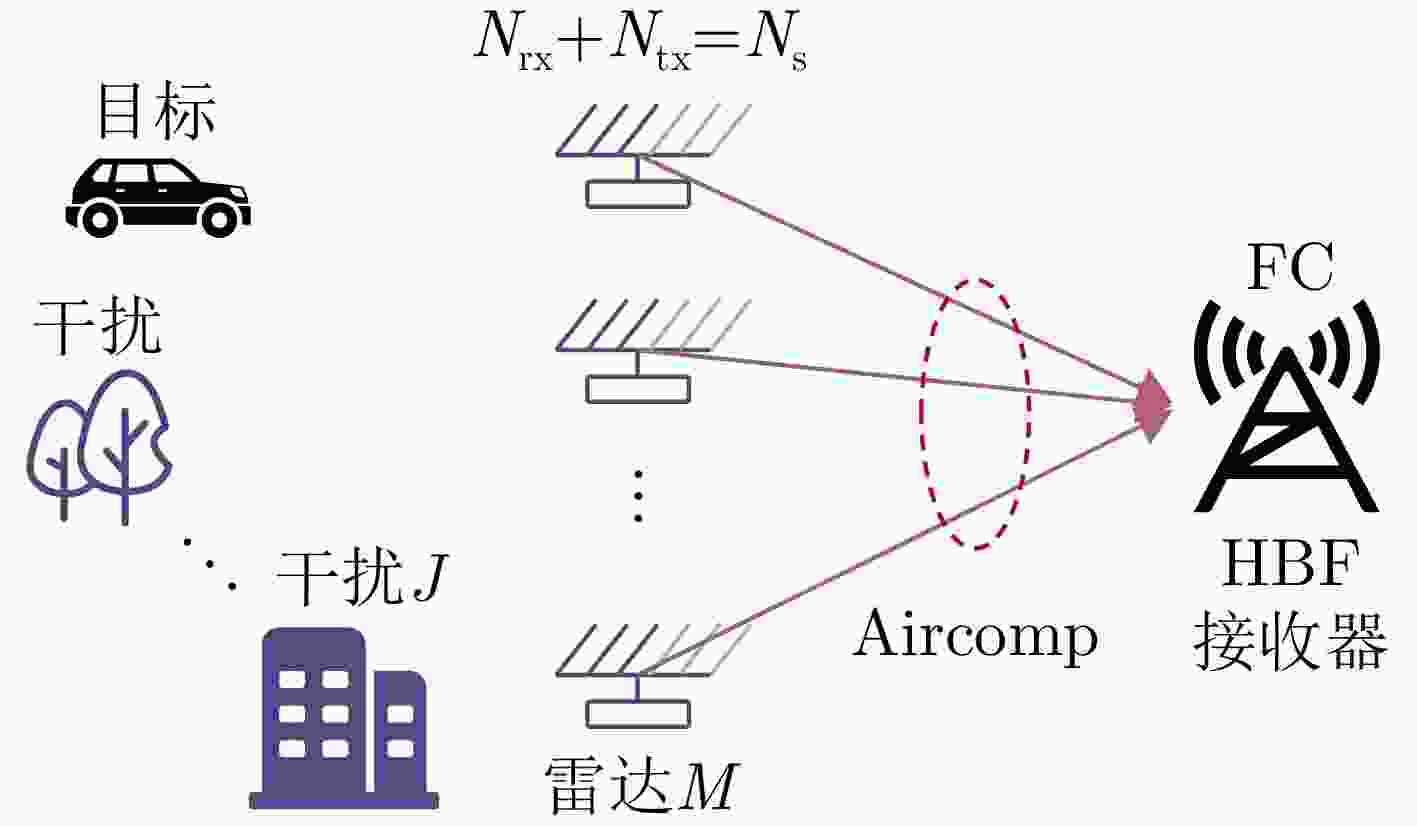
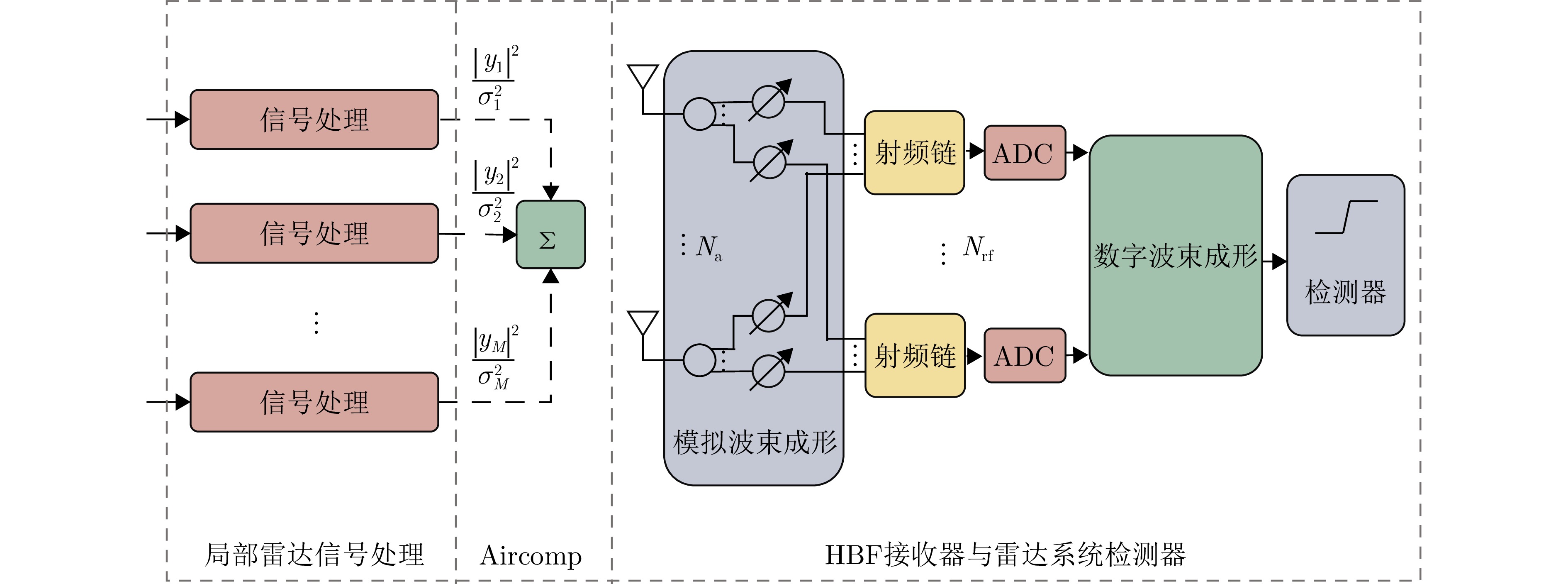
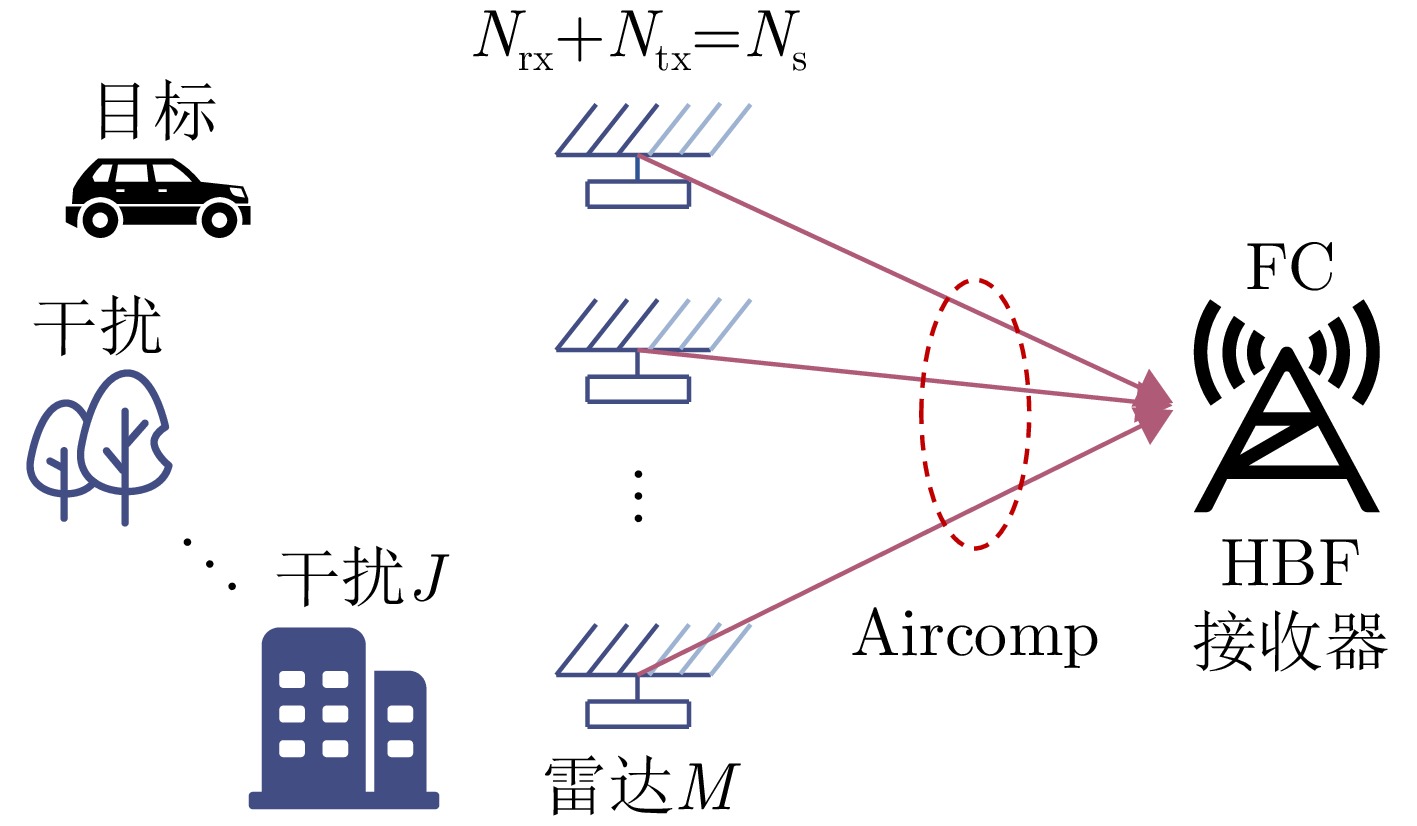
图 1 基于空中计算的分布式雷达网络场景图
Figure 1. Scenario of the over-the-air computation-based distributed radar network
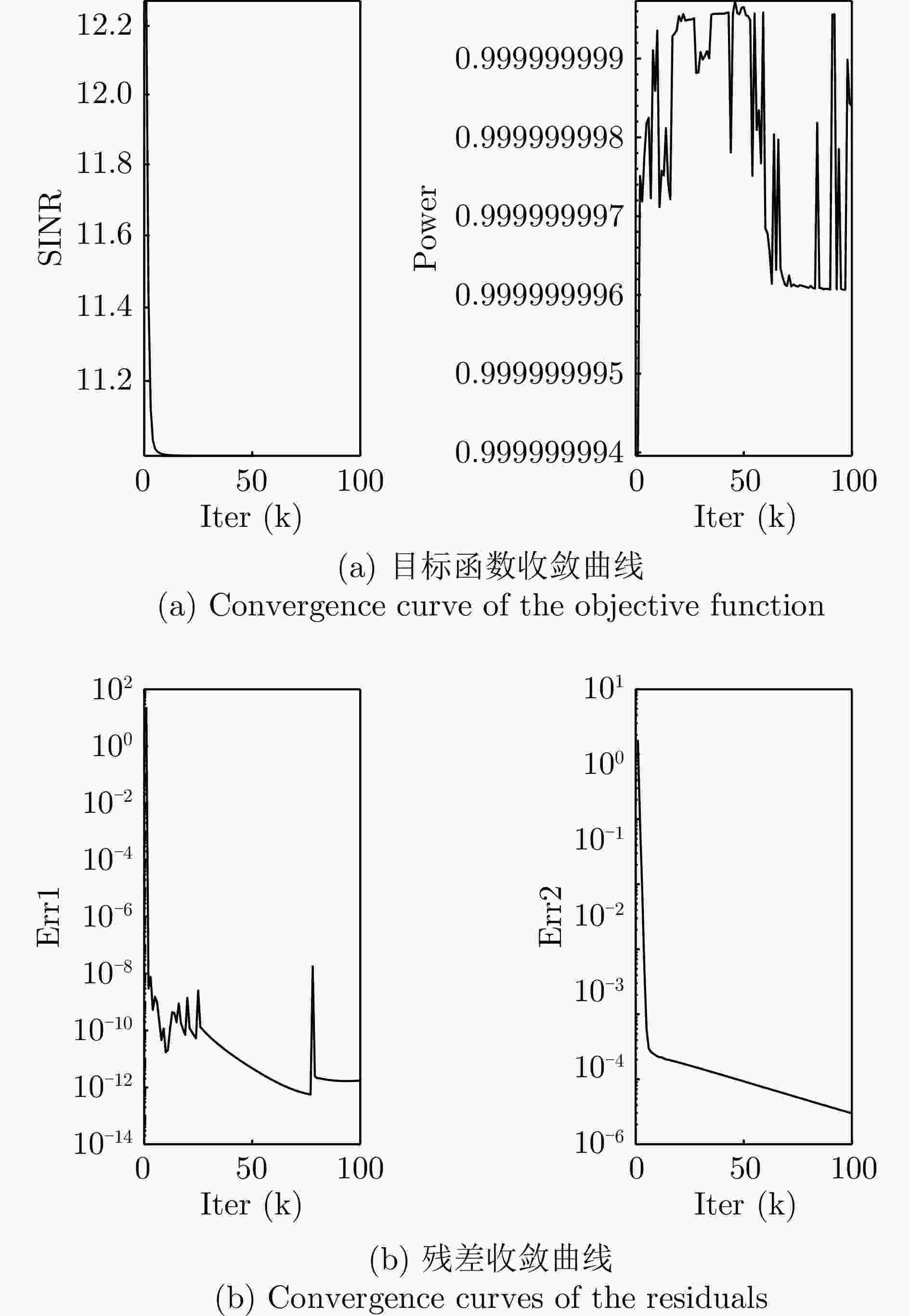
图 3 所提AirDRN-HBF算法的收敛性能
Figure 3. Convergence performance of the proposed AirDRN-HBF algorithm
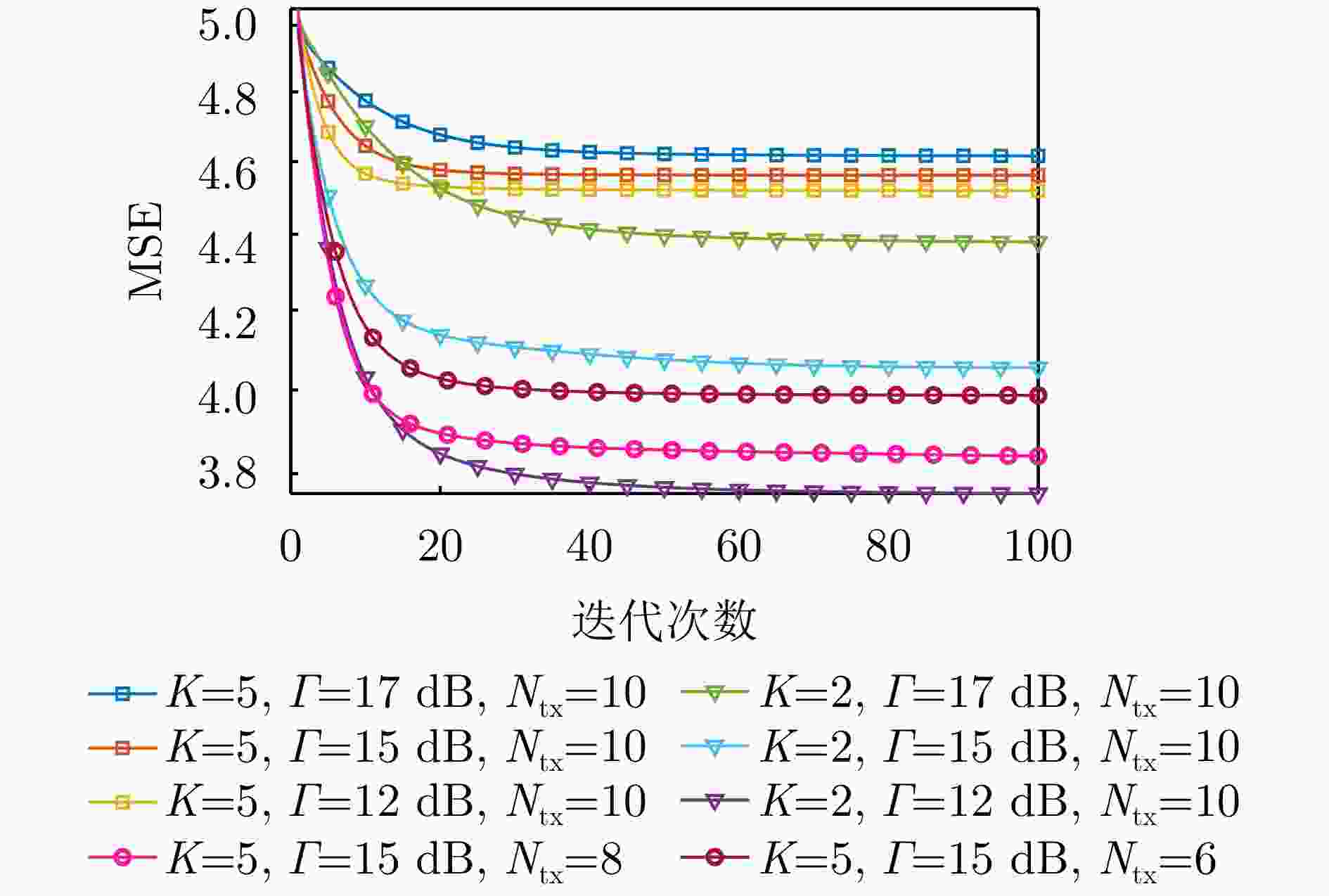
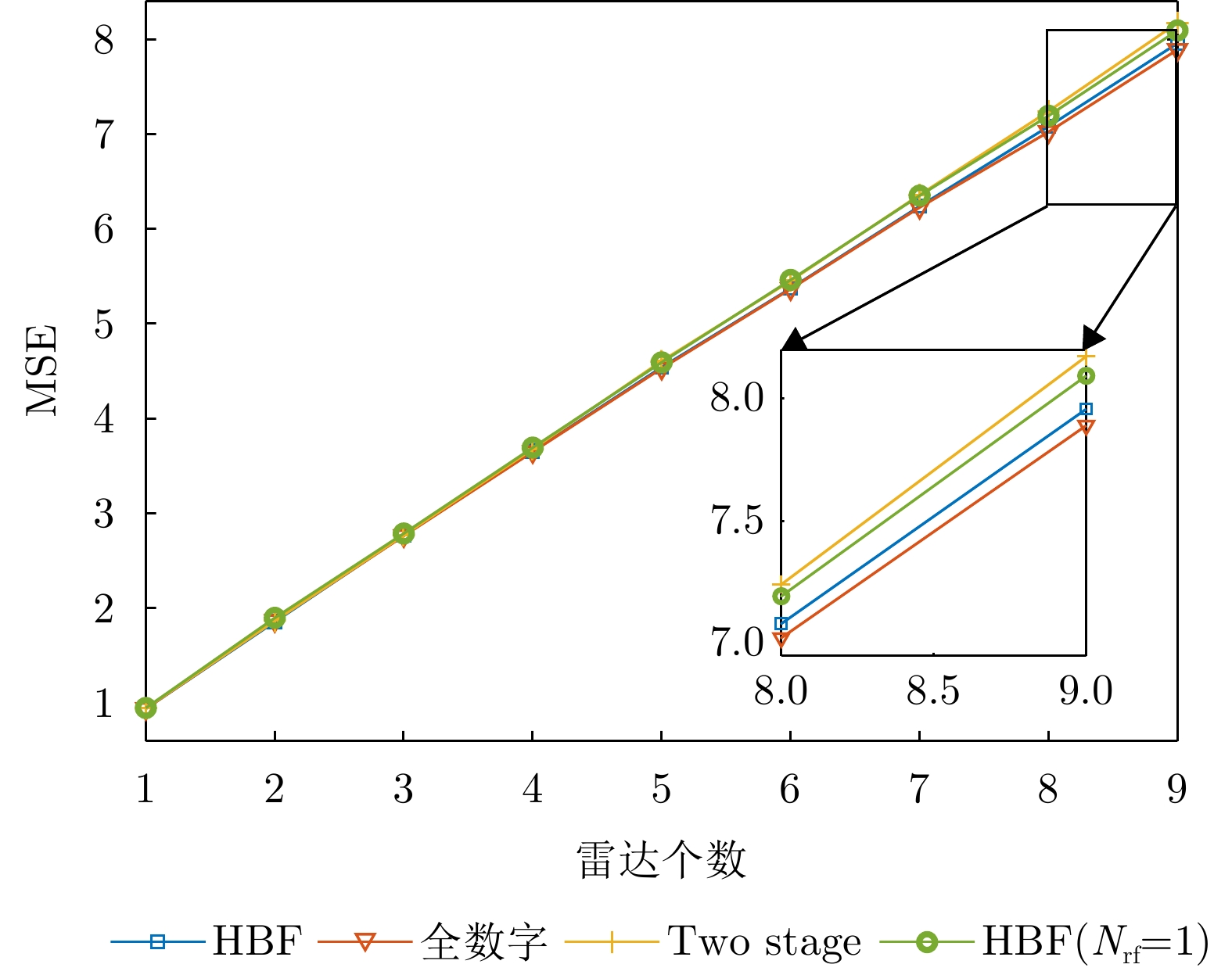
图 4 不同参数下的收敛曲线对比
Figure 4. Comparison of convergence curves under different parameter settings
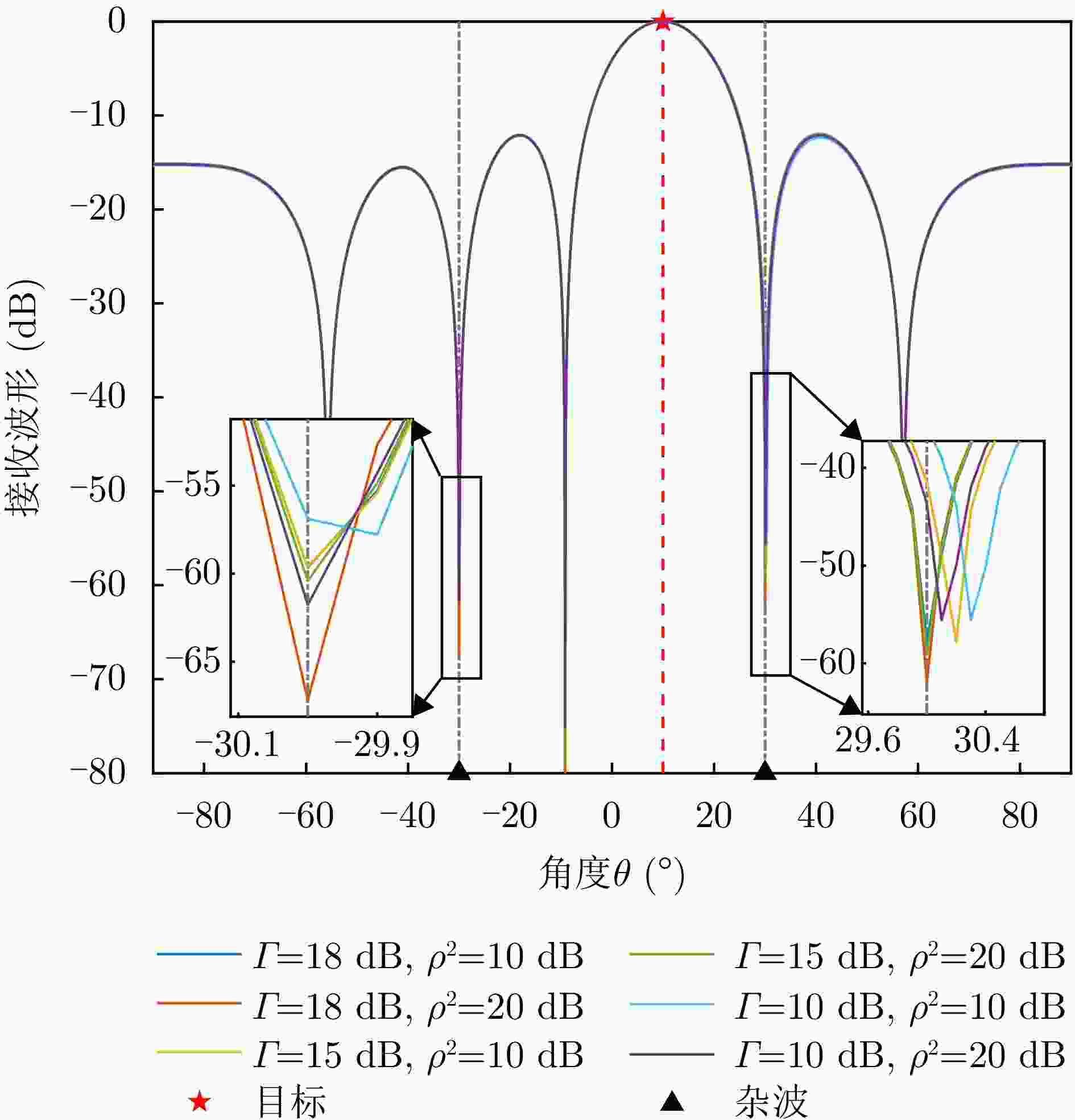
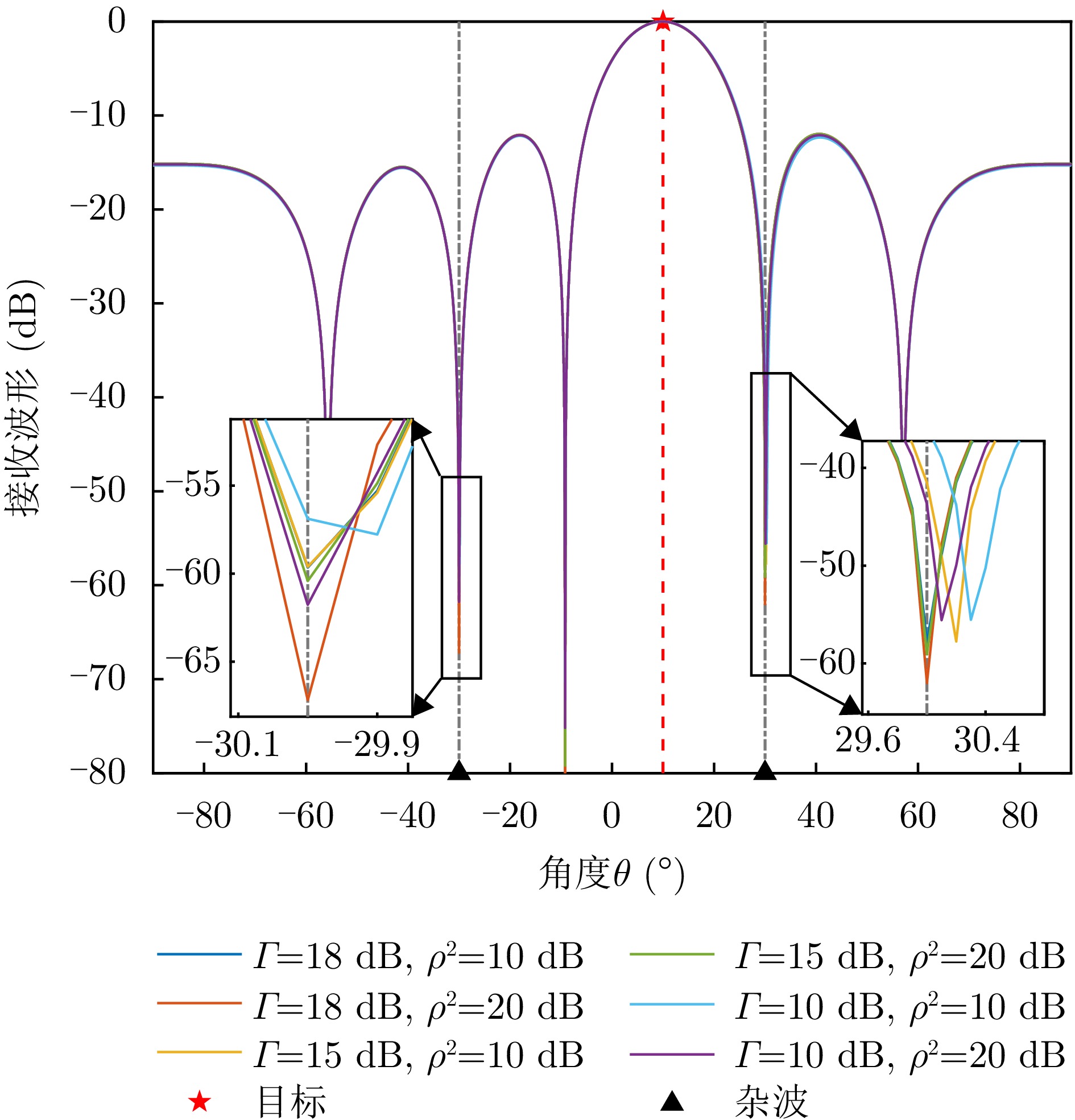
图 5 不同参数下接收方向图对比
Figure 5. Comparison of receive beampatterns under different parameter settings
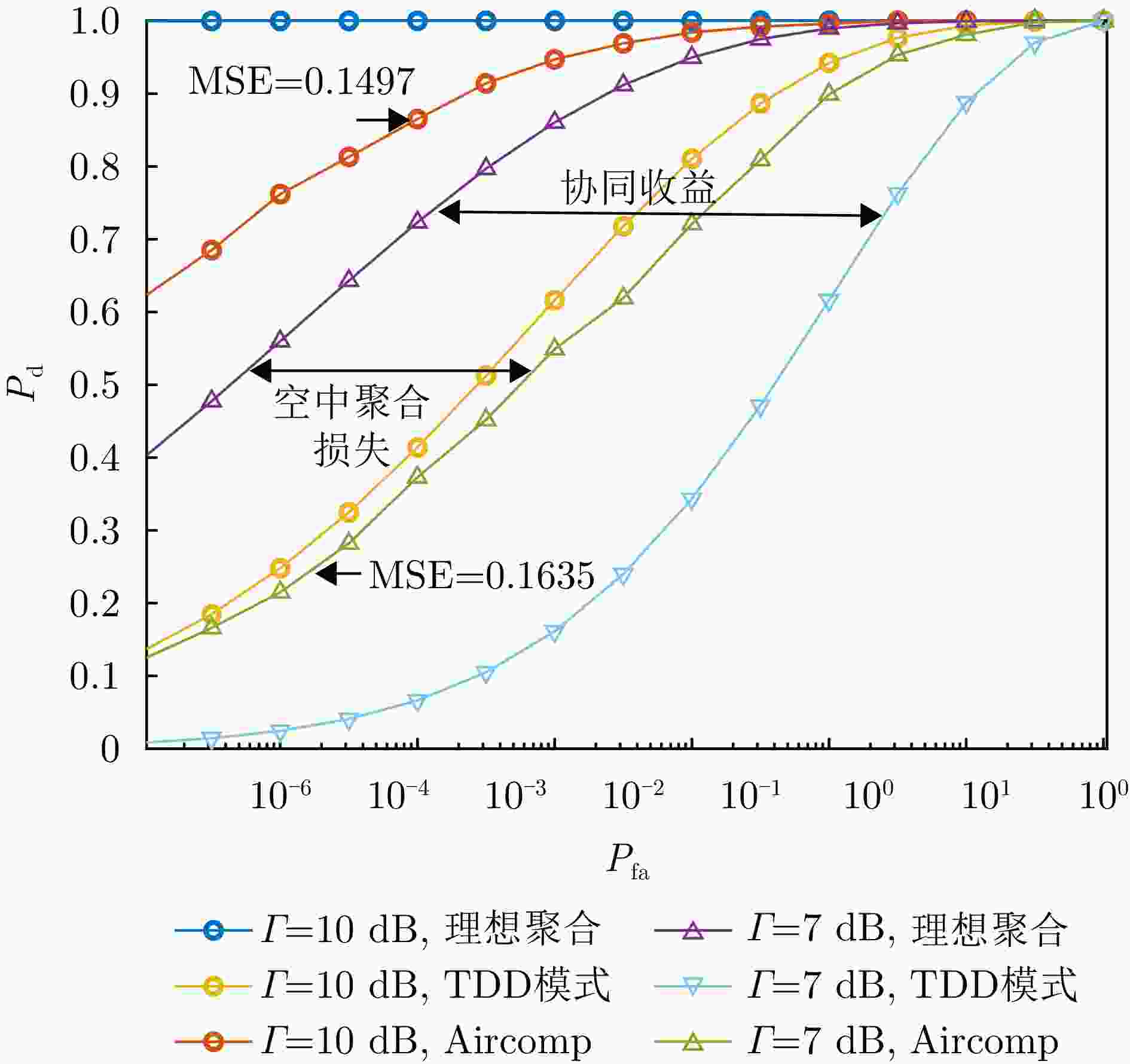
图 6 不同工作模式下的检测概率对比
Figure 6. Comparison of detection performance under different operating modes
1 AirDRN-HBF算法
1. AirDRN-HBF algorithm
1. 输入:系统参数。 2. 当算法未收敛时,执行以下循环: 3. 通过求解式(34)更新数字接收滤波矩阵$ {\left\{{\boldsymbol{w}}_{m}\right\}}^{t+1} $。 4. 通过求解式(36)更新矩阵$ {\left\{{\boldsymbol{G}}_{m}\right\}}^{t+1} $。 5. 通过求解式(38)更新矩阵$ {\left\{\boldsymbol{Y}\right\}}^{t+1} $。 6. 通过求解问题(42)更新矩阵$ {\left\{{\boldsymbol{U}}_{m}\right\}}^{t+1} $。 7. 通过求解式(46)更新$ {\left\{{\boldsymbol{V}}_{\text{bb}}\right\}}^{t+1} $。 8. 设置初始参数:$ {\left\{\boldsymbol{Y}\right\}}^{t+1} $, $ {\boldsymbol{D}}^{t} $;初始化:$ \boldsymbol{V}_{\text{rf}}^{}\in {\mathcal{M}}_{c} $,
$ {\text{grad}}^{+}f\left(\boldsymbol{V}_{\text{rf}}^{\left(0\right)}\right)=-\text{grad}f\left(\boldsymbol{V}_{\text{rf}}^{\left(0\right)}\right) $。9. 当算法未收敛时,执行以下循环: 10. 通过Armijo准则确定$ {\kappa }^{\left(q\right)} $。 11. 通过式(55)更新$ \boldsymbol{V}_{\text{rf}}^{\left(q+1\right)} $。 12. 通过式(53)更新$ {\tau }^{\left(q+1\right)} $。 13. 通过式(52)更新$ {\text{grad}}^{+}f\left(\boldsymbol{V}_{\text{rf}}^{\left(q+1\right)}\right) $。 14. 结束循环 输出:$ {\left\{{\boldsymbol{V}}_{\text{rf}}\right\}}^{t+1}=\boldsymbol{V}_{\text{rf}}^{q+1} $ 15. 计算中间变量$ {\boldsymbol{D}}^{t+1} $和$ {\boldsymbol{Z}}^{t+1} $ 16. 结束循环 17. 收敛后,将最终迭代结果赋值为输出变量: $ {\left\{{\boldsymbol{w}}_{m}\right\}}^{l}={\left\{{\boldsymbol{w}}_{m}\right\}}^{t+1} $,$ {\left\{{\boldsymbol{U}}_{m}\right\}}^{l}={\left\{{\boldsymbol{U}}_{m}\right\}}^{t+1} $, $ \boldsymbol{V}_{\text{bb}}^{l}=\boldsymbol{V}_{\text{bb}}^{t+1} $,
$ \boldsymbol{V}_{\text{rf}}^{l}=\boldsymbol{V}_{\text{rf}}^{t+1} $18. 输出:$ {\left\{{\boldsymbol{w}}_{m}\right\}}^{l} $, $ {\left\{{\boldsymbol{U}}_{m}\right\}}^{l} $, $ \boldsymbol{V}_{\text{bb}}^{l} $, $ \boldsymbol{V}_{\text{rf}}^{l} $  下载: 导出CSV
-
[1] GOGINENI S and NEHORAI A. Polarimetric MIMO radar with distributed antennas for target detection[J]. IEEE Transactions on Signal Processing, 2010, 58(3): 1689–1697. doi: 10.1109/TSP.2009.2036472. [2] HAIMOVICH A M, BLUM R S, and CIMINI L J. MIMO radar with widely separated antennas[J]. IEEE Signal Processing Magazine, 2008, 25(1): 116–129. doi: 10.1109/MSP.2008.4408448. [3] 程子扬, 何子述, 王智磊, 等. 分布式MIMO雷达目标检测性能分析[J]. 雷达学报, 2017, 6(1): 81–89. doi: 10.12000/JR16147.CHENG Ziyang, HE Zishu, WANG Zhilei, et al. Detection performance analysis for distributed MIMO radar[J]. Journal of Radars, 2017, 6(1): 81–89. doi: 10.12000/JR16147. [4] 何子述, 程子扬, 李军, 等. 集中式MIMO雷达研究综述[J]. 雷达学报, 2022, 11(5): 805–829. doi: 10.12000/JR22128.HE Zishu, CHENG Ziyang, LI Jun, et al. A survey of collocated MIMO radar[J]. Journal of Radars, 2022, 11(5): 805–829. doi: 10.12000/JR22128. [5] MENG Kaitao, MASOUROS C, PETROPULU A P, et al. Cooperative ISAC networks: Opportunities and challenges[J]. IEEE Wireless Communications, 2025, 32(3): 212–219. doi: 10.1109/MWC.008.2400151. [6] SHI Chenguang, WANG Yijie, SALOUS S, et al. Joint transmit resource management and waveform selection strategy for target tracking in distributed phased array radar network[J]. IEEE Transactions on Aerospace and Electronic Systems, 2022, 58(4): 2762–2778. doi: 10.1109/TAES.2021.3138869. [7] 杨诗兴, 张国鑫, 梁雲飞, 等. 动平台分布式雷达系统动目标低比特数据检测算法[J]. 雷达学报(中英文), 2024, 13(3): 584–600. doi: 10.12000/JR23240.YANG Shixing, ZHANG Guoxin, LIANG Yunfei, et al. Moving targets detection with low-bit quantization in distributed radar on moving platforms[J]. Journal of Radars, 2024, 13(3): 584–600. doi: 10.12000/JR23240. [8] ASHRAF M, TAN Bo, MOLTCHANOV D, et al. Joint optimization of radar and communications performance in 6G cellular systems[J]. IEEE Transactions on Green Communications and Networking, 2023, 7(1): 522–536. doi: 10.1109/TGCN.2023.3234258. [9] NAZER B and GASTPAR M. Computation over multiple-access channels[J]. IEEE Transactions on Information Theory, 2007, 53(10): 3498–3516. doi: 10.1109/TIT.2007.904785. [10] ŞAHIN A and YANG Rui. A survey on over-the-air computation[J]. IEEE Communications Surveys & Tutorials, 2023, 25(3): 1877–1908. doi: 10.1109/COMST.2023.3264649. [11] 曹晓雯, 莫小鹏, 许杰. 面向边缘智能的空中计算[J]. 中兴通讯技术, 2020, 26(4): 31–37. doi: 10.12142/ZTETJ.202004007.CAO Xiaowen, MO Xiaopeng, and XU Jie. Over-the-air computation for edge intelligence[J]. ZTE Technology Journal, 2020, 26(4): 31–37. doi: 10.12142/ZTETJ.202004007. [12] 谈玲, 许海, 刘玉风, 等. 基于多无人机的空中计算网络资源分配算法[J]. 电子学报, 2023, 51(11): 3070–3078. doi: 10.12263/DZXB.20230513.TAN Ling, XU Hai, LIU Yufeng, et al. Resource allocation algorithm of AirComp network based on multiple UAVs[J]. Acta Electronica Sinica, 2023, 51(11): 3070–3078. doi: 10.12263/DZXB.20230513. [13] LI Xiaoyang, ZHU Guangxu, GONG Yi, et al. Wirelessly powered data aggregation for IoT via over-the-air function computation: Beamforming and power control[J]. IEEE Transactions on Wireless Communications, 2019, 18(7): 3437–3452. doi: 10.1109/TWC.2019.2914046. [14] ZHAI Xiongfei, HAN Guojun, CAI Yunlong, et al. Beamforming design based on two-stage stochastic optimization for RIS-assisted over-the-air computation systems[J]. IEEE Internet of Things Journal, 2022, 9(7): 5474–5488. doi: 10.1109/JIOT.2021.3108894. [15] LI Xiaoyang, LIU Fan, ZHOU Ziqin, et al. Integrated sensing, communication, and computation over-the-air: MIMO beamforming design[J]. IEEE Transactions on Wireless Communications, 2023, 22(8): 5383–5398. doi: 10.1109/TWC.2022.3233795. [16] DONG Kai, VOROBYOV S A, YU Hao, et al. Beamforming design for integrated sensing, over-the-air computation, and communication in internet of robotic things[J]. IEEE Internet of Things Journal, 2024, 11(20): 32478–32489. doi: 10.1109/JIOT.2024.3433390. [17] SOHRABI F and YU Wei. Hybrid digital and analog beamforming design for large-scale antenna arrays[J]. IEEE Journal of Selected Topics in Signal Processing, 2016, 10(3): 501–513. doi: 10.1109/JSTSP.2016.2520912. [18] WANG Zihuan, LI Ming, LIU Qian, et al. Hybrid precoder and combiner design with low-resolution phase shifters in mmWave MIMO systems[J]. IEEE Journal of Selected Topics in Signal Processing, 2018, 12(2): 256–269. doi: 10.1109/JSTSP.2018.2819129. [19] WANG Bowen, LI Hongyu, LIU Fan, et al. Cooperative integrated sensing and communication networks: Analysis and distributed design[EB/OL]. arXiv:2407.13401, 2024[2026-09-03]. https://arxiv.org/abs/2407.13401. [20] DENG Weicao, LI Min, ZHAO Mingmin, et al. CSI transfer from sub-6G to mmWave: Reduced-overhead multi-user hybrid beamforming[J]. IEEE Journal on Selected Areas in Communications, 2025, 43(3): 973–987. doi: 10.1109/JSAC.2025.3536539. [21] BOYD S, PARIKH N, CHU E, et al. Distributed optimization and statistical learning via the alternating direction method of multipliers[J]. Foundations and Trends in Machine Learning, 2011, 3(1): 1–122. doi: 10.1561/2200000016. [22] CHENG Ziyang, HE Zishu, and LIAO Bin. Hybrid beamforming design for OFDM dual-function radar-communication system[J]. IEEE Journal of Selected Topics in Signal Processing, 2021, 15(6): 1455–1467. doi: 10.1109/JSTSP.2021.3118276. [23] CHENG Ziyang, HE Zishu, and LIAO Bin. Hybrid beamforming for multi-carrier dual-function radar-communication system[J]. IEEE Transactions on Cognitive Communications and Networking, 2021, 7(3): 1002–1015. doi: 10.1109/TCCN.2021.3063110. [24] LI Rencang. Rayleigh Quotient Based Optimization Methods for Eigenvalue Problems[M]. BAI Zhaojun, GAO Weiguo, and SU Yangfeng. Matrix Functions and Matrix Equations. Singapore: World Scientific, 2015: 76–108. [25] BOYD S and VANDENBERGHE L. Convex Optimization[M]. Cambridge: Cambridge University Press, 2004: 127–272. [26] SUN Ying, BABU P, and PALOMAR D P. Majorization-minimization algorithms in signal processing, communications, and machine learning[J]. IEEE Transactions on Signal Processing, 2017, 65(3): 794–816. doi: 10.1109/TSP.2016.2601299. [27] GRANT M C and BOYD S P. CVX: Matlab software for disciplined convex programming, version 2.2[EB/OL]. https://cvxr.com/cvx/, 2020. [28] BOUMAL N. An Introduction to Optimization on Smooth Manifolds[M]. Cambridge: Cambridge University Press, 2023: 51–78. [29] ABSIL P A, MAHONY R, and SEPULCHRE R. Optimization Algorithms on Matrix Manifolds[M]. Princeton, NJ, USA: Princeton University Press, 2008: 53–90. [30] UDRIŞTE C. Convex Functions and Optimization Methods on Riemannian Manifolds[M]. Dordrecht, The Netherlands: Springer, 1994: 56–107. doi: 10.1007/978-94-015-8390-9. [31] CHENG Ziyang and LIAO Bin. QoS-aware hybrid beamforming and DOA estimation in multi-carrier dual-function radar-communication systems[J]. IEEE Journal on Selected Areas in Communications, 2022, 40(6): 1890–1905. doi: 10.1109/JSAC.2022.3155529. -




计量
- 文章访问数:
- HTML全文浏览量:
- PDF下载量:
- 被引次数: 0