

 作者中心
作者中心 专家审稿
专家审稿 责编办公
责编办公 编辑办公
编辑办公
A Three-channel SAR-GMTI Multi-domain Barrage Jamming Method Based on Composite Modulation
-
摘要: 传统单干扰站合成孔径雷达(SAR)压制干扰在动目标指示(GMTI)体制下会产生压制盲区,增加目标暴露风险;同时,真实目标的运动会引起方位向能量展宽和位置偏移,进一步提高干扰机对压制范围与功率分配的需求。多干扰站信号级协同方法虽可缓解上述问题,但会增加硬件成本,且仅能针对固定的SAR方位向,增加了站点布防难度。为解决这些问题,该文提出一种基于四相位复合调制的压制干扰信号调控方法。该方法通过运动补偿相位生成具有与运动目标散焦与偏移特征相似的虚假点目标,利用子区域定位相位和中心位置调控相位控制各压制子区域的位置,并借助多尺度噪声模板相位调节噪声点的二维尺度。4个相位协同作用,使单台干扰机能够快速生成具备运动目标散焦与偏移特征的多区域、噪声尺度可控的压制干扰,从而实现对周边多个运动目标的同步压制。所生成的压制干扰区域具有与真实运动目标相似的方位向散焦特性,确保噪声点散焦长度接近真实目标散焦长度;噪声干扰的方位向偏移相对于真实目标的位置偏移在误差允许范围内,使得方位向偏移后的压制区域能够有效覆盖运动目标在SAR图像上的成像位置。经多通道相位中心偏置天线-顺轨干涉测量(DPCA-ATI)后,真实运动目标随压制区域被矫正至同一方位向,从而实现对多个运动目标的有效防护。该文理论分析与仿真验证为三通道SAR-GMTI干扰技术提供了可量化的评估依据。Abstract: Traditional barrage jamming in single-jammer jamming of a Synthetic Aperture Radar (SAR) operating in Ground Moving Target Indication (GMTI) mode creates blind zones, increasing the risk of target exposure. Simultaneously, the motion of real targets causes azimuth energy broadening and position shifts, further increasing the requirements for jamming power and coverage. Although multi-jammer signal cooperation can alleviate these problems, it increases hardware costs and is limited to fixed SAR azimuth directions, complicating deployment. To address these issues, this paper proposes a barrage jamming signal control method based on four-phase composite modulation. This method generates false point targets with moving target defocusing and shifting characteristics through motion phase compensation. It controls the position of each barrage subregion using a subregion positioning phase and a central position control phase. Simultaneously, it adjusts the two-dimensional scale of noise points using a multi-scale noise template phase. The synergistic interaction of these four phases enables a single jammer to rapidly produce multi-region barrage jamming with controllable noise scale, moving-target-like defocus, and offset features, thereby achieving synchronous barrage jamming of multiple nearby moving targets. The generated barrage jamming region exhibits azimuth defocusing characteristics similar to those of a real moving target, ensuring that the defocus length of the noise points is highly similar to that of the real target. The azimuth offset of the barrage jamming is within the allowable error range relative to the position of the real target, ensuring that the barrage after azimuth offset effectively covers the imaging position of the moving target on the SAR image. After multi-channel Displaced Phase Center Antenna-Along Track Interferometric (DPCA-ATI) processing, both the real moving target and the barrage interference region are corrected to the same azimuth position, thus effectively protecting multiple moving targets. Theoretical analysis and simulation validation provide a quantifiable evaluation standard for the three-channel SAR-GMTI jamming techniques.
-
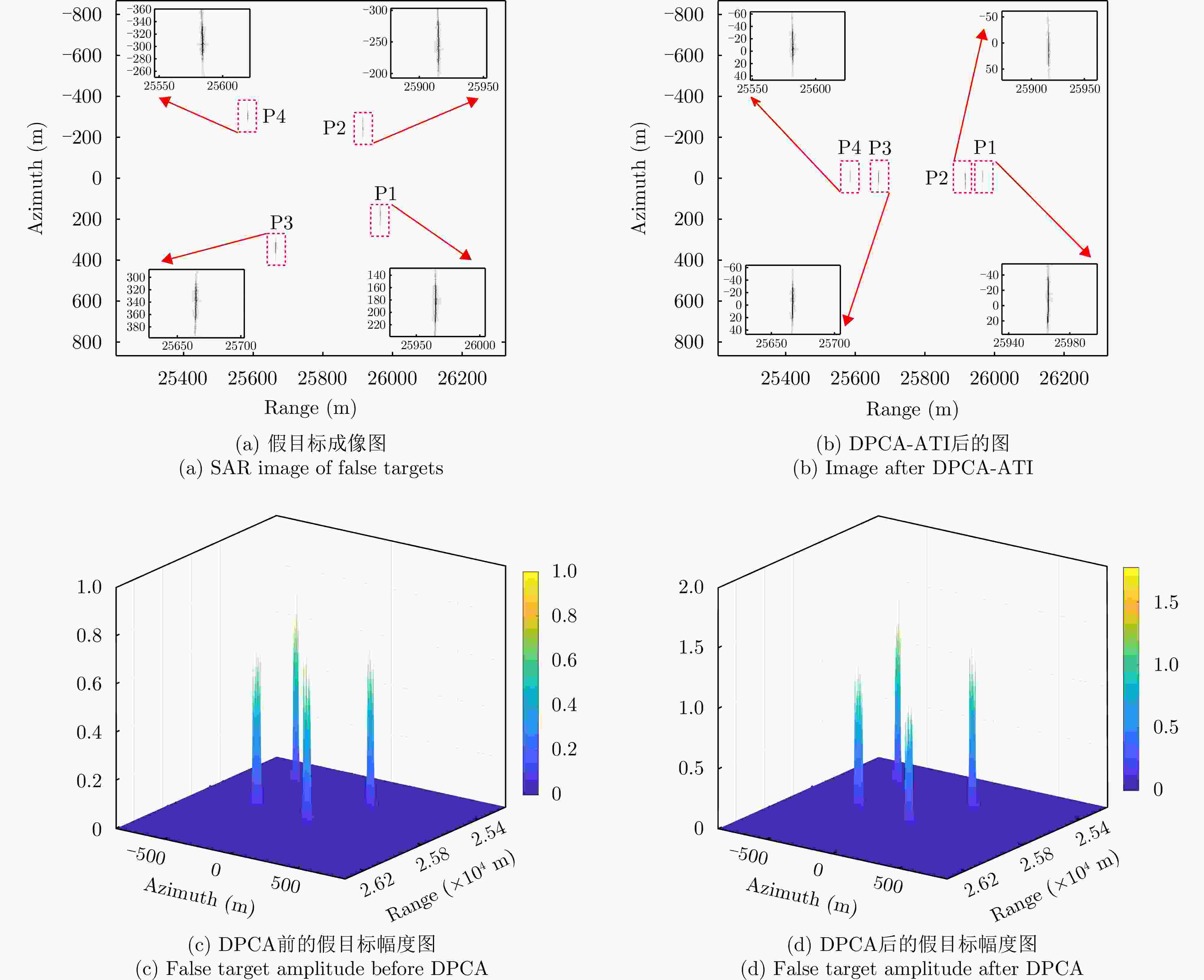
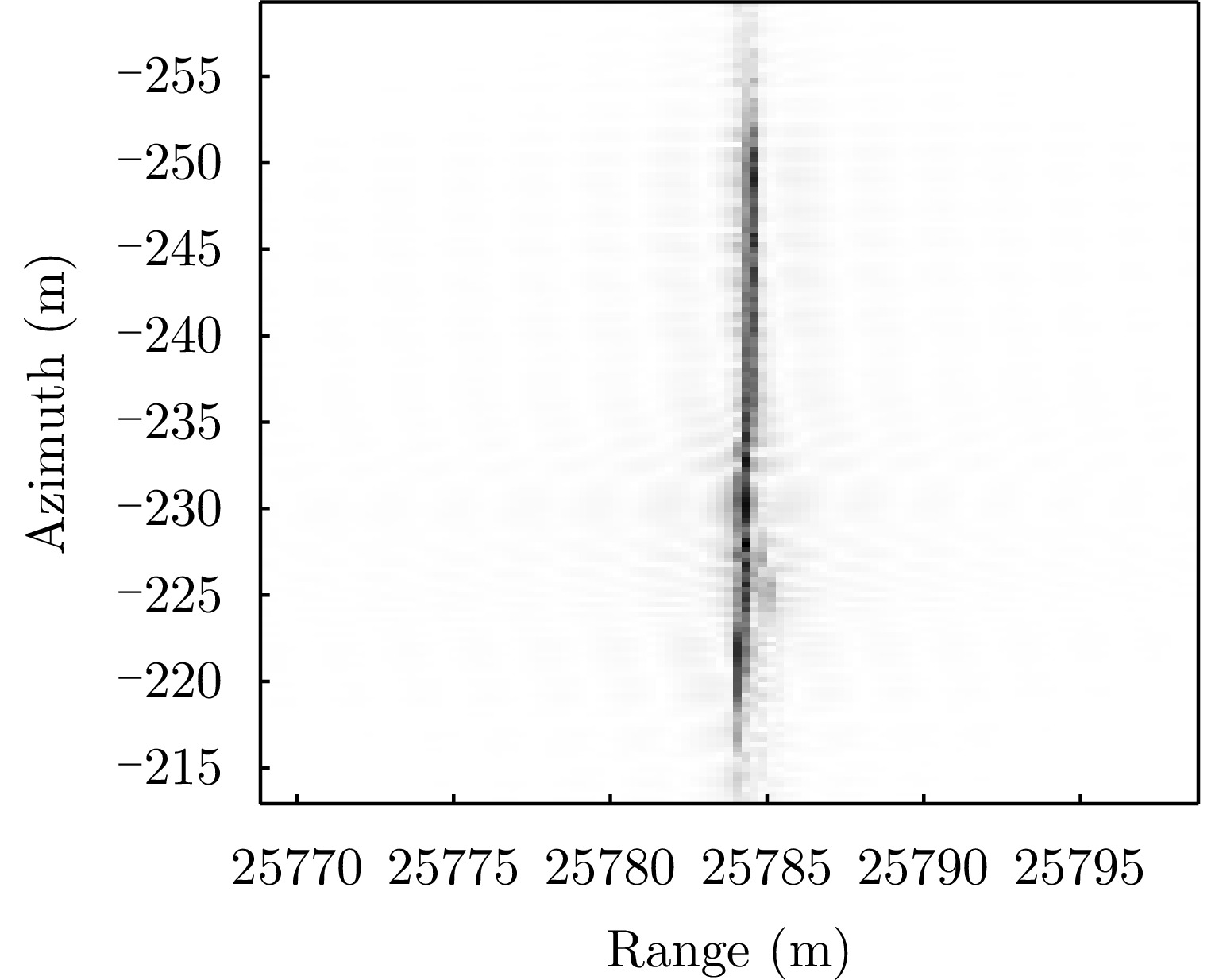
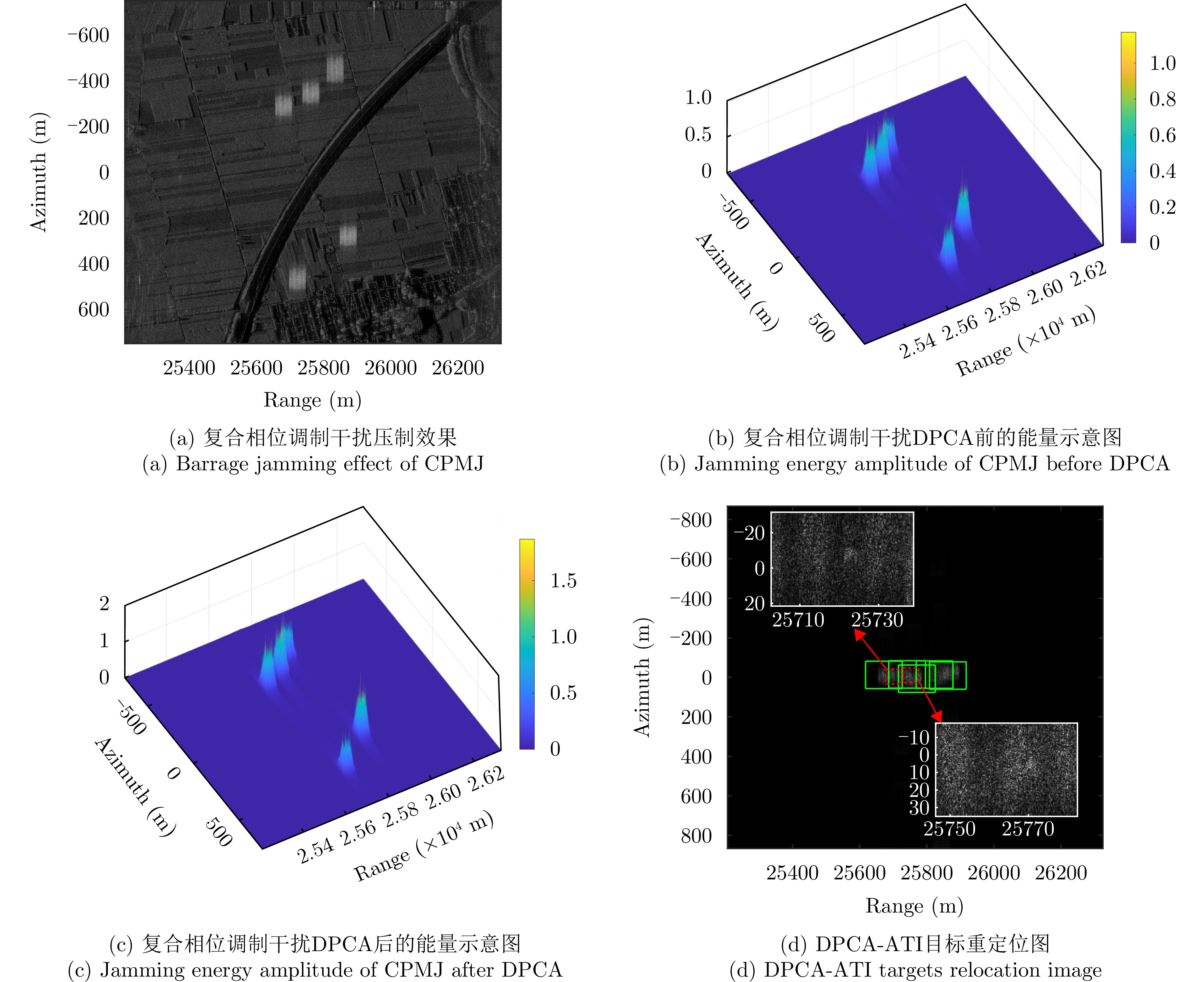
图 4 单干扰机虚假运动目标调制成像效果图
Figure 4. Imaging effect of false moving targets modulated by one jammer
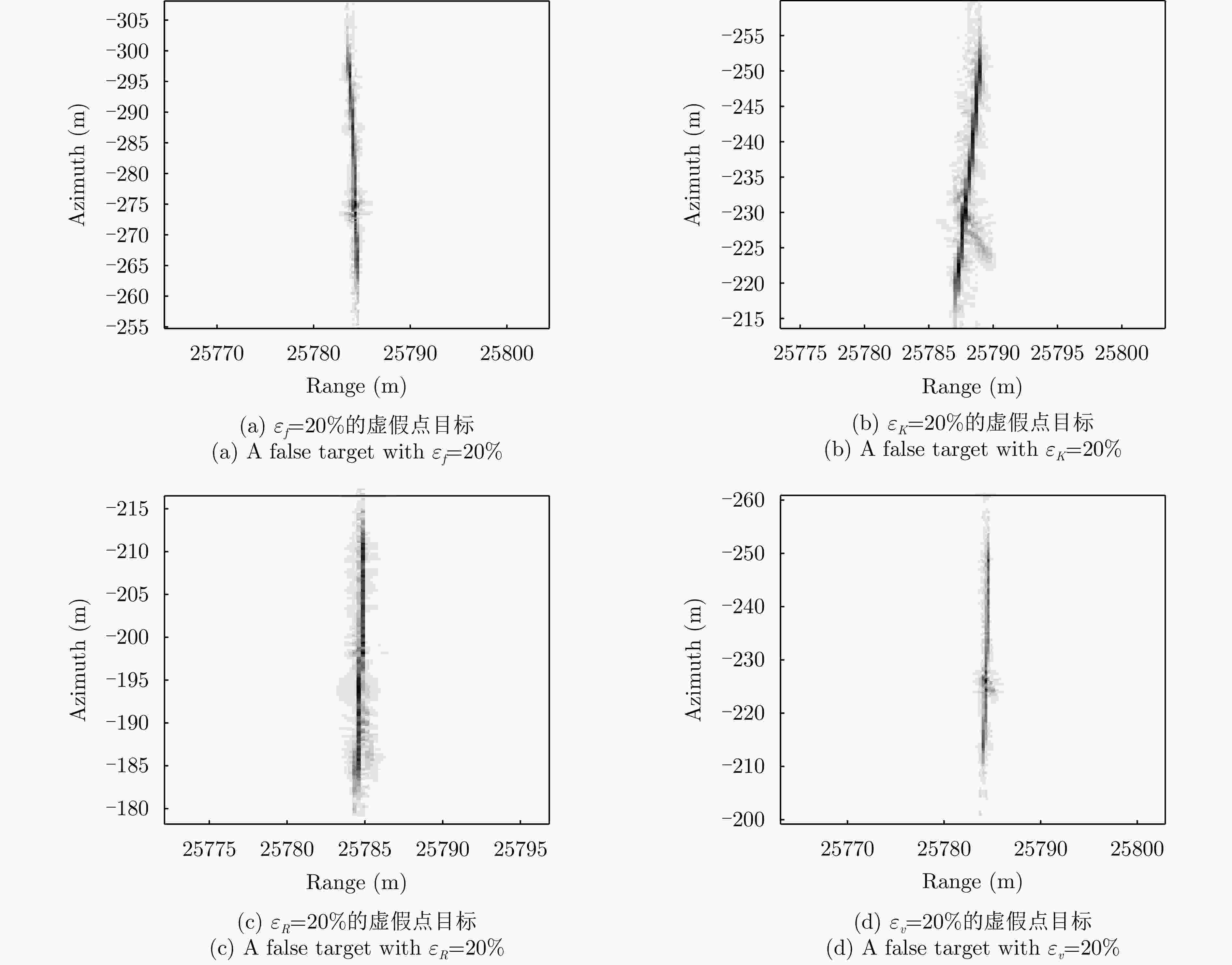
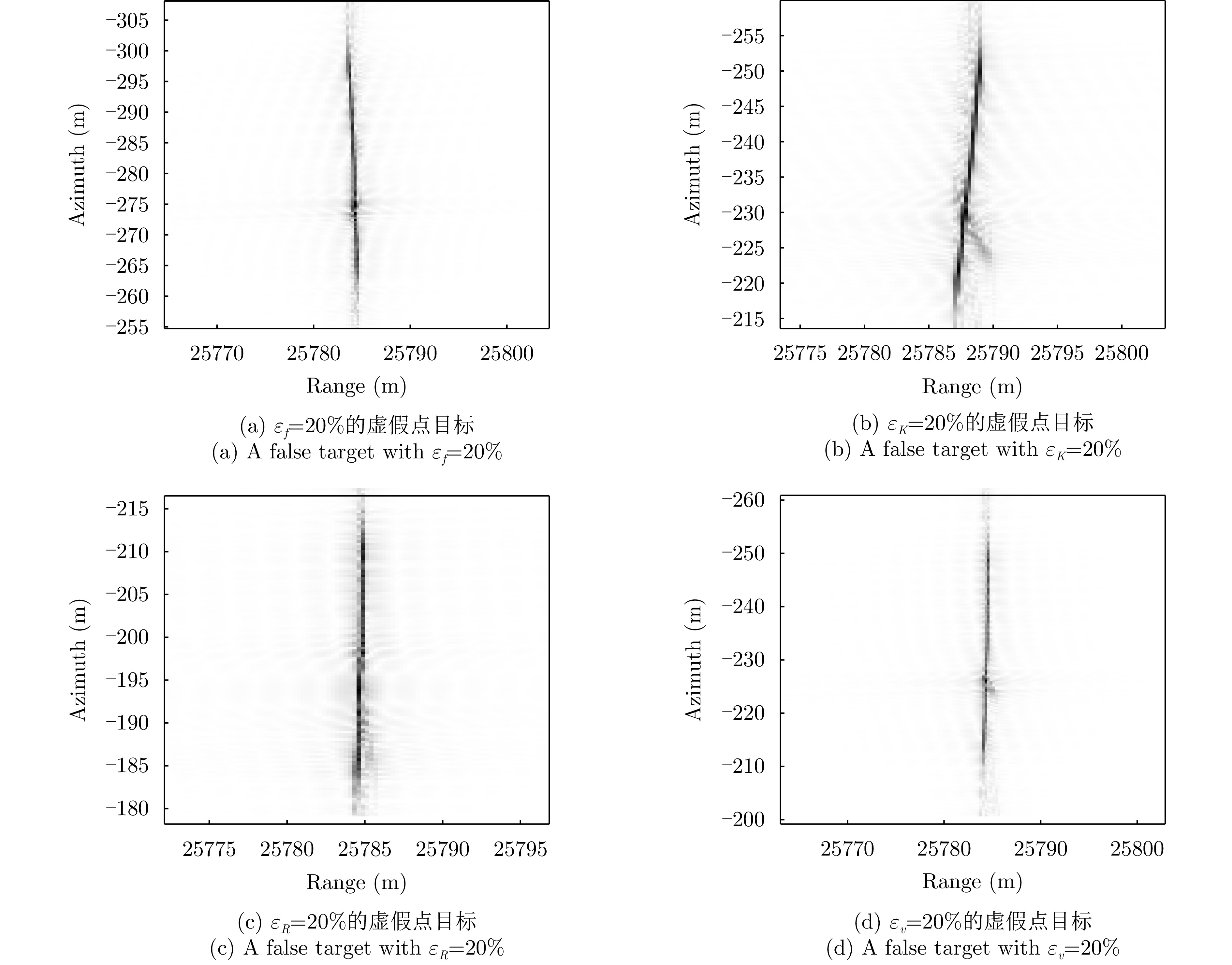
图 6 引入4种不同类型误差后的成像结果
Figure 6. Imaging results after introducing four different types of errors
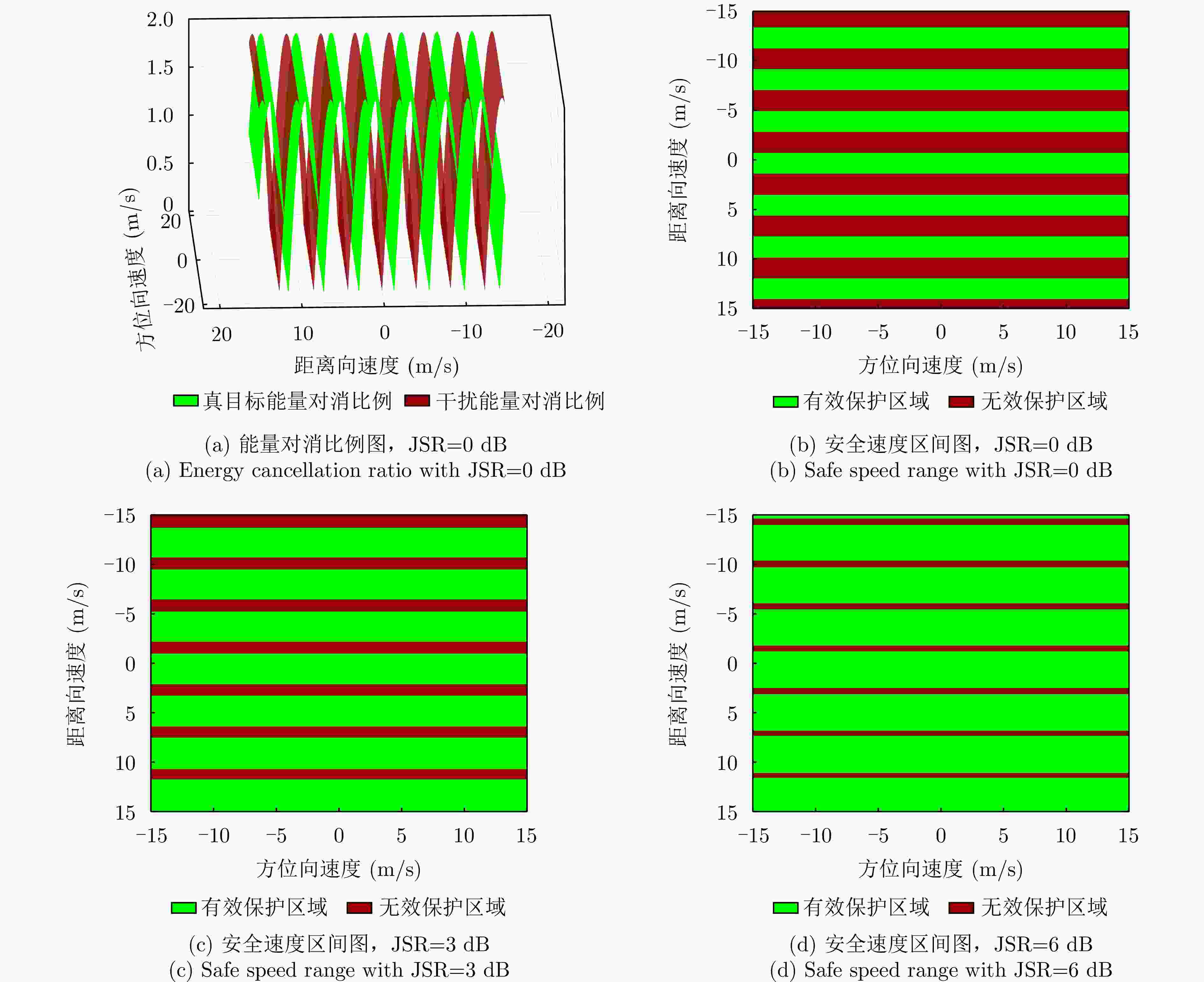
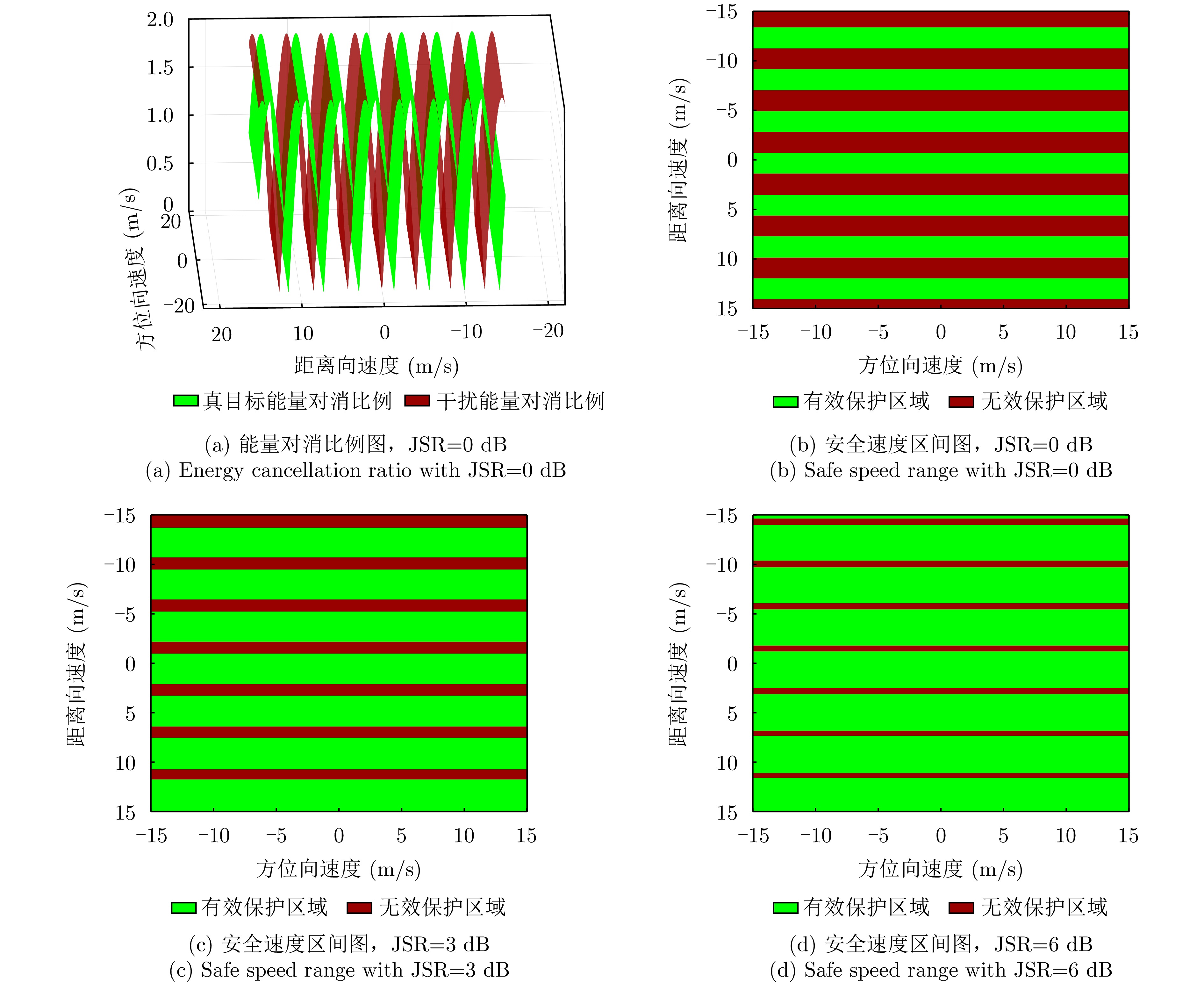
图 14 固定单位JSR及确定位置下的安全速度区间
Figure 14. Safe speed range under fixed unit JSR and determined position
表 1 仿真中X波段机载SAR参数
Table 1. X-band airborne SAR parameters in simulation
参数 数值 SAR平台速度 154.20 m/s 合成孔径长度 1021.8 m天线长度 0.69 m 相邻通道间隔 1.16 m SAR高度 6000.0 m景中心斜距 25765.5 m载频 9.59 GHz 脉冲持续时间 2.4 μs 调频率 200 MHz/μs 距离向采样频率 548.57 MHz 脉冲重复频率 533.33 Hz  下载: 导出CSV
表 2 不同速度下真假点目标成像效果对比
Table 2. Comparison of imaging effects between real and false targets at different speeds
目标 初始位置(m) 运动速度(m/s) 成像沿方位向
位置偏移(m)成像沿方位向
能量展宽(m)DPCA理论
对消比例DPCA仿真
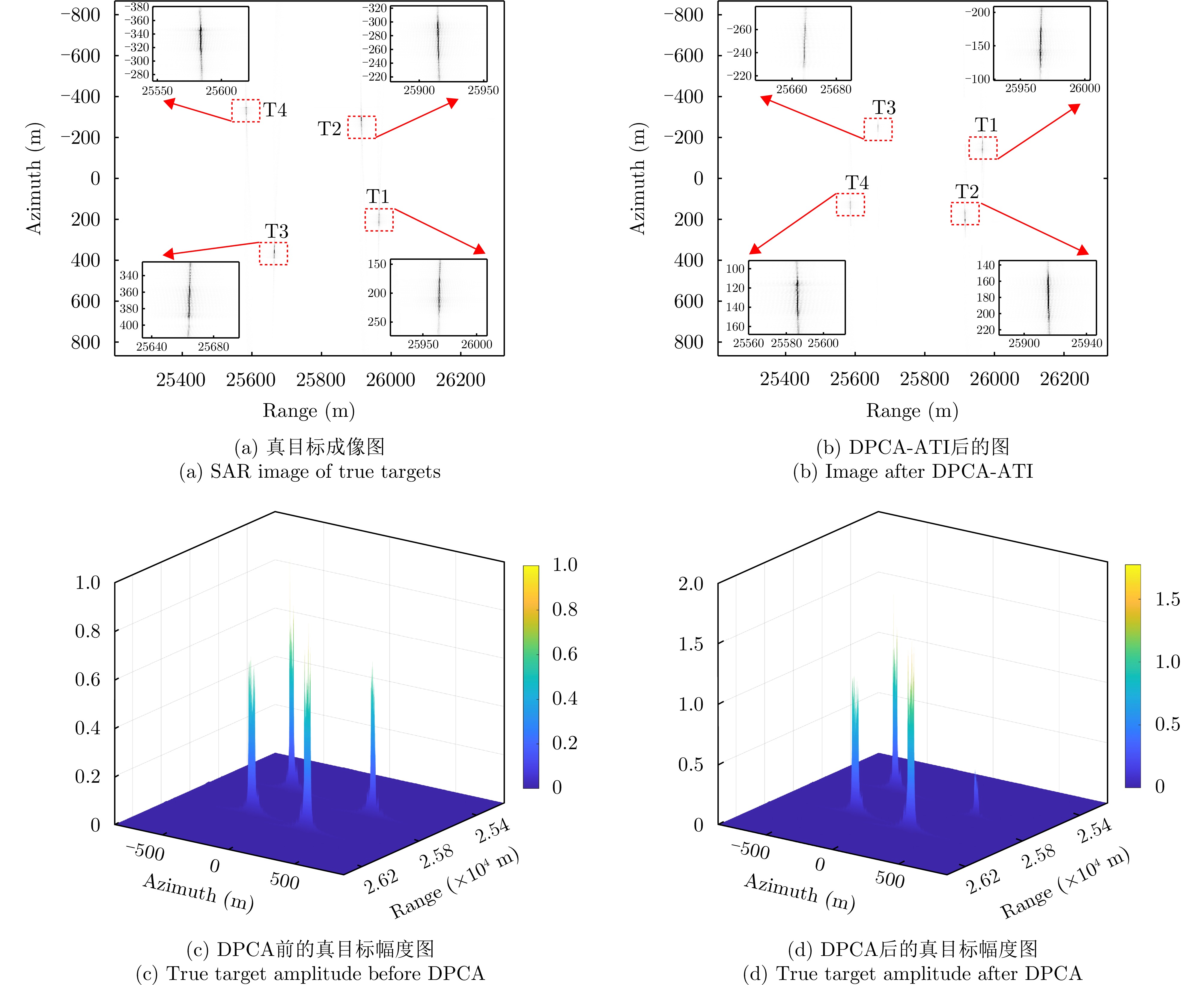
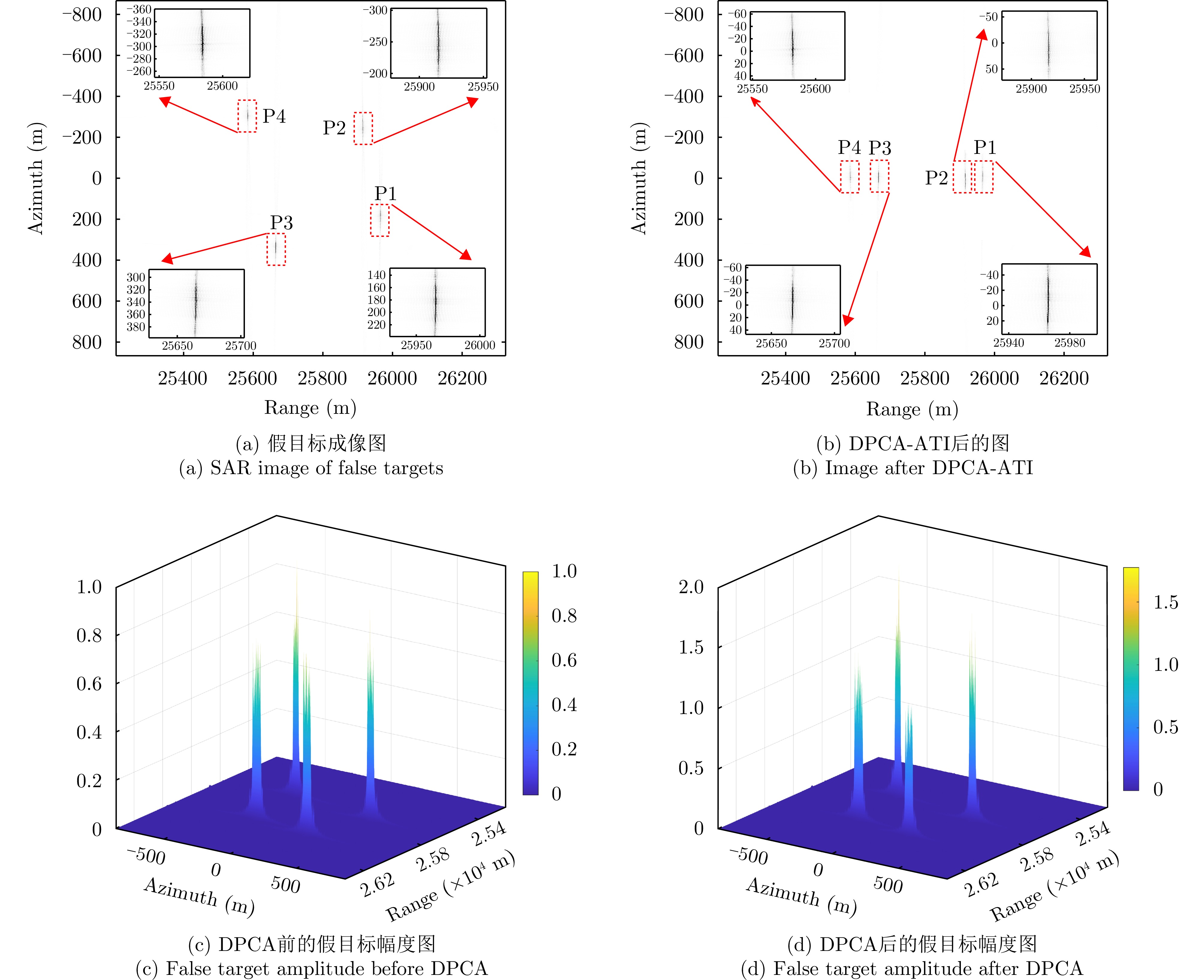
对消比例真实目标 T1 ( 25965.5 ,–150.0)(–2.1, 5.5) 359.7 71.1 2.00 2.00 T2 ( 25915.5 , 180.0)(2.7, 6.6) −460.8 80.8 1.79 1.76 T3 ( 25665.5 , –260.0)(−3.8, 5.8) 626.1 72.8 0.55 0.62 T4 ( 25585.5 , 130.0)(2.8, 4.8) –449.0 60.7 1.72 1.77 虚假目标 P1 ( 25965.5 , –150.0)(–2.1, 5.5) 346.0 71.7 1.52 1.53 P2 ( 25915.5 , 180.0)(2.7, 6.6) −441.6 81.0 1.84 1.8 P3 ( 25665.5 , –260.0)(−3.8, 5.8) 622.0 75.1 2.00 1.99 P4 ( 25585.5 , 130.0)(2.8, 4.8) –439.7 61.8 1.99 2.00
下载: 导出CSV
表 3 不同类型参数误差的假目标成像效果对比
Table 3. Comparison of imaging effects of a false target with different parameter errors
假目标 $ {{\Delta }R}_{\text{re}} $理
论值$ {{\Delta }R}_{\text{ae}} $理
论值$ {\delta x}_{\text{e}} $理
论值$ {{\Delta }x}_{\text{e}} $理
论值距离向
理论偏
移量(m)距离向
实际偏
移量(m)距离偏
移量误
差比例方位向
理论偏
移量(m)方位向
实际偏
移量(m)方位偏
移量误
差比例方位向
理论展
宽量(m)方位向
实际展
宽量(m)方位向
散焦误
差比例无误差 0 0 0 0 20.0 19.2 –4.0% –240.0 –227.9 –5.0% 40.9 40.4 –1.2% $ {\varepsilon }_{f}=20\% $ 0 4.0 8.2 –52.0 20.0 18.8 –6.4% –292.0 –273.3 –6.4% 49.1 48.5 –1.2% $ {\varepsilon }_{K}=20\% $ 3.3 0 0 0 23.3 22.5 –3.4% –240.0 –228.2 –4.9% 40.9 40.5 –1.0% $ {\varepsilon }_{v}=20\% $ 0 4.0 8.2 0 20.0 19.0 –5.0% –236.0 –232.8 –1.4% 49.1 48.3 –1.6% $ {\varepsilon }_{R}=20\% $ 0 –3.3 –6.8 43.3 20.0 19.5 –2.5% –196.7 –192.9 –1.9% 34.1 34.4 –0.9%
下载: 导出CSV
表 4 目标群的位置和速度参数
Table 4. Position and velocity parameters of targets
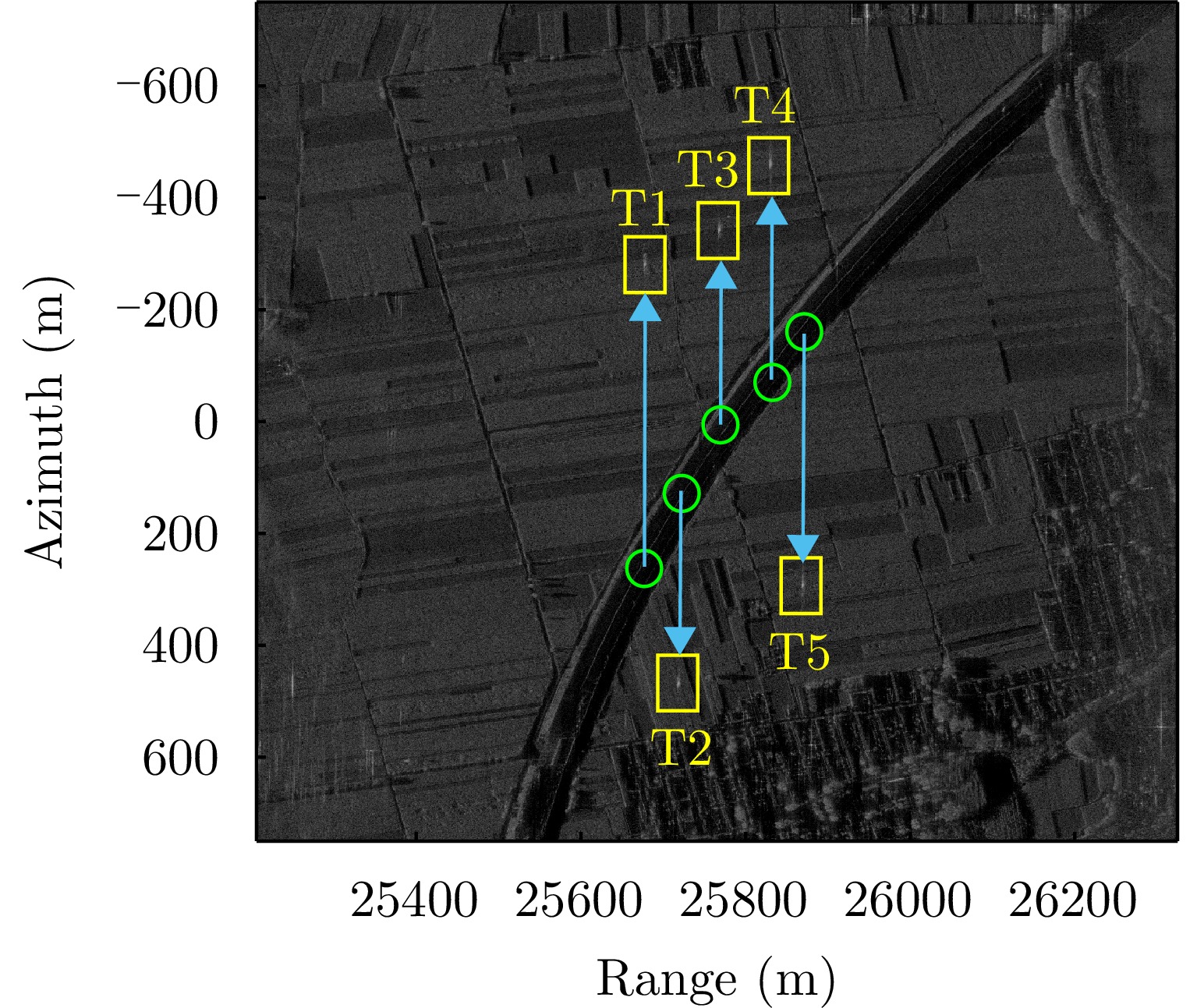
目标 坐标(m) 速度(距离向,方位向 m/s) T1 ( 25678.9 , 263.4)(3.3, 5.1) T2 ( 25723.5 , 124.5)(–2.1, –6.5) T3 ( 25771.5 , 0)(2.1, 5.5) T4 ( 25835.5 , –74.0)(2.4, 10.7) T5 ( 25871.5 , –168.2)(-2.8, 4.3)
下载: 导出CSV
表 5 4种干扰方法在JSR=0 dB和JSR=20 dB时的效果对比
Table 5. Comparison of four jamming methods at JSR=0 dB and JSR=20 dB
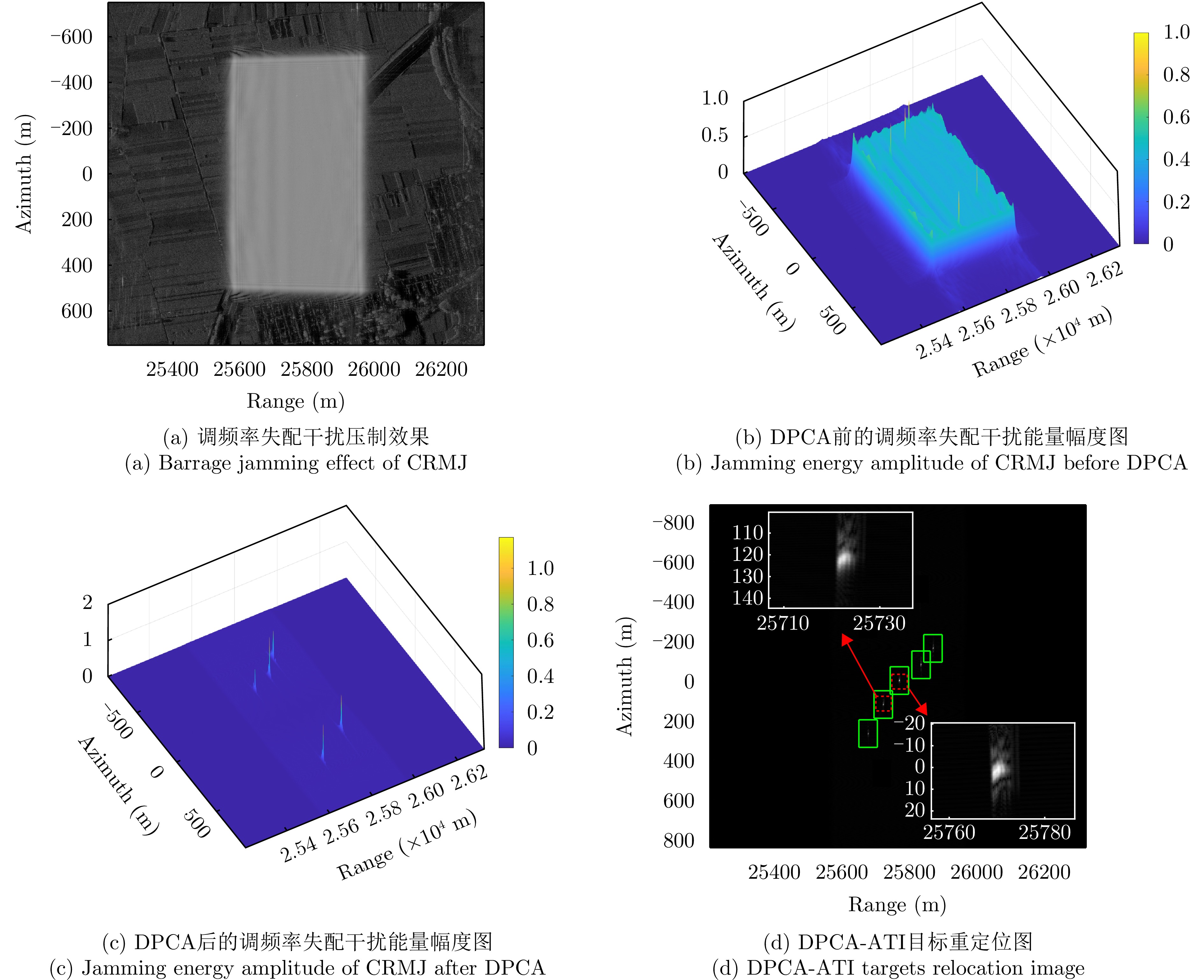
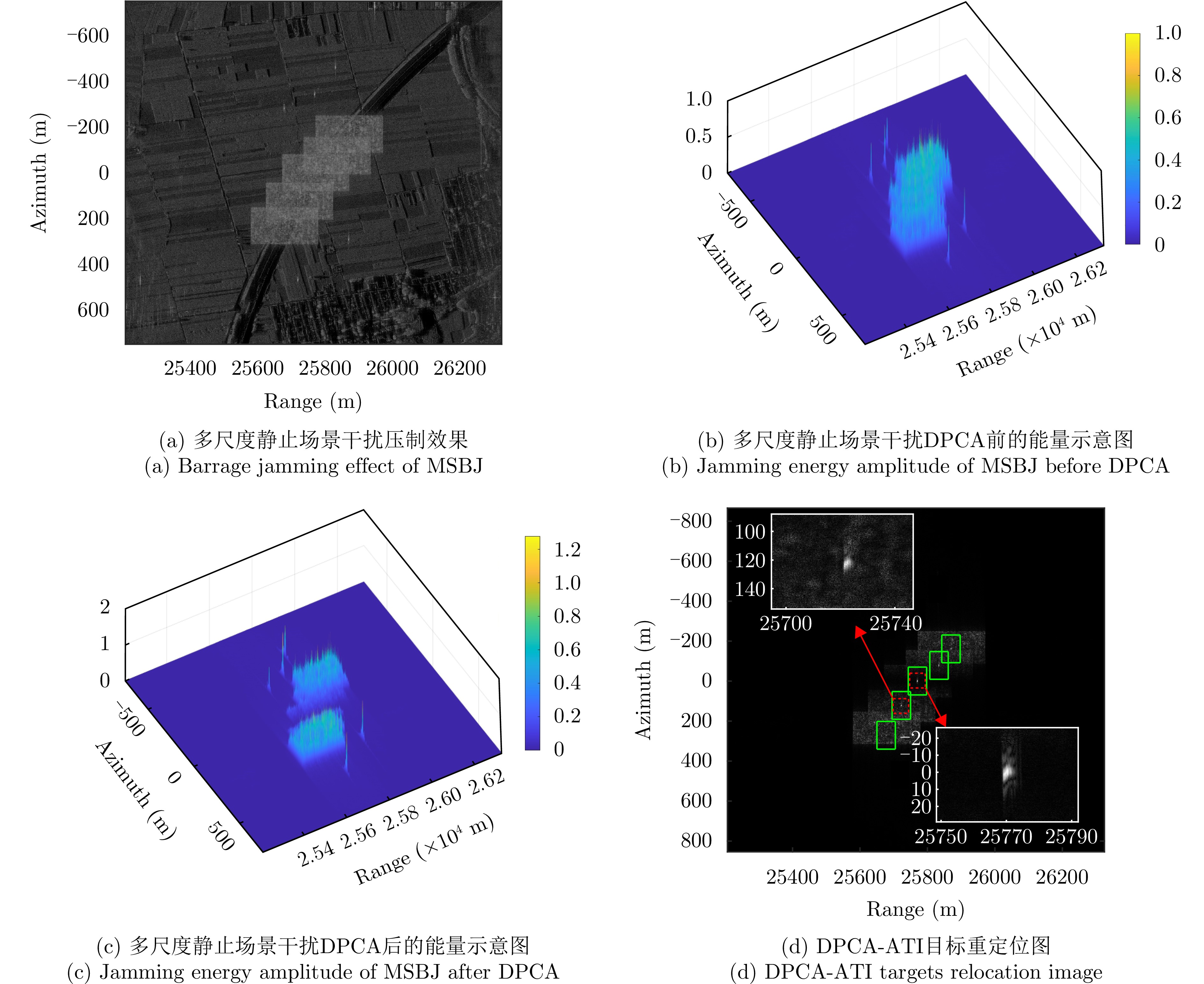
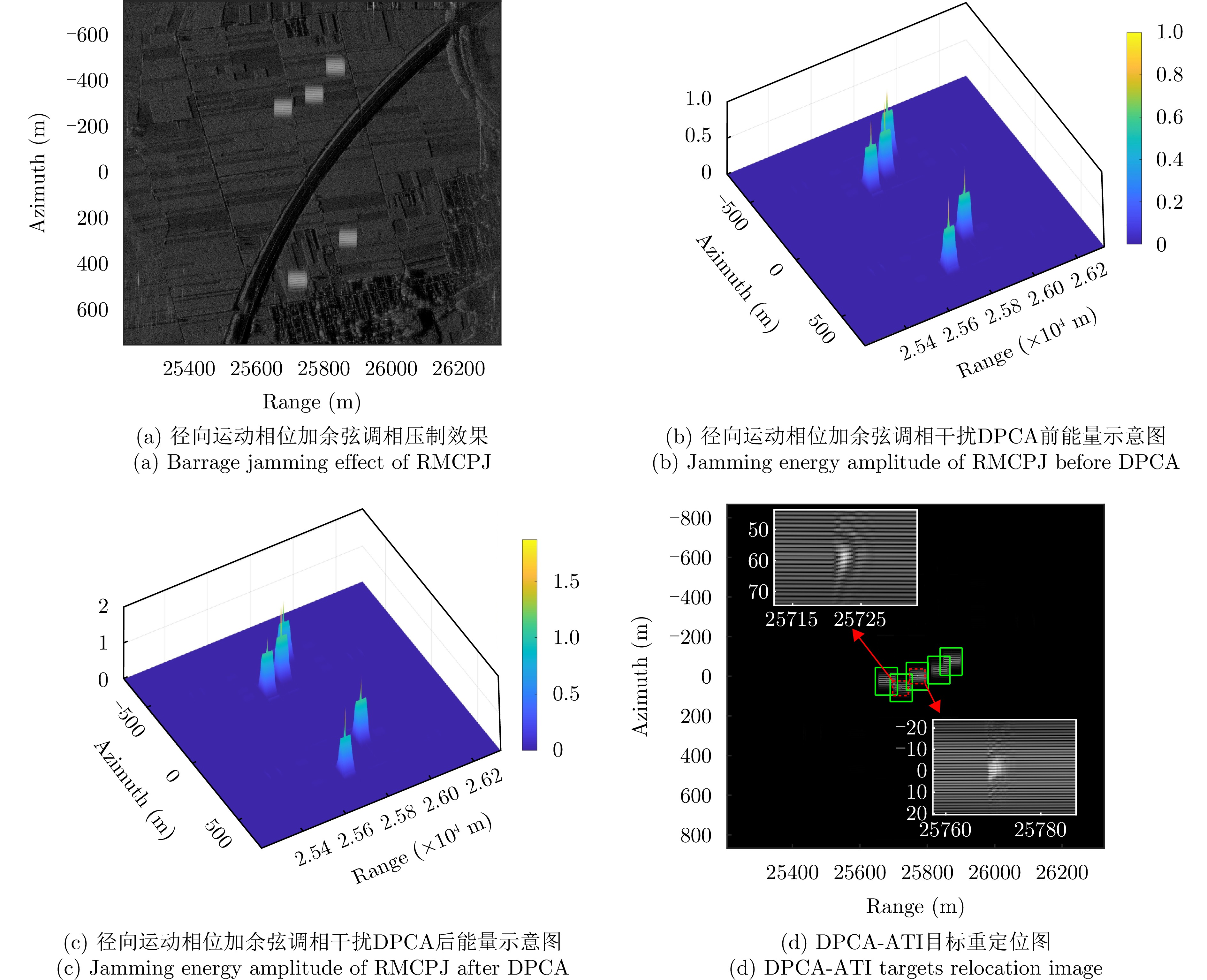
干扰方法 JSR=0 dB JSR=20 dB 正确识别目标数量 重定位误差T1; T2; T3; T4; T5 (m) 正确识别目标数量 重定位误差T1; T2; T3; T4; T5 (m) 无干扰 5 6.5; –2.9; –0.1; –3.9; 7.0 5 6.5; –2.9; –0.1; –3.9; 7.0 CRMJ 5 5.6; –3.5; 0.1; –5.9; 6.1 5 2.5; 5.8; 12.3; 17.5; 5.3 MSBJ 5 8.2; –2.6; –0.1; –4.8; 6.7 5 8.5; –1.5; –4.7; 12.0; 3.8 RMCPJ 5 –215.3; –65.4; –0.1; 44.1; 92.6 0 –263.0; –124.5; 0; 74.0; 168.2 CPMJ 0 –263.0; –124.5; 0; 74.0; 168.2 0 –263.0; –124.5; 0; 74.0; 168.2
下载: 导出CSV
表 6 X波段星载SAR参数
Table 6. X-band spaceborne SAR parameters
参数 数值 SAR平台速度 7100.0 m/s斜视角 0° 载频 9.6 GHz 调频率 2.1 MHz/μs 景中心斜距 850 km 信号带宽 66.4 MHz 脉冲持续时间 31.6 μs 天线长度 4.0 m 波束宽度 0.395° 合成孔径长度 5883.6 m相邻通道间隔 4.2 m
下载: 导出CSV
表 7 船舶的位置和速度
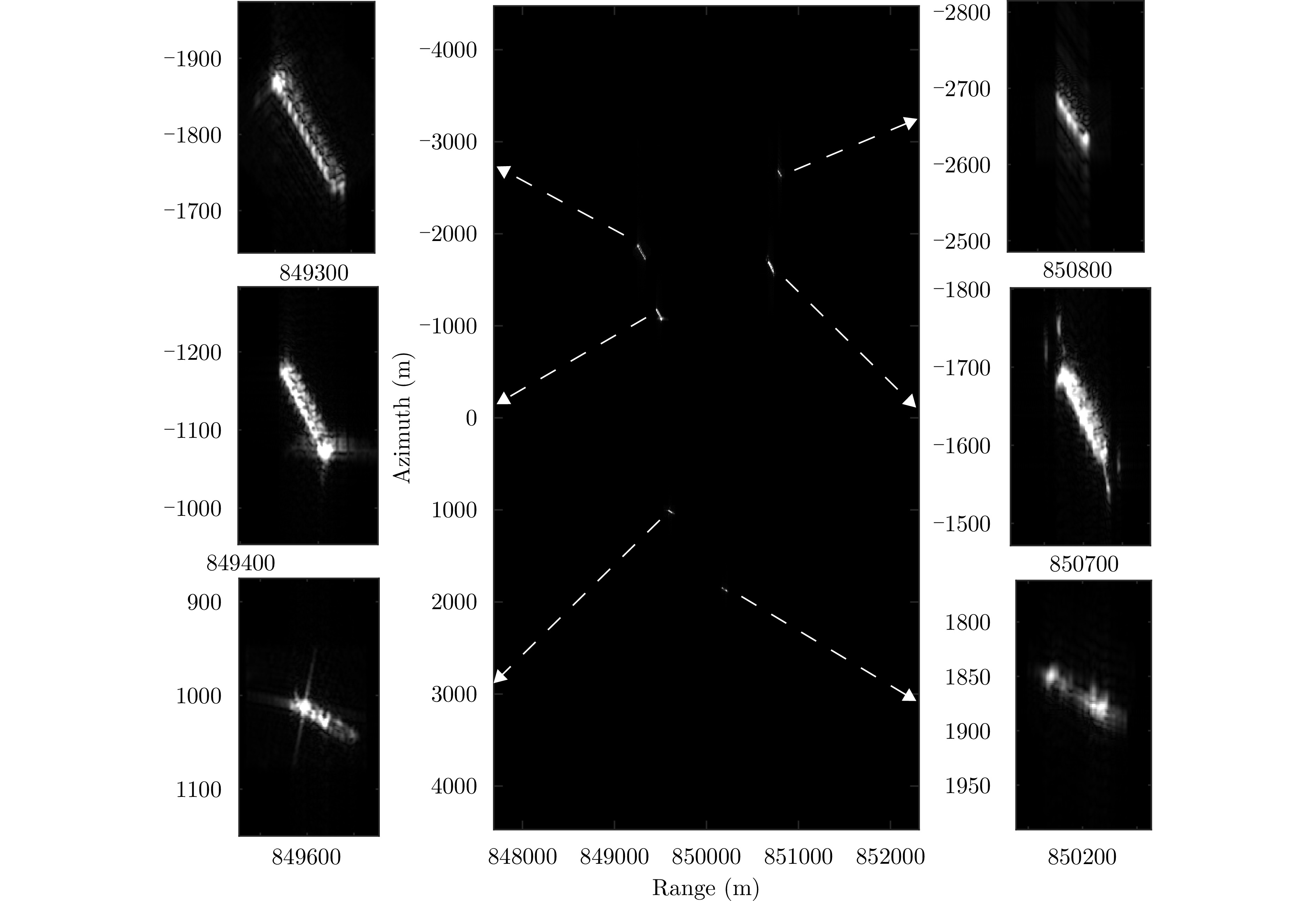
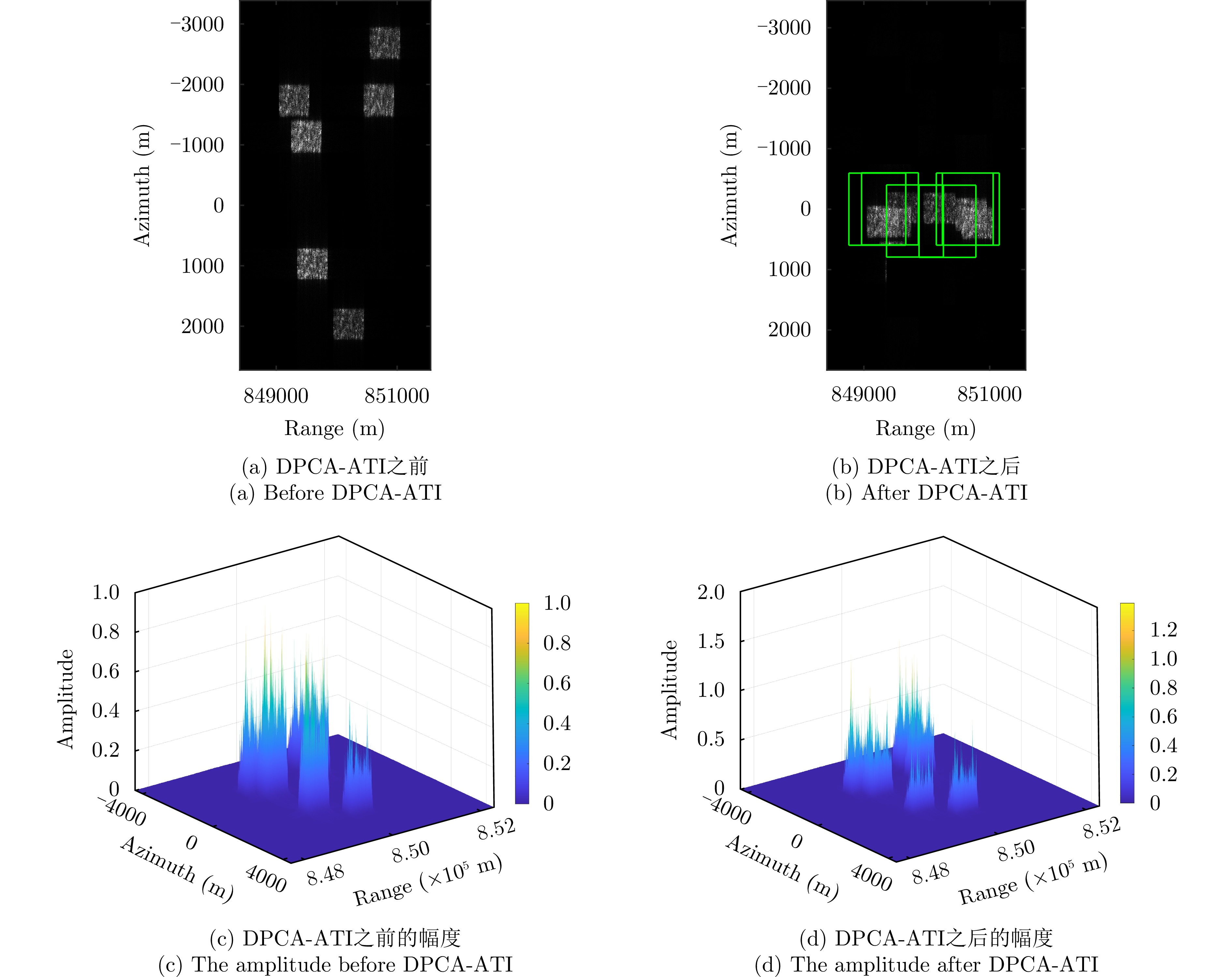
Table 7. Position and velocity parameters of ships
目标 坐标(m) 速度(距离向,方位向 m/s) T1 ( 849300 , 200)(23.8, 35.8) T2 ( 849500 , 800)(22.6, 29.8) T3 ( 849600 , –300)(–15.5, 12.8) T4 ( 850200 , 700)(–13.8, 23.5) T5 ( 850700 , 200)(21.8, 42.3) T6 ( 850800 , –750)(22.5, 52.6)
下载: 导出CSV
-
[1] CERUTTI-MAORI D, SIKANETA I, and GIERULL C H. Optimum SAR/GMTI processing and its application to the radar satellite RADARSAT-2 for traffic monitoring[J]. IEEE Transactions on Geoscience and Remote Sensing, 2012, 50(10): 3868–3881. doi: 10.1109/TGRS.2012.2186637. [2] CUMMING I G, and WONG F H. Digital Processing of Synthetic Aperture Radar Data: Algorithms and Implementation[M]. Boston: Artech House, 2004. [3] CERUTTI-MAORI D, SIKANETA I, KLARE J, et al. MIMO SAR processing for multichannel high-resolution wide-swath radars[J]. IEEE Transactions on Geoscience and Remote Sensing, 2014, 52(8): 5034–5055. doi: 10.1109/TGRS.2013.2286520. [4] ROSENBERG L and GRAY D A. Constrained fast-time STAP for interference suppression in multichannel SAR[J]. IEEE Transactions on Aerospace and Electronic Systems, 2013, 49(3): 1792–1805. doi: 10.1109/TAES.2013.6558020. [5] SUCHANDT S, RUNGE H, KOTENKOV A, et al. Extraction of traffic flows and surface current information using TerraSAR-X along-track interferometry data[C]. 2009 IEEE International Geoscience and Remote Sensing Symposium, Cape Town, South Africa, 2009: II-17–II-20. doi: 10.1109/IGARSS.2009.5417988. [6] SUWA K, YAMAMOTO K, TSUCHIDA M, et al. Image-based target detection and radial velocity estimation methods for multichannel SAR-GMTI[J]. IEEE Transactions on Geoscience and Remote Sensing, 2017, 55(3): 1325–1338. doi: 10.1109/TGRS.2016.2622712. [7] SHI Qingzhan, HUANG Jingjian, XIE Tao, et al. An active jamming method against ISAR based on periodic binary phase modulation[J]. IEEE Sensors Journal, 2019, 19(18): 7950–7960. doi: 10.1109/JSEN.2019.2905557. [8] ZHANG Jingke, DAI Dahai, XING Shiqi, et al. A novel barrage repeater jamming against SAR-GMTI[C]. 2016 10th European Conference on Antennas and Propagation (EuCAP), Davos, Switzerland, 2016: 1–5. doi: 10.1109/EuCAP.2016.7481636. [9] SUN Qingyang, SHU Ting, YU K B, et al. A novel deceptive jamming method against two-channel SAR-GMTI based on two jammers[J]. IEEE Sensors Journal, 2019, 19(14): 5600–5610. doi: 10.1109/JSEN.2019.2908030. [10] CHANG Xin, LI Yanbin, and ZHAO Yan. An improved scattered wave deceptive jamming method based on a moving jammer beam footprint against a three-channel short-time SAR GMTI[J]. IEEE Sensors Journal, 2021, 21(4): 4488–4499. doi: 10.1109/JSEN.2020.3030125. [11] SUN Qingyang, SHU Ting, TANG Mang, et al. Effective moving target deception jamming against multichannel SAR-GMTI based on multiple jammers[J]. IEEE Geoscience and Remote Sensing Letters, 2020, 17(3): 441–445. doi: 10.1109/LGRS.2019.2921678. [12] SUN Qingyang, SHU Ting, YU K B, et al. Efficient deceptive jamming method of static and moving targets against SAR[J]. IEEE Sensors Journal, 2018, 18(9): 3610–3618. doi: 10.1109/JSEN.2018.2813521. [13] ZHAO Bao, ZHOU Feng, and BAO Zheng. Deception jamming for squint SAR based on multiple receivers[J]. IEEE Journal of Selected Topics in Applied Earth Observations and Remote Sensing, 2015, 8(8): 3988–3998. doi: 10.1109/JSTARS.2014.2322612. [14] 周阳, 毕大平, 房明星, 等. 对SAR-GMTI的灵巧遮蔽干扰方法研究[J]. 现代雷达, 2016, 38(9): 79–85, 91. doi: 10.16592/j.cnki.1004-7859.2016.09.017.ZHOU Yang, BI Daping, FANG Mingxing, et al. A smart area shading jamming method for SAR-GMTI[J]. Modern Radar, 2016, 38(9): 79–85, 91. doi: 10.16592/j.cnki.1004-7859.2016.09.017. [15] 房明星, 毕大平, 沈爱国. 多通道SAR-GMTI二维余弦调相散射波干扰[J]. 上海交通大学学报, 2018, 52(3): 356–364. doi: 10.16183/j.cnki.jsjtu.2018.03.015.FANG Mingxing, BI Daping, and SHEN Aiguo. 2-D Cosinusoidal phase-modulated scatter-wave jamming to multi-channel SAR-GMTI[J]. Journal of Shanghai Jiao Tong University, 2018, 52(3): 356–364. doi: 10.16183/j.cnki.jsjtu.2018.03.015. [16] 纪朋徽, 邢世其, 代大海, 等. 基于多干扰机协同的极化SAR干扰方法[J]. 信号处理, 2024, 40(5): 907–921. doi: 10.16798/j.issn.1003-0530.2024.05.009.JI Penghui, XING Shiqi, DAI Dahai, et al. A multi-jammer cooperating jamming method against Polarimetric SAR[J]. Journal of Signal Processing, 2024, 40(5): 907–921. doi: 10.16798/j.issn.1003-0530.2024.05.009. [17] LI Guangyuan, LIU Guikun, XU Zhenyang, et al. Fast generation of deceptive jamming signal against SAR based on template space-domain processing[J]. IEEE Transactions on Aerospace and Electronic Systems, 2025, 61(6): 16169–16185. doi: 10.1109/TAES.2025.3593463. [18] LIU Guikun, LI Guangyuan, XU Zhenyang, et al. A controllable active jamming method against SAR based on secondary modulation[J]. IEEE Transactions on Aerospace and Electronic Systems, 2025, 61(6): 18262–18280. doi: 10.1109/TAES.2025.3610818. [19] LIU Guikun, LI Guangyuan, XU Zhenyang, et al. A novel jamming method based on sine function secondary modulation and phase coded modulation[J]. IEEE Journal of Selected Topics in Applied Earth Observations and Remote Sensing, 2025, 18: 11198–11212. doi: 10.1109/JSTARS.2025.3555630. [20] YANG Kaizhi, YE Wei, WU Xu, et al. Fast generation of deceptive jamming signal against space-borne SAR[J]. IEEE Journal of Selected Topics in Applied Earth Observations and Remote Sensing, 2020, 13: 5580–5596. doi: 10.1109/JSTARS.2020.3025217. [21] ZHOU Feng, ZHAO Bo, TAO Mingliang, et al. A large scene deceptive jamming method for space-borne SAR[J]. IEEE Transactions on Geoscience and Remote Sensing, 2013, 51(8): 4486–4495. doi: 10.1109/TGRS.2013.2259178. [22] WANG Yu, JIN Guodong, SONG Chen, et al. Parameterized and large-dynamic-range 2-D precise controllable SAR jamming: Characterization, modeling, and analysis[J]. IEEE Transactions on Geoscience and Remote Sensing, 2023, 61: 5209416. doi: 10.1109/TGRS.2023.3279461. [23] HUANG Long, DONG Chunxi, SHEN Zhibo, et al. The influence of rebound jamming on SAR GMTI[J]. IEEE Geoscience and Remote Sensing Letters, 2015, 12(2): 399–403. doi: 10.1109/LGRS.2014.2345091. [24] 吴晓芳, 王雪松, 梁景修. SAR-GMTI高逼真匀速运动假目标调制干扰方法[J]. 宇航学报, 2012, 33(10): 1472–1479. doi: 10.3873/j.issn.1000-1328.2012.10.016.WU Xiaofang, WANG Xuesong, and LIANG Jingxiu. Modulation jamming method for high-vivid false uniformly-moving targets against SAR-GMTI[J]. Journal of Astronautics, 2012, 33(10): 1472–1479. doi: 10.3873/j.issn.1000-1328.2012.10.016. [25] XU Zhenyang, LI Liang, LIU Guikun, et al. A multiple-targets jamming method based on phase compensation against three-channel SAR-GMTI[J]. IEEE Transactions on Aerospace and Electronic Systems, 2026, 62: 1356–1377. doi: 10.1109/TAES.2025.3629576. [26] 纪朋徽, 邢世其, 代大海, 等. 基于双干扰机协同的SAR-GMTI可控压制干扰生成方法[J]. 信号处理, 2022, 38(4): 667–676. doi: 10.16798/j.issn.1003-0530.2022.04.001.JI Penghui, XING Shiqi, DAI Dahai, et al. A controllable suppressed jamming area generation method against SAR-GMTI based on double synergetic jammers[J]. Journal of Signal Processing, 2022, 38(4): 667–676. doi: 10.16798/j.issn.1003-0530.2022.04.001. [27] 黄洪旭, 黄知涛, 吴京, 等. 对合成孔径雷达的步进移频干扰[J]. 宇航学报, 2011, 32(4): 898–902. doi: 10.3873/j.issn.1000-1328.2011.04.028.HUANG Hongxu, HUANG Zhitao, WU Jing, et al. Stepped-shift-frequency jamming to SAR[J]. Journal of Astronautics, 2011, 32(4): 898–902. doi: 10.3873/j.issn.1000-1328.2011.04.028. [28] LIU Guikun, LI Liang, MING Feng, et al. A controllable suppression jamming method against SAR based on active radar transponder[J]. Remote Sensing, 2022, 14(16): 3949. doi: 10.3390/rs14163949. [29] HUANG Lijie, SONG Chen, JIN Guodong, et al. Multiscale barrage jamming against SAR: A jamming signal modulation method and a template design method[J]. IEEE Transactions on Aerospace and Electronic Systems, 2024, 60(4): 4543–4558. doi: 10.1109/TAES.2024.3380583. [30] WANG Ying, LIU Guikun, MA Xile, et al. A convolution modulation jamming method based on the optimal combination of noise templates[J]. IEEE Geoscience and Remote Sensing Letters, 2024, 21: 4008905. doi: 10.1109/LGRS.2024.3386976. [31] HUANG Tianyou, LIN Huifu, YANG Chao, et al. A 2-D multiplication modulation jamming method against high-resolution spaceborne SAR based on defocus correction[J]. IEEE Geoscience and Remote Sensing Letters, 2025, 22: 4005805. doi: 10.1109/LGRS.2025.3534222. [32] 郭锋林, 杨康, 刘宇蕊, 等. 一种对CFAR检测门限的隐蔽干扰技术[J]. 现代电子技术, 2026, 49(3): 51–58. doi: 10.16652/j.issn.1004-373x.2026.03.009.GUO Fenglin, YANG Kang, LIU Yurui, et al. A covert jamming technique against CFAR detection thresholds[J]. Modern Electronics Technique, 2026, 49(3): 51–58. doi: 10.16652/j.issn.1004-373x.2026.03.009. -

计量
- 文章访问数:
- HTML全文浏览量:
- PDF下载量:
- 被引次数: 0