

 作者中心
作者中心 专家审稿
专家审稿 责编办公
责编办公 编辑办公
编辑办公
-
摘要: 多子带融合技术是突破雷达硬件带宽限制、提升图像分辨率的重要途径。相较于非参数化方法,基于散射模型的参数化方法在抑制噪声与实现超分辨成像方面优势显著;然而,现有基于几何绕射理论的模型由于缺乏对目标结构特性的描述,难以准确表征稀疏场景中的人造金属目标的频率响应特性。为此,该文提出一种面向稀疏场景中的人造金属目标的多子带融合方法。首先,构建了简化属性散射中心(SASC)模型,通过引入散射体长度等结构参数对频谱的影响,增强了对复杂结构散射特性的刻画能力。其次,针对该模型的阶数估计问题,提出一种改进的最大奇异值差分准则,以实现模型阶数的稳健判定。在此基础上,进一步设计了一种广义松弛算法,能够对SASC模型进行高精度参数估计,从而完成多子带信号的有效融合。实验结果表明,所提算法在保持目标结构的清晰与完整的基础上,完成了相对于单子带分辨率的6.7倍提升。Abstract: Multiband fusion technology is essential for enhancing radar image resolution by overcoming the hardware bandwidth limits of radar systems. Compared with nonparametric approaches, parametric methods based on scattering models offer notable advantages in noise suppression and super-resolution imaging. However, models based on the Geometric Theory of Diffraction (GTD) are inherently limited for analyzing scatterers with continuous structures, as GTD is an asymptotic high-frequency method suited primarily for discrete scattering centers. Consequently, it fails to adequately characterize the frequency response of such continuous scatterers. To address this issue, a multiband fusion method tailored for targets that can be sparsely represented by strong scattering centers is proposed. First, a Simplified Attributed Scattering Center (SASC) model is constructed, which improves the characterization of scattering properties by incorporating the influence of the scatterer length on the frequency spectrum. Second, to address the model order estimation problem, a modified maximum singular value difference criterion is introduced to robustly estimate the model order. Building on this, a generalized RELAX-based algorithm is designed to achieve high-precision parameter estimation for the SASC model, thereby enabling effective fusion of multiband signals. Experimental results demonstrate that the proposed algorithm achieves a 6.7-fold improvement in resolution relative to the single sub-band case, while preserving the clarity and integrity of the target structure.
-
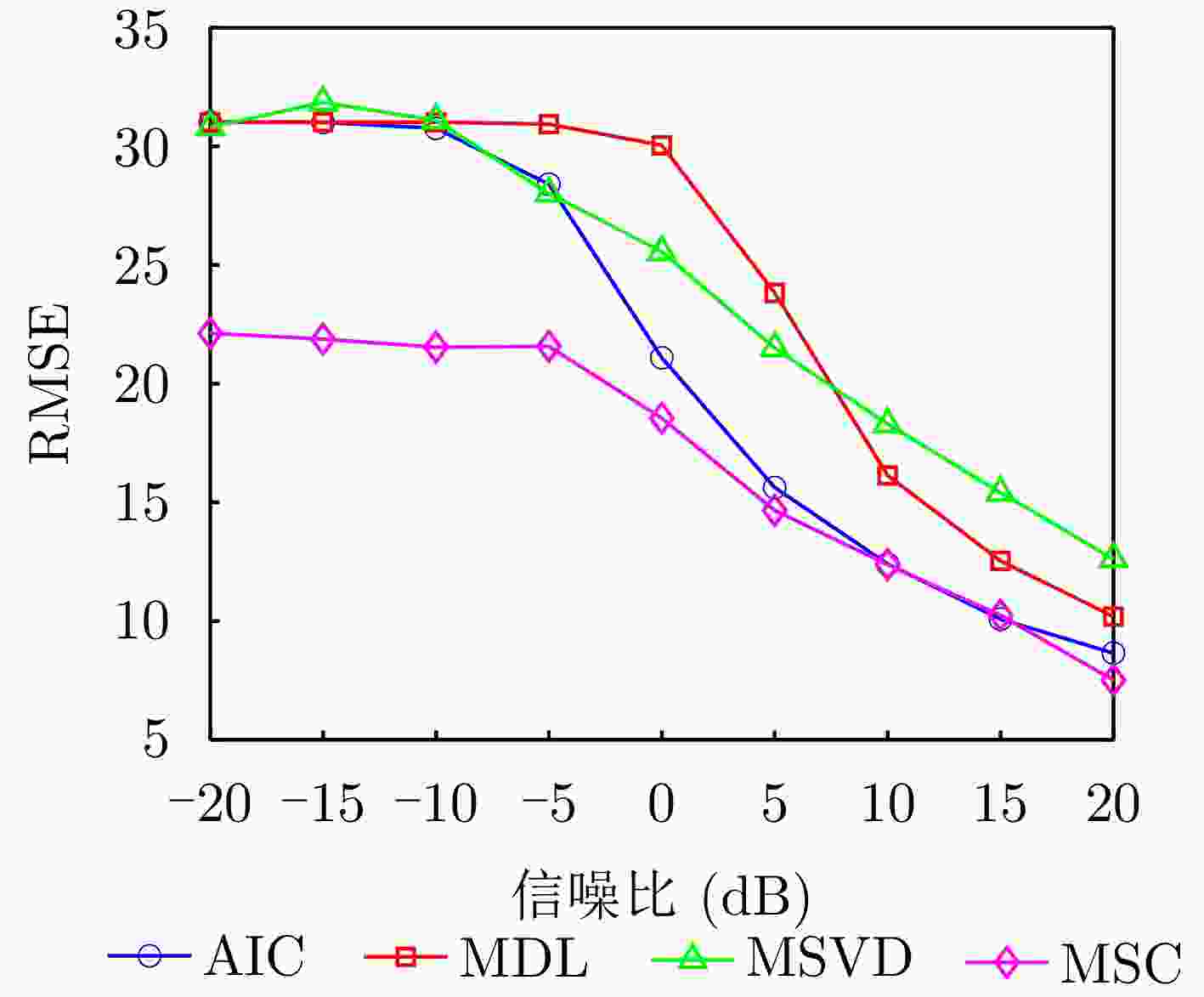
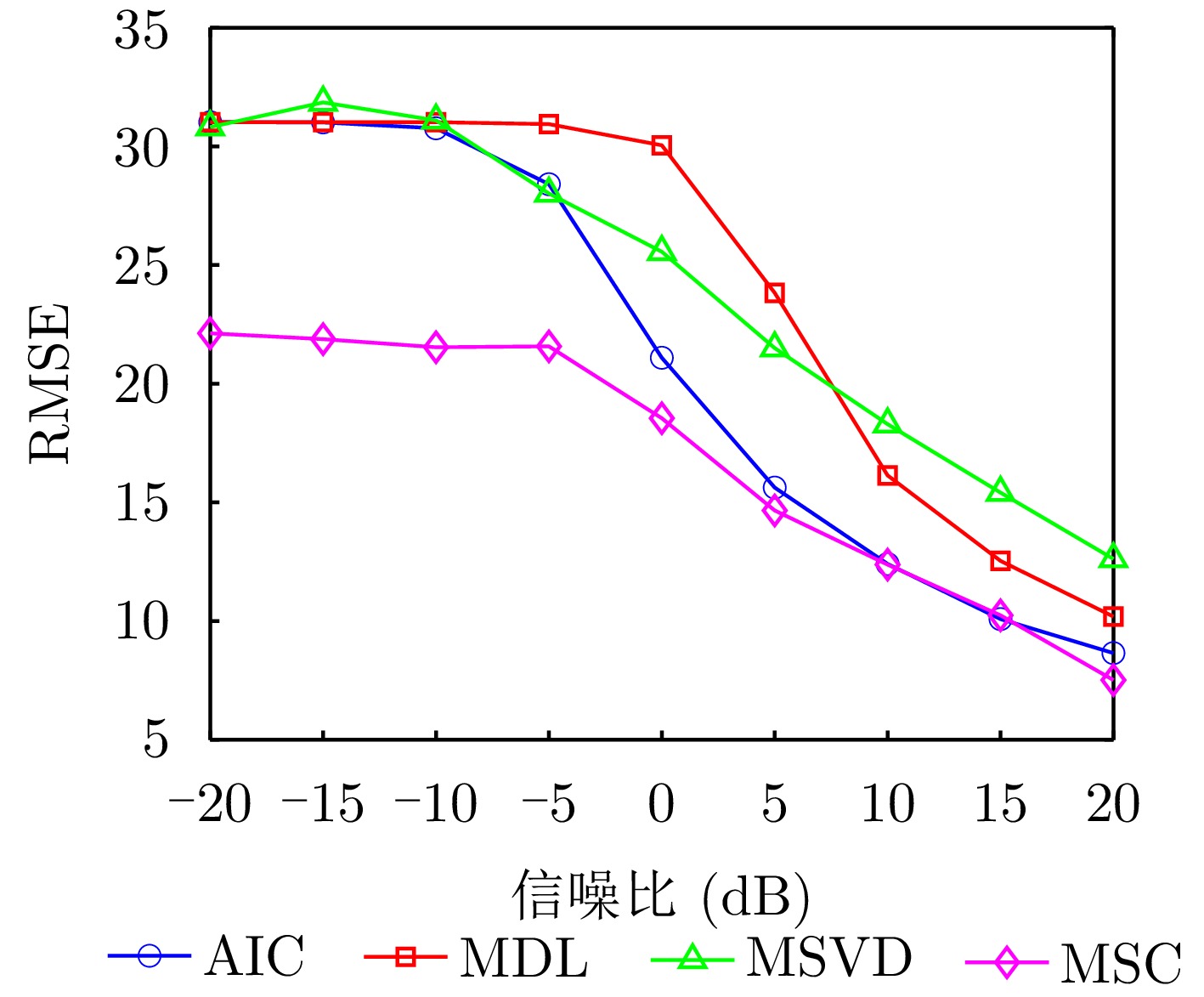
图 3 各阶数估计方法的RMSE对比图
Figure 3. RMSEs of order estimation results by different criterion
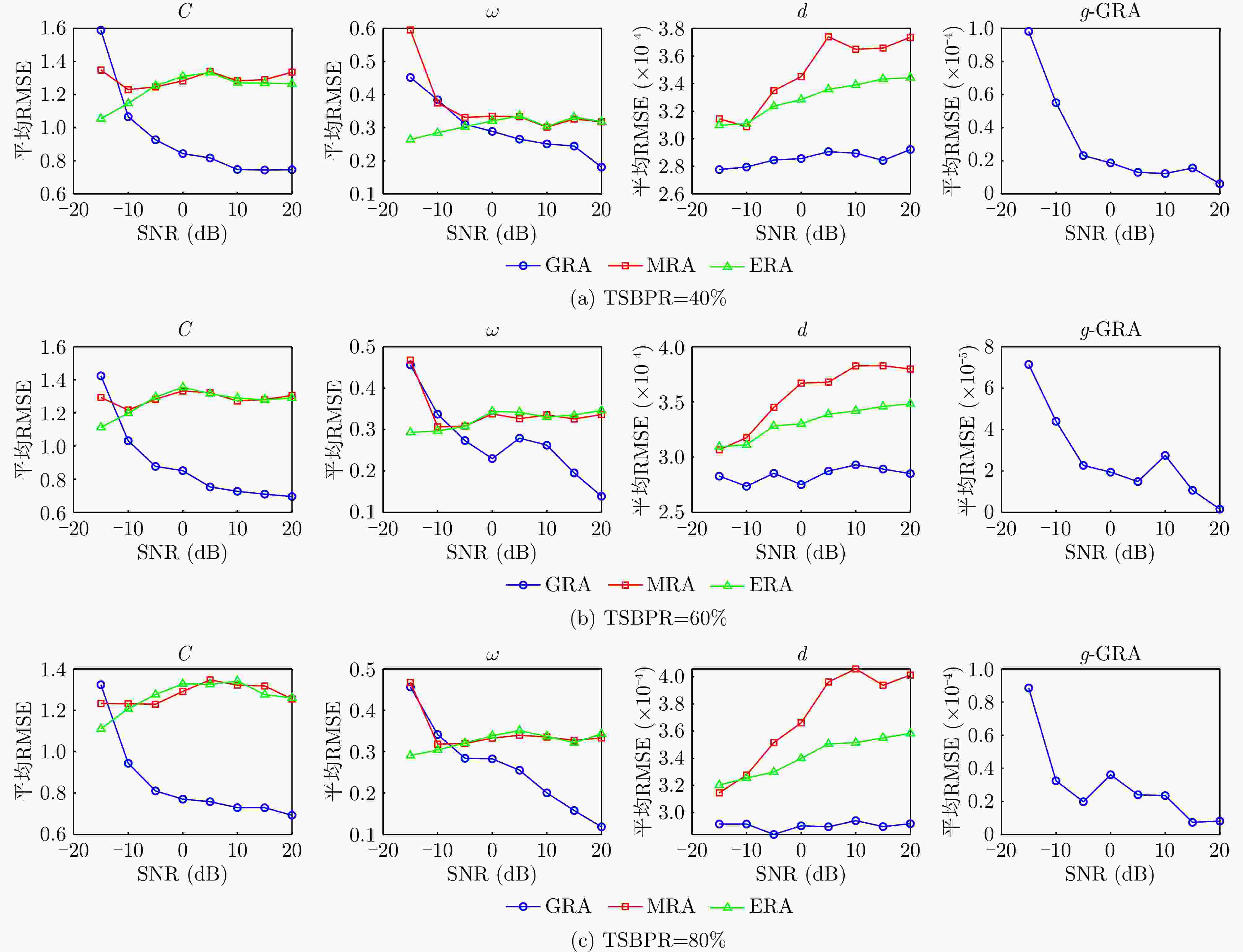
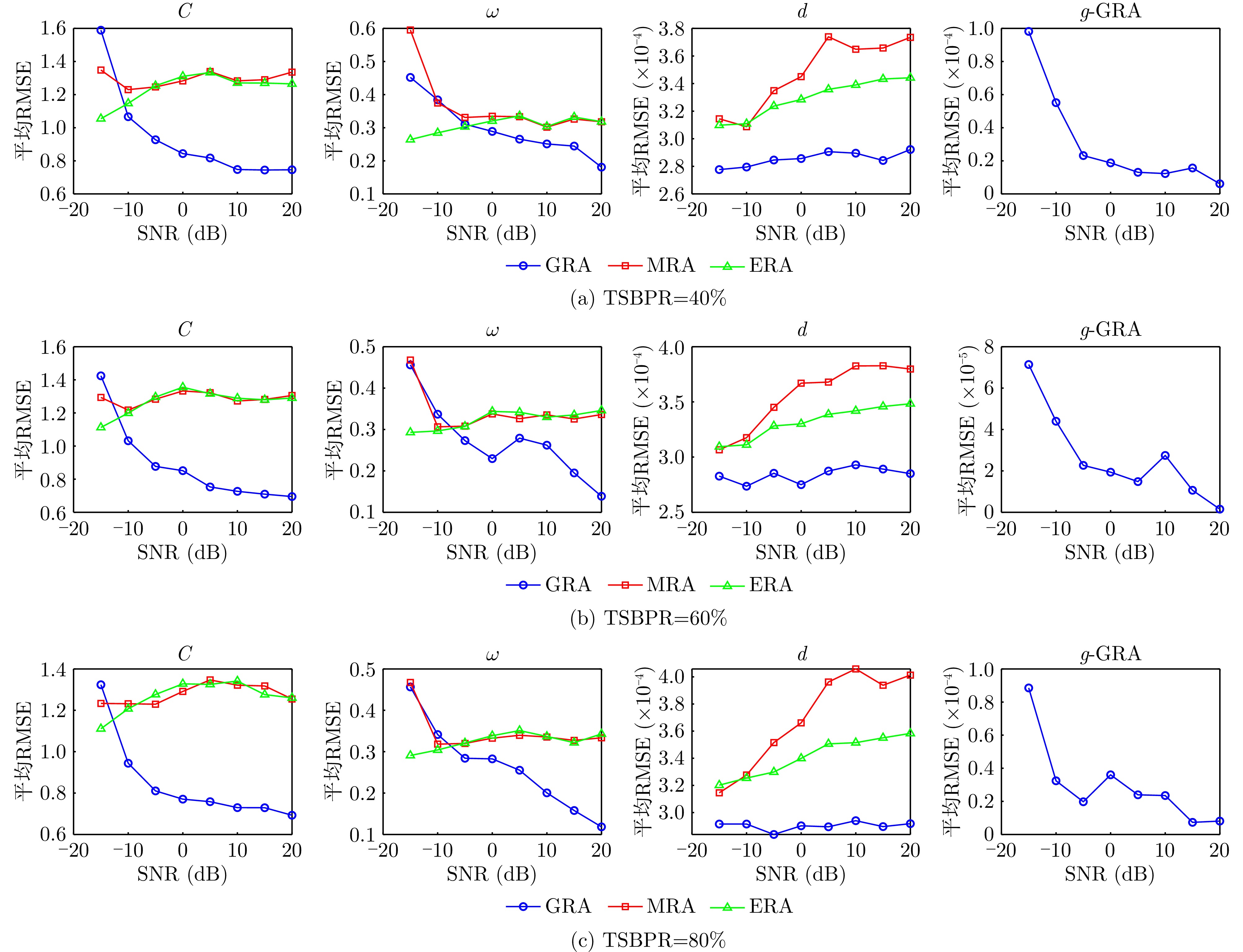
图 4 各方法对参数$ C,g,d,\omega $的估计RMSE对比图
Figure 4. RMSEs of parameter estimation results by different methods
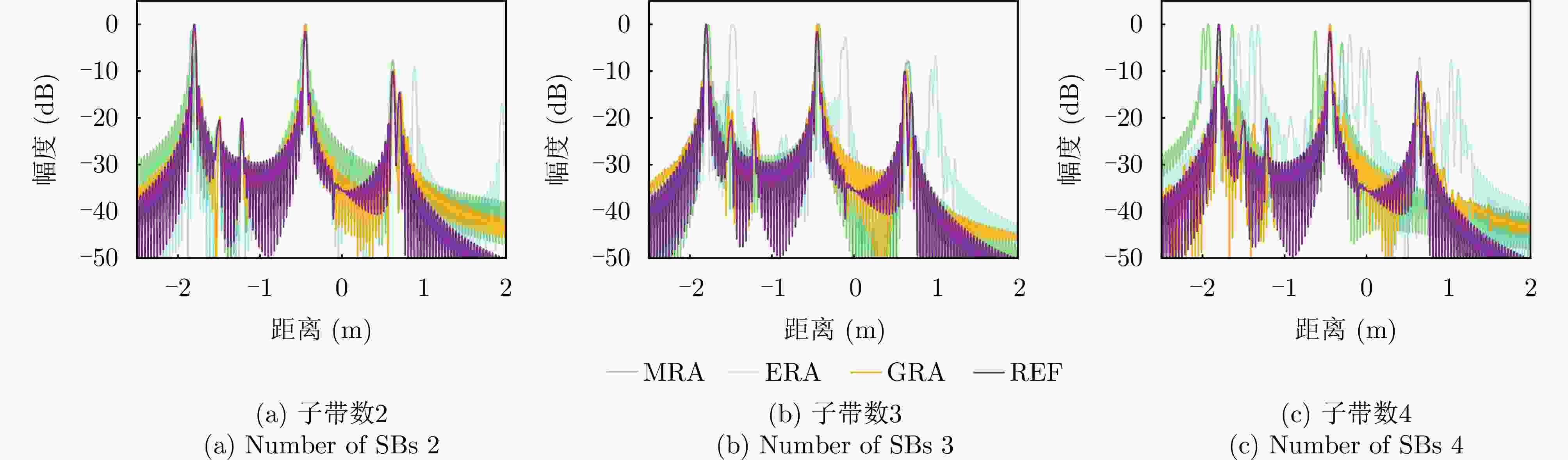
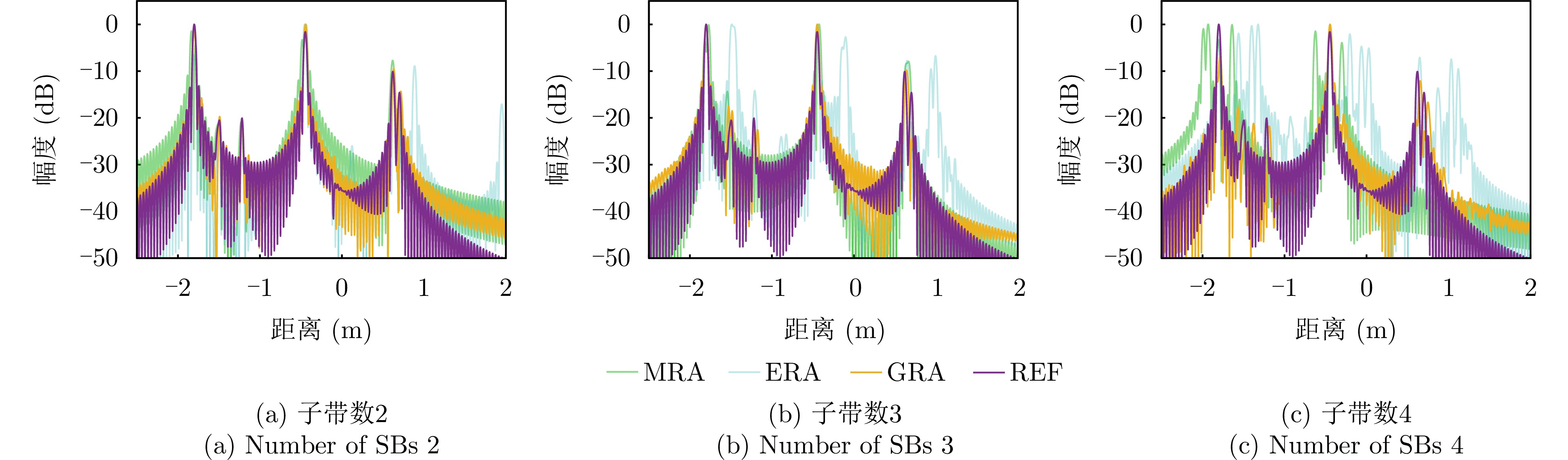
图 5 不同子带数量下,不同方法重建的全频带一维像与参考一维像的对比
Figure 5. Comparison of range profiles reconstructed by different methods with the reference range profile
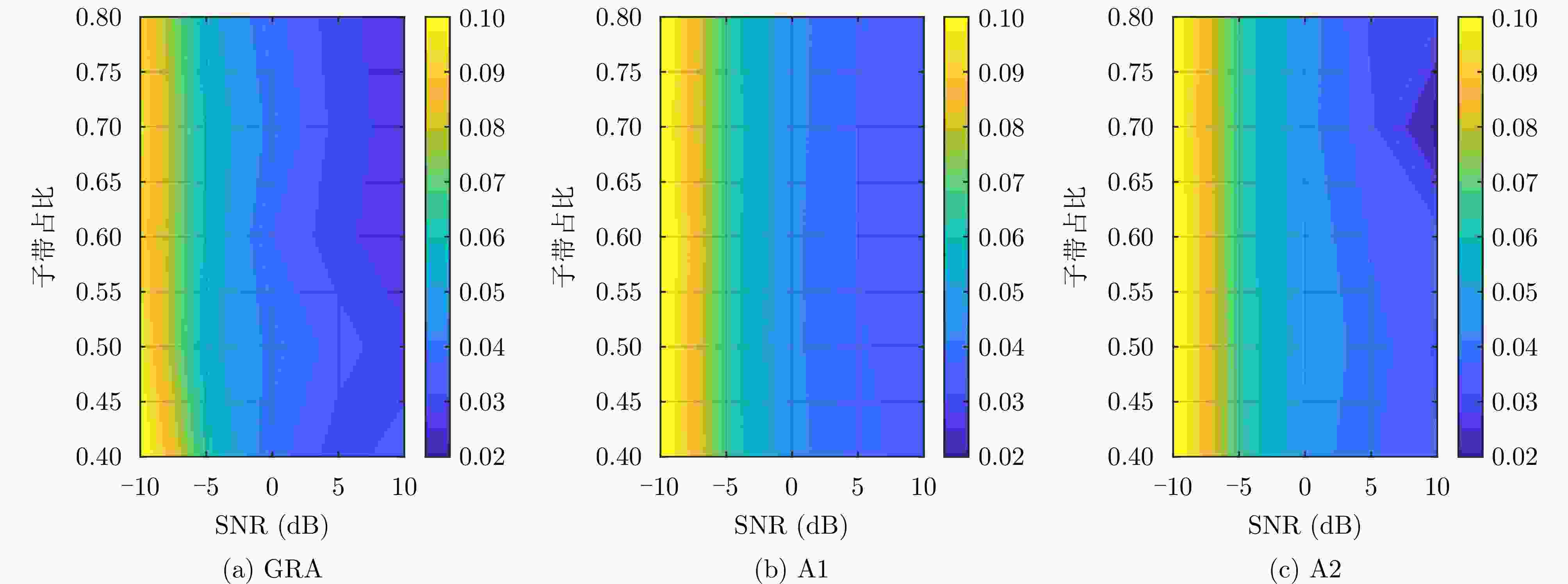
图 6 不同方法重建的全频带一维像与参考一维像的RMSEs
Figure 6. RMSEs of the range profiles reconstructed by different methods between the reference range profile
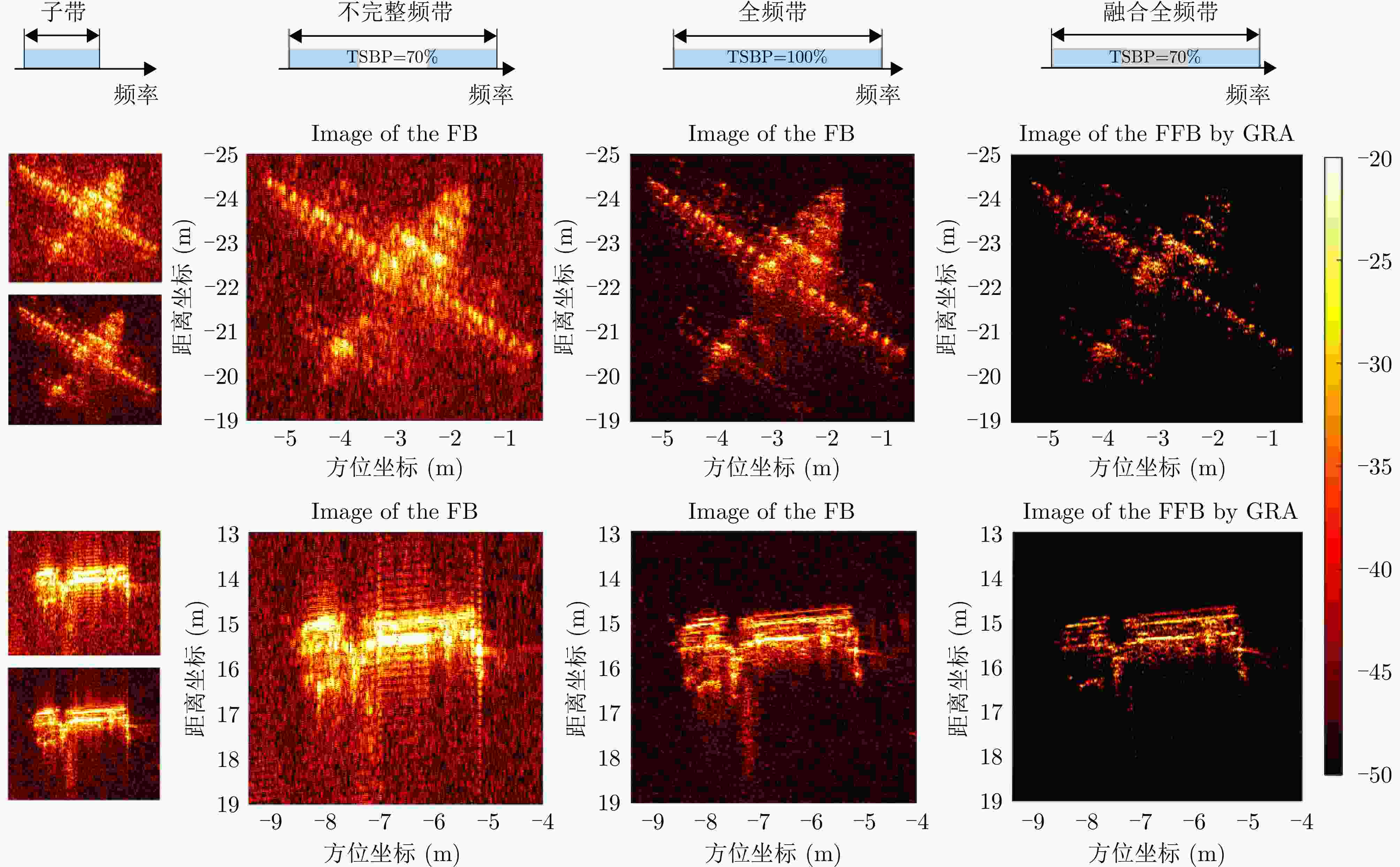
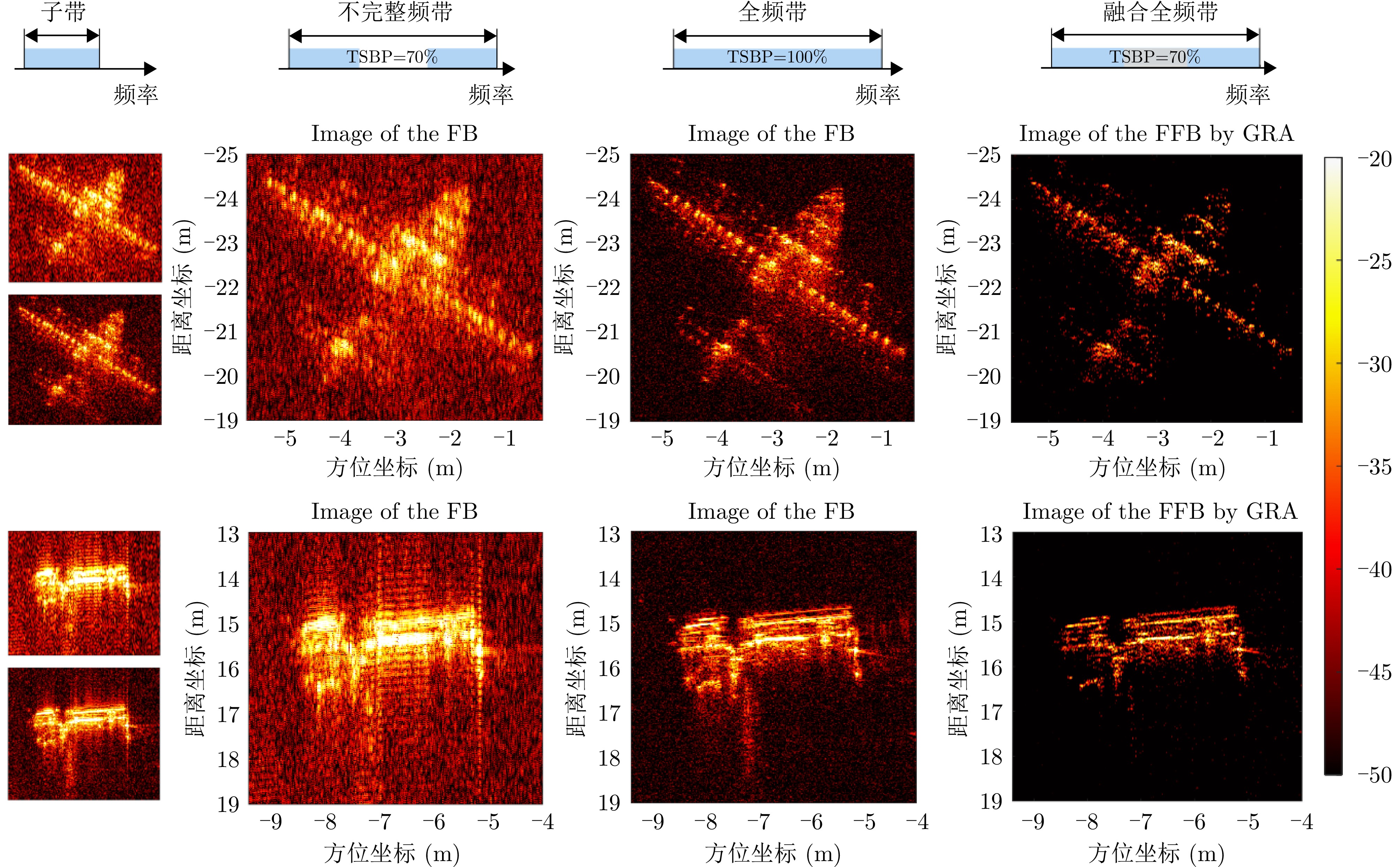
图 8 子带图像、不完整频带成像、所提算法所获融合全频带图像与参考全频带图像对比
Figure 8. Images of the subbands, the incomplete band imaging, the fused full band and the reference full band
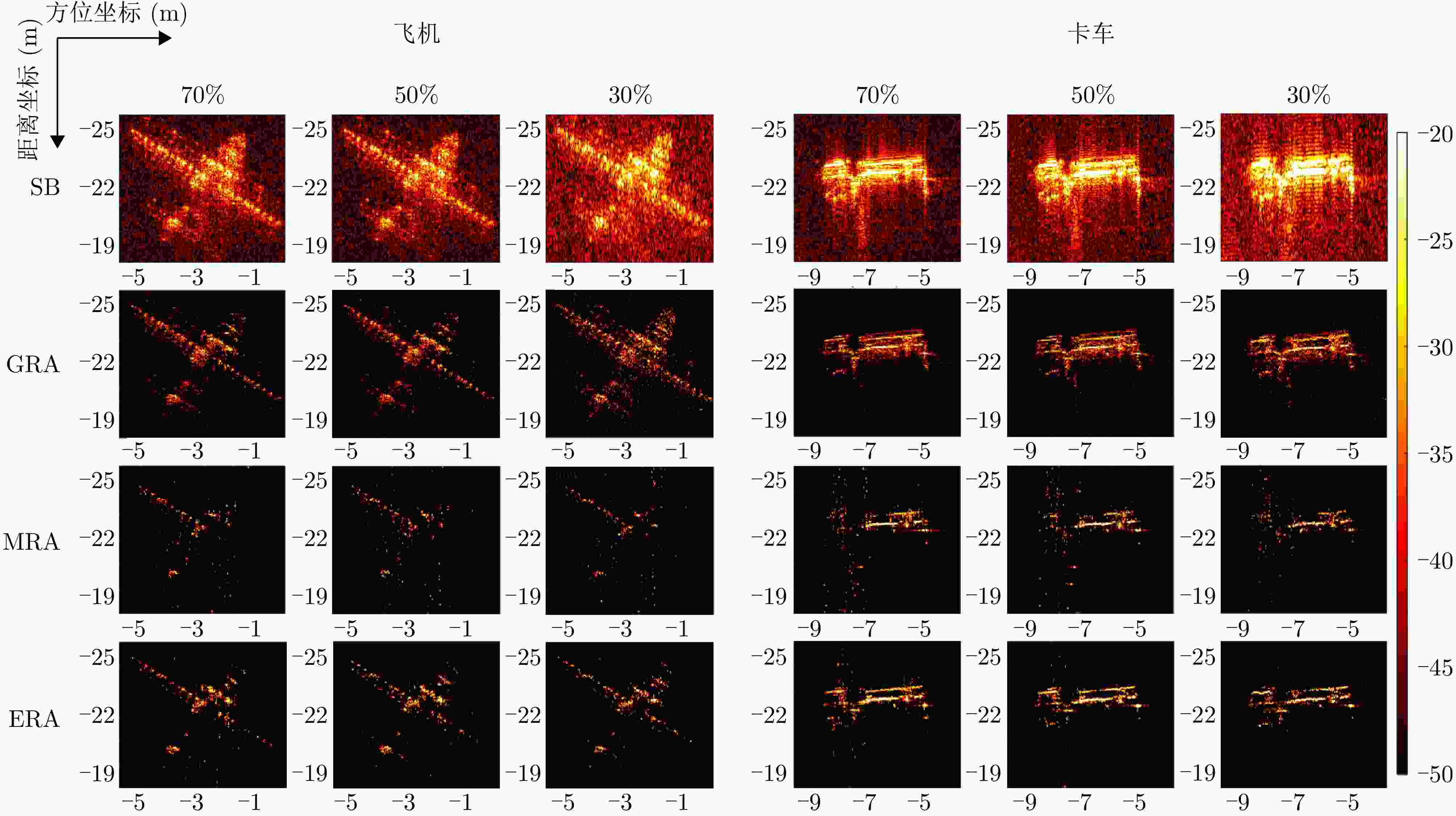
图 9 不同融合方法的成像结果
Figure 9. Imaging results by different algorithms with different TSBPs
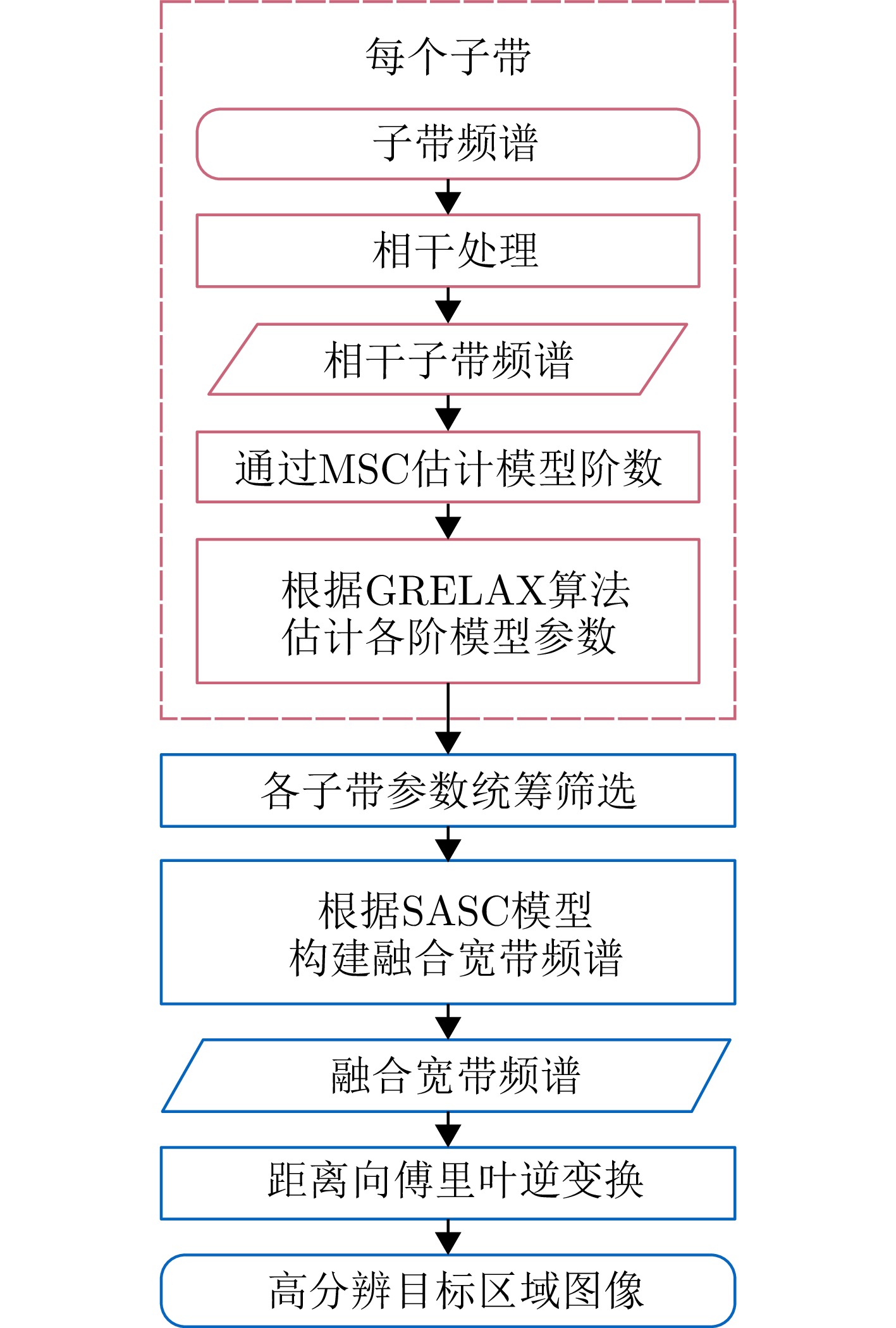
1 基于G-RELAX算法的参数估计伪代码流程
1. Pseudocode of parameter estimation based on G-RELAX algorithm
初始化:设置初始参数$ \boldsymbol{y}\leftarrow {\boldsymbol{S}}_{i},\hat{\boldsymbol{\varTheta }}\leftarrow \boldsymbol{0} $ 循环1:对每个分量$ k=1 $到$ {P}_{i} $逐个分量进行参数估计 1.1:频率估计
$ {\hat{\omega }}_{k}=\arg \mathop{\max }\limits_{\omega }\left| \text{FFT}[{\boldsymbol{y}}_{k}\odot \text{sinc}({\hat{g}}_{k}\boldsymbol{m})\odot \exp ({\hat{d}}_{k}\boldsymbol{m})]\right| $1.2:阻尼因子估计$ {\hat{d}}_{k}=\arg \mathop{\max }\limits_{d}\dfrac{\| {\boldsymbol{v}}^{{\mathrm{H}}}{\boldsymbol{y}}_{k}{\| }^{2}}{\| \boldsymbol{v}\| _{2}^{2}} $ 1.3:sinc参数估计$ {\hat{g}}_{k}=\arg \mathop{\max }\limits_{g}\dfrac{\| {\boldsymbol{v}}^{{\mathrm{H}}}{\boldsymbol{y}}_{k}{\| }^{2}}{\| \boldsymbol{v}\| _{2}^{2}} $ 1.4:幅度参数估计$ {\hat{C}}_{k}=\dfrac{{\boldsymbol{v}}^{{\mathrm{H}}}{\boldsymbol{y}}_{k}}{\| \boldsymbol{v}\| _{2}^{2}} $ 1.5:收敛判断$ \Delta \text{cost} \lt \epsilon $ 1.6:更新残差$ {\boldsymbol{y}}_{k}\leftarrow (\boldsymbol{y}-{\hat{{\boldsymbol{\phi}} }}_{k}) $ 循环2:全局精化迭代对所有分量进行联合优化 2.1:重新估计各分量固定其他分量,优化每个分量参数 2.2:全局收敛判断$ \Delta \text{global}\_ \text{cost} \lt \epsilon $ 输出:返回估计结果$ \{{\hat{C}}_{k},{\hat{g}}_{k},{\hat{\omega }}_{k},{\hat{d}}_{k}\}_{k=1}^{{P}_{i}} $  下载: 导出CSV
表 1 参数估计仿真信号参数
Table 1. Simulated signal parameters for parameter estimation
参数 数值 频率范围 4~8 GHz 采样点数 600 散射中心数 [5, 50] 散射参数 随机 信噪比 5$* $[–4, 4] dB
下载: 导出CSV
表 2 微波光子雷达信号参数
Table 2. Signal parameters of microwave photonic radar
参数 数值 频率范围 12.2~18.2 GHz 去斜采样率 312.5 MHz 脉冲重复时间 180 μs 中心视角 60° 最远作用距离 1.4 km
下载: 导出CSV
表 3 不同TSBP下的图像质量参数
Table 3. Parameters of image quality under different TSBPs
信号 30% TSBP 50% TSBP 70% TSBP Entropy Contrast RMSE Entropy Contrast RMSE Entropy Contrast RMSE FB 16.1635 1.2353 0 16.1635 1.2353 0 16.1635 1.2353 0 SB1 16.2405 1.3726 0.0515 16.2158 1.3319 0.0498 16.2007 1.3032 0.0476 SB2 16.1897 1.3075 0.0535 16.1692 1.2722 0.0512 16.1603 1.2602 0.0505 FFB (GRA) 14.3308 0.4496 0.0367 14.2087 0.4121 0.0351 14.1241 0.3978 0.0338 FFB (MRA) 14.0223 0.2086 0.0418 13.9709 0.2547 0.0412 14.0237 0.2252 0.0349 FFB (ERA) 14.2785 0.4796 0.0392 14.0376 0.4518 0.0379 14.0521 0.3519 0.0341
下载: 导出CSV
-
[1] SUWA K and IWAMOTO M. A two-dimensional bandwidth extrapolation technique for polarimetric synthetic aperture radar images[J]. IEEE Transactions on Geoscience and Remote Sensing, 2007, 45(1): 45–54. doi: 10.1109/TGRS.2006.885406. [2] ZOU Yongqiang, GAO Xunzhang, LI Xiang, et al. A matrix pencil algorithm based multiband iterative fusion imaging method[J]. Scientific Reports, 2016, 6(1): 19440. doi: 10.1038/srep19440. [3] WANG Jianping, AUBRY P, and YAROVOY A. Wavenumber-domain multiband signal fusion with matrix-pencil approach for high-resolution imaging[J]. IEEE Transactions on Geoscience and Remote Sensing, 2018, 56(7): 4037–4049. doi: 10.1109/TGRS.2018.2821001. [4] CUOMO K M, PION J E, and MAYHAN J T. Ultrawide-band coherent processing[J]. IEEE Transactions on Antennas and Propagation, 1999, 47(6): 1094–1107. doi: 10.1109/8.777137. [5] NAISHADHAM K and PIOU J E. A robust state space model for the characterization of extended returns in radar target signatures[J]. IEEE Transactions on Antennas and Propagation, 2008, 56(6): 1742–1751. doi: 10.1109/TAP.2008.916932. [6] GUHA S, BATHELT A, CONDE M H, et al. Radar band fusion using frame-based compressed sensing[J]. IEEE Journal of Selected Topics in Signal Processing, 2023, 17(2): 403–415. doi: 10.1109/JSTSP.2022.3220403. [7] JIANG Wen, HUANG Jiajie, and LI Wangzhe. A novel multiband fusion method based on a small multiband-measurement matrix and a nonconvex Log-Sum regularization[J]. IEEE Geoscience and Remote Sensing Letters, 2023, 20: 3500805. doi: 10.1109/LGRS.2023.3237868. [8] SONG Shaoqiu, DAI Yongpeng, SONG Yongping, et al. Efficient near-field radar microwave imaging based on joint constraints of low-rank and structured sparsity at low SNR[J]. IEEE Transactions on Microwave Theory and Techniques, 2025, 73(5): 2962–2977. doi: 10.1109/TMTT.2024.3479189. [9] ZHANG Ying, WANG Tingjing, ZHAO Huapeng, et al. Multiple radar subbands fusion algorithm based on support vector regression in complex noise environment[J]. IEEE Transactions on Antennas and Propagation, 2018, 66(1): 381–392. doi: 10.1109/TAP.2017.2769135. [10] ZHOU Feng and BAI Xueru. High-resolution sparse subband imaging based on Bayesian learning with hierarchical priors[J]. IEEE Transactions on Geoscience and Remote Sensing, 2018, 56(8): 4568–4580. doi: 10.1109/TGRS.2018.2827072. [11] HU Pengjiang, XU Shiyou, WU Wenzhen, et al. Sparse subband ISAR imaging based on autoregressive model and smoothed l0 algorithm[J]. IEEE Sensors Journal, 2018, 18(22): 9315–9323. doi: 10.1109/JSEN.2018.2869832. [12] WU Kejiang, CUI Wei, and XU Xiaojian. Superresolution radar imaging via peak search and compressed sensing[J]. IEEE Geoscience and Remote Sensing Letters, 2022, 19: 4024805. doi: 10.1109/LGRS.2022.3184067. [13] ZHANG Huanhuan and CHEN Rushan. Coherent processing and superresolution technique of multi-band radar data based on fast sparse Bayesian learning algorithm[J]. IEEE Transactions on Antennas and Propagation, 2014, 62(12): 6217–6227. doi: 10.1109/TAP.2014.2361158. [14] HAI Yu, WU Junjie, MA Yuxin, et al. Microwave photonic radar lost bandwidth spectrum recovery algorithm based on improved TSPN-ADMM-Net[J]. IEEE Transactions on Geoscience and Remote Sensing, 2023, 61: 5210415. doi: 10.1109/TGRS.2023.3286888. [15] HAI Yu, WU Junjie, PU Wei, et al. Joint optimization of spectrum recovery and target scattering parameter estimation in microwave photonic radar[J]. IEEE Transactions on Aerospace and Electronic Systems, 2024, 60(6): 8100–8117. doi: 10.1109/TAES.2024.3424788. [16] JIANG Wen, LIU Jianwei, YANG Jiyao, et al. A novel multiband fusion method based on a modified RELAX algorithm for high-resolution and anti-non-Gaussian colored clutter microwave imaging[J]. IEEE Transactions on Geoscience and Remote Sensing, 2022, 60: 5105312. doi: 10.1109/TGRS.2021.3109724. [17] HUANG Jiajie, JIANG Wen, LIU Jianwei, et al. A resolution-improving method for multiband imaging based on an extrapolated RELAX algorithm[J]. Remote Sensing, 2024, 16(23): 4446. doi: 10.3390/rs16234446. [18] GERRY M J, POTTER L C, GUPTA I J, et al. A parametric model for synthetic aperture radar measurements[J]. IEEE Transactions on Antennas and Propagation, 1999, 47(7): 1179–1188. doi: 10.1109/8.785750. [19] DUAN Jia, ZHANG Lei, XING Mengdao, et al. Polarimetric target decomposition based on attributed scattering center model for synthetic aperture radar targets[J]. IEEE Geoscience and Remote Sensing Letters, 2014, 11(12): 2095–2099. doi: 10.1109/LGRS.2014.2320053. [20] YANG Dongwen, NI Wei, DU Lan, et al. Efficient attributed scatter center extraction based on image-domain sparse representation[J]. IEEE Transactions on Signal Processing, 2020, 68: 4368–4381. doi: 10.1109/TSP.2020.3011332. [21] JIANG Wen. Research on reconstruction-large-bandwidth ISAR imaging method based on multiband scattering center extraction[D]. [Ph.D. dissertation], Shanghai Jiao Tong University, 2023: 47–66. [22] AKAIKE H. A new look at the statistical model identification[J]. IEEE Transactions on Automatic Control, 1974, 19(6): 716–723. doi: 10.1109/TAC.1974.1100705. [23] RISSANEN J. Modeling by shortest data description[J]. Automatica, 1978, 14(5): 465–471. doi: 10.1016/0005-1098(78)90005-5. -





计量
- 文章访问数:
- HTML全文浏览量:
- PDF下载量:
- 被引次数: 0