

 作者中心
作者中心 专家审稿
专家审稿 责编办公
责编办公 编辑办公
编辑办公
A Task Priority-driven Resource Scheduling Method of Asynchronous Phased Array Radar Network for Cognitive Tracking in Clutter
-
摘要: 相控阵雷达网络在复杂环境下的多目标跟踪能力受到有限资源与异步采样机制的双重制约,尤其在跟踪与搜索(TAS)体制下,搜索与跟踪任务之间的资源竞争以及量测不确定性会显著影响系统整体跟踪性能。针对上述问题,该文提出一种杂波环境下任务优先级驱动的异步相控阵雷达网络(APARN)认知跟踪资源调度方法(TPRS)。该方法在资源调度模型中引入软关联概率以及虚警密度、检测概率等环境参数,刻画量测不确定性对资源调度决策的影响;并在TAS体制下,针对目标已通过多帧检测完成航迹起始的场景,将资源调度重点聚焦于跟踪任务,在资源受限条件下按优先级实施序贯调度。在此基础上,结合集中式资源调度与分布式状态估计融合构建APARN闭环多目标跟踪框架,通过联合概率数据关联(JPDA)实现多目标状态估计,利用协方差交集(CI)完成异步量测融合,并以引入关联不确定性的后验Cramér-Rao下界(PCRLB)作为调度性能评价指标。针对该优化问题多维决策变量耦合且属于NP难问题的特点,提出一种多维解耦与顺序动态规划相结合的两阶段求解方法,以降低计算复杂度并实现资源受限条件下雷达-目标动态匹配与异步驻留时间的自适应调度。仿真结果表明,在资源受限与杂波干扰条件下,所提方法能够有效提升APARN的整体多目标跟踪精度与资源利用效率,为异步多雷达协同跟踪系统的工程化应用提供了可行技术路径。Abstract: The multi-target tracking performance of phased array radar networks is fundamentally constrained by limited resources and asynchronous sampling mechanisms, especially under the Track-And-Search (TAS) mode. In this context , competition between search and tracking tasks, together with measurement uncertainty, substantially affects overall system performance. To address these challenges, this paper proposes a Task Priority-DrivenResource Scheduling (TPRS) method for asynchronous phased array radar networks (APARNs) operating in cluttered environments. The proposed method incorporates soft association probabilities and environmental parameters, including false alarm density and detection probability, into the resource scheduling model to characterize the impact of measurement uncertainty on scheduling decisions. Within the TAS framework, where target tracking is established through multiframe detection, the scheduling strategy emphasizes tracking tasks and performs priority-driven sequential allocation under resource constraints. On this basis, a closed-loop multi-target tracking framework for APARNs is developed by integrating centralized resource scheduling with distributed state estimation and fusion. Joint probabilistic data association is employed for multi-target state estimation, while covariance intersection is adopted for asynchronous measurement fusion. The posterior Cramér-Rao lower bound incorporating association uncertainty is used as the scheduling performance metric. Given that the resulting optimization problem involves coupled multidimensional decision variables and is NP-hard, a two-stage solution method combining multidimensional decoupling and sequential dynamic programming is developed to reduce computational complexity and enable adaptive scheduling of radar–target assignments and asynchronous dwell time under resource constraints. Simulation results demonstrate that, under limited resources and clutter interference, the proposed method effectively improves overall multi-target tracking accuracy and resource utilization efficiency in APARNs, thereby providing a feasible technical framework for the practical deployment of asynchronous multiradar cooperative tracking systems.
-
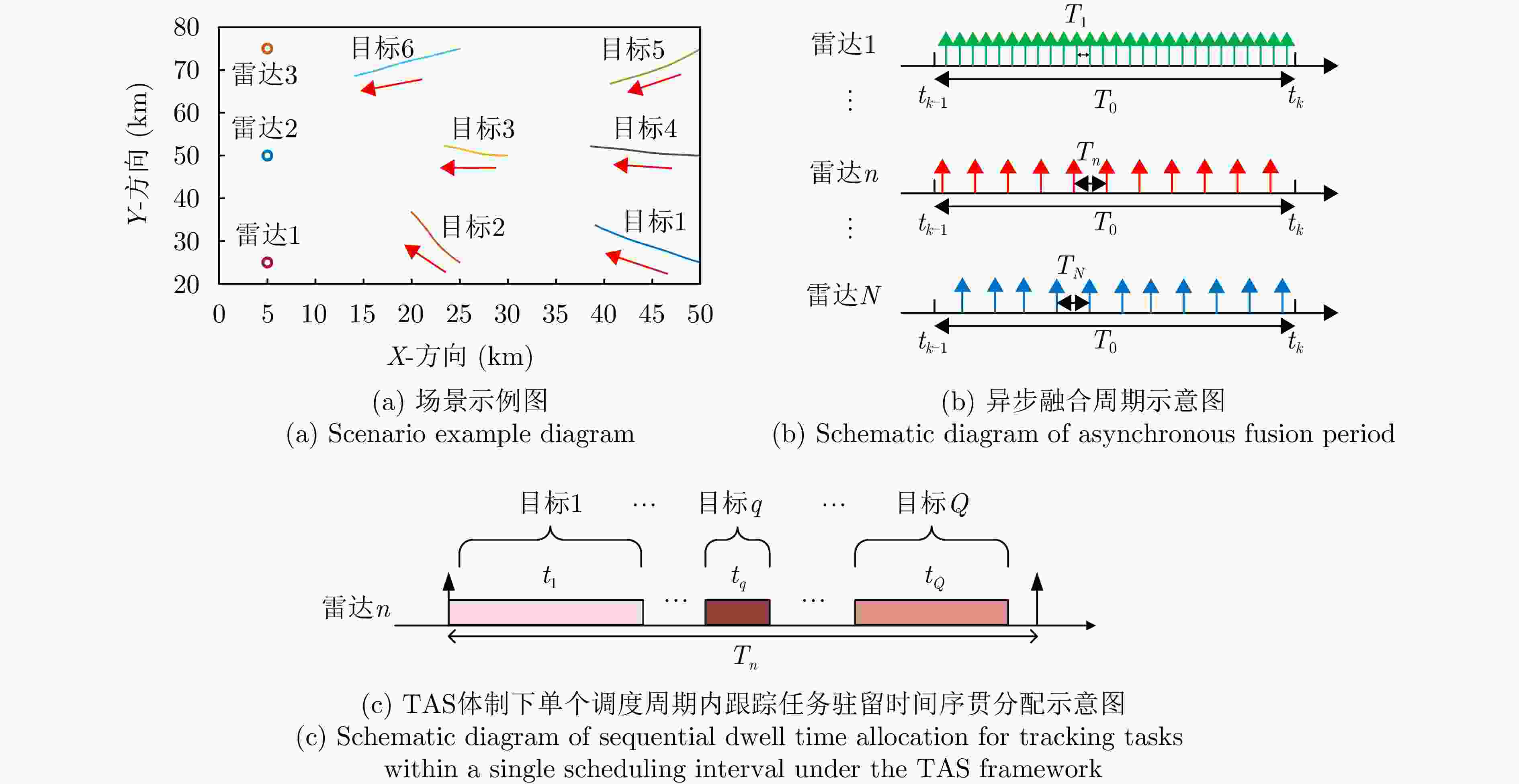
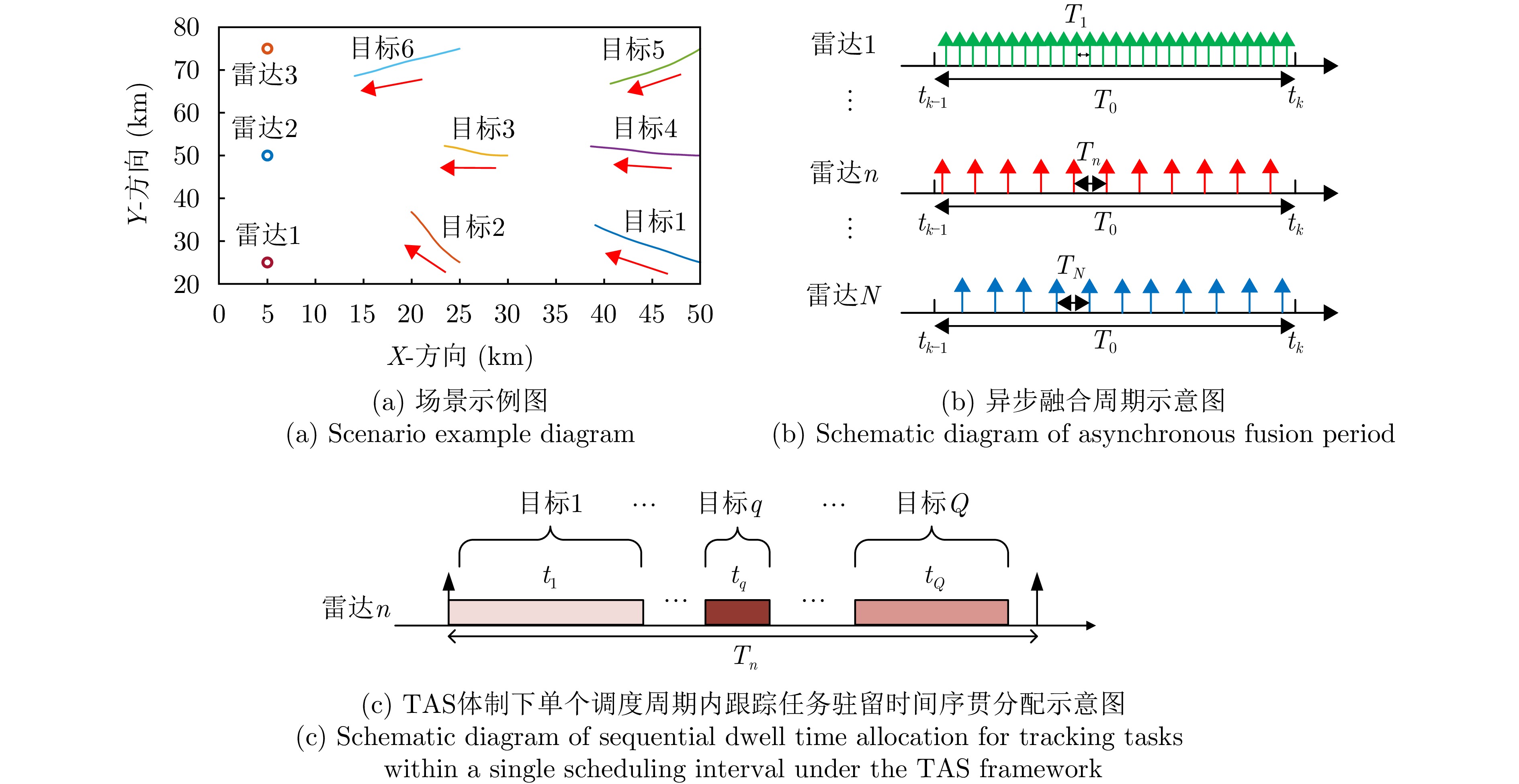
图 1 异步系统结构及关键参数说明图例
Figure 1. Asynchronous system architecture and illustration of key parameter descriptions
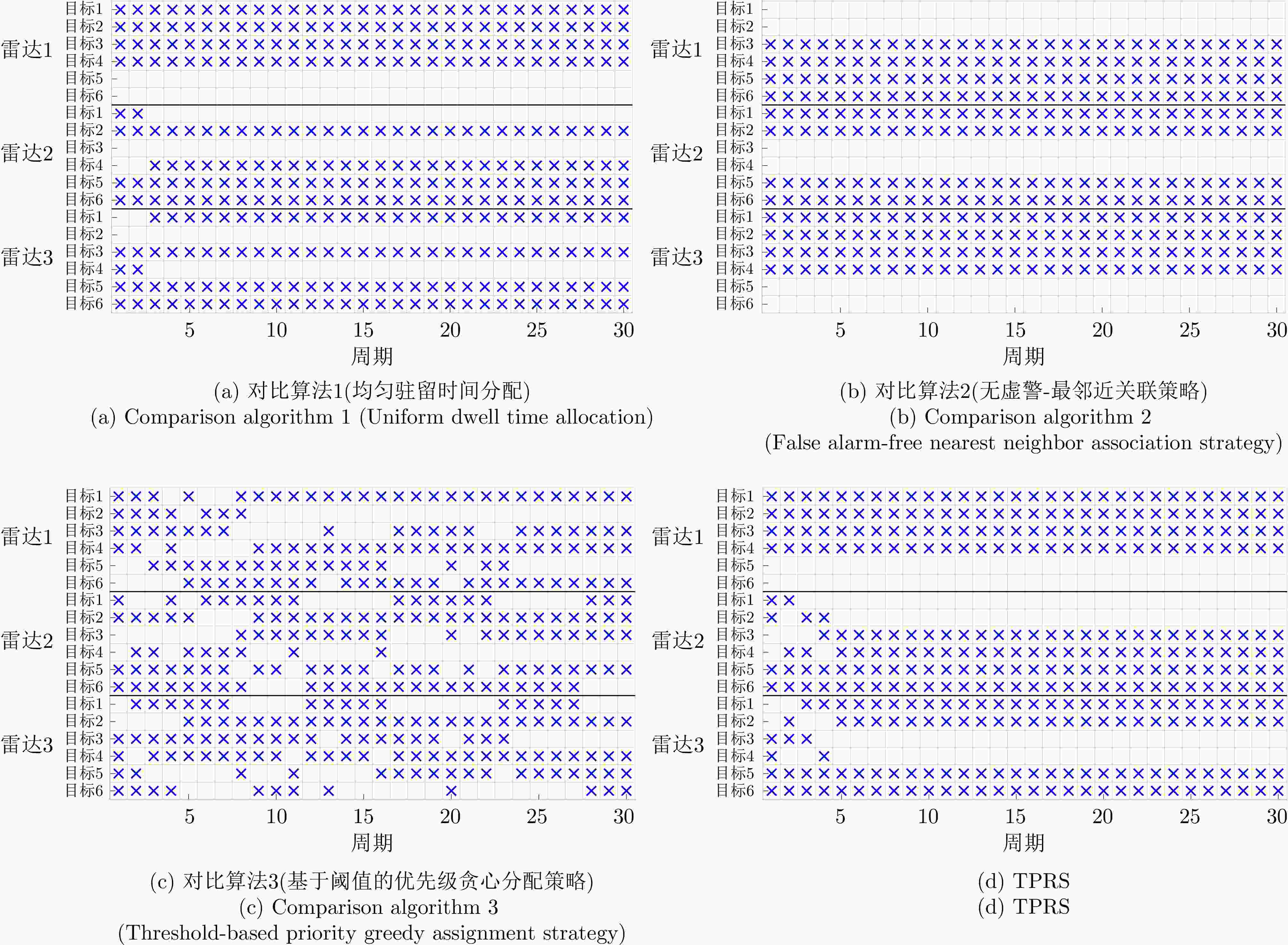
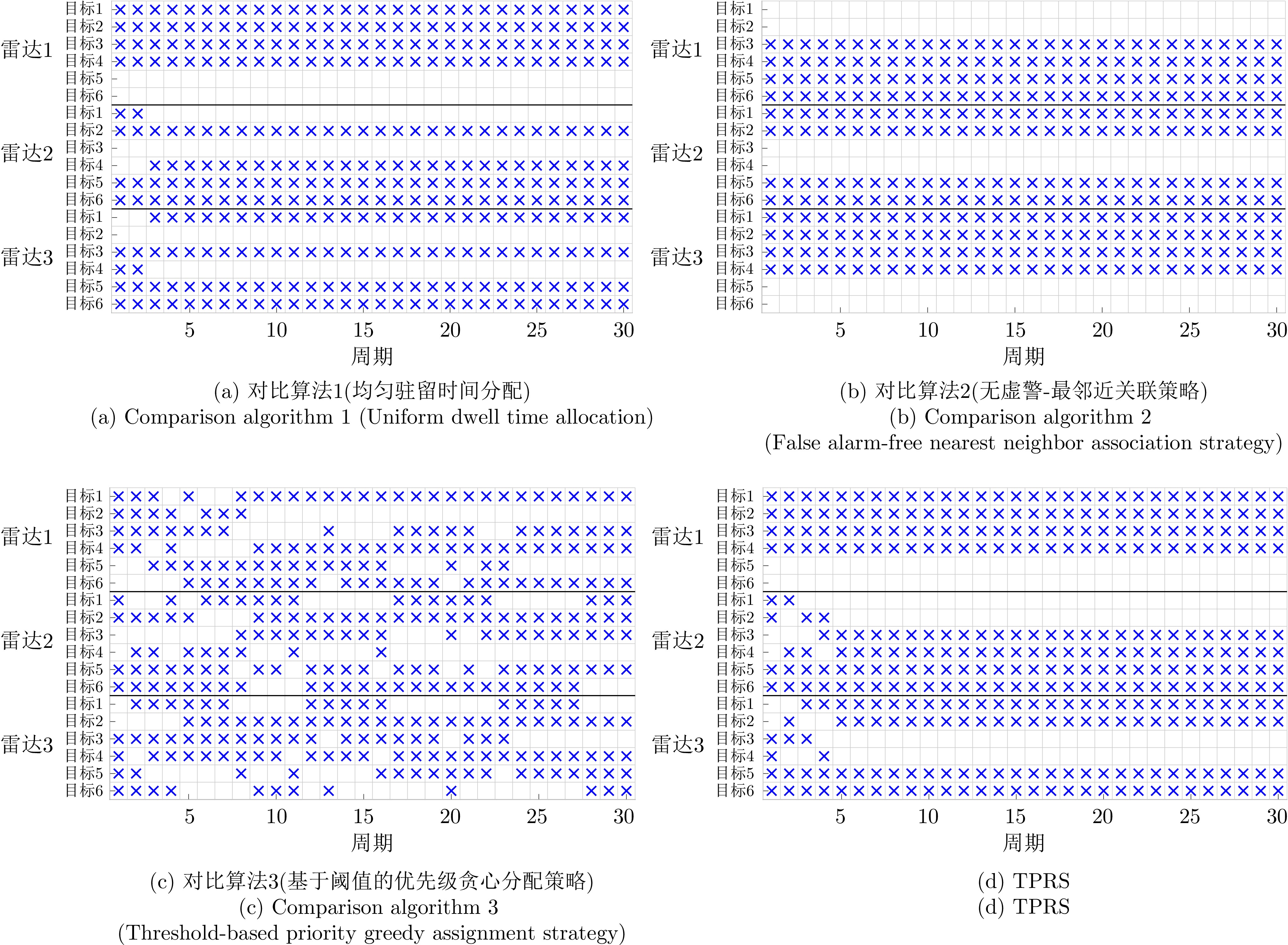
图 4 APARN在MTT过程中的单次雷达-目标分配结果
Figure 4. Single radar-target assignment results of APARN during MTT
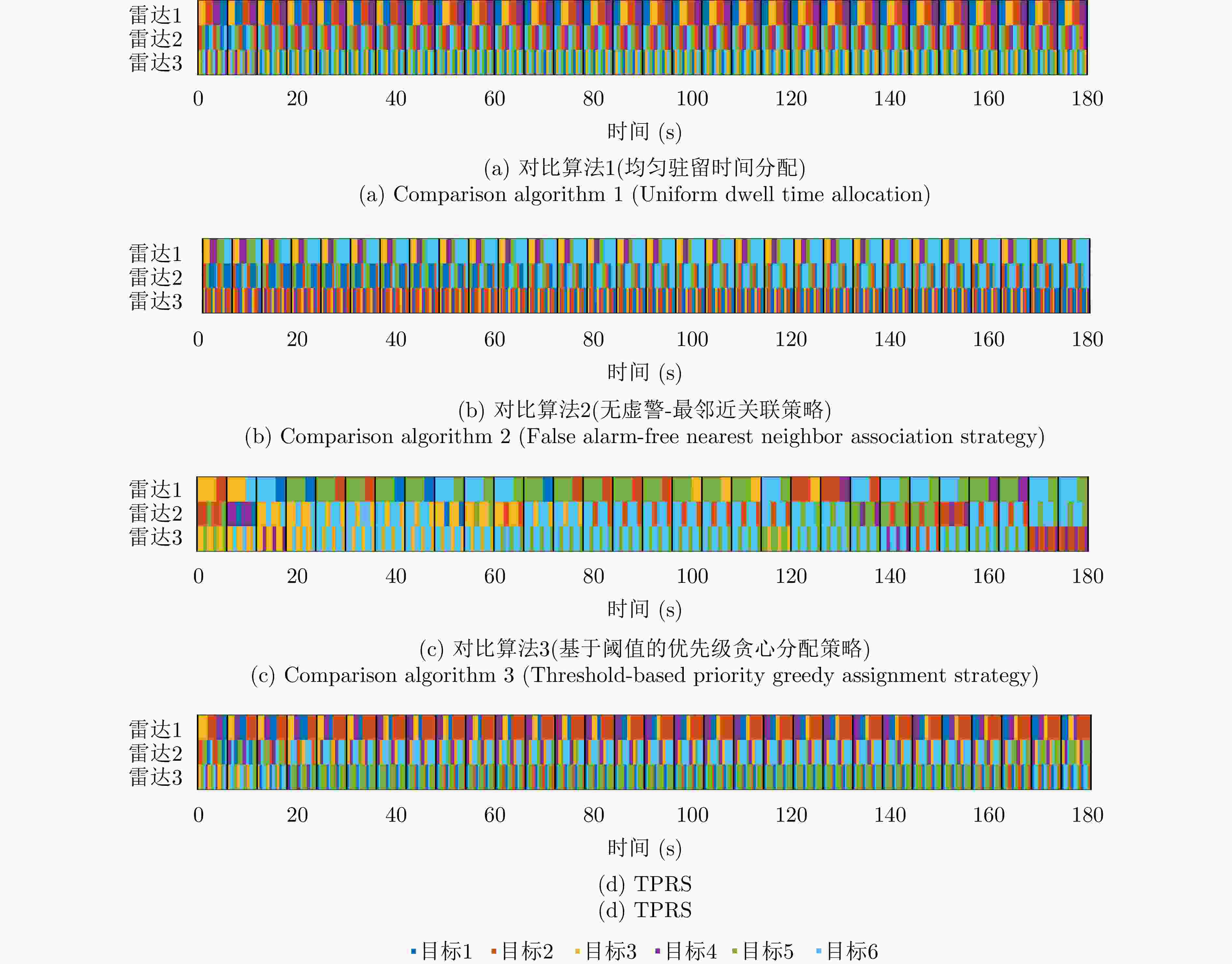
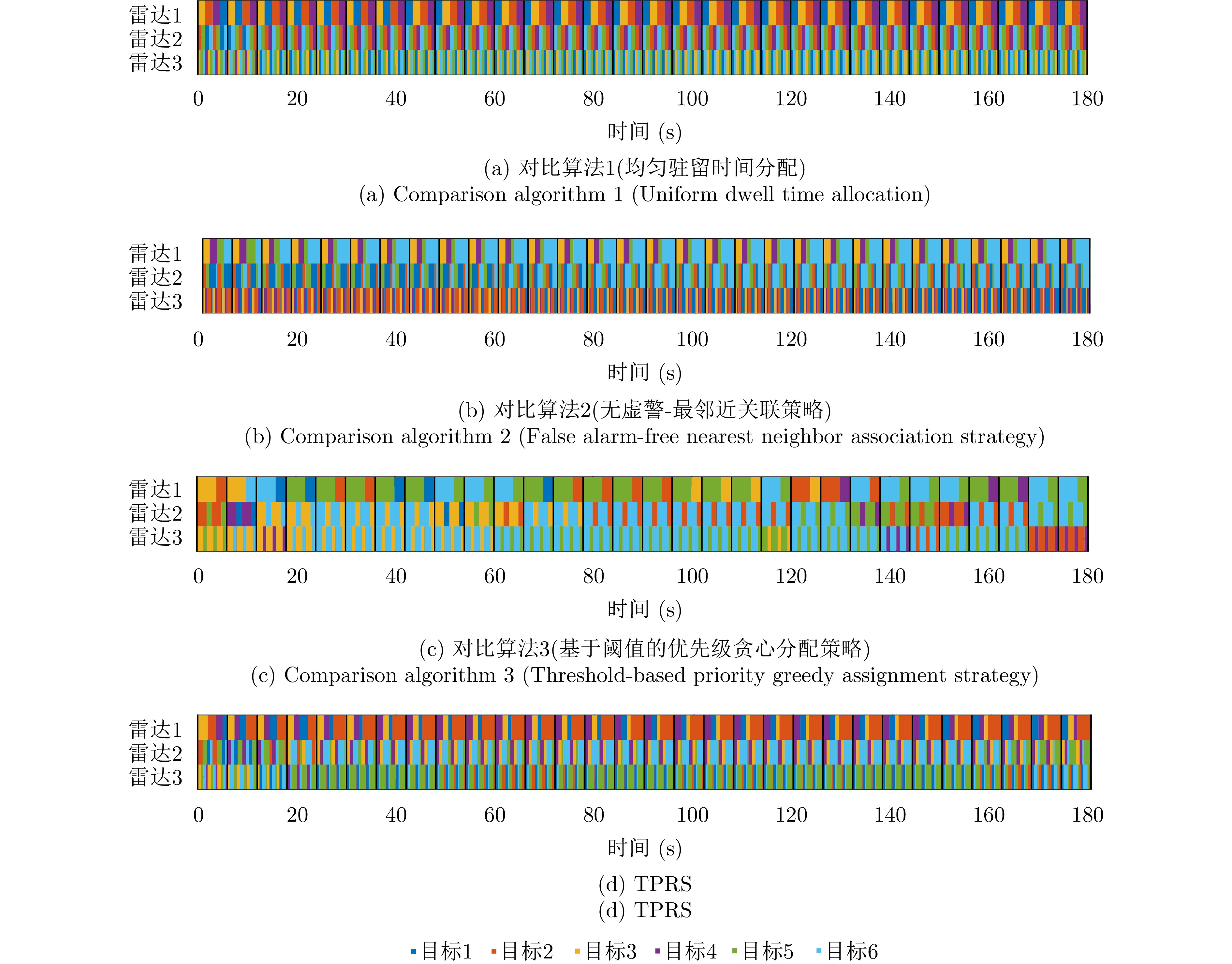
图 5 APARN在MTT过程中单次的驻留时间分配结果
Figure 5. Single dwell time allocation results of APARN during MTT
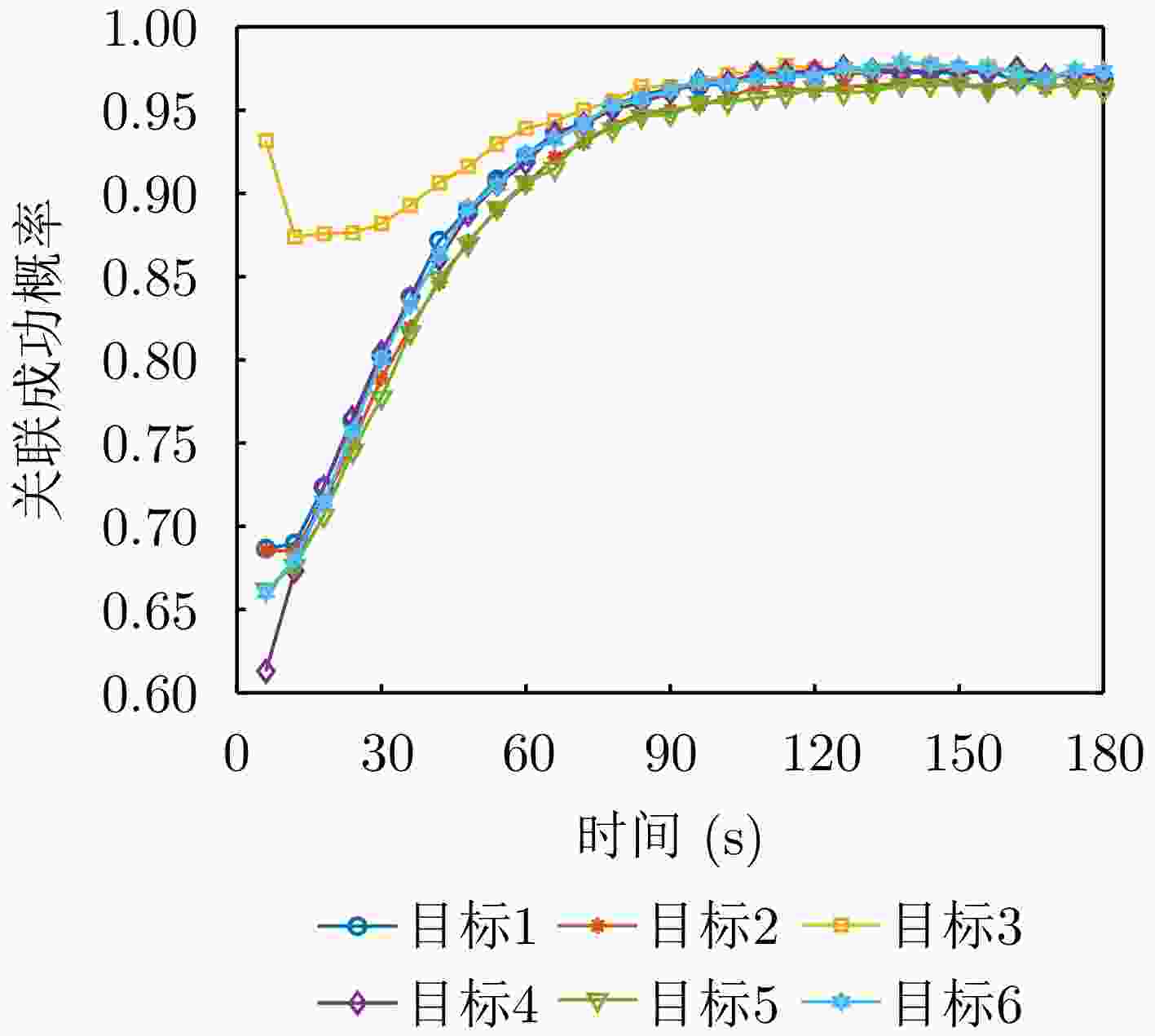
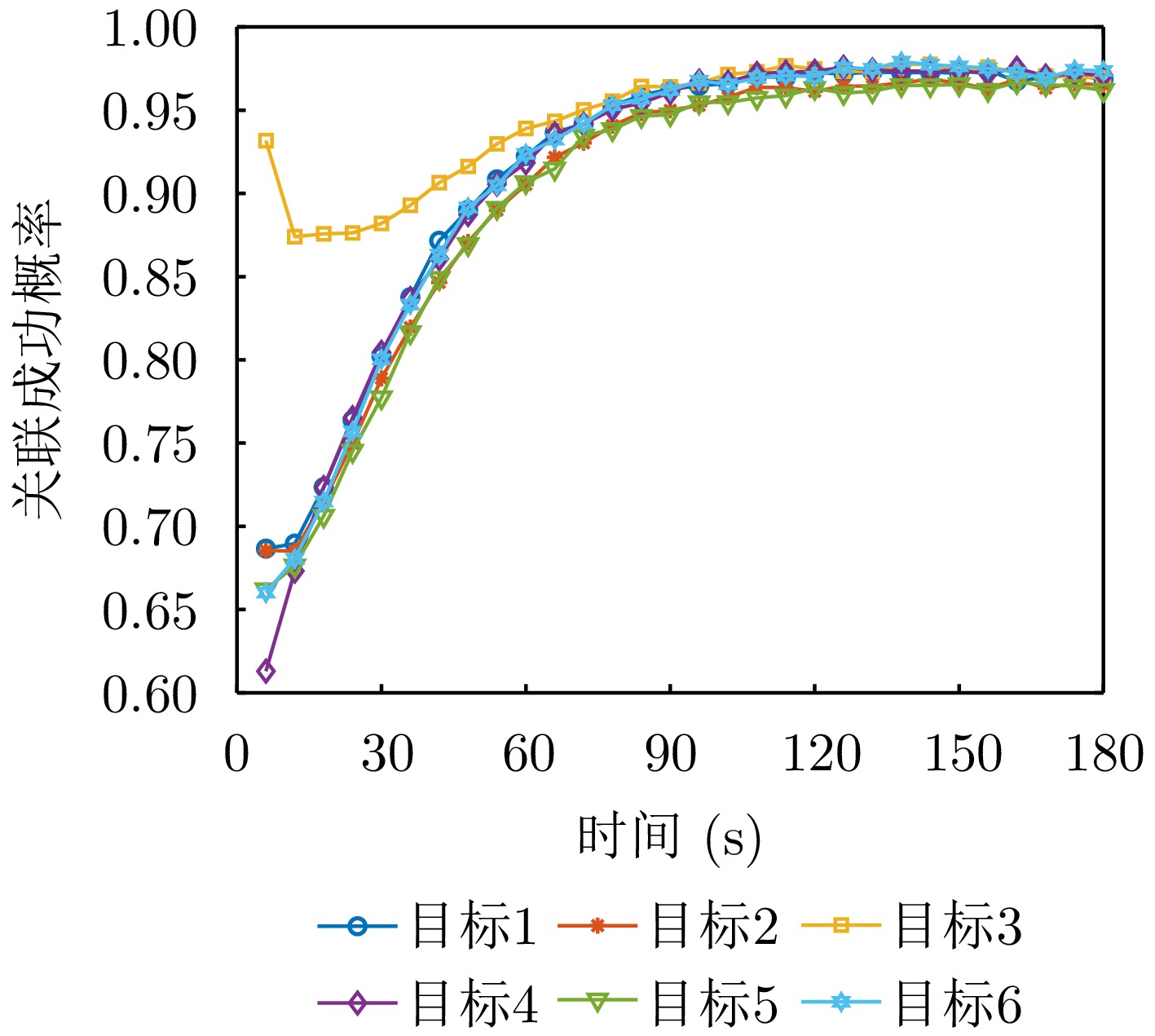
图 7 TPRS各目标关联成功概率曲线
Figure 7. Curves of successful association probability for each target in TPRS
表 1 PAR位置和采样周期
Table 1. PAR positions and sampling periods
PAR 位置 采样周期(s) PAR1 (–20, 25) 6 PAR2 (–20, 50) 3 PAR3 (–20, 75) 2  下载: 导出CSV
表 2 目标初始状态
Table 2. Initial states of targets
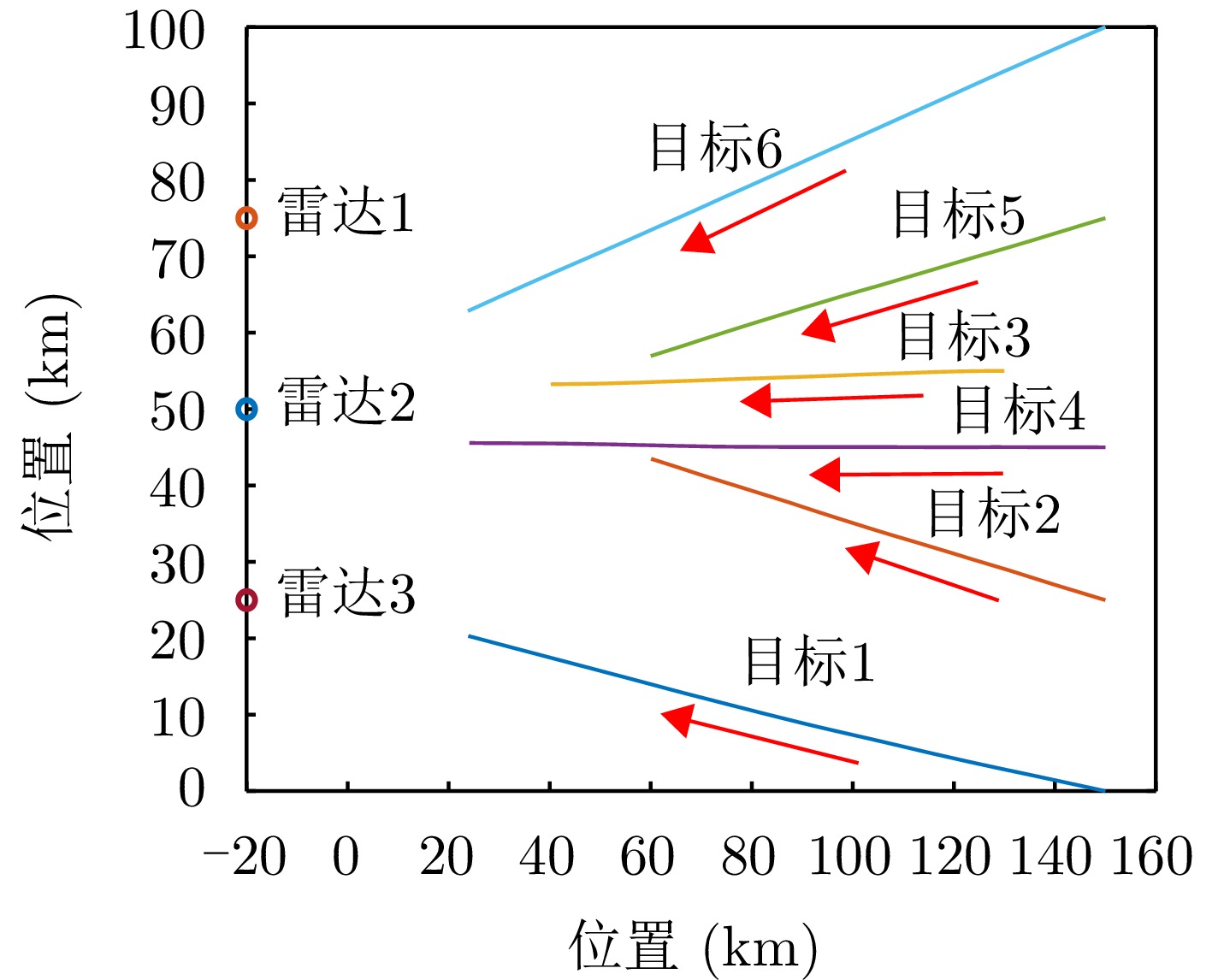
目标 位置(km) 速度(m/s) 目标1 (150, 0) (–700, 100) 目标2 (150, 25) (–500, 100) 目标3 (130, 55) (–500, 0) 目标4 (150, 45) (–700, 0) 目标5 (150, 75) (–500, –100) 目标6 (150, 100) (–700, –200)
下载: 导出CSV
表 3 关键参数
Table 3. Key parameters
参数 指标 过程噪声强度$ \gamma $ 0.012 有效带宽 106 Hz 平均辐射功率$ {P}_{\text{av}} $ 104 W 虚警密度 1×10⁻⁶ 验证门参数 3.5 检测概率 0.95 杂波类型 空间均匀 RCS 10
下载: 导出CSV
-
[1] FENN A J, TEMME D H, DELANEY W P, et al. The development of phased-array radar technology[J]. Lincoln Laboratory Journal, 2000, 12(2): 321–340. [2] HUANG T, SHLEZINGER N, XU X, et al. Multicarrier agile phased array radar[J]. IEEE Transactions on Signal Processing, 2020, 68: 5706–5721. doi: 10.1109/TSP.2020.3026186. [3] MAILLOUX R J. Phased Array Antenna Handbook[M]. 3rd ed. Boston: Artech House, 2018, 1–64. [4] SHI Chenguang, WANG Yijie, SALOUS S, et al. Joint transmit resource management and waveform selection strategy for target tracking in distributed phased array radar network[J]. IEEE Transactions on Aerospace and Electronic Systems, 2022, 58(4): 2762–2778. doi: 10.1109/TAES.2021.3138869. [5] LI Zhengjie, XIE Junwei, LIU Weijian, et al. Resource optimization strategy in phased array radar network for multiple target tracking when against active oppressive interference[J]. IEEE Systems Journal, 2023, 17(3): 3539–3550. doi: 10.1109/JSYST.2023.3283974. [6] AUBRY A, DE MAIO A, MARANO S, et al. Single-pulse simultaneous target detection and angle estimation in a multichannel phased array radar[J]. IEEE Transactions on Signal Processing, 2020, 68: 6649–6664. doi: 10.1109/TSP.2020.3039883. [7] LÜ Qingguo, LIAO Xiaofeng, DENG Shaojiang, et al. Asynchronous algorithms for decentralized resource allocation over directed networks[J]. IEEE Transactions on Parallel and Distributed Systems, 2023, 34(1): 16–32. doi: 10.1109/TPDS.2022.3212424. [8] LI Zeren, CAI Yunze, and LEUNG H. AoI-based sensor selection for target tracking in asynchronous sensor networks[J]. IEEE Sensors Journal, 2023, 23(18): 21385–21396. doi: 10.1109/JSEN.2023.3289883. [9] FORTMANN T, BAR-SHALOM Y, and SCHEFFE M. Sonar tracking of multiple targets using joint probabilistic data association[J]. IEEE Journal of Oceanic Engineering, 1983, 8(3): 173–184. doi: 10.1109/JOE.1983.1145560. [10] BAR-SHALOM Y and FORTMANN T E. Tracking and Data Association[M]. Boston: Academic Press, 1988: 220−260. [11] WU Linlong, MISHRA K V, SHANKAR M R B, et al. Resource allocation in heterogeneously-distributed joint radar-communications under asynchronous Bayesian tracking framework[J]. IEEE Journal on Selected Areas in Communications, 2022, 40(7): 2026–2042. doi: 10.1109/JSAC.2022.3157371. [12] WANG Mingyi, WANG Ruisong, MA Ruofei, et al. Resource allocation for multisatellite asynchronous transmission in integrated communication and navigation networks[J]. IEEE Internet of Things Journal, 2025, 12(10): 14172–14187. doi: 10.1109/JIOT.2025.3526154. [13] WANG Kuiwu, ZHANG Qin, ZHENG Guimei, et al. Multi-target tracking AA fusion method for asynchronous multi-sensor networks[J]. Sensors, 2023, 23(21): 8751. doi: 10.3390/s23218751. [14] SONG Liyuan, ZHANG Tingting, and ZHANG Qinyu. Power allocation for target positioning in asynchronous wireless radar sensor networks[C]. The 10th International Conference on Wireless Communications and Signal Processing, Hangzhou, China, 2018: 1–6. doi: 10.1109/WCSP.2018.8555703. [15] YAN Junkun, LIU Hongwei, PU Wenqiang, et al. Joint threshold adjustment and power allocation for cognitive target tracking in asynchronous radar network[J]. IEEE Transactions on Signal Processing, 2017, 65(12): 3094–3106. doi: 10.1109/TSP.2017.2679693. [16] YAN Junkun, PU Wenqiang, ZHOU Shenghua, et al. Optimal resource allocation for asynchronous multiple targets tracking in heterogeneous radar networks[J]. IEEE Transactions on Signal Processing, 2020, 68: 4055–4068. doi: 10.1109/TSP.2020.3007313. [17] ZHANG Haowei, LIU Weijian, and YANG Xiao. Resource saving based dwell time allocation and detection threshold optimization in an asynchronous distributed phased array radar network[J]. Chinese Journal of Aeronautics, 2023, 36(11): 311–327. doi: 10.1016/j.cja.2023.06.017. [18] DAI Jinhui, PU Wenqiang, YAN Junkun, et al. Multi-UAV collaborative trajectory optimization for asynchronous 3-D passive multitarget tracking[J]. IEEE Transactions on Geoscience and Remote Sensing, 2023, 61: 5101116. doi: 10.1109/TGRS.2023.3239952. [19] SHI Chenguang, TANG Zhicheng, DING Lintao, et al. Multidomain resource allocation for asynchronous target tracking in heterogeneous multiple radar networks with nonideal detection[J]. IEEE Transactions on Aerospace and Electronic Systems, 2024, 60(2): 2016–2033. doi: 10.1109/TAES.2023.3347214. [20] 宋晓程, 李陟, 任海伟, 等. 目标动态威胁度驱动的分布式组网相控阵雷达资源优化分配算法[J]. 雷达学报, 2023, 12(3): 629–641. doi: 10.12000/JR22240.SONG Xiaocheng, LI Zhi, REN Haiwei, et al. Threat-driven resource allocation algorithm for distributed netted phased array radars[J]. Journal of Radars, 2023, 12(3): 629–641. doi: 10.12000/JR22240. [21] 王增福, 杨广宇, 金术玲. 考虑综合性能最优的非短视快速天基雷达多目标跟踪资源调度算法[J]. 雷达学报(中英文), 2024, 13(1): 253–269. doi: 10.12000/JR23162.WANG Zengfu, YANG Guangyu, and JIN Shuling. A non-myopic and fast resource scheduling algorithm for multi-target tracking of space-based radar considering optimal integrated performance[J]. Journal of Radars, 2024, 13(1): 253–269. doi: 10.12000/JR23162. [22] 李浩情, 余点, 潘常春, 等. 基于模型知识融合的图神经网络多雷达协同任务调度算法[J]. 雷达学报(中英文), 2025, 14(2): 470–485. doi: 10.12000/JR24222.LI Haoqing, YU Dian, PAN Changchun, et al. Multiradar collaborative task scheduling algorithm based on graph neural networks with model knowledge embedding[J]. Journal of Radars, 2025, 14(2): 470–485. doi: 10.12000/JR24222. [23] 易伟, 袁野, 刘光宏, 等. 多雷达协同探测技术研究进展: 认知跟踪与资源调度算法[J]. 雷达学报, 2023, 12(3): 471–499. doi: 10.12000/JR23036.YI Wei, YUAN Ye, LIU Guanghong, et al. Recent advances in multi-radar collaborative surveillance: Cognitive tracking and resource scheduling algorithms[J]. Journal of Radars, 2023, 12(3): 471–499. doi: 10.12000/JR23036. [24] 时晨光, 唐志诚, 丁琳涛, 等. 非理想检测下面向异步多目标跟踪的异构多雷达网络功率时间联合优化算法[J]. 雷达学报, 2023, 12(3): 563–575. doi: 10.12000/JR23044.SHI Chenguang, TANG Zhicheng, DING Lintao, et al. Joint optimization of transmit power and dwell time for asynchronous multi-target tracking in heterogeneous multiple radar networks with imperfect detection[J]. Journal of Radars, 2023, 12(3): 563–575. doi: 10.12000/JR23044. [25] 石兆, 时晨光, 汪飞, 等. 针对多目标跟踪的组网雷达检测门限与功率分配联合优化算法[J]. 电子与信息学报, 2024, 46(5): 2065–2075. doi: 10.11999/JEIT231242.SHI Zhao, SHI Chenguang, WANG Fei, et al. Joint detection threshold and power allocation optimization strategy for multi-target tracking in radar networks[J]. Journal of Electronics & Information Technology, 2024, 46(5): 2065–2075. doi: 10.11999/JEIT231242. [26] 达凯, 杨烨, 朱永锋, 等. 视场非完全重叠的分布式雷达多目标跟踪方法[J]. 雷达学报, 2022, 11(3): 459–468. doi: 10.12000/JR21183.DA Kai, YANG Ye, ZHU Yongfeng, et al. Multitarget tracking using distributed radar with partially overlapping fields of views[J]. Journal of Radars, 2022, 11(3): 459–468. doi: 10.12000/JR21183. [27] 程婷, 恒思宇, 李中柱. 基于脉冲交错的分布式雷达组网系统波束驻留调度[J]. 雷达学报, 2023, 12(3): 616–628. doi: 10.12000/JR22211.CHENG Ting, HENG Siyu, and LI Zhongzhu. Real-time dwell scheduling algorithm for distributed phased array radar network based on pulse interleaving[J]. Journal of Radars, 2023, 12(3): 616–628. doi: 10.12000/JR22211. [28] 张大琳, 易伟, 孔令讲. 面向组网雷达干扰任务的多干扰机资源联合优化分配方法[J]. 雷达学报, 2021, 10(4): 595–606. doi: 10.12000/JR21071.ZHANG Dalin, YI Wei, and KONG Lingjiang. Optimal joint allocation of multijammer resources for jamming netted radar system[J]. Journal of Radars, 2021, 10(4): 595–606. doi: 10.12000/JR21071. [29] 袁野, 杨剑, 刘辛雨, 等. 基于任务效用最大化的多雷达协同任务规划算法[J]. 雷达学报, 2023, 12(3): 550–562. doi: 10.12000/JR23013.YUAN Ye, YANG Jian, LIU Xinyu, et al. Multiradar collaborative task planning based on task utility maximization[J]. Journal of Radars, 2023, 12(3): 550–562. doi: 10.12000/JR23013. [30] 李文娜, 张顺生, 王文钦. 基于Transformer网络的机载雷达多目标跟踪方法[J]. 雷达学报, 2022, 11(3): 469–478. doi: 10.12000/JR22009.LI Wenna, ZHANG Shunsheng, and WANG Wenqin. Multitarget-tracking method for airborne radar based on a Transformer network[J]. Journal of Radars, 2022, 11(3): 469–478. doi: 10.12000/JR22009. [31] 时晨光, 董璟, 周建江. 频谱共存下面向多目标跟踪的组网雷达功率时间联合优化算法[J]. 雷达学报, 2023, 12(3): 590–601. doi: 10.12000/JR22146.SHI Chenguang, DONG Jing, and ZHOU Jianjiang. Joint transmit power and dwell time allocation for multitarget tracking in radar networks under spectral coexistence[J]. Journal of Radars, 2023, 12(3): 590–601. doi: 10.12000/JR22146. [32] 王祥丽, 易伟, 孔令讲. 基于多目标跟踪的相控阵雷达波束和驻留时间联合分配方法[J]. 雷达学报, 2017, 6(6): 602–610. doi: 10.12000/JR17045.WANG Xiangli, YI Wei, and KONG Lingjiang. Joint beam selection and dwell time allocation for multi-target tracking in phased array radar system[J]. Journal of Radars, 2017, 6(6): 602–610. doi: 10.12000/JR17045. [33] 焦浩, 严俊坤, 郝佳, 等. 面向多机动目标的资源分配与精细化跟踪算法[J]. 雷达学报(中英文), 2026, 15(1): 292–306. doi: 10.12000/JR25037.JIAO Hao, YAN Junkun, HAO Jia, et al. Resource allocation and precise tracking algorithm for multiple maneuvering targets[J]. Journal of Radars, 2026, 15(1): 292–306. doi: 10.12000/JR25037. [34] YI Wei, MORELANDE M R, KONG Lingjiang, et al. An efficient multi-frame track-before-detect algorithm for multi-target tracking[J]. IEEE Journal of Selected Topics in Signal Processing, 2013, 7(3): 421–434. doi: 10.1109/JSTSP.2013.2256415. [35] HE Qian, BLUM R S, and HAIMOVICH A M. Noncoherent MIMO radar for location and velocity estimation: More antennas means better performance[J]. IEEE Transactions on Signal Processing, 2010, 58(7): 3661–3680. doi: 10.1109/TSP.2010.2044613. [36] THARMARASA R, KIRUBARAJAN T, HERNANDEZ M L, et al. PCRLB-based multisensor array management for multitarget tracking[J]. IEEE Transactions on Aerospace and Electronic Systems, 2007, 43(2): 539–555. doi: 10.1109/TAES.2007.4285352. [37] YI Wei, YUAN Ye, HOSEINNEZHAD R, et al. Resource scheduling for distributed multi-target tracking in netted Colocated MIMO radar systems[J]. IEEE Transactions on Signal Processing, 2020, 68: 1602–1617. doi: 10.1109/TSP.2020.2976587. [38] JULIER S J and UHLMANN J K. A non-divergent estimation algorithm in the presence of unknown correlations[C]. The 1997 American Control Conference, Albuquerque, USA, 1997: 2369–2373. doi: 10.1109/ACC.1997.609105. [39] BERTSEKAS D P. Dynamic Programming and Optimal Control, Volume I[M]. 4th ed. Belmont: Athena Scientific, 2012, 1−72. [40] RONG Aiying, HAKONEN H, and LAHDELMA R. A dynamic regrouping based sequential dynamic programming algorithm for unit commitment of combined heat and power systems[J]. Energy Conversion and Management, 2009, 50(4): 1108–1115. doi: 10.1016/j.enconman.2008.12.003. [41] VAN TREES H L. Detection, Estimation, and Modulation Theory, Part III[M]. New York: Wiley, 1971, 22–35. [42] RICHARDS M A. Fundamentals of Radar Signal Processing[M]. New York: McGraw-Hill, 2005, 19–25. -

计量
- 文章访问数:
- HTML全文浏览量:
- PDF下载量:
- 被引次数: 0