

 作者中心
作者中心 专家审稿
专家审稿 责编办公
责编办公 编辑办公
编辑办公
Extraction of Lunar Wrinkle Ridges Structure Based on Multimodal Semantic Segmentation
-
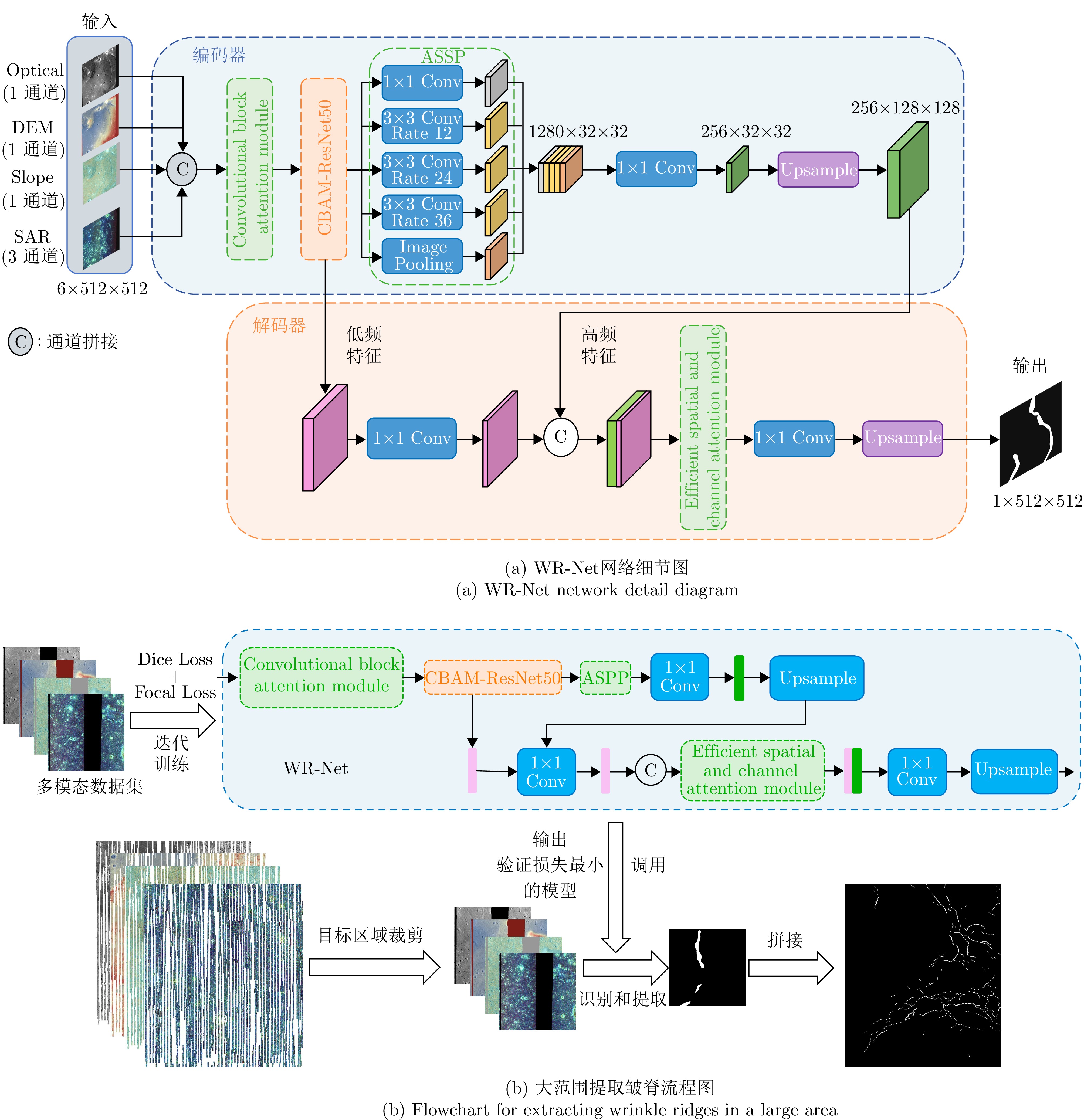
摘要: 月球皱脊是广泛分布于月表月海区域的重要线状构造,对研究月球应力场演化和火山活动历史具有重要意义。传统的皱脊识别与编目主要依赖人工解译,效率低且主观性强。该文提出了一种基于多模态语义分割的皱脊自动提取方法,通过构建高质量的皱脊遥感图像标注数据集,并引入合成孔径雷达(SAR)数据,通过迭代训练构建了基于DeepLabV3+的多模态语义分割网络WR-Net。该网络引入动态融合模块和注意力机制,有效优化了多模态图像的特征提取与融合过程,显著提升了模型的稳健性与精度。在多模态皱脊测试集上,WR-Net取得了优异的性能(Precision=95.516%, Recall=89.963%, F1-Score=92.657%, MIoU=92.944%)。进一步地,该团队利用WR-Net完成了月球南纬70°至北纬70°范围内皱脊的自动识别与提取,并对结果进行了编目与统计。该文提出的方法不仅适用于皱脊的识别,也为月球及其他行星体上类似线状结构的自动提取提供了有效范式。Abstract: Lunar wrinkle ridges are important linear structures that are widely distributed in the mare regions on the lunar surface and are of great importance for studying the evolution of the lunar stress field and the history of volcanic activities. Traditional lunar Wrinkle ridge recognition and cataloging mainly rely on manual interpretation, which is inefficient and subjective. In this paper, an automatic lunar wrinkle ridge extraction method based on multimodal semantic segmentation is proposed. By constructing a high-quality lunar wrinkle ridge remote sensing image annotation dataset and introducing synthetic aperture radar data, a DeepLabv3+-based multimodal semantic segmentation network WR-Net is constructed through iterative training. A dynamic fusion module and an attention mechanism were introduced into WR-Net, which effectively optimized the feature extraction and fusion process of multimodal images and markedly improved the robustness and accuracy of the model. On the multimodal lunar wrinkle ridge test set, WR-Net achieved excellent performance (Precision = 95.516%, Recall = 89.963%, F1-Score = 92.657%, and MIoU = 92.944%). Furthermore, we used WR-Net to automatically identify and extract the lunar wrinkle ridges from the 70° south latitude to the 70° north latitude of the moon and cataloged and statistically analyzed the results. The proposed method is suitable for the recognition of lunar wrinkle ridges and provides an effective paradigm for the automatic extraction of similar linear structures on the moon and other planetary bodies.
-
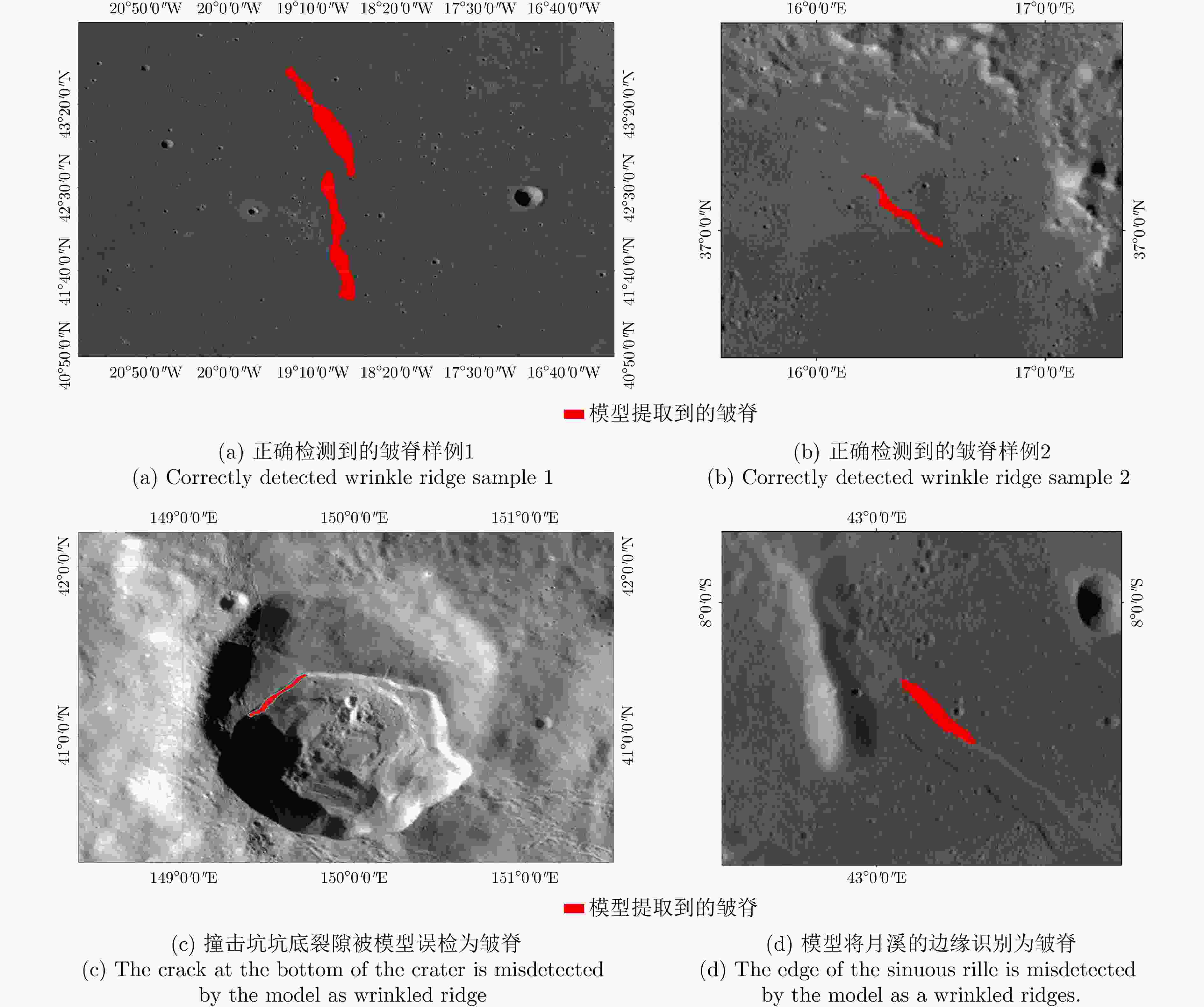
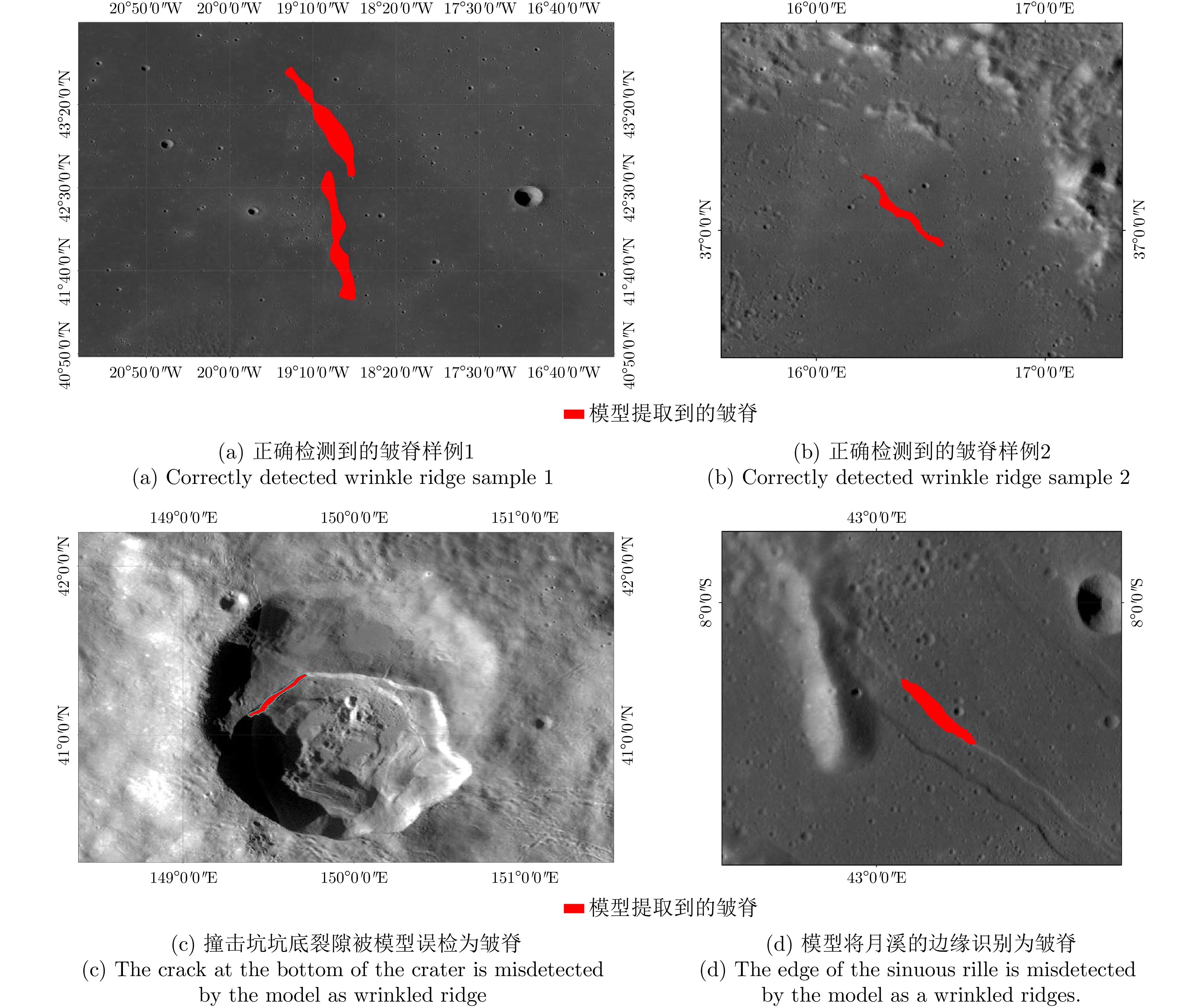
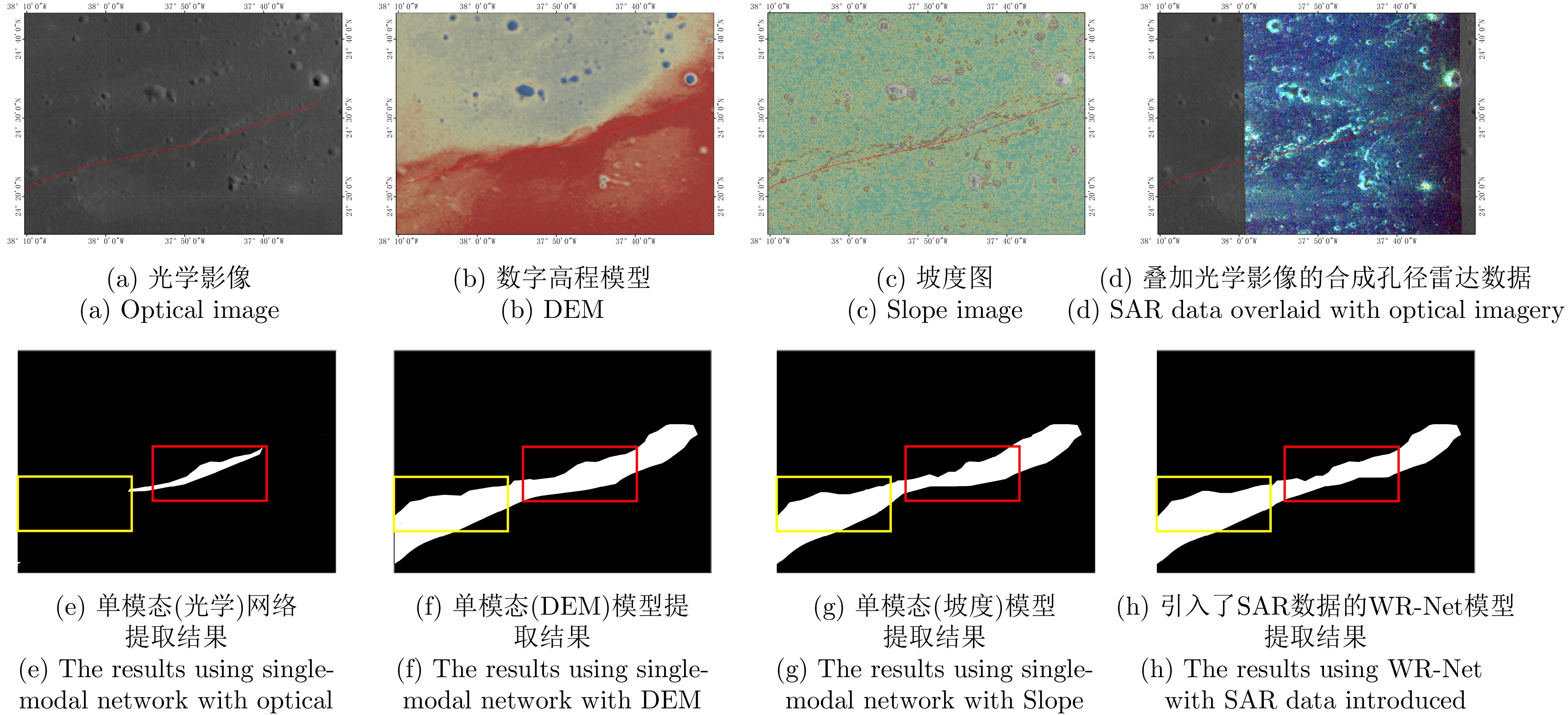
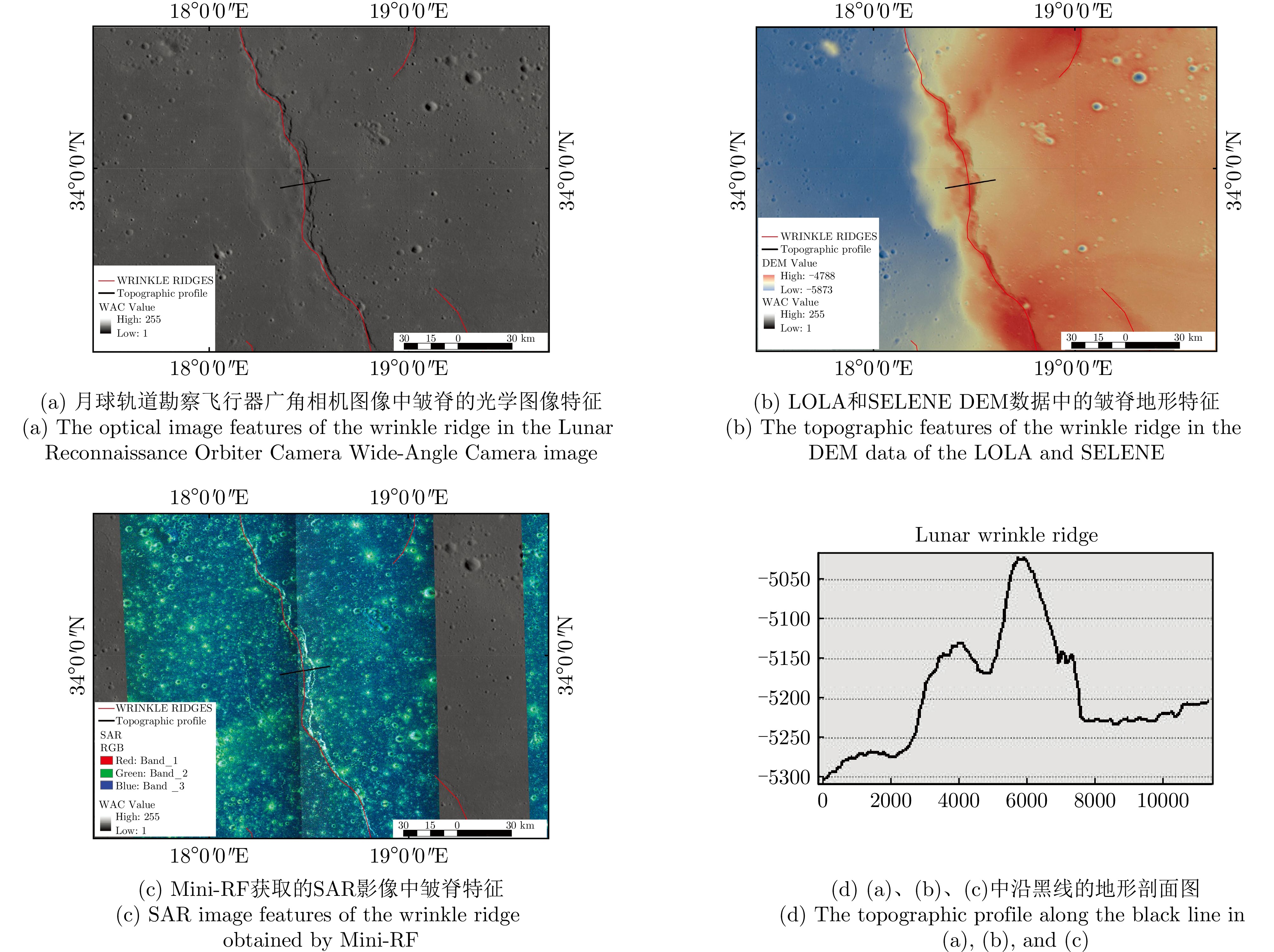
图 11 准确检测的皱脊样例及其他线性构造被误识别为皱脊的样例
Figure 11. The accurately detected wrinkled ridges examples and other linear constructions are misrecognized as wrinkled ridges examples
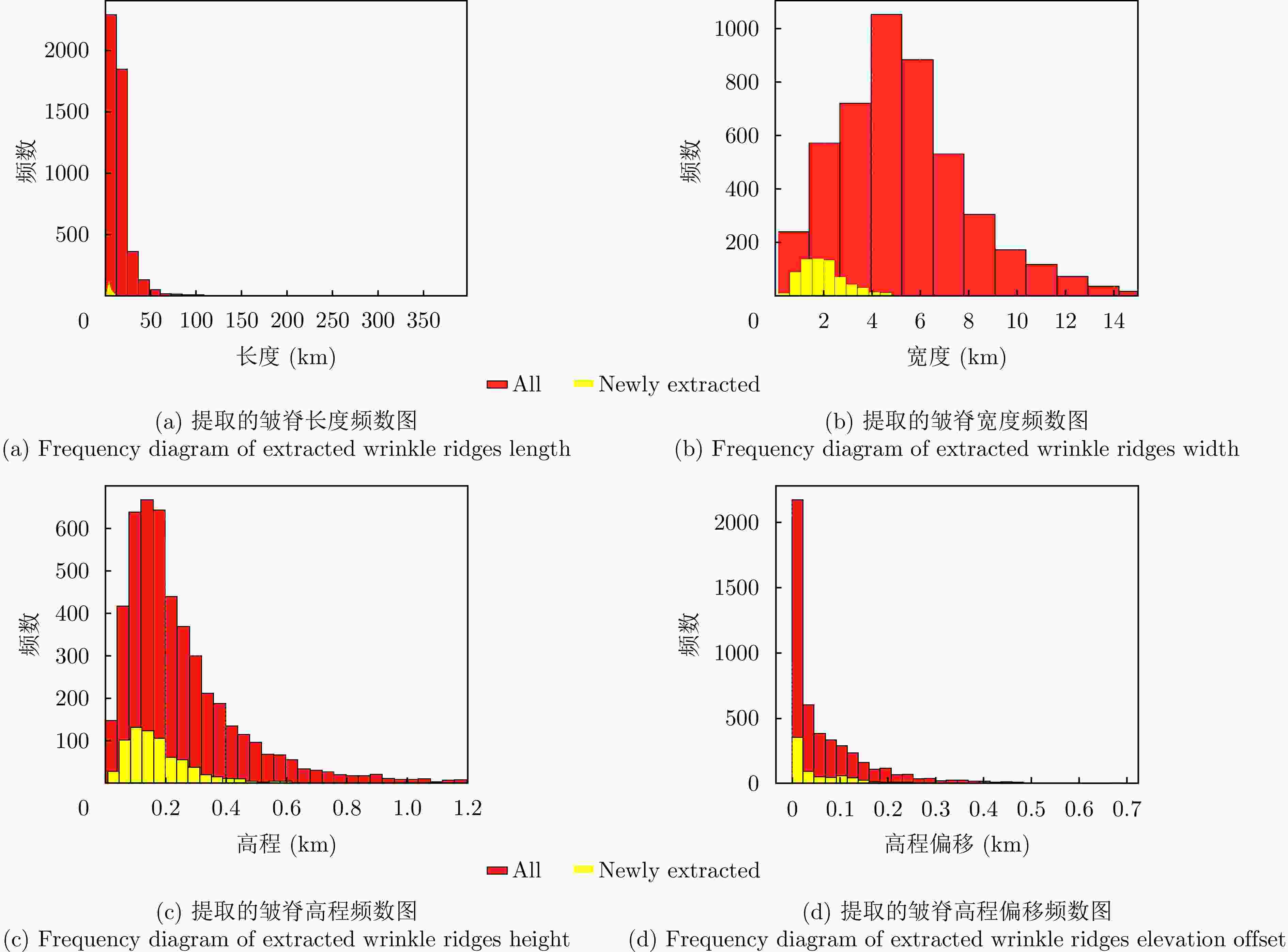
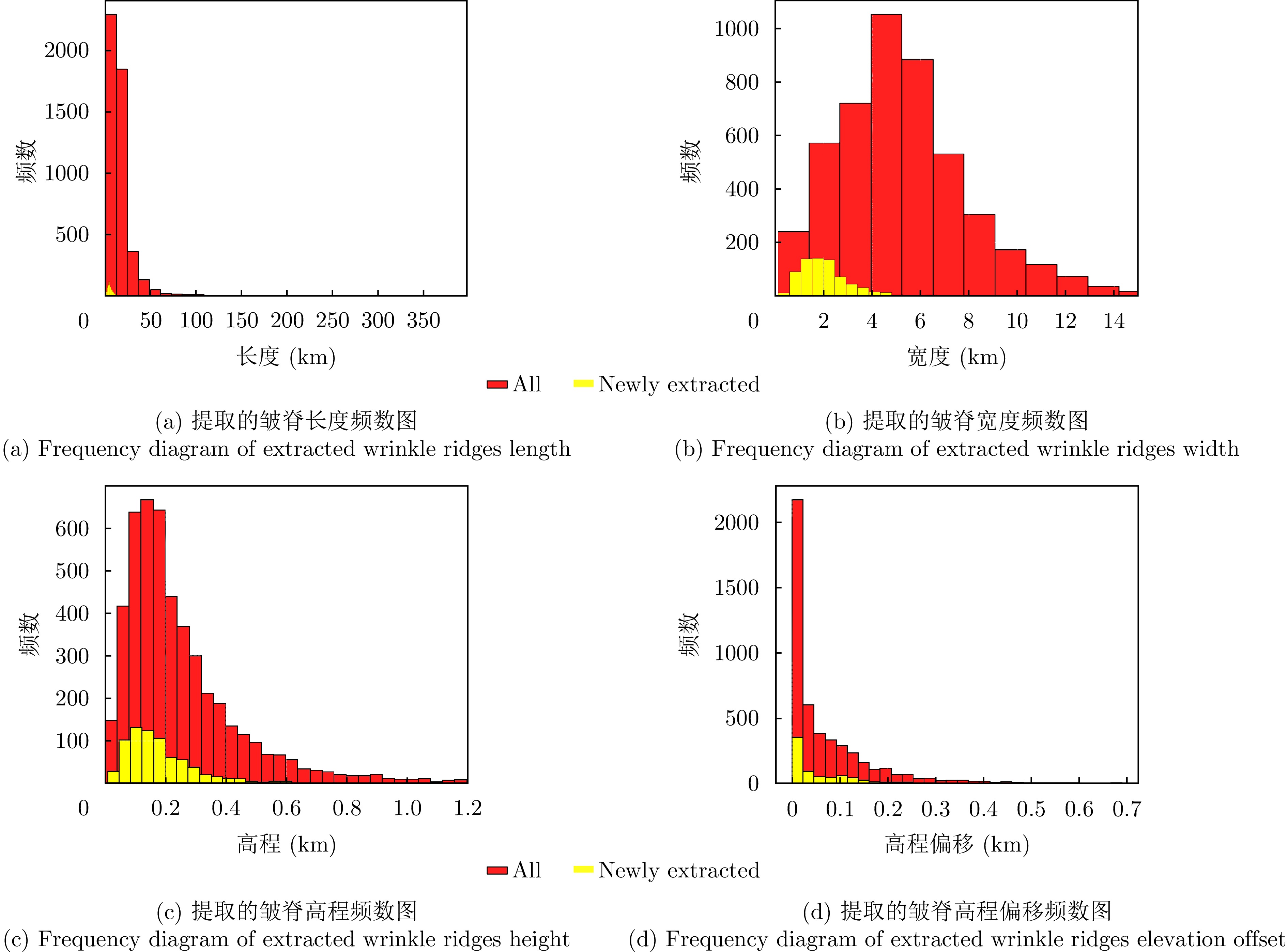
图 13 提取出的月球皱脊形貌参数频度分布
Figure 13. The frequency distribution of the extracted lunar wrinkle ridges morphology parameters
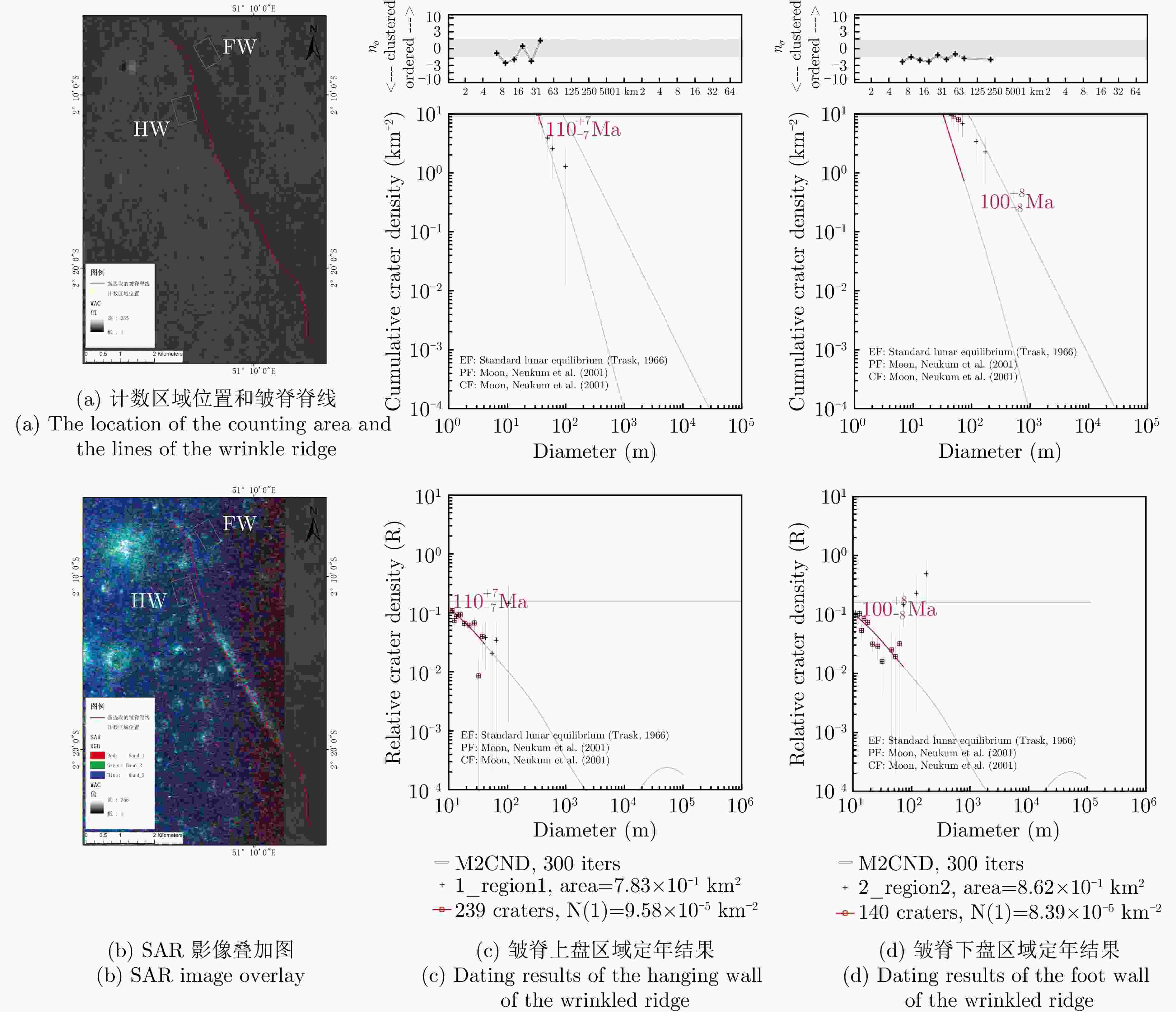
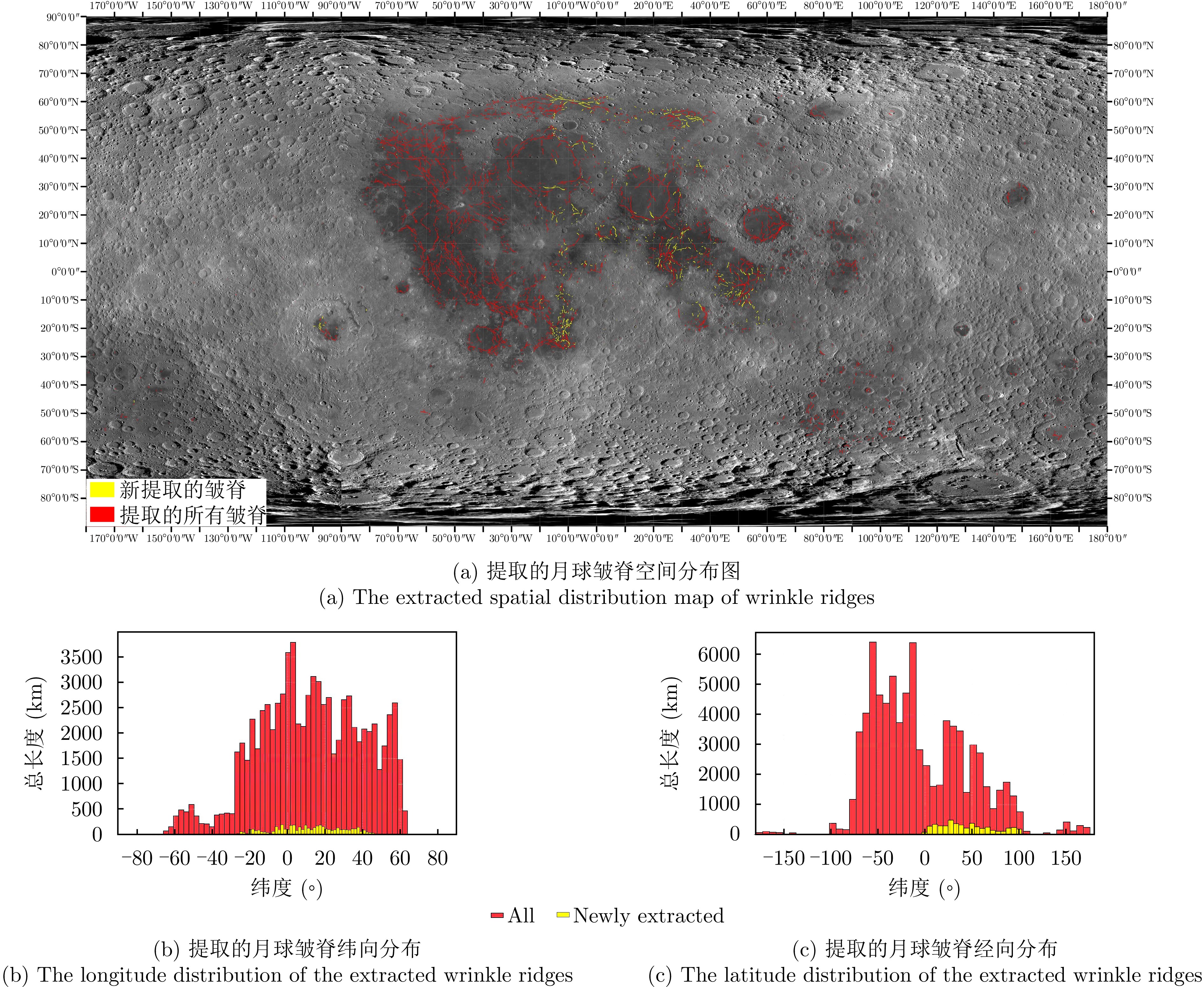
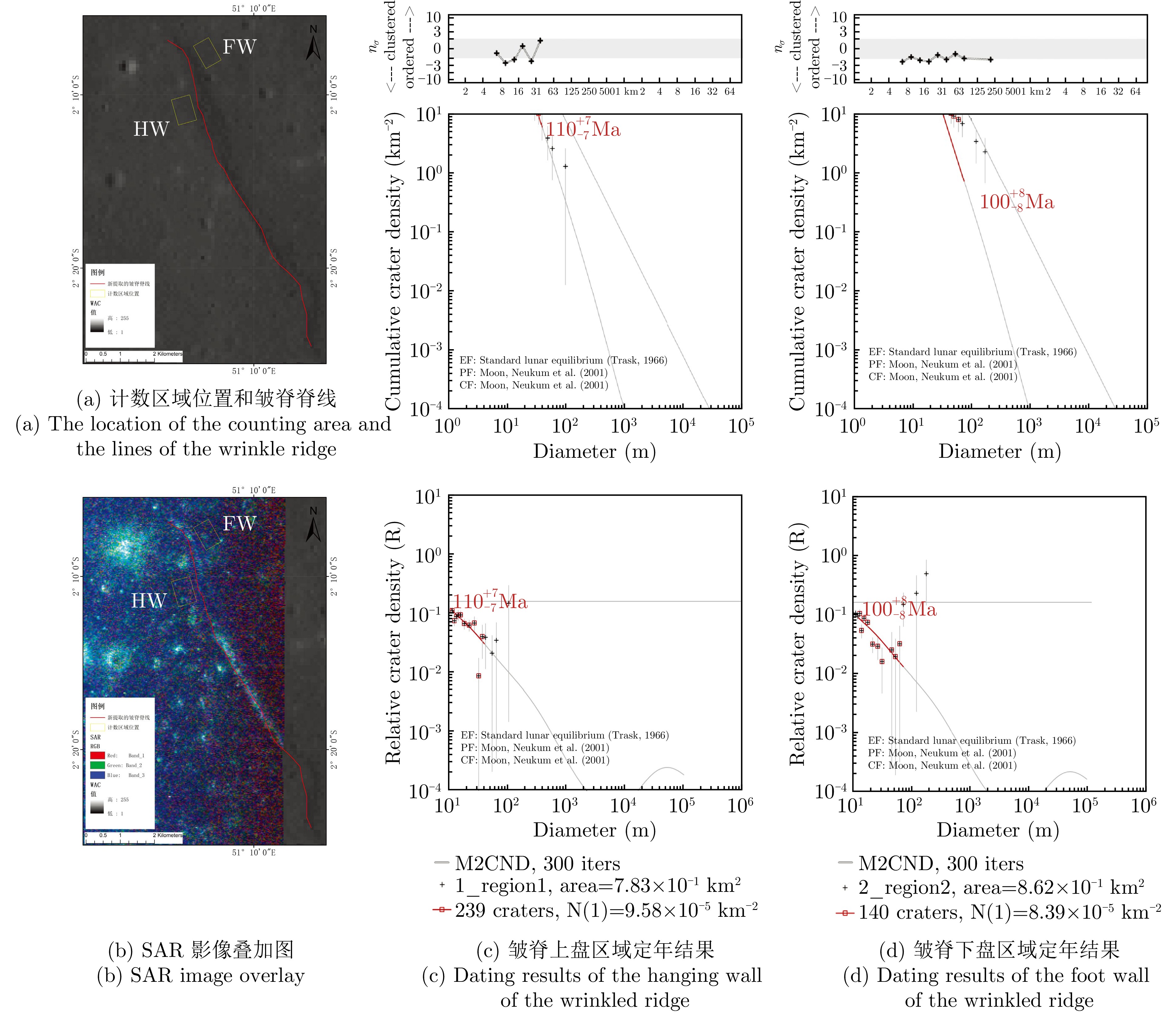
图 15 新提取的小型皱脊($ 2.23{^{\circ}}\mathrm{S},51.14{^{\circ}}\mathrm{E} $)定年结果
Figure 15. The dating results of newly extracted small wrinkle ridges (2.23°S, 51.14°E)
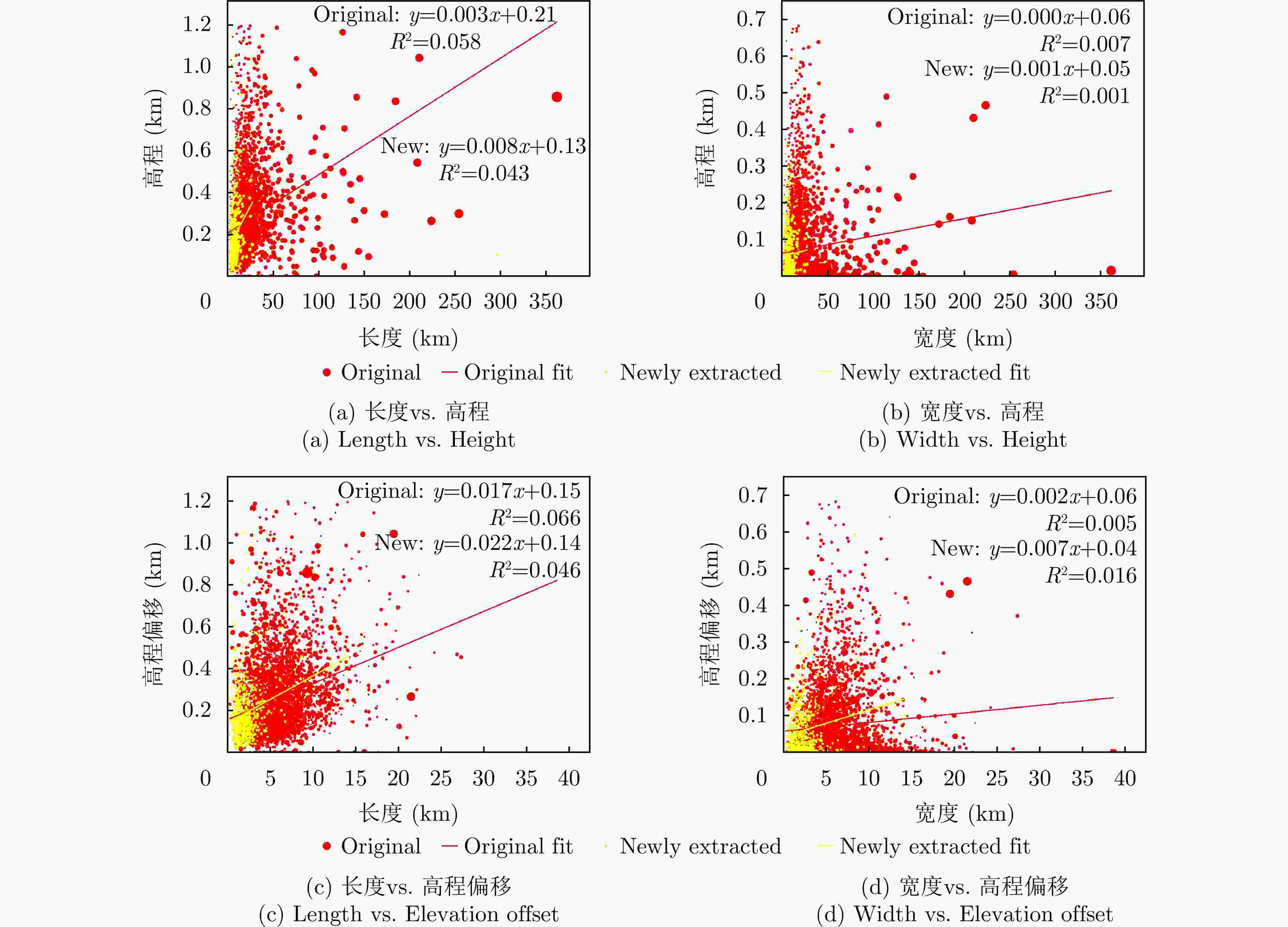
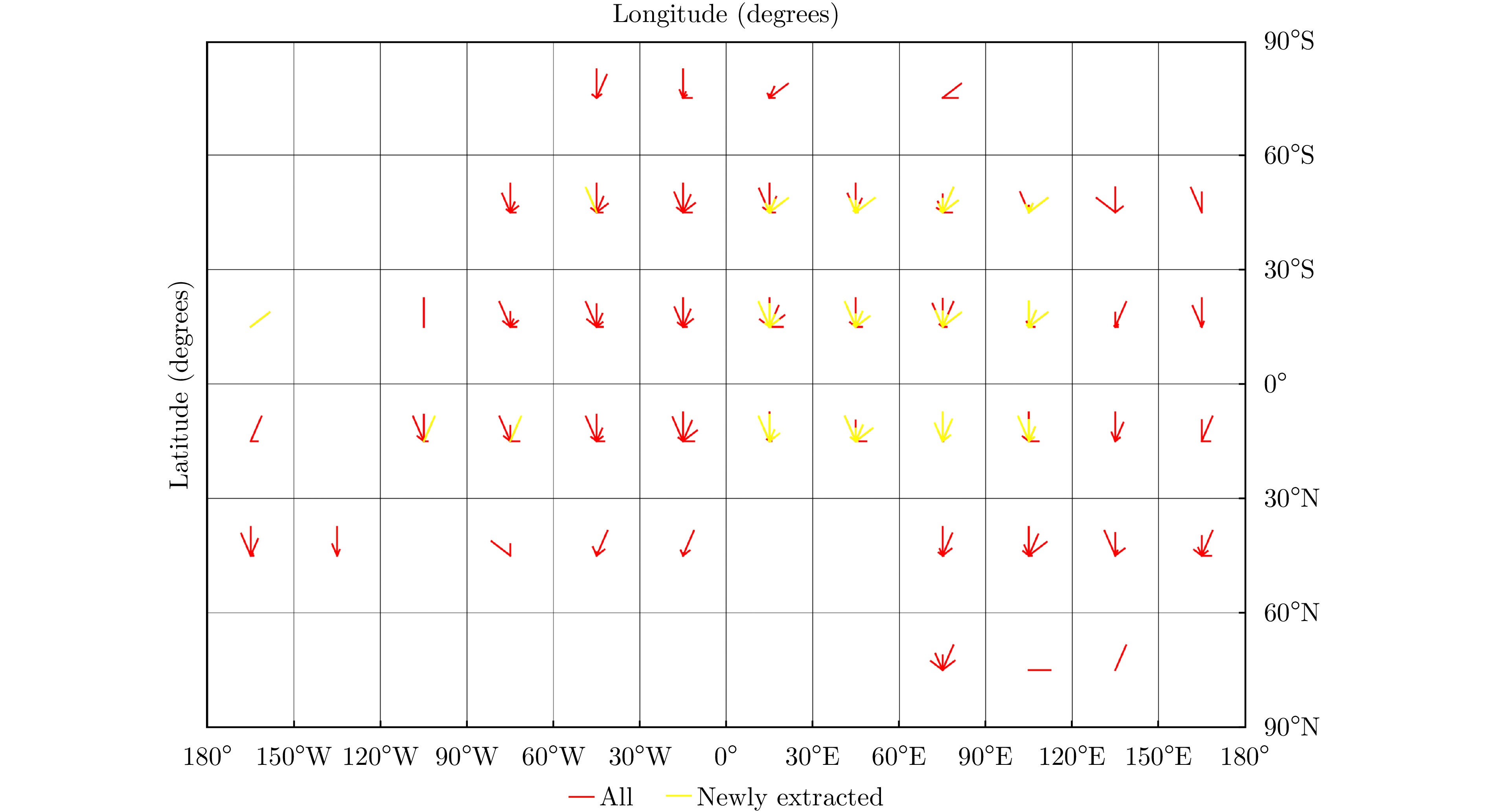
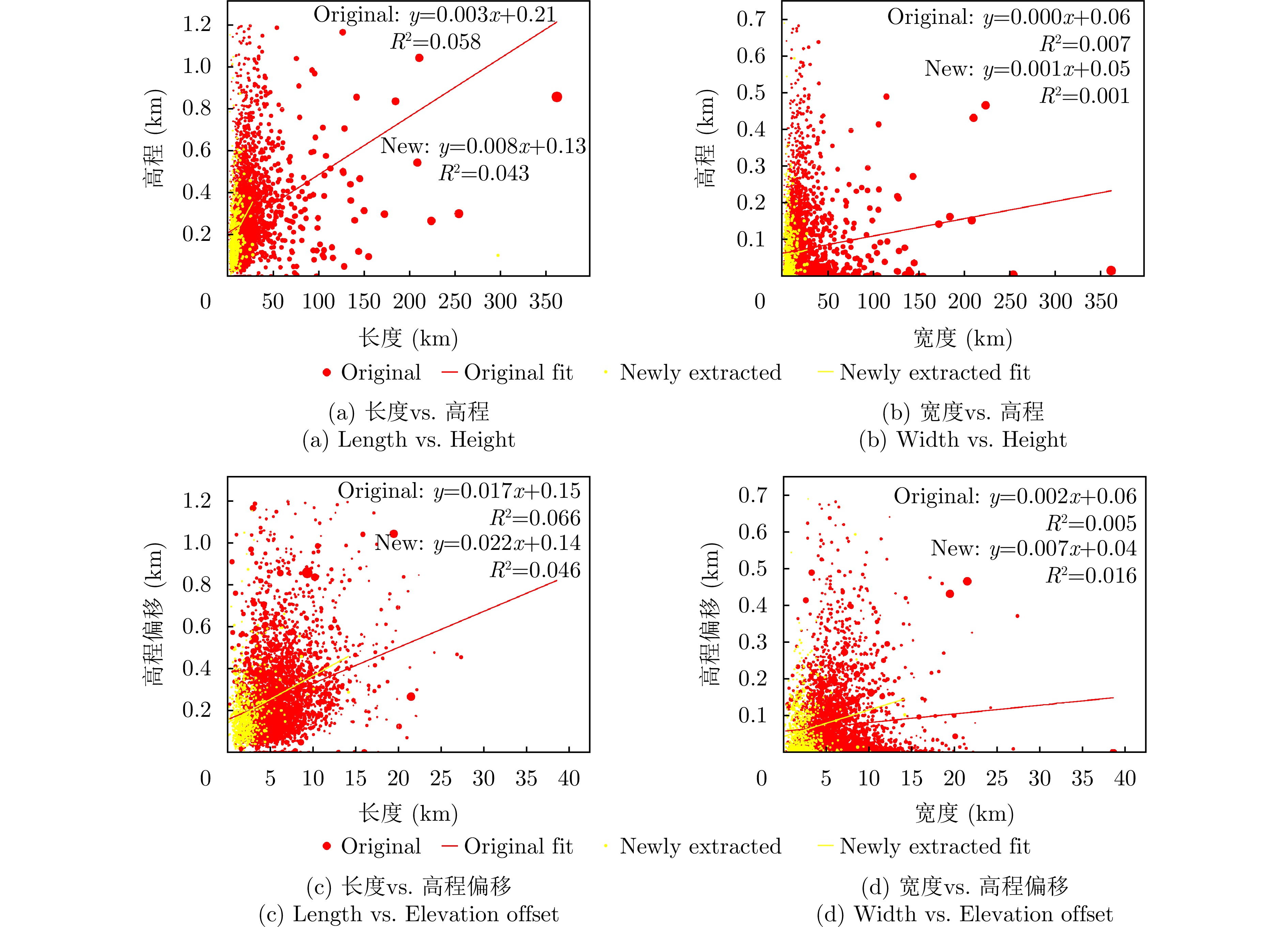
图 16 提取的皱脊长度(或宽度)与高度及高程差的关系图(需要注意的是,分段数量已根据各分段的长度加权)
Figure 16. The graph showing the relationship between the extracted wrinkle ridges length (or width), height and elevation difference (it should be noted that the number of segments has been weighted according to the length of each segment)
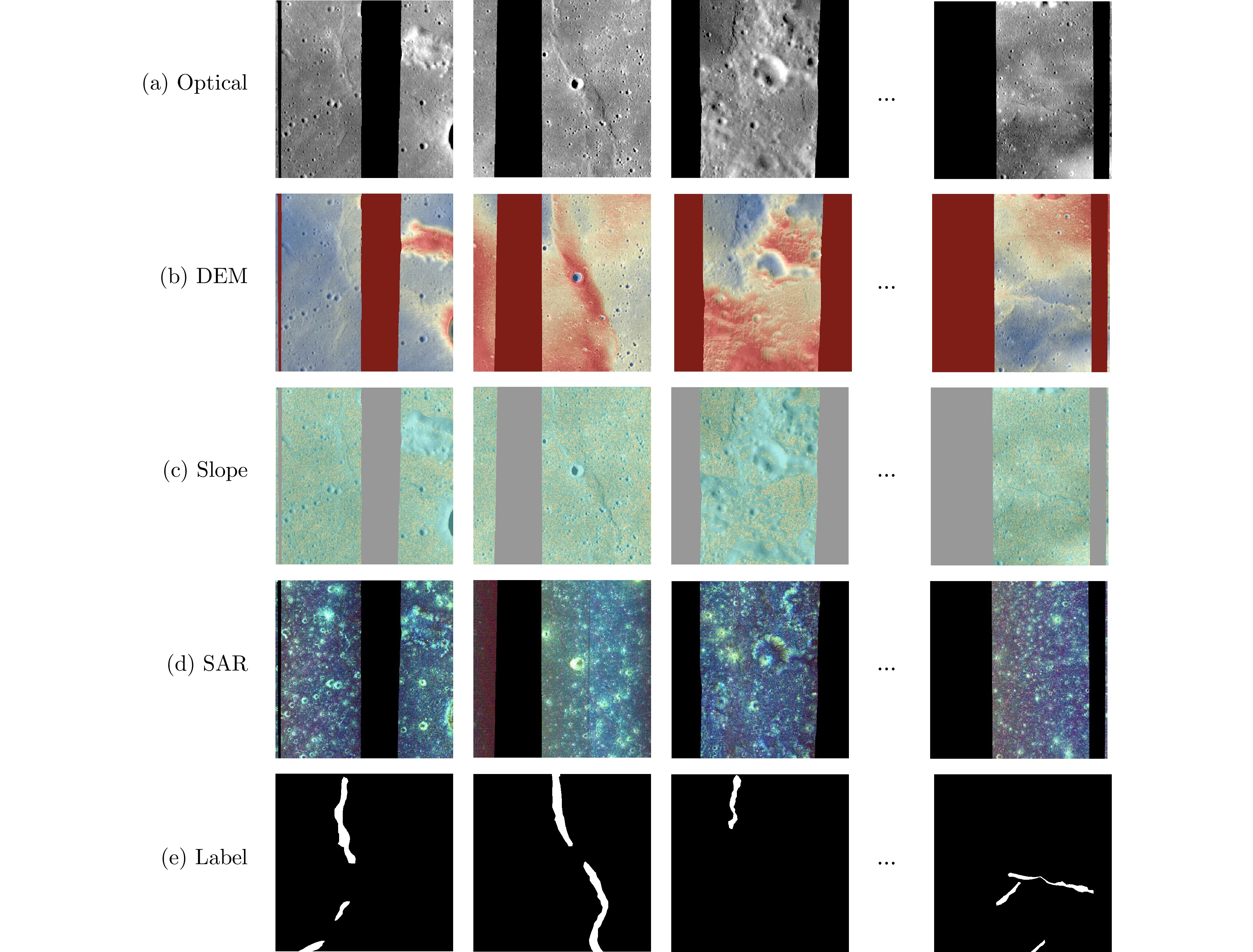
表 1 多模态数据集
Table 1. Multimodal dataset
数据集 数据数量 数据增强 训练集(60%) 4332 ×517328 ×5验证集(20%) 1444 ×55776 ×5测试集(20%) 1443 ×55772 ×5 下载: 导出CSV
1 WR-Net训练流程
1. WR-Net training process
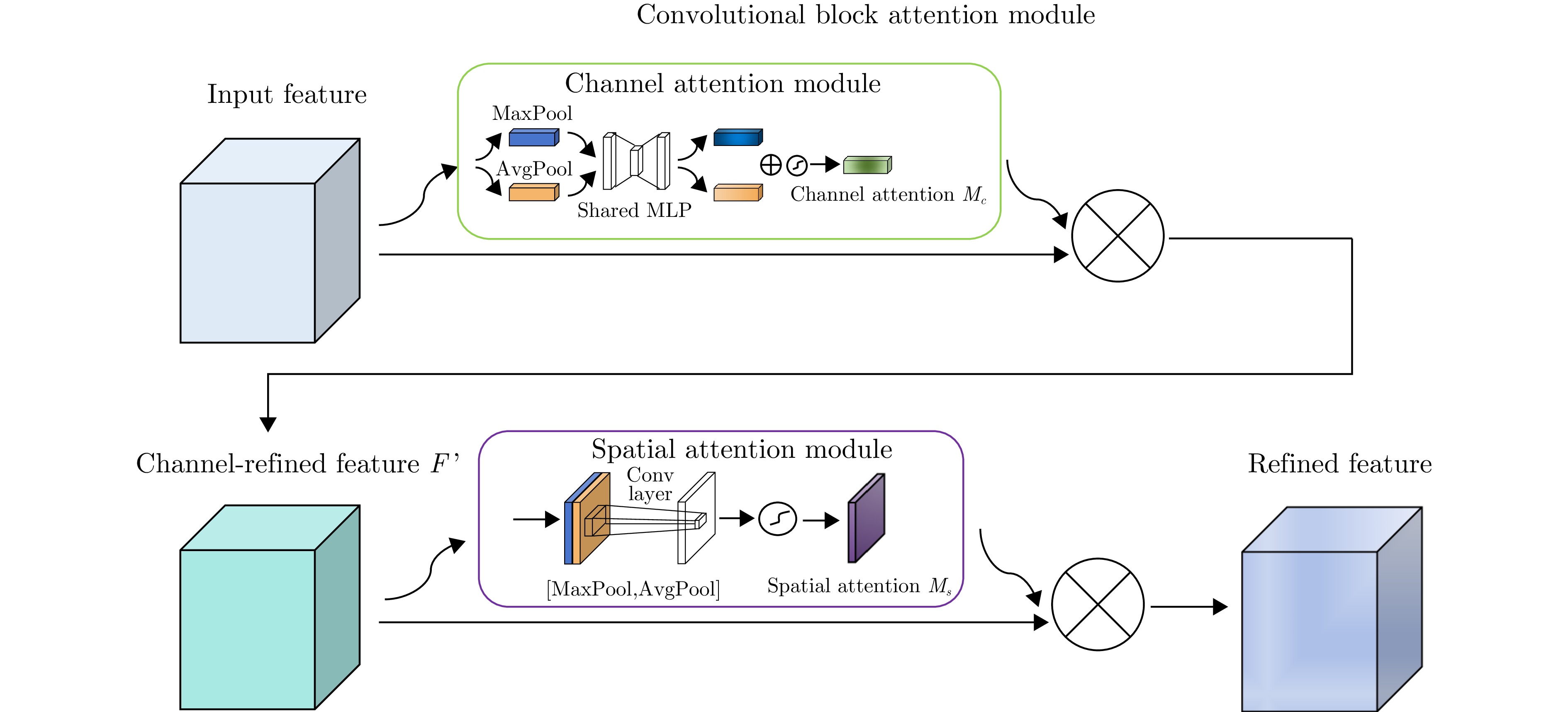
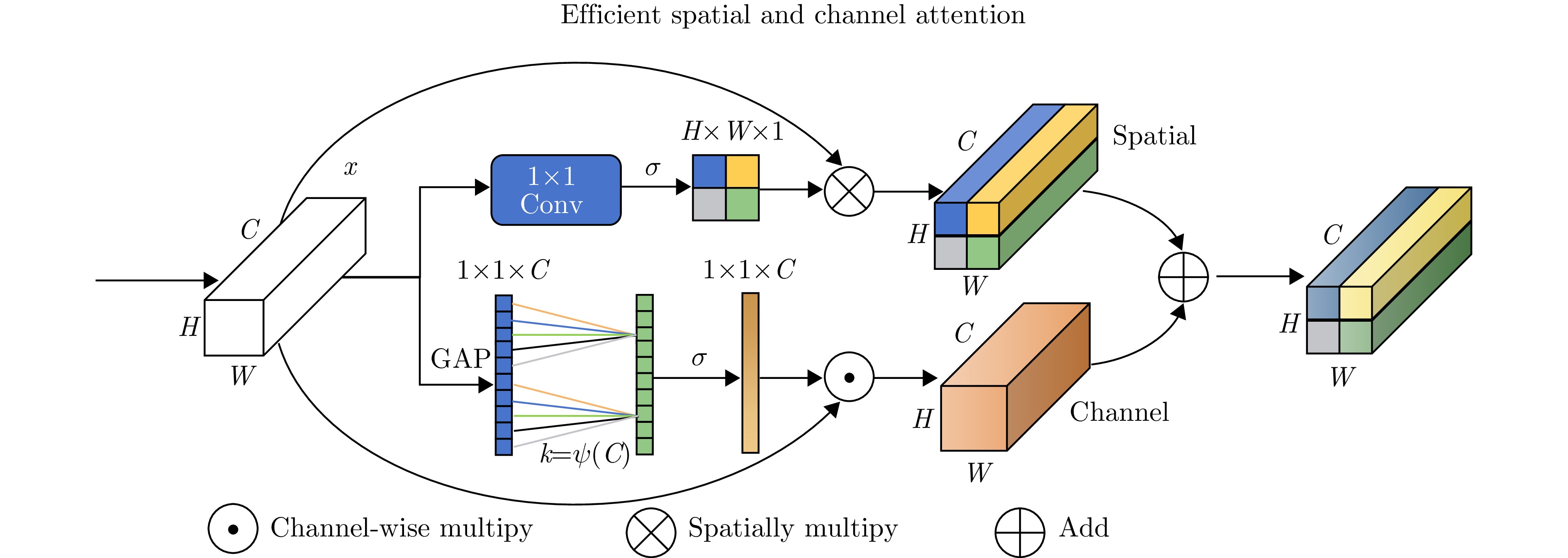
输入:多模态数据集D={(I_opt, I_dem, I_slope, I_sar, Y)},Y为皱脊真值掩膜,M为最大训练轮数(epochs) //输入 输出:训练好的WR-Net模型 //输出 1. Initialize WR-Net model //初始化模型 2. Initialize optimizer: Optimizer ← RMSprop(learning_rate=1E–4, weight_decay=1E–5) //初始化优化器 3. Initialize loss function: Loss ← Dice Loss + FocalLoss(α=0.25, γ=2.0) //初始化损失函数 4. forepoch ← 1 to M do 5. loss_sum ← 0 // 初始化当前轮次损失累加器 6. for batch in DataLoader (D, batch_size=4, shuffle=True) do 7. I_opt, I_dem, I_slope, I_sar, Y ← batch // 获取当前批次数据 8. feat_enc ← CBAM-ResNet50(I_opt, I_dem, I_slope, I_sar) // CBAM-ResNet50 编码 9. feat_aspp ← ASPP(feat_enc) // 多尺度上下文聚合 10. feat_dec ← ESCA-Decoder(feat_aspp, skip_connections) // 解码器上采样融合 11. pred ← DynamicFusion(feat_dec, modality_weights) // 动态加权融合输出预测 12. loss ← Loss(pred, Y) // 计算损失 13. Optimizer.zero_grad() // 清零梯度 14. loss.backward() // 反向传播 15. Optimizer.step() // 更新参数 16. loss_sum ← loss_sum + loss.item() // 累加损失值 17. end for 18. Update learning rate scheduler (CosineAnnealingLR) // 更新学习率 19. Output average loss for current epoch: loss_sum / number_of_batches // 输出平均损失 20. end for 21. return WR-Net model
下载: 导出CSV
表 2 基于DeepLabV3+ResNet50的多模态数据消融实验结果(%)
Table 2. Ablation study results of multimodal data based on DeepLabV3+ResNet50 (%)
输入数据类型 Precision Recall F1-Score MIoU Optical 69.252 70.123 69.685 74.289 DEM 74.623 72.847 73.724 78.456 SAR 74.856 72.134 73.481 78.127 Slope 75.912 73.456 74.664 79.823 Multimodal 80.135 78.432 79.274 81.995 注:加粗数值表示最优结果。
下载: 导出CSV
表 3 不同网络模型在验证集和测试集上的结果
Table 3. Results of different network models on validation and test sets
模型 数据集 Precision (%) Recall (%) F1-Score (%) MIoU (%) DeepLabV3+ResNet50 验证集 86.214 83.376 84.776 86.156 测试集 80.135 78.432 79.274 81.995 DeepLabV3+ESCA-ResNet50 验证集 95.812 93.683 94.736 94.785 测试集 88.844 89.127 88.985 89.625 DeepLabV3+CBAM-ResNet50 (WR-Net) 验证集 96.214 93.512 94.844 94.882 测试集 89.412 88.763 89.084 89.714 DeepLabV3+CBAM-ResNet50 (WR-Net)
Introduce SAR Data验证集 97.418% 94.430% 95.901% 95.942% 测试集 95.516% 89.963% 92.657% 92.944% U-Net 验证集 93.255 79.626 85.904 87.341 测试集 91.859 78.941 84.912 86.672 PSP-Net 验证集 96.366 87.238 91.521 92.047 测试集 95.074 86.521 90.596 91.289 注:加粗数值表示最优。
下载: 导出CSV
-
[1] BINDER A B. Post-imbrian global lunar tectonism: Evidence for an initially totally molten Moon[J]. The Moon and the Planets, 1982, 26(2): 117–133. doi: 10.1007/BF00929277. [2] LU Tianqi, ZHU Kai, CHEN Shengbo, et al. The 1:2,500,000-scale global tectonic map of the Moon[J]. Science Bulletin, 2022, 67(19): 1962–1966. doi: 10.1016/j.scib.2022.08.017. [3] WATTERS T R. Wrinkle ridge assemblages on the terrestrial planets[J]. Journal of Geophysical Research: Solid Earth, 1988, 93(B9): 10236–10254. doi: 10.1029/JB093iB09p10236. [4] SOLOMON S C and HEAD J W. Vertical movement in mare basins: Relation to mare emplacement, basin tectonics, and lunar thermal history[J]. Journal of Geophysical Research: Solid Earth, 1979, 84(B4): 1667–1682. doi: 10.1029/JB084iB04p01667. [5] YUE Zongyu, LI Wei, DI Kaichang, et al. Global mapping and analysis of lunar wrinkle ridges[J]. Journal of Geophysical Research: Planets, 2015, 120(5): 978–994. doi: 10.1002/2014JE004777. [6] SHARPTON V L and HEAD III J W. Stratigraphy and structural evolution of southern Mare Serenitatis: A reinterpretation based on Apollo Lunar Sounder Experiment data[J]. Journal of Geophysical Research: Solid Earth, 1982, 87(B13): 10983–10998. doi: 10.1029/JB087iB13p10983. [7] ANDREWS-HANNA J C, BESSERER J, HEAD III J W, et al. Structure and evolution of the lunar Procellarum region as revealed by GRAIL gravity data[J]. Nature, 2014, 514(7520): 68–71. doi: 10.1038/nature13697. [8] RAVAT D, PURUCKER M E, and OLSEN N. Lunar magnetic field models from lunar prospector and SELENE/Kaguya along-track magnetic field gradients[J]. Journal of Geophysical Research: Planets, 2020, 125(7): e2019JE006187. doi: 10.1029/2019JE006187. [9] WATTERS T R. Lunar wrinkle ridges and the evolution of the nearside lithosphere[J]. Journal of Geophysical Research: Planets, 2022, 127(3): e2021JE007058. doi: 10.1029/2021JE007058. [10] SPUDIS P D, MCGOVERN P J, and KIEFER W S. Large shield volcanoes on the Moon[J]. Journal of Geophysical Research: Planets, 2013, 118(5): 1063–1081. doi: 10.1002/jgre.20059. [11] MONTÉSI L G J and ZUBER M T. Clues to the lithospheric structure of Mars from wrinkle ridge sets and localization instability[J]. Journal of Geophysical Research: Planets, 2003, 108(E6): 5048. doi: 10.1029/2002JE001974. [12] WATTERS T R and JOHNSON C L. Lunar Tectonics[M]. WATTERS T R and SCHULTZ R A. Planetary Tectonics. Cambridge: Cambridge University Press, 2010: 121–182. doi: 10.1017/CBO9780511691645.005. [13] THOMPSON T J, ROBINSON M S, WATTERS T R, et al. Global lunar wrinkle ridge identification and analysis[C]. The 48th Lunar and Planetary Science Conference, The Woodlands, USA, 2017: 2665. [14] VERMA N, BHATT M, DANGI M, et al. Exploring water-ice deposits in lunar polar craters with Chandrayaan-2 DFSAR data[J]. Icarus, 2025, 432: 116492. doi: 10.1016/j.icarus.2025.116492. [15] NOZETTE S, SPUDIS P, BUSSEY B, et al. The lunar reconnaissance orbiter miniature radio frequency (Mini-RF) technology demonstration[J]. Space Science Reviews, 2010, 150(1): 285–302. doi: 10.1007/s11214-009-9607-5. [16] ONO T, KUMAMOTO A, NAKAGAWA H, et al. Lunar radar sounder observations of subsurface layers under the nearside Maria of the moon[J]. Science, 2009, 323(5916): 909–912. doi: 10.1126/science.1165988. [17] CAHILL J T S, THOMSON B J, PATTERSON G W, et al. The Miniature Radio Frequency instrument’s (Mini-RF) global observations of Earth’s Moon[J]. Icarus, 2014, 243: 173–190. doi: 10.1016/j.icarus.2014.07.018. [18] TARIQ A, YAN Jianguo, DENG Qingyun, et al. Analysis and mapping of Lunar Wrinkle Ridges (LWRs) using automated LWRs detection process with LROC-WAC and LOLA data[J]. Frontiers in Astronomy and Space Sciences, 2023, 10: 1037395. doi: 10.3389/fspas.2023.1037395. [19] ROBBINS S J, ANTONENKO I, KIRCHOFF M R, et al. The variability of crater identification among expert and community crater analysts[J]. Icarus, 2014, 234: 109–131. doi: 10.1016/j.icarus.2014.02.022. [20] ZHANG Sheng, LIU Jianzhong, MICHAEL G, et al. Detecting lunar linear structures based on multimodal semantic segmentation: The case of sinuous rilles[J]. Remote Sensing, 2024, 16(9): 1602. doi: 10.3390/rs16091602. [21] HUANG Liwei, JIANG Bitao, LV Shouye, et al. Deep-learning-based semantic segmentation of remote sensing images: A survey[J]. IEEE Journal of Selected Topics in Applied Earth Observations and Remote Sensing, 2024, 17: 8370–8396. doi: 10.1109/JSTARS.2023.3335891. [22] HU Yifan, XIAO Jun, LIU Lupeng, et al. Detection of small impact craters via semantic segmenting lunar point clouds using deep learning network[J]. Remote Sensing, 2021, 13(9): 1826. doi: 10.3390/rs13091826. [23] WAGNER R V, SPEYERER E J, ROBINSON M S, et al. New mosaicked data products from the LROC team[C]. The 46th Lunar and Planetary Science Conference, The Woodlands, USA, 2015: 1473. [24] BARKER M K, MAZARICO E, NEUMANN G A, et al. A new lunar digital elevation model from the Lunar Orbiter Laser Altimeter and SELENE Terrain Camera[J]. Icarus, 2016, 273: 346–355. doi: 10.1016/j.icarus.2015.07.039. [25] XU Zihan, ZHAO Fei, LU Pingping, et al. A robust digital elevation model-based registration method for Mini-RF/Mini-SAR images[J]. Remote Sensing, 2025, 17(4): 613. doi: 10.3390/rs17040613. [26] ZHAO Fei, LU Pingping, MENG Tingyu, et al. Selection of landing sites for the Chang’E-7 mission using multi-source remote sensing data[J]. Remote Sensing, 2025, 17(7): 1121. doi: 10.3390/rs17071121. [27] RANEY R K, CAHILL J T S, PATTERSON G W, et al. The m-chi decomposition of hybrid dual-polarimetric radar data with application to lunar craters[J]. Journal of Geophysical Research: Planets, 2012, 117(E12): E00H21. doi: 10.1029/2011JE003986. [28] PIZER S M, AMBURN E P, AUSTIN J D, et al. Adaptive histogram equalization and its variations[J]. Computer Vision, Graphics, and Image Processing, 1987, 39(3): 355–368. doi: 10.1016/S0734-189X(87)80186-X. [29] RAMPONI G. A cubic unsharp masking technique for contrast enhancement[J]. Signal Processing, 1998, 67(2): 211–222. doi: 10.1016/S0165-1684(98)00038-3. [30] CHEN L C, PAPANDREOU G, KOKKINOS I, et al. DeepLab: Semantic image segmentation with deep convolutional nets, atrous convolution, and fully connected CRFs[J]. IEEE Transactions on Pattern Analysis and Machine Intelligence, 2018, 40(4): 834–848. doi: 10.1109/TPAMI.2017.2699184. [31] HE Kaiming, ZHANG Xiangyu, REN Shaoqing, et al. Deep residual learning for image recognition[C]. 2016 IEEE Conference on Computer Vision and Pattern Recognition, Las Vegas, USA, 2016: 770–778. doi: 10.1109/CVPR.2016.90. [32] ZHAO Hengshuang, SHI Jianping, QI Xiaojuan, et al. Pyramid scene parsing network[C]. 2017 IEEE Conference on Computer Vision and Pattern Recognition, Honolulu, USA, 2017: 6230–6239. doi: 10.1109/CVPR.2017.660. [33] RONNEBERGER O, FISCHER P, and BROX T. U-Net: Convolutional Networks for Biomedical Image Segmentation[M]. NAVAB N, HORNEGGER J, WELLS W M, et al. Medical Image Computing and Computer-Assisted Intervention – MICCAI 2015. Cham: Springer, 2015: 234–241. doi: 10.1007/978-3-319-24574-4_28. [34] WOO S, PARK J, LEE J Y, et al. CBAM: Convolutional Block Attention Module[M]. FERRARI V, HEBERT M, SMINCHISESCU C, et al. Computer Vision – ECCV 2018. Cham: Springer, 2018: 3–19. doi: 10.1007/978-3-030-01234-2_1. [35] ZHAO Zixiang, BAI Haowen, ZHANG Jiangshe, et al. CDDFuse: Correlation-driven dual-branch feature decomposition for multi-modality image fusion[C]. 2023 IEEE/CVF Conference on Computer Vision and Pattern Recognition, Vancouver, Canada, 2023: 5906–5916. doi: 10.1109/CVPR52729.2023.00572. [36] SZEGEDY C, LIU Wei, JIA Yangqing, et al. Going deeper with convolutions[C]. 2015 IEEE Conference on Computer Vision and Pattern Recognition, Boston, USA, 2015: 1–9. doi: 10.1109/CVPR.2015.7298594. [37] EVERINGHAM M, VAN GOOL L, WILLIAMS C K I, et al. The PASCAL Visual Object Classes (VOC) challenge[J]. International Journal of Computer Vision, 2010, 88(2): 303–338. doi: 10.1007/s11263-009-0275-4. [38] POWERS D M W. Evaluation: From precision, recall and F-measure to ROC, informedness, markedness & correlation[J]. Journal of Machine Learning Technologies, 2011, 2(1): 2229–3981. doi: 10.9735/2229-3981. [39] LI Shutao, KANG Xudong, FANG Leyuan, et al. Pixel-level image fusion: A survey of the state of the art[J]. Information Fusion, 2017, 33: 100–112. doi: 10.1016/j.inffus.2016.05.004. [40] HIESINGER H, JAUMANN R, NEUKUM G, et al. Ages of mare basalts on the lunar nearside[J]. Journal of Geophysical Research: Planets, 2000, 105(E12): 29239–29275. doi: 10.1029/2000JE001244. [41] HIESINGER H, HEAD III J W, WOLF U, et al. Ages and stratigraphy of mare basalts in Oceanus Procellarum, Mare Nubium, Mare Cognitum, and Mare Insularum[J]. Journal of Geophysical Research: Planets, 2003, 108(E7): 5065. doi: 10.1029/2002JE001985. [42] YUE Zongyu, MICHAEL G G, DI Kaichang, et al. Global survey of lunar wrinkle ridge formation times[J]. Earth and Planetary Science Letters, 2017, 477: 14–20. doi: 10.1016/j.jpgl.2017.07.048. [43] 卢瑜. 月球雨海内部年轻皱脊研究[D]. [硕士论文]. 南京大学, 2019.LU Yu. Study on young wrinkle ridges inside Mare Imbrium[D]. [Master dissertation], Nanjing University, 2019. [44] HEAD III J W. Lunar volcanism in space and time[J]. Reviews of Geophysics, 1976, 14(2): 265–300. doi: 10.1029/RG014i002p00265. [45] HUAN Linxi, XUE Nan, ZHENG Xianwei, et al. Unmixing convolutional features for crisp edge detection[J]. IEEE Transactions on Pattern Analysis and Machine Intelligence, 2022, 44(10): 6602–6609. doi: 10.1109/TPAMI.2021.3084197. [46] ROBBINS S. A new global database of lunar impact craters >1–2 km: 1. Crater locations and sizes, comparisons with published databases, and global analysis[J]. Journal of Geophysical Research: Planets, 2019, 124(4): 871–892. doi: 10.1029/2018JE005592. [47] BILOTTI F and SUPPE J. The global distribution of wrinkle ridges on Venus[J]. Icarus, 1999, 139(1): 137–157. doi: 10.1006/icar.1999.6092. [48] WANG Chi, JIA Yingzhuo, XUE Changbin, et al. Scientific objectives and payload configuration of the Chang’E-7 mission[J]. National Science Review, 2024, 11(2): nwad329. doi: 10.1093/nsr/nwad329. -

计量
- 文章访问数:
- HTML全文浏览量:
- PDF下载量:
- 被引次数: 0