

 作者中心
作者中心 专家审稿
专家审稿 责编办公
责编办公 编辑办公
编辑办公
Prior-guided Lightweight Noise-robust Multi-label Radar Composite Interference Recognition Network
-
摘要: 干扰辨识是提升雷达目标识别系统抗干扰能力的关键环节。相较于单一干扰,复合干扰由于结构复杂、组合形式灵活,其辨识难度显著增加。然而,现有辨识方法大多为数据驱动模型,未引入干扰的先验信息,导致模型在复杂场景下存在性能瓶颈,且可解释性不足;同时,大多方法缺乏噪声抑制机制,在复杂环境下易出现噪声过拟合问题。为此,该文基于不同干扰在时域上的对称性数学先验,提出了一种干扰先验引导的噪声鲁棒雷达复合干扰多标签识别网络。首先,通过由粗到细去噪的策略对复合干扰进行噪声抑制,并优化干扰的先验结构,缓解辨识过程中由噪声引起的过拟合问题;其次,计算自相关对称性得分量化干扰先验强度,并通过对称编码器,将先验强度映射为门控机制,引导干扰特征融合并时序建模;最后,将噪声强度与时序特征联合嵌入到识别网络中,进一步增强模型在不同信噪比条件下的鲁棒性。实验表明,在低信噪比条件下,所提方法对15种间歇采样转发复合干扰和30种复杂复合干扰的平均识别准确率均超过90%,在性能优于最优对比模型的同时,显著降低了模型参数量。Abstract: Interference identification is a critical component in enhancing the anti-jamming capability of radar target recognition systems. Compared with single-type interference, composite interference poses substantially greater identification challenges due to its structural complexity and flexible combination patterns. However, most existing identification methods are purely data-driven and fail to incorporate interference prior knowledge, resulting in performance bottlenecks in complex scenarios and limited interpretability. Moreover, many approaches lack effective noise suppression mechanisms and are prone to noise overfitting under low Signal-to-Noise Ratio (SNR) conditions. To address these limitations, this study proposes a prior-guided, noise-robust multi-label recognition network for radar composite interference, which exploits time-domain symmetry priors in different interference types. First, a coarse-to-fine denoising strategy is employed to suppress noise while preserving and enhancing their prior structural characteristics, thereby alleviating noise-induced overfitting during the recognition process. Second, an autocorrelation-based symmetry score is introduced to quantify the strength of the interference prior. The score is then mapped into a gating mechanism via a symmetry encoder to guide interference feature fusion and temporal representation learning. Finally, noise intensity and temporal features are jointly embedded into the recognition network, further enhancing the robustness of the proposed method across varying SNR conditions. Experimental results demonstrate that, under low-SNR conditions, the proposed method achieves average recognition accuracies exceeding 90% for 15 types of intermittent sampling repeater composite interference and 30 types of complex composite interference. Moreover, the proposed approach outperforms the strongest baseline model while significantly reducing model parameters.
-
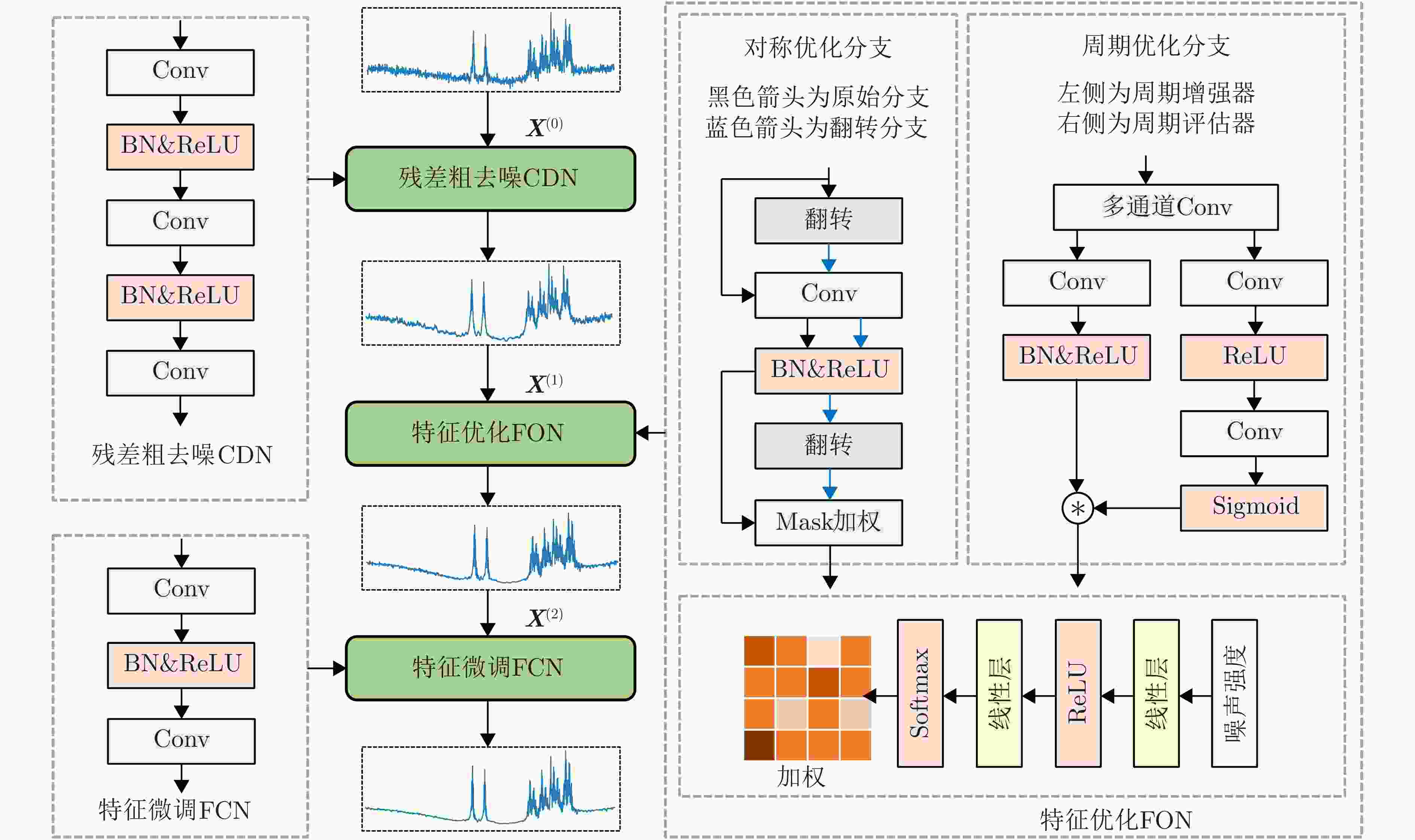
图 4 噪声抑制与特征优化模块结构图
Figure 4. Architecture of the noise suppression and feature optimization module
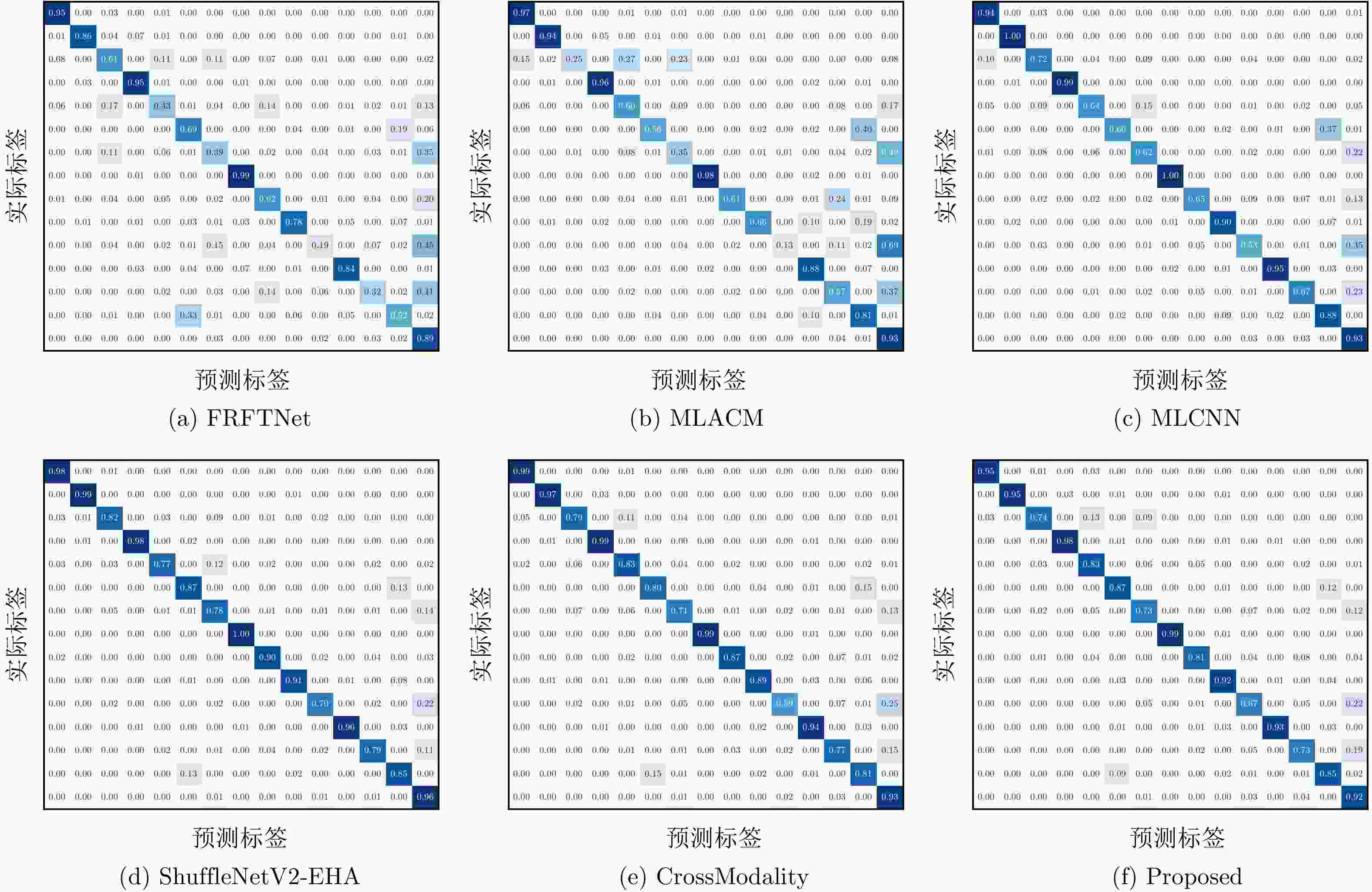
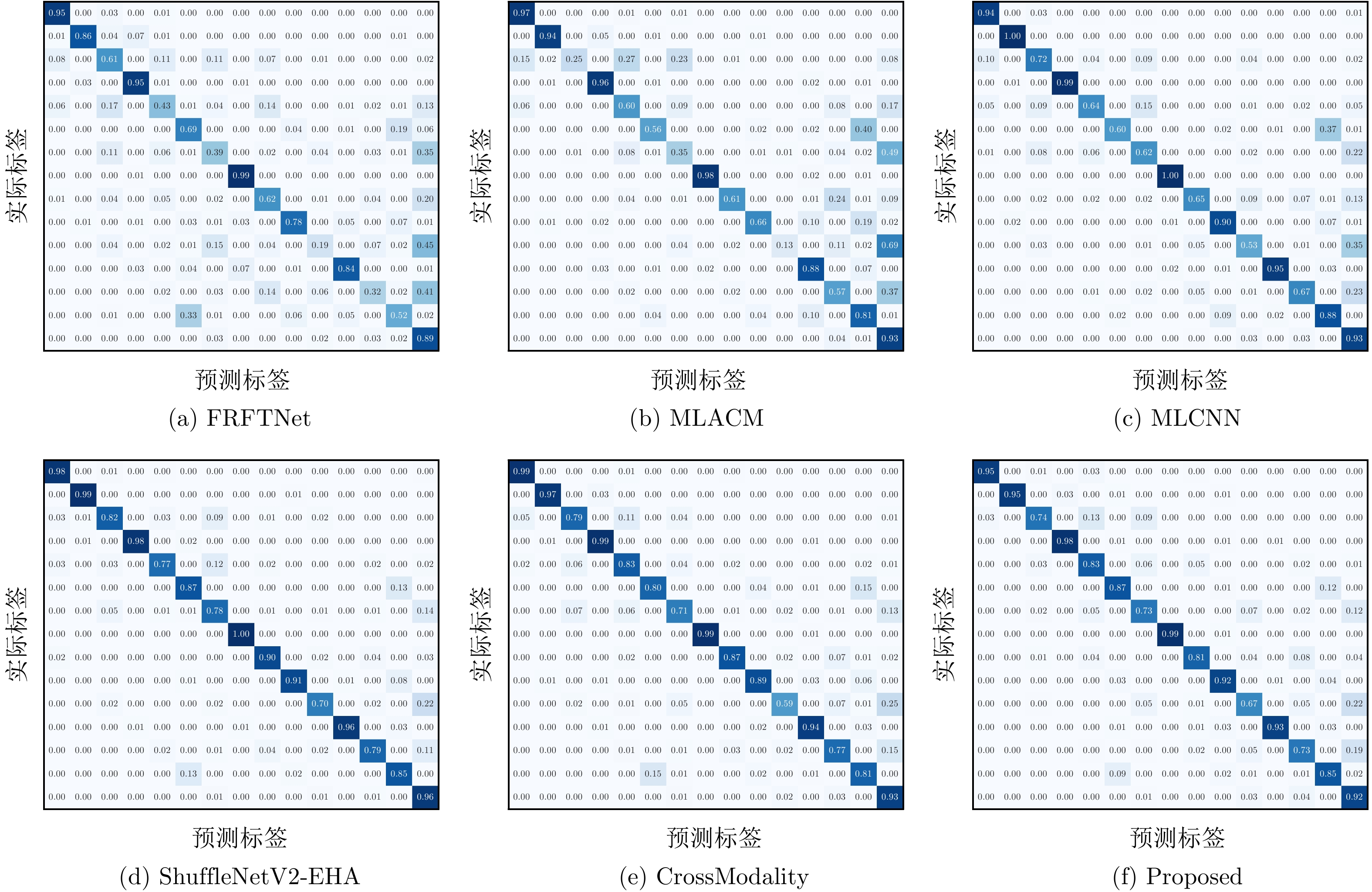
图 7 本文与对比网络混淆矩阵结果图
Figure 7. Confusion matrices of our method and comparative networks
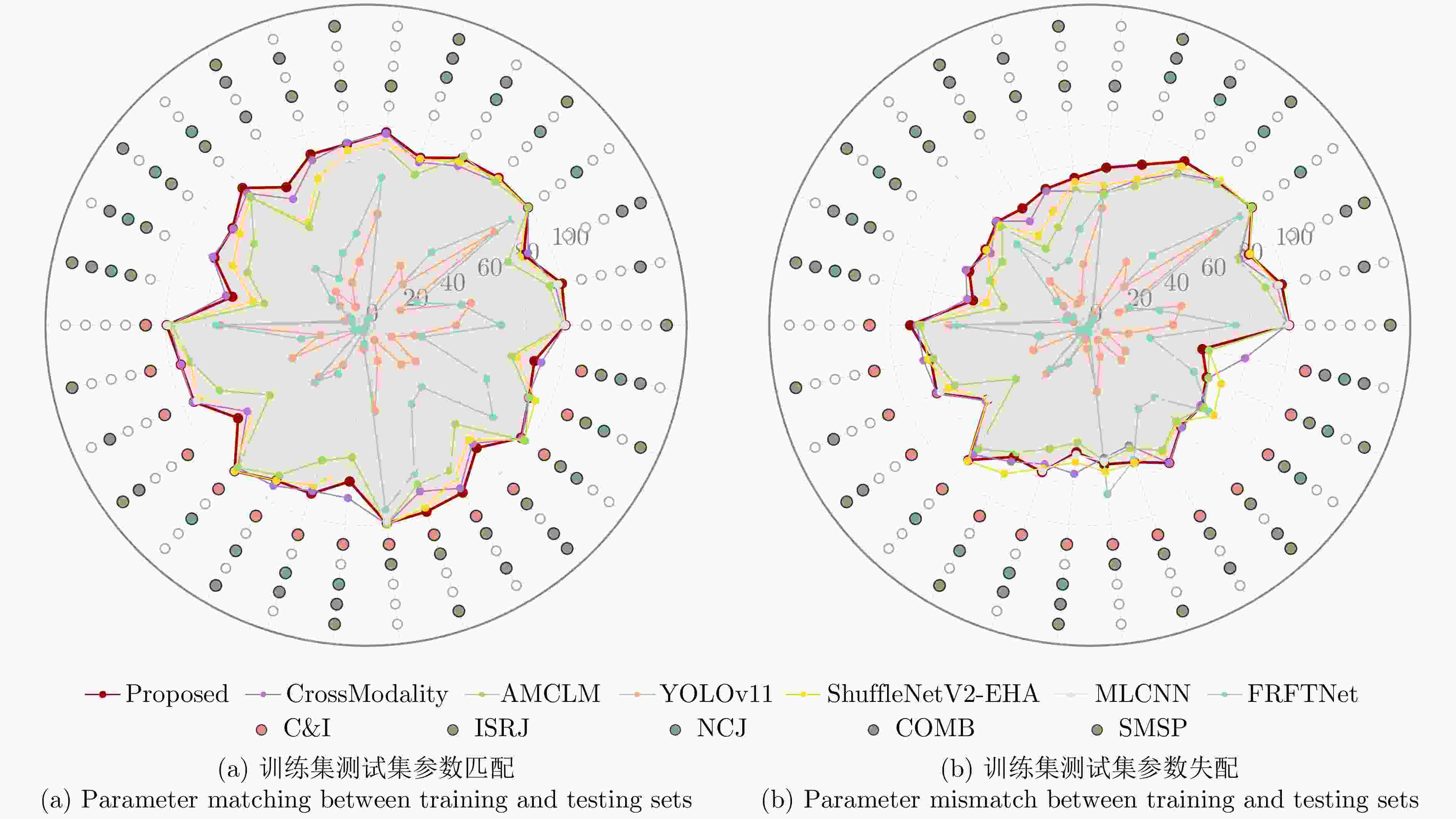
图 8 复杂干扰数据集识别准确率雷达图
Figure 8. Complex interference dataset classification accuracy radar chart
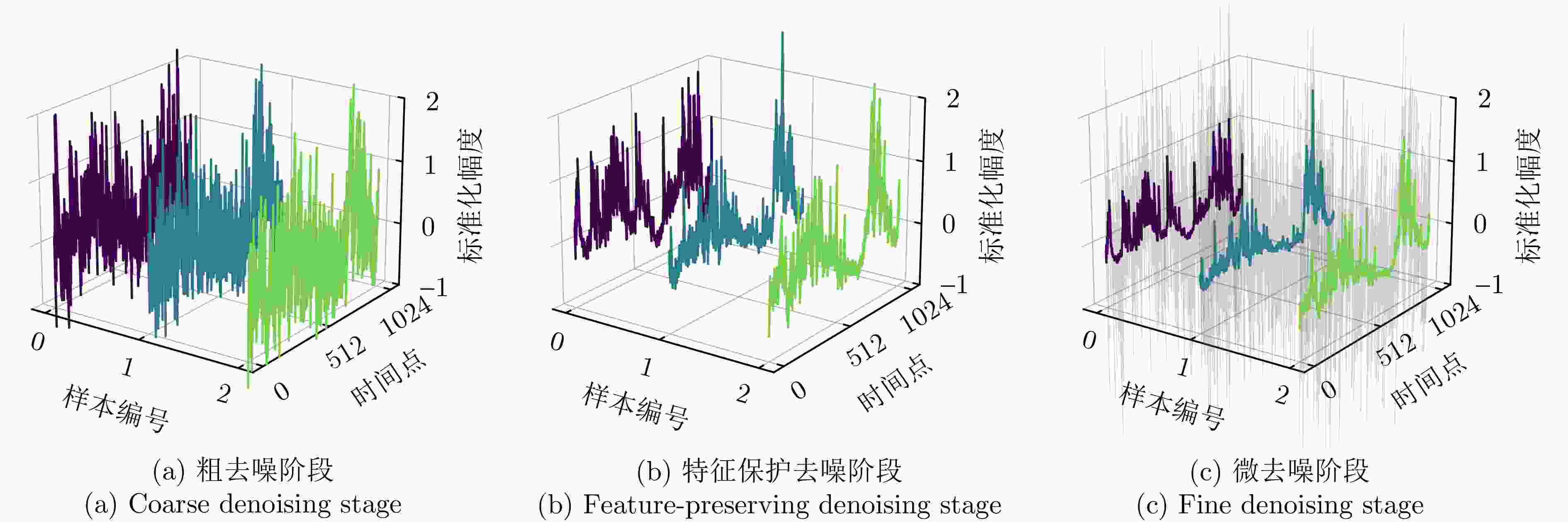
图 9 噪声抑制与特征优化效果图
Figure 9. Visualization of noise suppression and feature optimization effects
表 1 噪声感知分类器结构
Table 1. Noise-aware classifier architecture
层 操作 输出形状 输入 Fdec (B, 24+2) 1 线性层26→64, ReLU (B, 64) 2 Dropout (p=0.3) (B, 64) 3 线性层64→32, ReLU (B, 32) 4 线性层32→分类数 (B,分类数)  下载: 导出CSV
表 2 3个数据集的参数配置
Table 2. Parameter configurations for three datasets
数据集 参数 取值范围 1 总样本数 30000 雷达带宽 10 MHz 雷达脉宽 20 μs 雷达波长 0.1911 m 干扰幅度 0.8~1.2 SNR –8~20 dB 采样占空比 0.160~0.875 速度 300~1200 m/s 距离 1500 ~4900 m转发次数 2~6 次 噪声长度(SNISRJ-1) 0.5~1.5 μs 噪声长度(SNISRJ-2) 10~30 μs 2 总样本数 40000 SNR 0~20 dB 速度 100~600 m/s 距离 1500 ~5000 m干扰幅度 0.8~1.2 采样占空比(ISRJ) 0.3~0.5 谱线数(COMB) 5~15 频率步长(COMB) 0.5~2.0 MHz 切片数(SMSP) 2~4 频率步长(SMSP) 1~3 MHz 采样宽度(C&I) 0.5~1.5 μs 采样周期(C&I) 1~6 μs 3 采样占空比(ISRJ) 0.1~0.5 谱线数(COMB) 5~20 切片数(SMSP) 2~8 采样宽度(C&I) 0.8~1.8 μs 采样周期(C&I) 1.6~7.2 μs
下载: 导出CSV
表 3 各类间歇采样转发干扰在不同网络模型下的识别性能对比
Table 3. Recognition performance comparison of various ISRJ types across different network models
评估类别 干扰类型 模型 YOLOv11 FRFTNet MLACM MLCNN SNV2-EHA CMNet Proposed 单类干扰识别率(%) 1 90.55 99.50 98.59 99.85 99.90 98.39 99.90 2 64.95 94.57 95.54 98.15 99.51 98.48 98.21 3 75.54 91.24 90.62 99.49 96.78 95.54 99.38 4 84.43 95.14 96.43 95.33 97.62 96.95 98.38 复合干扰识别率(%) 1+2 37.08 82.83 90.33 94.17 96.58 92.50 96.00 2+4 19.61 49.22 68.83 63.88 78.64 82.04 78.93 2+3 40.00 68.81 49.25 66.87 81.64 81.27 84.18 2+3+4 20.15 41.24 34.95 57.68 70.93 71.29 78.66 1+4 25.26 63.42 56.49 69.39 87.63 80.00 90.96 1+3 42.41 76.98 63.97 87.16 89.74 90.43 89.22 1+3+4 12.72 19.47 10.44 52.18 54.95 67.91 69.51 3+4 34.22 65.62 27.50 68.36 76.56 72.03 83.20 1+2+4 2.99 30.10 53.97 64.61 74.22 74.07 81.18 1+2+3 34.26 47.35 78.70 85.37 80.62 84.20 87.78 1+2+3+4 89.67 89.20 92.30 91.32 93.28 92.83 97.13 总体效果(%) 平均精确率 48.30 65.42 72.38 78.32 81.07 81.37 85.52 平均召回率 42.12 63.42 63.00 74.61 79.91 79.87 83.29 平均F1分数 42.78 63.38 63.55 75.98 80.27 80.47 84.24 子集准确率 54.98 71.58 72.41 82.17 86.60 86.78 90.54 模型复杂度 浮点运算次(109) 0.183 0.166 0.652 0.005 0.037 4.596 0.160 参数量(106) 1.20 0.66 33.78 0.04 0.65 92.66 0.16 测试时间(s) 0.78 1.14 0.90 0.61 0.64 3.81 0.74 注:加粗表示最优指标;干扰1—4分别对应ISDJ, ISPJ, SNISRJ-1, SNISRJ-2;为方便布局,表格对模型名称进行了简化。
下载: 导出CSV
表 4 不同模型在数据集2与数据集3上的性能对比
Table 4. Performance comparison on dataset 2 and dataset 3
序号 模型 数据集2准确率(%) 数据集3(失配)准确率(%) 1 Proposed 90.66 77.14 2 CrossModality 89.60 76.12 3 ShuffleNetV2-EHA 86.40 75.29 4 MLACM 81.79 70.06 5 MLCNN 78.21 65.68 6 FRFTNet 39.12 37.50 7 YOLOv11 27.36 25.63 注:加粗表示最优指标。
下载: 导出CSV
表 5 模块消融结果
Table 5. Ablation results of modules
实验 噪声抑制 噪声感知 先验引导 小波分支 准确率(%) 1 √ √ √ √ 90.62 2 √ √ √ 87.21 3 √ √ √ 86.71 4 √ √ √ 85.68 5 √ √ √ 86.44 6 √ √ 85.37 7 √ √ 86.68 8 √ √ 85.87 9 √ 84.43 注:加粗表示最优指标。
下载: 导出CSV
-
[1] 崔国龙, 余显祥, 魏文强, 等. 认知智能雷达抗干扰技术综述与展望[J]. 雷达学报, 2022, 11(6): 974–1002. doi: 10.12000/JR22191.CUI Guolong, YU Xianxiang, WEI Wenqiang, et al. An overview of antijamming methods and future works on cognitive intelligent radar[J]. Journal of Radars, 2022, 11(6): 974–1002. doi: 10.12000/JR22191. [2] 刘振, 隋金坪, 魏玺章, 等. 雷达有源干扰识别技术研究现状与发展趋势[J]. 信号处理, 2017, 33(12): 1593–1601. doi: 10.16798/j.issn.1003-0530.2017.12.010.LIU Zhen, SUI Jinping, WEI Xizhang, et al. The development and prospect of the radar active jamming recognition[J]. Journal of Signal Processing, 2017, 33(12): 1593–1601. doi: 10.16798/j.issn.1003-0530.2017.12.010. [3] 周胜文, 沙明辉, 胡小春. 基于梳状谱调制和间歇采样重复转发的复合干扰[J]. 系统工程与电子技术, 2021, 43(12): 3495–3501. doi: 10.12305/j.issn.1001-506X.2021.12.10.ZHOU Shengwen, SHA Minghui, and HU Xiaochun. Composite jamming based on comb spectrum modulation and interrupted sampling repetitive repeater[J]. Systems Engineering and Electronics, 2021, 43(12): 3495–3501. doi: 10.12305/j.issn.1001-506X.2021.12.10. [4] JIE Xiao, WEI Xizhang, and SUN Jia. Interrupted-sampling multi-strategy forwarding jamming with amplitude constraints based on simultaneous transmission and reception technology[J]. Digital Signal Processing, 2024, 147: 104416. doi: 10.1016/j.dsp.2024.104416. [5] 周阳, 毕大平, 沈爱国, 等. 基于运动调制的SAR-GMTI间歇采样遮蔽干扰方法[J]. 雷达学报, 2017, 6(4): 359–367. doi: 10.12000/JR16075.ZHOU Yang, BI Daping, SHEN Aiguo, et al. Intermittent sampling repeater shading jamming method based on motion modulation for SAR-GMTI[J]. Journal of Radars, 2017, 6(4): 359–367. doi: 10.12000/JR16075. [6] 郭文杰, 吴振华, 曹宜策, 等. 多域浅层特征引导下雷达有源干扰多模态对比识别方法[J]. 雷达学报(中英文), 2024, 13(5): 1004–1018. doi: 10.12000/JR24129.GUO Wenjie, WU Zhenhua, CAO Yice, et al. Multidomain characteristic-guided multimodal contrastive recognition method for active radar jamming[J]. Journal of Radars, 2024, 13(5): 1004–1018. doi: 10.12000/JR24129. [7] WANG Zan, GUO Zhengwei, SHU Gaofeng, et al. Radar jamming recognition: Models, methods, and prospects[J]. IEEE Journal of Selected Topics in Applied Earth Observations and Remote Sensing, 2025, 18: 3315–3343. doi: 10.1109/JSTARS.2024.3522951. [8] 周红平, 王子伟, 郭忠义. 雷达有源干扰识别算法综述[J]. 数据采集与处理, 2022, 37(1): 1–20. doi: 10.16337/j.1004-9037.2022.01.001.ZHOU Hongping, WANG Ziwei, and GUO Zhongyi. Overview on recognition algorithms of radar active jamming[J]. Journal of Data Acquisition and Processing, 2022, 37(1): 1–20. doi: 10.16337/j.1004-9037.2022.01.001. [9] HAO Guocheng, BU Laite, LU Mengyuan, et al. Radar jamming signal recognition algorithm based on multi-feature fusion[J]. Digital Signal Processing, 2025, 158: 104950. doi: 10.1016/j.dsp.2024.104950. [10] SHI Yuxin, LU Xinjin, NIU Yingtao, et al. Efficient jamming identification in wireless communication: Using small sample data driven naive Bayes classifier[J]. IEEE Wireless Communications Letters, 2021, 10(7): 1375–1379. doi: 10.1109/LWC.2021.3064843. [11] 刘一兵, 罗强, 胡然, 等. 基于多维小波特征的有源雷达欺骗干扰识别[J]. 现代防御技术, 2024, 52(3): 120–127. doi: 10.3969/j.issn.1009-086x.2024.03.015.LIU Yibing, LUO Qiang, HU Ran, et al. Active radar deception jamming recognition based on multi-dimensional wavelet features[J]. Modern Defence Technology, 2024, 52(3): 120–127. doi: 10.3969/j.issn.1009-086x.2024.03.015. [12] 王佳祥, 孟进, 李伟, 等. YOLO-S3: 一种轻量化的雷达复合干扰识别网络[J]. 雷达学报(中英文), 待出版. doi: 10.12000/JR25080.WANG Jiaxiang, MENG Jin, LI Wei, et al. YOLO-S3: A lightweight network for radar composite jamming signal recognition[J]. Journal of Radars, in press. doi: 10.12000/JR25080. [13] ZHAO Qingyuan, LIU Yang, CAI Linjie, et al. Research on electronic jamming identification based on CNN[C]. 2019 IEEE International Conference on Signal, Information and Data Processing, Chongqing, China, 2019: 1–5. doi: 10.1109/ICSIDP47821.2019.9172911. [14] LIN Junjie and FAN Xiaolei. Radar active jamming recognition based on recurrence plot and convolutional neural network[C]. 2021 IEEE 4th Advanced Information Management, Communicates, Electronic and Automation Control Conference, Chongqing, China, 2021: 1511–1515. doi: 10.1109/IMCEC51613.2021.9481990. [15] WU Yaojun, DUAN Lining, YANG Liaoming, et al. Fine-grained recognition and suppression of ISRJ based on UNet-A[J]. IEEE Geoscience and Remote Sensing Letters, 2024, 21: 3508805. doi: 10.1109/LGRS.2024.3448611. [16] ZHOU Hongping, WANG Ziwei, WU Ruowu, et al. Jamming recognition algorithm based on variational mode decomposition[J]. IEEE Sensors Journal, 2023, 23(15): 17341–17349. doi: 10.1109/JSEN.2023.3283397. [17] ZHOU Hongping, WANG Lei, and GUO Zhongyi. Recognition of radar compound jamming based on convolutional neural network[J]. IEEE Transactions on Aerospace and Electronic Systems, 2023, 59(6): 7380–7394. doi: 10.1109/TAES.2023.3288080. [18] ZHU Mengtao, LI Yunjie, PAN Zesi, et al. Automatic modulation recognition of compound signals using a deep multi-label classifier: A case study with radar jamming signals[J]. Signal Processing, 2020, 169: 107393. doi: 10.1016/j.sigpro.2019.107393. [19] QU Qizhe, WEI Shunjun, LIU Shan, et al. JRNet: Jamming recognition networks for radar compound suppression jamming signals[J]. IEEE Transactions on Vehicular Technology, 2020, 69(12): 15035–15045. doi: 10.1109/TVT.2020.3032197. [20] LV Qinzhe, FAN Hanxin, LIU Junliang, et al. Multilabel deep learning-based lightweight radar compound jamming recognition method[J]. IEEE Transactions on Instrumentation and Measurement, 2024, 73: 2521115. doi: 10.1109/TIM.2024.3400337. [21] LIU Mei, GAO Xunzhang, QIU Xiangfeng, et al. Deep Gaussian hidden Markov network for robust HRRP sequence modeling and target recognition[J]. IEEE Transactions on Aerospace and Electronic Systems, 2025, 61(6): 19068–19083. doi: 10.1109/TAES.2025.3615896. [22] LIU Mei, GAO Xunzhang, and ZHANG Zhiwei. Noise robust HRRP sequence recognition based on a deep unfolded go decomposition network[J]. Signal Processing, 2025, 230: 109876. doi: 10.1016/j.sigpro.2024.109876. [23] ZHANG Lingyun, TAN Hui, and WANG Zhili. Interference response prediction of receiver based on wavelet transform and a temporal convolution network[J]. Electronics, 2024, 13(1): 162. doi: 10.3390/electronics13010162. [24] YU Yifei, LI Yuanxiang, ZHOU Yunqing, et al. A learnable and explainable wavelet neural network for EEG artifacts detection and classification[J]. IEEE Transactions on Neural Systems and Rehabilitation Engineering, 2024, 32: 3358–3368. doi: 10.1109/TNSRE.2024.3452315. [25] 寇雯博, 董灏, 邹岷强, 等. 混杂复合材料等效热传导性能预测的小波-机器学习混合方法[J]. 物理学报, 2021, 70(3): 030701. doi: 10.7498/aps.70.20201085.KOU Wenbo, DONG Hao, ZOU Minqiang, et al. Hybrid wavelet-based learning method of predicting effective thermal conductivities of hybrid composite materials[J]. Acta Physica Sinica, 2021, 70(3): 030701. doi: 10.7498/aps.70.20201085. [26] SU Hanning, BAO Qinglong, PAN Jiameng, et al. Waveform-domain complementary signal sets for interrupted sampling repeater jamming suppression[J]. IEEE Transactions on Aerospace and Electronic Systems, 2024, 60(5): 7142–7158. doi: 10.1109/TAES.2024.3410952. [27] 施富强, 周超, 刘泉华. 间歇采样重复转发式干扰特性分析[J]. 信号处理, 2017, 33(12): 1616–1624. doi: 10.16798/j.issn.1003-0530.2017.12.013.SHI Fuqiang, ZHOU Chao, and LIU Quanhua. Characteristics analysis of interrupted-sampling repeater jamming[J]. Journal of Signal Processing, 2017, 33(12): 1616–1624. doi: 10.16798/j.issn.1003-0530.2017.12.013. [28] 潘小义, 刘晓斌, 陈吉源, 等. 间歇采样转发干扰技术研究述评[J]. 系统工程与电子技术, 2024, 46(9): 2887–2901. doi: 10.12305/j.issn.1001-506X.2024.09.01.PAN Xiaoyi, LIU Xiaobin, CHEN Jiyuan, et al. Overview of intermittent sampling repeater jamming technology[J]. Systems Engineering and Electronics, 2024, 46(9): 2887–2901. doi: 10.12305/j.issn.1001-506X.2024.09.01. [29] WU Zhenhua, WANG Tengxin, CAO Yice, et al. Radar active deception jamming recognition based on Siamese squeeze wavelet attention network[J]. IET Radar, Sonar & Navigation, 2023, 17(12): 1886–1898. doi: 10.1049/rsn2.12482. [30] HUANG Junjie and DRAGOTTI P L. WINNet: Wavelet-inspired invertible network for image denoising[J]. IEEE Transactions on Image Processing, 2022, 31: 4377–4392. doi: 10.1109/TIP.2022.3184845. [31] BATOOL I and IMRAN M. A dual residual dense network for image denoising[J]. Engineering Applications of Artificial Intelligence, 2025, 147: 110275. doi: 10.1016/j.engappai.2025.110275. [32] DONG Ganggang, WANG Zixuan, and LIU Hongwei. A cross-modality contrastive learning method for radar jamming recognition[J]. IEEE Transactions on Instrumentation and Measurement, 2025, 74: 2520811. doi: 10.1109/TIM.2025.3554858. [33] WANG Yongyao, SUN Haiyang, LUO Kai, et al. A lightweight YOLOv11-based framework for small steel defect detection with a newly enhanced feature fusion module[J]. Scientific Reports, 2025, 15(1): 34322. doi: 10.1038/s41598-025-16619-9. -




计量
- 文章访问数:
- HTML全文浏览量:
- PDF下载量:
- 被引次数: 0