

 作者中心
作者中心 专家审稿
专家审稿 责编办公
责编办公 编辑办公
编辑办公
Parameter Estimation of a Moving Target with Combined Translational and Rotational Motion Based on Single Mode Vortex Electromagnetic Waves
-
摘要: 近年来,涡旋电磁波由于其独特的波前分布结构在运动目标探测方面具有重要价值,而准确估计径向多普勒和旋转多普勒频移是对运动目标平动、旋转运动参数进行高精度测量的关键。然而,现有基于涡旋电磁波的多普勒估计方法通常依赖于同时发射多个模态,在高速运动目标场景下需要额外先验信息处理多普勒模糊,并且径向-旋转多普勒分离精度有限。针对前述问题,该文提出了一种基于自适应分段稀疏表征(APWSR)瞬时频率估计的单模态涡旋电磁波径向-旋转多普勒分离方法。通过引入多普勒压缩技术,仅利用单模态回波即可实现径向与旋转多普勒分量的有效分离,并利用APWSR实现高精度瞬时频率估计。在此基础上,进一步提取了目标的平动速度、旋转半径、旋转频率及欧拉角等运动参数。仿真实验验证了所提方法的有效性与稳健性,结果表明,所提方法在多普勒频率与运动参数估计精度方面均优于已有双模态方法。Abstract: Vortex electromagnetic waves have proven highly effective for moving-target detection due to their distinctive wavefront phase distribution. Accurate estimation of translational and rotational Doppler shifts is essential for high-precision measurement of motion parameters. Existing methods typically rely on transmitting multiple modes of vortex electromagnetic waves, and they often require additional prior information to resolve Doppler ambiguities for high-speed targets, and the separation accuracy of translational and rotational Doppler components is limited. To address these challenges, this work proposes a single mode vortex electromagnetic wave-based Doppler separation method combined with Adaptive Piece-Wise Sparse Representation (APWSR) for high-precision instantaneous frequency estimation. Using the Doppler compression technique, translational and rotational Doppler components can be effectively separated using only a single mode, while APWSR enables high-precision instantaneous frequency estimation. From these results, the translational velocity, rotation radius, rotational frequency, and Euler angles of the target are extracted. Simulations validate the effectiveness and robustness of the proposed method, demonstrating that it outperforms existing dual-mode approaches in Doppler frequency and motion parameter estimation.
-
Key words:
- Vortex electromagnetic wave /
- Single mode /
- Rotational Doppler /
- Moving target /
- Parameter estimation
-
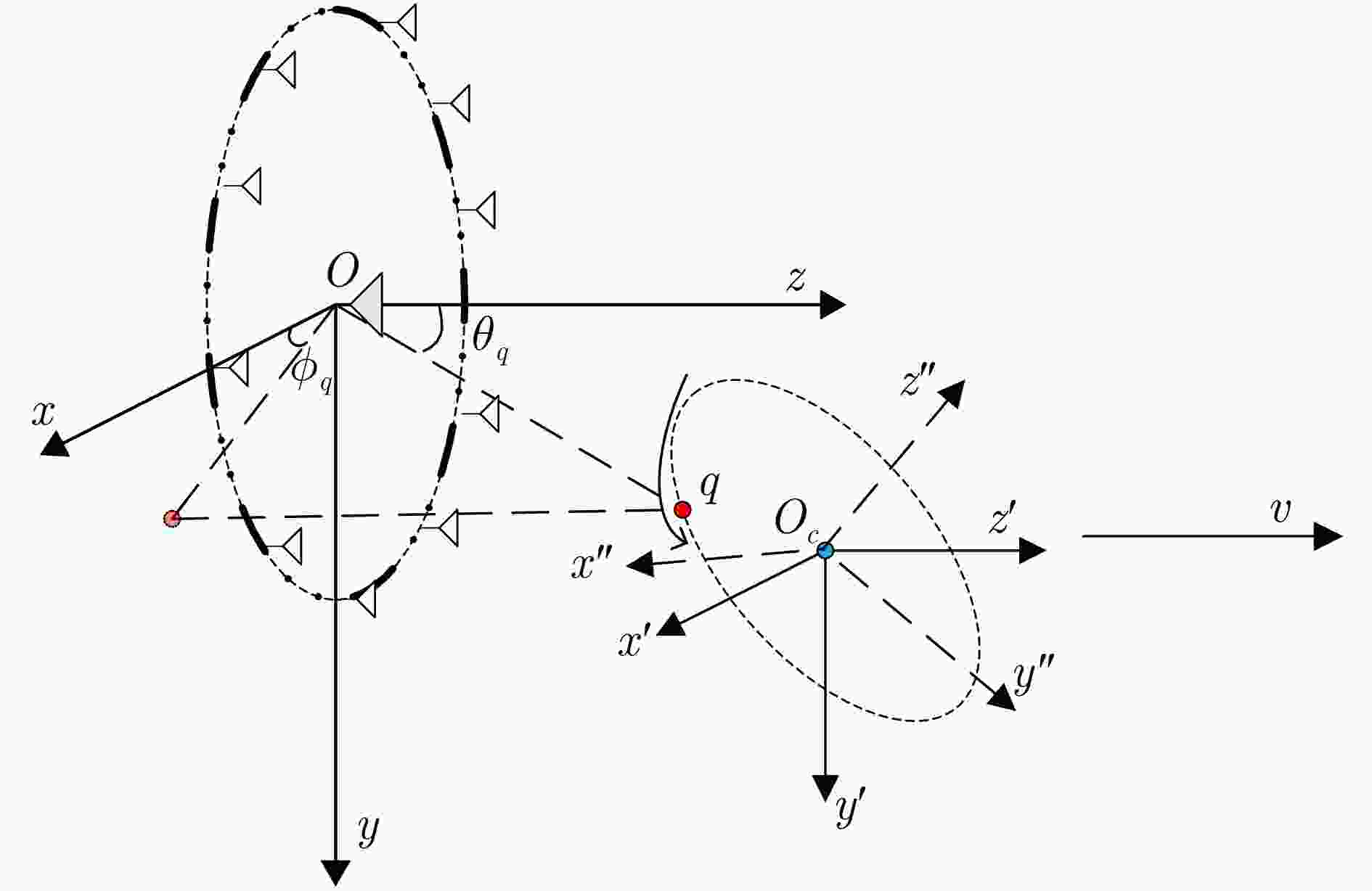
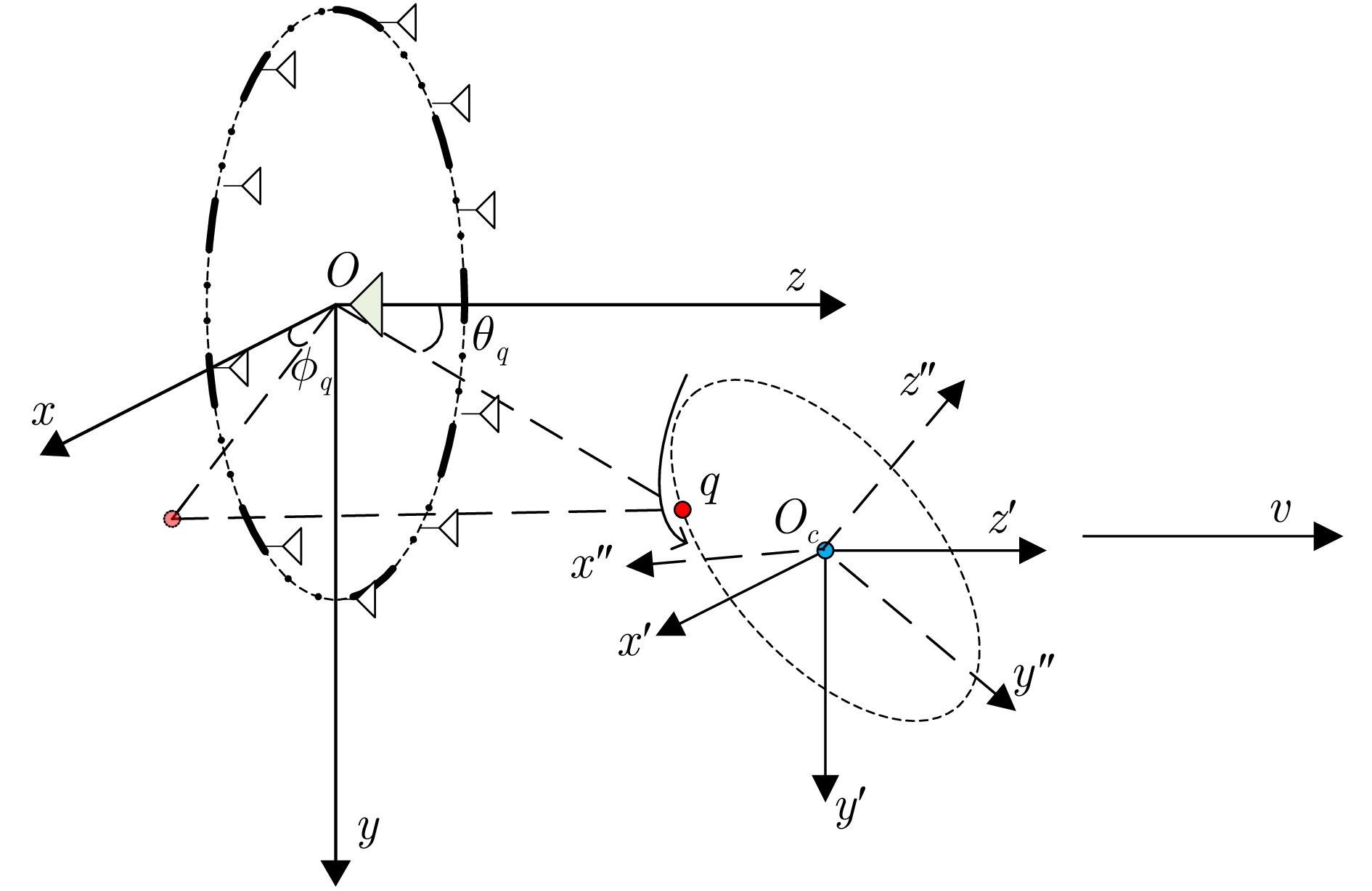
图 1 电磁涡旋雷达照射下平动旋转目标运动几何
Figure 1. Geometric of the target with translational-rotational motion illuminated by the electromagnetic vortex radar
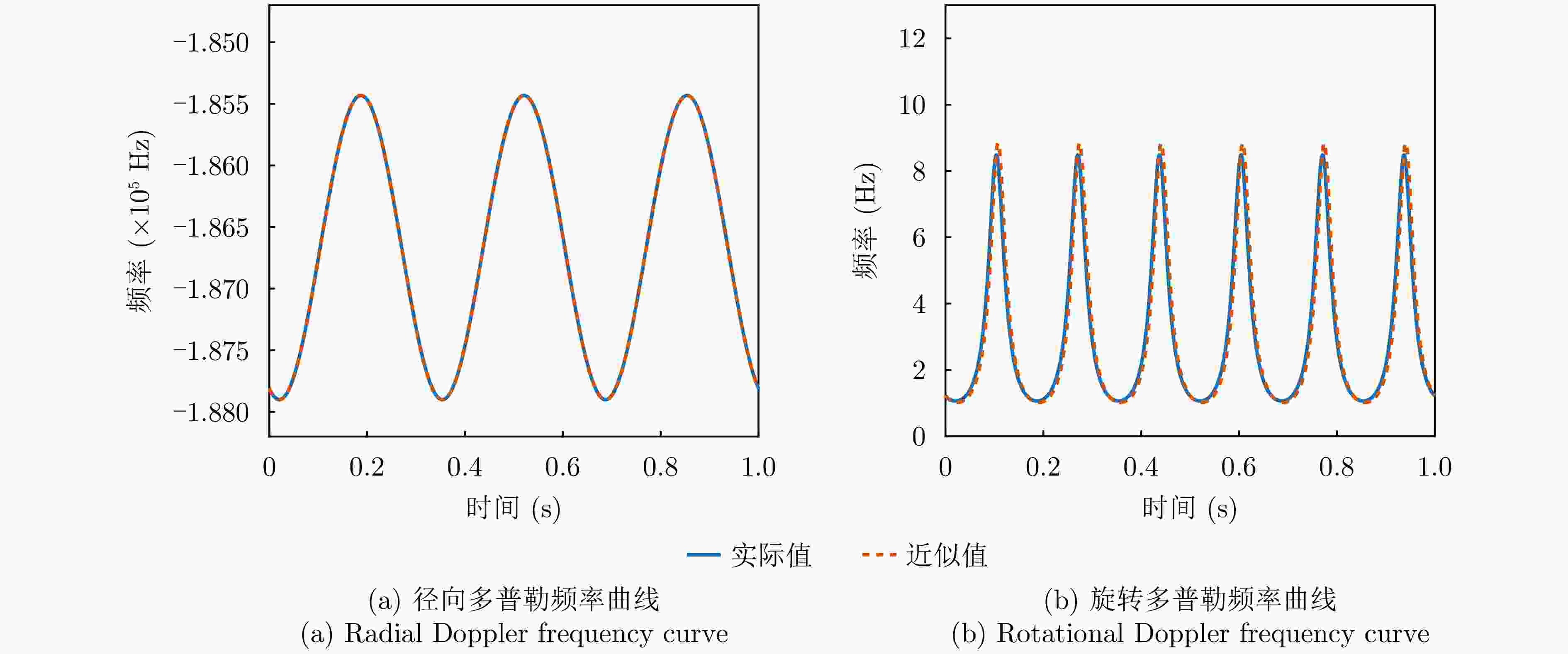
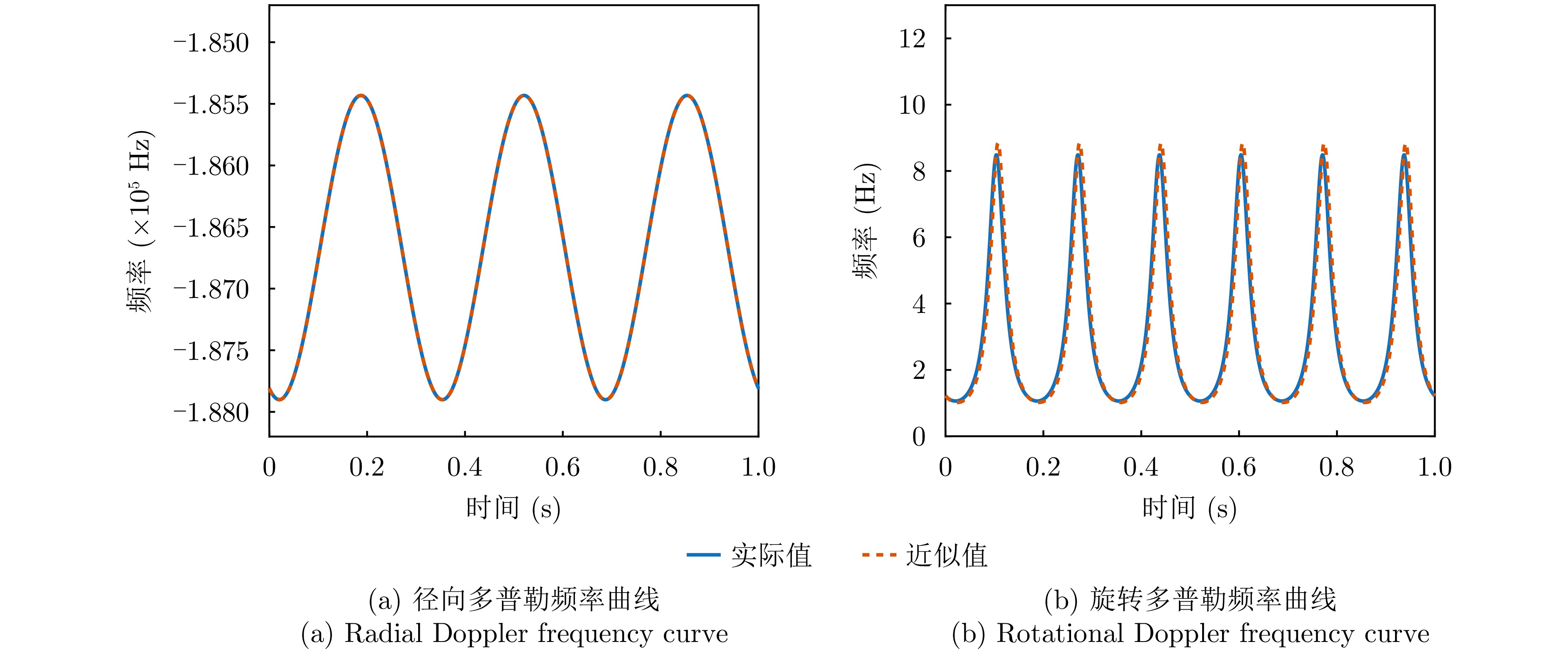
图 2 多普勒近似值与实际值拟合曲线
Figure 2. Fitting curves between approximation Doppler and actual Doppler
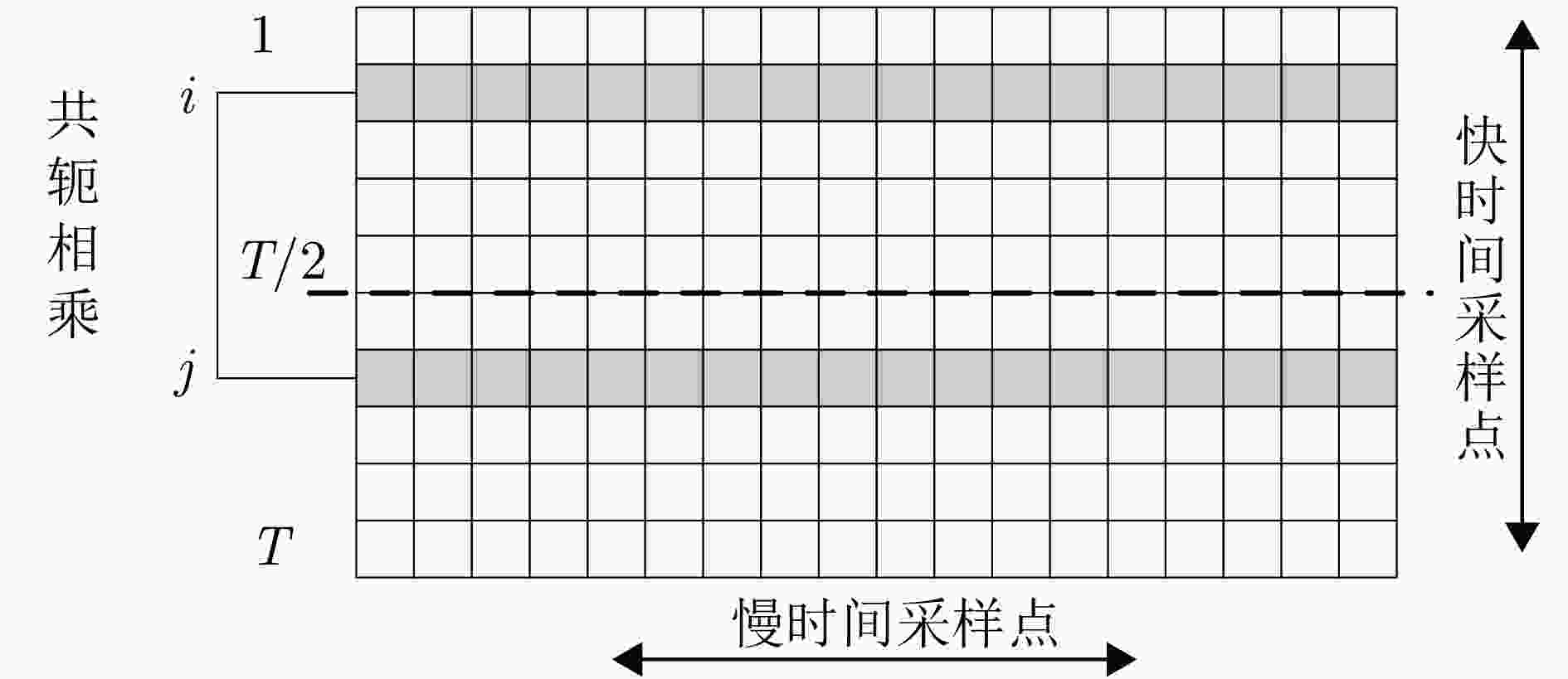
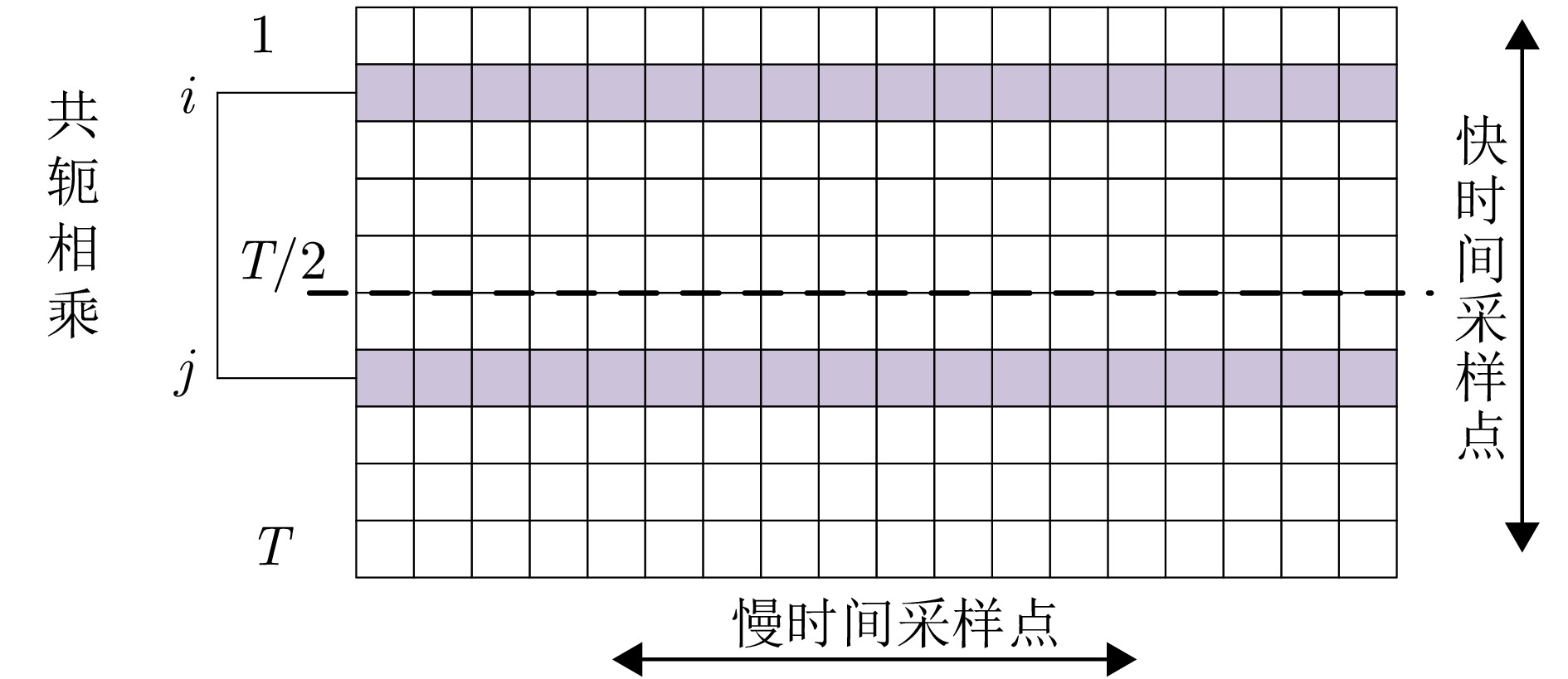
图 3 回波数据矩阵处理过程示意图
Figure 3. Schematic of the processing procedure for the echo data matrix
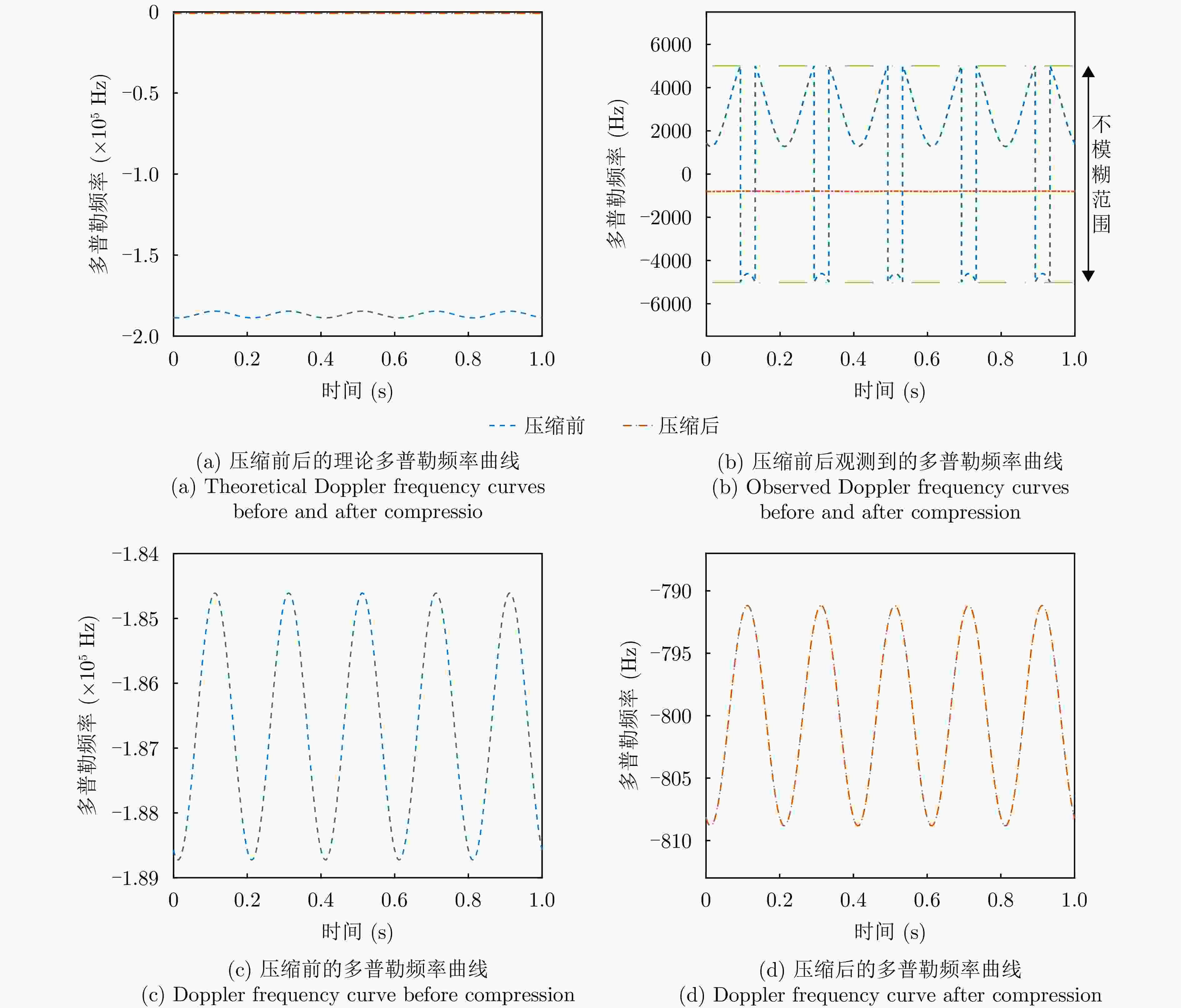
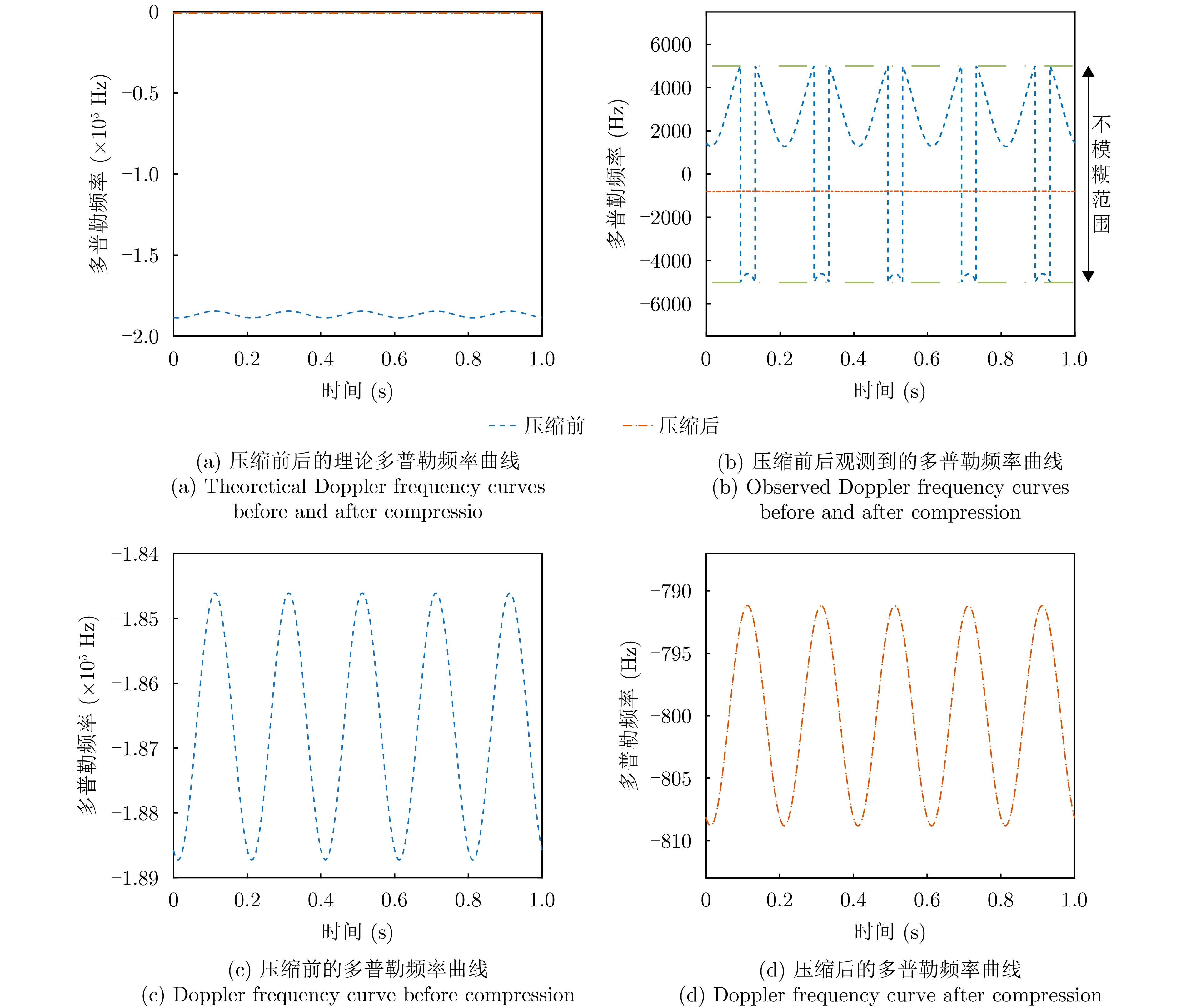
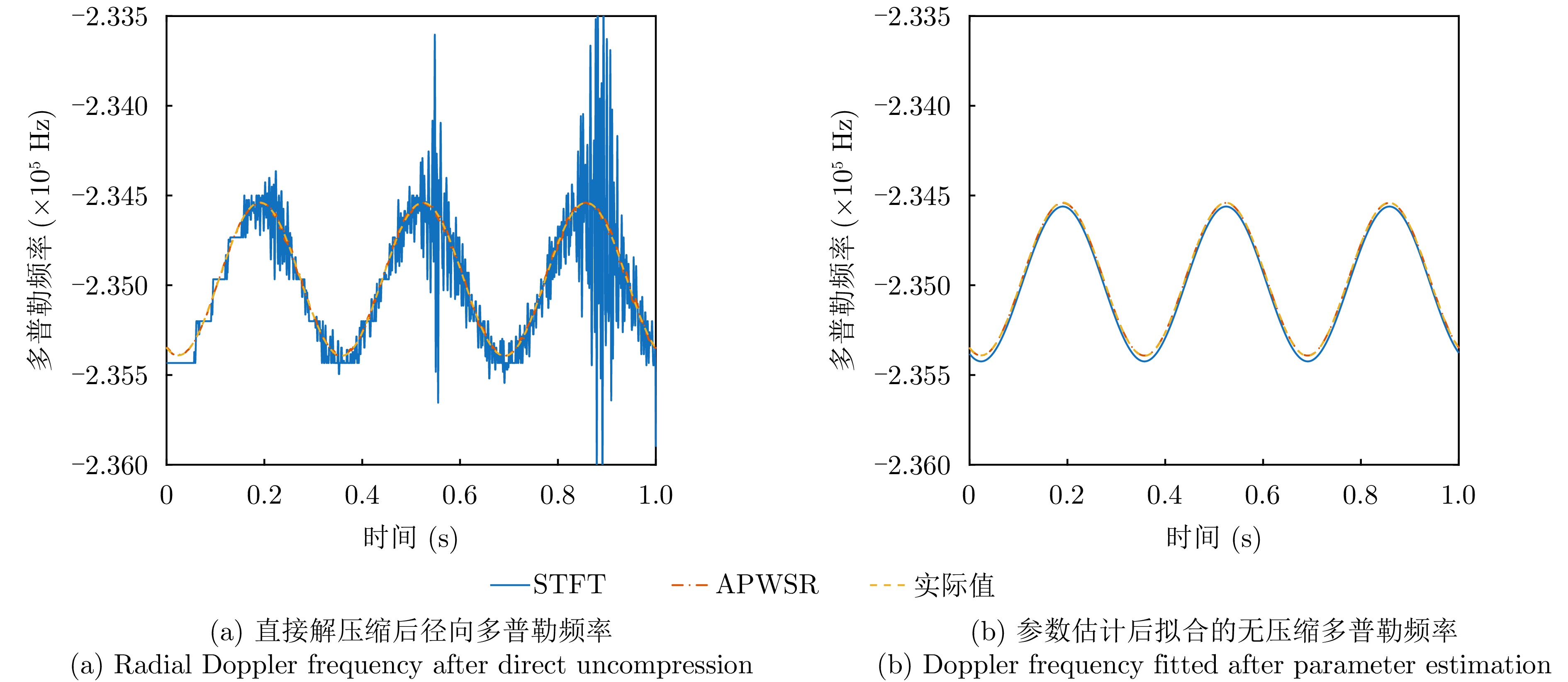
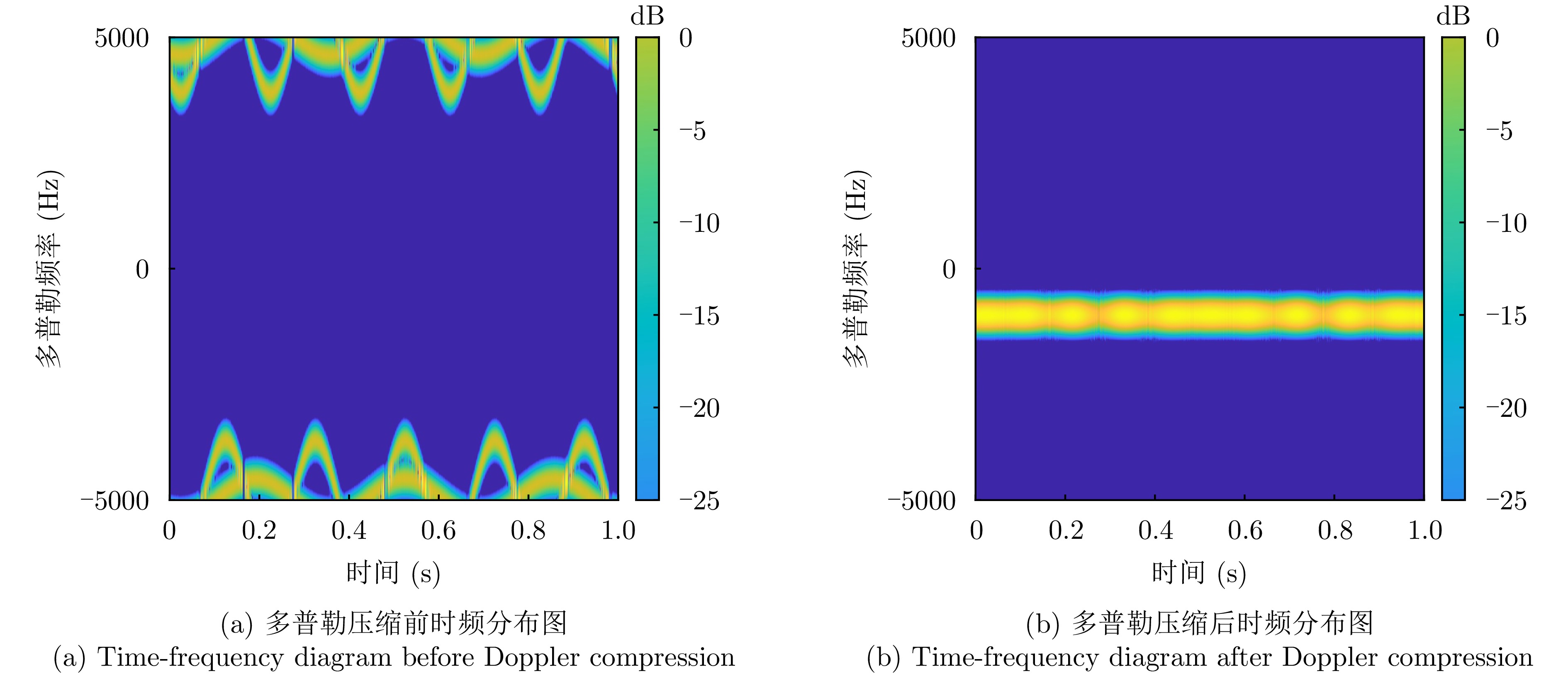
图 4 多普勒压缩前后的多普勒频率曲线图
Figure 4. Doppler frequency curves before and after Doppler compression
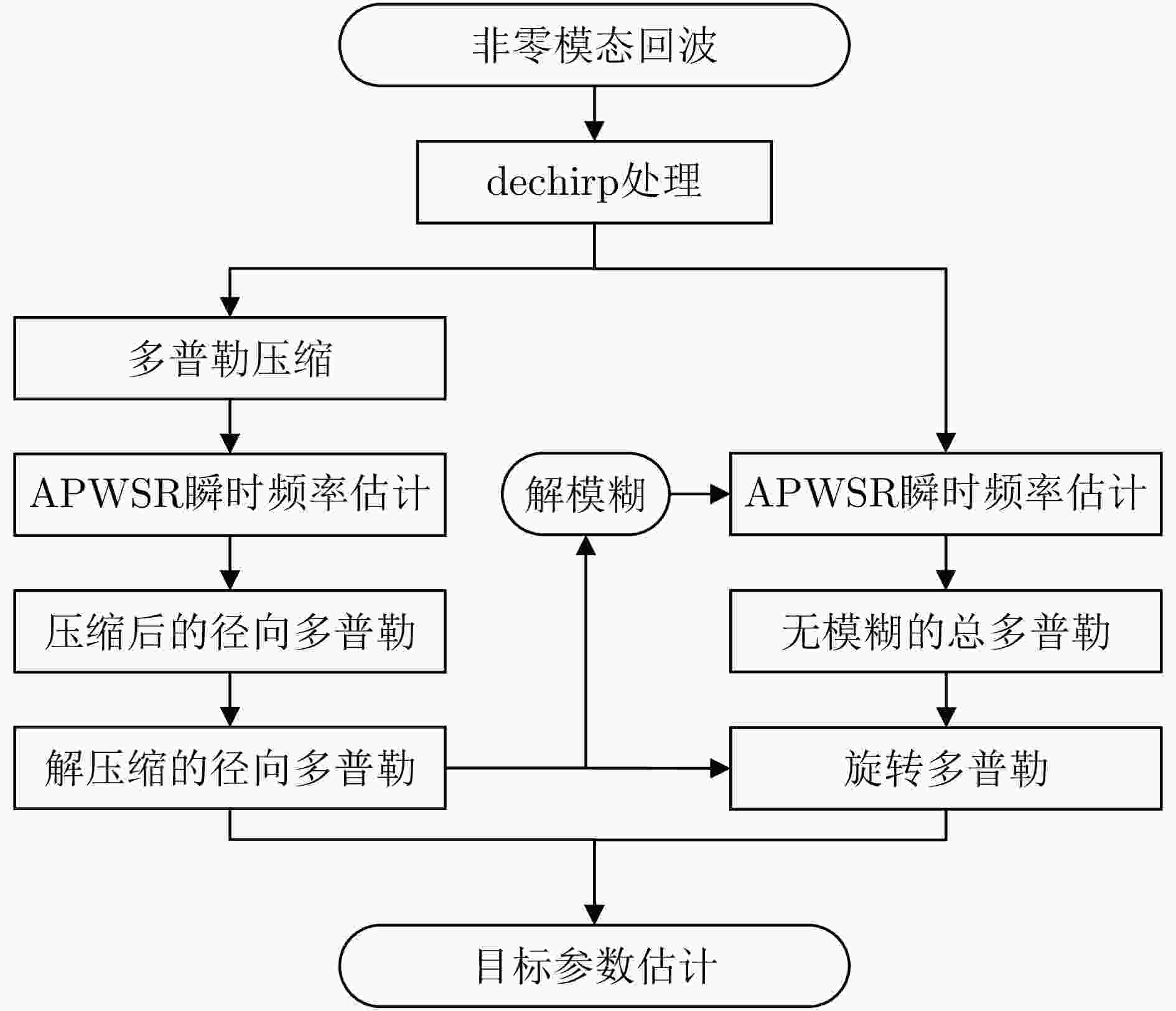
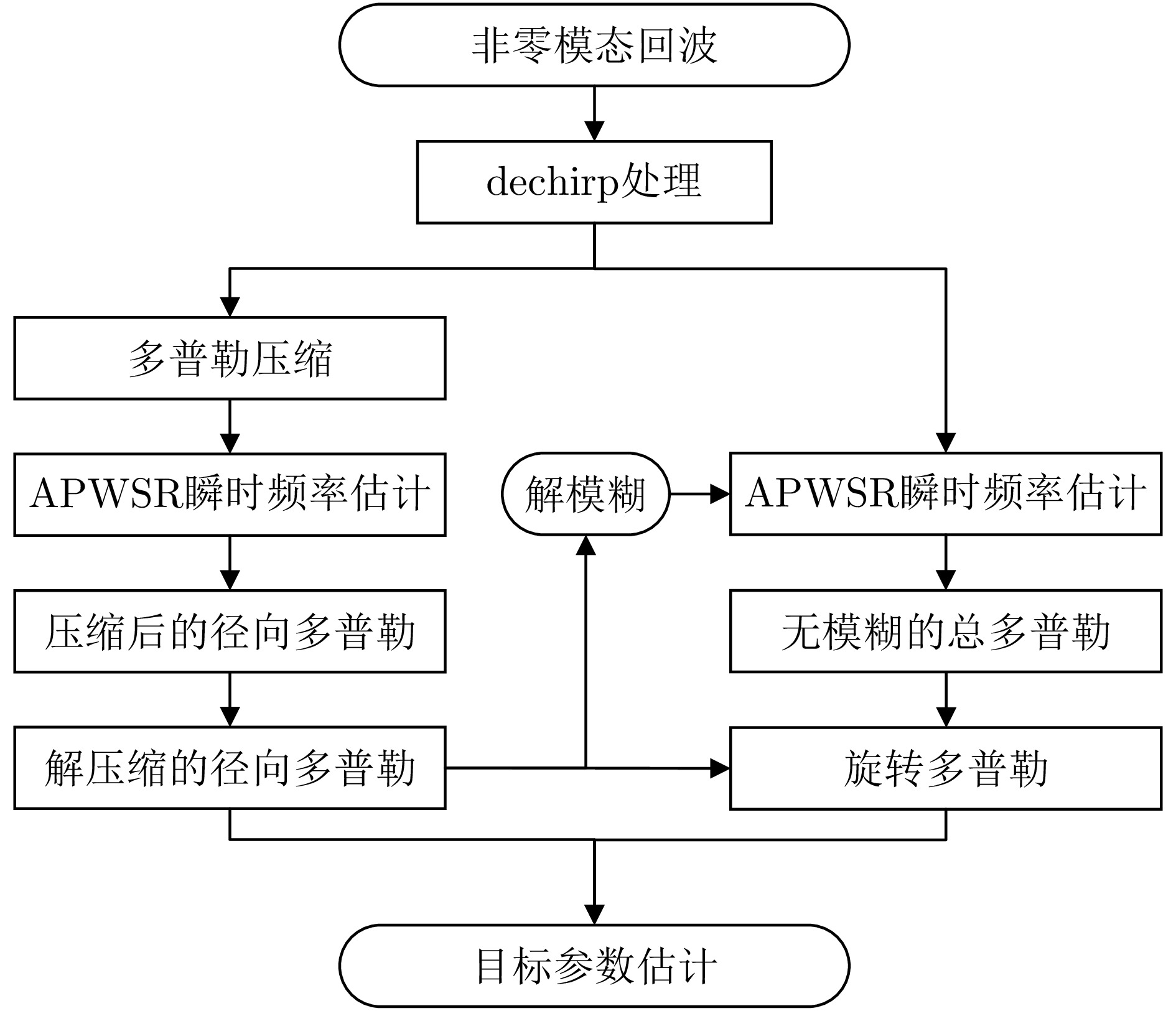
图 6 单模态涡旋电磁波径向-旋转多普勒分离方法
Figure 6. Method of separation electromagnetic vortex wave radial-rotational Doppler with single mode
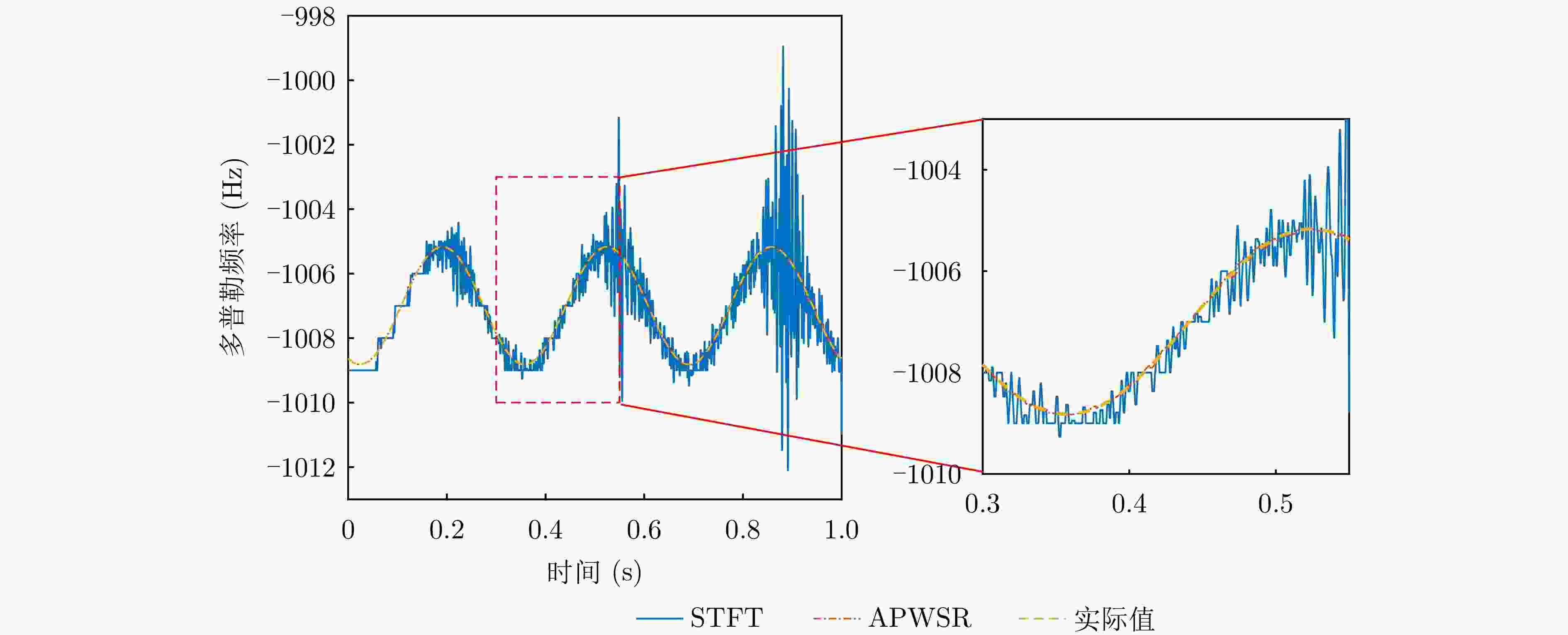
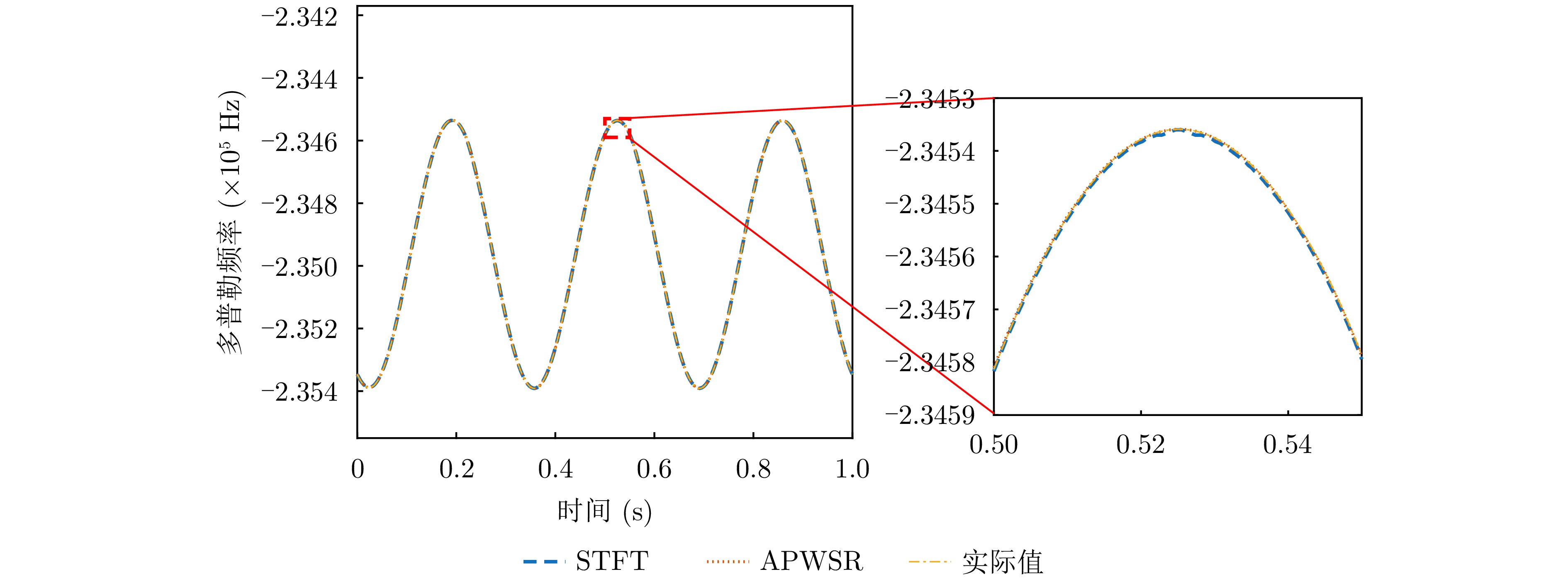
图 7 模态1多普勒频率曲线估计结果
Figure 7. Estimation results of the Doppler frequency curve under OAM mode 1
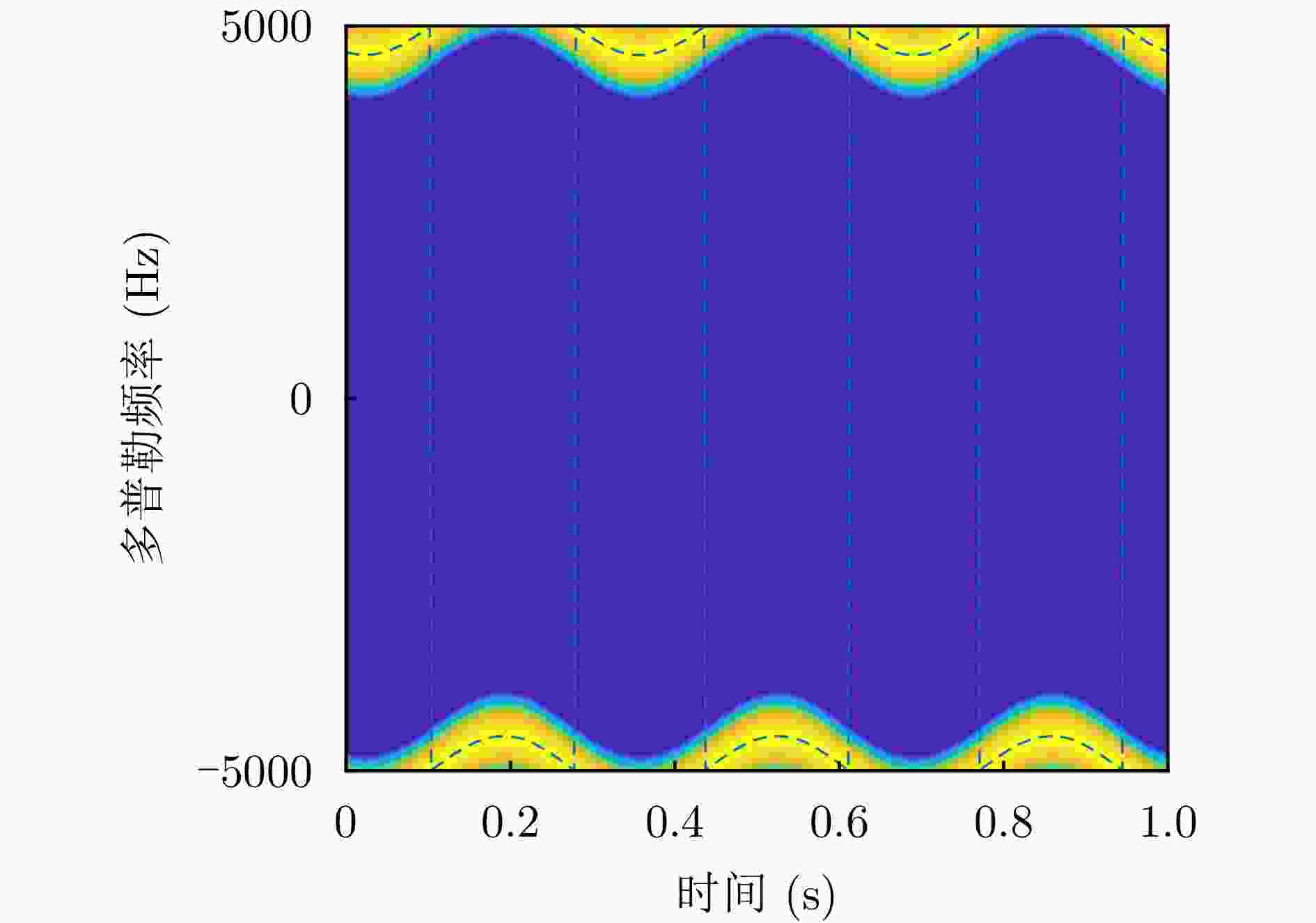
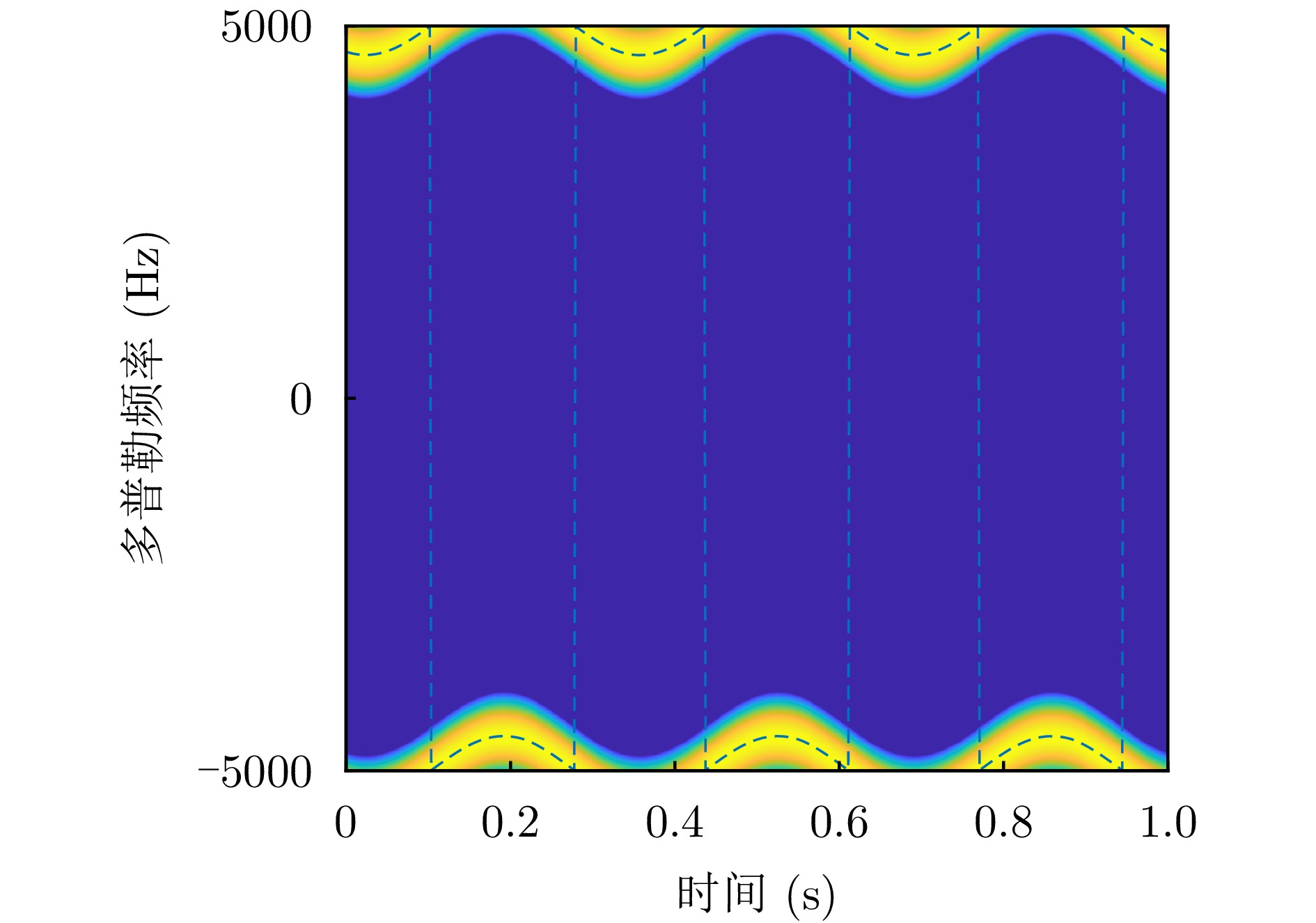
图 9 STFT方法对应的总多普勒时频图
Figure 9. Time-frequency diagram of the total Doppler with the STFT method
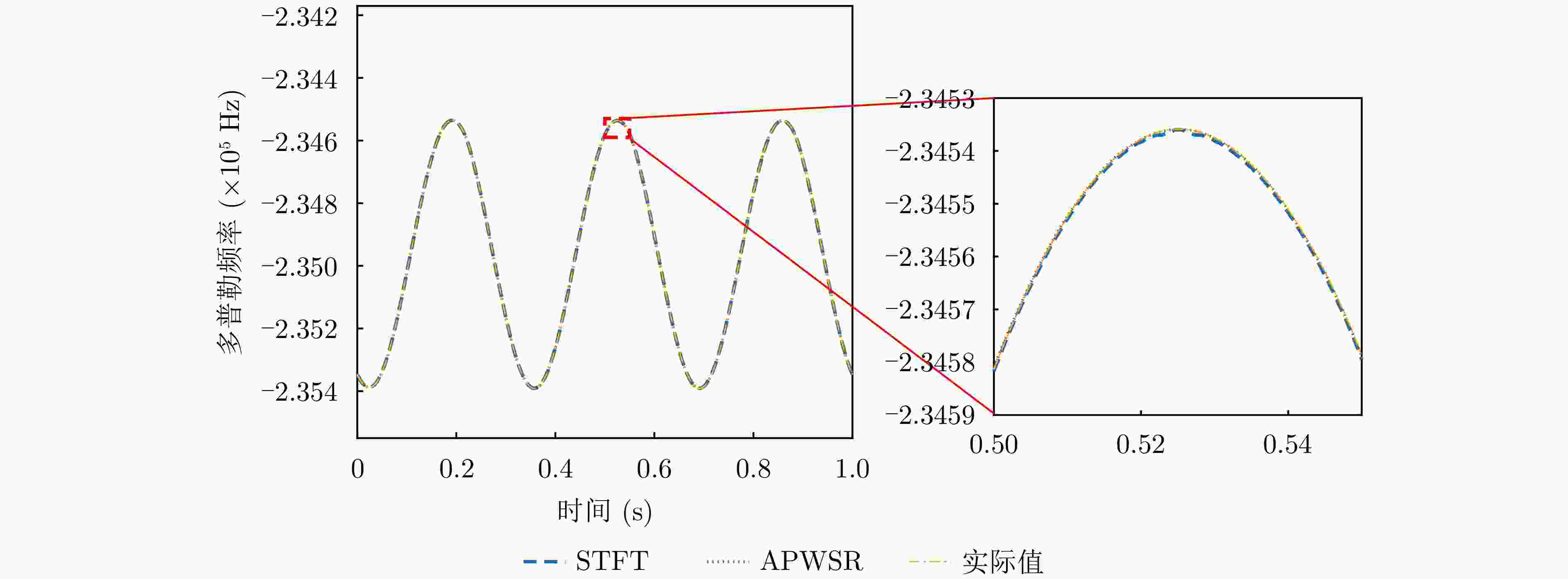
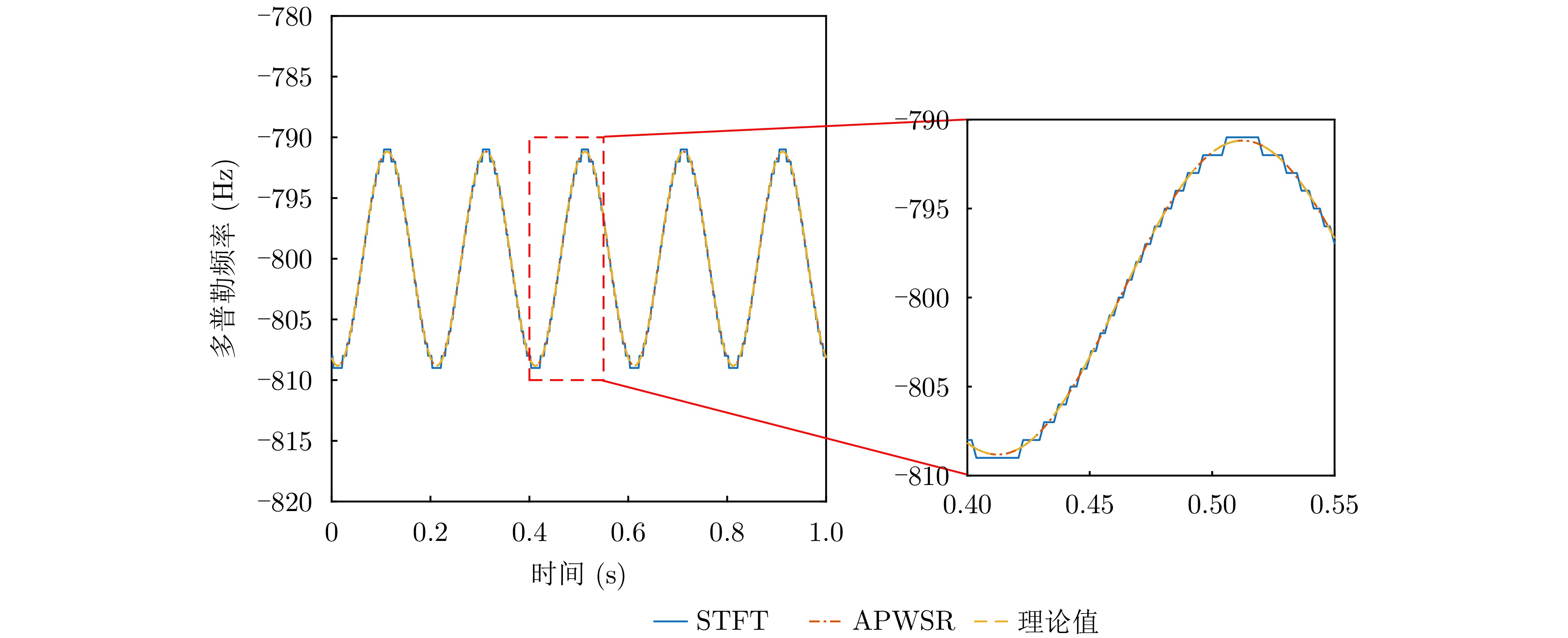
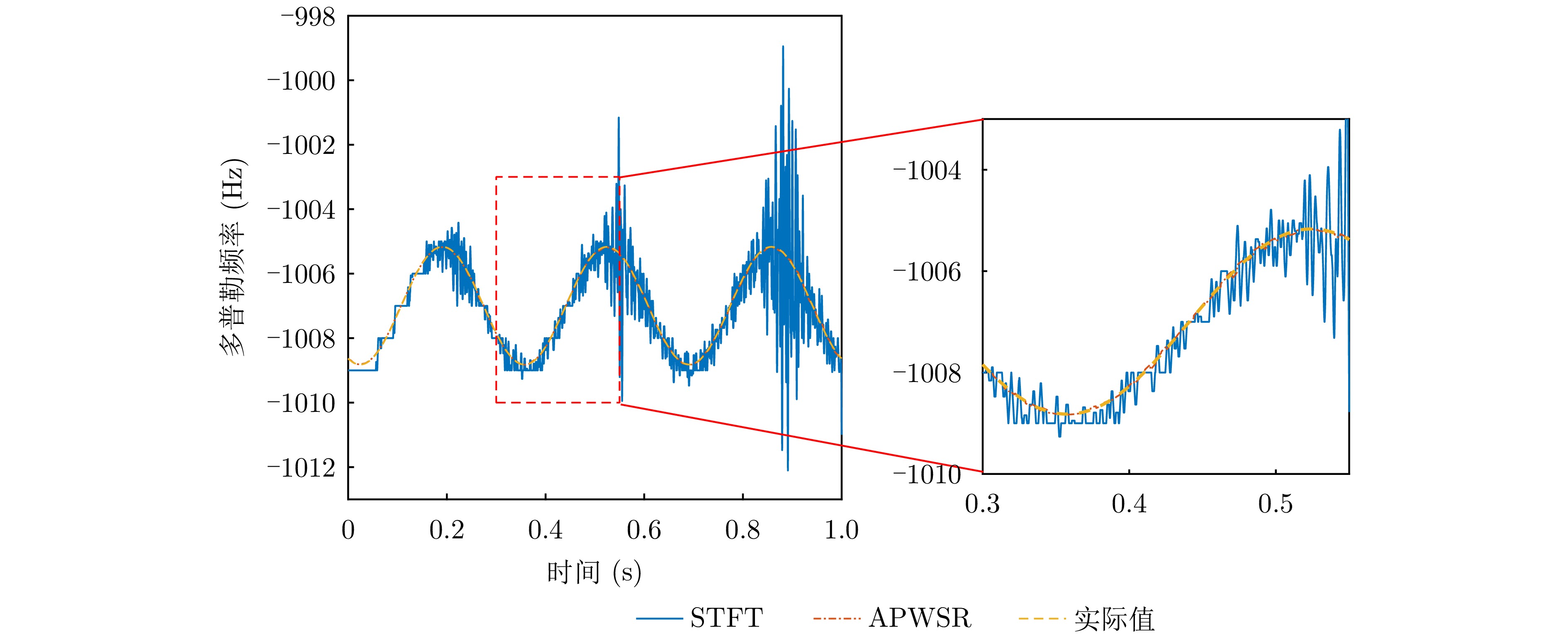
图 10 两种方法估计出的总体多普勒频率
Figure 10. Total Doppler frequency curves estimated by two methods
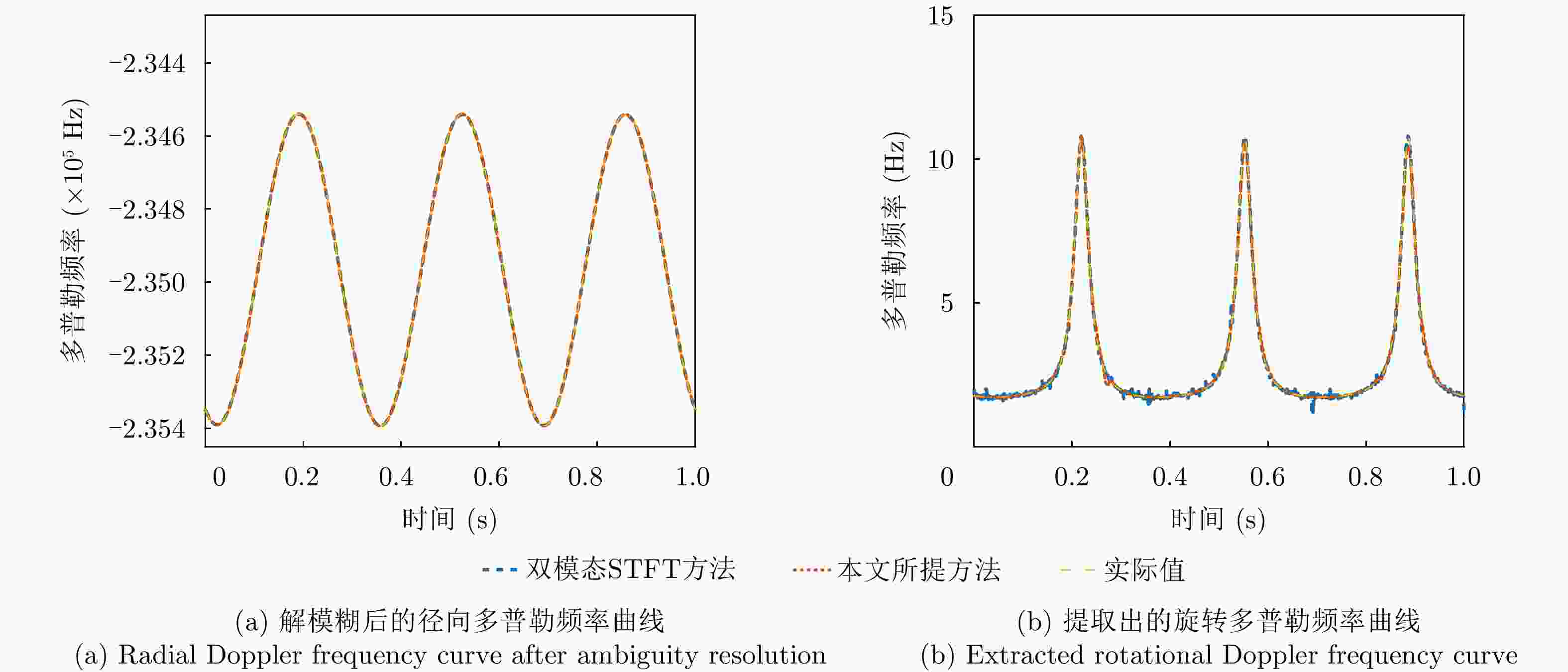
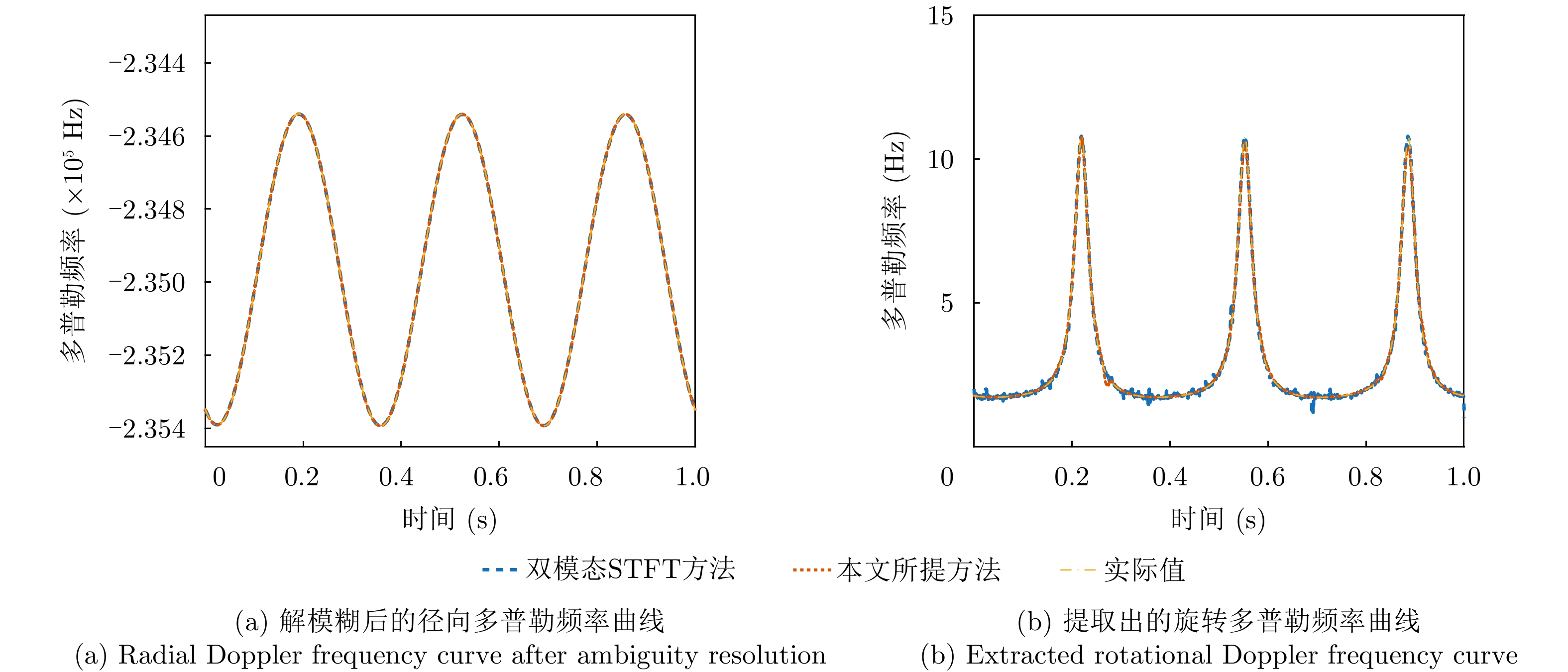
图 11 径向多普勒、旋转多普勒频率曲线估计结果
Figure 11. Estimation results of radial Doppler and rotational Doppler frequency curves
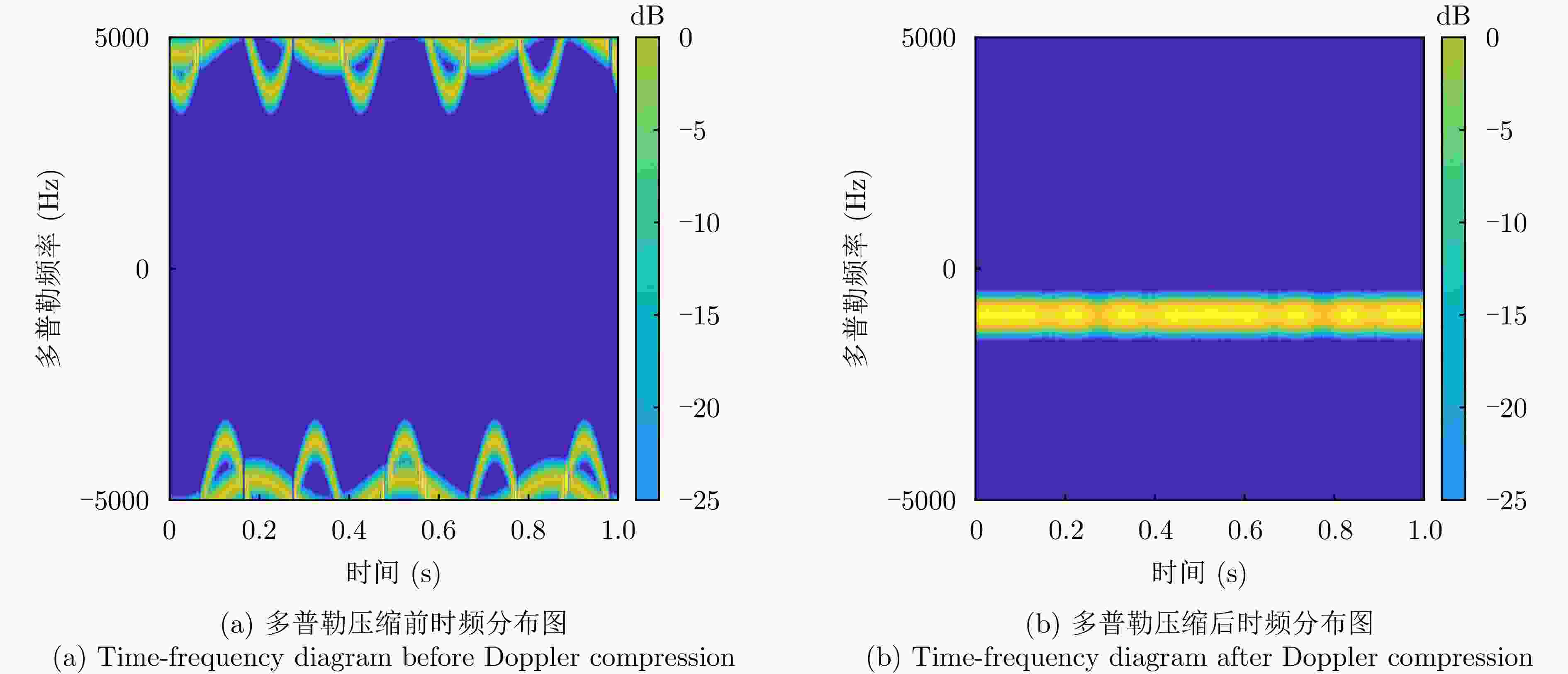
图 12 多普勒压缩前后时频分布图(2散射点)
Figure 12. Time-frequency diagram before and after Doppler compression (2 scatters)
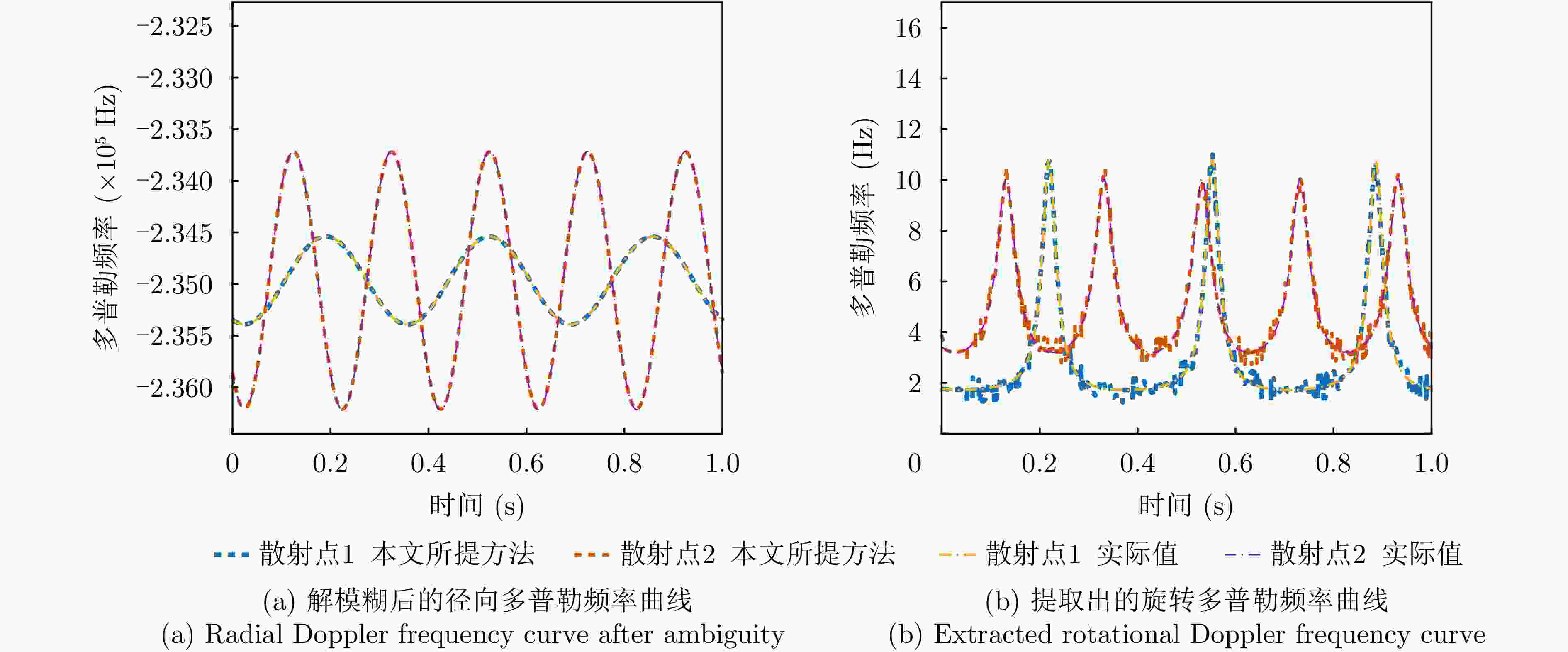
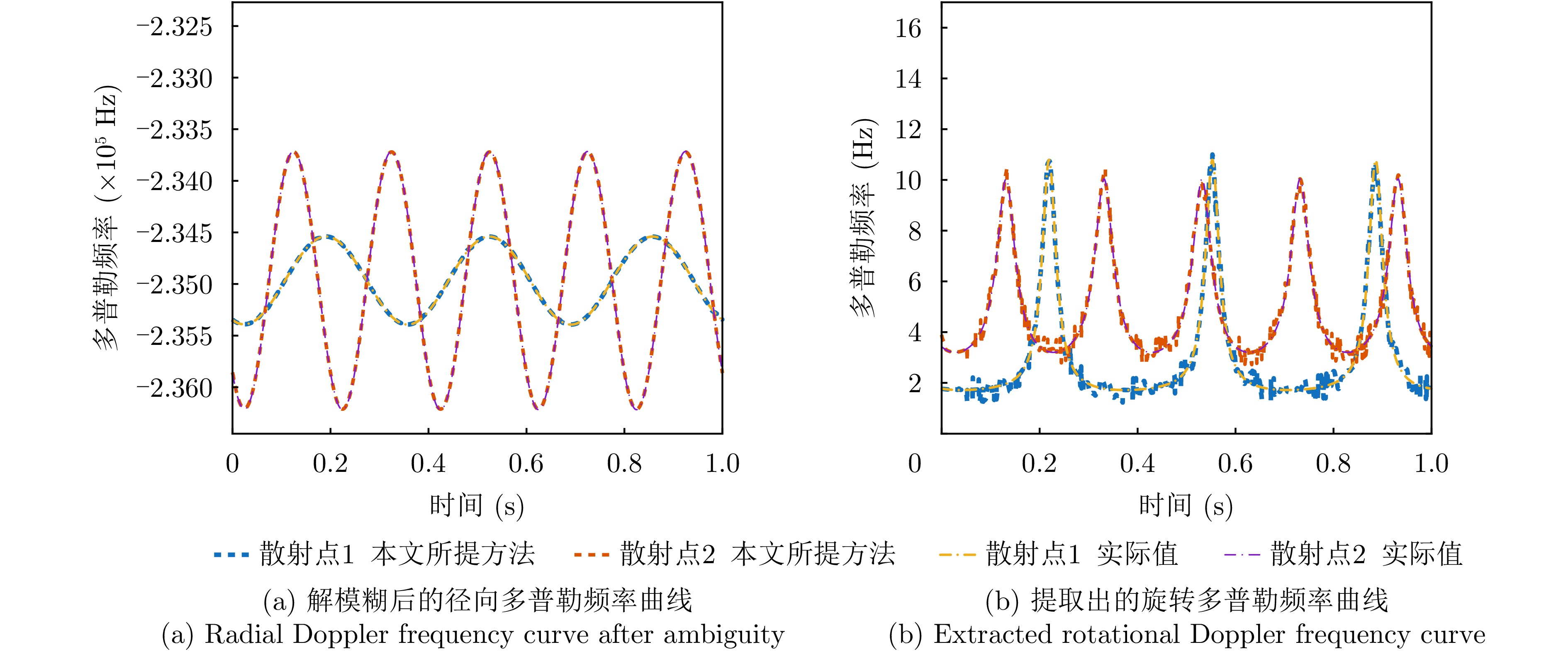
图 13 径向多普勒、旋转多普勒频率曲线估计结果(2散射点)
Figure 13. Estimation results of radial Doppler and rotational Doppler frequency curves (2 scatterers)
表 1 现有方法和所提方法的特点
Table 1. The characteristics of the existing methods and the proposed method
 下载: 导出CSV
表 2 电磁涡旋雷达主要仿真参数
Table 2. Key parameters of EMV radar
参数 数值 中心频率$ {f}_{{\mathrm{c}}} $ 35 GHz 带宽B 300 MHz 脉冲宽度$ {T}_{\rm p} $ 1 μs 脉冲重复频率$ {T}_{{\mathrm{r}}} $ 10 kHz 发射模态l 1
下载: 导出CSV
表 3 本文所提方法和双模态STFT方法所得运动参数估计结果
Table 3. The estimation results of the proposed method and DUAL-OAM STFT method
欧拉角(°) 旋转中心(m) 旋转半径(m) 平动速度(m/s) 旋转频率(Hz) 真值 ( 10.0000 ,5.0000 )(0.2000, 0.3000) 0.5000 (0, 0, 1007) 3.0000 本文所提方法 ( 9.7551 ,4.5412 )(0.1778, 0.3198) 0.5192 (0, 0, 1007.0087) 2.9986 双模态STFT方法 ( 11.4207 ,4.0481 )(0.1719, 0.2647) 0.4617 (0, 0, 1007.1070) 3.0016
下载: 导出CSV
表 4 两散射点目标运动参数估计结果
Table 4. The estimation results of the target with two scatters
散射点 类型 欧拉角(°) 旋转中心(m) 旋转半径(m) 平动速度(m/s) 旋转频率(Hz) 1 真值 ( 10.0000 ,5.0000 )(0.2000, 0.3000) 0.5000 (0, 0, 1007) 3.0000 所提方法估计值 ( 7.2537 ,7.0008 )(0.2179, 0.3313) 0.5540 (0, 0, 1006.9648) 2.9986 2 真值 ( 10.0000 ,10.0000 )(0.2000, 0.3000) 0.7000 (0, 0, 1007) 5.0000 所提方法估计值 ( 9.4331 ,12.1597 )(0.1719, 0.2647)
0.6446 (0, 0, 1006.9642) 4.9869
下载: 导出CSV
-
[1] 陈小龙, 何肖阳, 邓振华, 等. 雷达微弱目标智能化处理技术与应用[J]. 雷达学报(中英文), 2024, 13(3): 501–524. doi: 10.12000/JR23160.CHEN Xiaolong, HE Xiaoyang, DENG Zhenhua, et al. Radar intelligent processing technology and application for weak target[J]. Journal of Radars, 2024, 13(3): 501–524. doi: 10.12000/JR23160. [2] 陈小龙, 关键, 何友. 微多普勒理论在海面目标检测中的应用及展望[J]. 雷达学报, 2013, 2(1): 123–134. doi: 10.3724/SP.J.1300.2013.20102.CHEN Xiaolong, GUAN Jian, and HE You. Applications and prospect of micro-motion theory in the detection of sea surface target[J]. Journal of Radars, 2013, 2(1): 123–134. doi: 10.3724/SP.J.1300.2013.20102. [3] 杨琪, 邓彬, 王宏强, 等. 太赫兹雷达目标微动特征提取研究进展[J]. 雷达学报, 2018, 7(1): 22–45. doi: 10.12000/JR17087.YANG Qi, DENG Bin, WANG Hongqiang, et al. Advancements in research on micro-motion feature extraction in the terahertz region[J]. Journal of Radars, 2018, 7(1): 22–45. doi: 10.12000/JR17087. [4] BAI Xueru, HUI Ye, WANG Li, et al. Radar-based human gait recognition using dual-channel deep convolutional neural network[J]. IEEE Transactions on Geoscience and Remote Sensing, 2019, 57(12): 9767–9778. doi: 10.1109/TGRS.2019.2929096. [5] 张群, 胡健, 罗迎, 等. 微动目标雷达特征提取、成像与识别研究进展[J]. 雷达学报, 2018, 7(5): 531–547. doi: 10.12000/JR18049.ZHANG Qun, HU Jian, LUO Ying, et al. Research progresses in radar feature extraction, imaging, and recognition of target with micro-motions[J]. Journal of Radars, 2018, 7(5): 531–547. doi: 10.12000/JR18049. [6] TIAN Xudong, BAI Xueru, and ZHOU Feng. Recognition of micro-motion space targets based on attention-augmented cross-modal feature fusion recognition network[J]. IEEE Transactions on Geoscience and Remote Sensing, 2023, 61: 5104909. doi: 10.1109/TGRS.2023.3275991. [7] ZHOU Xuening, BAI Xueru, WANG Li, et al. Robust ISAR target recognition based on ADRISAR-net[J]. IEEE Transactions on Aerospace and Electronic Systems, 2022, 58(6): 5494–5505. doi: 10.1109/TAES.2022.3174826. [8] YANG Zheng, CHENG Yongqiang, WU Hao, et al. Enhanced matrix information geometry detection for weak targets in heterogeneous clutter environment[J]. Science China Information Sciences, 2025, 68(11): 219301. doi: 10.1007/s11432-024-4556-9. [9] 罗迎, 龚逸帅, 陈怡君, 等. 基于跟踪脉冲的MIMO雷达多目标微动特征提取[J]. 雷达学报, 2018, 7(5): 575–584. doi: 10.12000/JR18035.LUO Ying, GONG Yishuai, CHEN Yijun, et al. Multi-target micro-motion feature extraction based on tracking pulses in MIMO radar[J]. Journal of Radars, 2018, 7(5): 575–584. doi: 10.12000/JR18035. [10] LIU Kang, LIU Hongyan, LI Shuangxun, et al. Three-dimensional object imaging with vortex wave tomography[J]. Optics Express, 2025, 33(10): 20798–20806. doi: 10.1364/OE.563860. [11] COURTIAL J, DHOLAKIA K, ROBERTSON D A, et al. Measurement of the rotational frequency shift imparted to a rotating light beam possessing orbital angular momentum[J]. Physical Review Letters, 1998, 80(15): 3217–3219. doi: 10.1103/PhysRevLett.80.3217. [12] 郭忠义, 汪彦哲, 王运来, 等. 涡旋电磁波旋转多普勒效应研究进展[J]. 雷达学报, 2021, 10(5): 725–739. doi: 10.12000/JR21109.GUO Zhongyi, WANG Yanzhe, WANG Yunlai, et al. Research advances on the rotational doppler effect of vortex electromagnetic waves[J]. Journal of Radars, 2021, 10(5): 725–739. doi: 10.12000/JR21109. [13] ZHAO Mingyang, GAO Xinlu, XIE Mutong, et al. Measurement of the rotational doppler frequency shift of a spinning object using a radio frequency orbital angular momentum beam[J]. Optics Letters, 2016, 41(11): 2549–2552. doi: 10.1364/OL.41.002549. [14] LIU Kang, CHENG Yongqiang, LI Xiang, et al. Microwave-sensing technology using orbital angular momentum: Overview of its advantages[J]. IEEE Vehicular Technology Magazine, 2019, 14(2): 112–118. doi: 10.1109/MVT.2018.2890673. [15] LIU Kang, CHENG Yongqiang, LI Xiang, et al. Passive OAM-based radar imaging with single-in-multiple-out mode[J]. IEEE Microwave and Wireless Components Letters, 2018, 28(9): 840–842. doi: 10.1109/LMWC.2018.2852146. [16] LUO Ying, CHEN Yijun, ZHU Yongzhong, et al. Doppler effect and micro-Doppler effect of vortex-electromagnetic-wave-based radar[J]. IET Radar, Sonar & Navigation, 2020, 14(1): 2–9. doi: 10.1049/iet-rsn.2019.0124. [17] WANG Yu, LIU Kang, LIU Hongyan, et al. Detection of rotational object in arbitrary position using vortex electromagnetic waves[J]. IEEE Sensors Journal, 2021, 21(4): 4989–4994. doi: 10.1109/jsen.2020.3032665. [18] YUAN Hang, LUO Ying, CHEN Yijun, et al. Micro-motion parameter extraction of rotating target based on vortex electromagnetic wave radar[J]. IET Radar, Sonar & Navigation, 2021, 15(12): 1594–1606. doi: 10.1049/rsn2.12149. [19] 王煜, 刘康, 王建秋, 等. 涡旋电磁波雷达锥体目标旋转多普勒探测[J]. 雷达学报, 2021, 10(5): 740–748. doi: 10.12000/JR21074.WANG Yu, LIU Kang, WANG Jianqiu, et al. Rotational doppler detection of a cone-shaped target under the illumination of a vortex electromagnetic wave[J]. Journal of Radars, 2021, 10(5): 740–748. doi: 10.12000/JR21074. [20] 袁航, 何其芳, 罗迎, 等. 涡旋电磁波雷达平动旋转目标三维微动参数提取方法[J]. 雷达学报, 2023, 12(4): 804–816. doi: 10.12000/JR23065.YUAN Hang, HE Qifang, LUO Ying, et al. Three-dimensional micro-motion parameters extraction of translational rotating targets based on vortex electromagnetic wave radar[J]. Journal of Radars, 2023, 12(4): 804–816. doi: 10.12000/JR23065. [21] 罗迎, 袁航, 袁延鑫. 单频涡旋电磁波雷达旋转目标微动参数提取方法[J]. 信号处理, 2023, 39(9): 1587–1595. doi: 10.16798/j.issn.1003-0530.2023.09.005.LUO Ying, YUAN Hang, and YUAN Yanxin. A method for micro-motion parameters extraction of rotating targets based on single-frequency vortex electromagnetic wave radar[J]. Journal of Signal Processing, 2023, 39(9): 1587–1595. doi: 10.16798/j.issn.1003-0530.2023.09.005. [22] YUAN Tiezhu, CHENG Yongqiang, WANG Hongqiang, et al. Beam steering for electromagnetic vortex imaging using uniform circular arrays[J]. IEEE Antennas and Wireless Propagation Letters, 2017, 16: 704–707. doi: 10.1109/LAWP.2016.2600404. [23] ZHONG Jingang and HUANG Yu. Time-frequency representation based on an adaptive short-time fourier transform[J]. IEEE Transactions on Signal Processing, 2010, 58(10): 5118–5128. doi: 10.1109/TSP.2010.2053028. [24] PEI S C and HUANG S G. STFT with adaptive window width based on the chirp rate[J]. IEEE Transactions on Signal Processing, 2012, 60(8): 4065–4080. doi: 10.1109/TSP.2012.2197204. [25] ABATZOGLOU T J. Fast maximum likelihood joint estimation of frequency and frequency rate[J]. IEEE Transactions on Aerospace and Electronic Systems, 1986, AES-22(6): 708–715. doi: 10.1109/TAES.1986.310805. [26] O'SHEA P. A fast algorithm for estimating the parameters of a quadratic FM signal[J]. IEEE Transactions on Signal Processing, 2004, 52(2): 385–393. doi: 10.1109/TSP.2003.821097. [27] LIU Zhen, YOU Peng, WEI Xizhang, et al. High resolution time-frequency distribution based on short-time sparse representation[J]. Circuits, Systems, and Signal Processing, 2014, 33(12): 3949–3965. doi: 10.1007/s00034-014-9832-3. [28] 李康乐. 雷达目标微动特征提取与估计技术研究[D]. [博士论文], 国防科学技术大学, 2010.LI Kangle. Research on feature extraction and parameters estimation for radar targets with micro-motions[D]. [Ph.D. dissertation], National University of Defense Technology, 2010. [29] YANG Yang, CHENG Yongqiang, WU Hao, et al. Parametric instantaneous frequency estimation via PWSR with adaptive QFM dictionary[J]. IEEE Signal Processing Letters, 2023, 30: 738–742. doi: 10.1109/LSP.2023.3287129. [30] TROPP J A and GILBERT A C. Signal recovery from random measurements via orthogonal matching pursuit[J]. IEEE Transactions on Information Theory, 2007, 53(12): 4655–4666. doi: 10.1109/TIT.2007.909108. -

计量
- 文章访问数:
- HTML全文浏览量:
- PDF下载量:
- 被引次数: 0