

 作者中心
作者中心 专家审稿
专家审稿 责编办公
责编办公 编辑办公
编辑办公
-
摘要: 合成孔径雷达(SAR)在军事和民用领域应用广泛,SAR图像目标智能解译是SAR应用的重要组成部分。视觉语言模型在SAR目标解译过程中发挥了关键作用,通过引入自然语言理解有效弥补了SAR目标特性差异大和高质量标注样本稀缺的挑战,实现了从纯视觉解译到目标语义理解的发展。该文结合团队在SAR目标解译理论、算法及应用等方面的长期研究积累,对基于视觉语言的SAR图像目标智能解译进行了全面回顾和综述,深入分析了现有挑战和任务并总结了研究现状,汇总整理了公开数据集,系统梳理了从特定任务的视觉语言模型到对比式、对话式和生成式视觉语言模型和基础模型的发展历程,最后探讨了该领域的最新挑战与展望。Abstract: Synthetic Aperture Radar (SAR) is widely used in military and civilian applications, with intelligent target interpretation of SAR images being a crucial component of SAR applications. Vision-Language Models (VLMs) play an important role in SAR target interpretation. By incorporating natural language understanding, VLMs effectively address the challenges posed by large intraclass variability in target characteristics and the scarcity of high-quality labeled samples, thereby advancing the field from purely visual interpretation toward semantic understanding of targets. Drawing upon our team’s extensive research experience in SAR target interpretation theory, algorithms, and applications, this paper provides a comprehensive review of intelligent SAR target interpretation based on VLMs. We provide an in-depth analysis of existing challenges and tasks, summarize the current state of research, and compile available open-source datasets. Furthermore, we systematically outline the evolution, ranging from task-specific VLMs to contrastive-, conversational-, and generative-based VLMs and foundational models. Finally, we discuss the latest challenges and future outlooks in SAR target interpretation by VLMs.
-
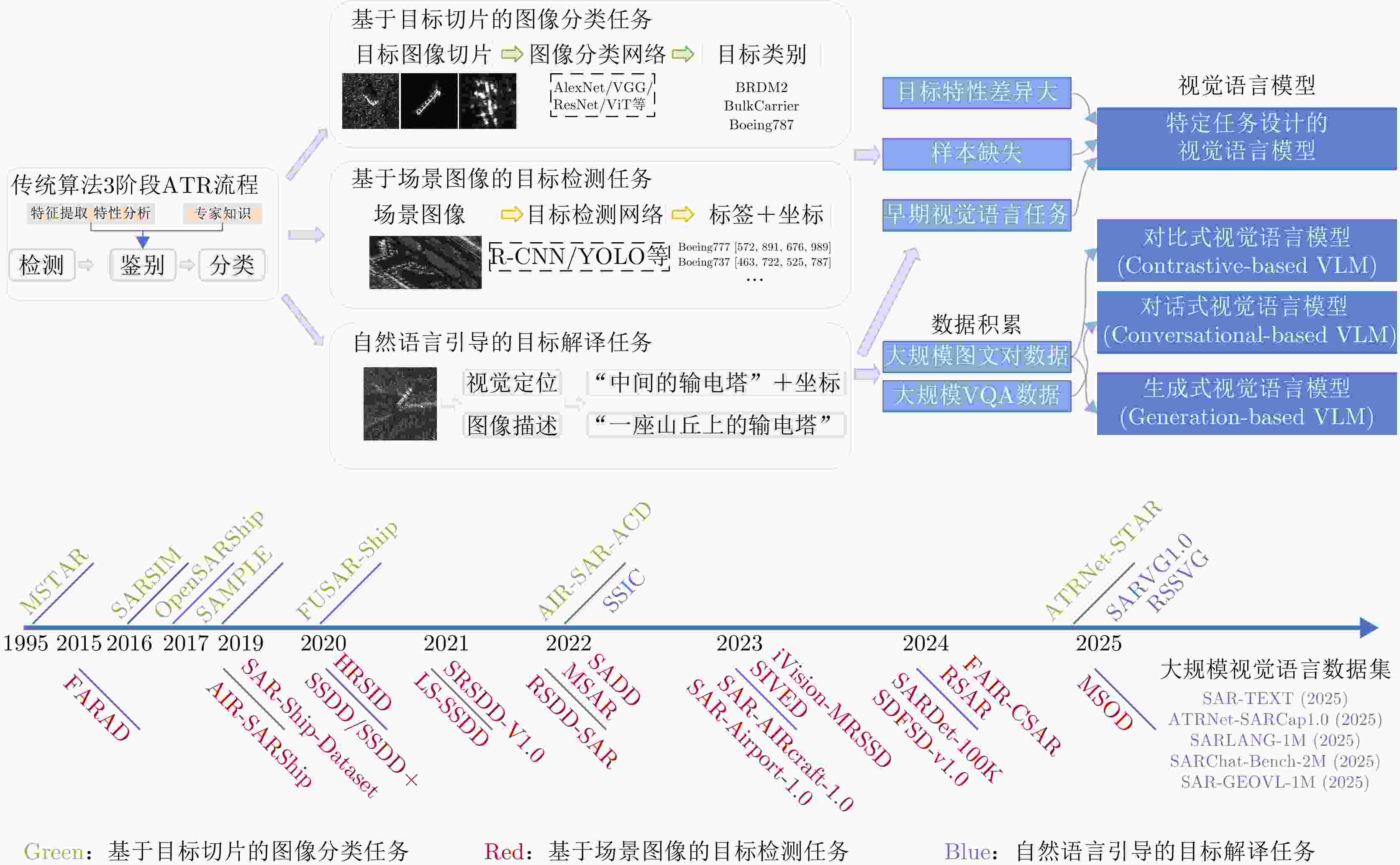
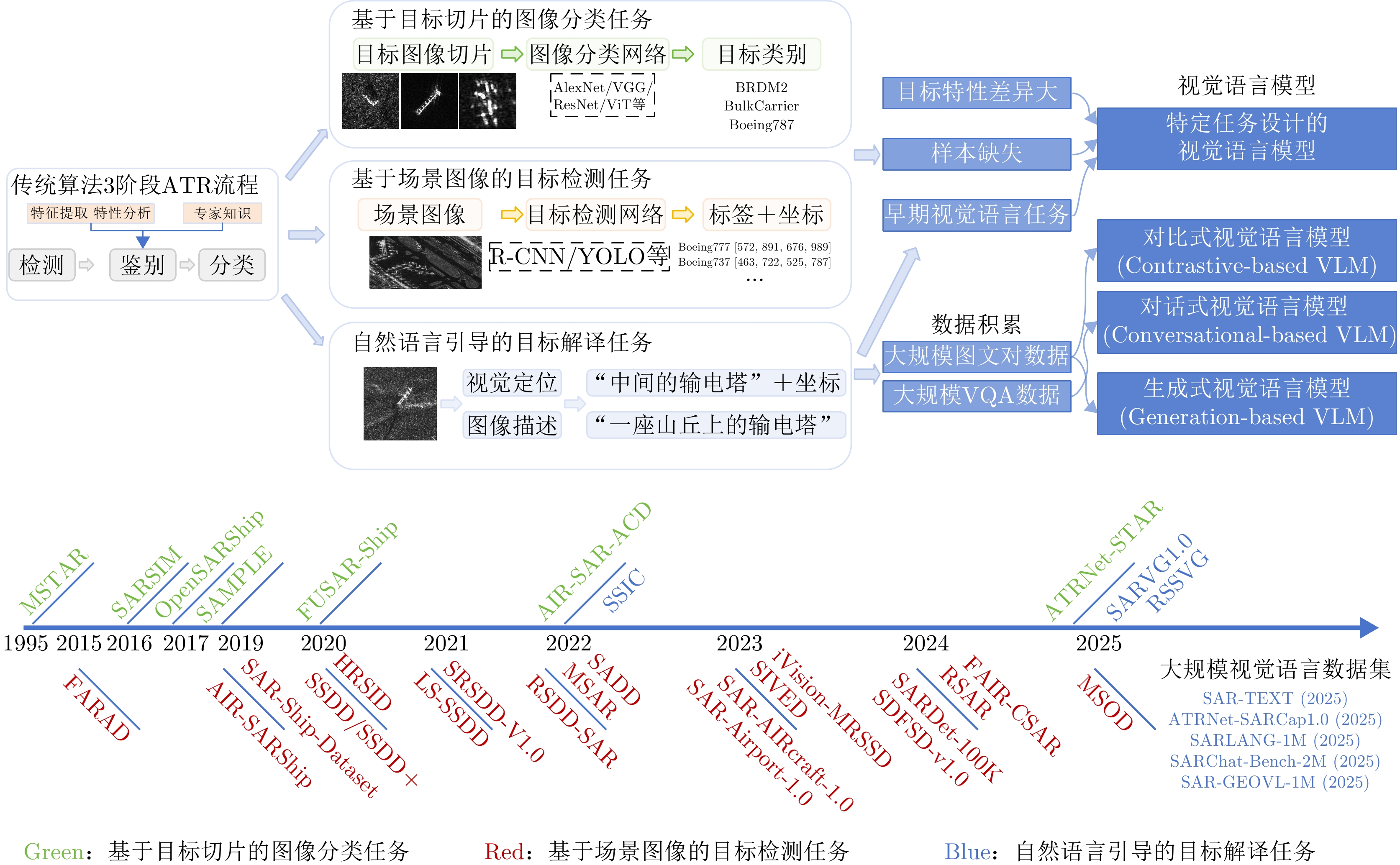
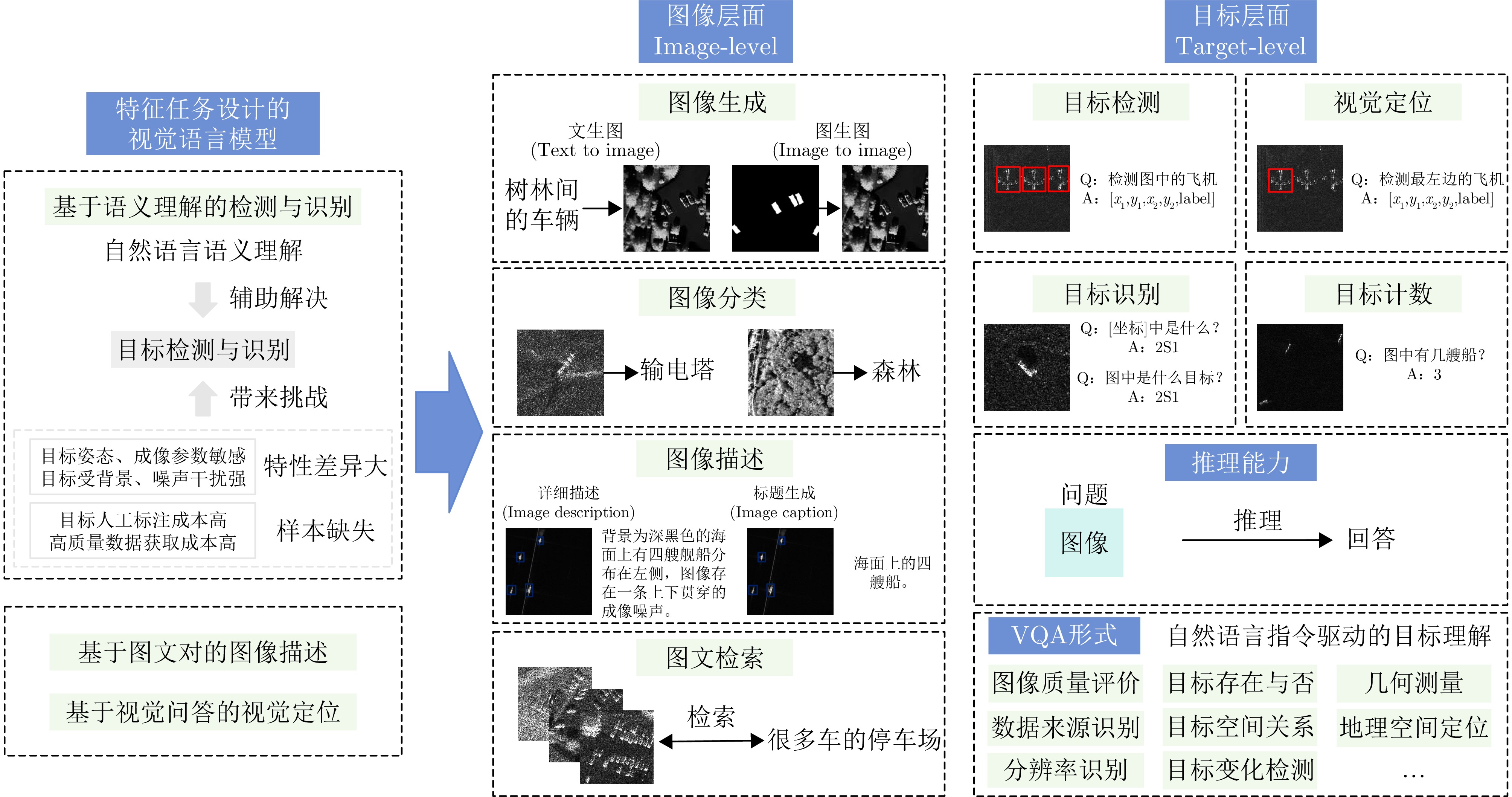
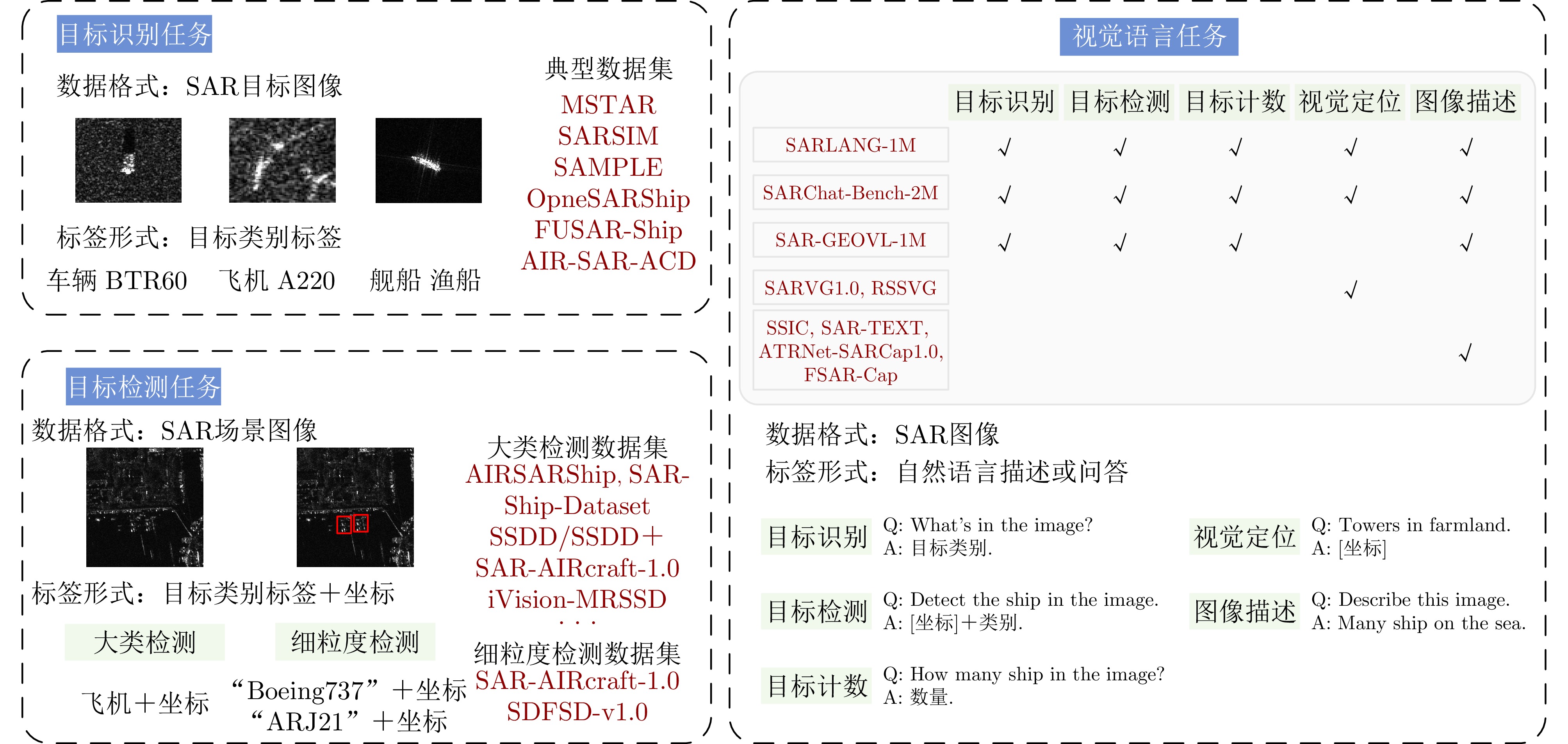
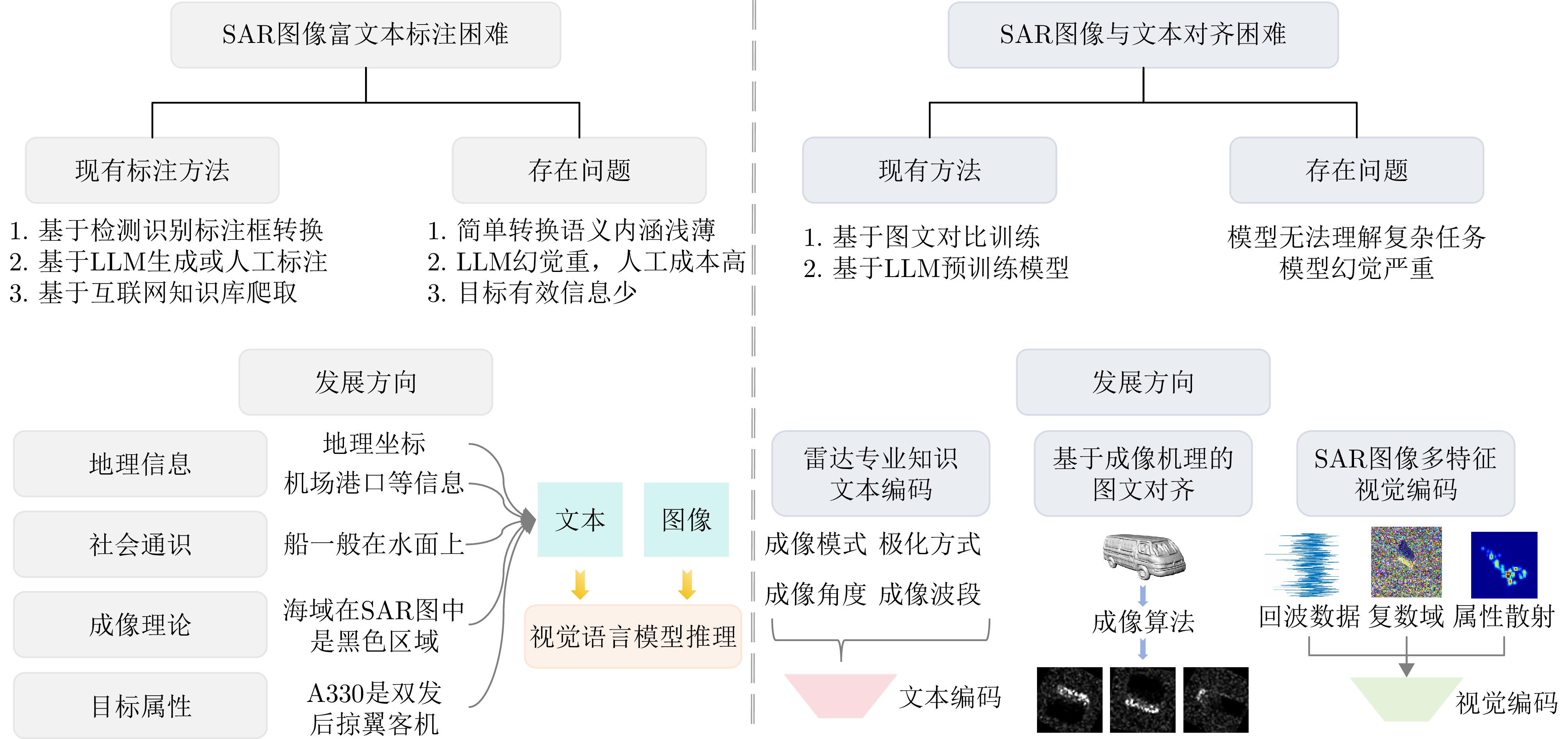
图 4 从视觉到视觉语言的SAR目标解译
Figure 4. SAR image target interpretation from vision to vision-language
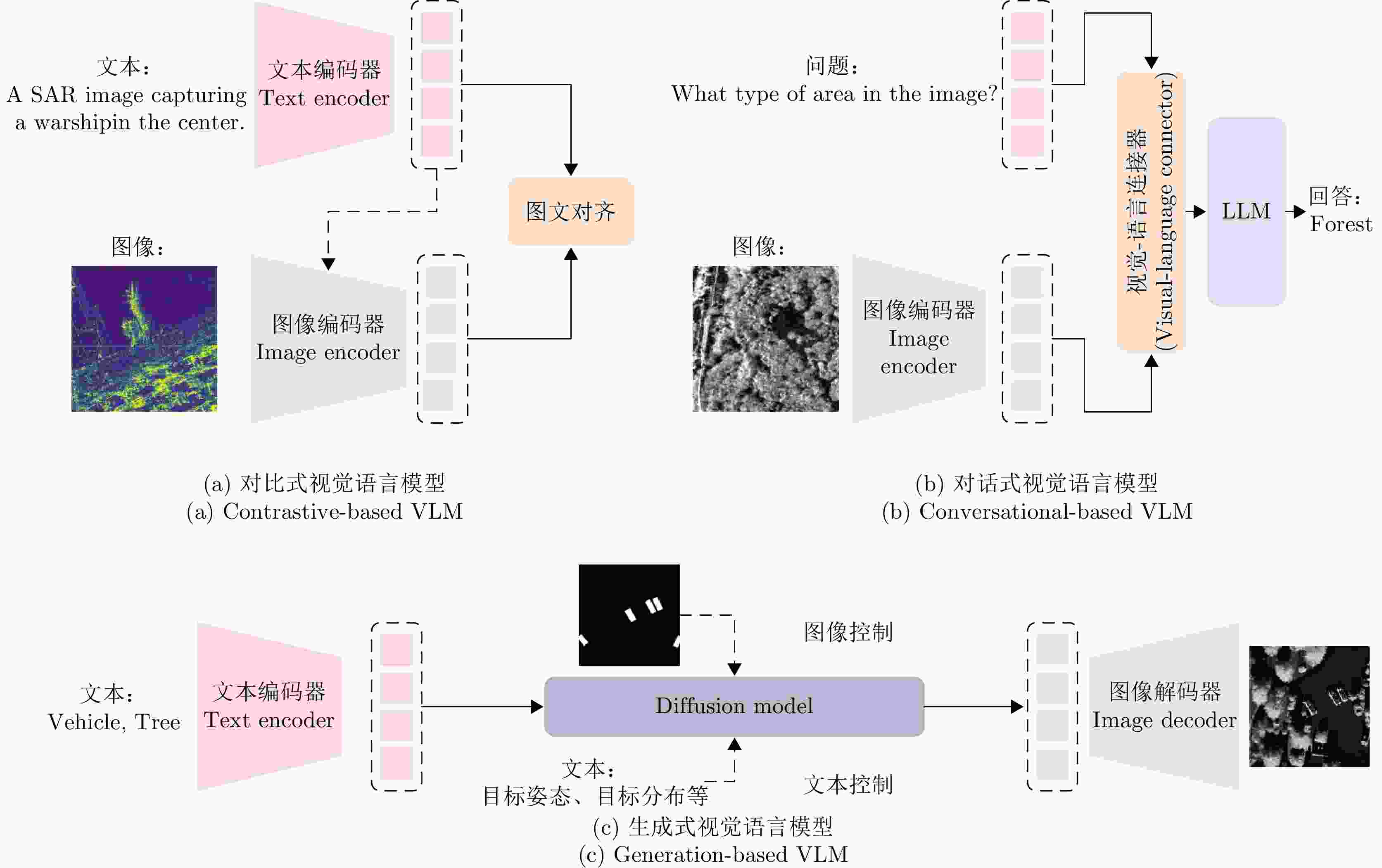
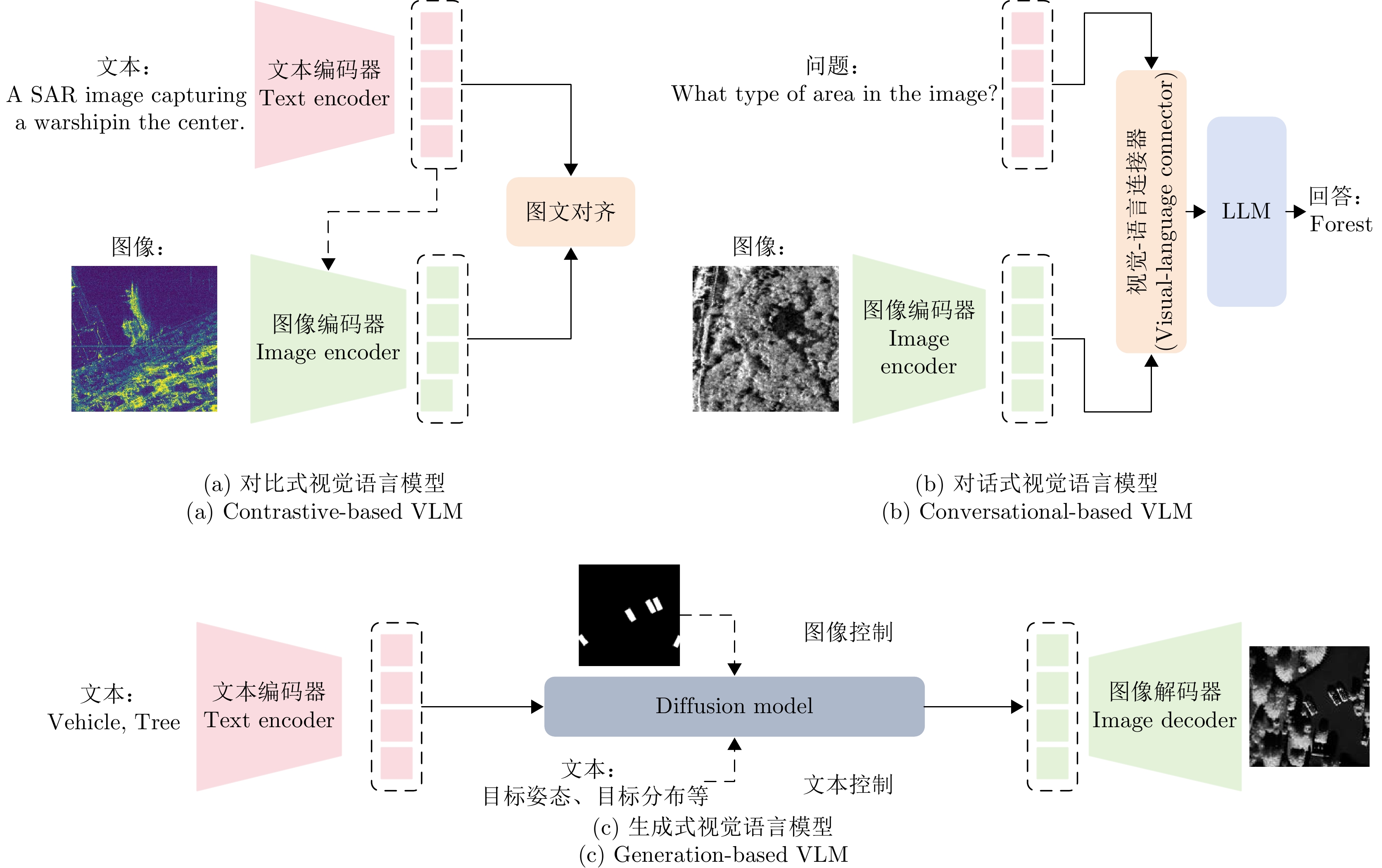
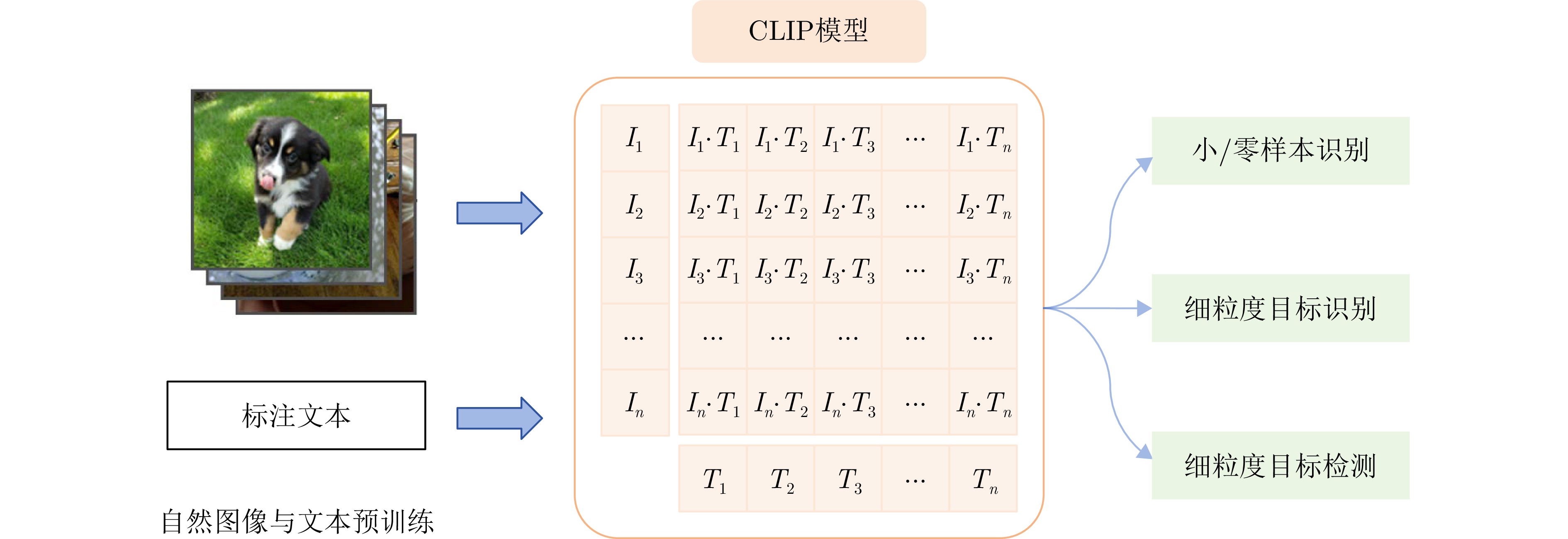
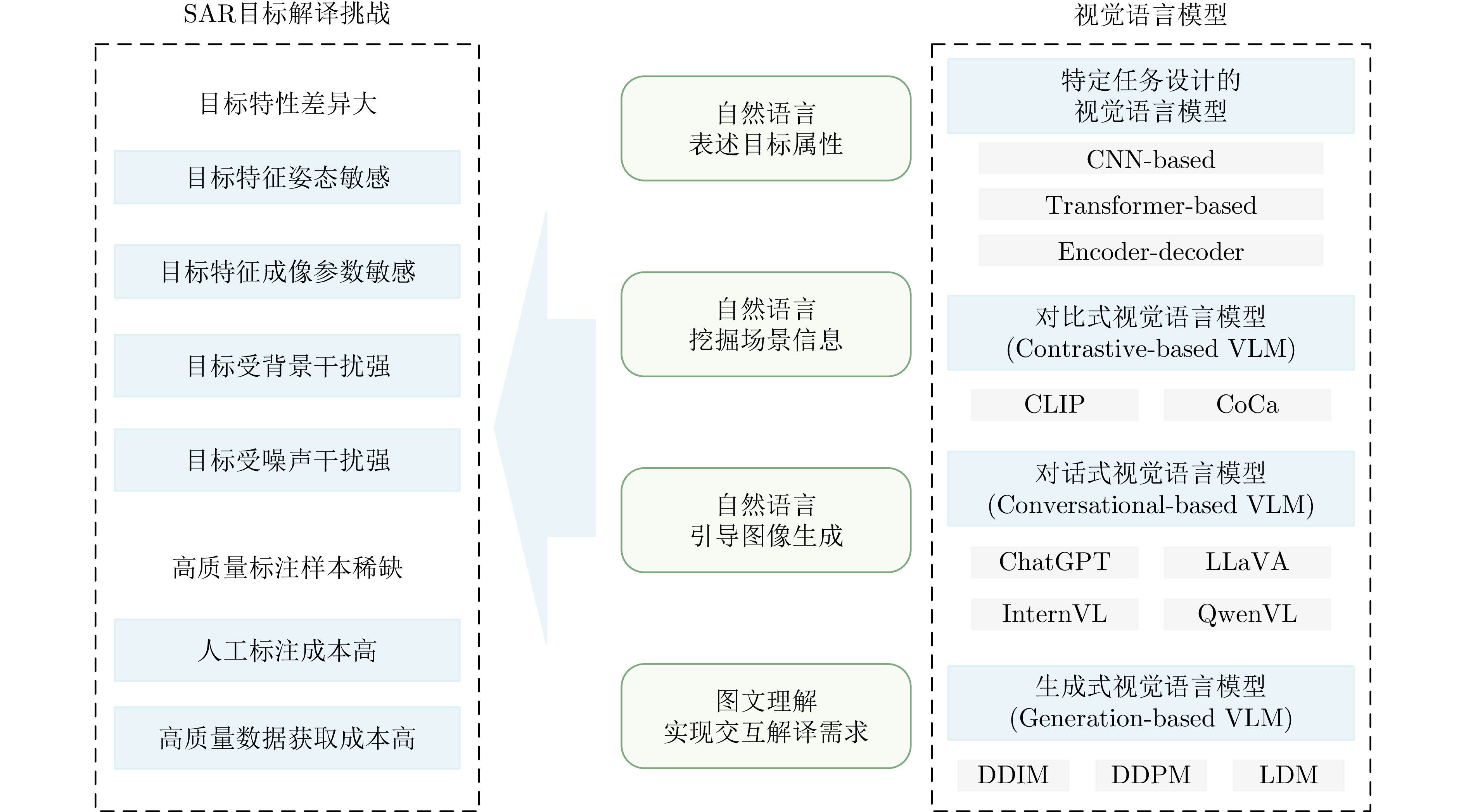
图 6 基于基础模型的典型视觉语言模型结构
Figure 6. Classical vision-language model structure based on foundation model
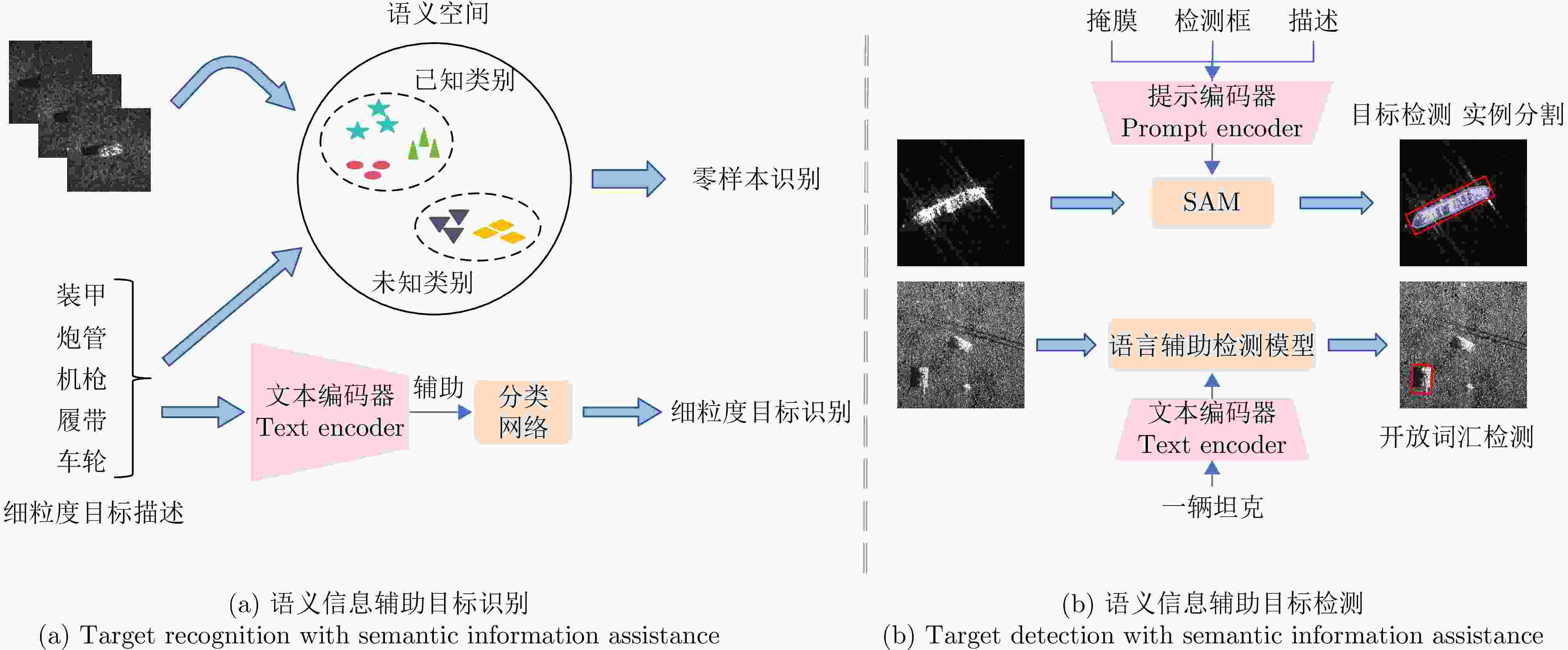
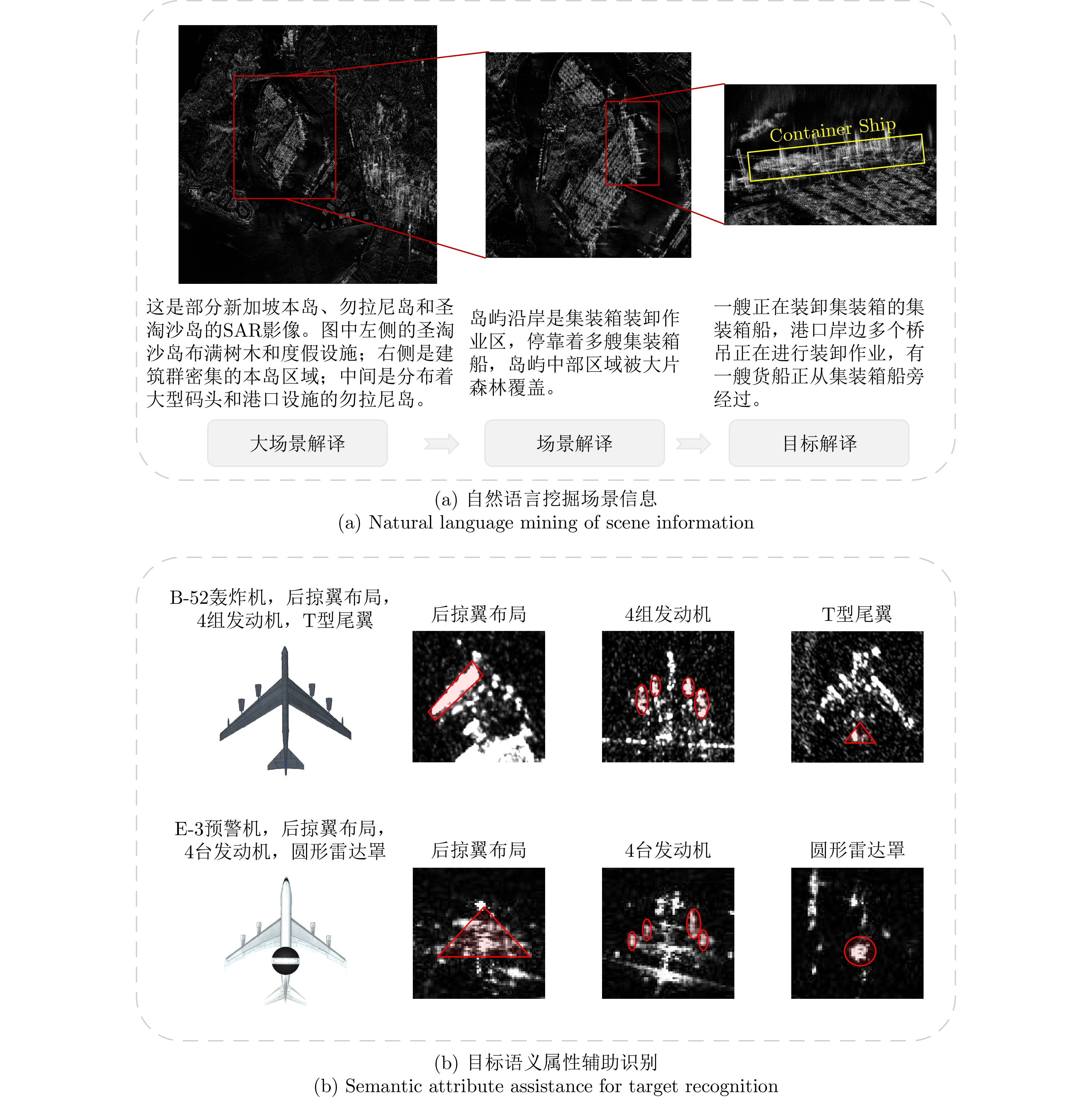
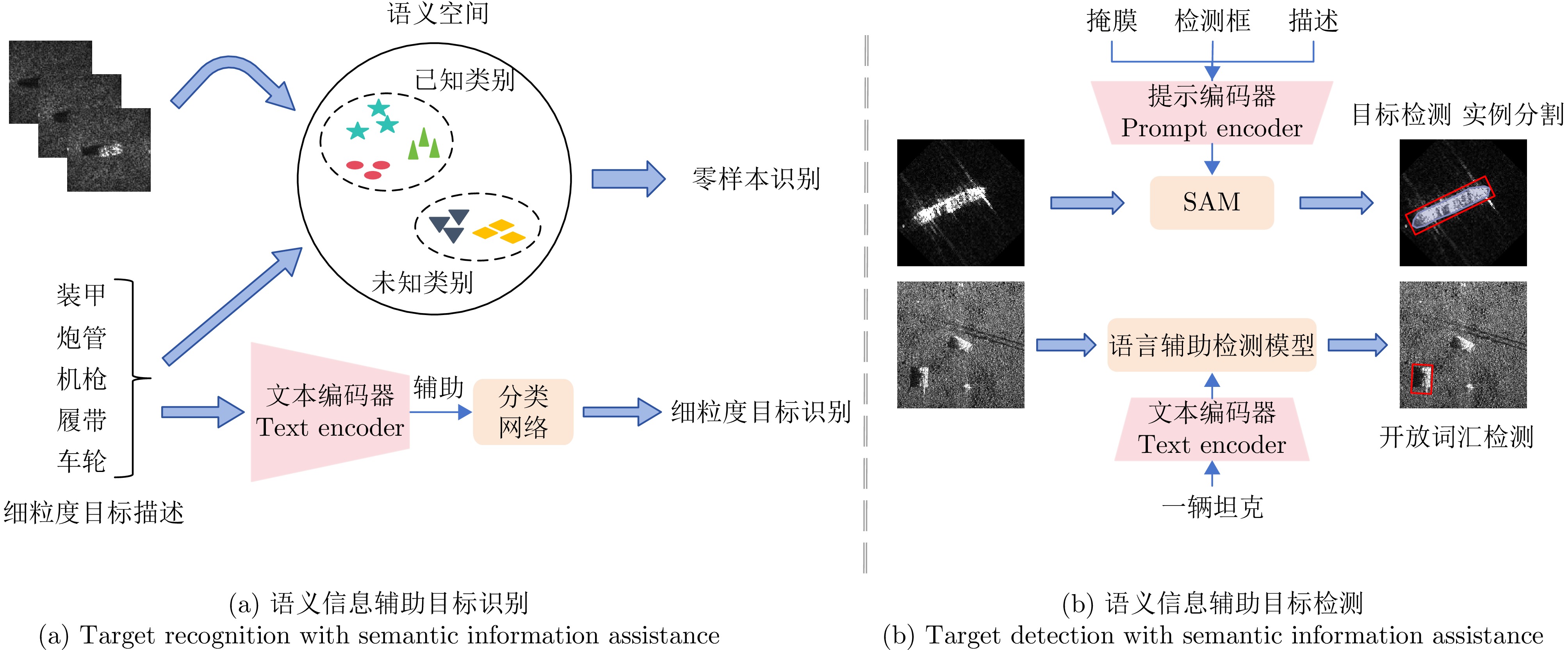
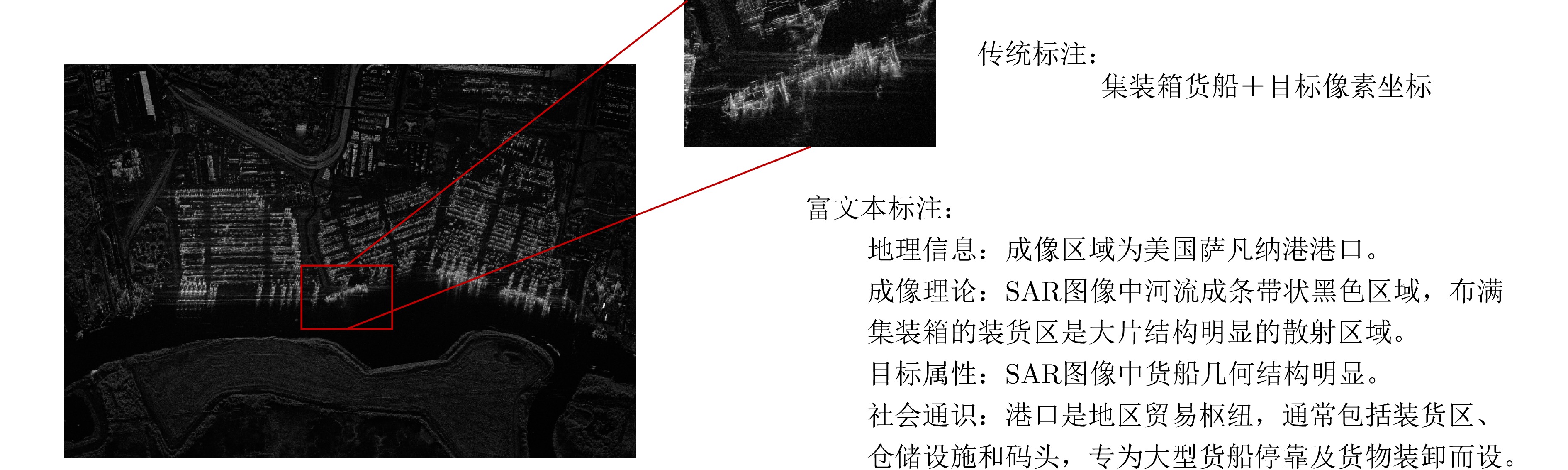
图 9 基于自然语言引导的检测识别任务
Figure 9. Target detection and recognition guided by natural language
表 1 典型遥感视觉语言模型
Table 1. Classical VLM for remote sensing
模型 模型
类型网络结构 训练
方式模态 图像
生成图像
分类图像
描述图文
检索视觉
定位目标
检测目标
计数推理
能力GRAFT[42] 对比式 ViT-B (CLIP) 微调 O √ √ RemoteCLIP[43] 对比式 ResNet/ViT-B/L (CLIP) 持续预训练 O √ √ √ GeoRSCLIP[44] 对比式 ViT-B/L/H (CLIP) 参数高效微调 O √ √ √ SkyScript[45] 对比式 ViT-B/L (CLIP) 持续预训练 O √ √ SARCLIP-Ma[26] 对比式 ResNet/ViT-B/L (CLIP) 光学预训练
SAR微调O/S √ √ SARCLIP-Jiang[25] 对比式 ResNet/ViT-B/L (CLIP) 持续预训练 S √ √ SAR-KnowLIP[46] 对比式 ViT-B/L (CLIP) 持续预训练 S √ √ √ √ RSGPT[47] 对话式 ViT-G, Q-Former, Vicuna-13B 微调Q-Former O √ √ √ GeoChat[48] 对话式 ViT-L, MLP, Vicuna-v1.5-7B LoRA Vicuna O √ √ √ √ √ SkySenseGPT[49] 对话式 ViT-L, MLP, Vicuna-v1.5-7B 微调MLP
LoRA VicunaO √ √ √ √ √ RS-LLaVA[50] 对话式 ViT-L, MLP, Vicuna-v1.5-13B 微调MLP
LoRA VicunaO √ √ √ EarthGPT[51] 对话式 ViT-L, 投影层, LLaMA2-7B 微调模型后
指令微调O/I/S √ √ √ √ √ √ VHM (H2RSVLM)[52] 对话式 ViT-L, MLP, Vicuna-v1.5-7B 微调MLP
LoRA VicunaO √ √ √ LHRS-Bot[53] 对话式 ViT-L, MLP, Vicuna-v1.5-7B 课程学习 O √ √ √ √ √ PE-RSIC[54] 对话式 ViT-G, Q-Former, OPT-2.7B 微调Q-Former O √ SkyEyeGPT[55] 对话式 ViT-G, Linear Projector, LLaMA2-7B 微调Projector
LoRA LLaMAO √ √ √ √ √ SAR-RS-GPT[27] 对话式 TinyGPT-V 两阶段微调 S √ √ CRS-Diff[56] 生成式 Stable Diffusion 微调 O √ RsDiff[57] 生成式 T5+Diffusion 微调Diffusion O √ DiffusionSat[58] 生成式 Stable Diffusion 微调 O √ 注:O表示光学 (Optical),I表示红外 (Infrared),S表示合成孔径雷达 (SAR)。  下载: 导出CSV
表 2 SAR目标解译视觉语言方法概要
Table 2. Overview of SAR vision-language target interpretation methods
章节 模型 方法 核心思路 3.1节 特定任务设计模型 语义信息辅助目标检测与识别 将目标的属性、类别标签等语义信息引入目标解译,
辅助目标检测与目标识别任务3.2节、3.3节 特定任务设计模型 单一视觉语言任务设计模型 设计专门的网络结构实现SAR图像的视觉定位与图像描述 第4节 对比式视觉语言模型 基于图文对齐的预训练与微调 利用CLIP架构,通过SAR图文对数据对比学习建立图像特征与
文本特征的共享语义空间,实现目标检测与目标识别任务第5节 对话式视觉语言模型 基于VLM图文理解的目标解译 利用对话式VLM的图文理解能力,通过视觉问答的形式
实现可交互的目标检测和识别任务第6节 生成式视觉语言模型 文本引导的样本生成与扩充 利用扩散生成模型学习SAR数据分布,并通过文本提示
生成可控的SAR目标或场景图像第7节 SAR基础模型 大规模SAR领域数据训练模型 利用SAR领域日益扩大的数据训练出SAR目标解译领域的对比式、
对话式和生成式基础模型
下载: 导出CSV
表 3 特定任务设计的SAR目标解译视觉语言模型
Table 3. SAR target interpretation VLMs designed for specific tasks
作者 时间 目标 任务类别 模型结构 Wei等人[72] 20-Mar-2023 车辆 零样本目标识别 CNN-based Yan等人[12] 19-Mar-2024 飞机 零样本目标识别 WGAN-based Chen等人[73] 22-Nov-2024 舰船 零样本目标识别 Dual-branch model based Liu等人[17] 25-May-2024 舰船、飞机 零样本目标识别 Dual-branch model based Wang等人[74] 1-Jul-2024 车辆 零样本目标识别 BLIP-2-based Chen等人[75] 11-Mar-2025 舰船 细粒度目标识别 Prototype-guided model Chen等人[76] 20-Jun-2025 舰船 细粒度目标识别 Open pretrained Transformers model Jin等人[77] 3-Nov-2024 车辆、飞机、舰船 开放词汇检测 GroundingDINO-based Liu等人[78] 16-Oct-2024 舰船 实例分割 SAM-based Zhang等人[79] 26-Mar-2025 舰船 实例分割 SAM-based Chen等人[80] 19-Jan-2024 舰船 实例分割 SAM-based Li等人[70] 24-Feb-2025 输电塔 视觉定位 BERT-based Chen等人[71] 31-Mar-2025 舰船 视觉定位 Transformer-based Zhao等人[69] 22-Aug-2022 舰船 图像描述 Encoder-decoder structure Gao等人[81] 24-Aug-2025 飞机 图像描述 Encoder-decoder structure Li等人[82] 10-Jan-2025 舰船 图像描述 Encoder-decoder structure Zhang等人[18] 18-Oct-2025 22类细粒度 图像描述 Encoder-decoder structure
下载: 导出CSV
表 4 基于对比式、对话式和生成式视觉语言模型的SAR目标解译工作
Table 4. SAR target interpretation VLM based on contrastive, conversational, and generative model
类型 作者 时间 目标 任务类别 模型结构 对比式
VLMCao等人[83] 17-Jun-2025 飞机 细粒度目标识别 CLIP-based classification Xie等人[21] 4-Apr-2025 舰船、飞机 细粒度目标识别 CLIP-based classification Wang等人[84] 2-Jan-2025 车辆 细粒度目标识别 CLIP-based classification Guo等人[85] 17-Jun-2024 车辆 目标识别 CLIP-based classification Qi等人[86] 30-Aug-2025 车辆 车辆检测 CLIP-based detection Xu等人[87] 12-Mar-2025 飞机 细粒度目标检测 CLIP-based detection Zhao等人[88] 2-Jul-2025 舰船 目标检测 CLIP-based image generation Jiang等人[25] 17-Oct-2025 多目标 SAR基础模型 对比式基础模型 Ma等人[26] 26-Oct-2025 多目标 SAR基础模型 对比式基础模型 He等人[27] 4-Oct-2025 多目标 SAR基础模型 对比式基础模型 对话式
VLMZhang等人[51] 4-Jun-2024 舰船、飞机 视觉问答 LLaMA Ramirez等人[89] 29-May-2025 车辆 图像描述、视觉问答 LLaVA Tosato等人[90] 2-Aug-2025 地物 视觉问答 DistilBERT Wang等人[91] 3-Nov-2024 舰船 目标检测 Qwen2-VL+YOLO Wang等人[92] 20-Mar-2025 多目标 目标检测 Qwen2.5-VL Zhang等人[93] 30-Oct-2024 舰船 目标检测 LLaMA Li等人[94] 23-Sep-2025 多目标 目标检测 InternVL+ViT Yang等人[46] 5-Nov-2025 多目标 SAR基础模型 对话式基础模型 He等人[27] 4-Oct-2025 多目标 SAR基础模型 对话式基础模型 Ma等人[95] 4-Mar-2025 多目标 SAR基础模型 对话式基础模型 生成式
VLMZhang等人[96] 3-Dec-2023 舰船 图像生成 DDPM-based Wang等人[97] 5-Apr-2024 舰船 图像生成 LDM+CLIP-based classification Ni等人[98] 9-Sep-2025 卫星 图像生成 LDM-based Trouvé等人[99] 26-Apr-2024 地物 图像生成 LDM-based Debuysère等人[100] 21-Oct-2024 地物 图像生成 LDM-based Tian等人[101] 29-Nov-2023 舰船 图像生成 LoRA LDM Debuysère等人[102] 5-May-2025 地物 图像生成 LDM-based Debuysère等人[28] 14-Aug-2025 地物 图像生成 生成式基础模型
下载: 导出CSV
表 5 SAR目标解译领域数据集汇总
Table 5. Summary of datasets for SAR target interpretation
数据集 发布
时间目标类别 分辨率(m) 数据来源 成像
波段图像数量
数量目标实例
数量图文对数量 目标
切片MSTAR[114] 1995 车辆分类 0.3 机载SAR X 14577 14577 / SARSIM[124] 2016 车辆分类 0.3 电磁仿真 X 2160 2160 / SAMPLE[125] 2019 车辆分类 0.3 电磁仿真 X 5380 5380 / OpenSARShip[126] 2017 舰船分类 2.3~17.4 S-1 C 26679 26679 / FUSAR-Ship[115] 2020 舰船分类 1.0 GF3 C 16144 16144 / AIR-SAR-ACD[116] 2022 飞机分类 1.0 GF3 C 3032 3032 / 场景
图像Sandia MiniSAR[127] 2006 车辆检测 0.1 机载SAR Ku 15 662 / FARAD[127] 2015 车辆检测 0.1 机载SAR Ka, X 89 2296 / AIR-SARShip[128] 2019 舰船检测 1.0~3.0 GF3 C 31 461 / SAR-Ship-Dataset[129] 2019 舰船检测 3.0~25.0 S-1 GF3 C 43819 59535 / SSDD/SSDD+[130] 2020 舰船检测 1.0~15.0 T-X S-1 RadarSat-2 C/X 1160 2456 / HRSID[117] 2020 舰船检测 0.5~3.0 S-1 T-X TanDEMX C/X 5604 16951 / LS-SSDD[131] 2021 舰船检测 1.0~15.0 S-1 C/X 9000 16951 / SRSDD-V1.0[132] 2021 舰船检测 1.0 GF3 C 666 2884 / RSDD-SAR[133] 2022 舰船检测 1.0 GF3 T-X C/X 7000 10263 / MSAR[134] 2022 大类检测 1.0 HaiSi-1 GF3 C 28449 60396 / SADD[135] 2022 飞机检测 0.5~3.0 T-X X 2966 7835 / SAR-Airport-1.0[136] 2022 机场检测 10.0 S-1 C 624 624 / SAR-AIRcraft-1.0[119] 2023 飞机细粒度检测 1.0 GF3 C 4368 16463 / SIVED[118] 2023 车辆检测 0.1~0.3 车辆目标开源数据集 Ka/Ku/X 1044 12013 / iVision-MRSSD[137] 2023 舰船检测 0.5~100.0 Capella ICEYE T-X,
Alos-PALSAR S-1C/L/X 11590 27885 / SDFSD-v1.0[138] 2024 舰船细粒度检测 0.25~1.00 Umbra Capella ICEYE GF3 C/X 35787 96921 / 大规模
数据SARDet-100K[120] 2024 大类检测 / 开源目标检测数据集汇总 / 116598 245653 / RSAR[121] 2024 大类检测 / SARDet-100K标注旋转框 / 95842 183534 / FAIR-CSAR[122] 2024 大类/细粒度检测 1.0~5.0 GF3 C 15300 93956 / MSOD[139] 2025 大类检测 / S-1 C 40000 998898 / ATRNet-STAR[123] 2025 车辆分类 0.12~0.15 机载SAR Ku/X 194324 194324 / 视觉
语言
数据集SARVG1.0[70] 2025 输电塔视觉定位 0.5~1.0 CAPELLA ICEYE GF3 X/C 2465 7617 7617 VGRSS[71] 2025 舰船视觉定位 3.0~25.0 来自SAR-Ship-Dataset C 43798 54429 54429 SSIC[69] 2022 舰船图像描述 3.0~25.0 来自SAR-Ship-Dataset C 1500 / 3000 +SAR-TEXT[27] 2025 图像描述 / 多个开源数据集 / / / 136584 ATRNet-SARCap1.0[81] 2025 飞机图像描述 0.5~3.0 飞机目标开源数据集 C/X 5251 47259 47259 FSAR-Cap[18] 2025 图像描述 1.0~5.0 来自FAIR-CSAR C 14480 / 72400 SARLANG-1M[140] 2024 图文对 0.1~25.0 多个开源数据集 / 118331 / 1126277 SARChat-Bench-2M[95] 2025 图文对 0.3~10.0 多个开源数据集 / / / 2063548 SAR-GEOVL-1M[46] 2025 图文对 0.5~3.0 Qilu-1 PIESAT-2 GF3 C/X/Ku 120000 / 1000000 FAIR-CSAR-CoT[141] 2025 图文对 1.0~5.0 来自FAIR-CSAR C / / / 注:GF3表示高分三号(Gaofen-3),S-1表示哨兵一号(Sentinel-1),T-X表示TerraSAR-X。
下载: 导出CSV
表 6 SAR目标解译基础模型
Table 6. The foundation model for SAR target interpretation
SAR基础模型 年份 模型类别 训练方法 SAR训练数据 SAR-JEPA[164] 2024 视觉基础模型 联合嵌入预测 94766 张图像SAR ATR-X[24] 2025 视觉基础模型 掩码图像建模 18万张图像 SARDet-100K[120] 2025 视觉基础模型 滤波增强的多阶段预训练 SARDet-100K微调 AFRL DINOv2[165] 2025 视觉基础模型 DINO自蒸馏 11万张图像 SAR-RS-CLIP, SAR-RS-CoCa, SAR-RS-GPT[27] 2025 对比式VLM、对话式VLM SAR-TEXT数据集微调 13万图文对 SARCLIP-Jiang[25] 2025 对比式VLM InfoNCE损失函数微调 40万图文对 SARCLIP-Ma[26] 2025 对比式VLM InfoNCE损失函数微调 170万图文对 SAR-KnowLIP[46] 2025 对比式VLM ViT和BERT图文协同训练 100万图文对 DiffusionSAR-Debuysère[28] 2025 生成式VLM Stable Diffusion微调 10万张图像
下载: 导出CSV
表 7 典型SAR对比式视觉语言模型目标识别任务性能表现
Table 7. Typical SAR contrastive-based VLMs performance in target classification tasks
模型 骨干网络 目标分类任务准确率(%) MSTAR FUSAR-Ship AIR-SAR-ACD SAR-JEPA ViT-B / 63.69 69.40 CLIP ViT-B 61.89 64.21 38.65 BLIP ViT-B / 65.58 56.25 RemoteCLIP ViT-B 69.97 64.63 44.57 GeoRSCLIP ViT-B 76.00 65.05 44.57 SkyScript ViT-B / 65.58 54.11 SARCLIP-Ma ViT-B / / / SAR-KnowLIP ViT-B / 81.90 91.11 RemoteCLIP ViT-L 78.80 61.69 45.55 GeoRSCLIP ViT-L 82.26 / / GeoChat ViT-L / 60.70 43.25 SkyScript ViT-L / 65.58 47.53 SARCLIP-Ma ViT-L 99.83 / / SAR-KnowLIP ViT-L / 75.96 77.46
下载: 导出CSV
-
[1] MOREIRA A, PRATS-IRAOLA P, YOUNIS M, et al. A tutorial on synthetic aperture radar[J]. IEEE Geoscience and Remote Sensing Magazine, 2013, 1(1): 6–43. doi: 10.1109/MGRS.2013.2248301. [2] SINGH P, DIWAKAR M, SHANKAR A, et al. A review on SAR image and its despeckling[J]. Archives of Computational Methods in Engineering, 2021, 28(7): 4633–4653. doi: 10.1007/s11831-021-09548-z. [3] KECHAGIAS-STAMATIS O and AOUF N. Automatic target recognition on synthetic aperture radar imagery: A survey[J]. IEEE Aerospace and Electronic Systems Magazine, 2021, 36(3): 56–81. doi: 10.1109/MAES.2021.3049857. [4] ZHAO Zhi, JI Kefeng, XING Xiangwei, et al. Ship surveillance by integration of space-borne SAR and AIS-review of current research[J]. The Journal of Navigation, 2014, 67(1): 177–189. doi: 10.1017/S0373463313000659. [5] AMITRANO D, DI MARTINO G, DI SIMONE A, et al. Flood detection with SAR: A review of techniques and datasets[J]. Remote Sensing, 2024, 16(4): 656. doi: 10.3390/rs16040656. [6] LANG Ping, FU Xiongjun, DONG Jian, et al. Recent advances in deep-learning-based SAR image targets detection and recognition[J]. IEEE Journal of Selected Topics in Applied Earth Observations and Remote Sensing, 2025, 18: 6884–6915. doi: 10.1109/JSTARS.2025.3543531. [7] 徐丰, 王海鹏, 金亚秋. 合成孔径雷达图像智能解译[M]. 北京: 科学出版社, 2020: 463.XU Feng, WANG Haipeng, and JIN Yaqiu. Intelligent Interpretation of Synthetic Aperture Radar Images[M]. Beijing: Science Press, 2020: 463. [8] 何奇山, 赵凌君, 计科峰, 等. 面向SAR目标识别成像参数敏感性的深度学习技术研究进展[J]. 电子与信息学报, 2024, 46(10): 3827–3848. doi: 10.11999/JEIT240155.HE Qishan, ZHAO Lingjun, JI Kefeng, et al. Research progress of deep learning technology for imaging parameter sensitivity of SAR target recognition[J]. Journal of Electronics & Information Technology, 2024, 46(10): 3827–3848. doi: 10.11999/JEIT240155. [9] ZHAO Yan, ZHAO Lingjun, ZHANG Siqian, et al. Azimuth-aware subspace classifier for few-shot class-incremental SAR ATR[J]. IEEE Transactions on Geoscience and Remote Sensing, 2024, 62: 5203020. doi: 10.1109/tgrs.2024.3354800. [10] YIN Junjun, DUAN Changxian, WANG Hongbo, et al. A review on the few-shot SAR target recognition[J]. IEEE Journal of Selected Topics in Applied Earth Observations and Remote Sensing, 2024, 17: 16411–16425. doi: 10.1109/JSTARS.2024.3454266. [11] 罗汝, 赵凌君, 何奇山, 等. SAR图像飞机目标智能检测识别技术研究进展与展望[J]. 雷达学报(中英文), 2024, 13(2): 307–330. doi: 10.12000/JR23056.LUO Ru, ZHAO Lingjun, HE Qishan, et al. Intelligent technology for aircraft detection and recognition through SAR imagery: Advancements and prospects[J]. Journal of Radars, 2024, 13(2): 307–330. doi: 10.12000/JR23056. [12] YAN Kaijia, SUN Yuchuang, and LI Wangzhe. Feature generation-aided zero-shot fast sar target recognition with semantic attributes[J]. IEEE Geoscience and Remote Sensing Letters, 2024, 21: 4006805. doi: 10.1109/lgrs.2024.3380202. [13] HUANG Zhongling, ZHANG Xidan, TANG Zuqian, et al. Generative artificial intelligence meets synthetic aperture radar: A survey[J]. IEEE Geoscience and Remote Sensing Magazine, 2024: 2–44. doi: 10.1109/mgrs.2024.3483459. [14] XIAO Aoran, XUAN Weihao, WANG Junjue, et al. Foundation models for remote sensing and earth observation: A survey[J]. IEEE Geoscience and Remote Sensing Magazine, 2025, 13(4): 297–324. doi: 10.1109/mgrs.2025.3576766. [15] ZHOU Jie, LIU Yongxiang, LIU Li, et al. Fifty years of SAR automatic target recognition: The road forward[EB/OL]. https://arxiv.org/abs/2509.22159, 2025. [16] ZHOU Zheng, CUI Zongyong, TIAN Yu, et al. Dynamic semantics-guided meta-transfer learning for few-shot SAR target detection[J]. IEEE Transactions on Geoscience and Remote Sensing, 2025, 63: 5209517. doi: 10.1109/TGRS.2025.3561682. [17] LIU Bo, XU Jiping, ZENG Hui, et al. Semantic space analysis for zero-shot learning on SAR images[J]. Remote Sensing, 2024, 16(14): 2627. doi: 10.3390/rs16142627. [18] ZHANG Jinqi, ZHANG Lamei, and ZOU Bin. FSAR-Cap: A fine-grained two-stage annotated dataset for SAR image captioning[EB/OL]. https://arxiv.org/abs/2510.16394, 2025. [19] LI Xiang, WEN Congcong, HU Yuan, et al. Vision-language models in remote sensing: Current progress and future trends[J]. IEEE Geoscience and Remote Sensing Magazine, 2024, 12(2): 32–66. doi: 10.1109/MGRS.2024.3383473. [20] RUDANI K, GALA R, SHAH Y, et al. VLM in remote sensing: A comprehensive review[C]. 2nd International Conference on Advanced Computing Techniques in Engineering and Technology, Jaipur, India, 2025: 66–76. doi: 10.1007/978-3-031-95540-2_6. [21] XIE Nishang, ZHANG Tao, ZHANG Lanyu, et al. VLF-SAR: A novel vision-language framework for few-shot SAR target recognition[J]. IEEE Transactions on Circuits and Systems for Video Technology, 2025, 35(9): 9530–9544. doi: 10.1109/TCSVT.2025.3558801. [22] LIU Haotian, LI Chunyuan, WU Qingyang, et al. Visual instruction tuning[C]. The 37th International Conference on Neural Information Processing Systems, New Orleans, USA, 2023: 1516. [23] XIAO Linhui, YANG Xiaoshan, LAN Xiangyuan, et al. Towards visual grounding: A survey[J]. IEEE Transactions on Pattern Analysis and Machine Intelligence, 2025: 1–20. doi: 10.1109/TPAMI.2025.3630635. [24] LI Weijie, YANG Wei, HOU Yuenan, et al. SARATR-X: Towards building a foundation model for SAR target recognition[J]. IEEE Transactions on Image Processing, 2025, 34: 869–884. doi: 10.1109/TIP.2025.3531988. [25] JIANG Chaowei, WANG Chao, WU Fan, et al. SARCLIP: A multimodal foundation framework for SAR imagery via contrastive language-image pre-training[J]. ISPRS Journal of Photogrammetry and Remote Sensing, 2026, 231: 17–34. doi: 10.1016/j.isprsjprs.2025.10.017. [26] MA Qiwei, WANG Zhiyu, LIU Wang, et al. SARVLM: A vision language foundation model for semantic understanding and target recognition in SAR imagery[EB/OL]. https://arxiv.org/abs/2510.22665, 2025. [27] HE Yiguo, CHENG Xinjun, ZHU Junjie, et al. SAR-TEXT: A large-scale SAR image-text dataset built with SAR-narrator and a progressive learning strategy for downstream tasks[EB/OL]. https://arxiv.org/abs/2507.18743, 2025. [28] DEBUYSÈRE S, TROUVÉ N, LETHEULE N, et al. Quantitative comparison of fine-tuning techniques for pretrained latent diffusion models in the generation of unseen SAR images[EB/OL]. https://arxiv.org/abs/2506.13307, 2025. [29] LIU Chenyang, ZHANG Jiafan, CHEN Keyan, et al. Remote sensing spatiotemporal vision-language models: A comprehensive survey[J]. IEEE Geoscience and Remote Sensing Magazine, 2025: 2–42. doi: 10.1109/mgrs.2025.3598283. [30] ZHANG Jingyi, HUANG Jiaxing, JIN Sheng, et al. Vision-language models for vision tasks: A survey[J]. IEEE Transactions on Pattern Analysis and Machine Intelligence, 2024, 46(8): 5625–5644. doi: 10.1109/TPAMI.2024.3369699. [31] NOVAK L M, OWIRKA G J, and NETISHEN C M. Performance of a high-resolution polarimetric SAR automatic target recognition system[J]. The Lincoln Laboratory Journal, 1993, 6(1): 11–24. [32] HE Kaiming, ZHANG Xiangyu, REN Shaoqing, et al. Deep residual learning for image recognition[C]. The IEEE Conference on Computer Vision and Pattern Recognition, Las Vegas, USA, 2016: 770–778. doi: 10.1109/CVPR.2016.90. [33] SIMONYAN K and ZISSERMAN A. Very deep convolutional networks for large-scale image recognition[C]. ICLR, 2015: 1–14. [34] DOSOVITSKIY A, BEYER L, KOLESNIKOV A, et al. An image is worth 16x16 words: Transformers for image recognition at scale[C]. International Conference on Learning Representations, Vienna, Austria, 2021. [35] GIRSHICK R, DONAHUE J, DARRELL T, et al. Rich feature hierarchies for accurate object detection and semantic segmentation[C]. The IEEE Conference on Computer Vision and Pattern Recognition, Columbus, USA, 2014: 580–587. doi: 10.1109/CVPR.2014.81. [36] REDMON J and FARHADI A. YOLOv3: An incremental improvement[EB/OL]. https://arxiv.org/abs/1804.02767, 2018. [37] CARION N, MASSA F, SYNNAEVE G, et al. End-to-end object detection with transformers[C]. European Conference on Computer Vision, Glasgow, UK, 2020: 213–229. doi: 10.1007/978-3-030-58452-8_13. [38] NARAYANAN R M, ZAUNEGGER J S, SINGERMAN P G, et al. Emerging trends in radar: Natural language processing[J]. IEEE Aerospace and Electronic Systems Magazine, 2025, 40(6): 122–126. doi: 10.1109/MAES.2025.3533946. [39] GRAVES A. Long Short-term Memory[M]. GRAVES A. Supervised Sequence Labelling with Recurrent Neural Networks. Berlin: Springer, 2012: 37–45. doi: 10.1007/978-3-642-24797-2_4. [40] RADFORD A, KIM J W, HALLACY C, et al. Learning transferable visual models from natural language supervision[C]. The 38th International Conference on Machine Learning, 2021: 8748–8763. [41] ROMBACH R, BLATTMANN A, LORENZ D, et al. High-resolution image synthesis with latent diffusion models[C]. The IEEE/CVF Conference on Computer Vision and Pattern Recognition, New Orleans, USA, 2022: 10674–10685. doi: 10.1109/CVPR52688.2022.01042. [42] MALL U, PHOO C P, LIU M K, et al. Remote sensing vision-language foundation models without annotations via ground remote alignment[C]. The 12th International Conference on Learning Representations, Vienna, Austria, 2024. [43] LIU Fan, CHEN Delong, GUAN Zhangqingyun, et al. RemoteCLIP: A vision language foundation model for remote sensing[J]. IEEE Transactions on Geoscience and Remote Sensing, 2024, 62: 5622216. doi: 10.1109/TGRS.2024.3390838. [44] ZHANG Zilun, ZHAO Tiancheng, GUO Yulong, et al. RS5M and GeoRSCLIP: A large-scale vision-language dataset and a large vision-language model for remote sensing[J]. IEEE Transactions on Geoscience and Remote Sensing, 2024, 62: 5642123. doi: 10.1109/TGRS.2024.3449154. [45] WANG Zhecheng, PRABHA R, HUANG Tianyuan, et al. SkyScript: A large and semantically diverse vision-language dataset for remote sensing[C]. The 38th AAAI Conference on Artificial Intelligence, Vancouver, Canada, 2024: 5805–5813. doi: 10.1609/aaai.v38i6.28393. [46] YANG Yi, ZHANG Xiaokun, FANG Qingchen, et al. SAR-KnowLIP: Towards multimodal foundation models for remote sensing[EB/OL]. https://arxiv.org/abs/2509.23927v1, 2025. [47] HU Yuan, YUAN Jianlong, WEN Congcong, et al. RSGPT: A remote sensing vision language model and benchmark[J]. ISPRS Journal of Photogrammetry and Remote Sensing, 2025, 224: 272–286. doi: 10.1016/j.isprsjprs.2025.03.028. [48] KUCKREJA K, DANISH M S, NASEER M, et al. GeoChat: Grounded large vision-language model for remote sensing[C]. The IEEE/CVF Conference on Computer Vision and Pattern Recognition, Seattle, USA, 2024: 27831–27840. doi: 10.1109/CVPR52733.2024.02629. [49] LUO Junwei, PANG Zhen, ZHANG Yongjun, et al. SkySenseGPT: A fine-grained instruction tuning dataset and model for remote sensing vision-language understanding[EB/OL]. https://arxiv.org/abs/2406.10100, 2024. [50] BAZI Y, BASHMAL L, AL RAHHAL M M, et al. RS-LLaVA: A large vision-language model for joint captioning and question answering in remote sensing imagery[J]. Remote Sensing, 2024, 16(9): 1477. doi: 10.3390/rs16091477. [51] ZHANG Wei, CAI Miaoxin, ZHANG Tong, et al. EarthGPT: A universal multimodal large language model for multisensor image comprehension in remote sensing domain[J]. IEEE Transactions on Geoscience and Remote Sensing, 2024, 62: 5917820. doi: 10.1109/tgrs.2024.3409624. [52] PANG Chao, WENG Xingxing, WU Jiang, et al. VHM: Versatile and honest vision language model for remote sensing image analysis[C]. The 39th AAAI Conference on Artificial Intelligence, Philadelphia, Pennsylvania, 2025: 6381–6388. doi: 10.1609/aaai.v39i6.32683. [53] MUHTAR D, LI Zhenshi, GU Feng, et al. LHRs-Bot: Empowering remote sensing with VGI-enhanced large multimodal language model[C]. 18th European Conference on Computer Vision, Milan, Italy, 2024: 440–457. doi: 10.1007/978-3-031-72904-1_26. [54] ZHAO Xuezhi, YANG Zhigang, LI Qiang, et al. Parameter-efficient transfer learning for remote sensing image captioning[J]. IEEE Transactions on Geoscience and Remote Sensing, 2025, 63: 5630512. doi: 10.1109/tgrs.2025.3584887. [55] ZHAN Yang, XIONG Zhitong, and YUAN Yuan. SkyEyeGPT: Unifying remote sensing vision-language tasks via instruction tuning with large language model[J]. ISPRS Journal of Photogrammetry and Remote Sensing, 2025, 221: 64–77. doi: 10.1016/j.isprsjprs.2025.01.020. [56] TANG Datao, CAO Xiangyong, HOU Xingsong, et al. CRS-Diff: Controllable remote sensing image generation with diffusion model[J]. IEEE Transactions on Geoscience and Remote Sensing, 2024, 62: 5638714. doi: 10.1109/TGRS.2024.3453414. [57] SEBAQ A and ELHElW M. RSDiff: Remote sensing image generation from text using diffusion model[J]. Neural Computing and Applications, 2024, 36(36): 23103–23111. doi: 10.1007/s00521-024-10363-3. [58] KHANNA S, LIU P, ZHOU Linqi, et al. DiffusionSat: A generative foundation model for satellite imagery[C]. The 12th International Conference on Learning Representations, Vienna, Austria, 2024. [59] ALAPARTHI S and MISHRA M. Bidirectional Encoder Representations from Transformers (BERT): A sentiment analysis odyssey[EB/OL]. https://arxiv.org/abs/2007.01127, 2020. [60] ZHANG Sheng, XU Yanbo, USUYAMA N, et al. Large-scale domain-specific pretraining for biomedical vision-language processing[EB/OL]. https://huggingface.co/papers/2303.00915, 2023. [61] MOONEY P and MINGHINI M. A Review of OpenStreetMap Data[M]. FOODY G, SEE L, FRITZ S, et al. Mapping and the Citizen Sensor. Ubiquity Press, 2017: 37–59. doi: 10.5334/bbf.c. [62] LI Junnan, LI Dongxu, XIONG Caiming, et al. BLIP: Bootstrapping language-image pre-training for unified vision-language understanding and generation[C]. The 39th International Conference on Machine Learning, Baltimore, USA, 2022: 12888–12900. [63] CHEN Zhe, WU Jiannan, WANG Wenhai, et al. Intern VL: Scaling up vision foundation models and aligning for generic visual-linguistic tasks[C]. The IEEE/CVF Conference on Computer Vision and Pattern Recognition, Seattle, USA , 2024: 24185–24198. doi: 10.1109/CVPR52733.2024.02283. [64] ZHENG Lianmin, CHIANG Weilin, SHENG Ying, et al. Judging LLM-as-a-judge with MT-bench and chatbot arena[C]. The 37th International Conference on Neural Information Processing Systems, New Orleans, USA, 2023: 2020. [65] SONG Jiaming, MENG Chenlin, and ERMON S. Denoising diffusion implicit models[C]. International Conference on Learning Representations, Vienna, Austria, 2021. [66] HO J, JAIN A, and ABBEEL P. Denoising diffusion probabilistic models[C]. The 34th International Conference on Neural Information Processing Systems, Vancouver, Canada, 2020: 574. [67] ZHANG Lvmin, RAO Anyi, and AGRAWALA M. Adding conditional control to text-to-image diffusion models[C]. The IEEE/CVF International Conference on Computer Vision, Paris, France, 2023: 3813–3824. doi: 10.1109/ICCV51070.2023.00355. [68] MA Jian, BIAN Mingming, FAN Fan, et al. Vision-language guided semantic diffusion sampling for small object detection in remote sensing imagery[J]. Remote Sensing, 2025, 17(18): 3203. doi: 10.3390/rs17183203. [69] ZHAO Kai and XIONG Wei. Exploring data and models in SAR ship image captioning[J]. IEEE Access, 2022, 10: 91150–91159. doi: 10.1109/ACCESS.2022.3202193. [70] LI Tianyang, WANG Chao, TIAN Sirui, et al. TACMT: Text-aware cross-modal transformer for visual grounding on high-resolution SAR images[J]. ISPRS Journal of Photogrammetry and Remote Sensing, 2025, 222: 152–166. doi: 10.1016/j.isprsjprs.2025.02.022. [71] CHEN Yaxiong, ZHAN Liwen, ZHAO Yichen, et al. VGRSS: Datasets and models for visual grounding in remote sensing ship images[J]. IEEE Transactions on Geoscience and Remote Sensing, 2025, 63: 4703411. doi: 10.1109/TGRS.2025.3562717. [72] WEI Qianru, CHEN Chengyu, HE Mingyi, et al. Zero-shot SAR target recognition based on classification assistance[J]. IEEE Geoscience and Remote Sensing Letters, 2023, 20: 4003705. doi: 10.1109/lgrs.2023.3258939. [73] CHEN Jian, YONG Qifeng, DU Lan, et al. SAR target zero-shot recognition with optical image assistance[C]. 2024 IEEE International Conference on Signal, Information and Data Processing (ICSIDP), Zhuhai, China, 2024: 1–6. doi: 10.1109/ICSIDP62679.2024.10868138. [74] WANG Junyu, SUN Hao, TANG Tao, et al. Leveraging visual language model and generative diffusion model for zero-shot SAR target recognition[J]. Remote Sensing, 2024, 16(16): 2927. doi: 10.3390/rs16162927. [75] CHEN Liang, LI Jianhao, ZHONG Honghu, et al. PGMNet: A prototype-guided multimodal network for ship recognition in SAR images[J]. IEEE Transactions on Geoscience and Remote Sensing, 2025, 63: 5215517. doi: 10.1109/tgrs.2025.3583282. [76] CHEN Jinyue, WU Youming, DAI Wei, et al. Text-enhanced multimodal method for SAR ship classification with geometry and polarization information[J]. IEEE Journal of Selected Topics in Applied Earth Observations and Remote Sensing, 2025, 18: 8659–8671. doi: 10.1109/JSTARS.2025.3551239. [77] JIN Yuhao, LIANG Qiujin, ZHANG Tao, et al. Open vocabulary SAR object detection with denoising and scaled box loss[C]. 2024 China Automation Congress (CAC), Qingdao, China, 2024: 2756–2759. doi: 10.1109/CAC63892.2024.10865046. [78] LIU Wei, ZHOU Lifan, ZHONG Shan, et al. Semantic assistance in SAR object detection: A mask-guided approach[J]. IEEE Journal of Selected Topics in Applied Earth Observations and Remote Sensing, 2024, 17: 19395–19407. doi: 10.1109/JSTARS.2024.3481368. [79] ZHANG Chaochen, CHEN Jie, HUANG Zhongling, et al. SAR image target segmentation guided by the scattering mechanism-based visual foundation model[J]. Remote Sensing, 2025, 17(7): 1209. doi: 10.3390/rs17071209. [80] CHEN Keyan, LIU Chenyang, CHEN Hao, et al. RSPrompter: Learning to prompt for remote sensing instance segmentation based on visual foundation model[J]. IEEE Transactions on Geoscience and Remote Sensing, 2024, 62: 4701117. doi: 10.1109/tgrs.2024.3356074. [81] GAO Ziyi, SUN Shuzhou, CHENG Mingming, et al. Multimodal large models driven SAR image captioning: A benchmark dataset and baselines[J]. IEEE Journal of Selected Topics in Applied Earth Observations and Remote Sensing, 2025, 18: 24011–24026. doi: 10.1109/JSTARS.2025.3603036. [82] LI Yuanli, LIU Wei, LU Wanjie, et al. Synthetic aperture radar image captioning: Building a dataset and explore models[C]. 2025 5th International Conference on Neural Networks, Information and Communication Engineering (NNICE), Guangzhou, China, 2025: 465–472. doi: 10.1109/NNICE64954.2025.11063765. [83] CAO Qinglong, CHEN Yuntian, LU Lu, et al. Generalized domain prompt learning for accessible scientific vision-language models[J]. Nexus, 2025, 2(2): 100069. doi: 10.1016/j.ynexs.2025.100069. [84] WANG Siyuan, WANG Yinghua, ZHANG Xiaoting, et al. Visual-semantic cooperative learning for few-shot SAR target classification[J]. IEEE Journal of Selected Topics in Applied Earth Observations and Remote Sensing, 2025, 18: 6532–6550. doi: 10.1109/JSTARS.2025.3530442. [85] GUO Weilong, LIV Shengyang, and YANG Jian. Scattering prompt tuning: A fine-tuned foundation model for SAR object recognition[C]. The IEEE/CVF Conference on Computer Vision and Pattern Recognition Workshops, Seattle, USA, 2024: 3056–3065. doi: 10.1109/CVPRW63382.2024.00311. [86] QI Xiyu, YANG Kunyu, SHI Hanru, et al. Multimodal bind for few-shot SAR object detection in drone remote sensing images[C]. 2025 5th International Conference on Data Information in Online Environments, Sanya, China, 2024: 3–15. doi: 10.1007/978-3-031-97352-9_1. [87] XU Xueru, CHEN Zhong, HU Yuxin, et al. More signals matter to detection: Integrating language knowledge and frequency representations for boosting fine-grained aircraft recognition[J]. Neural Networks, 2025, 187: 107402. doi: 10.1016/j.neunet.2025.107402. [88] ZHAO Guowei, JIANG Jiaqing, DONG Ganggang, et al. SAR ship detection via knowledge transfer: From optical image[J]. IEEE Journal of Selected Topics in Applied Earth Observations and Remote Sensing, 2025, 18: 17526–17538. doi: 10.1109/JSTARS.2025.3582808. [89] RAMIREZ D F, OVERMAN T L, JASKIE K, et al. Towards a large language-vision question answering model for MSTAR automatic target recognition[C]. Automatic Target Recognition XXXV, Orlando, USA, 2025: 122–137. doi: 10.1117/12.3053859. [90] TOSATO L, LOBRY S, WEISSGERBER F, et al. SAR strikes back: A new hope for RSVQA[J]. IEEE Journal of Selected Topics in Applied Earth Observations and Remote Sensing, 2025, 18: 20624–20635. doi: 10.1109/JSTARS.2025.3596678. [91] WANG Fei, CHEN Chengcheng, CHEN Hongyu, et al. A visual question answering method for SAR ship: Breaking the requirement for multimodal dataset construction and model fine-tuning[EB/OL]. https://arxiv.org/abs/2411.01445, 2024. [92] WANG Fei, CHEN Chengcheng, CHEN Hongyu, et al. Bring remote sensing object detect into nature language model: Using SFT method[EB/OL]. https://arxiv.org/abs/2503.08144, 2025. [93] ZHANG Wei, CAI Miaoxin, ZHANG Tong, et al. Popeye: A unified visual-language model for multisource ship detection from remote sensing imagery[J]. IEEE Journal of Selected Topics in Applied Earth Observations and Remote Sensing, 2024, 17: 20050–20063. doi: 10.1109/JSTARS.2024.3488034. [94] LI Yuxuan, ZHANG Yicheng, TANG Wenhao, et al. Visual instruction pretraining for domain-specific foundation models[EB/OL]. https://arxiv.org/abs/2509.17562, 2025. [95] MA Zhiming, XIAO Xiayang, DONG Sihao, et al. SARChat-Bench-2M: A multi-task vision-language benchmark for SAR image interpretation[EB/OL]. https://arxiv.org/pdf/2502.08168v1, 2025. [96] ZHANG Xin, LI Yang, LI Feng, et al. Ship-Go: SAR ship images inpainting via instance-to-image generative diffusion models[J]. ISPRS Journal of Photogrammetry and Remote Sensing, 2024, 207: 203–217. doi: 10.1016/j.isprsjprs.2023.12.002. [97] WANG Lu, QI Yuhang, MATHIOPOULOS P T, et al. An improved SAR ship classification method using text-to-image generation-based data augmentation and squeeze and excitation[J]. Remote Sensing, 2024, 16(7): 1299. doi: 10.3390/rs16071299. [98] NI He, JIANG Yicheng, CHEN Ruida, et al. STRE-Diffusion: Few-shot spaceborne ISAR target recognition via spatial-time relationship estimation and improved diffusion model[J]. IEEE Transactions on Aerospace and Electronic Systems, 2025, 61(6): 17906–17923. doi: 10.1109/taes.2025.3608122. [99] TROUVÉ N, LETHEULE N, LEVEQUE O, et al. SAR image synthesis using text conditioned pre-trained generative AI models[C]. EUSAR 2024; 15th European Conference on Synthetic Aperture Radar, Munich, Germany, 2024: 1387–1392. [100] DEBUYSÈRE S, TROUVÉ N, LETHEULE N, et al. Synthesizing SAR images with generative AI: Expanding to large-scale imagery[C]. 2024 International Radar Conference (RADAR), Florence, Italy, 2024: 1–6. doi: 10.1109/RADAR58436.2024.10993695. [101] TIAN Zichen, CHEN Zhaozheng, and SUN Qianru. Non-visible light data synthesis: A case study for synthetic aperture radar imagery[C]. The 12th International Conference on Learning Representations, Vienna, Austria, 2024. [102] DEBUYSERE S, TROUVE N, LETHEULE N, et al. From spaceborne to airborne: SAR image synthesis using foundation models for multi-scale adaptation[EB/OL]. https://arxiv.org/abs/2106.03844, 2025. [103] European Space Agency. Satellite constellation[EB/OL]. https://sentinels.copernicus.eu/copernicus/sentinel-1, 2025. [104] KROUPNIK G, DE LISLE D, CÔTÉ S, et al. RADARSAT constellation mission overview and status[C]. 2021 IEEE Radar Conference (RadarConf21), Atlanta, USA, 2021: 1–5. doi: 10.1109/RadarConf2147009.2021.9455298. [105] ZHANG Heng, DENG Yunkai, WANG Robert, et al. Spaceborne/stationary bistatic SAR imaging with TerraSAR-X as an illuminator in staring-spotlight mode[J]. IEEE Transactions on Geoscience and Remote Sensing, 2016, 54(9): 5203–5216. doi: 10.1109/tgrs.2016.2558294. [106] JI Yifei, DONG Zhen, ZHANG Yongsheng, et al. Equatorial ionospheric scintillation measurement in advanced land observing satellite phased array-type L-band synthetic aperture radar observations[J]. Engineering, 2025, 47: 70–85. doi: 10.1016/j.eng.2024.01.027. [107] Gunter’s Space Page. Qilu 1[EB/OL]. https://space.skyrocket.de/doc_sdat/qilu-1.htm, 2025. [108] ZHANG Tian, QIAN Yonggang, LI Chengming, et al. Imaging and interferometric mapping exploration for PIESAT-01: The world’s first four-satellite “Cartwheel” formation constellation[J]. Atmosphere, 2024, 15(6): 621. doi: 10.3390/atmos15060621. [109] IGNATENKO V, LAURILA P, RADIUS A, et al. ICEYE microsatellite SAR constellation status update: Evaluation of first commercial imaging modes[C]. 2020 IEEE International Geoscience and Remote Sensing Symposium, Waikoloa, USA, 2020: 3581–3584. doi: 10.1109/IGARSS39084.2020.9324531. [110] CASTELLETTI D, FARQUHARSON G, STRINGHAM C, et al. Capella space first operational SAR satellite[C]. 2021 IEEE International Geoscience and Remote Sensing Symposium IGARSS, Brussels, Belgium, 2021: 1483–1486. doi: 10.1109/IGARSS47720.2021.9554100. [111] Umbra. Space systems[EB/OL]. https://umbra.space/space-systems/, 2025. [112] Gunter’s Space Page. Haisi 1[EB/OL]. https://space.skyrocket.de/doc_sdat/haisi-1.htm, 2025. [113] Spacety. New SAR satellite launched, with improved capabilities[EB/OL]. https://en.spacety.com/index.php/2022/03/01/, 2025. [114] DIEMUNSCH J R and WISSINGER J. Moving and Stationary Target Acquisition and Recognition (MSTAR) model-based automatic target recognition: Search technology for a robust ATR[C]. Algorithms for Synthetic Aperture Radar Imagery V, Orlando, USA, 1998: 481–492. doi: 10.1117/12.321851. [115] HOU Xiyue, AO Wei, SONG Qian, et al. FUSAR-Ship: Building a high-resolution SAR-AIS matchup dataset of Gaofen-3 for ship detection and recognition[J]. Science China Information Sciences, 2020, 63(4): 140303. doi: 10.1007/s11432-019-2772-5. [116] SUN Xian, LV Yixuan, WANG Zhirui, et al. SCAN: Scattering characteristics analysis network for few-shot aircraft classification in high-resolution SAR images[J]. IEEE Transactions on Geoscience and Remote Sensing, 2022, 60: 5226517. doi: 10.1109/tgrs.2022.3166174. [117] WEI Shunjun, ZENG Xiangfeng, QU Qizhe, et al. HRSID: A high-resolution SAR images dataset for ship detection and instance segmentation[J]. IEEE Access, 2020, 8: 120234–120254. doi: 10.1109/ACCESS.2020.3005861. [118] LIN Xin, ZHANG Bo, WU Fan, et al. SIVED: A SAR image dataset for vehicle detection based on rotatable bounding box[J]. Remote Sensing, 2023, 15(11): 2825. doi: 10.3390/rs15112825. [119] 王智睿, 康玉卓, 曾璇, 等. SAR-AIRcraft-1.0:高分辨率SAR飞机检测识别数据集[J]. 雷达学报, 2023, 12(4): 906–922. doi: 10.12000/JR23043.WANG Zhirui, KANG Yuzhuo, ZENG Xuan, et al. SAR-AIRcraft-1.0: High-resolution SAR aircraft detection and recognition dataset[J]. Journal of Radars, 2023, 12(4): 906–922. doi: 10.12000/JR23043. [120] LI Yuxuan, LI Xiang, LI Weijie, et al. SARDet-100K: Towards open-source benchmark and toolkit for large-scale SAR object detection[C]. The 38th International Conference on Neural Information Processing Systems, Vancouver, Canada, 2024: 4079. [121] ZHANG Xin, YANG Xue, LI Yuxuan, et al. RSAR: Restricted state angle resolver and rotated SAR benchmark[C]. 2025 IEEE/CVF Conference on Computer Vision and Pattern Recognition, Nashville, USA, 2025: 7416–7426. doi: 10.1109/CVPR52734.2025.00695. [122] WU Youming, SUO Yuxi, MENG Qingbiao, et al. FAIR-CSAR: A benchmark dataset for fine-grained object detection and recognition based on single-look complex SAR images[J]. IEEE Transactions on Geoscience and Remote Sensing, 2025, 63: 5201022. doi: 10.1109/tgrs.2024.3519891. [123] LIU Yongxiang, LI Weijie, LIU Li, et al. ATRNet-STAR: A large dataset and benchmark towards remote sensing object recognition in the wild[J]. IEEE Transactions on Pattern Analysis and Machine Intelligence, 2025. doi: 10.1109/TPAMI.2026.3658649. [124] KUSK A, ABULAITIJIANG A, and DALL J. Synthetic SAR image generation using sensor, terrain and target models[C]. The 11th European Conference on Synthetic Aperture Radar, Hamburg, Germany, 2016: 1–5. [125] LEWIS B, SCARNATI T, SUDKAMP E, et al. A SAR dataset for ATR development: The Synthetic and Measured Paired Labeled Experiment (SAMPLE)[C]. SPIE 10987, Algorithms for Synthetic Aperture Radar Imagery XXVI, Baltimore, USA, 2019: 39–54. doi: 10.1117/12.2523460. [126] HUANG Lanqing, LIU Bin, LI Boying, et al. OpenSARShip: A dataset dedicated to Sentinel-1 ship interpretation[J]. IEEE Journal of Selected Topics in Applied Earth Observations and Remote Sensing, 2018, 11(1): 195–208. doi: 10.1109/JSTARS.2017.2755672. [127] Sandia National Laboratories. Pathfinder radar ISR & SAR systems: Complex SAR data[EB/OL]. https://www.sandia.gov/radar/pathfinder-radar-isr-and-synthetic-aperture-radar-sar-systems/complex-data/, 2025. [128] 孙显, 王智睿, 孙元睿, 等. AIR-SARShip-1.0:高分辨率SAR舰船检测数据集[J]. 雷达学报, 2019, 8(6): 852–862. doi: 10.12000/JR19097.SUN Xian, WANG Zhirui, SUN Yuanrui, et al. AIR-SARShip-1.0: High-resolution SAR ship detection dataset[J]. Journal of Radars, 2019, 8(6): 852–862. doi: 10.12000/JR19097. [129] WANG Yuanyuan, WANG Chao, ZHANG Hong, et al. A SAR dataset of ship detection for deep learning under complex backgrounds[J]. Remote Sensing, 2019, 11(7): 765. doi: 10.3390/rs11070765. [130] ZHANG Tianwen, ZHANG Xiaoling, LI Jianwei, et al. SAR Ship Detection Dataset (SSDD): Official release and comprehensive data analysis[J]. Remote Sensing, 2021, 13(18): 3690. doi: 10.3390/rs13183690. [131] ZHANG Tianwen, ZHANG Xiaoling, KE Xiao, et al. LS-SSDD-v1.0: A deep learning dataset dedicated to small ship detection from large-scale Sentinel-1 SAR images[J]. Remote Sensing, 2020, 12(18): 2997. doi: 10.3390/rs12182997. [132] LEI Songlin, LU Dongdong, QIU Xiaolan, et al. SRSDD-v1.0: A high-resolution SAR rotation ship detection dataset[J]. Remote Sensing, 2021, 13(24): 5104. doi: 10.3390/rs13245104. [133] 徐从安, 苏航, 李健伟, 等. RSDD-SAR: SAR舰船斜框检测数据集[J]. 雷达学报, 2022, 11(4): 581–599. doi: 10.12000/JR22007.XU Congan, SU Hang, LI Jianwei, et al. RSDD-SAR: Rotated ship detection dataset in SAR images[J]. Journal of Radars, 2022, 11(4): 581–599. doi: 10.12000/JR22007. [134] XIA Runfang, CHEN Jie, HUANG Zhixiang, et al. CRTransSAR: A visual transformer based on contextual joint representation learning for SAR ship detection[J]. Remote Sensing, 2022, 14(6): 1488. doi: 10.3390/rs14061488. [135] ZHANG Peng, XU Hao, TIAN Tian, et al. SEFEPNet: Scale expansion and feature enhancement pyramid network for SAR aircraft detection with small sample dataset[J]. IEEE Journal of Selected Topics in Applied Earth Observations and Remote Sensing, 2022, 15: 3365–3375. doi: 10.1109/JSTARS.2022.3169339. [136] WANG Daochang, ZHANG Fan, MA Fei, et al. A benchmark Sentinel-1 SAR dataset for airport detection[J]. IEEE Journal of Selected Topics in Applied Earth Observations and Remote Sensing, 2022, 15: 6671–6686. doi: 10.1109/JSTARS.2022.3192063. [137] HUMAYUN M F, BHATTI F A, and KHURSHID K. iVision MRSSD: A comprehensive multi-resolution SAR ship detection dataset for state of the art satellite based maritime surveillance applications[J]. Data in Brief, 2023, 50: 109505. doi: 10.1016/j.dib.2023.109505. [138] CAI Peixin, LIU Bingxin, WANG Peilin, et al. SDFSD-v1.0: A sub-meter SAR dataset for fine-grained ship detection[J]. Remote Sensing, 2024, 16(21): 3952. doi: 10.3390/rs16213952. [139] WANG Chao, FANG Wenxuan, LI Xiang, et al. MSOD: A large-scale multiscene dataset and a novel Diagonal-Geometry loss for SAR object detection[J]. IEEE Transactions on Geoscience and Remote Sensing, 2025, 63: 5220413. doi: 10.1109/tgrs.2025.3605720. [140] WEI Yimin, XIAO Aoran, REN Yexian, et al. SARLANG-1M: A benchmark for vision-language modeling in SAR image understanding[J]. IEEE Transactions on Geoscience and Remote Sensing, in press. 2026. doi: 10.1109/TGRS.2026.3652099. [141] LI Chaoran, XU Xingguo, and MU Siyuan. Reframing SAR target recognition as visual reasoning: A chain-of-thought dataset with multimodal LLMs[EB/OL]. https://arxiv.org/abs/2507.09535, 2025. [142] LU Da, CAO Lanying, and LIU Hongwei. Few-shot learning neural network for SAR target recognition[C]. 6th Asia-Pacific Conference on Synthetic Aperture Radar (APSAR), Xiamen, China, 2019: 1–4. doi: 10.1109/APSAR46974.2019.9048517. [143] Fu Yanwei, Xiang Tao, Jiang Yugang, et al. Recent advances in zero-shot recognition: Toward data-efficient understanding of visual content[J]. IEEE Signal Processing Magazine, 2018, 35(1): 112–125. doi: 10.1109/MSP.2017.2763441. [144] RADFORD A, WU J, CHILD R, et al. Language models are unsupervised multitask learners[J]. OpenAI, 2019, 1(8): 9. [145] ZHANG Susan, ROLLER S, GOYAL N, et al. OPT: Open pre-trained transformer language models[EB/OL]. https://arxiv.org/abs/2205.01068, 2022. [146] WU Jianzong, LI Xiangtai, XU Shilin, et al. Towards open vocabulary learning: A survey[J]. IEEE Transactions on Pattern Analysis and Machine Intelligence, 2024, 46(7): 5092–5113. doi: 10.1109/TPAMI.2024.3361862. [147] LIU Shilong, ZENG Zhaoyang, REN Tianhe, et al. Grounding DINO: Marrying DINO with grounded pre-training for open-set object detection[C]. 18th European Conference on Computer Vision, Milan, Italy, 2024: 38–55. doi: 10.1007/978-3-031-72970-6_3. [148] KIRILLOV A, MINTUN E, RAVI N, et al. Segment anything[C]. The IEEE/CVF International Conference on Computer Vision, Paris, France, 2023: 3992–4003. doi: 10.1109/ICCV51070.2023.00371. [149] DENG Jiajun, YANG Zhengyuan, CHEN Tianlang, et al. TransVG: End-to-end visual grounding with transformers[C]. The IEEE/CVF International Conference on Computer Vision, Montreal, Canada, 2021: 1749–1759. doi: 10.1109/ICCV48922.2021.00179. [150] SUN Zhongzhen, LENG Xiangguang, ZHANG Xianghui, et al. Ship recognition for complex SAR images via dual-branch transformer fusion network[J]. IEEE Geoscience and Remote Sensing Letters, 2024, 21: 4009905. doi: 10.1109/lgrs.2024.3398013. [151] ZHANG Hao, LI Feng, LIU Shilong, et al. DINO: DETR with improved denoising anchor boxes for end-to-end object detection[C]. The 11th International Conference on Learning Representations, Kigali, Rwanda, 2023. [152] HE Kaiming, FAN Haoqi, WU Yuxin, et al. Momentum contrast for unsupervised visual representation learning[C]. The IEEE/CVF Conference on Computer Vision and Pattern Recognition, Seattle, USA, 2020: 9726–9735. doi: 10.1109/CVPR42600.2020.00975. [153] ZHANG Hongyi, CISSÉ M, DAUPHIN Y N, et al. Mixup: Beyond empirical risk minimization[C]. 6th International Conference on Learning Representations, Vancouver, Canada, 2018. [154] GENG Zhe, LI Wei, YU Xiang, et al. Out-of-library SAR target recognition with deep learning from synthetic data and multiview information fusion[C]. 2023 24th International Radar Symposium (IRS), Berlin, Germany, 2023: 1–10. doi: 10.23919/IRS57608.2023.10172440. [155] GENG Zhe, XU Ying, WANG Beining, et al. Target recognition in SAR images by deep learning with training data augmentation[J]. Sensors, 2023, 23(2): 941. doi: 10.3390/s23020941. [156] FU Shilei and XU Feng. Differentiable SAR renderer and image-based target reconstruction[J]. IEEE Transactions on Image Processing, 2022, 31: 6679–6693. doi: 10.1109/TIP.2022.3215069. [157] WANG Ke, ZHANG Gong, LENG Yang, et al. Synthetic aperture radar image generation with deep generative models[J]. IEEE Geoscience and Remote Sensing Letters, 2019, 16(6): 912–916. doi: 10.1109/LGRS.2018.2884898. [158] QIN Jikai, LIU Zheng, RAN Lei, et al. A target SAR image expansion method based on conditional Wasserstein deep convolutional GAN for automatic target recognition[J]. IEEE Journal of Selected Topics in Applied Earth Observations and Remote Sensing, 2022, 15: 7153–7170. doi: 10.1109/JSTARS.2022.3199091. [159] WANG Keao, PAN Zongxu, and WEN Zixiao. SVDDD: SAR vehicle target detection dataset augmentation based on diffusion model[J]. Remote Sensing, 2025, 17(2): 286. doi: 10.3390/rs17020286. [160] DEBUYSÈRE S, LETHEULE N, TROUVÉ N, et al. Bridging text and synthetic aperture radar with multimodal vision-language models[C]. ESA Workshop-Living Planet Symposium 2025, Vienna, Austria, 2025. [161] HU Xuran, XU Ziqiang, CHEN Zhihan, et al. SAR despeckling via regional denoising diffusion probabilistic model[C]. 2024 IEEE International Geoscience and Remote Sensing Symposium, Athens, Greece, 2024: 7226–7230. doi: 10.1109/IGARSS53475.2024.10641283. [162] PAUL A and SAVAKIS A. On denoising diffusion probabilistic models for synthetic aperture radar despeckling[J]. Sensors, 2025, 25(7): 2149. doi: 10.3390/s25072149. [163] GUO Zhengyu, HU Weidong, ZHENG Shichao, et al. Efficient conditional diffusion model for SAR despeckling[J]. Remote Sensing, 2025, 17(17): 2970. doi: 10.3390/rs17172970. [164] LI Weijie, YANG Wei, LIU Tianpeng, et al. Predicting gradient is better: Exploring self-supervised learning for SAR ATR with a joint-embedding predictive architecture[J]. ISPRS Journal of Photogrammetry and Remote Sensing, 2024, 218: 326–338. doi: 10.1016/j.isprsjprs.2024.09.013. [165] INKAWHICH N. On the status of foundation models for SAR imagery[EB/OL]. https://arxiv.org/abs/2509.21722, 2025. [166] ASSRAN M, DUVAL Q, MISRA I, et al. Self-supervised learning from images with a joint-embedding predictive architecture[C]. The IEEE/CVF Conference on Computer Vision and Pattern Recognition, Vancouver, Canada, 2023: 15619–15629. doi: 10.1109/CVPR52729.2023.01499. [167] OQUAB M, DARCET T, MOUTAKANNI T, et al. DINOv2: Learning robust visual features without supervision[EB/OL]. https://arxiv.org/abs/2304.07193, 2023. [168] SIMÉONI O, VO H V, SEITZER M, et al. DINOv3[EB/OL]. https://arxiv.org/abs/2508.10104, 2025. [169] KIM Y, KIM M, PARK H, et al. PBVS 2024 solution: Self-supervised learning and sampling strategies for SAR classification in extreme long-tail distribution[EB/OL]. https://arxiv.org/abs/2412.12565, 2024. [170] CHEN Zhe, WANG Weiyun, CAO Yue, et al. Expanding performance boundaries of open-source multimodal models with model, data, and test-time scaling[EB/OL]. https://arxiv.org/abs/2412.05271, 2024. [171] BAI Shuai, CHEN Keqin, LIU Xuejing, et al. Qwen2.5-VL technical report[EB/OL]. https://arxiv.org/abs/2502.13923, 2025. [172] LIU Haotian, LI Chunyuan, LI Yuheng, et al. Improved baselines with visual instruction tuning[C]. The IEEE/CVF Conference on Computer Vision and Pattern Recognition, Seattle, USA, 2024: 26286–26296. doi: 10.1109/CVPR52733.2024.02484. [173] LU Haoyu, LIU Wen, ZHANG Bo, et al. DeepSeek-VL: Towards real-world vision-language understanding[EB/OL]. https://arxiv.org/abs/2403.05525, 2024. [174] ZHAO Qiang, YU Le, LI Xuecao, et al. Progress and trends in the application of Google Earth and Google Earth Engine[J]. Remote Sensing, 2021, 13(18): 3778. doi: 10.3390/rs13183778. [175] DAVIS E and MARCUS G. Commonsense reasoning and commonsense knowledge in artificial intelligence[J]. Communications of the ACM, 2015, 58(9): 92–103. doi: 10.1145/2701413. [176] BHARGAVA P and NG V. Commonsense knowledge reasoning and generation with pre-trained language models: A survey[C]. The 36th AAAI Conference on Artificial Intelligence, 2022: 12317–12325. doi: 10.1609/aaai.v36i11.21496. [177] SPEER R, CHIN J, and HAVASI C. ConceptNet 5.5: An open multilingual graph of general knowledge[C]. The 31st AAAI Conference on Artificial Intelligence, San Francisco, USA, 2017: 4444–4451. doi: 10.1609/aaai.v31i1.11164. [178] XU Xiao, WU Chenfei, ROSENMAN S, et al. BridgeTower: Building bridges between encoders in vision-language representation learning[C]. The 37th AAAI Conference on Artificial Intelligence, Washington, USA, 2023: 10637–10647. doi: 10.1609/aaai.v37i9.26263. [179] TAN Xiangdong, LENG Xiangguang, JI Kefeng, et al. RCShip: A dataset dedicated to ship detection in range-compressed SAR data[J]. IEEE Geoscience and Remote Sensing Letters, 2024, 21: 4004805. doi: 10.1109/lgrs.2024.3366749. [180] ZHANG Lvmin, RAO Anyi, and AGRAWALA M. Scaling in-the-wild training for diffusion-based illumination harmonization and editing by imposing consistent light transport[C]. The 13th International Conference on Learning Representations, Singapore, Singapore, 2025. -


计量
- 文章访问数:
- HTML全文浏览量:
- PDF下载量:
- 被引次数: 0