

 作者中心
作者中心 专家审稿
专家审稿 责编办公
责编办公 编辑办公
编辑办公
Millimeter-wave Radar Heart Rate Estimation Method Based on Parameter-adaptive Multivariate Variational Mode Decomposition
-
摘要: 心率作为反映人体健康的核心生理指标,其精准监测在心律失常筛查、冠心病预警、慢性心衰管理等场景中具有重要临床意义。然而,心跳回波信号易受呼吸运动伪影、环境电磁干扰等耦合影响,导致信号信噪比降低,进而影响心率估计的准确性。针对上述问题,该文充分挖掘不同通道间的共有心跳信息,提出一种基于多变量变分模态分解(MVMD)的多通道联合心率估计方法。该方法首先构建以模态总带宽最小化为目标、以重构残差为约束的多通道联合优化模型;其次,利用多通道频谱峰值的累积效应自适应初始化中心频率,从而在多通道数据中稳健分离出具有频率一致性的心跳模态;最后,依据能量最大准则从分解模态中筛选出心率模态,完成心率估计。基于6名受试者的实测数据验证显示,该文所提出的基于多通道联合估计方法的心率中位误差为1.53 bpm,性能优于传统单通道及现有多通道融合心率估计方法。Abstract: Heart Rate (HR), a core physiological indicator of human health, is of substantial clinical importance when accurately monitored in applications such as arrhythmia screening, early warning of coronary heart disease, and chronic heart failure management. However, cardiac echo signals are susceptible to coupled disturbances, including respiratory motion artifacts and environmental electromagnetic interference, which degrade the signal-to-noise ratio and compromise HR estimation accuracy. To address these challenges, we propose a multi-channel joint HR estimation method based on Multivariate Variational Mode Decomposition (MVMD) that exploits shared cardiac information across different channels. Specifically, the proposed method first constructs a multi-channel joint optimization model that minimizes the total modal bandwidth under reconstruction residual constraints. It then adaptively initialize the center frequency by leveraging the cumulative effect of multi-channel spectral peaks, enabling robust separation of heartbeat modes with consistent frequencies across channels. Finally, the HR mode is selected from the decomposed modes using a maximum energy criterion to complete HR estimation. Validation on real-world data from six subjects demonstrated that the proposed method achieves a median HR error of 1.53 bpm, outperforming conventional single-channel approaches and existing multi-channel fusion-based HR estimation methods.
-
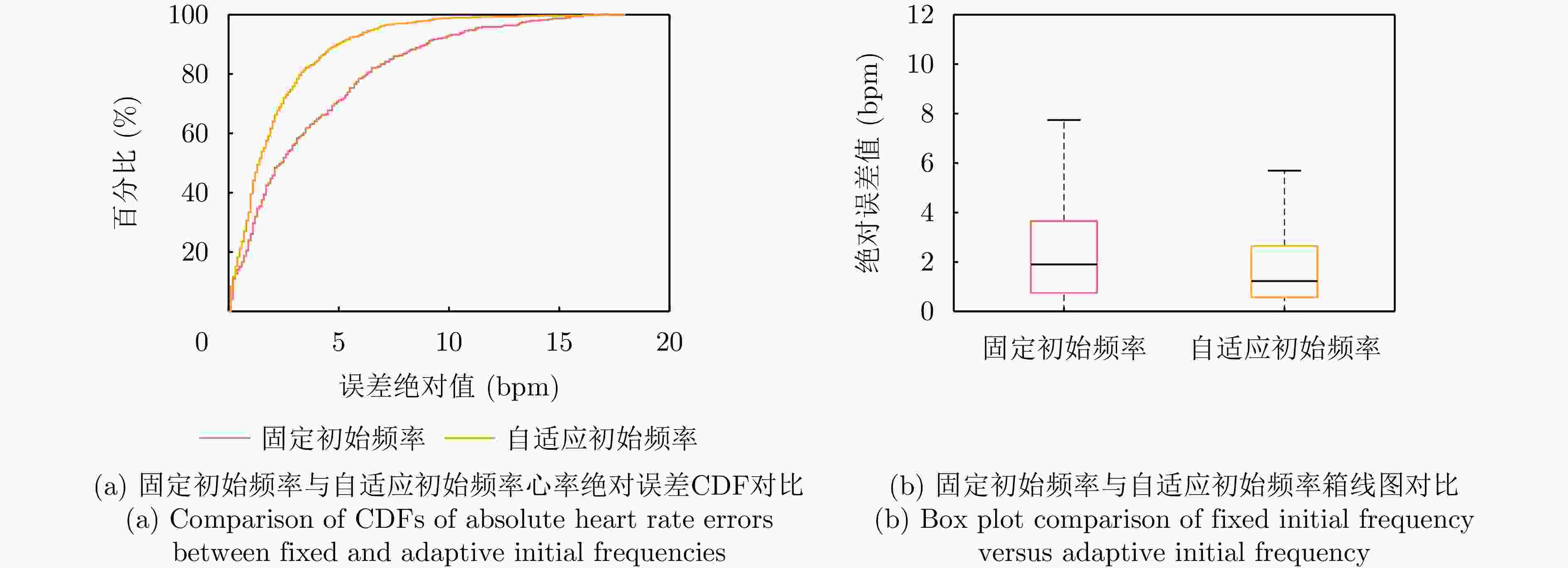
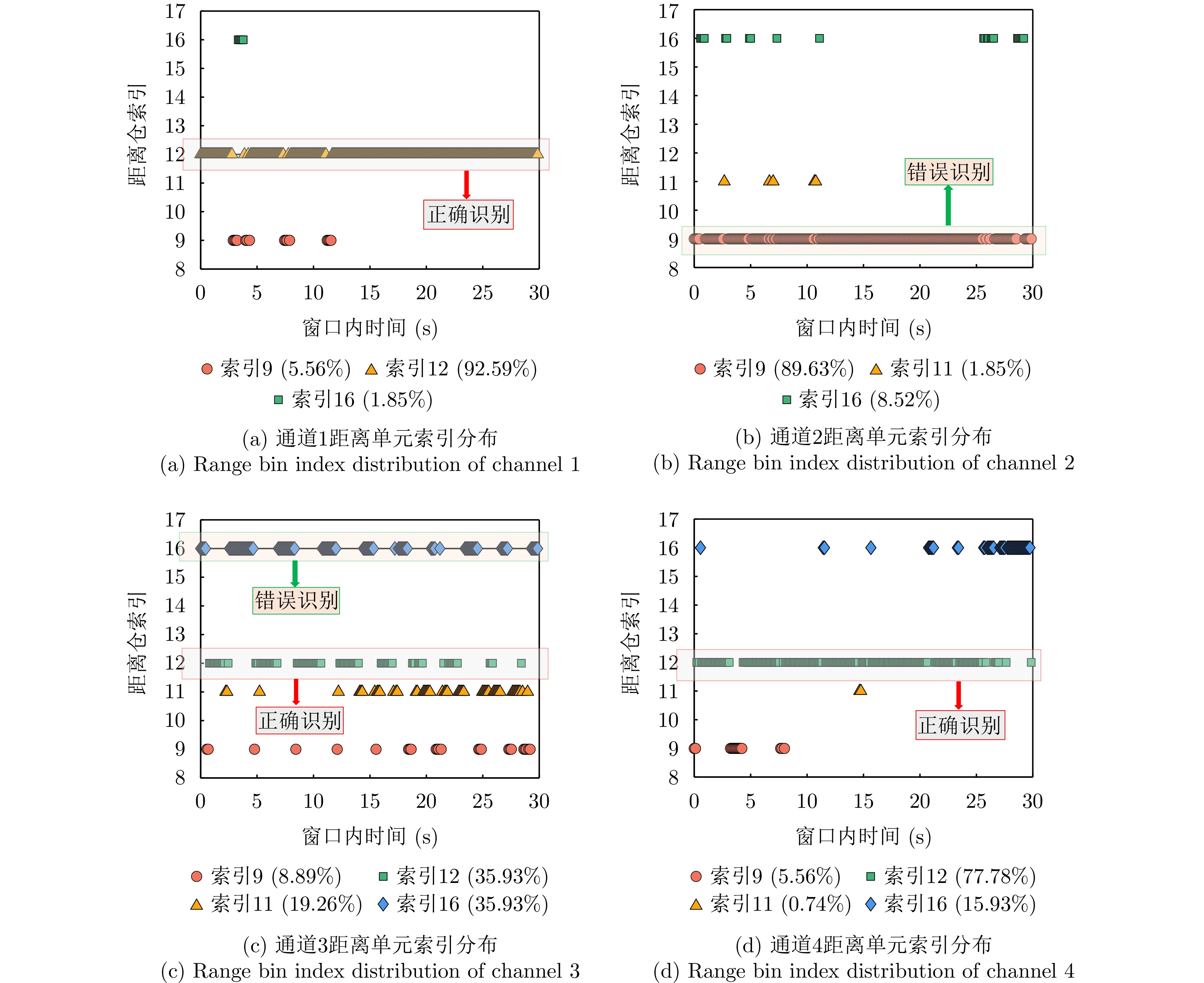
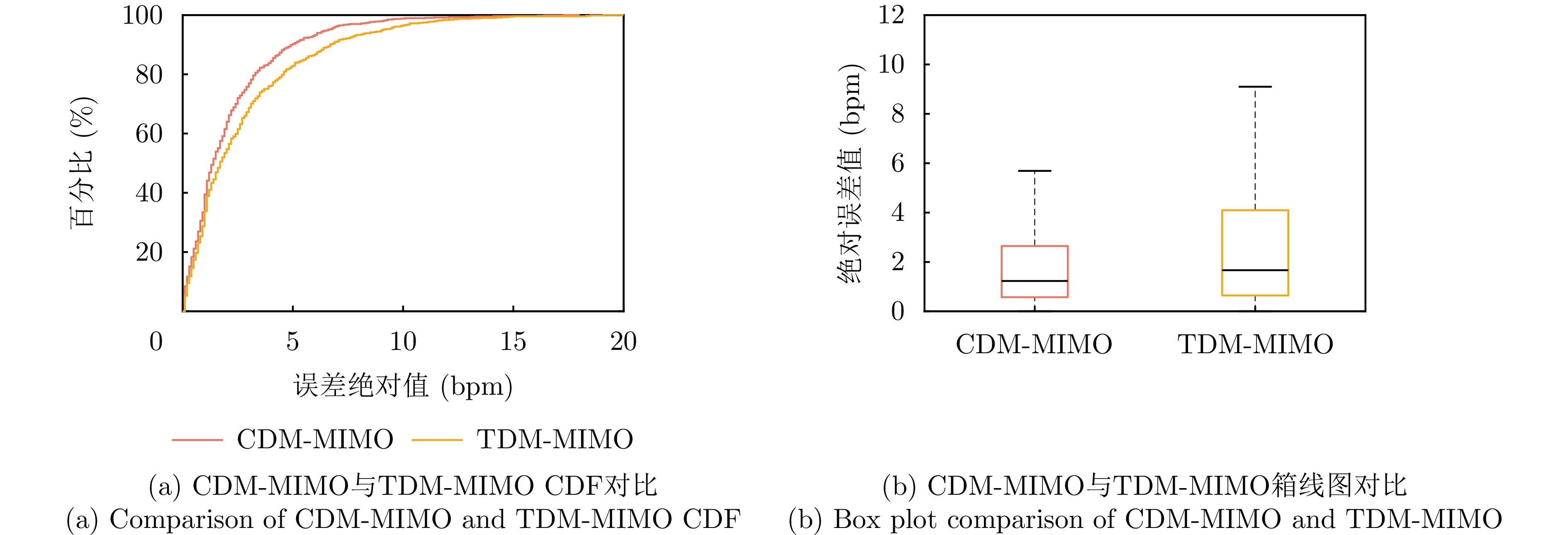
图 7 固定初始频率与自适应初始频率心率绝对误差结果对比
Figure 7. Comparison of absolute heart rate errors between fixed and adaptive initial frequencies
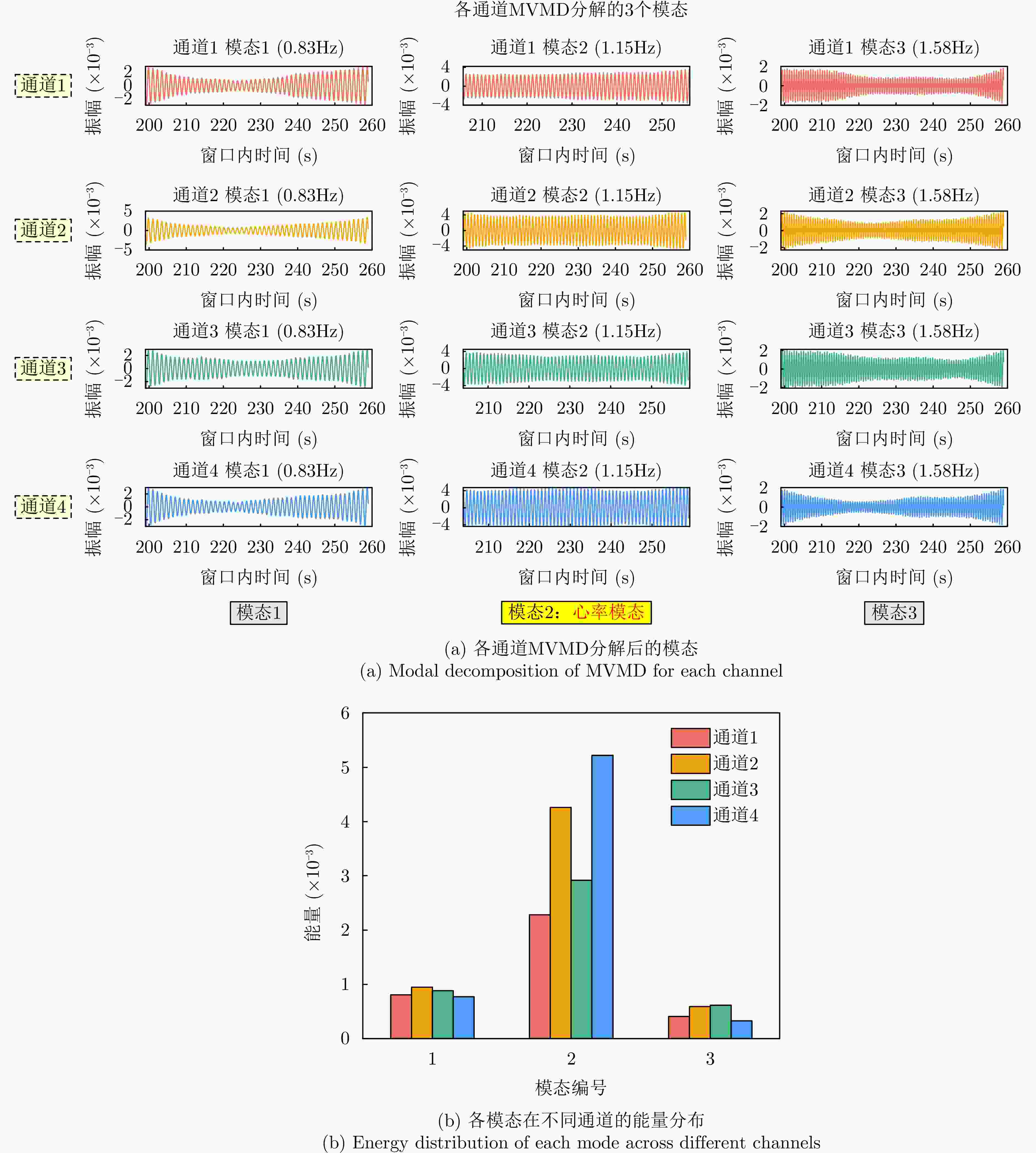
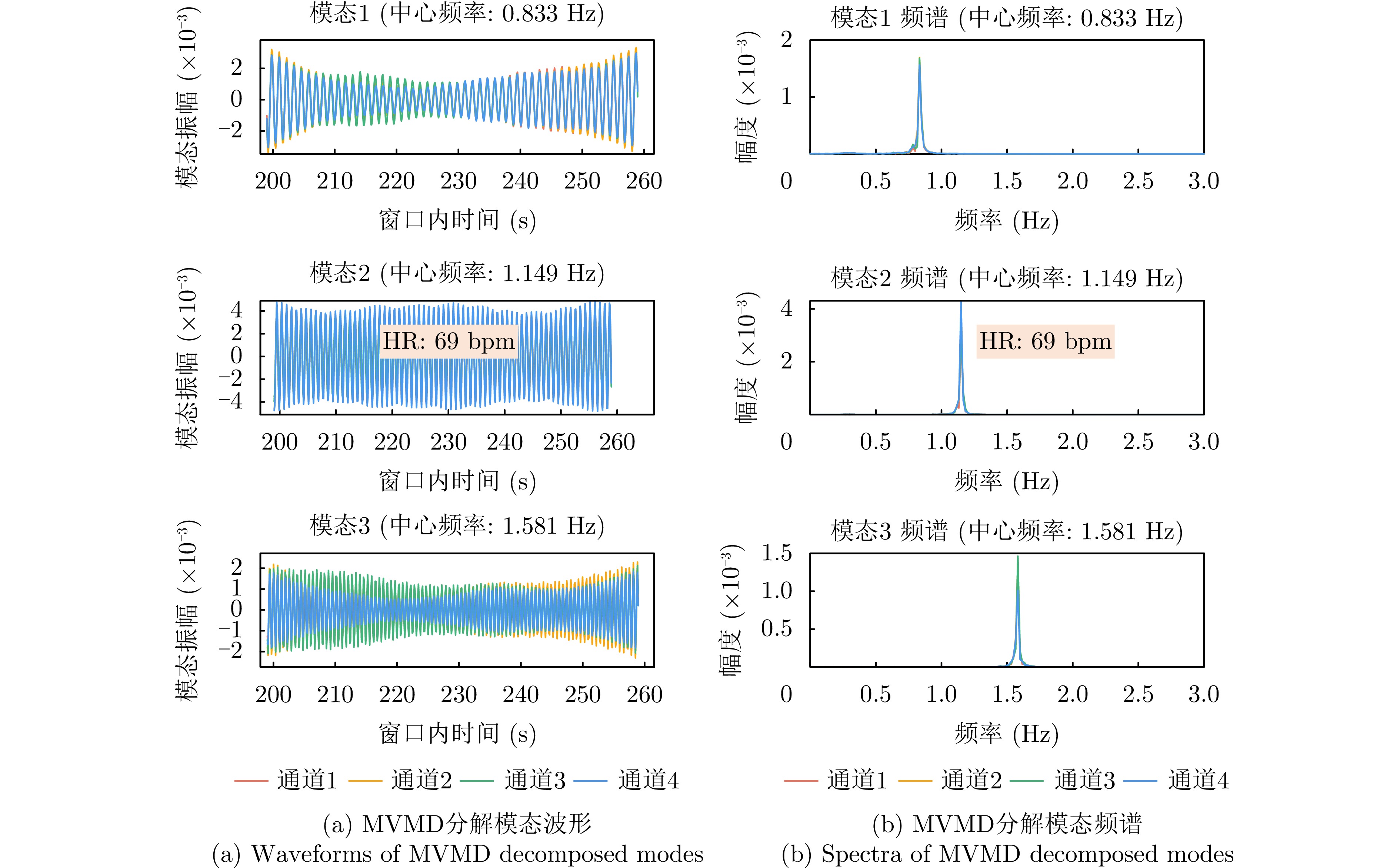
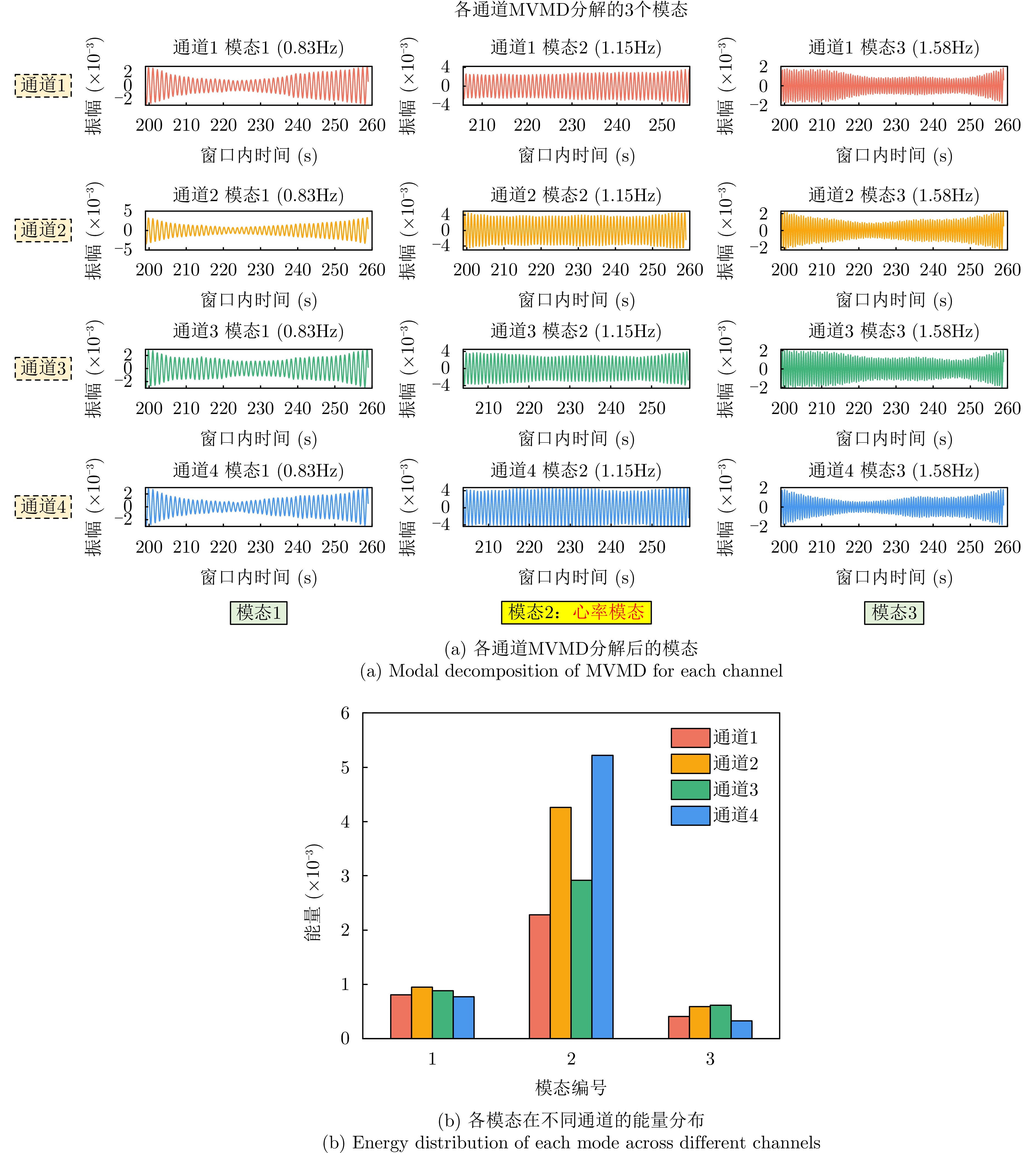
图 9 各通道MVMD分解模态波形及其能量分布
Figure 9. Waveforms and energy distribution of MVMD modes for each channel
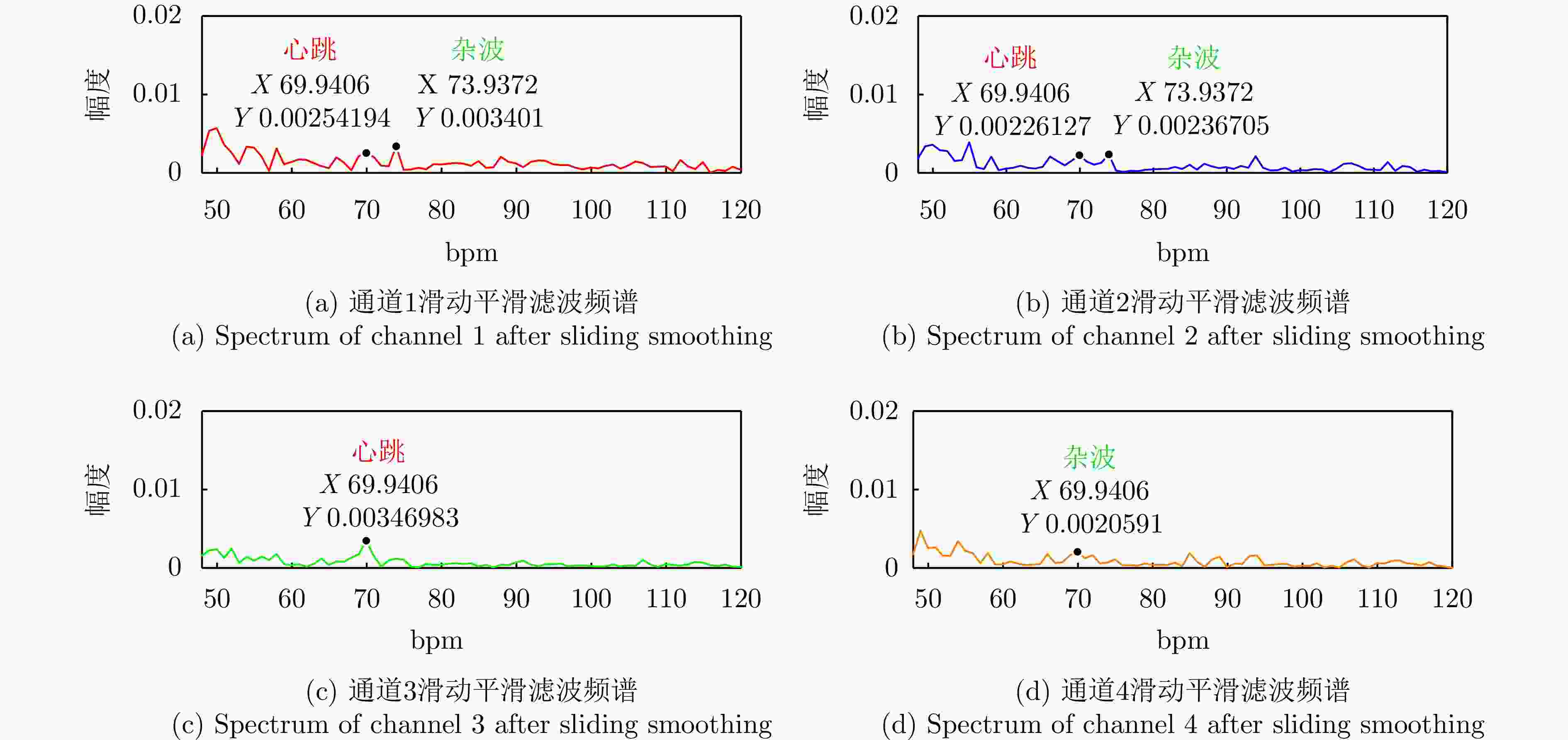
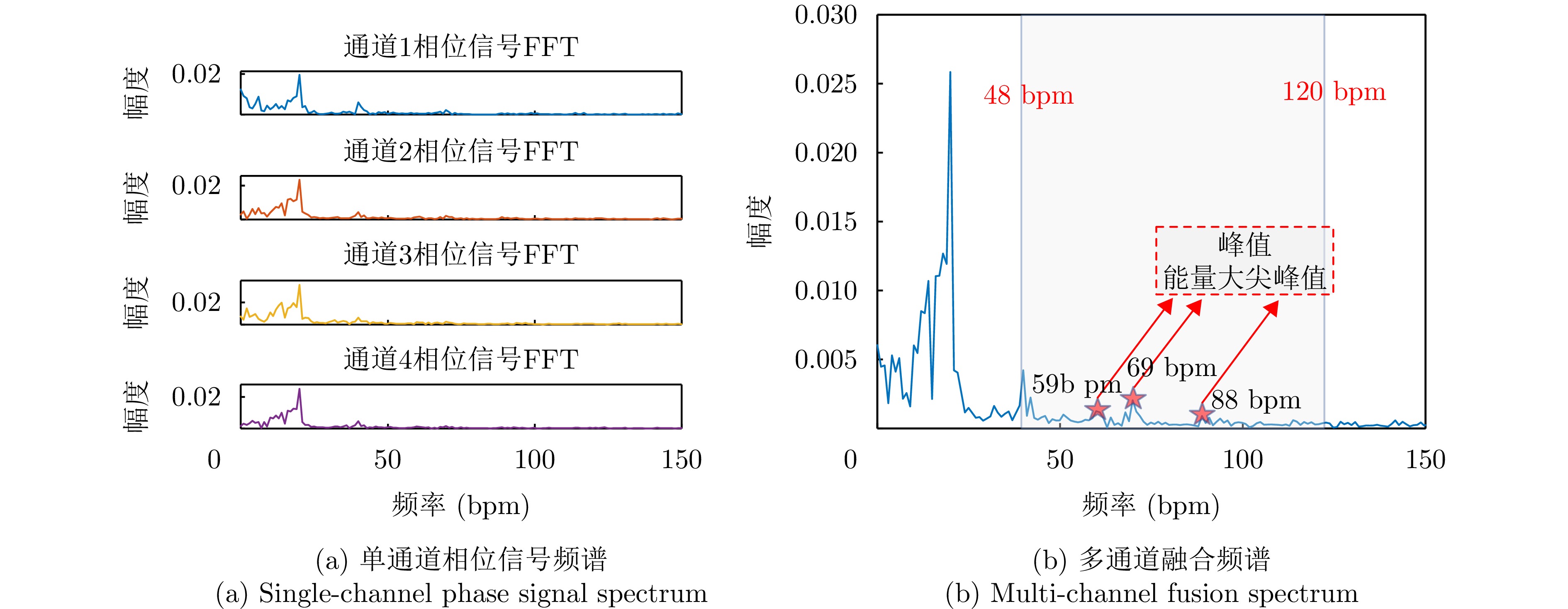
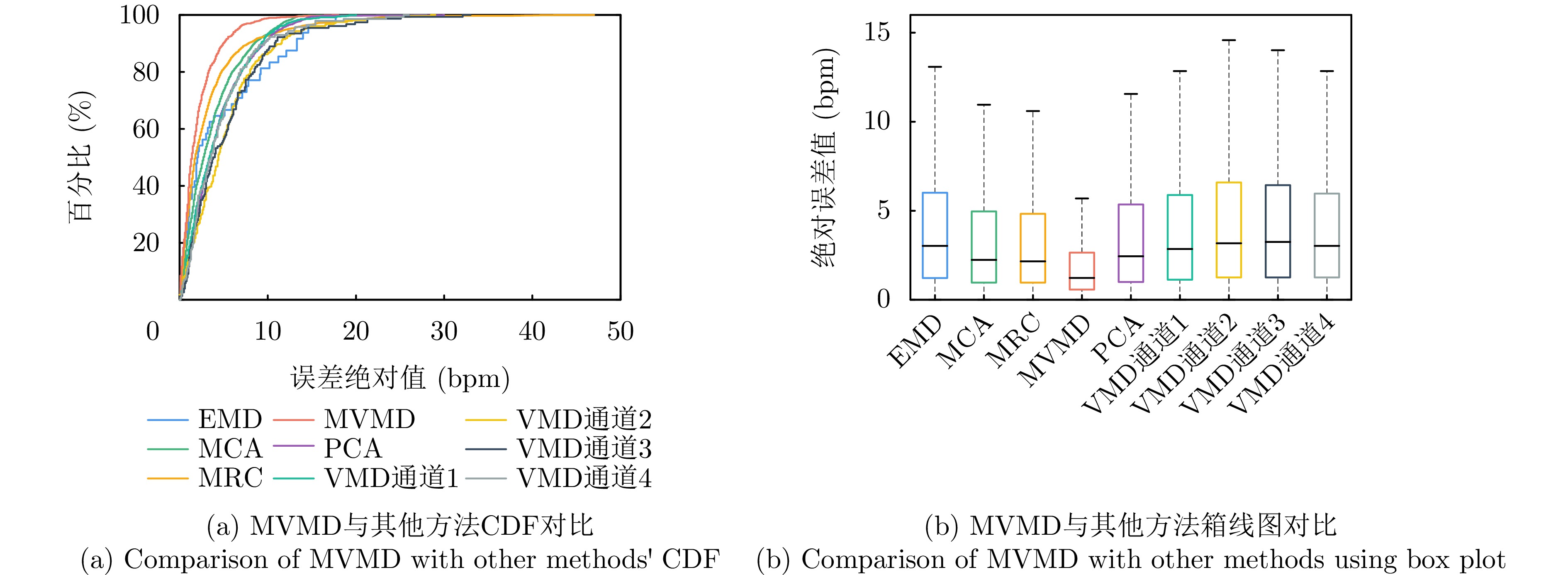
图 13 多通道预处理后心率频带内的频谱特性对比
Figure 13. Comparison of spectral characteristics within the heart rate band following multi-channel preprocessing
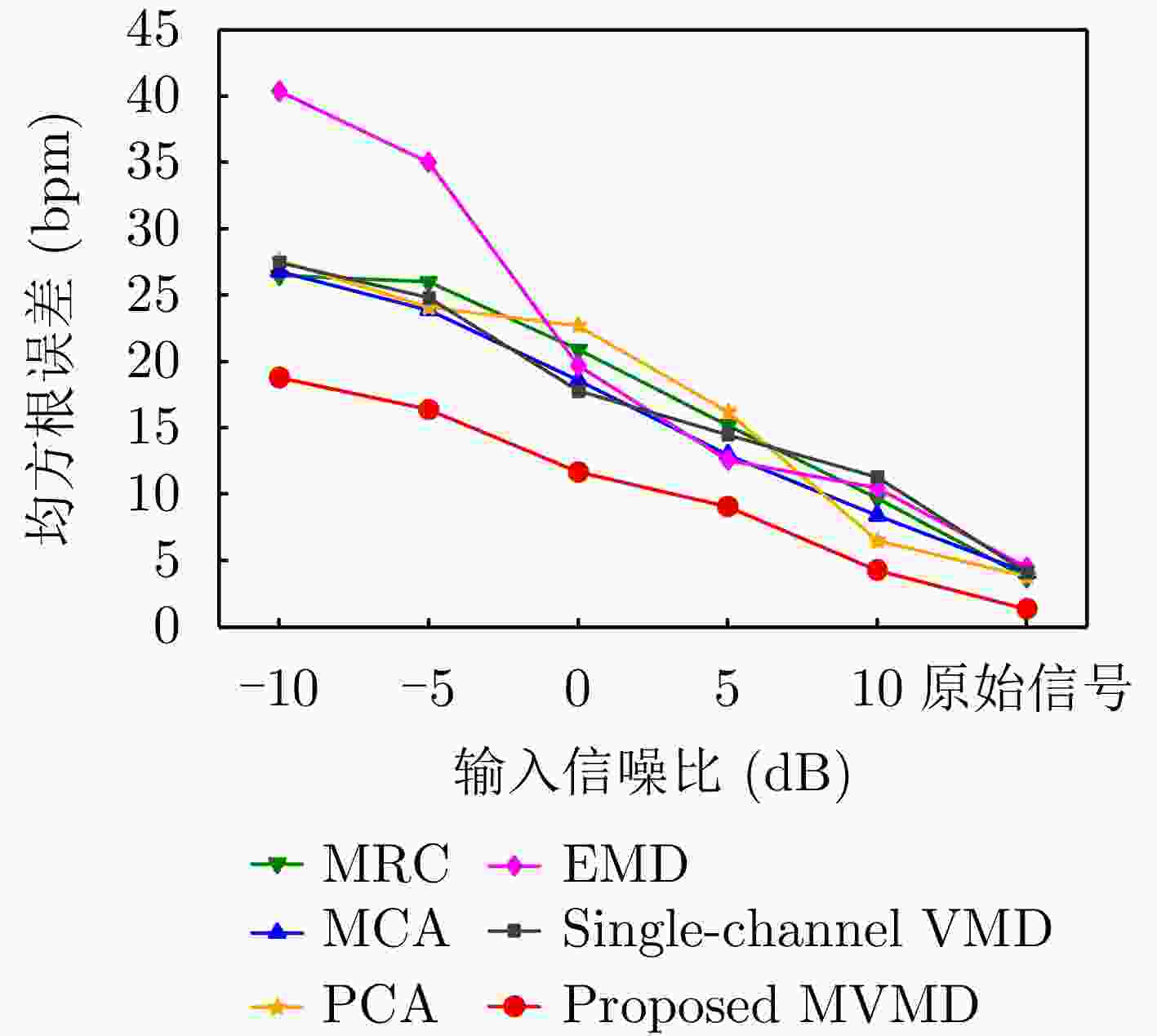
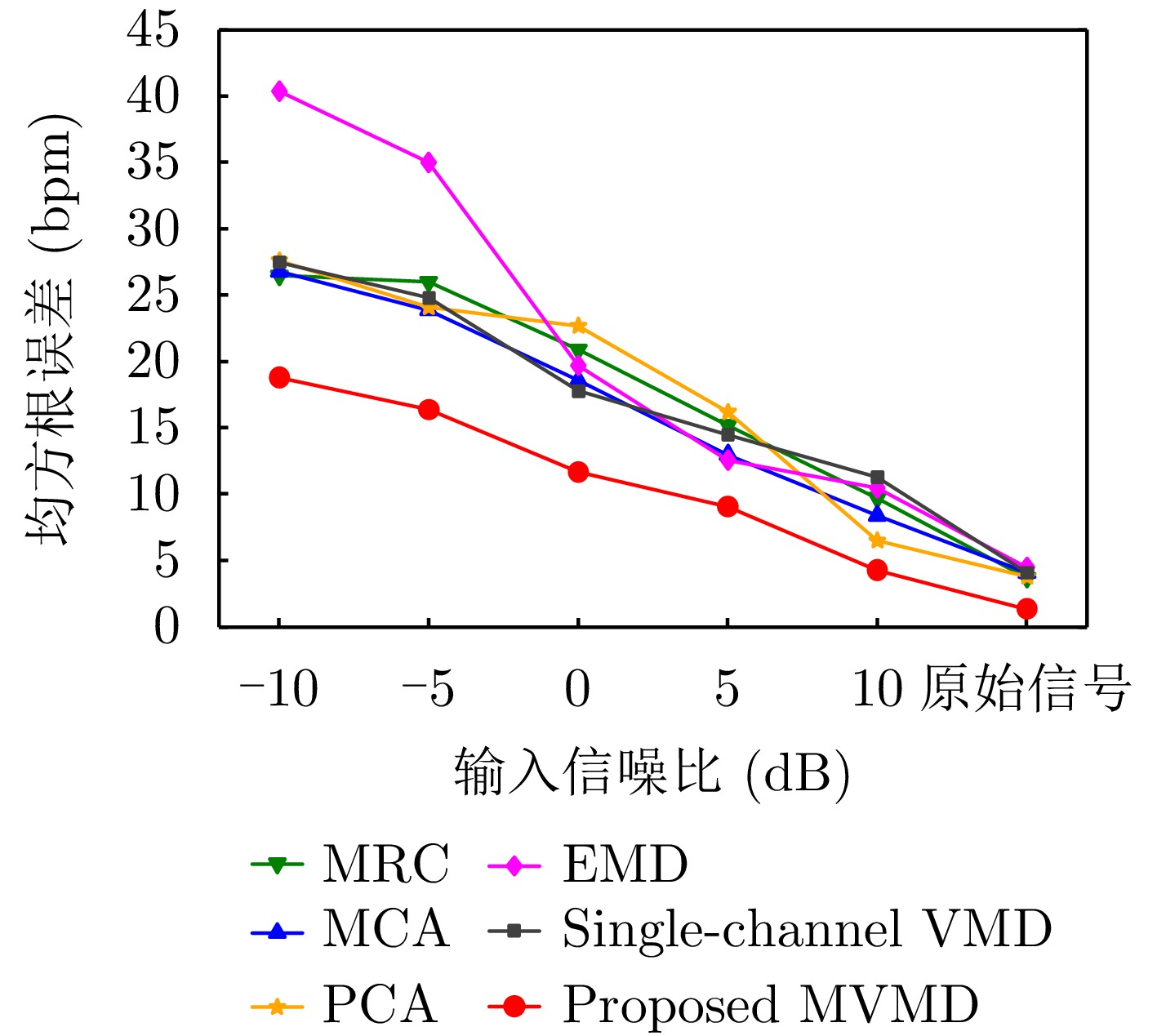
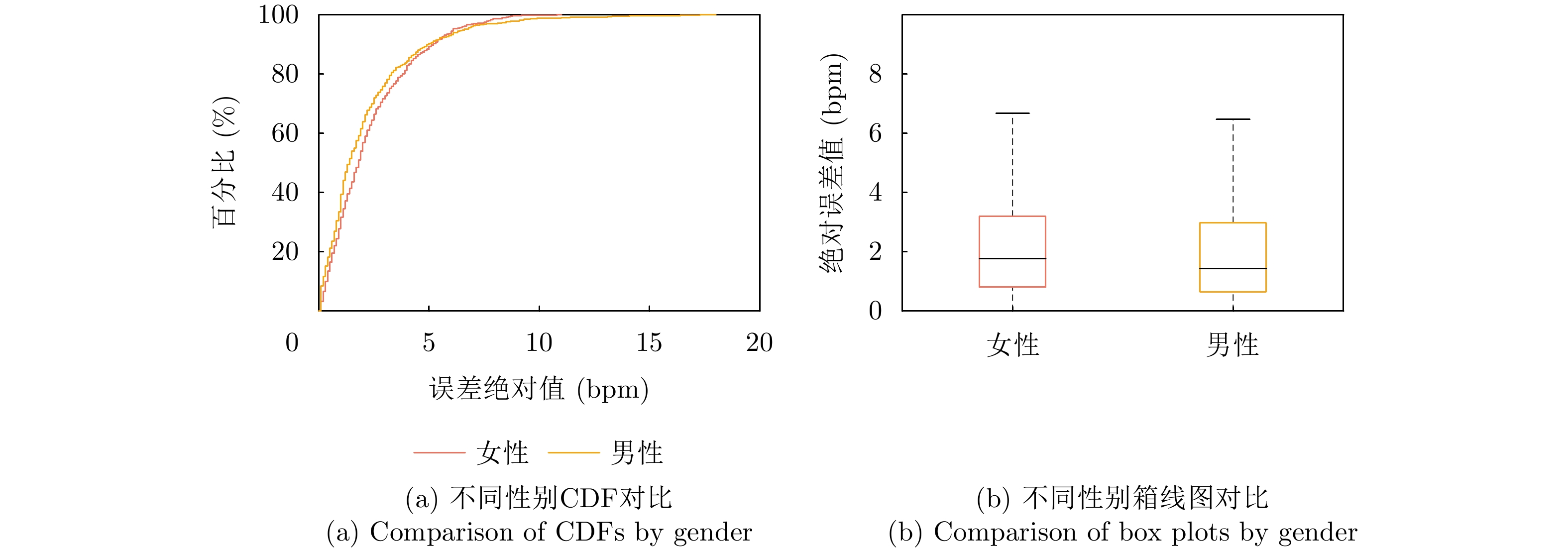
图 15 不同输入信噪比下的心率估计性能对比
Figure 15. Comparison of heart rate estimation performance under different input signal-to-noise ratios
1 MVMD算法流程
1. Algorithm of MVMD
1: Initialization $\hat{u}_{k,p}^1$, $\omega_k^1 $, $\lambda_p^1 $ 2: repeat 3: for $k\to 1$: K do 4: for $p\to 1$: P do Update mode $\hat{u}_{k,p}$ 5: $\hat u_{k,p}^{n+1}(\omega)=\dfrac{\hat y_p(\omega)-\displaystyle\sum\limits_{i\neq K}\hat u_{i,p}(\omega)+\frac{\hat\lambda_p^n(\omega)}{2}}{1+2\alpha(\omega-\omega_k^n)^2} $ 6: end for 7: end for 8: for $k\to 1$: K do Update center frequency $\omega_k$ 9: $\omega_k^{n+1}=\frac{\displaystyle\sum\limits_{p=1}^P \displaystyle\int\limits_0^\infty \omega|u_{k,p}^{n+1}(\omega)|^2 {\mathrm{d}}\omega}{\displaystyle\sum\limits_{p=1}^P\displaystyle\int\limits_0^\infty |u_{k,p}^{n+1}(\omega)|^2 {\mathrm{d}}\omega}$ 10: end for 11: for $p\to 1$: P do Update $\lambda_p$ for all $\omega\geq 0$ 12: $\hat\lambda_p^{n+1}(\omega)=\hat\lambda_p^n(\omega)+\tau(\hat y_p(\omega)-\displaystyle\sum\limits_{k=1}^K\hat{u}_{k,p}^{n+1}(\omega))$ 13: end for 14: until Convergence 15: $\left\|\omega_k^{(n)}-\omega_k^{(n-1)}\right\|_\infty< \epsilon_1$ & $ \mathop{\max }\limits_{k,p}\left(1-\rho_k^{(n)}(p)\right)<\epsilon_2$  下载: 导出CSV
表 1 实测参数
Table 1. Measured parameters
参数 数值 中心频率 60.75 GHz 调频斜率 54.7 MHz/μs 频带宽度 3.23 GHz 发射功率 12 dBm 采样频率 2.95 MHz 脉冲数 96 帧周期 111 ms 帧数目 2700
下载: 导出CSV
表 2 不同心率估计算法的计算复杂度与耗时对比
Table 2. Comparison of computational complexity and time consumption
算法 时间复杂度 浮点运算次数估算 实际单窗平均耗时(s) VMD O (IKNlog2N) 7.35×10⁷ 0.041 EMD O(N2) 1.62×10⁵ 0.035 MCA O(PN) 3.24×10³ 0.028 MRC O(PN) 4.32×10³ 0.029 PCA O(P2N+ P3) 8.70×10³ 0.030 所提MVMD方法 O(PIKNlog2N) 2.94×10⁸ 0.099
下载: 导出CSV
-
[1] HU Shan, BOWLDS R L, GU Ye, et al. Pulse wave sensor for non-intrusive driver’s drowsiness detection[C]. 2009 Annual International Conference of the IEEE Engineering in Medicine and Biology Society, Minneapolis, USA, 2009: 2312–2315. doi: 10.1109/IEMBS.2009.5335036. [2] GROMER M, SALB D, WALZER T, et al. ECG sensor for detection of driver’s drowsiness[J]. Procedia Computer Science, 2019, 159: 1938–1946. doi: 10.1016/j.procs.2019.09.366. [3] SACCO G and PISA S. A MIMO radar for vital signs recording[C]. 2019 Photonics & Electromagnetics Research Symposium - Spring, Rome, Italy, 2019: 387–393. doi: 10.1109/PIERS-Spring46901.2019.9017283. [4] CARDILLO E and CADDEMI A. Radar range-breathing separation for the automatic detection of humans in cluttered environments[J]. IEEE Sensors Journal, 2021, 21(13): 14043–14050. doi: 10.1109/JSEN.2020.3024961. [5] CORMAN B H P, RAJUPET S, YE Fan, et al. The role of unobtrusive home-based continuous sensing in the management of postacute sequelae of SARS CoV-2[J]. Journal of Medical Internet Research, 2022, 24(1): e32713. doi: 10.2196/32713. [6] KIM J D, LEE W H, LEE Y, et al. Non-contact respiration monitoring using impulse radio ultrawideband radar in neonates[J]. Royal Society Open Science, 2019, 6(6): 190149. doi: 10.1098/rsos.190149. [7] HÄMÄLÄINEN M, MUCCHI L, CAPUTO S, et al. Ultra-wideband radar-based indoor activity monitoring for elderly care[J]. Sensors, 2021, 21(9): 3158. doi: 10.3390/s21093158. [8] TSAI C Y, CHANG N C, FANG H C, et al. A novel non-contact self-injection-locked radar for vital sign sensing and body movement monitoring in COVID-19 isolation ward[J]. Journal of Medical Systems, 2020, 44(10): 177. doi: 10.1007/s10916-020-01637-z. [9] AARDAL Ø, PAICHARD Y, BROVOLL S, et al. Physical working principles of medical radar[J]. IEEE Transactions on Biomedical Engineering, 2013, 60(4): 1142–1149. doi: 10.1109/TBME.2012.2228263. [10] GARBEY M, MERLA A, and PAVLIDIS I. Estimation of blood flow speed and vessel location from thermal video[C]. 2004 IEEE Computer Society Conference on Computer Vision and Pattern Recognition, Washington, USA, 2004: I. doi: 10.1109/CVPR.2004.1315054. [11] KHANAM F T Z, AL-NAJI A, PERERA A G, et al. Non-contact automatic vital signs monitoring of neonates in NICU using video camera imaging[J]. Computer Methods in Biomechanics and Biomedical Engineering: Imaging & Visualization, 2023, 11(2): 278–285. doi: 10.1080/21681163.2022.2069598. [12] WANG Beibei, XU Qinyi, CHEN Chen, et al. The promise of radio analytics: A future paradigm of wireless positioning, tracking, and sensing[J]. IEEE Signal Processing Magazine, 2018, 35(3): 59–80. doi: 10.1109/MSP.2018.2806300. [13] LIU K J R and WANG Beibei. Wireless AI: Wireless Sensing, Positioning, IoT, and Communications[M]. Cambridge, UK: Cambridge University Press, 2019: 199–227. [14] CIANCA E, DE SANCTIS M, and DI DOMENICO S. Radios as sensors[J]. IEEE Internet of Things Journal, 2017, 4(2): 363–373. doi: 10.1109/JIOT.2016.2563399. [15] XIE Wangdong, GAN Liangyu, HUANG Leilei, et al. A real-time respiration monitoring system using WiFi sensing based on the concentric circle model[J]. IEEE Transactions on Biomedical Circuits and Systems, 2023, 17(2): 157–168. doi: 10.1109/TBCAS.2022.3229435. [16] QIU Jiefan, ZHENG Pan, CHI Kaikai, et al. Respiration monitoring in high-dynamic environments via combining multiple WiFi channels based on wire direct connection between RX/TX[J]. IEEE Internet of Things Journal, 2023, 10(2): 1558–1573. doi: 10.1109/JIOT.2022.3209172. [17] HA U, ASSANA S, and ADIB F. Contactless seismocardiography via deep learning radars[C]. The 26th Annual International Conference on Mobile Computing and Networking, London, UK, 2020: 62. doi: 10.1145/3372224.3419982. [18] WEISHAUPT F, WALTERSCHEID I, BIALLAWONS O, et al. Vital sign localization and measurement using an LFMCW MIMO radar[C]. The 2018 19th International Radar Symposium, Bonn, Germany, 2018: 1–8. doi: 10.23919/IRS.2018.8448229. [19] WANG Wen, WANG Yong, ZHOU Mu, et al. A novel vital sign sensing algorithm for multiple people detection based on FMCW radar[C]. 2020 IEEE Asia-Pacific Microwave Conference, Hong Kong, China, 2020: 1104–1106. doi: 10.1109/APMC47863.2020.9331552. [20] SINGH A, YONGCHAREON S, REHMAN S U, et al. A real-time beam steering and accurate vital sign estimation method in an indoor environment[J]. IEEE Internet of Things Journal, 2024, 11(18): 30278–30292. doi: 10.1109/JIOT.2024.3410209. [21] WANG Fengyu, ZHANG Feng, WU Chenshu, et al. ViMo: Multiperson vital sign monitoring using commodity millimeter-wave radio[J]. IEEE Internet of Things Journal, 2021, 8(3): 1294–1307. doi: 10.1109/JIOT.2020.3004046. [22] ZHANG Jinhong, QIU Jiefan, WANG Ke, et al. Millimeter-wave radar-based unsteady vital signs monitoring for smart home[C]. IEEE International Conference on Communications, Denver, USA, 2024: 3358–3364. doi: 10.1109/ICC51166.2024.10622996. [23] AHMAD A, ROH J C, WANG Dan, et al. Vital signs monitoring of multiple people using a FMCW millimeter-wave sensor[C]. 2018 IEEE Radar Conference, Oklahoma City, USA, 2018: 1450–1455. doi: 10.1109/RADAR.2018.8378778. [24] 胡锡坤, 金添. 基于自适应小波尺度选择的生物雷达呼吸与心跳分离方法[J]. 雷达学报, 2016, 5(5): 462–469. doi: 10.12000/JR16103.HU Xikun and JIN Tian. Adaptive wavelet scale selection-based method for separating respiration and heartbeat in bio-radars[J]. Journal of Radars, 2016, 5(5): 462–469. doi: 10.12000/JR16103. [25] HUANG N E, SHEN Zhen, LONG S R, et al. The empirical mode decomposition and the Hilbert spectrum for nonlinear and non-stationary time series analysis[J]. Proceedings of the Royal Society A: Mathematical, Physical and Engineering Sciences, 1998, 454(1971): 903–995. doi: 10.1098/rspa.1998.0193. [26] 倪杰, 王勇, 杨小龙, 等. 基于毫米波雷达的心率变异性检测方法[J]. 移动通信, 2024, 48(12): 103–115. doi: 10.3969/j.issn.1006-1010.20241024-0001.NI Jie, WANG Yong, YANG Xiaolong, et al. Heart rate variability detection method based on millimeter wave radar[J]. Mobile Communications, 2024, 48(12): 103–115. doi: 10.3969/j.issn.1006-1010.20241024-0001. [27] 屈乐乐, 刘淑杰, 杨天虹, 等. 基于多通道的调频连续波雷达生命信号提取[J]. 电子与信息学报, 2022, 44(4): 1318–1326. doi: 10.11999/JEIT211073.QU Lele, LIU Shujie, YANG Tianhong, et al. Life signal extraction based on multi-channel frequency modulated continuous wave radar[J]. Journal of Electronics & Information Technology, 2022, 44(4): 1318–1326. doi: 10.11999/JEIT211073. [28] TANG Shiqing, WANG Jinwei, LIU Yunxue, et al. A millimeter-wave radar heartbeat detection method based on multi-channel accumulation and Root-MUSIC frequency estimation[C]. The 2025 IEEE 8th International Conference on Electronic Information and Communication Technology, Weihai, China, 2025: 316–321. doi: 10.1109/ICEICT66683.2025.11159940. [29] GU Changzhan, LI Changzhi, LIN J, et al. Instrument-based noncontact Doppler radar vital sign detection system using heterodyne digital quadrature demodulation architecture[J]. IEEE Transactions on Instrumentation and Measurement, 2010, 59(6): 1580–1588. doi: 10.1109/TIM.2009.2028208. [30] REHMAN N U and AFTAB H. Multivariate variational mode decomposition[J]. IEEE Transactions on Signal Processing, 2019, 67(23): 6039–6052. doi: 10.1109/TSP.2019.2951223. [31] DRAGOMIRETSKIY K and ZOSSO D. Variational mode decomposition[J]. IEEE Transactions on Signal Processing, 2014, 62(3): 531–544. doi: 10.1109/TSP.2013.2288675. [32] RONG Yu, DUTTA A, CHIRIYATH A, et al. Motion-tolerant non-contact heart-rate measurements from radar sensor fusion[J]. Sensors, 2021, 21(5): 1774. doi: 10.3390/s21051774. [33] YANG Xiuzhu, ZHANG Xinyue, DING Yi, et al. Indoor activity and vital sign monitoring for moving people with multiple radar data fusion[J]. Remote Sensing, 2021, 13(18): 3791. doi: 10.3390/rs13183791. [34] GOTTINGER M, NOTARI N, DUTLER S, et al. Key vital signs monitor based on MIMO radar[J]. Sensors, 2025, 25(13): 4081. doi: 10.3390/s25134081. -










计量
- 文章访问数:
- HTML全文浏览量:
- PDF下载量:
- 被引次数: 0