

 作者中心
作者中心 专家审稿
专家审稿 责编办公
责编办公 编辑办公
编辑办公
Microwave Radar Scattering Characteristics of Ring-moat Dome Structures in Mare Tranquillitatis on the Moon
-
摘要: 环形凹陷穹丘(RMDS)是发育于月海玄武岩表面的一类小型穹隆构造。其平均高度仅3~4 m,直径约200 m,形态低缓;因其数量巨大,已成为理解月球火山活动与岩浆热力学行为的重要研究对象。尽管光学遥感观测结果支持RMDSs的火山作用成因机制,但仍有学者提出了其他可能性。因此,其成因的确证仍需更多地质证据的支撑。微波雷达因其穿透性而具备探测月面次表层结构与物理特性的独特优势,然而截至目前,针对RMDSs微波雷达散射特征的研究仍处于空白。该文重点利用星载雷达微型射频仪(Mini-RF)和地基雷达阿雷西博(Arecibo)的S波段(波长12.6 cm)数据,以静海盆地月海表面一RMDSs密集分布区为研究区,开展其雷达后向散射功率和圆极化率(CPR)等特征分析。结果显示:(1)RMDSs以低后向散射功率为基本特征,这与泡沫岩浆成因理论预测的雷达弱散射特征高度吻合。该理论认为,RMDSs表面2~3 m深度范围内覆盖的亚毫米级细粒物质,是导致其呈现低强度雷达散射回波的主要原因;(2)受撞击作用、地形起伏及物质坡移等因素的影响,部分RMDSs局部区域表现出不同程度的后向散射增强特征,但长期风化会弱化这一特征;(3)RMDSs的雷达散射系数及CPR均值统计结果均与火山碎屑堆积物高度接近,这表明二者的表面物理性质相似,其表面物质颗粒尺度应与以微米至毫米级细颗粒为主的火山碎屑物相当。上述研究进一步证实,多波段、高分辨率、多极化雷达数据能够为RMDSs的精细化研究提供更丰富的地质证据。这不仅深化了对RMDSs形成与演化机制的认识,同时也为后续月表火山地貌的微波遥感探测研究提供了有价值的参考。Abstract: The Ring-Moat Dome Structure (RMDS) is a small-scale domical landform that develops on the lunar mare basalt surface. With an average height of only 3–4 m and a mean diameter of approximately 200 m, these features display a low-relief morphology. Owing to their abundance, RMDSs have become an important subject for understanding lunar volcanic activity and magmatic thermodynamic processes. Although optical remote sensing observations support a volcanic origin for RMDSs, alternative hypotheses have been proposed. Therefore, confirming their genesis requires further geological evidence. Microwave radar provides a distinct advantage in probing the subsurface structure and physical properties of the Moon owing to its penetrative capability. However, to date, no studies have examined the microwave radar scattering characteristics of RMDSs. This paper therefore analyzes the radar backscatter power and Circular Polarization Ratio (CPR) characteristics of RMDSs using S-band (12.6 cm wavelength) data acquired by the spaceborne Miniature Radio Frequency (Mini-RF) instrument and the ground-based Arecibo radar. The study area is a region densely populated with RMDSs on the mare surface within the Mare Tranquillitatis basin. The results indicate the following: (1) RMDSs exhibit low backscatter power, which is highly consistent with the weak radar scattering predicted by the foamy magma genetic model. According to this model, the primary cause of the low-intensity radar echo is the presence of submillimeter-scale fine-grained materials within the uppermost ~2–3 m depth range. (2) Influenced by impact cratering, topographic variations, and mass wasting, some RMDSs display localized enhancement of backscatter to varying degrees; however, prolonged space weathering diminishes this effect. (3) The mean statistical values of the radar backscatter coefficient and the CPR for RMDSs are remarkably close to those of pyroclastic deposits, indicating that their surface physical properties are analogous and that the particle size of their surface materials should be comparable to those of pyroclastic materials, which are predominantly fine-grained particles in the micrometer-to-millimeter range. These findings further confirm that multiband, high-resolution, and multipolarization radar data can yield richer geological evidence for the detailed investigation of RMDSs. This not only deepens the understanding of RMDS formation and evolutionary mechanisms but also provides a valuable reference for future microwave remote sensing exploration of lunar volcanic landforms.
-
Key words:
- Ring-Moat Dome Structure (RMDS) /
- Microwave radar /
- Mare basalt /
- Volcanism /
- The Moon
-
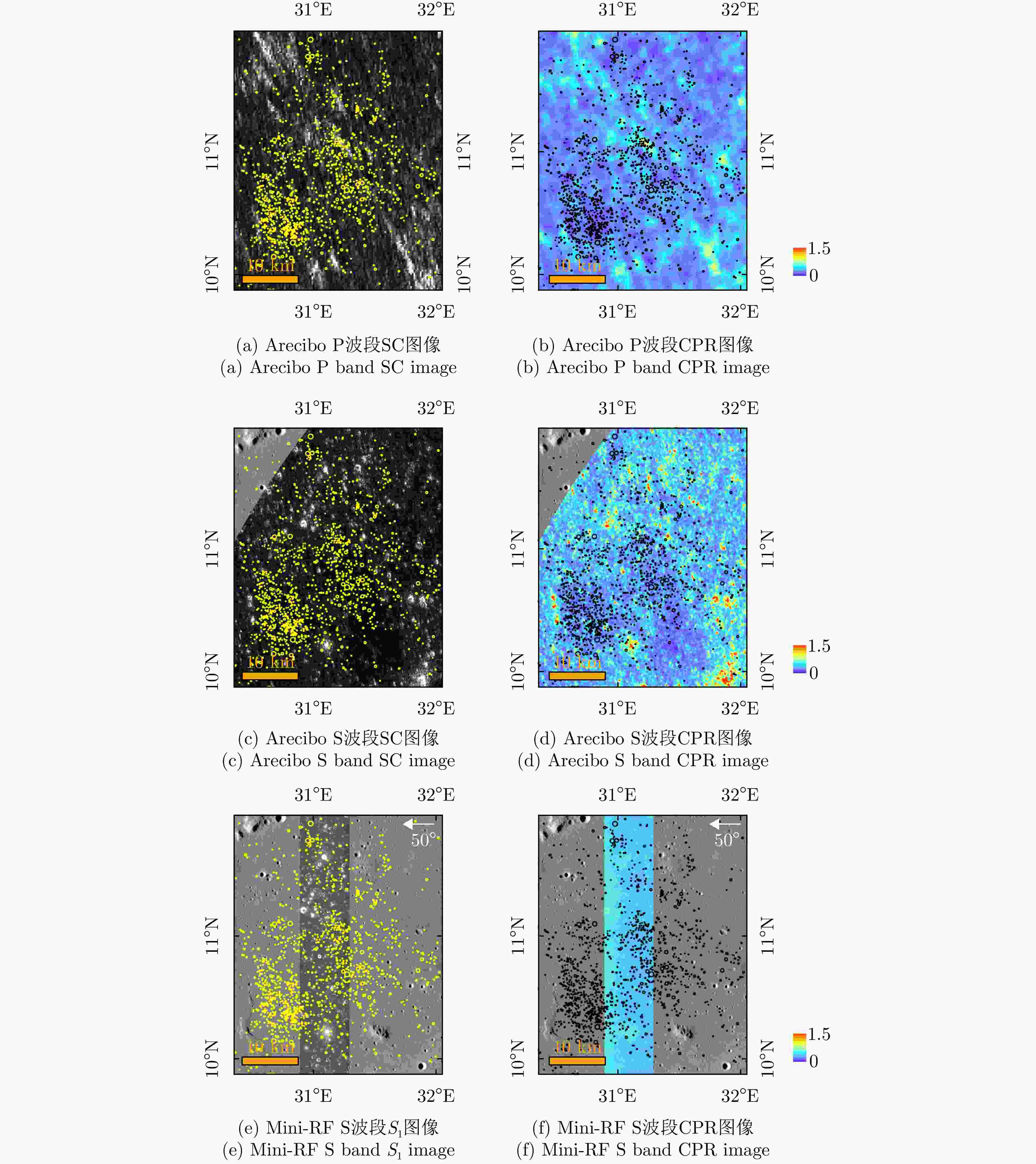
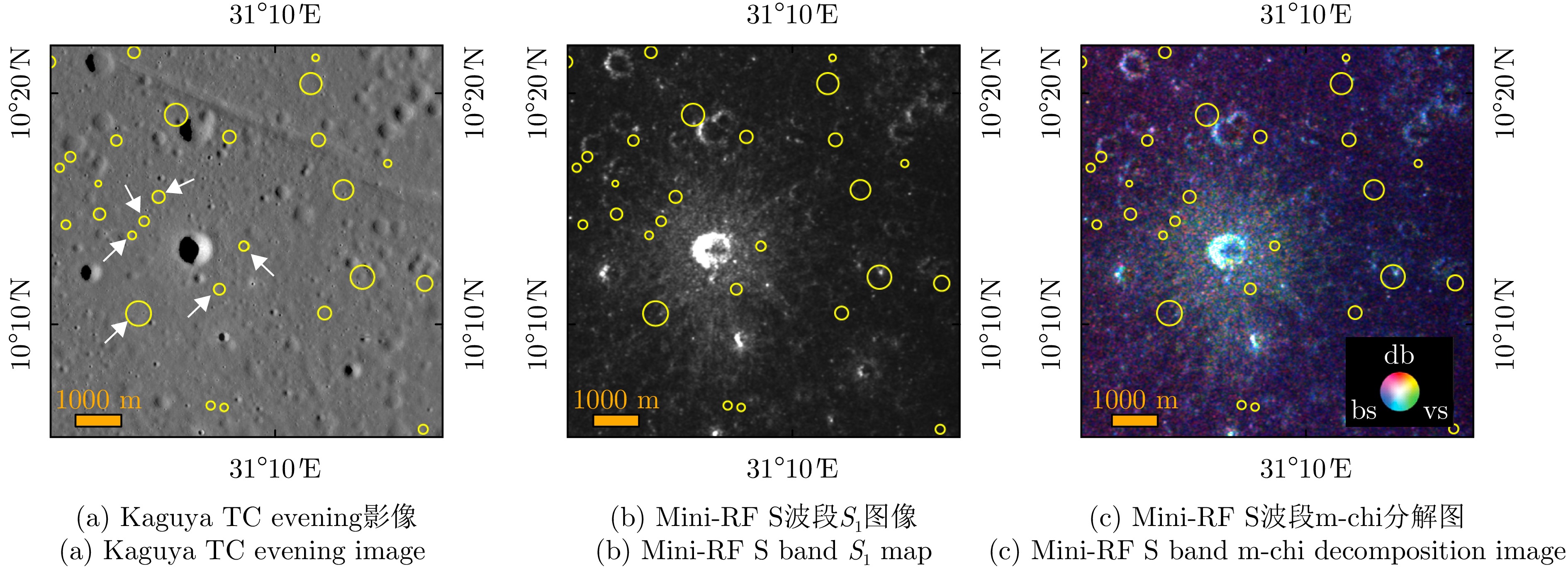
图 2 研究区雷达图像(底图为Kaguya TC evening map)
Figure 2. Radar images of the study area (The base map is the Kaguya TC evening map)
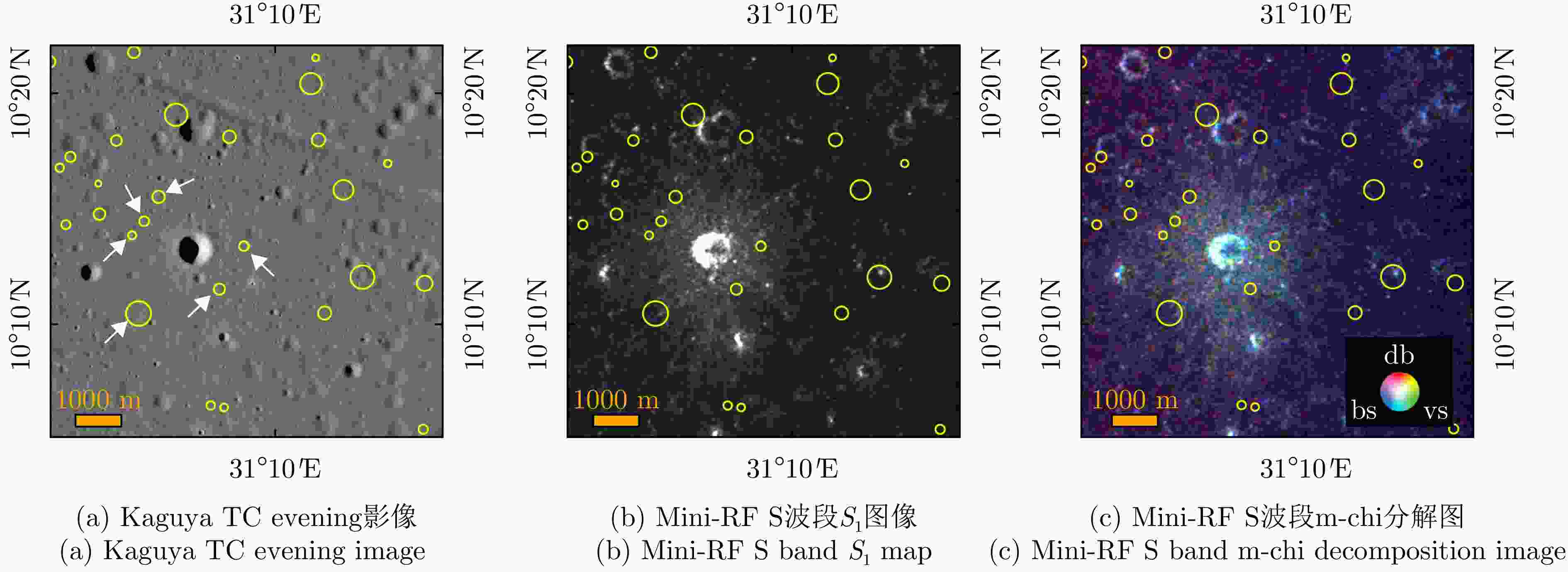
图 3 一撞击坑溅射物范围内的RMDSs
Figure 3. RMDSs located within the ejecta deposit of an impact crater
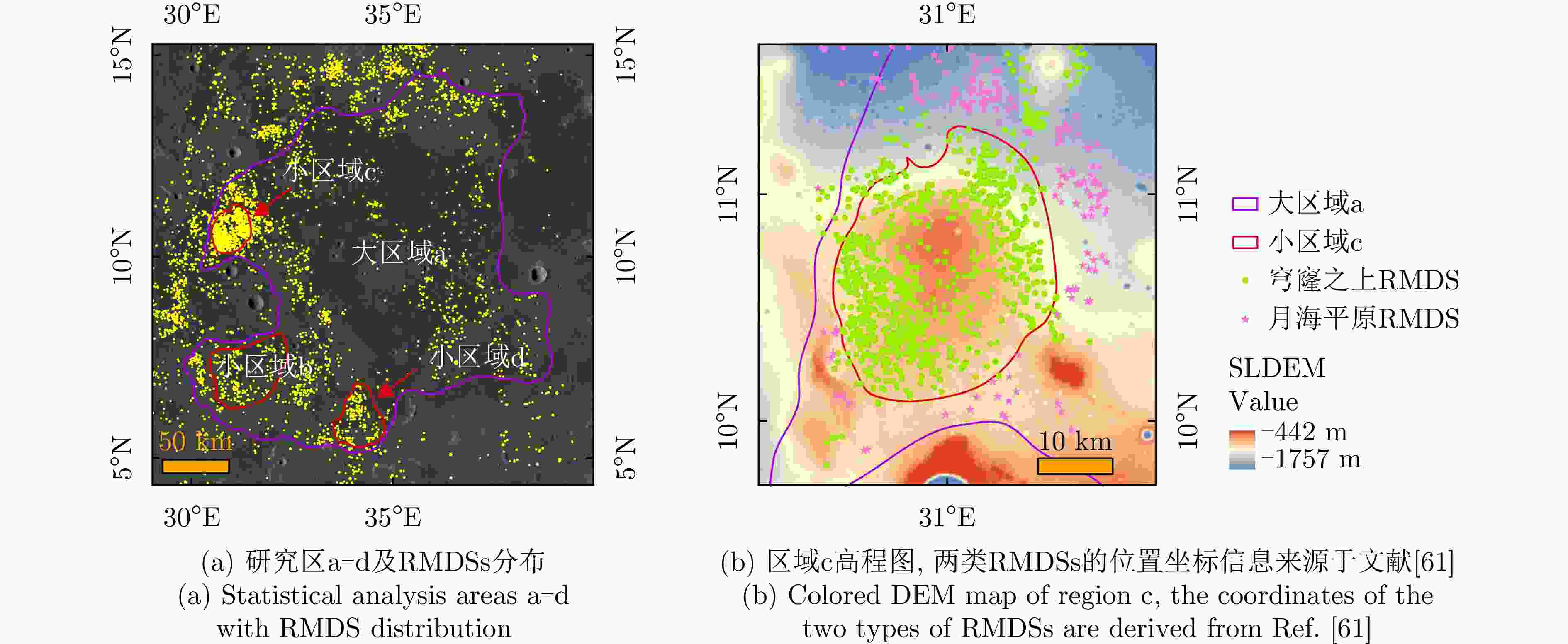
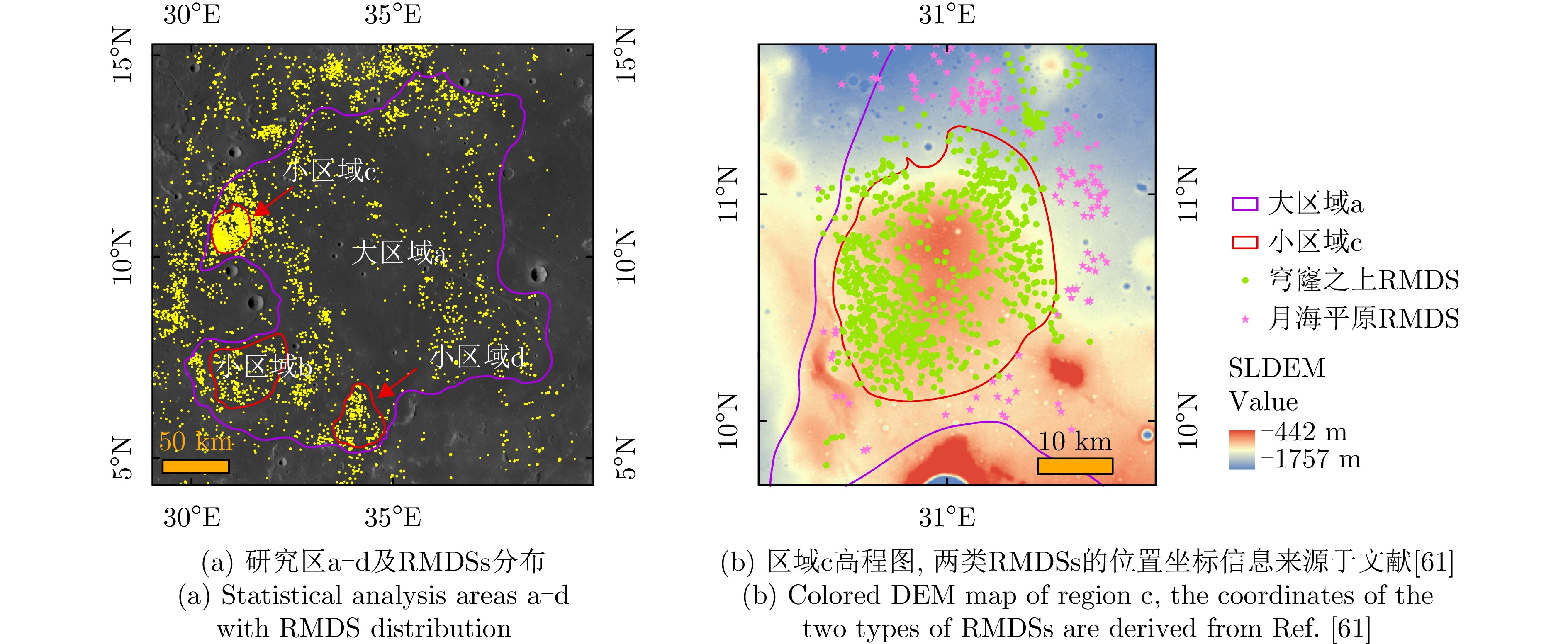
图 6 静海CPR值统计分析区域划分与区域c地区的RMDSs分布图
Figure 6. Statistical zoning of CPR values in Mare Tranquillitatis and distribution of RMDSs in region c
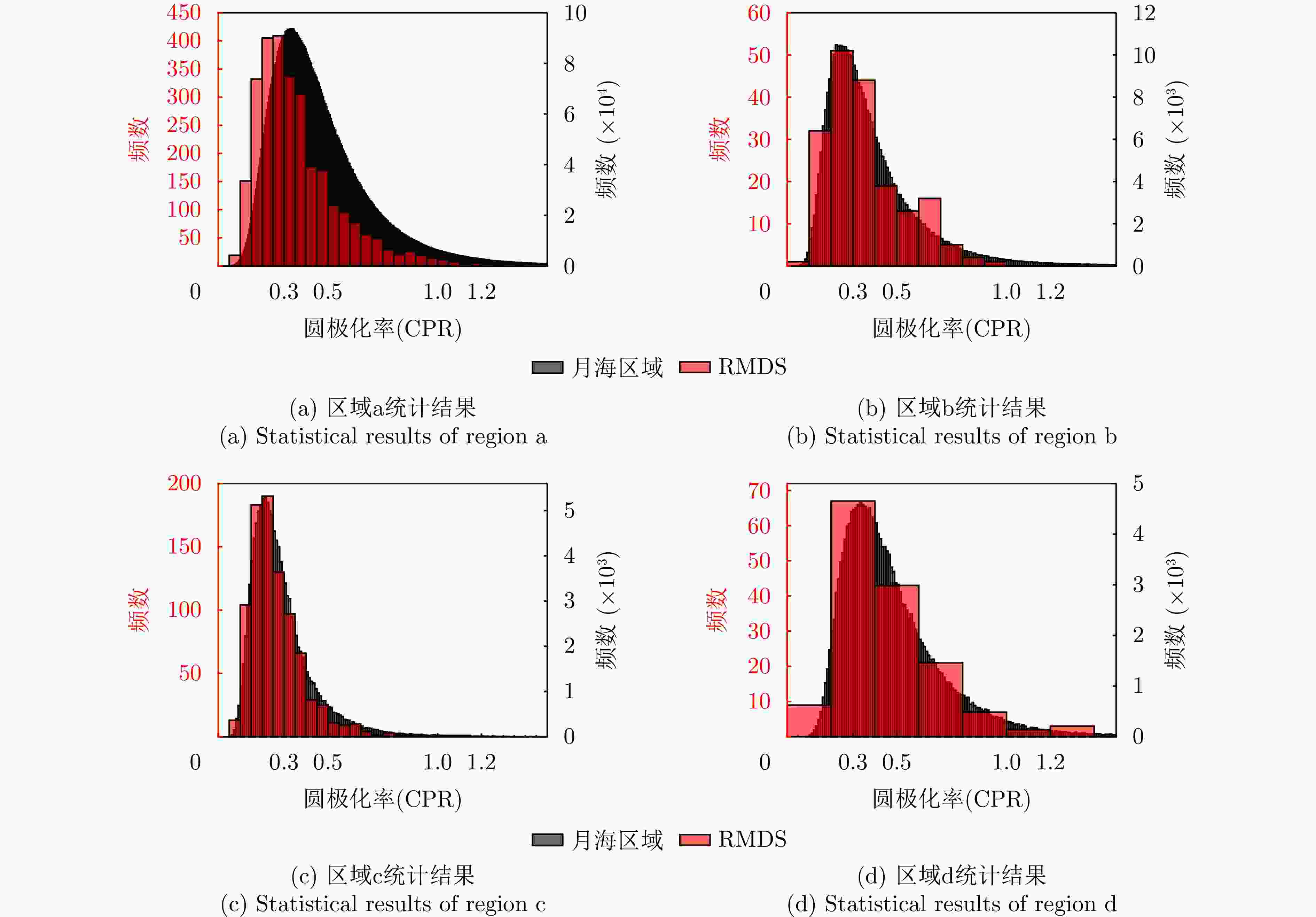
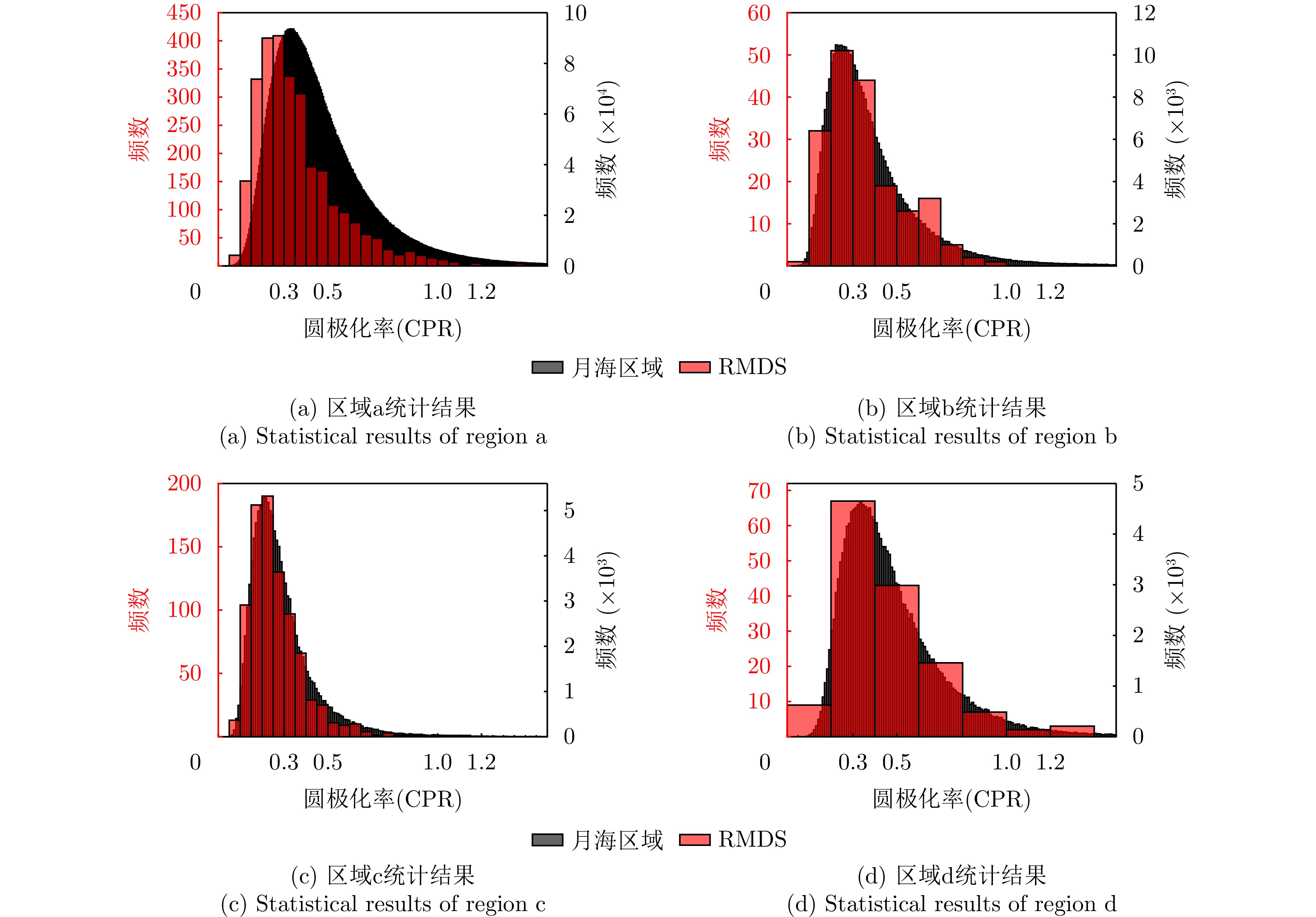
图 7 RMDSs及其所在月海CPR值的统计直方图
Figure 7. Statistical histograms of CPR values of RMDSs and their host mare
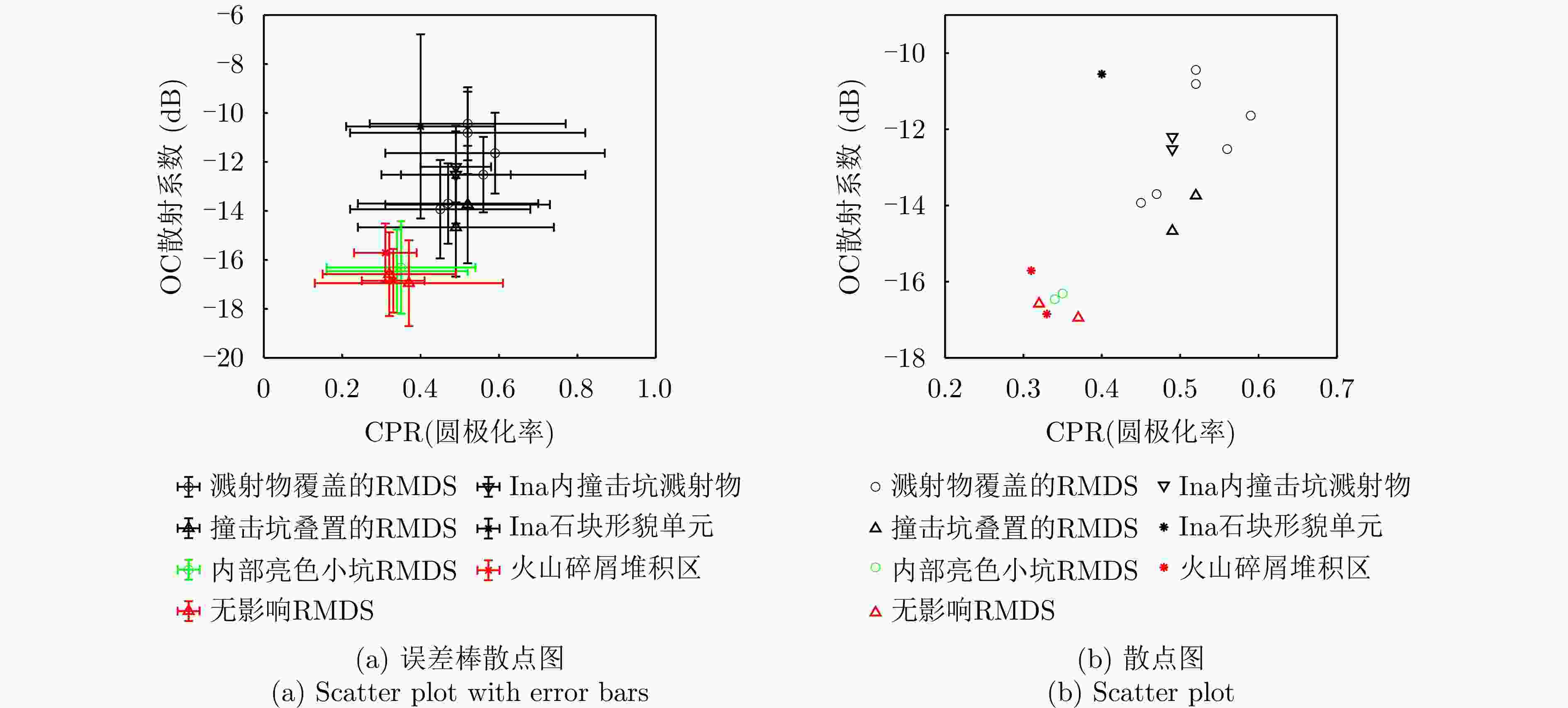
图 8 RMDSs、不规则月海斑块Ina及火山碎屑堆积物的OC散射系数与CPR值散点图
Figure 8. Scatter plots of RMDSs, irregular mare patch Ina, and pyroclastic deposits in terms of OC scattering coefficient and CPR values
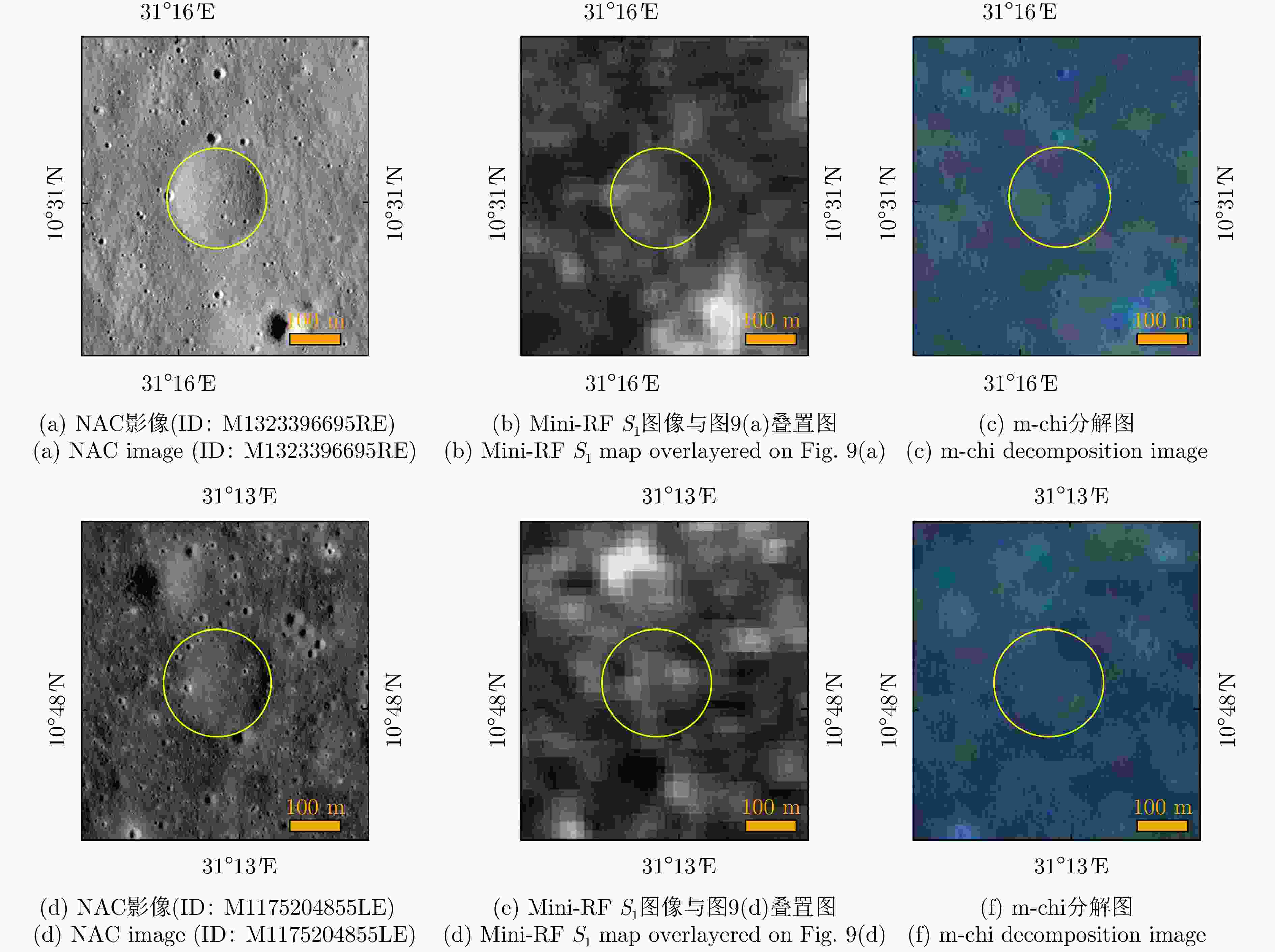
图 9 非撞击因素引起RMDSs局部出现较高雷达散射强度的案例
Figure 9. Cases of locally elevated radar scattering intensity of RMDSs caused by non-impact factors
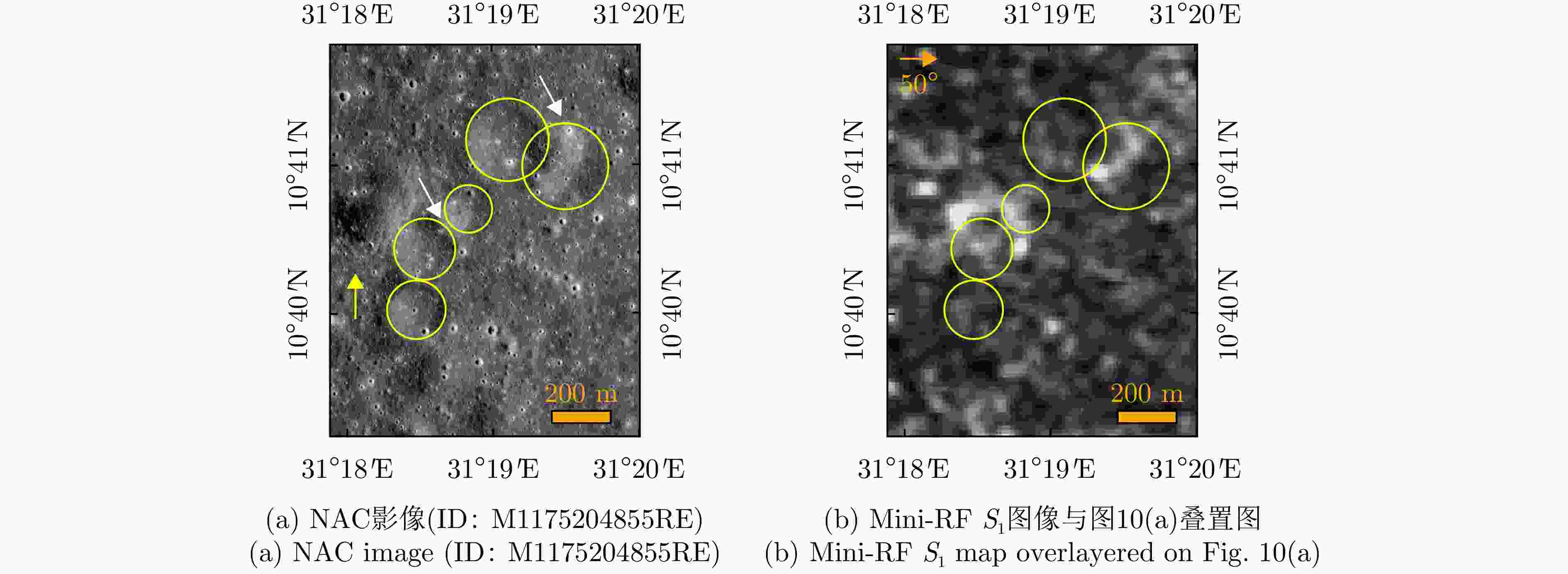
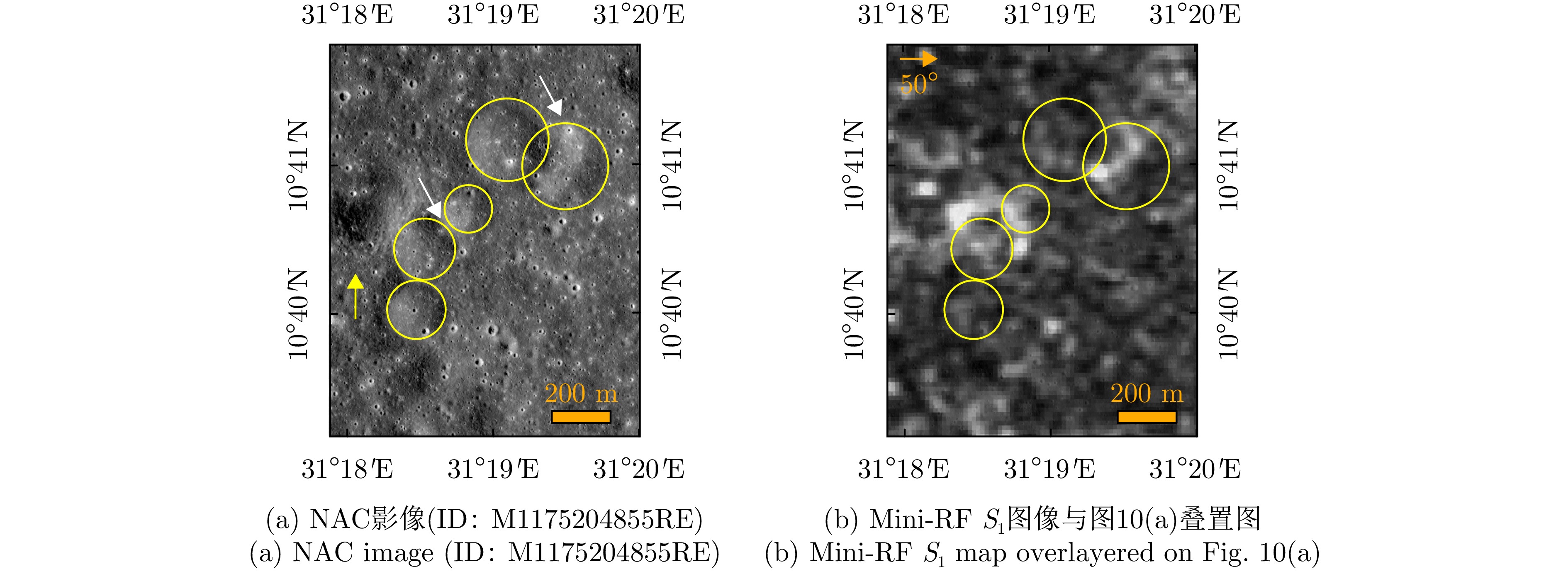
图 10 串珠状(或链状)RMDSs的雷达信号散射特征
Figure 10. Radar scattering characteristics of beaded (or chain) RMDSs
表 1 RMDSs与其他火山地貌的雷达散射特征均值统计表
Table 1. Statistical results of mean radar scattering characteristics for RMDSs and other volcanic landforms
特征描述 OC散射系数(dB) CPR值 样本数 撞击坑溅射物覆盖的RMDSs –13.70±1.64 0.47±0.23 256 –12.52±1.54 0.56±0.26 172 –11.64±1.65 0.59±0.28 118 –13.93±2.01 0.45±0.23 1063 –10.81±1.68 0.52±0.30 188 –10.44±1.49 0.52±0.25 150 与撞击坑叠置的RMDSs –13.74±2.40 0.52±0.21 771 –14.67±2.01 0.49±0.25 96 表面有亮色小坑的RMDSs –16.46±1.70 0.34±0.18 4711 –16.31±1.89 0.35±0.19 2486 无撞击作用影响的RMDSs –16.95±1.75 0.37±0.24 155 –16.58±1.71 0.32±0.17 171 火山碎屑堆积物 –15.71±1.20 0.31±0.08 / –16.85±1.30 0.33±0.08 / Ina月海斑块内石块单元 –10.55±3.76 0.40±0.19 / 月海斑块内退化撞击坑溅射物 –12.20±1.45 0.49±0.09 / –12.52±1.99 0.49±0.14 /  下载: 导出CSV
-
[1] 乔乐, 陈剑, 凌宗成. 月球火山作用的地貌学特征[J]. 地质学报, 2021, 95(9): 2678–2691. doi: 10.19762/j.cnki.dizhixuebao.2021264.QIAO Le, CHEN Jian, and LING Zongcheng. Volcanic landforms on the Moon[J]. Acta Geologica Sinica, 2021, 95(9): 2678–2691. doi: 10.19762/j.cnki.dizhixuebao.2021264. [2] 杨蔚, 胡森, 李秋立, 等. 月球火山活动究竟能持续多久?[J]. 地球科学, 2022, 47(10): 3789–3791. doi: 10.3799/dqkx.2022.810.YANG Wei, HU Sen, LI Qiuli, et al. How long has lunar volcanism lasted?[J]. Earth Science, 2022, 47(10): 3789–3791. doi: 10.3799/dqkx.2022.810. [3] 肖龙, 钱煜奇, 乔乐, 等. 月球火山活动及热演化历史研究进展[J]. 中国科学基金, 2022, 36(6): 841–850. doi: 10.16262/j.cnki.1000-8217.20221208.010.XIAO Long, QIAN Yuqi, QIAO Le, et al. Advances in the study of lunar volcanism and thermal evolution[J]. Bulletin of National Natural Science Foundation of China, 2022, 36(6): 841–850. doi: 10.16262/j.cnki.1000-8217.20221208.010. [4] 肖龙, 黄俊, 肖智勇, 等. 太阳系天体火山地质作用[J]. 中国科学: 地球科学, 2023, 53(11): 2457–2481. doi: 10.1360/SSTe-2022-0123.XIAO Long, HUANG Jun, XIAO Zhiyong, et al. Volcanism in the solar system[J]. Science China Earth Sciences, 2023, 53(11): 2457–2481. doi: 10.1360/SSTe-2022-0123. [5] WHITTEN J L and HEAD J W. Lunar cryptomaria: Physical characteristics, distribution, and implications for ancient volcanism[J]. Icarus, 2015, 247: 150–171. doi: 10.1016/j.icarus.2014.09.031. [6] SCHULTZ P H and GREELEY R.Ring-moat structures: Preserved flow morphology on lunar Maria[C]. The 7th Lunar and Planetary Science Conference, The Woodlands, Houston, USA, 1976: 788–789. [7] SCHULTZ P H, GREELEY R, and GAULT D E. Degradation of small mare surface features[C]. The 7th Lunar and Planetary Science Conference Proceedings, The Woodlands, Houston, USA, 1976: 985–1003. [8] ZHANG Feng, HEAD J W, BASILEVSKY A T, et al. Newly discovered ring-moat dome structures in the lunar Maria: Possible origins and implications[J]. Geophysical Research Letters, 2017, 44(18): 9216–9224. doi: 10.1002/2017GL074416. [9] ZHANG Feng, HEAD J W, WÖHLER C, et al. Ring-Moat Dome Structures (RMDSs) in the lunar Maria: Statistical, compositional, and morphological characterization and assessment of theories of origin[J]. Journal of Geophysical Research: Planets, 2020, 125(7): e2019JE005967. doi: 10.1029/2019JE005967. [10] ZHANG Feng, HEAD J W, WÖHLER C, et al. The lunar mare Ring-Moat Dome Structure (RMDS) age conundrum: Contemporaneous with Imbrian-aged host lava flows or emplaced in the Copernican?[J]. Journal of Geophysical Research: Planets, 2021, 126(8): e2021JE006880. doi: 10.1029/2021JE006880. [11] ZHANG Feng, HEAD J W, WILSON L, et al. Insights into lunar basaltic volcanism from mare domes superposed by ring-moat dome structures (RMDSs) in Mare Tranquillitatis[J]. Journal of Geophysical Research: Planets, 2024, 129(8): e2023JE007969. doi: 10.1029/2023JE007969. [12] WILSON L, HEAD J W, and ZHANG Feng. A theoretical model for the formation of Ring Moat Dome Structures: Products of second boiling in lunar basaltic lava flows[J]. Journal of Volcanology and Geothermal Research, 2019, 374: 160–180. doi: 10.1016/j.jvolgeores.2019.02.018. [13] 党亚南, 张锋, 苏子昂, 等. 月球Marius Hills火山复合区火山机构与环形凹陷穹丘的空间分布特征研究[J]. 矿物学报, 2025, 45(6): 1115–1124. doi: 10.3724/j.1000-4734.2025.45.099.DANG Yanan, ZHANG Feng, SU Ziang, et al. A study on the spatial distribution characteristics of volcanic edifices and ring-moat dome structures in the Marius Hills Volcanic Complex on the Moon[J]. Acta Mineralogica Sinica, 2025, 45(6): 1115–1124. doi: 10.3724/j.1000-4734.2025.45.099. [14] FITZ-GERALD B. Lunar section circular[EB/OL]. https://britastro.org/document_folder/baa-document-store/sections/lunar-section/lunar-section-circulars-1965-present, 2021 (November), 58(11): 14-28. [15] XIAO Long and HEAD J W. Geological Characteristics of the Moon[M]. Oxford Research Encyclopedia of Planetary Science. Oxford University Press, Oxford, 2020. doi: 10.1093/acrefore/9780190647926.013.90. [16] JOLLIFF B L. Science and Exploration of the Moon: Overview[M]. Oxford Research Encyclopedia of Planetary Science. Oxford University Press, Oxford, 2021. doi: 10.1093/acrefore/9780190647926.013.19. [17] ZHAO Siyuan, QIAN Yuqi, XIAO Long, et al. Lunar mare fecunditatis: A science-rich region and a concept mission for long-distance exploration[J]. Remote Sensing, 2022, 14(5): 1062. doi: 10.3390/rs14051062. [18] HEAD J W, WILSON L, HIESINGER H, et al. Lunar mare basaltic volcanism: Volcanic features and emplacement processes[J]. Reviews in Mineralogy and Geochemistry, 2023, 89(1): 453–507. doi: 10.2138/rmg.2023.89.11. [19] ZHAO Jiannan, QIAO Le, ZHANG Feng, et al. Volcanism and deep structures of the Moon[J]. Space: Science & Technology, 2023, 3: 0076. doi: 10.34133/space.0076. [20] ZHU Kai, LIU Jianzhong, MICHAEL G, et al. Evolution of the lunar tectonic framework and structures[J]. Space: Science & Technology, 2024, 4: 0110. doi: 10.34133/space.0110. [21] KANG Zhizhong, XU Xiaojian, XU Yi, et al. Shallow subsurface structure of the Moon: Key questions for future exploration[J]. Space: Science & Technology, 2024, 4: 0173. doi: 10.34133/space.0173. [22] HEAD J W and WILSON L. Generation, ascent and eruption of magma on the Moon: New insights into source depths, magma supply, intrusions and effusive/explosive eruptions (Part 2: Predicted emplacement processes and observations)[J]. Icarus, 2017, 283: 176–223. doi: 10.1016/j.icarus.2016.05.031. [23] WILSON L and HEAD J W. Generation, ascent and eruption of magma on the Moon: New insights into source depths, magma supply, intrusions and effusive/explosive eruptions (Part 1: Theory)[J]. Icarus, 2017, 283: 146–175. doi: 10.1016/j.icarus.2015.12.039. [24] HON K, KAUAHIKAUA J, DENLINGER R, et al. Emplacement and inflation of pahoehoe sheet flows: Observations and measurements of active lava flows on Kilauea Volcano, Hawaii[J]. GSA Bulletin, 1994, 106(3): 351–370. doi: 10.1130/0016-7606(1994)106<0351:EAIOPS>2.3.CO;2. [25] SELF S, KESZTHELYI L, and THORDARSON T. The importance of pahoehoe[J]. Annual Review of Earth and Planetary Sciences, 1998, 26: 81–110. doi: 10.1146/annurev.earth.26.1.81. [26] GARRICK-BETHELL I and SERITAN M R K. Laccolith model for lunar ring-moat dome structures[C]. The 52nd Lunar and Planetary Science Conference, The Woodlands, Houston, USA, 2021: 2369. [27] HIESINGER H, HEAD III J W, WOLF U, et al. Ages and Stratigraphy of Lunar Mare Basalts: A Synthesis[M]. AMBROSE W A and WILLIAMS D A. Recent Advances and Current Research Issues in Lunar Stratigraphy. Boulder: Geological Society of America, 2011: 1–51. doi: 10.1130/2011.2477(01). [28] BART G D, NICKERSON R D, LAWDER M T, et al. Global survey of lunar regolith depths from LROC images[J]. Icarus, 2011, 215(2): 485–490. doi: 10.1016/j.icarus.2011.07.017. [29] HEAD J W and WILSON L. Rethinking lunar mare basalt regolith formation: New concepts of lava flow protolith and evolution of regolith thickness and internal structure[J]. Geophysical Research Letters, 2020, 47(20): e2020GL088334. doi: 10.1029/2020GL088334. [30] CAHILL J T S, THOMSON B J, PATTERSON G W, et al. The Miniature Radio Frequency instrument’s (Mini-RF) global observations of Earth’s Moon[J]. Icarus, 2014, 243: 173–190. doi: 10.1016/j.icarus.2014.07.018. [31] CAMPBELL B A. Planetary geology with imaging radar: Insights from earth-based lunar studies, 2001–2015[J]. Publications of the Astronomical Society of the Pacific, 2016, 128(964): 062001. doi: 10.1088/1538-3873/128/964/062001. [32] KELLER J W, PETRO N E, VONDRAK R R, et al. The lunar reconnaissance orbiter mission – six years of science and exploration at the Moon[J]. Icarus, 2016, 273: 2–24. doi: 10.1016/j.icarus.2015.11.024. [33] THOMPSON T W, CAMPBELL B A, and BUSSEY D B J. 50 years of Arecibo Lunar Radar mapping[J]. URSI Radio Science Bulletin, 2016, 2016(357): 23–35. doi: 10.23919/URSIRSB.2016.7909801. [34] MORGAN G A, CAMPBELL B A, CAMPBELL D B, et al. Investigating the stratigraphy of Mare Imbrium flow emplacement with Earth-based radar[J]. Journal of Geophysical Research: Planets, 2016, 121(8): 1498–1513. doi: 10.1002/2016JE005041. [35] CHAUHAN M, BHATTACHARYA S, SARAN S, et al. Compton-Belkovich Volcanic Complex (CBVC): An ash flow caldera on the Moon[J]. Icarus, 2015, 253: 115–129. doi: 10.1016/j.icarus.2015.02.024. [36] TRANG D, GILLIS-DAVIS J J, LEMELIN M, et al. The compositional and physical properties of localized lunar pyroclastic deposits[J]. Icarus, 2017, 283: 232–253. doi: 10.1016/j.icarus.2016.09.025. [37] CAMPBELL B A, CARTER L M, HAWKE B R, et al. Volcanic and impact deposits of the Moon’s Aristarchus Plateau: A new view from Earth-based radar images[J]. Geology, 2008, 36(2): 135–138. doi: 10.1130/G24310A.1. [38] 陆萍萍, 高瑶, 孟听雨, 等. 合成孔径雷达月球探测研究进展[J]. 遥感学报, 2025, 29(2): 342–361. doi: 10.11834/jrs.20254003.LU Pingping, GAO Yao, MENG Tingyu, et al. Research progress on synthetic aperture radar in lunar exploration[J]. National Remote Sensing Bulletin, 2025, 29(2): 342–361. doi: 10.11834/jrs.20254003. [39] WILHELMS D E, MCCAULEY J F, and TRASK N J. The geologic history of the Moon[R]. U.S. Geological Survey Professional Paper 1348, 1987. doi: 10.3133/pp1348. [40] NEUMANN G A, ZUBER M T, WIECZOREK M A, et al. Lunar impact basins revealed by Gravity Recovery and Interior Laboratory measurements[J]. Science Advances, 2015, 1(9): e1500852. doi: 10.1126/sciadv.1500852. [41] STAID M I, PIETERS C M, and HEAD III J W. Mare Tranquillitatis: Basalt emplacement history and relation to lunar samples[J]. Journal of Geophysical Research: Planets, 1996, 101(E10): 23213–23228. doi: 10.1029/96JE02436. [42] RAJMON D and SPUDIS P. Distribution and stratigraphy of basaltic units in Maria Tranquillitatis and Fecunditatis: A clementine perspective[J]. Meteoritics & Planetary Science, 2004, 39(10): 1699–1720. doi: 10.1111/j.1945-5100.2004.tb00067.x. [43] SHEARER C K, HESS P C, WIECZOREK M A, et al. Thermal and magmatic evolution of the Moon[J]. Reviews in Mineralogy and Geochemistry, 2006, 60(1): 365–518. doi: 10.2138/rmg.2006.60.4. [44] WAGNER R V, SPEYERER E J, ROBINSON M S, et al. New mosaicked data products from the LROC team[C]. The 46th Lunar and Planetary Science Conference, Texas, USA, 2015: 1473. [45] HARUYAMA J, OHTAKE M, MATSUNAGA T, et al. Planned radiometrically calibrated and geometrically corrected products of lunar high-resolution Terrain Camera on SELENE[J]. Advances in Space Research, 2008, 42(2): 310–316. doi: 10.1016/j.asr.2007.04.062. [46] QIAO Le, HEAD J W, WILSON L, et al. Mare domes in mare tranquillitatis: Identification, characterization, and implications for their origin[J]. Journal of Geophysical Research: Planets, 2021, 126(9): e2021JE006888. doi: 10.1029/2021JE006888. [47] ROBINSON M S, BRYLOW S M, TSCHIMMEL M, et al. Lunar Reconnaissance Orbiter Camera (LROC) instrument overview[J]. Space Science Reviews, 2010, 150(1/4): 81–124. doi: 10.1007/s11214-010-9634-2. [48] CAMPBELL B A, CARTER L M, CAMPBELL D B, et al. Earth-based 12.6-cm wavelength radar mapping of the Moon: New views of impact melt distribution and mare physical properties[J]. Icarus, 2010, 208(2): 565–573. doi: 10.1016/j.icarus.2010.03.011. [49] CAMPBELL B A, CAMPBELL D B, MARGOT J L, et al. Focused 70-cm wavelength radar mapping of the Moon[J]. IEEE Transactions on Geoscience and Remote Sensing, 2007, 45(12): 4032–4042. doi: 10.1109/TGRS.2007.906582. [50] CARTER L M, CAMPBELL D B, and CAMPBELL B A. Geologic studies of planetary surfaces using radar polarimetric imaging[J]. Proceedings of the IEEE, 2011, 99(5): 770–782. doi: 10.1109/JPROC.2010.2099090. [51] NOZETTE S, SPUDIS P, BUSSEY B, et al. The lunar reconnaissance orbiter Miniature Radio Frequency (Mini-RF) technology demonstration[J]. Space Science Reviews, 2010, 150(1/4): 285–302. doi: 10.1007/s11214-009-9607-5. [52] CARTER L M, NEISH C D, BUSSEY D B J, et al. Initial observations of lunar impact melts and ejecta flows with the Mini-RF radar[J]. Journal of Geophysical Research: Planets, 2012, 117(E12): E00H09. doi: 10.1029/2011JE003911. [53] CARTER L M, CAMPBELL B A, NEISH C D, et al. A comparison of radar polarimetry data of the moon from the LRO Mini-RF instrument and earth-based systems[J]. IEEE Transactions on Geoscience and Remote Sensing, 2017, 55(4): 1915–1927. doi: 10.1109/TGRS.2016.2631144. [54] FASSETT C I, BRAMSON A M, CAHILL J T S, et al. Improved orthorectification and empirical reduction of topographic effects in monostatic Mini-RF S-band observations of the Moon[J]. The Planetary Science Journal, 2024, 5(1): 4. doi: 10.3847/PSJ/ad0a61. [55] MORGAN G A, JAWIN E R, CAMPBELL B A, et al. Radar perspective of the Aristarchus pyroclastic deposit and implications for future missions[J]. The Planetary Science Journal, 2023, 4(11): 209. doi: 10.3847/PSJ/ad023a. [56] NORD M E, AINSWORTH T L, LEE J S, et al. Comparison of compact polarimetric synthetic aperture radar modes[J]. IEEE Transactions on Geoscience and Remote Sensing, 2009, 47(1): 174–188. doi: 10.1109/TGRS.2008.2000925. [57] RANEY R K, CAHILL J T S, PATTERSON G W, et al. The m-chi decomposition of hybrid dual-polarimetric radar data with application to lunar craters[J]. Journal of Geophysical Research: Planets, 2012, 117(E12): E00H21. doi: 10.1029/2011JE003986. [58] MCGETCHIN T R, SETTLE M, and HEAD J W. Radial thickness variation in impact crater ejecta: Implications for lunar basin deposits[J]. Earth and Planetary Science Letters, 1973, 20(2): 226–236. doi: 10.1016/0012-821X(73)90162-3. [59] THOMPSON T W, ZISK S H, SHORTHILL R W, et al. Lunar craters with radar bright ejecta[J]. Icarus, 1981, 46(2): 201–225. doi: 10.1016/0019-1035(81)90209-8. [60] CARRIER III W D, OLHOEFT G R, and MENDELL W W. Physical Properties of the Lunar Surface[M]. HEIKEN G, VANIMAN D, and FRENCH B M. Lunar Sourcebook. New York: Cambridge University Press, 1991: 475–567. [61] ZHANG Feng, HEAD J W, WILSON L, et al. The data presented in Figure 6, the 120 mare domes hosting no RMDSs shown in Fig. 5, and all the RMDSs (more than 6400 in number) identified in Mare Tranquillitatis[EB/OL]. Zenodo. https://doi.org/10.5281/zenodo.8009470, 2023. [62] CARTER L M, CAMPBELL B A, HAWKE B R, et al. Radar remote sensing of pyroclastic deposits in the southern Mare Serenitatis and Mare Vaporum regions of the Moon[J]. Journal of Geophysical Research: Planets, 2009, 114(E11): E11004. doi: 10.1029/2009JE003406. [63] ZHAO Fei, GAO Yao, DANG Yanan, et al. Refining constraints on the origin of lunar irregular mare patches via Mini-RF and DFSAR Data analysis[J]. IEEE Journal of Selected Topics in Applied Earth Observations and Remote Sensing, 2024, 17: 8213–8229. doi: 10.1109/JSTARS.2024.3364830. [64] CHUNG D H, WESTPHAL W B, and SIMMONS G. Dielectric properties of Apollo 11 lunar samples and their comparison with earth materials[J]. Journal of Geophysical Research, 1970, 75(32): 6524–6531. doi: 10.1029/JB075i032p06524. [65] TAYLOR P A, WILKINSON S R, PAGANELLI F, et al. NGRADAR: The highest resolution images of the Moon ever taken from the ground[C]. The 54th Lunar and Planetary Science Conference, The Woodlands, Houston, USA, 2023: 2086. [66] WILKINSON S R, HANSEN C, ALEXIA B, et al. A planetary radar system for detection and high-resolution imaging of nearby celestial bodies[J]. Microwave Journal, 2022, 65(1): 22–42. [67] WANG Yingjie, WANG R, LIU Kaiyu, et al. Lunar microwave imaging radar (LMIR)[C].The 14th European Conference on Synthetic Aperture Radar, Leipzig, Germany, 2022: 1–3. [68] WANG Chi, JIA Yingzhuo, XUE Changbin, et al. Scientific objectives and payload configuration of the Chang’E-7 mission[J]. National Science Review, 2024, 11(2): nwad329. doi: 10.1093/nsr/nwad329. -







计量
- 文章访问数:
- HTML全文浏览量:
- PDF下载量:
- 被引次数: 0