

 作者中心
作者中心 专家审稿
专家审稿 责编办公
责编办公 编辑办公
编辑办公
-
摘要: 经典的直方图方法易受反侦察参数的欺骗干扰。针对此问题,该文提出一种对抗反侦察欺骗干扰的分选方法。通过理论推导建立兼容0~50%脉冲丢失率的骨架周期检测机制;进而联合自相关与交叠率实现骨架周期的精准识别,有效区分伪装成固定脉冲重复间隔(PRI)的干扰项,避免分选被误导;同时引入相干鉴别机制以有效应对参数相似场景,并且实现同一框架内兼容固定、参差、滑变及正弦4种PRI调制。实验表明,面对反侦察参数,直方图方法性能骤降,最大降至0,而所提方法性能最低为96.5%;同时,参数相似场景下该方法性能最低为95.31%。该方法无论反侦察参数存在与否,均可有效应对4种调制,显著提升了复杂电磁环境下的分选可靠性,对电子战系统的发展具有重要意义。Abstract: Radar signal deinterleaving is a critical technology in electronic intelligence and electronic support measures systems. The classical histogram-based method, although valued for its simplicity, is susceptible to deceptive jamming under counter-reconnaissance parameter design. This study proposes a deinterleaving method that is resistant to such deception. The main contributions are as follows: a frame period detection mechanism compatible with pulse missing rates from 0% to 50% is established through theoretical derivation; by integrating autocorrelation and the overlap rate, accurate frame period identification is achieved, which effectively distinguishes interference disguised as fixed Pulse Repetition Intervals (PRI) and prevents interference with the deinterleaving process; moreover, a coherent discrimination mechanism is introduced to handle scenarios with similar parameters and to accommodate fixed, staggered, sliding, and wobulated PRI modulation—within a unified framework. Experimental results show that the performance of histogram-based methods degrades severely in the presence of counterreconnaissance parameters, with maximum performance dropping to 0, while the proposed method maintains a minimum performance of 96.5%. Meanwhile, the proposed method reaches a minimum performance of 95.31% in parameter-similar scenarios. The proposed method remains effective against the four modulation types, whether counterreconnaissance parameters are present or not. It demonstrates antideception capability against counterreconnaissance design, strong generalization across modulation types, and reliable performance in parameter-similar scenarios, thereby greatly improving the deinterleaving reliability in complex electromagnetic environments and offering important implications for the development of electronic warfare systems.
-
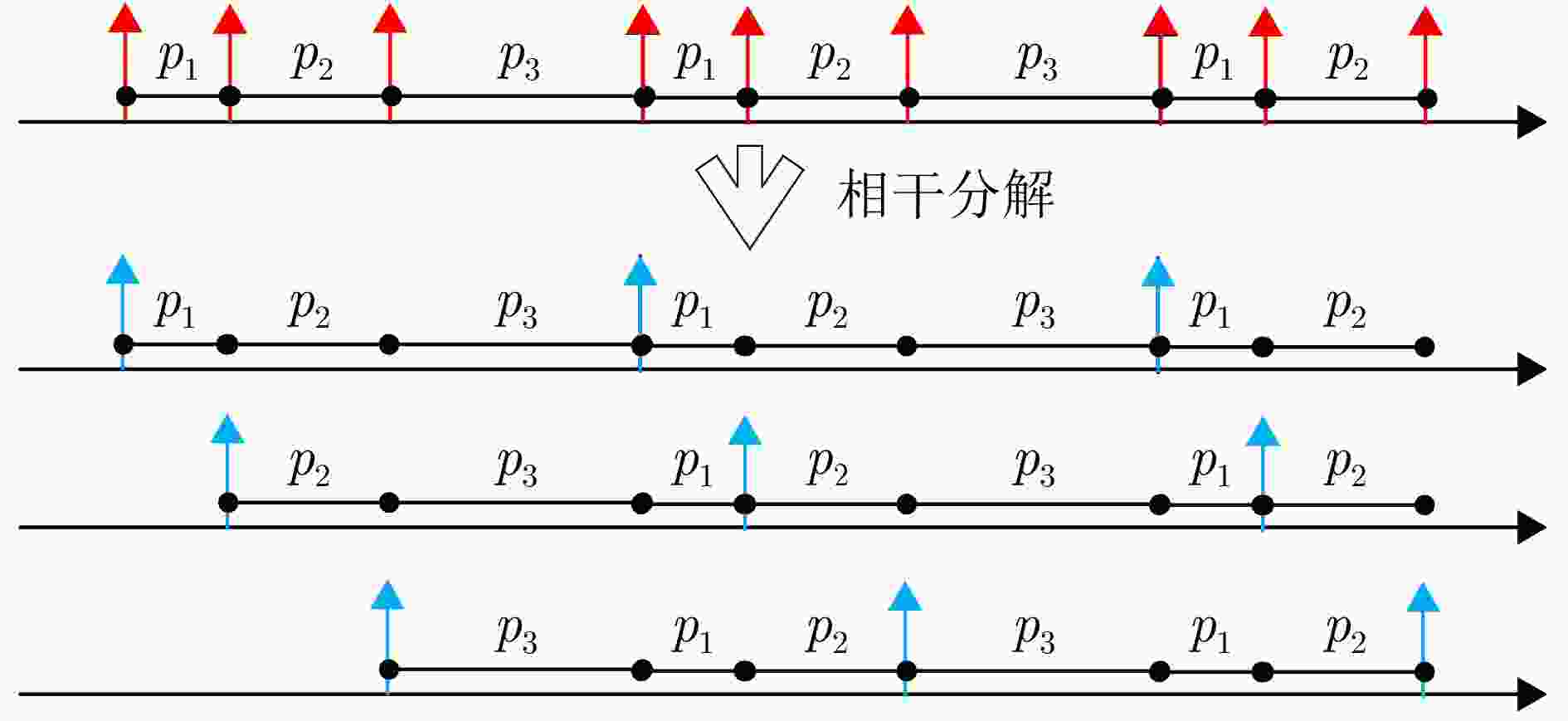
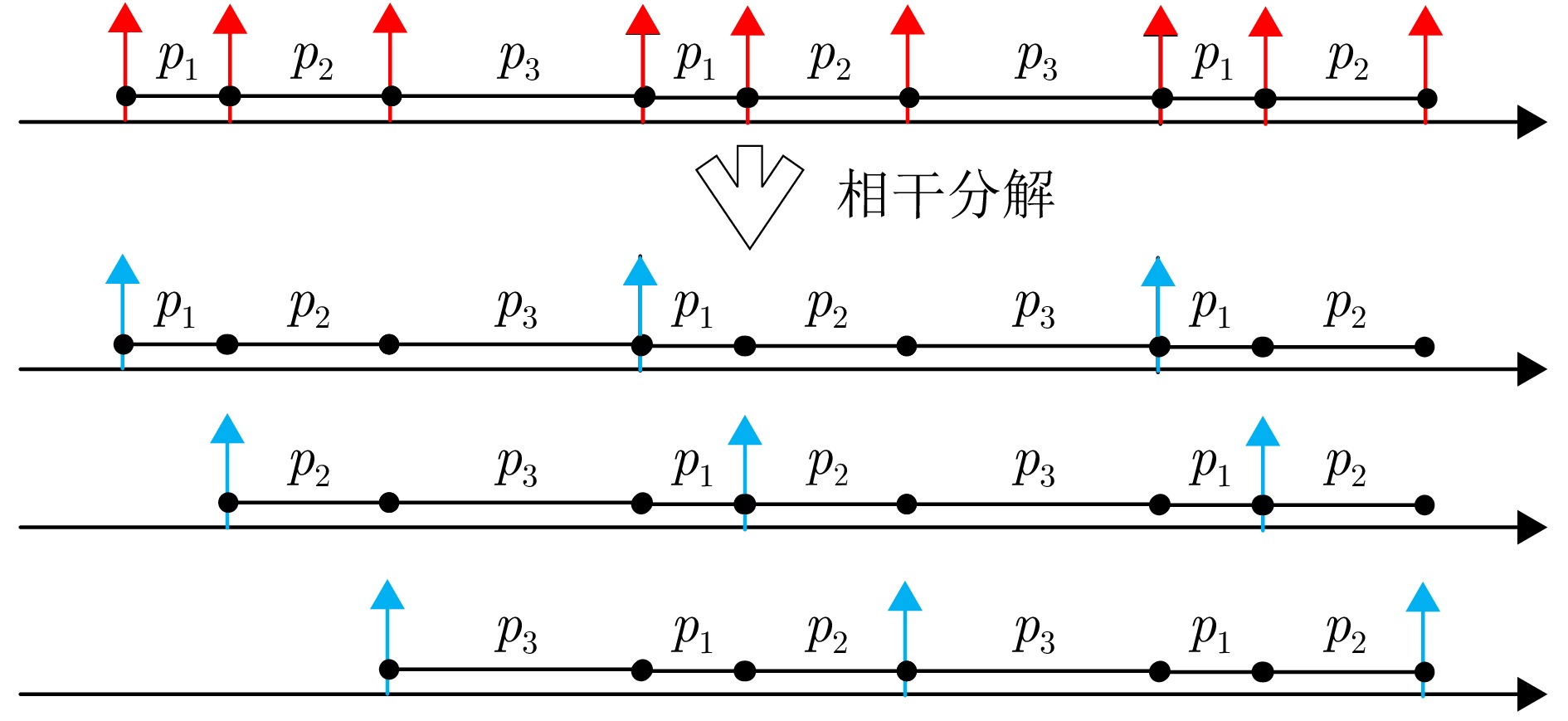
图 3 相干分解示意图($ \text{p}\_\text{law}=\{{p}_{1},{p}_{2},{p}_{3}\} $)
Figure 3. Diagram of coherent decomposition ($ \text{p}\_\text{law}=\{{p}_{1},{p}_{2},{p}_{3}\} $)
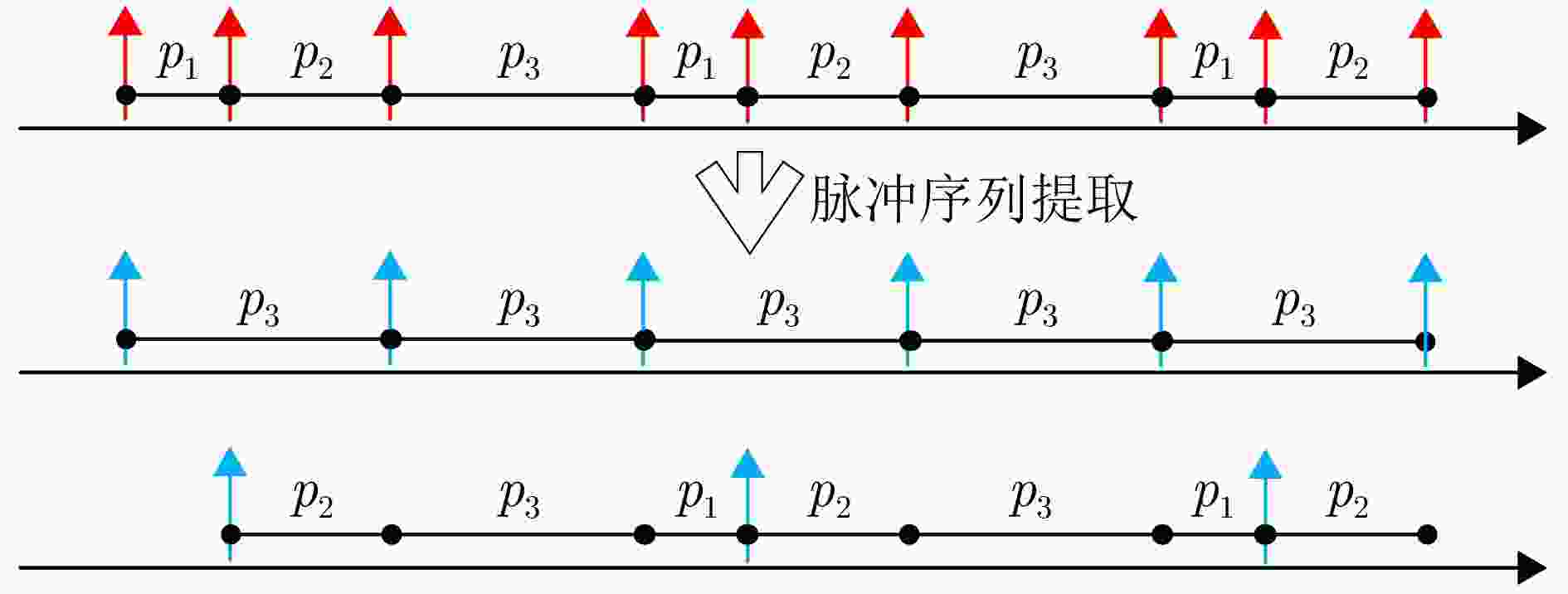
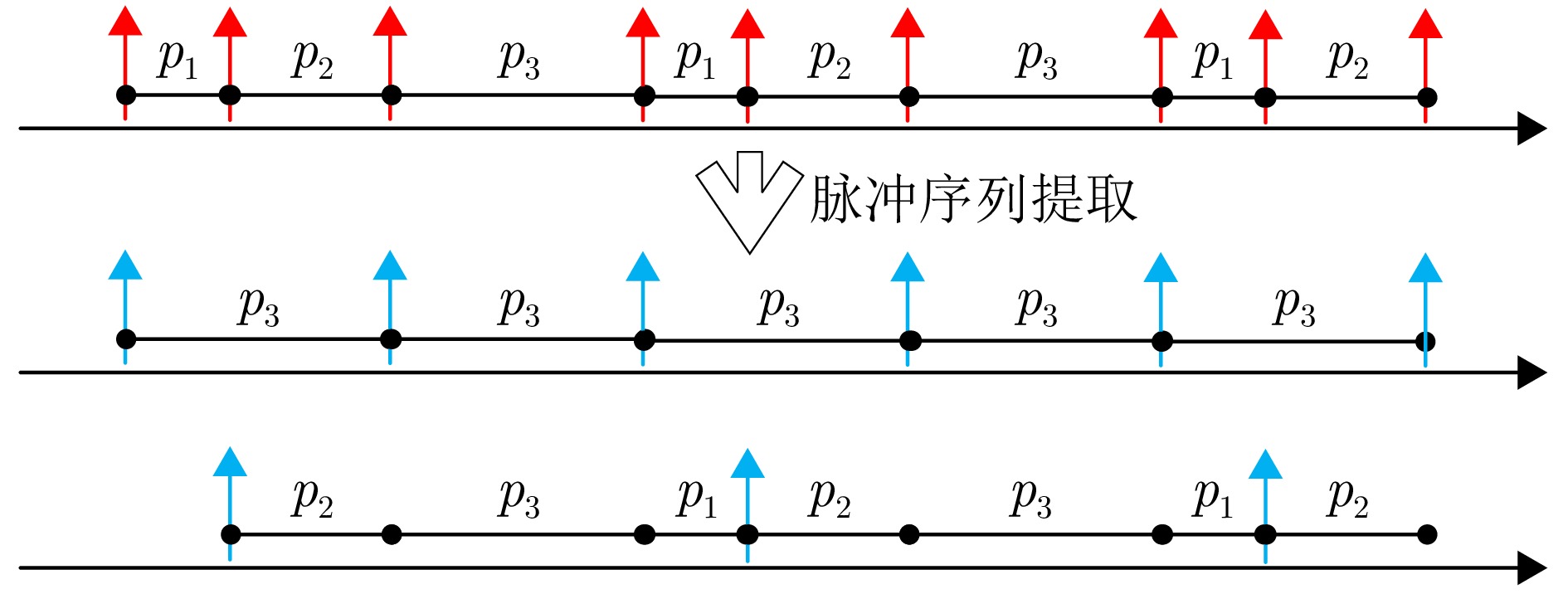
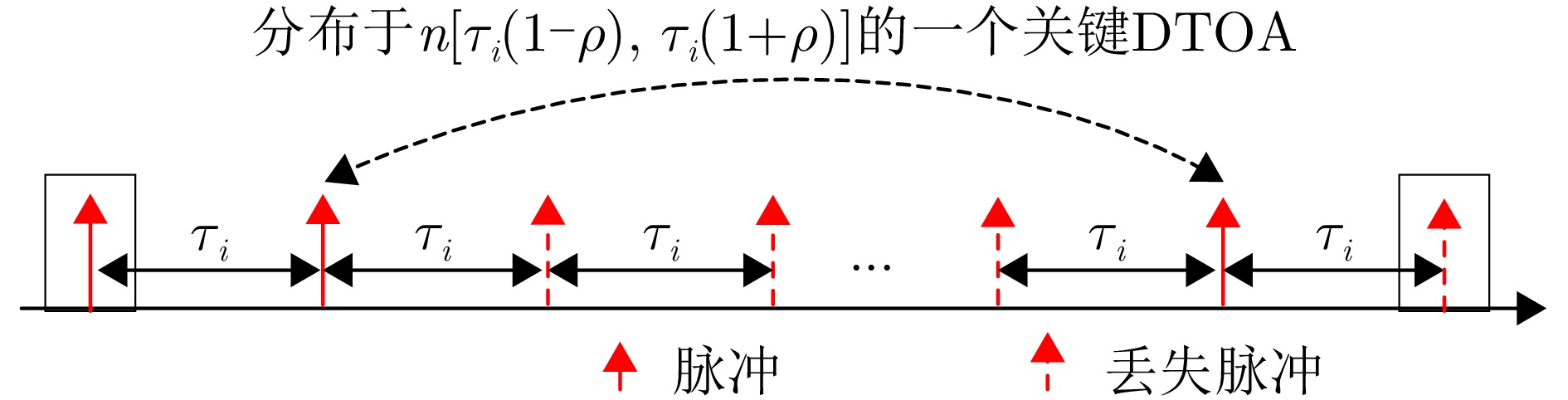
图 4 干扰项作用下的脉冲序列提取结果(非相干分解)
Figure 4. Sequence extraction results under the intervention of interference items (not coherent decomposition)
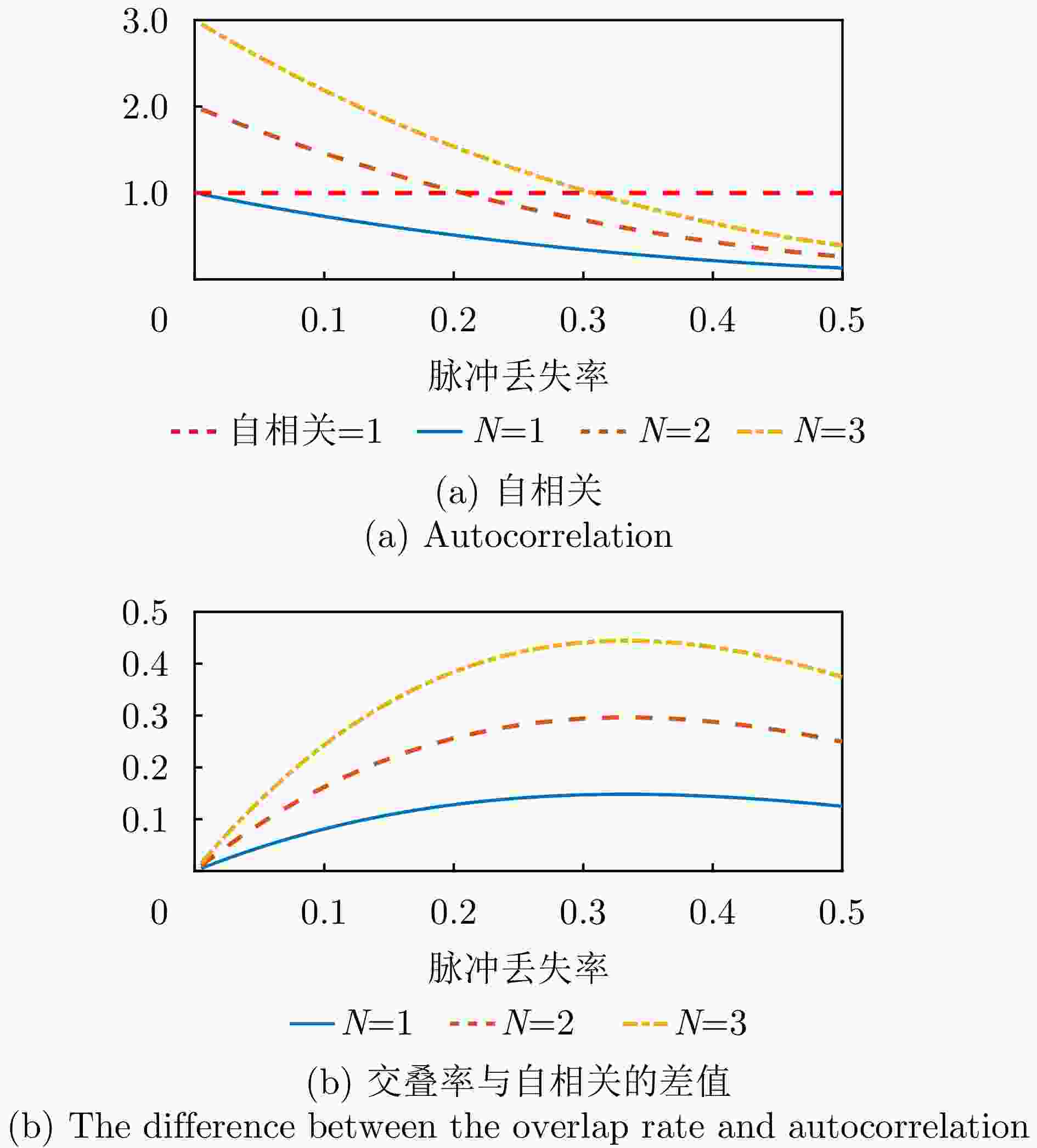
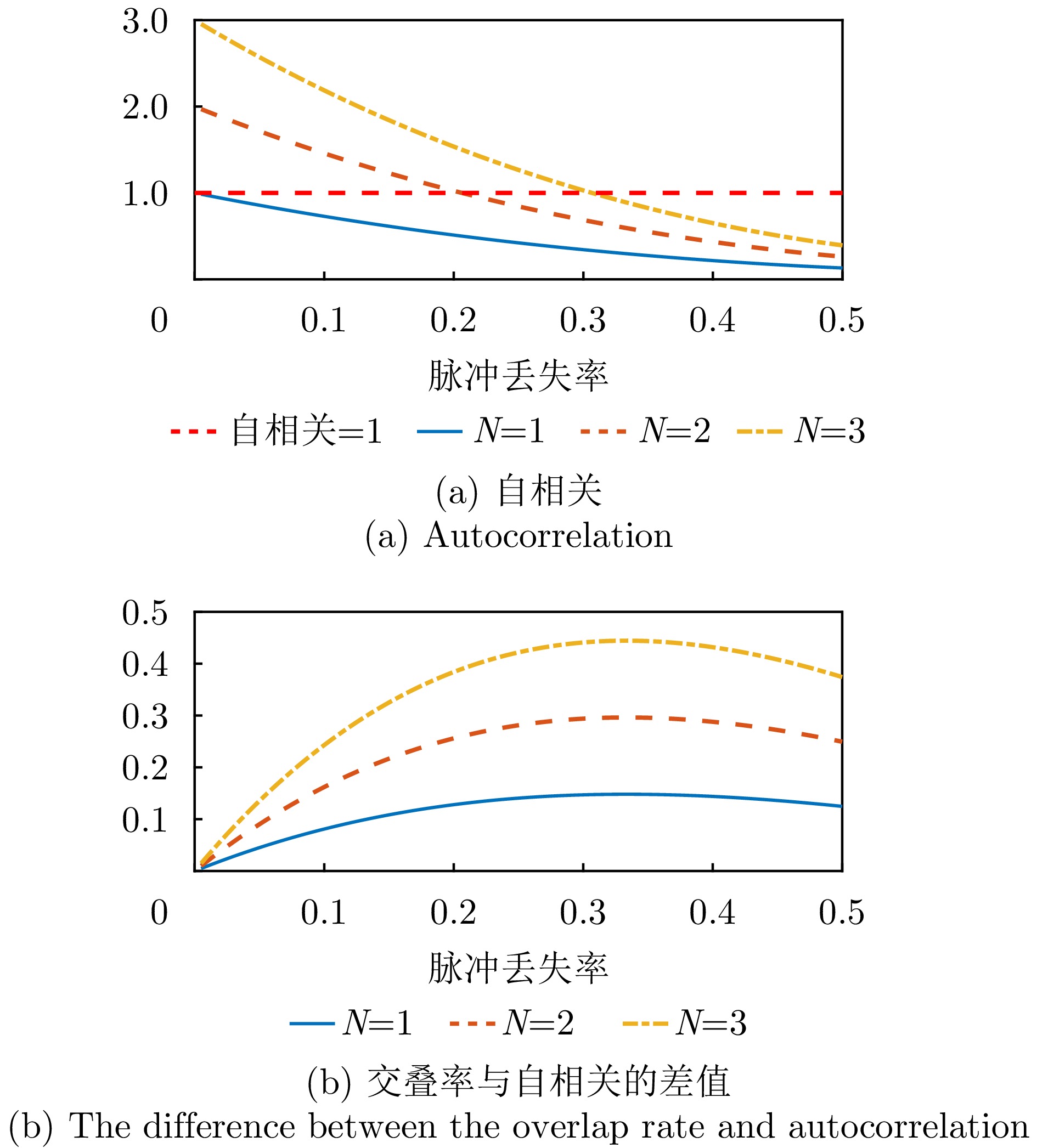
图 7 不同脉冲丢失率下的自相关及交叠率与自相关的差值(公式计算)
Figure 7. Autocorrelation and the difference between overlap rate and autocorrelation under different missing pulse rates (formula calculation)
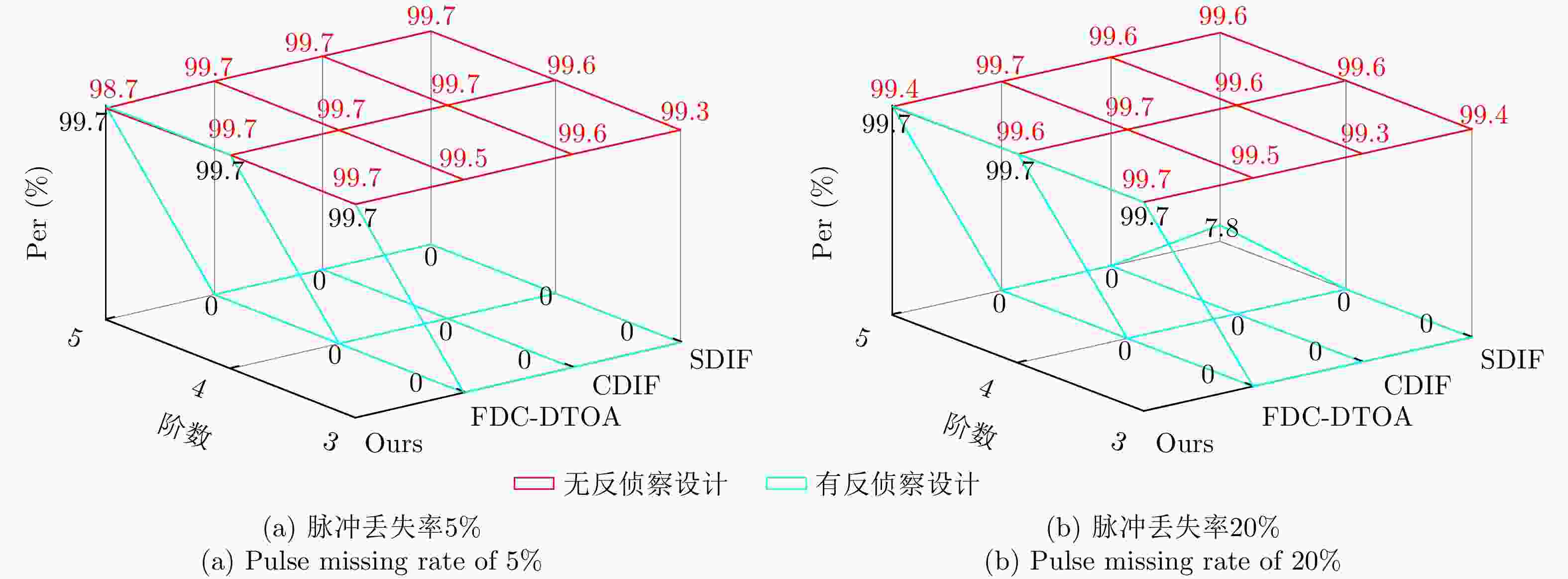
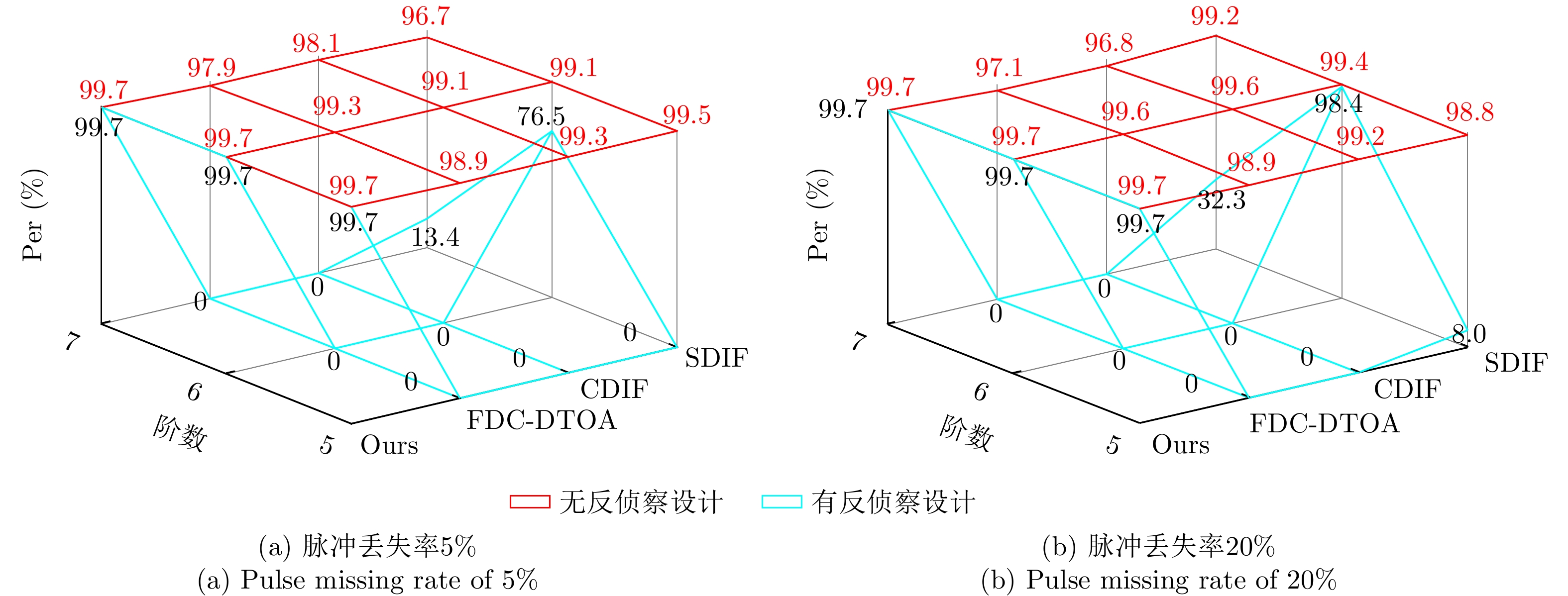
图 9 不同阶数条件下对参差信号的分选性能
Figure 9. Performance under different orders in deinteleaving stagered sequences
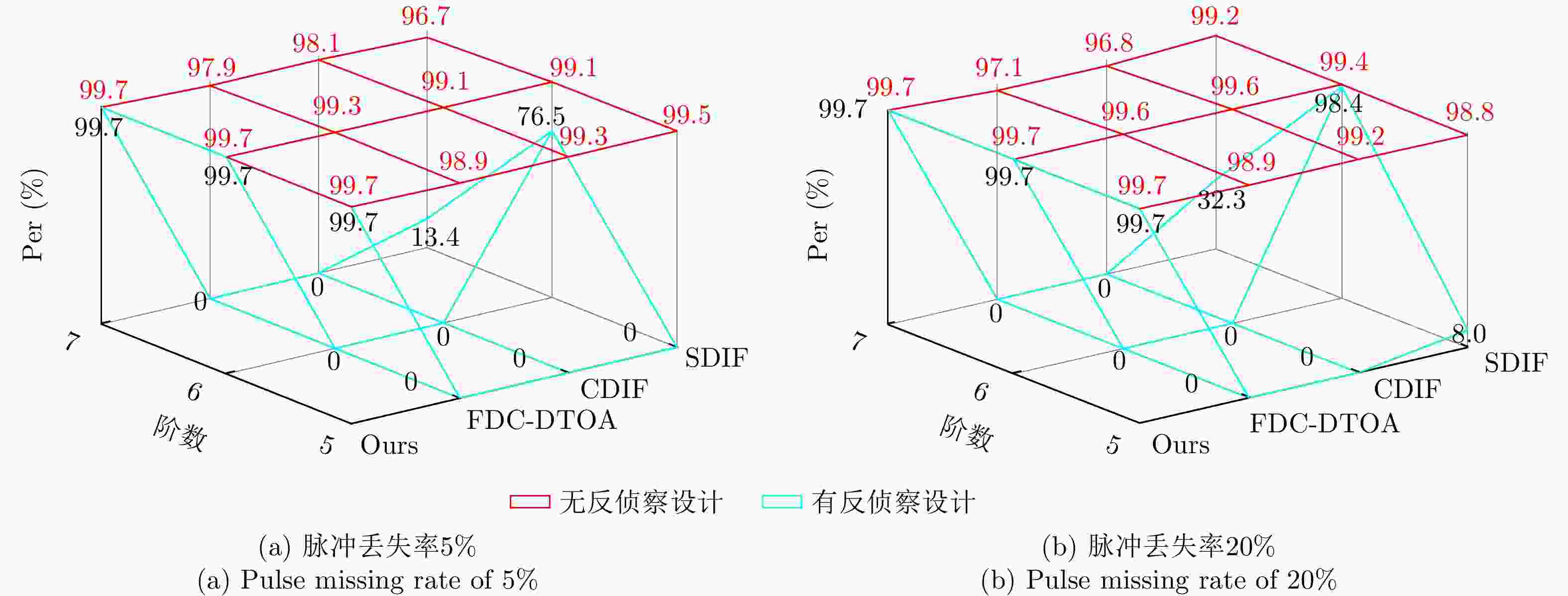
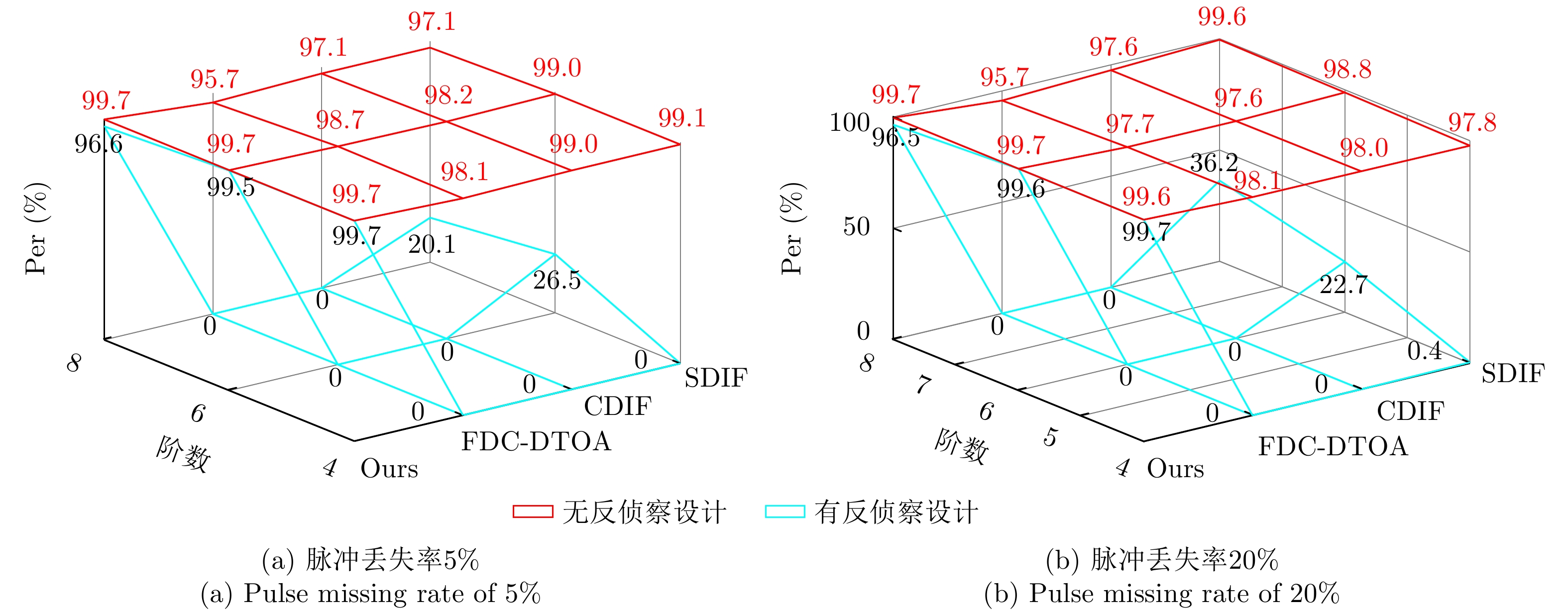
图 10 不同阶数条件下对滑变信号的分选性能
Figure 10. Performance under different orders in deinteleaving sliding sequences
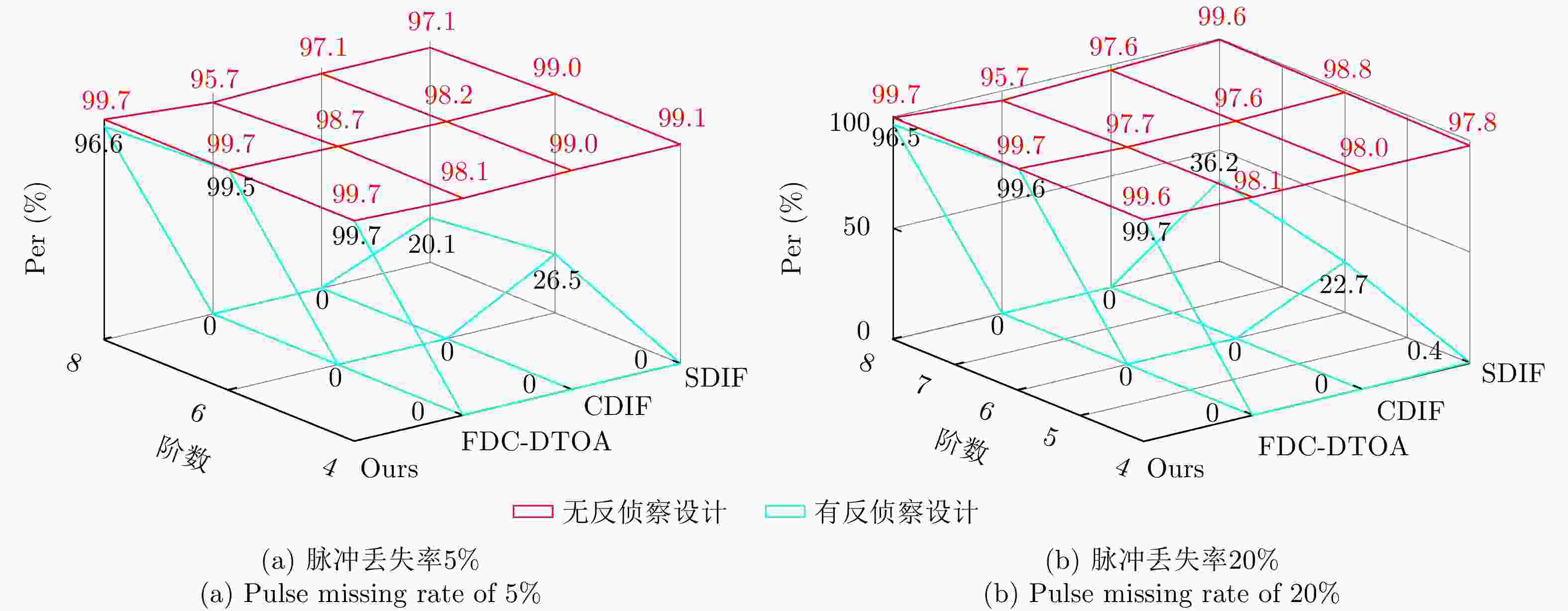
图 11 不同阶数条件下对正弦信号的分选性能
Figure 11. Performance under different orders in deinteleaving wobulated sequences
表 1 PRI调制类型
Table 1. PRI modulation types
类型 $ \text{p}\_\text{law} $ 固定 $ \{{p}_{i}=K\},N=1 $ 参差 $ \{{p}_{i}={k}_{i}|i=1,2,\cdots ,N\} $ 滑变 $ \{{p}_{i}={K}_{1}+(i-1)\Delta K|i=1,2,\cdots ,N\} $ 正弦 $ \{{p}_{i}={K}_{0}+{K}_{{\mathrm{a}}}\cdot \sin (2\text{π} (i-1)/N+\phi )|i=1,2,\cdots ,N\} $ 组变 $ \{{p}_{i}|i=1,2,\cdots ,N\}=\{{n}_{1}个{s}_{1},{n}_{2}个{s}_{2},\cdots ,{n}_{m}个{s}_{m}\} $  下载: 导出CSV
表 2 反侦察参数设计
Table 2. Design of anti-reconnaissance parameters
N 参差 滑变 正弦 3 $ {k}_{1}\colon {k}_{2}\colon {k}_{3}=2\colon 5\colon 7 $ / / 4 $ {k}_{1}\colon {k}_{2}\colon {k}_{3}\colon {k}_{4}=5\colon 7\colon 9\colon 11 $ / $ \phi =\text{3}\text{π} /4 $ 5 $ {k}_{1}\colon {k}_{2}\colon {k}_{3}\colon {k}_{4}\colon {k}_{5}=5\colon 7\colon 18\colon 11\colon 19 $ $ \Delta K={K}_{1}/4 $ 6 / $ \Delta K=2{K}_{1}/3 $ $ \phi =\text{2}\text{π} /3 $ 7 / $ \Delta K={K}_{1}/9,{K}_{1}/3,{K}_{1},3{K}_{1} $ / 8 / / $ \phi =\text{5}\text{π} /\text{8} $
下载: 导出CSV
表 3 不同脉冲丢失率下积极样本剩余比例
Table 3. Remaining proportion of positive samples under various missing pulse rates
脉冲丢失率 均值 标准差 10% 0.8064 0.0246 20% 0.6381 0.0299 30% 0.4891 0.0308 40% 0.3595 0.0284 50% 0.2481 0.0249 注:加粗数值表示应用3倍标准差准则时标准差的参考基准。
下载: 导出CSV
表 4 不同脉冲丢失率下的自相关及交叠率与自相关的差值(计算机仿真)
Table 4. Difference between overlap ratio and autocorrelation under different pulse missing rates in computer simulations (computer simulation)
脉冲丢失率 均值(N=1) 标准差(N=1) 均值(N=2) 标准差(N=2) 20% 0.1288 0.0100 0.2576 0.0201 30% 0.1474 0.0090 0.2948 0.0179 40% 0.1446 0.0086 0.2891 0.0171 50% 0.1258 0.0098 0.2516 0.0196 注:加粗数值表示应用3倍标准差准则时均值与标准差的参考基准。
下载: 导出CSV
表 5 相干时不同交叠长度下的鉴别指标
Table 5. Discrimination indicator under different overlap lengths for the coherent case
交叠长度 均值 QF (0.98) 20 0.0020 0.0026 30 0.0020 0.0025 40 0.0020 0.0024 50 0.0020 0.0024 60 0.0020 0.0023 注:加粗数值表示相干鉴别阈值设置基准。
下载: 导出CSV
表 6 不相干时不同交叠长度下的鉴别指标
Table 6. Discrimination indicator under different overlap lengths for the incoherent case
交叠长度 均值 EC ( 0.0026 )5 0.0069 0.1678 10 0.0096 0.0478 15 0.0116 0.0128 20 0.0133 0.0050 25 0.0150 0.0030
下载: 导出CSV
表 7 PRI调制设置
Table 7. PRI modulation settings
类型 $ \text{p}\_\text{law} $ 固定 $ K\in [50,100]\;\text{μs} $ 参差 $ {k}_{i}\in [2,19]\times 10\;\text{μs},{k}_{i}/10两两互质,N\in \{3,4,5\} $ 滑变 $ {K}_{1}\in [30,50]\;\text{μs},\Delta K\in [4,8]\;\text{μs},N\in \{5,6,7\} $ 正弦 $ {K}_{0} \in [60,80]\;\text{μs,}\;{K}_{a} \in [10,30]\;\text{μs,}\;\phi \in [-\text{π} ,\text{π} ],N \in \{4,6,8\} $
下载: 导出CSV
表 8 不同脉冲丢失率下对固定信号的分选性能(%)
Table 8. Performance under different missing rate in deinteleaving fixed sequences (%)
下载: 导出CSV
表 9 参数相似场景下的分选性能(%)
Table 9. Performance in scenarios with similar parameters (%)
脉冲丢失率 固定 参差 滑变 正弦 10% 99.84 98.21 99.61 97.46 20% 99.84 96.32 99.16 98.22 30% 99.82 97.77 98.23 98.42 40% 99.81 95.31 97.66 98.68
下载: 导出CSV
-
[1] ADAMY D. EW 101: A First Course in Electronic Warfare[M]. Norwood, USA: Artech House, 2001: 2–5. [2] GUO Qiang, HUANG Shuai, QI Liangang, et al. A radar signal deinterleaving method based on complex network and laplacian graph clustering[J]. IEEE Signal Processing Letters, 2024, 31: 2580–2584. doi: 10.1109/LSP.2024.3461656. [3] PINSOLLE J, GOUDET O, ENDERLI C, et al. Deinterleaving of discrete renewal process mixtures with application to electronic support measures[J]. IEEE Transactions on Signal Processing, 2024, 72: 4983–4991. doi: 10.1109/TSP.2024.3464753. [4] BAO Jiadi, ZHU Mengtao, LI Yunjie, et al. Interleaved hidden markov processes inference for deinterleaving radar pulse sequences[J]. IEEE Transactions on Signal Processing, 2025, 73: 3448–3462. doi: 10.1109/TSP.2025.3597790. [5] 隋金坪, 刘振, 刘丽, 等. 雷达辐射源信号分选研究进展[J]. 雷达学报, 2022, 11(3): 418–433. doi: 10.12000/JR21147.SUI Jinping, LIU Zhen, LIU Li, et al. Progress in radar emitter signal deinterleaving[J]. Journal of Radars, 2022, 11(3): 418–433. doi: 10.12000/JR21147. [6] 刘光霞, 李琦, 韩壮志, 等. 基于Arnold映射的抗分选混沌调制PRI设计方法[J]. 电讯技术, 2025, 65(3): 363–370. doi: 10.20079/j.issn.1001-893x.231227006.LIU Guangxia, LI Qi, HAN Zhuangzhi, et al. A design method of anti-sorting chaotic modulation PRI based on arnold mapping[J]. Telecommunication Engineering, 2025, 65(3): 363–370. doi: 10.20079/j.issn.1001-893x.231227006. [7] MARDIA H K. New techniques for the deinterleaving of repetitive sequences[J]. IEE Proceedings F Radar and Signal Processing, 1989, 136(4): 149–154. doi: 10.1049/ip-f-2.1989.0025. [8] MILOJEVIĆ D J and POPOVIĆ B M. Improved algorithm for the deinterleaving of radar pulses[J]. IEE Proceedings F Radar and Signal Processing, 1992, 139(1): 98–104. doi: 10.1049/ip-f-2.1992.0012. [9] ZHANG Chunjie, LIU Yuchen, and SI Weijian. Synthetic algorithm for deinterleaving radar signals in a complex environment[J]. IET Radar, Sonar & Navigation, 2020, 14(12): 1918–1928. doi: 10.1049/iet-rsn.2020.0251. [10] NELSON D. Special purpose correlation functions for improved signal detection and parameter estimation[C]. 1993 IEEE International Conference on Acoustics, Speech, and Signal Processing, Minneapolis, USA, 1993: 73–76. doi: 10.1109/ICASSP.1993.319597. [11] SANG Xin, HE Yonghua, and LI Yonggang. Radar signal binning based on improved SDIF algorithm[C]. IEEE 7th Information Technology and Mechatronics Engineering Conference (ITOEC), Chongqing, China, 2023: 203–207. doi: 10.1109/ITOEC57671.2023.10291843. [12] LI Zhao-zhe, CUI Haihan, and XING Zhiqiang. An improved algorithm for staggered discrimination based on SDIF threshold failure[C]. IEEE 3rd International Conference on Image Processing and Computer Applications (ICIPCA), Shenyang, China, 2025: 853–857. doi: 10.1109/ICIPCA65645.2025.11138531. [13] 刘严, 郭福成. 基于滑动时间窗的雷达脉冲列分选方法[J]. 电子与信息学报, 2022, 44(11): 3900–3909. doi: 10.11999/JEIT210982.LIU Yan and GUO Fucheng. Deinterleaving radar pulse trains with sliding time windows[J]. Journal of Electronics & Information Technology, 2022, 44(11): 3900–3909. doi: 10.11999/JEIT210982. [14] CHENG Wenhai, ZHANG Qunying, DONG Jiaming, et al. An enhanced algorithm for deinterleaving mixed radar signals[J]. IEEE Transactions on Aerospace and Electronic Systems, 2021, 57(6): 3927–3940. doi: 10.1109/TAES.2021.3087832. [15] GE Zhipeng, SUN Xian, REN Wenjuan, et al. Improved algorithm of radar pulse repetition interval deinterleaving based on pulse correlation[J]. IEEE Access, 2019, 7: 30126–30134. doi: 10.1109/ACCESS.2019.2901013. [16] XIE Min, ZHAO Chuang, ZHAO Yongjun, et al. A novel method for deinterleaving radar signals: First‐order difference curve based on sorted TOA difference sequence[J]. IET Signal Processing, 2023, 17(1): e12162. doi: 10.1049/sil2.12162. [17] 贾金伟, 刘利民, 韩壮志, 等. 基于重频滑变的抗分选信号设计[J]. 电光与控制, 2023, 30(4): 111–115. doi: 10.3969/j.issn.1671-637X.2023.04.021.JIA Jinwei, LIU Limin, HAN Zhuangzhi, et al. Anti-sorting signal design based on pulse repetition interval slide[J]. Electronics Optics & Control, 2023, 30(4): 111–115. doi: 10.3969/j.issn.1671-637X.2023.04.021. [18] 贾金伟, 刘利民, 韩壮志, 等. 基于压缩感知的抗SDIF分选射频隐身信号设计及回波信号处理[J]. 航空学报, 2023, 44(13): 327934. doi: 10.7527/S1000-6893.2022.27934.JIA Jinwei, LIU Limin, HAN Zhuangzhi, et al. Design of anti-SDIF radio frequency stealth signal and echo signal processing technology based on compressed sensing[J]. Acta Aeronautica et Astronautica Sinica, 2023, 44(13): 327934. doi: 10.7527/S1000-6893.2022.27934. [19] TAO Jianwu, YANG Chengzhi, and XU Chengwei. Estimation of PRI stagger in case of missing observations[J]. IEEE Transactions on Geoscience and Remote Sensing, 2020, 58(11): 7982–8001. doi: 10.1109/TGRS.2020.2985768. [20] LIU Zhangmeng, KANG Shiqian, and CHAI Xianming. Automatic pulse repetition pattern reconstruction of conventional radars[J]. IET Radar, Sonar & Navigation, 2021, 15(5): 500–509. doi: 10.1049/rsn2.12053. [21] 康仕乾, 刘章孟. 常规体制雷达交错脉冲列中的重频模式自动解析[J]. 信号处理, 2021, 37(11): 2069–2076. doi: 10.16798/j.issn.1003-0530.2021.11.007.KANG Shiqian and LIU Zhangmeng. Automatic reconstruction of regular radar pulse repetition patterns based on interleaved pluse train[J]. Journal of Signal Processing, 2021, 37(11): 2069–2076. doi: 10.16798/j.issn.1003-0530.2021.11.007. [22] 谢敏, 赵闯, 胡德秀, 等. 联合DTOA一阶差分曲线和相关分析的参差信号分选方法[J]. 电子学报, 2023, 51(11): 3271–3281. doi: 10.12263/DZXB.20220799.XIE Min, ZHAO Chuang, HU Dexiu, et al. Signal sorting method for jagger PRI radar based on first-order difference curve of DTOA and correlation analysis[J] Acta Electronica Sinica, 2023, 51(11): 3271–3281. doi: 10.12263/DZXB.20220799. [23] ZHANG Chunjie, LIU Yuchen, and SI Weijian. Pri modulation recognition and sequence search under small sample prerequisite[J]. Journal of Systems Engineering and Electronics, 2023, 34(3): 706–713. doi: 10.23919/JSEE.2023.000007. [24] 张春杰, 青松, 邓志安, 等. 一种针对驻留转换雷达的信号分选算法[J]. 系统工程与电子技术, 2024, 46(6): 1925–1934. doi: 10.12305/j.issn.1001-506X.2024.06.10.ZHANG Chunjie, QING Song, DENG Zhian, et al. Signal deinterleaving algorithm for dwell and switch radar[J]. Systems Engineering and Electronics, 2024, 46(6): 1925–1934. doi: 10.12305/j.issn.1001-506X.2024.06.10. [25] XIE Min, ZHAO Chuang, HUANG Jie, et al. Deinterleaving method for radar signals with dwell and switch pulse repetition intervals in a prior unknown scenario[J]. IEEE Transactions on Aerospace and Electronic Systems, 2024, 60(6): 9307–9323. doi: 10.1109/TAES.2024.3440277. [26] 贾金伟, 韩壮志, 刘利民, 等. 基于参差信号组合设计的交错掩护抗分选射频隐身信号设计原理[J]. 火力与指挥控制, 2024, 49(5): 102–110. doi: 10.3969/j.issn.1002-0640.2024.05.014.JIA Jinwei, HAN Zhuangzhi, LIU Limin, et al. Design principle of staggered shielding and anti-sorting RF stealth signal based on staggered signal combination[J]. Fire Control & Command Control, 2024, 49(5): 102–110. doi: 10.3969/j.issn.1002-0640.2024.05.014. [27] 张保群. 一种抗SDIF分选的脉冲重复间隔参差设计方法[J]. 兵器装备工程学报, 2016, 37(9): 87–91, 114. doi: 10.11809/scbgxb2016.09.021.ZHANG Baoqun. A design method of PRI stagger countering the SDIF sorting algorithm[J]. Journal of Ordnance Equipment Engineering, 2016, 37(9): 87–91, 114. doi: 10.11809/scbgxb2016.09.021. [28] XIE Min, HUANG Jie, ZHAO Chuang, et al. Radar signal deinterleaving based on markov chains in scenarios known a priori[J]. IEEE Geoscience and Remote Sensing Letters, 2024, 21: 3509205. doi: 10.1109/LGRS.2024.3449086. -






计量
- 文章访问数:
- HTML全文浏览量:
- PDF下载量:
- 被引次数: 0