

 作者中心
作者中心 专家审稿
专家审稿 责编办公
责编办公 编辑办公
编辑办公
A multi-target Cooperative Direct Position Determination Algorithm Fusing Satellite and Shortwave Signals in the Presence of Satellite Orbit errors
-
摘要: 针对星历误差影响下多个地面辐射源的超视距定位问题,提出了一种基于卫星信号与短波信号的多目标协同直接定位算法。通过利用地球椭圆模型下短波方位角、卫星时差与目标辐射源地理坐标之间的几何关系,建立联合短波和卫星观测信号的超视距多目标定位模型。在此基础上,结合两种频段的观测信号模型与星历误差统计模型,构造基于贝叶斯理论的最大似然代价函数,通过设计交替迭代算法实现了对多个目标地理坐标与星历误差等参数的迭代求解。仿真结果表明,该算法的定位精度较基于卫星与短波单一频段的定位算法有明显提升,不易受观测站与目标几何构型变化影响,而且能够有效削弱星历误差带来的定位扰动,在大星历误差条件下具有较强的鲁棒性。Abstract: To address the over-the-horizon localization of multiple ground-based radiating sources in the presence of satellite orbit errors, this paper proposes a multi-target cooperative Direct Position Determination (DPD) algorithm fusing satellite and shortwave signals. Under the Earth ellipsoid model, the geometric relationships among shortwave azimuth angles, satellite time differences of arrival, and the geodetic coordinates of the target radiators are exploited to construct a multi-target over-the-horizon localization model that jointly incorporates shortwave and satellite observations. Furthermore, the statistical model of satellite orbit errors is combined with the observation models of the two frequency bands to formulate a Bayesian maximum likelihood cost function, and an alternating iterative scheme is designed to jointly estimate the unknown parameters, including the geodetic coordinates of the multiple targets and the satellite orbit errors. Simulation results show that the proposed algorithm attains markedly higher localization accuracy than methods relying solely on satellite or on shortwave measurements, and that it remains robust to changes in the geometric layout of observers and targets. Moreover, the algorithm also effectively mitigates the accuracy degradation caused by satellite orbit errors and maintains strong performance even when these errors are large.
-
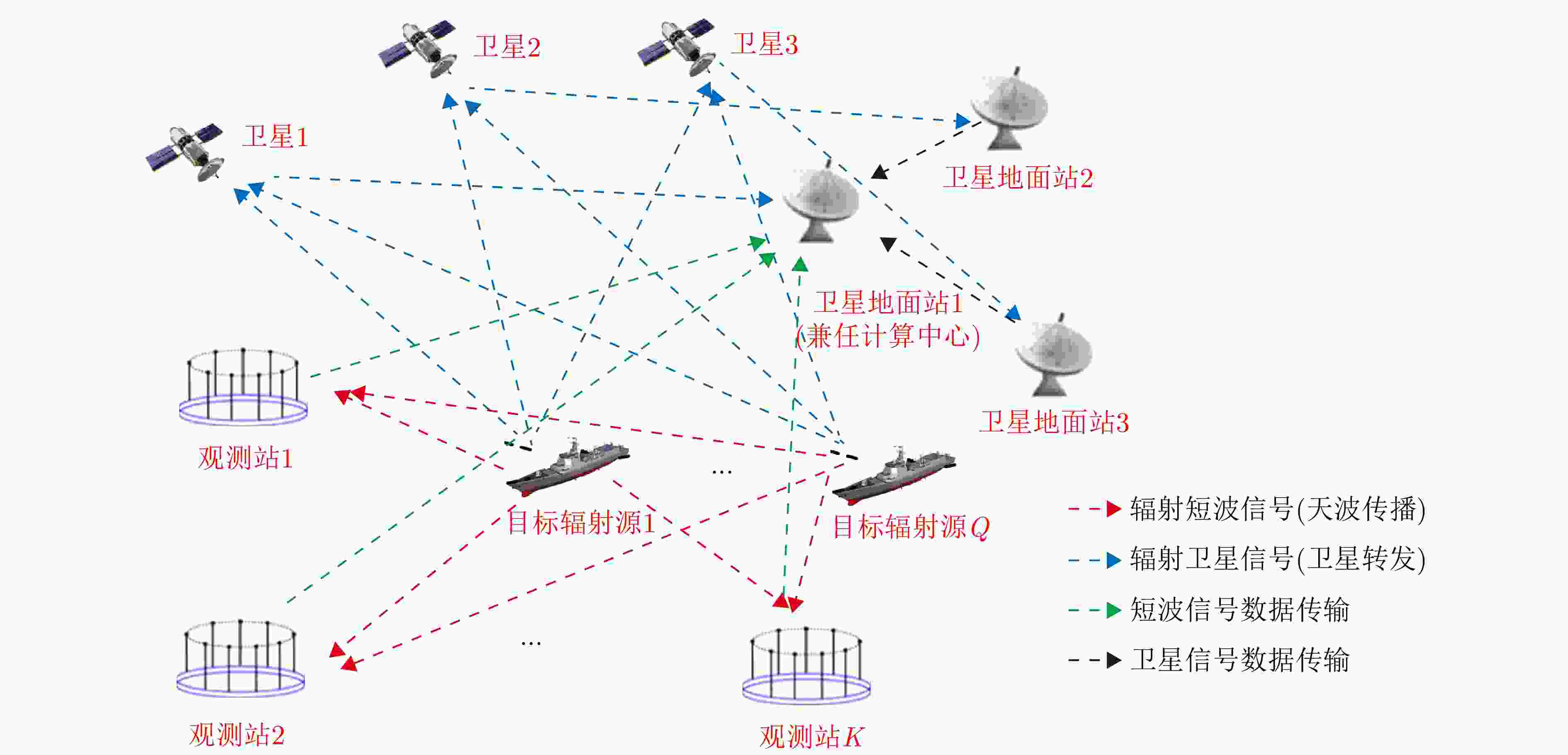
图 1 卫星与短波多目标协同直接定位场景示意图
Figure 1. The scenario of cooperative DPD based on satellite and shortwave signals for multiple targets
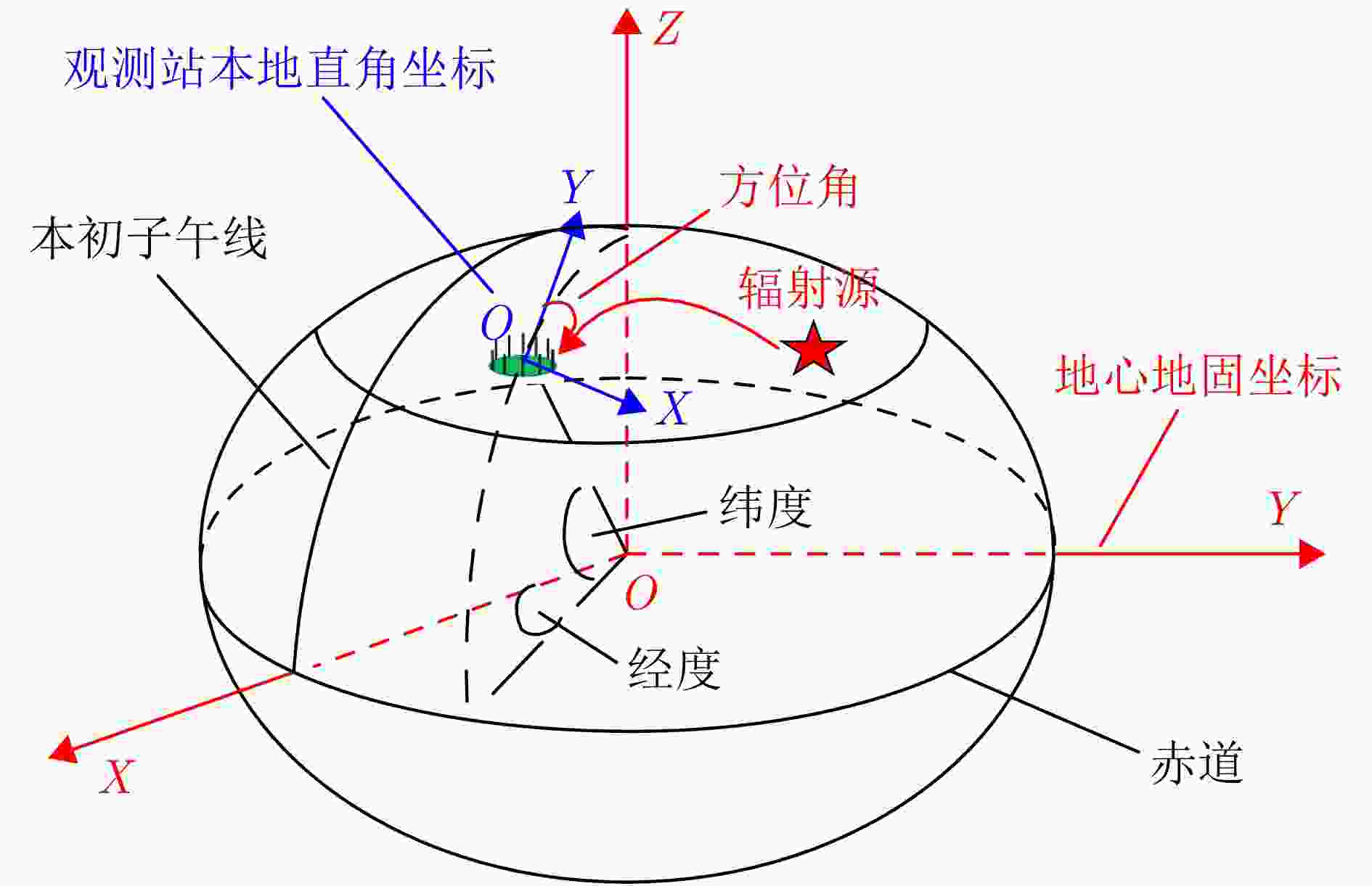
图 2 基于地球椭圆模型的短波方位角几何示意图
Figure 2. Geometric diagram of shortwave azimuth angle based on ellipse Earth model
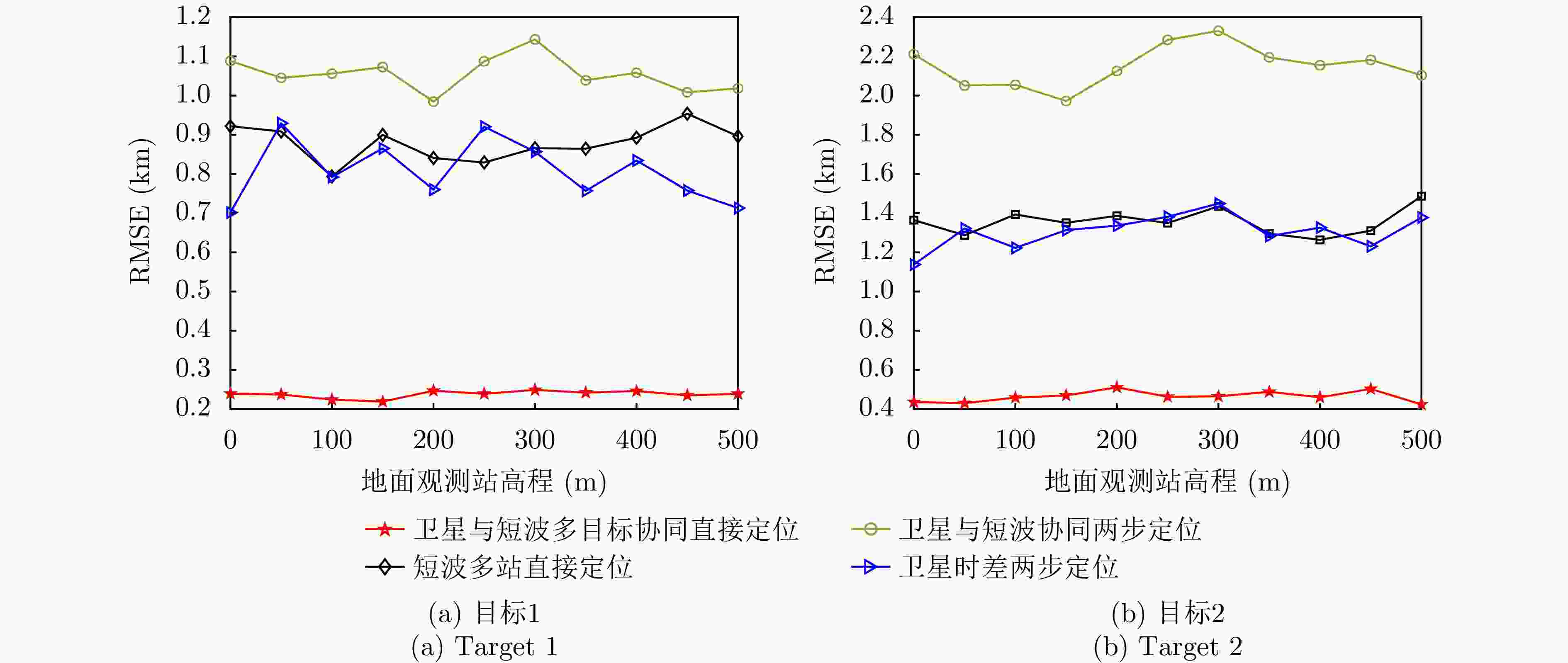
Figure 4. The estimated RMSE curves versus height of HF observers and satellite ground stations in the absence of ionospheric disturbance
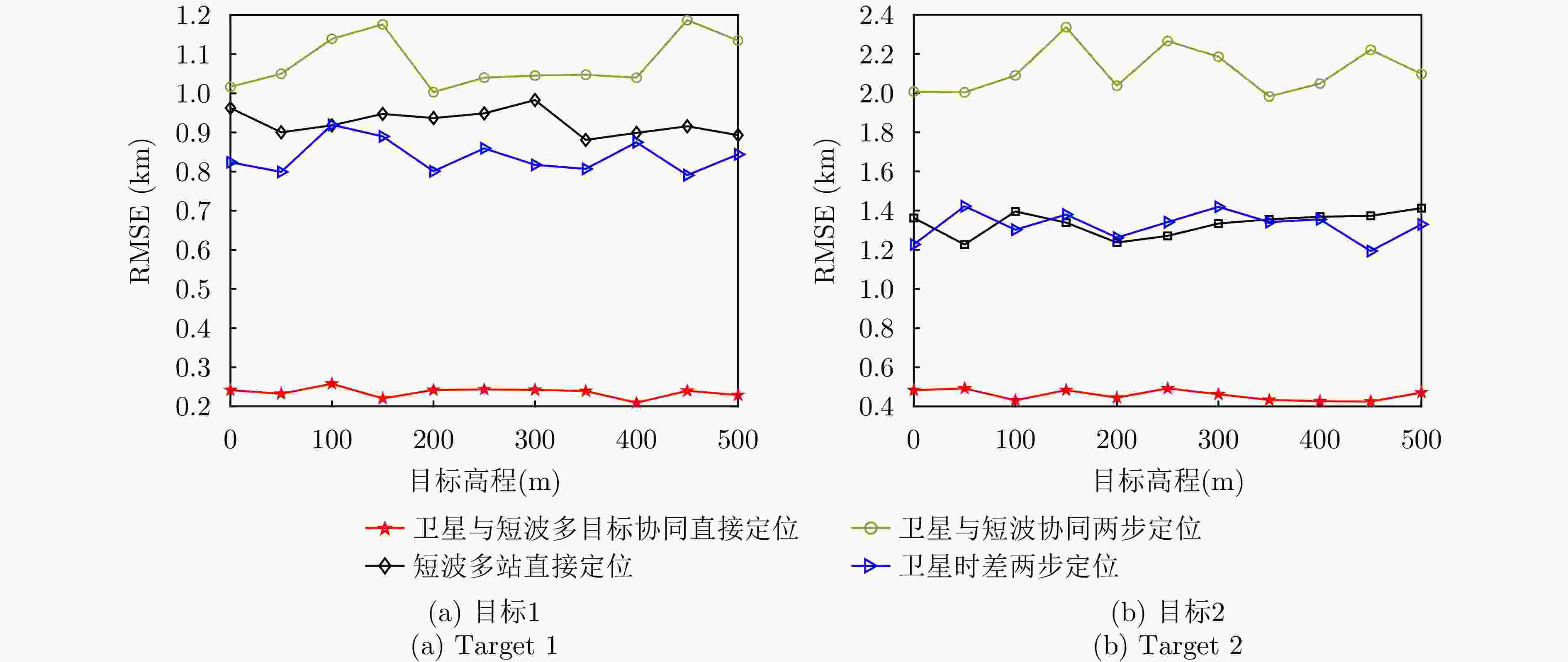
图 5 定位均方根误差随着目标高程的变化曲线(无电离层扰动影响)
Figure 5. The estimated RMSE curves versus height of targets in the absence of ionospheric disturbance
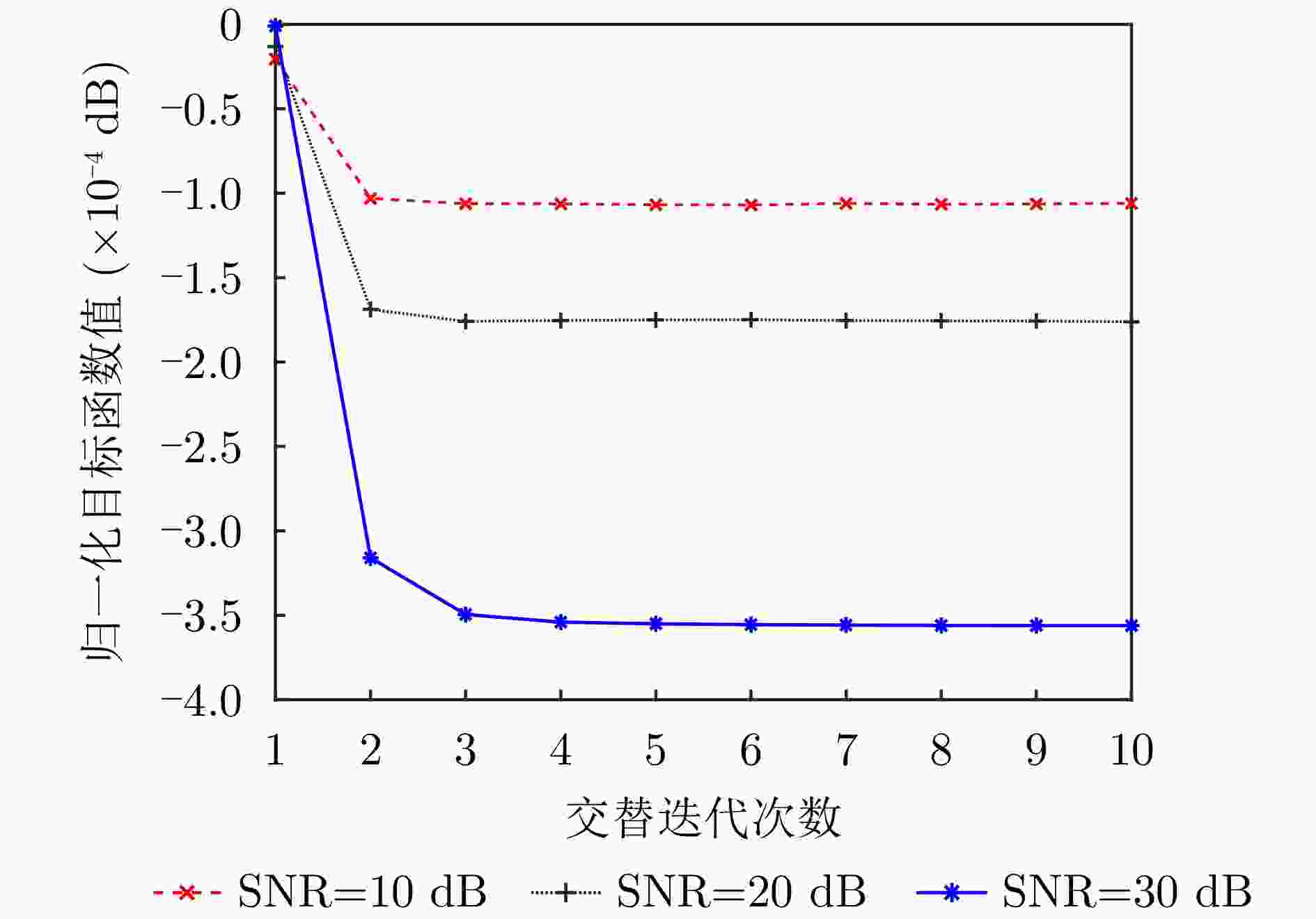
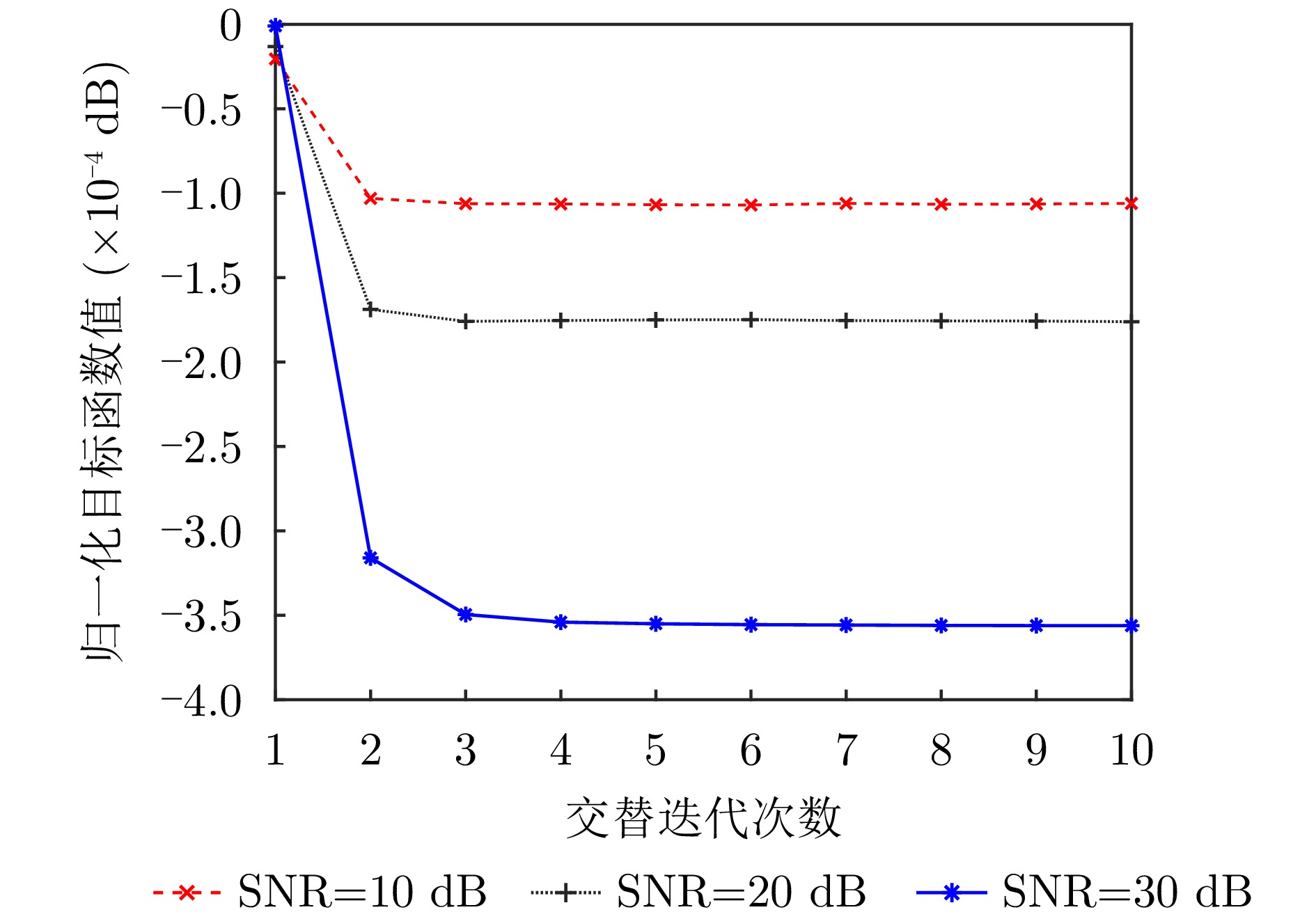
图 6 归一化目标函数值随交替迭代次数的变化曲线
Figure 6. Curves of normalized values of objective function varying with the alternating iteration step
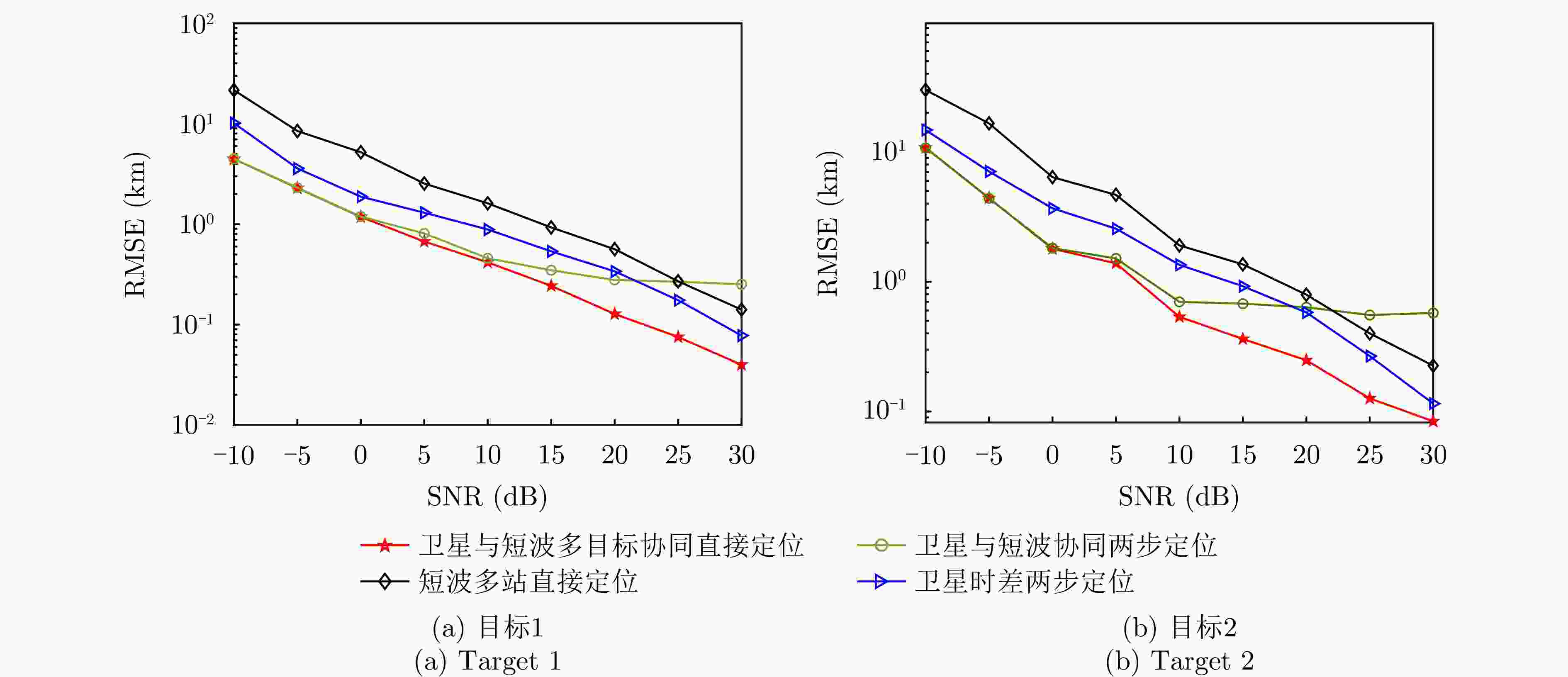
图 7 定位均方根误差随着信噪比的变化曲线(无电离层扰动影响)
Figure 7. The estimated RMSE curves versus SNR in the absence of ionospheric disturbance
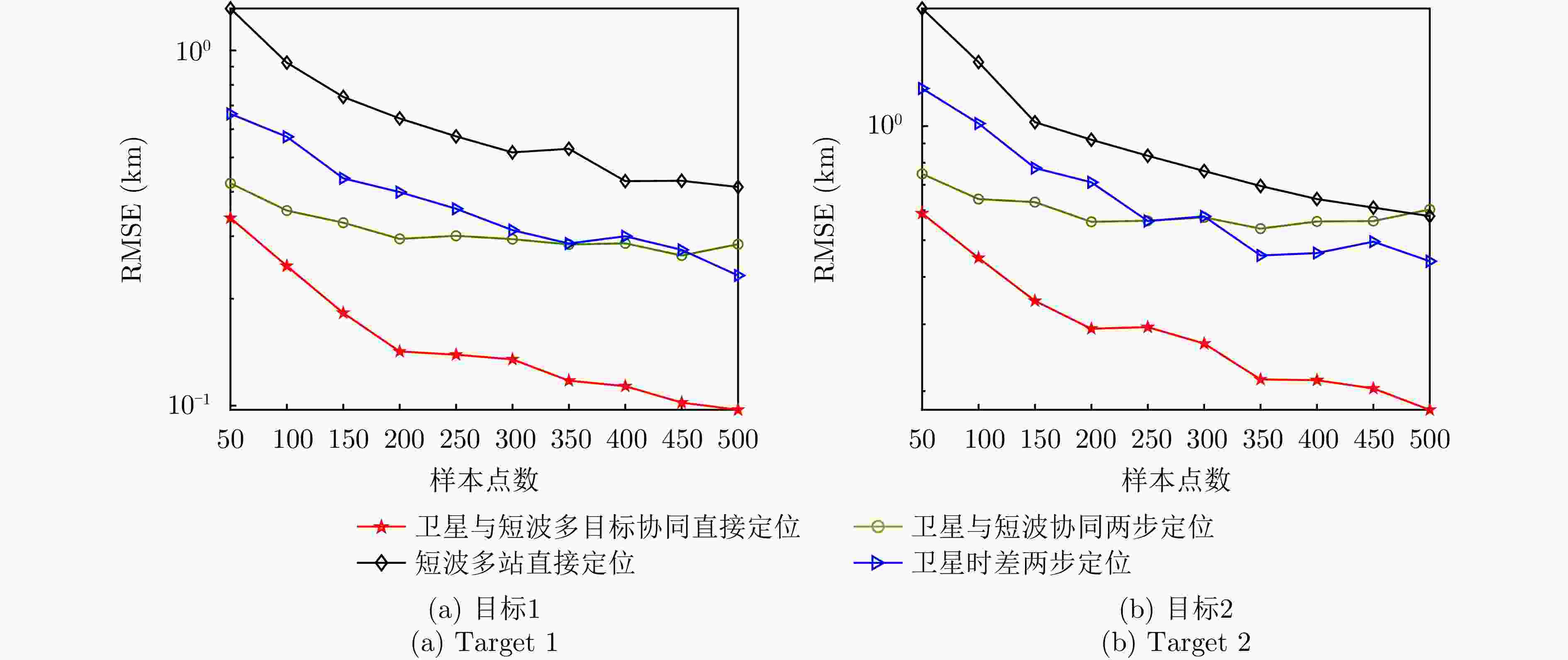
图 8 定位均方根误差随着样本点数的变化曲线(无电离层扰动影响)
Figure 8. The estimated RMSE curves versus sampling snapshot in the absence of ionospheric disturbance
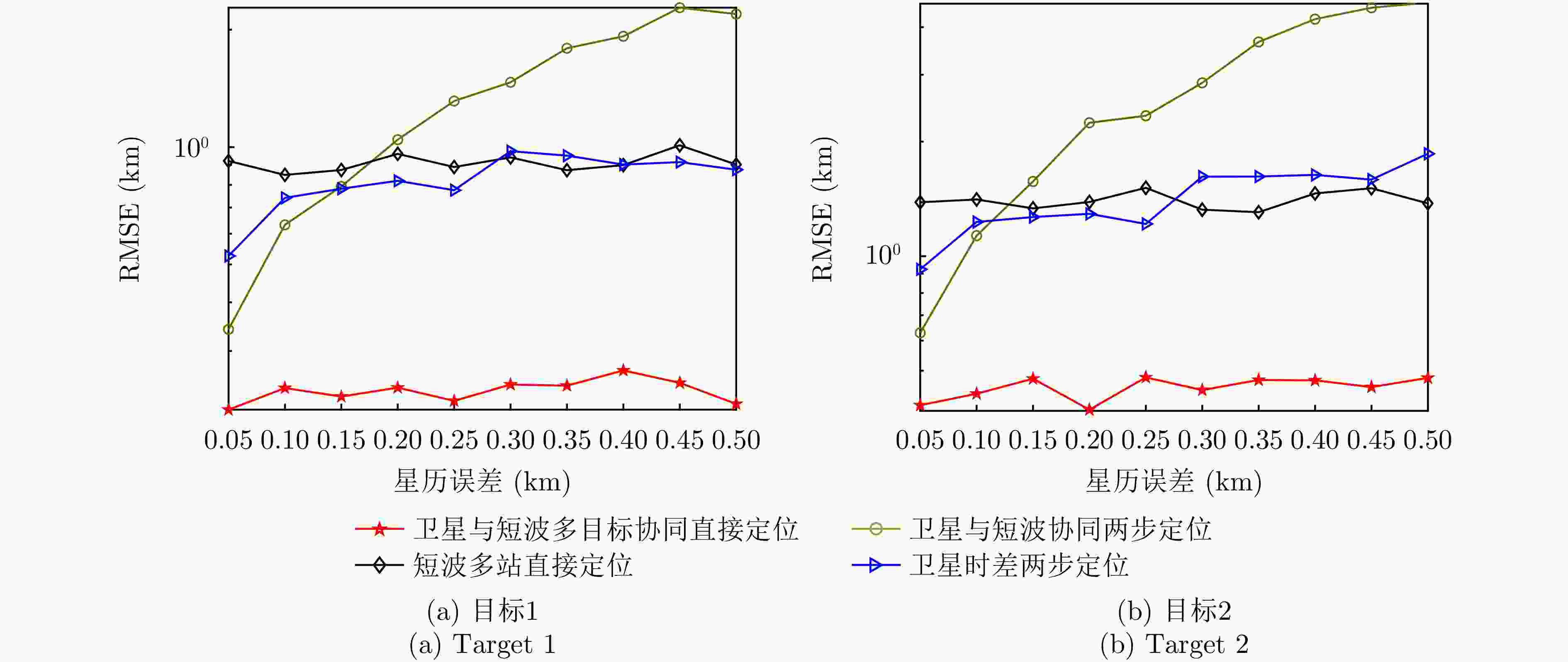
图 9 定位均方根误差随着星历误差的变化曲线(无电离层扰动影响)
Figure 9. The estimated RMSE curves versus standard deviation of satellite orbit errors in the absence of ionospheric disturbance
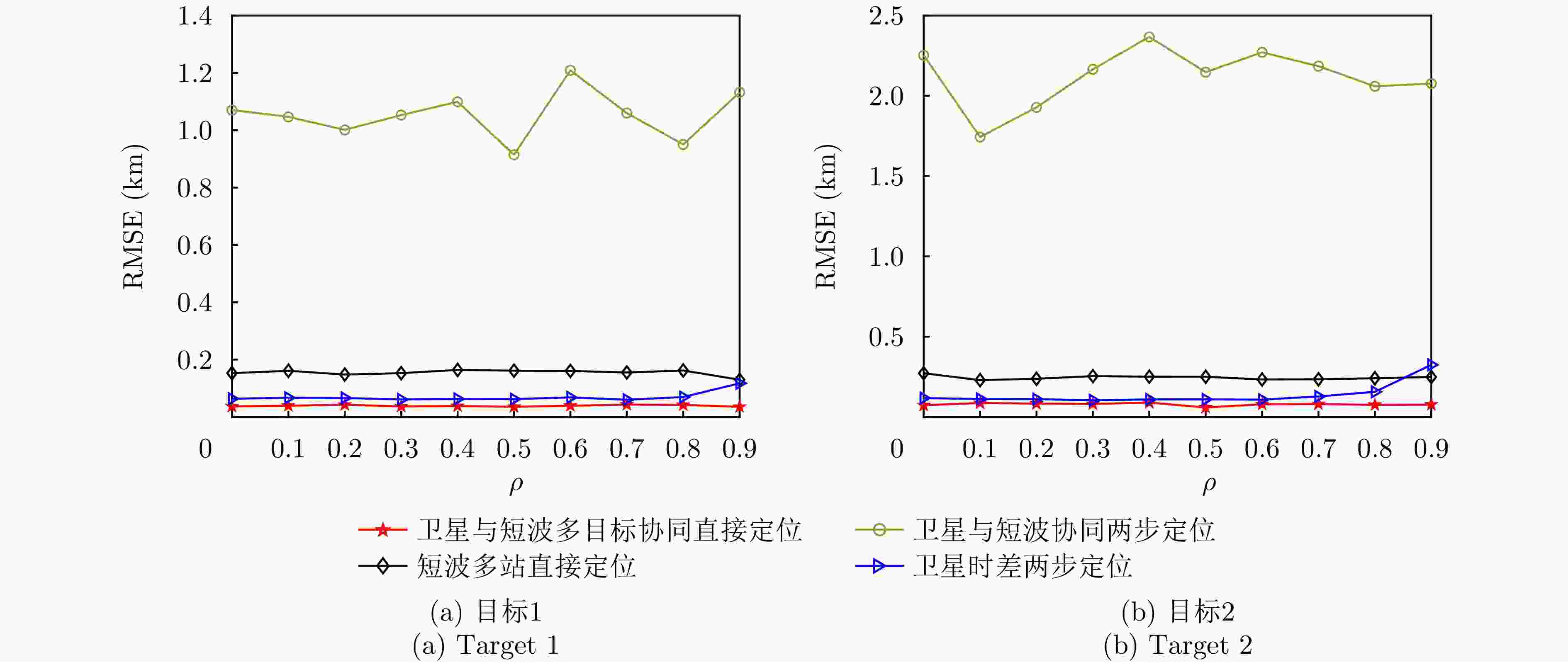
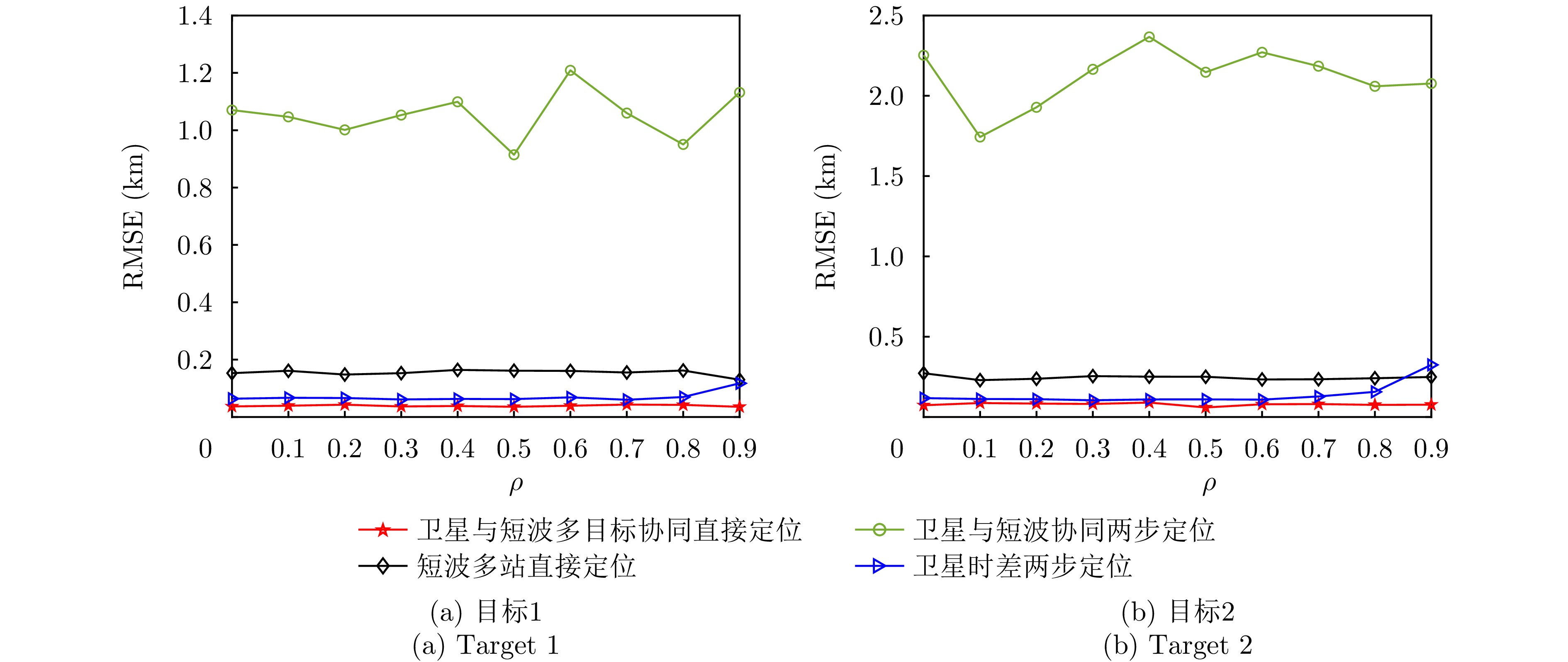
图 10 定位均方根误差随着高斯分布星历误差与先验统计特性失配程度的变化曲线(无电离层扰动影响)
Figure 10. The estimated RMSE curves versus mismatching degree of a priori statistical characteristics of Gaussian satellite orbit errors in the absence of ionospheric disturbance
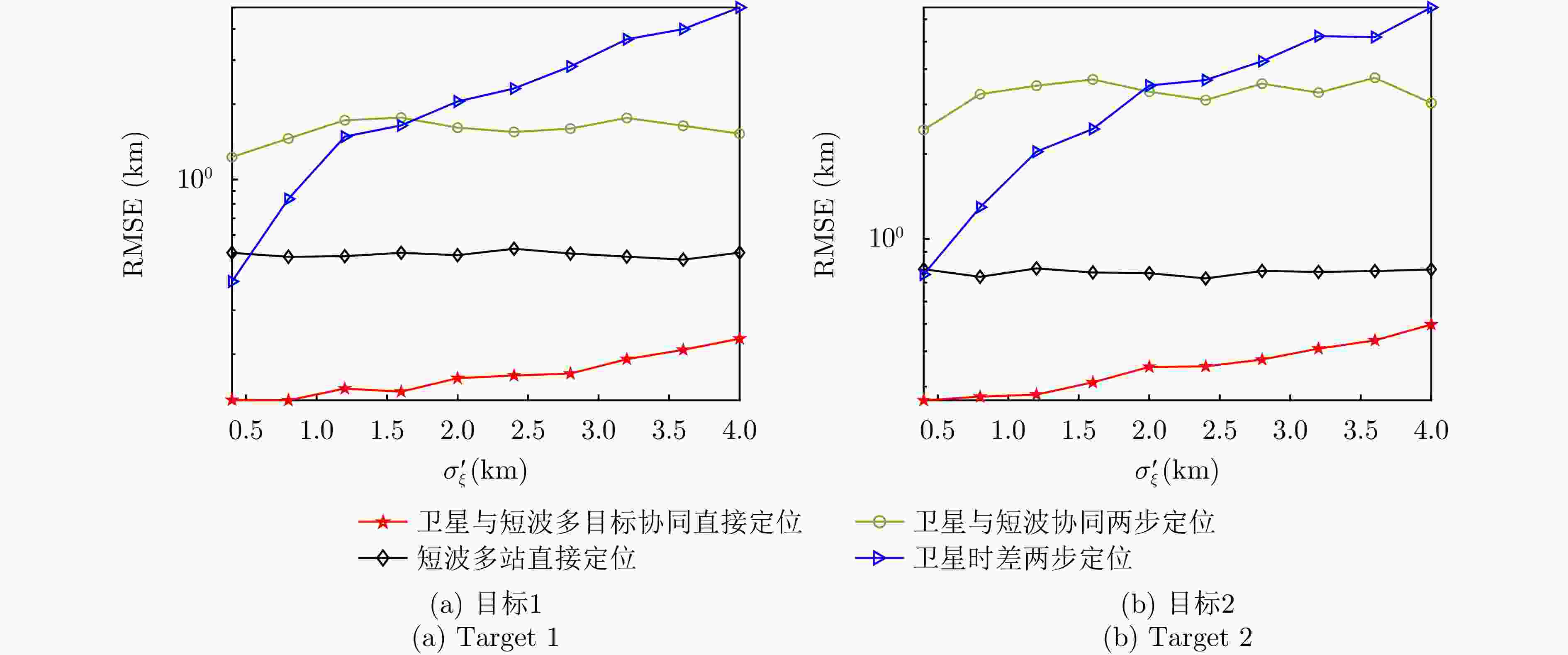
图 11 定位均方根误差随着非高斯分布星历误差拖尾强度的变化曲线(无电离层扰动影响)
Figure 11. The estimated RMSE curves versus tail strength of non-Gaussian satellite orbit errors in the absence of ionospheric disturbance
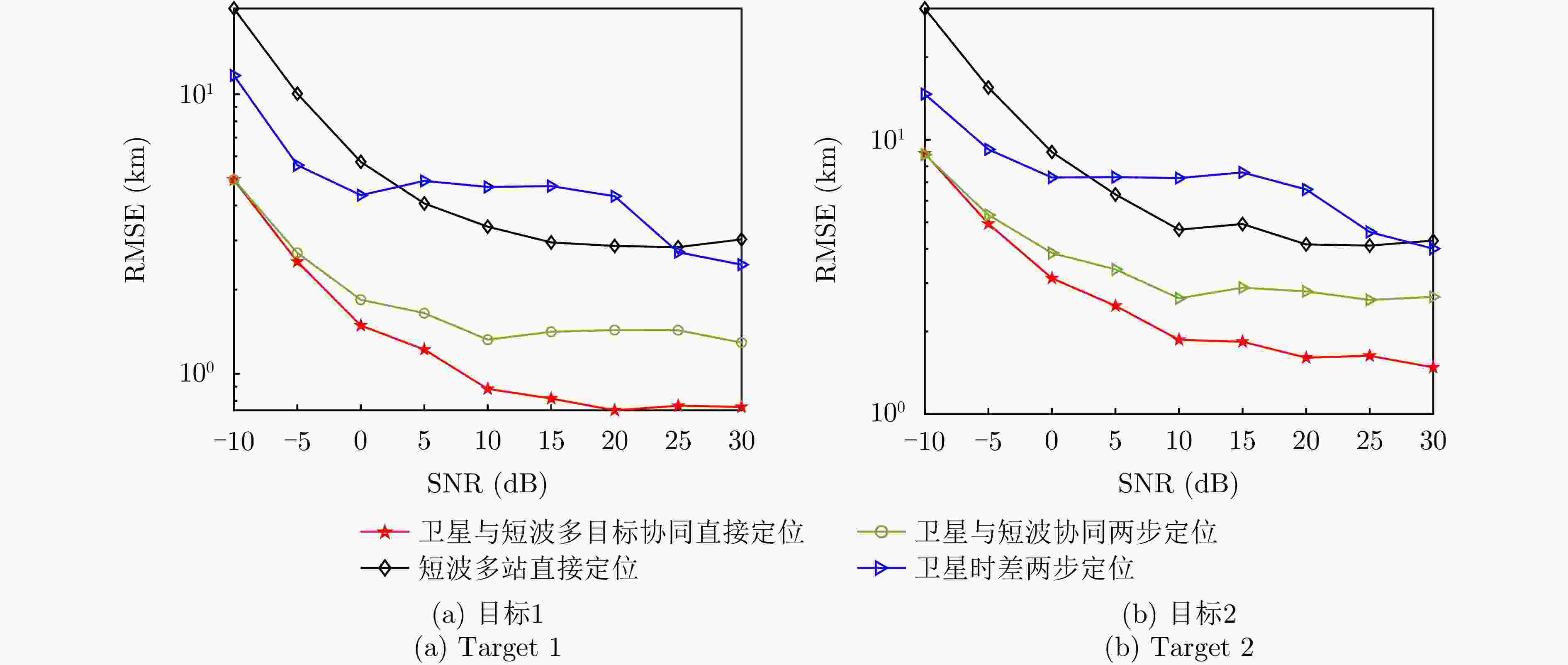
图 12 定位均方根误差随着信噪比的变化曲线(电离层扰动影响)
Figure 12. The estimated RMSE curves versus SNR in the presence of ionospheric disturbance
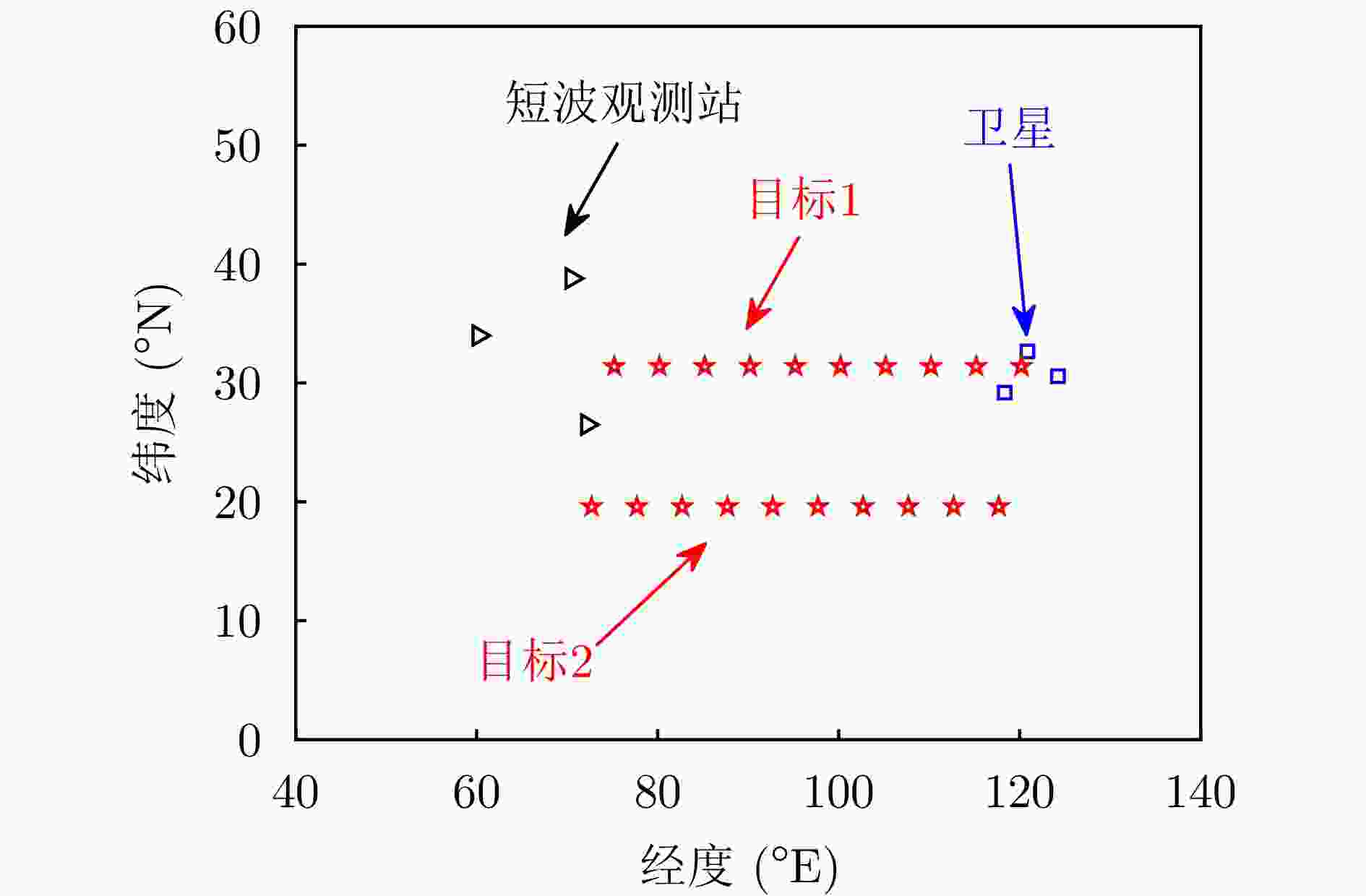
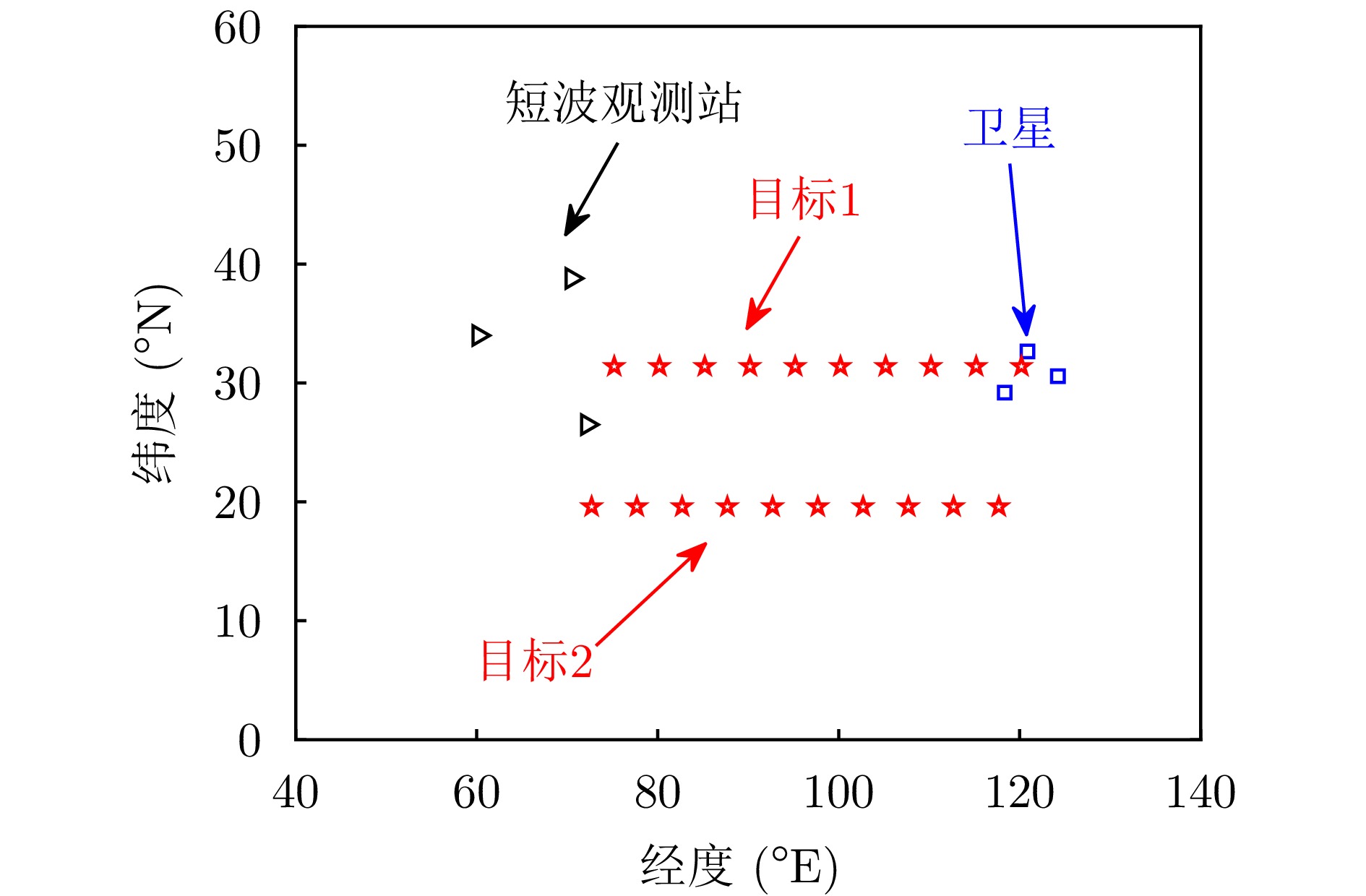
图 13 卫星与短波协同多目标定位的不同目标位置分布
Figure 13. The layout of different positions of multiple targets in scenario of cooperative location based on satellite and shortwave signals
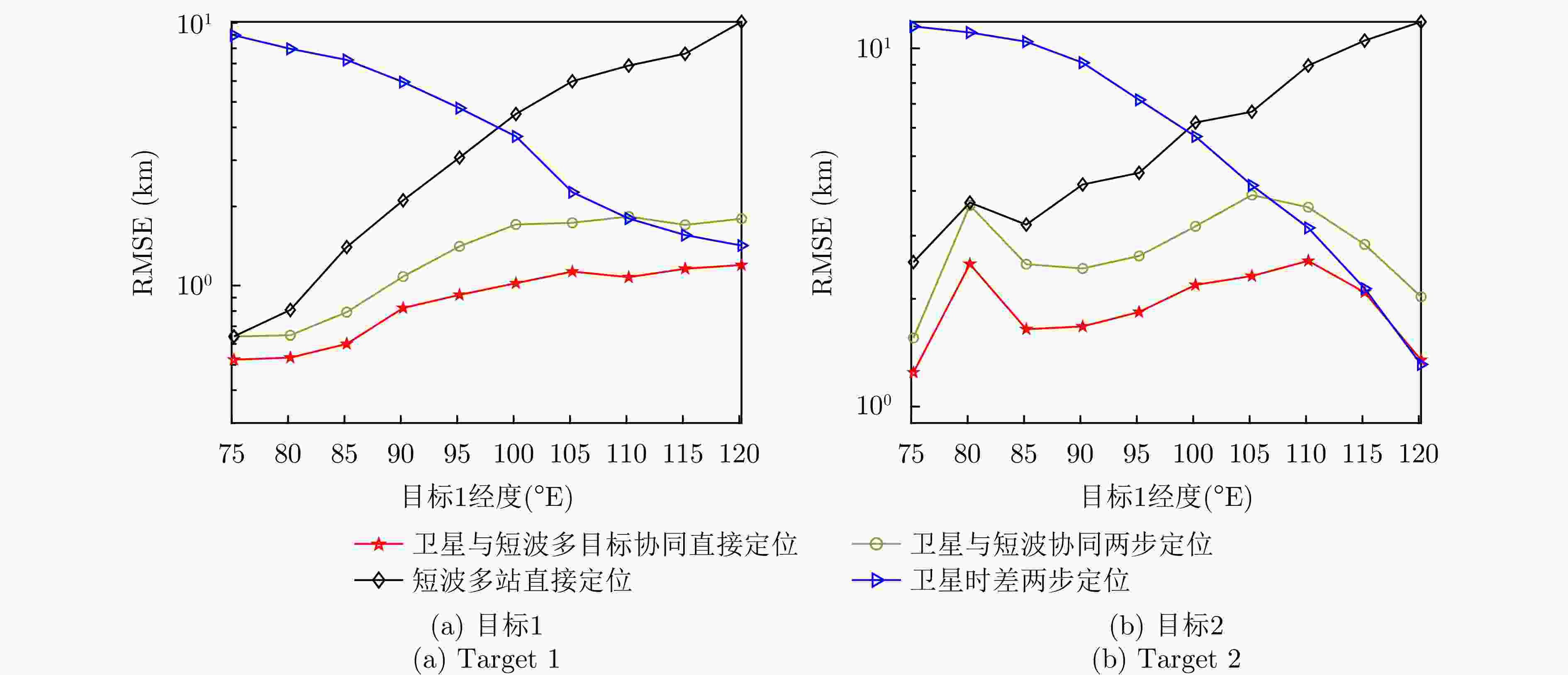
图 14 定位均方根误差随着不同目标位置的变化曲线(电离层扰动影响)
Figure 14. The estimated RMSE curves for different positions of multiple targets in the presence of ionospheric disturbance
表 1 符号说明
Table 1. Notation explanation
符号 说明 $ {\{\cdot \}}^{* } $ 表示矩阵或矢量的共轭 {·}T 表示矩阵或矢量的转置 $ \{\cdot\}^{{\mathrm{H}}} $ 表示矩阵或矢量的共轭转置 $ \{\cdot\}^\dagger $ 表示矩阵或矢量的Moore-Penrose逆 $ \odot $ 表示矩阵Hadamard乘积 diag{·} 表示由矢量中的元素构成的对角矩阵/提取矩阵中对角元素组成矢量 $ {\boldsymbol{\varPi}}[{\boldsymbol{X}}] $与$ {\boldsymbol{\varPi}}^ \bot [{\boldsymbol{X}}] $ 表示矩阵$ {\boldsymbol{X}} $的列空间和列补空间上的正交投影矩阵 $ \delta_{k,k'} $ 表示Kronecker Delta函数,即当且仅当k=k',有$ \delta _{k,k'}=1 $;否则$ \delta _{k,k'}=0$ $\mathbb{E} [\cdot] $ 表示求期望运算 $ {\mathrm{tr}}\{\cdot\} $ 表示矩阵的迹 $ {\mathrm{Re}}\{\cdot\} $ 表示取实部 $ {\boldsymbol{I}}_N $ 表示$ N\times N $维的单位矩阵 $ \mathbb{R}^{N\times M} $ 表示$N\times M $维的实数矩阵集合 $ \mathbb{C}^{N\times M} $ 表示$ N\times M $维的复数矩阵集合 $ \|\cdot\|_2 $ 表示矢量的Euclidean范数 $ c $ 表示电波传播速度  下载: 导出CSV
表 2 本文算法的计算复杂度
Table 2. Computational Complexity of the Proposed Algorithm.
求解阶段 计算复杂度 目标位置矢量参数更新 $ {O}_{1}=O\left(4K{M}^{2}N+12{N}^{2}+\left(\dfrac{8}{3}{Q}^{4}K+12{Q}^{3}KM+12{Q}^{2}N{\log }_{2}N+48Q{N}^{2}\right){N}_{\boldsymbol{p}}N_{\text{iter}}^{\text{(I)}}\right) $ 短波俯仰角参数更新 $ {O}_{2}=O\left(\left(\dfrac{10}{3}{Q}^{3}K+28{Q}^{2}KM+8QK{M}^{2}\right)N_{\text{iter}}^{\text{(II)}}\right) $ 星历参数更新 $ {O}_{3}=O\left(\left(24{Q}^{3}+108{Q}^{2}N+12QN{\log }_{2}N+36{N}^{2}\right)N_{\text{iter}}^{\text{(III)}}\right) $ 整体交替迭代 $ {O}_{\text{total}}=\left({O}_{1}+{O}_{2}+{O}_{3}\right)N_{\text{iter}}^{} $
下载: 导出CSV
表 3 仿真系统参数列表
Table 3. Setting of simulation parameters
参数名称 参数设置 短波观测站数量 3 短波观测站1坐标 经度60.2°E, 纬度34.0°N,
高程范围[0, 500 m]短波观测站2坐标 经度70.5°E, 纬度38.8°N,
高程范围[0, 500 m]短波观测站3坐标 经度72.2°E, 纬度26.5°N,
高程范围[0, 500 m]短波信号载波频率 15.25 MHz 卫星数量 3 卫星1坐标 经度124.23°E, 纬度30.57°N,
轨道高度1000 km卫星2坐标 经度118.35°E, 纬度29.19°N,
轨道高度1000 km卫星3坐标 经度120.87°E, 纬度32.65°N,
轨道高度1200 km卫星地面站坐标 经度110.3°E, 纬度25.7°N,
高程范围[0, 500 m]卫星信号载波频率 300MHz 卫星信号带宽 50KHz 卫星信号基带采样频率 75KHz 目标数量 2 目标1坐标 经度95.2°E,纬度31.4°N,
高程范围[0, 500 m]目标2坐标 经度92.7°E,纬度19.6°N,
高程范围[0, 500 m]接收信噪比范围 [–10 dB, 30 dB] 高斯分布星历误差标准差范围 [50 m, 500 m] 样本点数范围 [50, 500] 蒙特卡洛次数 200 算法迭代收敛门限 10–7
下载: 导出CSV
表 4 在SNR=–10 dB条件下本文算法与其他算法的定位误差性能对比(无电离层扰动影响)
Table 4. Comparison of RMSEs of the proposed algorithm with other algorithms when SNR=–10 dB in the absence of ionospheric disturbance
算法 目标1 目标2 RMSE(km) RMSE降低(%) RMSE(km) RMSE降低(%) 卫星与短波多目标协同直接定位 4.4630 – 10.7485 – 卫星与短波协同两步定位 4.4834 0.4550 10.7759 0.2543 短波多站直接定位 21.6264 79.3632 30.0282 64.2053 卫星时差两步定位 10.1454 56.0096 14.7667 27.2112
下载: 导出CSV
表 5 在SNR=30 dB条件下本文算法与其他算法的定位误差性能对比(无电离层扰动影响)
Table 5. Comparison of RMSEs of the proposed algorithm with other algorithms when SNR=30 dB in the absence of ionospheric disturbance
算法 目标1 目标2 RMSE(km) RMSE降低(%) RMSE(km) RMSE降低(%) 卫星与短波多目标协同直接定位 0.0399 – 0.0840 – 卫星与短波协同两步定位 0.2526 84.2043 0.5745 85.3786 短波多站直接定位 0.1409 71.6820 0.2256 62.7660 卫星时差两步定位 0.0778 48.7147 0.1152 27.0833
下载: 导出CSV
表 6 在SNR=–10 dB条件下本文算法与其他算法的定位误差性能对比(电离层扰动影响)
Table 6. Comparison of RMSEs of the proposed algorithm with other algorithms when SNR=–10 dB in the presence of ionospheric disturbance
算法 目标1 目标2 RMSE(km) RMSE降低(%) RMSE(km) RMSE降低(%) 卫星与短波多目标协同直接定位 4.9439 — 9.1781 — 卫星与短波协同两步定位 4.9507 0.1374 9.2275 0.5354 短波多站直接定位 20.2697 75.6094 29.0506 68.4065 卫星时差两步定位 11.6728 57.6460 13.7481 33.2410
下载: 导出CSV
表 7 在SNR=30 dB条件下本文算法与其他算法的定位误差性能对比(电离层扰动影响)
Table 7. Comparison of RMSEs of the proposed algorithm with other algorithms when SNR=30 dB in the presence of ionospheric disturbance
算法 目标1 目标2 RMSE(km) RMSE降低(%) RMSE(km) RMSE降低(%) 卫星与短波多目标协同直接定位 0.7613 — 1.4799 — 卫星与短波协同两步定位 1.2929 41.1169 2.6744 44.6642 短波多站直接定位 3.0249 74.8322 4.2879 65.4866 卫星时差两步定位 2.4561 69.0037 4.0069 63.0662
下载: 导出CSV
表 8 四种算法运行时间的比较(s)
Table 8. Comparison of running time for four algorithms (s)
算法 运行时间 卫星与短波多目标协同直接定位 5.5258 卫星与短波协同两步定位 1.9348 短波多站直接定位 0.2097 卫星时差两步定位 2.4933
下载: 导出CSV
-
[1] WANG Qi, CHEN Xiaoming, QI Qiao, et al. Multiple-satellite cooperative information communication and location sensing in LEO satellite constellations[J]. IEEE Transactions on Wireless Communications, 2025, 24(4): 3346–3361. doi: 10.1109/TWC.2025.3530083. [2] 任文娟, 胡东辉, 丁赤飚. 三星时差定位系统的多时差联合定位方法[J]. 雷达学报, 2012, 1(3): 262–269. doi: 10.3724/SP.J.1300.2012.20050.REN Wenjuan, HU Donghui, and DING Chibiao. Multi-TDOA location algorithm for three satellites TDOA passive location system[J]. Journal of Radars, 2012, 1(3): 262–269. doi: 10.3724/SP.J.1300.2012.20050. [3] 王金龙, 陈瑾, 徐煜华. 短波通信技术研究进展与发展需求[J]. 陆军工程大学学报, 2022, 1(1): 1–7. doi: 10.12018/j.issn.2097-0730.20211218001.WANG Jinlong, CHEN Jin, and XU Yuhua. On research advances and development requirements of high frequency communication technologies[J]. Journal of Army Engineering University of PLA, 2022, 1(1): 1–7. doi: 10.12018/j.issn.2097-0730.20211218001. [4] 王鼎, 尹洁昕, 高路, 等. 一种协同二维DOA和TDOA观测量的超视距短波辐射源定位新方法[J]. 雷达学报, 2024, 13(6): 1135–1156. doi: 10.12000/JR24136.WANG Ding, YIN Jiexin, GAO Lu, et al. A novel cooperative positioning method for over-the-horizon shortwave emitter based on two-dimensional direction-of-arrival and time-difference-of-arrival measurements[J]. Journal of Radars, 2024, 13(6): 1135–1156. doi: 10.12000/JR24136. [5] 郭福成, 李金洲, 张敏. 无源定位原理与方法[M]. 北京: 国防工业出版社, 2021: 433.GUO Fucheng, LI Jinzhou, and ZHANG Min. Passive Location Theories and Methods[M]. Beijing: National Defense Industry Press, 2021: 433. [6] 王鼎, 尹洁昕, 朱中梁. 针对超视距短波辐射源的测角与测时差协同定位方法[J]. 中国科学: 信息科学, 2022, 52(11): 1942–1973. doi: 10.1360/SSI-2021-0331.WANG Ding, YIN Jiexin, and ZHU Zhongliang. Novel cooperative localization method of over-the-horizon shortwave emitters based on direction-of-arrival and time-difference-of-arrival measurements[J]. Scientia Sinica: Informationis, 2022, 52(11): 1942–1973. doi: 10.1360/SSI-2021-0331. [7] POISEL R A, 屈晓旭, 罗勇, 译. 电子战目标定位方法[M]. 北京: 电子工业出版社, 2008. (查阅网上资料,未找到对应的页码信息,请确认).POISEL R A, QU Xiaoxu and LUO Yong, translation. Electronic Warfare Target Location Methods[M]. Beijing: Publishing House of Electronics Industry, 2008. [8] YIN Jiexin, WANG Ding, YANG Xin, et al. Combination of land-based and satellite-based OTH geolocations using differentiable exact penalty method[J]. IEEE Transactions on Aerospace and Electronic Systems, 2022, 58(3): 2363–2382. doi: 10.1109/TAES.2021.3133303. [9] YIN Jiexin, WANG Ding, YANG Bin, et al. A single-step method for over-the-horizon geolocation using importance sampling[J]. Mathematical Problems in Engineering, 2021, 2021: 5574110. doi: 10.1155/2021/5574110. [10] 李建峰, 朱珂慧, 江航, 等. 基于多频率聚焦与融合的相干辐射源时差直接定位方法[J]. 电子学报, 2023, 51(8): 2110–2117. doi: 10.12263/DZXB.20230170.LI Jianfeng, ZHU Kehui, JIANG Hang, et al. A direct position determination method of TDOA based on multi-frequency focusing and fusion for coherent radiation sources[J]. Acta Electronica Sinica, 2023, 51(8): 2110–2117. doi: 10.12263/DZXB.20230170. [11] LI Jiaqi, LI Jianfeng, YOU Mingyi, et al. Direct position determination of coherently distributed sources based on canonical polyadic decomposition[J]. Digital Signal Processing, 2025, 166: 105353. doi: 10.1016/j.dsp.2025.105353. [12] 余天歌, 尹洁昕, 王鼎, 等. 基于多目标空域规律约束的卫星与短波信号协同直接定位方法[J]. 系统工程与电子技术, 2026, 48(7): 2153–2163. doi: 10.12305/j.issn.1001-506X.2026.07.03.YU Tiange, YIN Jiexin, WANG Ding, et al. Cooperative direct position determination method for satellite and shortwave signals based on multi-target spatial domain law constraints[J]. Systems Engineering and Electronics, 2026, 48(7): 2153–2163. doi: 10.12305/j.issn.1001-506X.2026.07.03. [13] 孙凤娟, 柳文, 李铁成. 电离层对短波测向系统的影响分析[J]. 装备环境工程, 2017, 14(7): 45–49. doi: 10.7643/issn.1672-9242.2017.07.009.SUN Fengjuan, LIU Wen, and LI Tiecheng. Effects of ionosphere on high-frequency direction finding systems[J]. Equipment Environmental Engineering, 2017, 14(7): 45–49. doi: 10.7643/issn.1672-9242.2017.07.009. [14] 赵宁, 周芳, 王震, 等. P波段雷达成像电离层效应的地面观测与校正[J]. 雷达学报, 2014, 3(1): 45–52. doi: 10.3724/SP.J.1300.2014.13144.ZHAO Ning, ZHOU Fang, WANG Zhen, et al. Ground observation and correction of P-band radar imaging ionospheric effects[J]. Journal of Radars, 2014, 3(1): 45–52. doi: 10.3724/SP.J.1300.2014.13144. [15] CAO Yalu, PENG Li, LI Jinzhou, et al. A new iterative algorithm for geolocating a known altitude target using TDOA and FDOA measurements in the presence of satellite location uncertainty[J]. Chinese Journal of Aeronautics, 2015, 28(5): 1510–1518. doi: 10.1016/j.cja.2015.08.015. [16] CHEN Xin, WANG Ding, YIN Jiexin, et al. Augmented Lagrange geolocation algorithm using TDOA measurements and calibration sources in the presence of satellite position errors[J]. AEU-International Journal of Electronics and Communications, 2019, 111: 152900. doi: 10.1016/j.aeue.2019.152900. [17] HAO Benjian, LI Zan, SI Jiangbo, et al. Joint source localisation and sensor refinement using time differences of arrival and frequency differences of arrival[J]. IET Signal Processing, 2014, 8(6): 588–600. doi: 10.1049/iet-spr.2013.0186. [18] 王鼎, 尹洁昕, 郑娜娥, 等. 收发未精确同步条件下非相关多运动辐射源TOAs/FOAs协同定位方法[J]. 电子学报, 2024, 52(2): 550–563. doi: 10.12263/DZXB.20230524.WANG Ding, YIN Jiexin, ZHENG Na’e, et al. TOAs/FOAs cooperative localization method for multiple disjoint moving emitters in presence of imperfect synchronization between receivers and transmitters[J]. Acta Electronica Sinica, 2024, 52(2): 550–563. doi: 10.12263/DZXB.20230524. [19] WU Guizhou, ZHANG Min, and GUO Fucheng. Self-calibration direct position determination using a single moving array with sensor gain and phase errors[J]. Signal Processing, 2020, 173: 107587. doi: 10.1016/j.sigpro.2020.107587. [20] DENG Jie, YIN Jiexin, YANG Bin, et al. Direct position determination algorithm for non-circular sources in the presence of mutual coupling and its theoretical performance analysis[J]. IET Signal Processing, 2023, 17(3): e12193. doi: 10.1049/sil2.12193. [21] ZHU Kehui, JIANG Hang, LI Jianfeng, et al. A direct position determination method using distributed UAVs with synchronization error[J]. IEEE Sensors Journal, 2024, 24(1): 780–787. doi: 10.1109/JSEN.2023.3333950. [22] XU Chen, CAI Hongtao, GAO Shunzu, et al. A method for HF skywave source geolocation in unknown ionosphere environments and experimental results[J]. IEEE Antennas and Wireless Propagation Letters, 2023, 22(5): 1059–1063. doi: 10.1109/LAWP.2022.3232399. [23] ZHU Peng, ZHANG Yuannong, YANG Guobin, et al. Development of backscatter sounding single-site location system[J]. IET Radar, Sonar & Navigation, 2016, 10(3): 632–636. doi: 10.1049/iet-rsn.2015.0424. [24] 凯, 罗鹏飞, 译. 统计信号处理基础——估计与检测理论[M]. 北京: 电子工业出版社, 2011. (查阅网上资料,未找到对应的页码信息,请确认).KAY S M, LUO Pengfei, translation. Fundamentals of Statistical Signal Processing Processing[M]. Beijing: Publishing House of Electronics Industry, 2011. [25] ZISKIND I and WAX M. Maximum likelihood localization of multiple sources by alternating projection[J]. IEEE Transactions on Acoustics, Speech, and Signal Processing, 1988, 36(10): 1553–1560. doi: 10.1109/29.7543. [26] WU Hao, SU Weimin, and GU Hong. A novel Taylor series method for source and receiver localization using TDOA and FDOA measurements with uncertain receiver positions[C]. 2011 IEEE CIE International Conference on Radar, Chengdu, China, 2011: 1037–1040. doi: 10.1109/CIE-Radar.2011.6159729. [27] 张小飞, 李建峰, 徐大专. 传感器阵列信源定位[M]. 北京: 电子工业出版社, 2018. (查阅网上资料,未找到对应的英文翻译和页码信息,请确认). [28] 郭福成, 樊昀, 张敏, 等. 航天电子侦察定位原理[M]. 北京: 电子工业出版社, 2025. (查阅网上资料,未找到页码信息,请确认).GUO Fucheng, FAN Yun, ZHANG Min, et al. Localization Principles of Aerospace Electronic Reconnaissance[M]. Beijing: Publishing House of Electronics Industry, 2025. [29] 郭福成. 低轨电子侦察卫星轨道高度与定位体制效能分析[J]. 航天电子对抗, 2025, 41(3): 1–5. doi: 10.16328/j.htdz8511.2025.03.001.GUO Fucheng. Analysis of efficiency with height of low orbit spaceborne ELINT location system[J]. Aerospace Electronic Warfare, 2025, 41(3): 1–5. doi: 10.16328/j.htdz8511.2025.03.001. [30] 徐玲玲, 赵航, 宋静, 等. 基于SGP4模型的空间站轨道精度分析[J]. 全球定位系统, 2024, 49(2): 98–105. doi: 10.12265/j.gnss.2023194.XU Lingling, ZHAO Hang, SONG Jing, et al. Space station orbital accuracy analysis based on the SGP4 model[J]. GNSS World of China, 2024, 49(2): 98–105. doi: 10.12265/j.gnss.2023194. [31] YANG Baojian, HUANG Hao, and CAO Lu. Centered error entropy-based sigma-point Kalman filter for spacecraft state estimation with non-Gaussian noise[J]. Space: Science & Technology, 2022, 2022: 9854601. doi: 10.34133/2022/9854601. [32] LIU Jihua, LI Zhigang, YANG Xuhai, et al. Variation of satellite transponder delay[J]. Chinese Science Bulletin, 2014, 59(21): 2568–2573. doi: 10.1007/s11434-014-0342-2. -








计量
- 文章访问数:
- HTML全文浏览量:
- PDF下载量:
- 被引次数: 0