

 作者中心
作者中心 专家审稿
专家审稿 责编办公
责编办公 编辑办公
编辑办公
Collaborative Learning of Visual- and Semantic Features for Few-Shot SAR Target Recognition
-
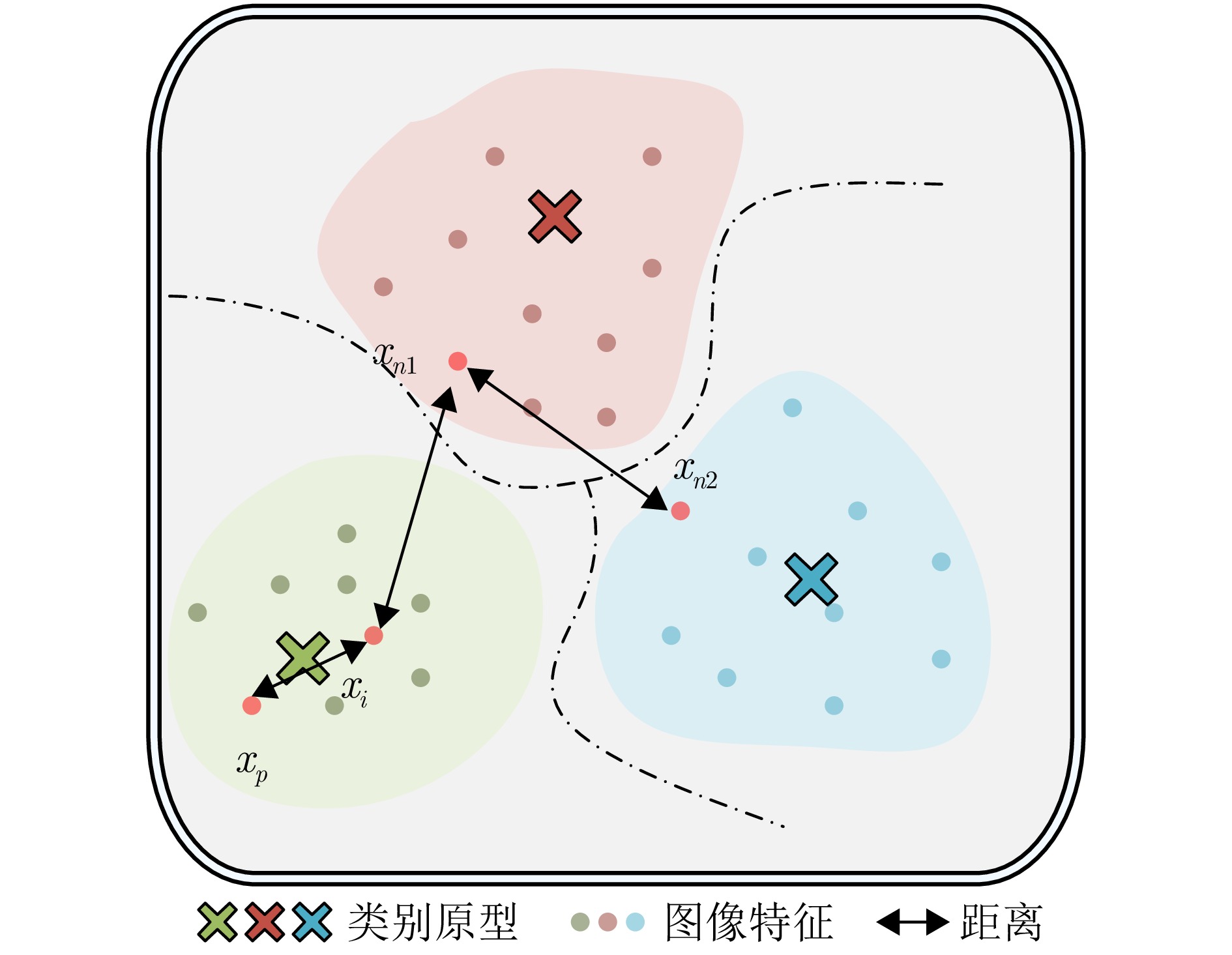
摘要: 针对合成孔径雷达(SAR)目标识别模型在少样本条件下极易发生过拟合、且类间鉴别性差的问题,该文提出了一种基于视觉-语义特征协同学习的少样本SAR 目标识别方法。首先,考虑到少样本条件下SAR图像数据蕴含的视觉信息有限,该文提出一种基于“生成-编码-筛选”思路的SAR目标语义信息构建方法,并基于语义先验信息构建类语义原型,后与视觉特征协同,实现目标类属性识别。其次,提出一种视觉-语义特征双分支协同学习网络来提取更具判别性SAR目标类特征。其中,SAR图像视觉分支通过皮尔逊相关系数对齐视觉原型与语义原型的关系矩阵,使得语义先验的类别信息向视觉分支传递,并基于动态四元组损失优化网络,提升视觉特征的判别性;SAR图像语义分支采用最优传输理论通过视觉特征优化语义特征,增强语义特征的判别性。最后,提出一种基于实例级预测置信度的加权决策融合策略,实现联合语义-视觉特征的SAR目标稳健识别。在 MSTAR 数据集的标准集和拓展集,以及OpenSARShip数据集上进行实验。实验结果表明,该方法在少样本条件下能够有效利用目标视觉与语义特征的互补优势,识别准确率与鲁棒性均得到显著提升。Abstract: To address the susceptibility of Synthetic Aperture Radar (SAR) target recognition models to overfitting and their limited inter-class discriminability under few-shot conditions, this paper proposes a few-shot SAR target recognition method that employs collaborative learning of visual and semantic features. First, given the limited visual information available in SAR imagery under few-shot conditions, a semantic information construction method for SAR targets is developed based on a “generation–encoding–selection” paradigm. Class-level semantic prototypes are then constructed from semantic prior information to capture target-class attributes and complement visual features. Second, a dual-branch collaborative learning network for visual and semantic features is developed to extract more discriminative class representations of SAR targets. In the visual branch, the Pearson correlation matrices of the visual and semantic prototypes are aligned, to transfer category-related information from the semantic prior information to the visual branch. A dynamic quadruplet loss is employed to optimize the network and enhance the discriminability of the visual features. In the semantic branch, optimal transport theory is introduced to refine semantic features using visual features, thereby improving their discriminative capability. Third, a weighted decision-level fusion strategy based on instance-level prediction confidence is proposed to achieve robust SAR target recognition by jointly exploiting semantic and visual features. Experiments were conducted on the standard and extended sets of the MSTAR dataset, as well as on the OpenSARShip dataset. The experimental results demonstrate that the proposed method effectively exploits the complementary strengths of visual and semantic target features under few-shot conditions, leading to substantial improvements in both recognition accuracy and robustness.
-
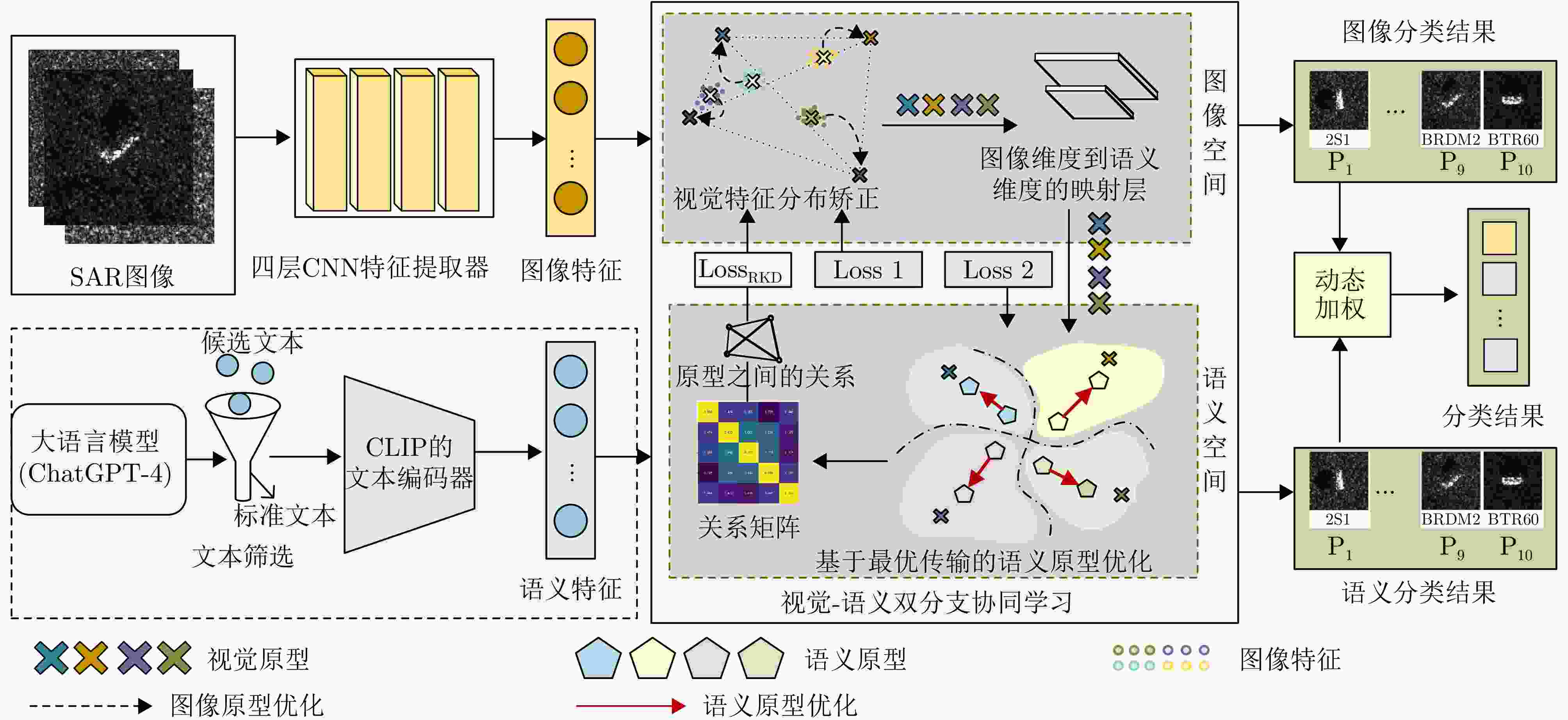
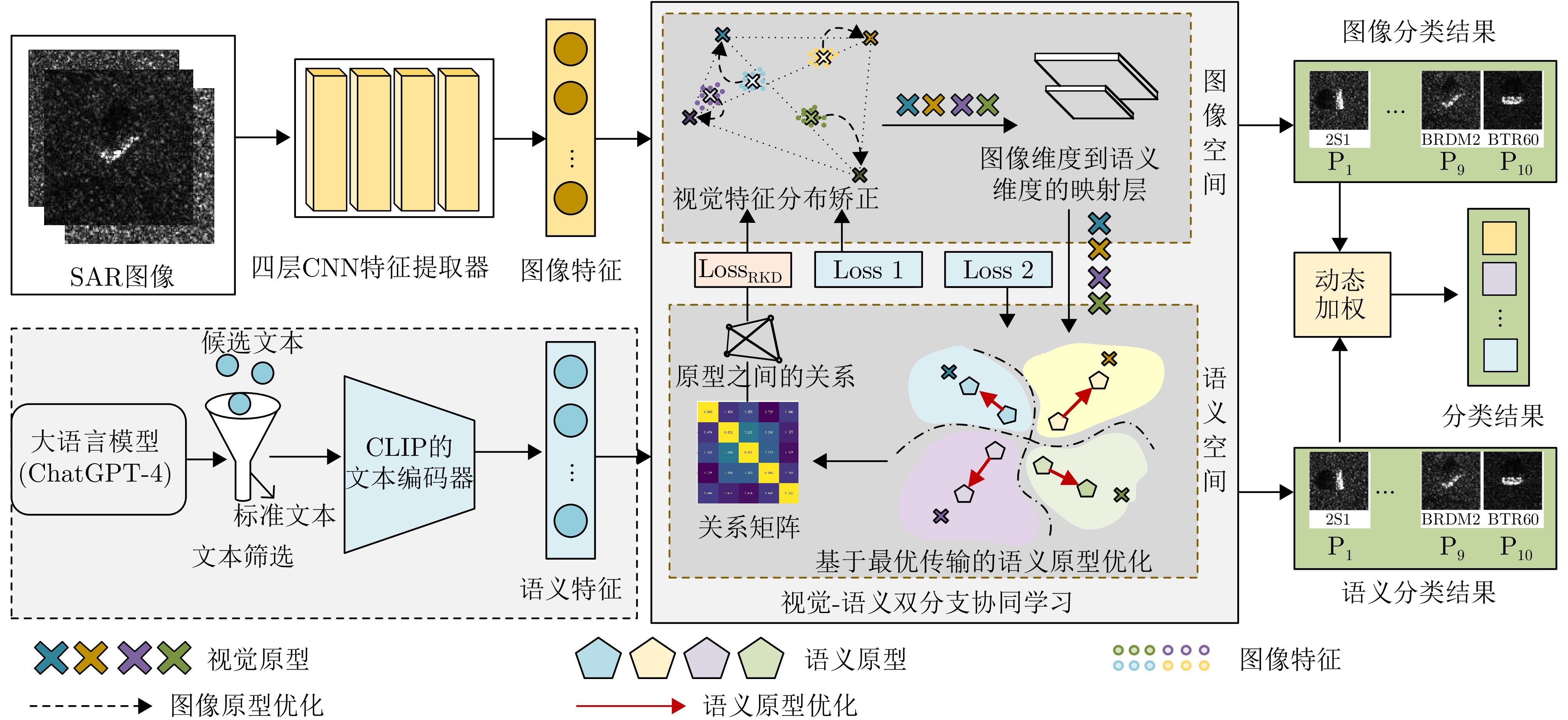
图 1 视觉-语义特征协同学习的SAR目标识别网络框架
Figure 1. Visual-Semantic feature collaborative learning framework for SAR target recognition
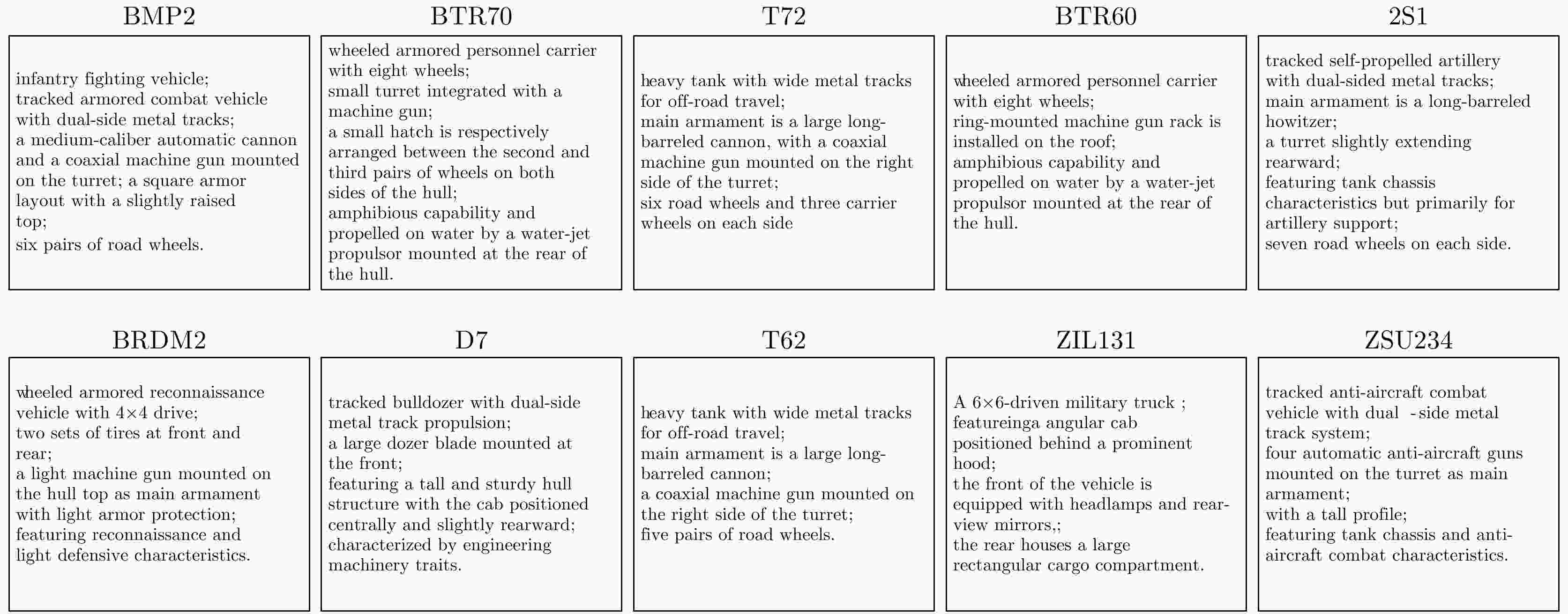
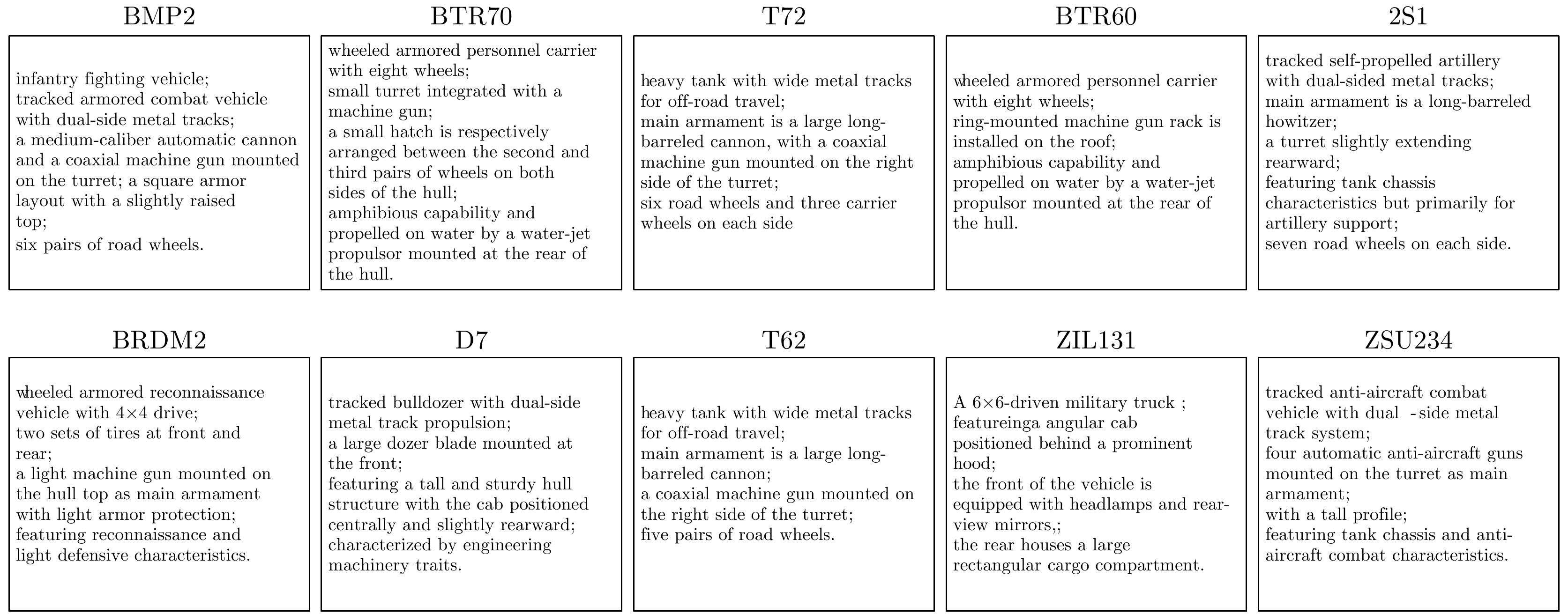
图 2 MSTAR数据集中各个类别的人工设计标准文本
Figure 2. Manually Designed Standard Texts for Each Category in the MSTAR Dataset
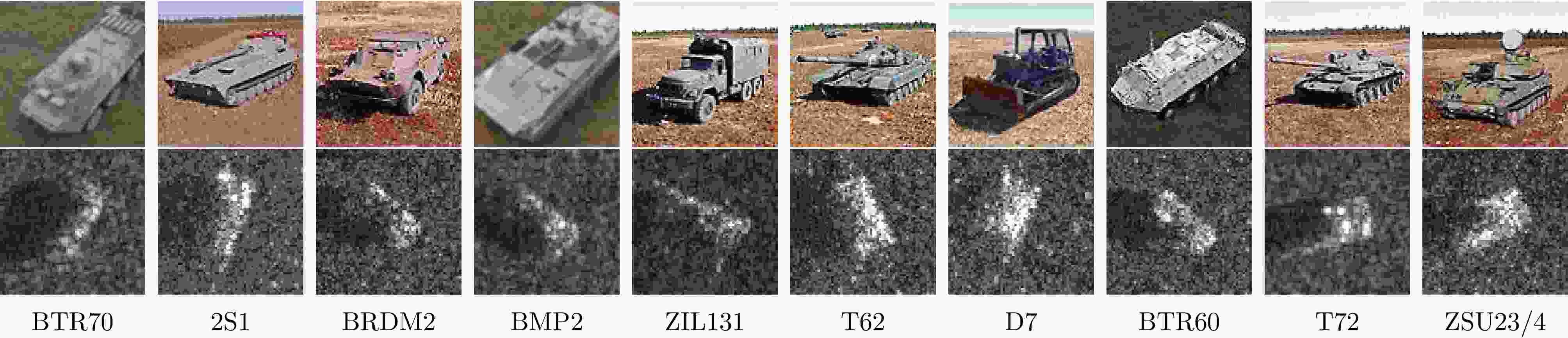
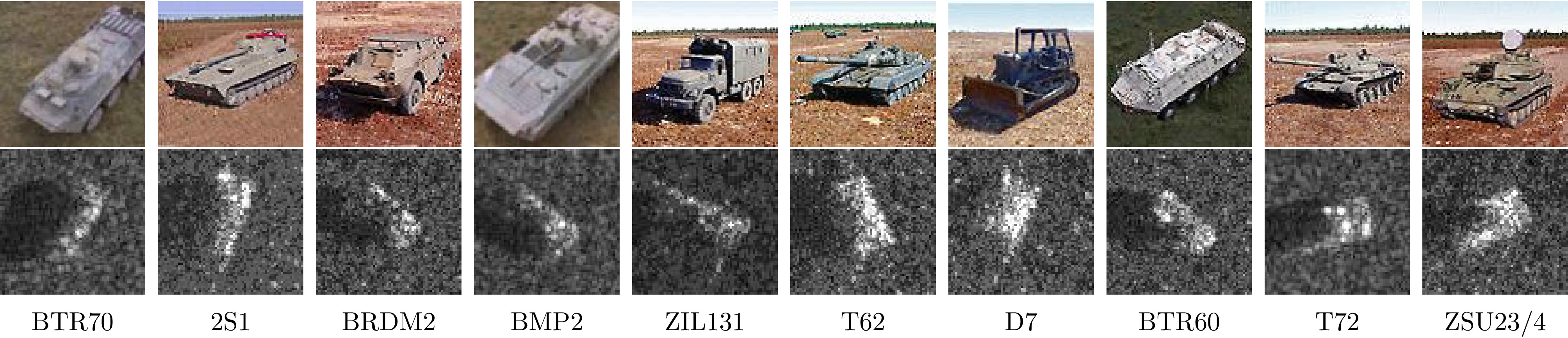
图 4 MSTAR数据集中地面军事目标的光学图像及相应的SAR图像
注:BTR70、BTR60为苏联装甲输送车;2S1为苏联自行榴弹炮;BRDM2为苏联装甲侦察车;BMP2为苏联步兵战车;ZIL131为苏联卡车;T62、T72为苏联主战坦克;D7为美国推土机;ZSU23/4为苏联自行高射炮。
Figure 4. Optical images and corresponding SAR images of ground military targets in the MSTAR dataset
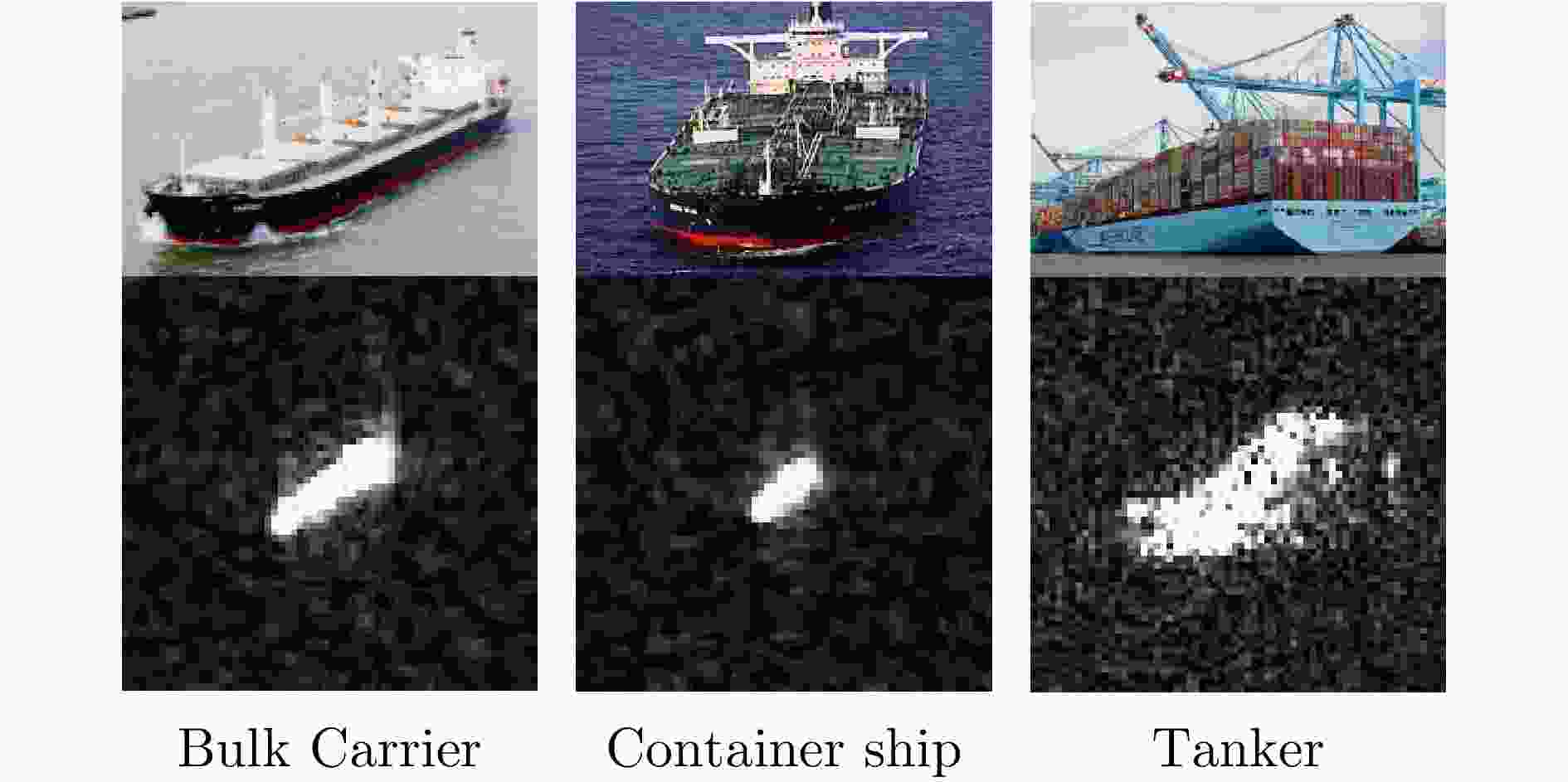
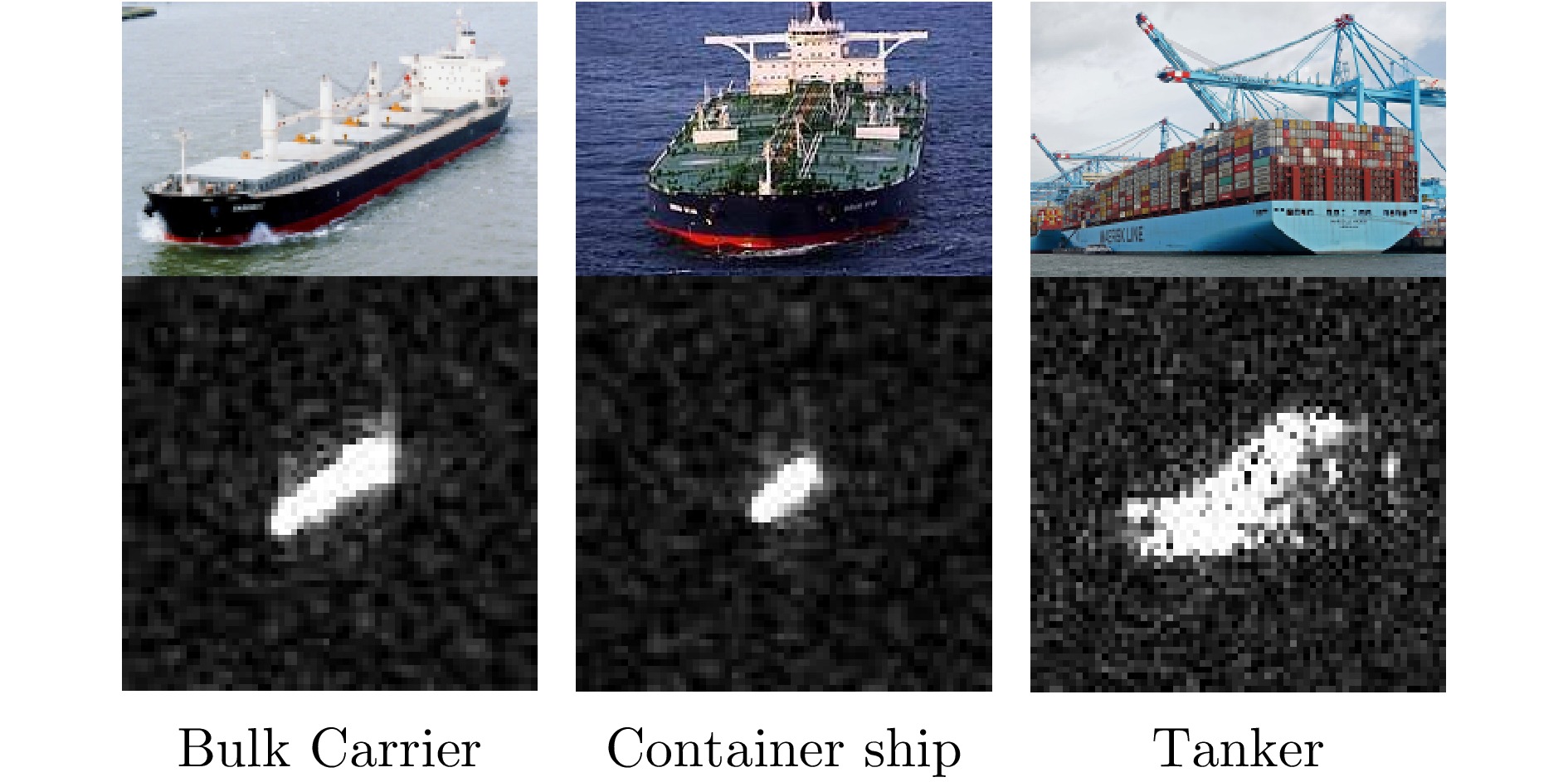
图 5 OpenSARShip数据集中船舶目标的光学图像及相应的SAR图像
注:Bulk Carrier为散货船;Container ship为集装箱船;Tanker为油罐船。
Figure 5. Optical images and corresponding SAR images of target ships in the OpenSARShip dataset
表 1 MSTAR SOC数据集的详细设置
Table 1. Detailed setting of MSTAR SOC dataset
类别 训练样本(17°) 测试样本(15°) BMP2 233( 9563 )192( 9563 )BTR70 233 196 T72 233(132) 196(132) BTR60 255 195 2S1 299 274 BRDM2 298 274 D7 299 274 T62 299 273 ZIL131 299 274 ZSU23/4 299 274  下载: 导出CSV
表 2 MSTAR EOC-1数据集的详细设置
Table 2. Detailed setting of MSTAR EOC-1 dataset
类别 训练样本(17°) 测试样本(30°) 2S1 299 288 BRDM2 298 287 T72 233(132) 288(132) ZSU23/4 299 288
下载: 导出CSV
表 3 OpenSARShip数据集的详细设置
Table 3. Detailed setting of OpenSARShip dataset
类别 训练样本 测试样本 Bulk Carrier 120 218 Container ship 120 218 Tanker 120 218
下载: 导出CSV
表 4 MSTAR SOC 数据集上不同样本数量下各类的识别准确率
Table 4. Recognition Accuracy of Each Class with Different Sample Sizes on MSTAR SOC
Class 2S1 BMP2 BRDM2 BTR70 BTR60 D7 T62 T72 ZIL131 ZSU23/4 Average 5shot 67.63 51.79 81.06 56.43 51.85 80.69 78.28 85.66 76.57 87.26 73.06 10shot 84.89 70.41 94.12 69.34 74.05 90.26 94.18 92.14 90.22 95.44 86.67 20shot 92.59 87.38 98.61 89.59 84.87 97.30 98.17 94.49 97.12 98.50 94.48 30shot 96.13 91.69 98.54 94.74 89.44 98.58 98.64 98.37 98.54 99.31 96.77 40shot 97.77 94.26 99.34 95.92 93.03 99.64 99.45 99.34 98.83 99.67 98.00 50shot 98.50 95.85 99.64 97.55 94.10 99.49 99.30 99.49 99.60 99.67 98.52
下载: 导出CSV
表 5 MSTAR SOC数据集上不同样本数量下的F1、acc、recall、precision
Table 5. F1 Score, accuracy, recall, and precision under different sample sizes on the MSTAR SOC Dataset
样本数 F1 acc recall precision 5shot 71.37 73.06 71.72 73.18 10shot 85.40 86.67 85.50 86.25 20shot 93.84 94.48 93.86 93.97 30shot 96.41 96.77 96.40 96.52 40shot 97.74 98.00 97.72 97.79 50shot 98.33 98.52 98.32 98.38
下载: 导出CSV
表 6 MSTAR EOC-1数据集上不同样本数量下各类的识别准确率
Table 6. Recognition accuracy of each class with different sample sizes on MSTAR EOC-1
Class 2S1 BRDM2 T72 ZSU23/4 Average 10shot 96.08 92.13 79.90 71.98 85.01 20shot 98.19 93.34 90.42 82.99 91.23 40shot 98.75 95.99 93.61 84.72 93.27 60shot 99.13 96.27 94.41 89.93 94.93 80shot 99.10 96.93 94.44 91.84 95.58 100shot 99.10 97.28 95.14 93.26 96.19
下载: 导出CSV
表 7 MSTAR EOC-1数据集上不同样本数量下的F1、acc、recall、precision
Table 7. F1 score, accuracy, recall, and precision under different sample sizes on the MSTAR EOC-1 Dataset
样本数 F1 acc recall precision 10shot 84.84 85.01 85.02 86.40 20shot 91.23 91.23 91.24 91.97 40shot 93.27 93.27 93.27 93.79 60shot 94.95 94.93 94.94 95.24 80shot 95.58 95.58 95.58 95.76 100shot 96.21 96.19 96.20 96.38
下载: 导出CSV
表 8 OpenSARShip数据集上不同样本数量下各类的识别准确率
Table 8. Recognition accuracy of each class with different sample sizes on OpenSARShip
Class Bulk Carrier Container ship Tanker Average 20shot 71.93 65.00 76.97 71.30 40shot 73.99 69.68 80.60 74.76 50shot 74.72 71.47 81.01 75.73 80shot 77.75 73.94 81.65 77.78 100shot 79.08 74.72 81.15 78.32 120shot 78.85 76.97 80.96 78.93
下载: 导出CSV
表 9 OpenSARShip数据集上不同样本数量下的F1、acc、recall、precision
Table 9. F1 Score, accuracy, recall, and precision under different sample sizes on the OpenSARShip Dataset
样本数 F1 acc recall precision 20shot 71.25 71.30 71.30 72.04 40shot 74.68 74.76 74.76 75.02 50shot 75.73 75.73 75.73 75.93 80shot 77.77 77.78 77.78 77.91 100shot 78.33 78.32 78.32 78.51 120shot 78.95 78.93 78.93 79.11
下载: 导出CSV
表 10 MSTAR 数据集上的对比实验结果
Table 10. Comparative Experimental Results in MSTAR
Method Semisupervised PD Net DBRSA Dens-CapsNet MSF-Net RemoteCLIP GeoRSCLIP Ours 10shot 80.88 83.73 77.36 80.26 65.54 - - 86.67 20shot 92.62 93.00 - 92.95 85.48 - - 94.48 30shot - 94.63 92.45 94.56 87.05 - - 96.77 40shot 97.11 - - 96.50 - - - 98.00 50shot - - 97.58 97.61 - 69.97(total) 76.00(total) 98.52 注:表内加粗数值表示相同样本条件下的最高识别精度
下载: 导出CSV
表 11 OpenSARShip 数据集上的对比实验结果
Table 11. Comparative Experimental Results in OpenSARShip
Method Number of training samples 1-49 50-99 100-120 SDA-Tr – – 68.87(100) STr-BS – – 68.56(100) Semisupervised 61.88(20) 68.67(80) 71.29(120) 64.73(40) CNN+Matrix - 72.86(50) 75.31(100) UDA-ALE - 73.75(50) 76.25(100) Ours 71.30(20) 75.73(50) 78.32(100) 74.76(40) 77.78(80) 78.93(120) 注:表内加粗数值表示相同样本条件下的最高识别精度
下载: 导出CSV
表 12 不同文本策略的识别准确率对比
Table 12. Recognition Accuracy with Different Text Strategies
Strategies 随机文本 传统文本 筛选文本 5shot 71.18 70.93 73.06 10shot 85.65 85.28 86.67 20shot 94.52 94.31 94.48 30shot 96.12 95.92 96.77 注:表内加粗数值表示相同样本条件下的最高识别精度
下载: 导出CSV
表 13 不同文本数量的实验结果对比
Table 13. Experimental results with different text counts
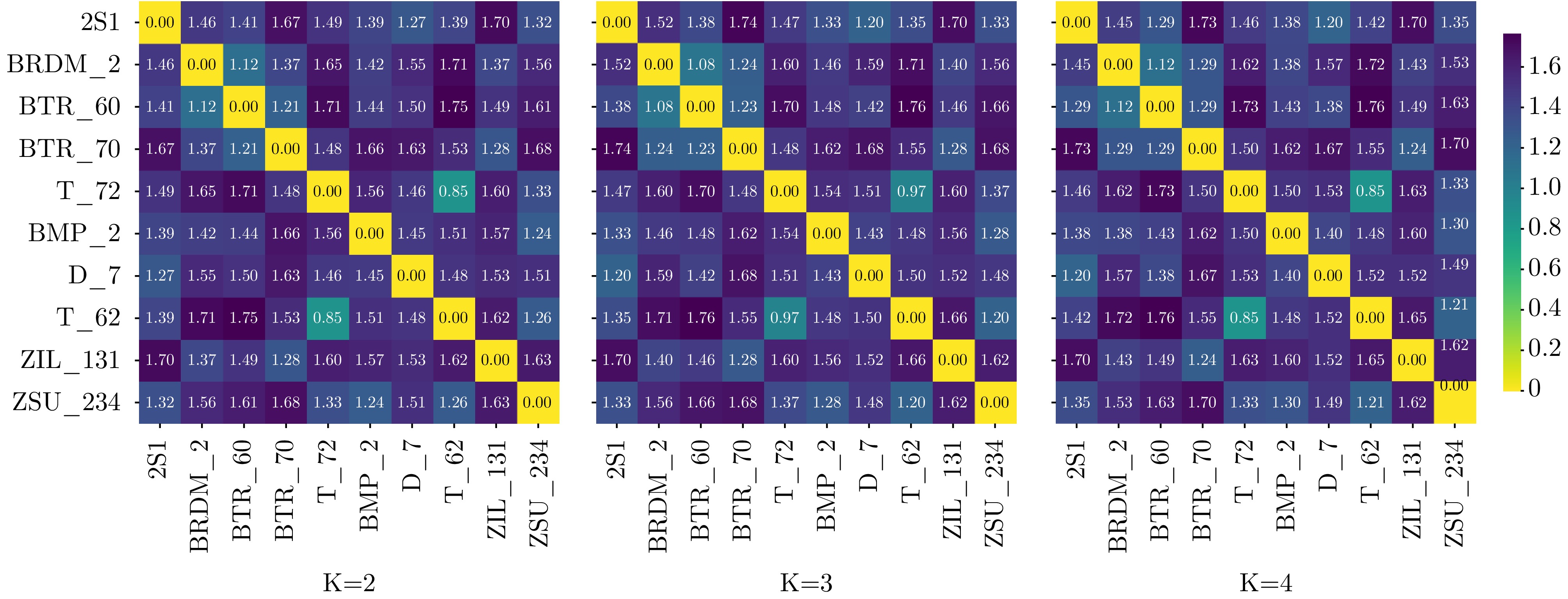
样本数 K=2 K=3 K=4 5shot 70.79 73.06 70.64 10shot 85.05 86.67 85.05 20shot 93.80 94.48 93.67 注:表内加粗数值表示相同样本条件下的最高识别精度
下载: 导出CSV
表 14 消融实验结果
Table 14. Ablation Results
关系对齐 四元损失 最优传输 动态加权 5shot 10shot 20shot 纯四层CNN网络 40.74 59.67 79.63 √ 65.65 80.73 91.52 √ 67.93 84.19 93.58 √ 66.27 81.33 91.56 √ √ 69.86 85.13 93.78 √ √ √ 72.89 85.82 94.11 √ √ √ 72.87 85.85 94.26 √ √ √ 73.00 86.34 94.42 P P P P 73.06 86.67 94.48 注:表内加粗数值表示相同样本条件下的最高识别精度,P说明网络中包含该模块
下载: 导出CSV
-
[1] 孙浩, 陈进, 雷琳, 等. 深度卷积神经网络图像识别模型对抗鲁棒性技术综述[J]. 雷达学报, 2021, 10(4): 571–594. doi: 10.12000/JR21048.Sun Hao, Chen Jin, Lei Lin, et al. Adversarial robustness of deep convolutional neural network-based image recognition models: A review[J]. Journal of Radars, 2021, 10(4): 571–594. doi: 10.12000/JR21048. [2] 郭炜炜, 张增辉, 郁文贤, 等. SAR图像目标识别的可解释性问题探讨[J]. 雷达学报, 2020, 9(3): 462–476. doi: 10.12000/JR20059.Guo Weiwei, Zhang Zenghui, Yu Wenxian, et al. Perspective on explainable SAR target recognition[J]. Journal of Radars, 2020, 9(3): 462–476. doi: 10.12000/JR20059. [3] Kechagias-Stamatis O and Aouf N. Automatic target recognition on synthetic aperture radar imagery: A survey[J]. IEEE Aerospace and Electronic Systems Magazine, 2021, 36(3): 56–81. doi: 10.1109/MAES.2021.3049857. [4] Novak L M, Owirka G J, Brower W S, et al. The automatic target-recognition system in SAIP[J]. The Lincoln Laboratory Journal, 1997, 10(2): 187–202. [5] Diemunsch J R and Wissinger J. Moving and stationary target acquisition and recognition (MSTAR) model-based automatic target recognition: Search technology for a robust ATR[C]. SPIE 3370, Algorithms for Synthetic Aperture Radar Imagery V, Orlando, USA,1998: 481–492. doi: 10.1117/12.321851. [6] WANG Zhaocheng, DU Lan, ZHANG Peng, et al. Visual attention-based target detection and discrimination for high-resolution SAR images in complex scenes[J]. IEEE Transactions on Geoscience and Remote Sensing, 2018, 56(4): 1855–1872. doi: 10.1109/TGRS.2017.2769045. [7] DONG Ganggang, KUANG Gangyao, WANG Na, et al. Classification via sparse representation of steerable wavelet frames on Grassmann manifold: Application to target recognition in SAR image[J]. IEEE Transactions on Image Processing, 2017, 26(6): 2892–2904. doi: 10.1109/TIP.2017.2692524. [8] LI Tingli and DU Lan. SAR automatic target recognition based on attribute scattering center model and discriminative dictionary learning[J]. IEEE Sensors Journal, 2019, 19(12): 4598–4611. doi: 10.1109/JSEN.2019.2901050. [9] ZHANG Yukun, GUO Xiansheng, LEUNG H, et al. Cross-task and cross-domain SAR target recognition: A meta-transfer learning approach[J]. Pattern Recognition, 2023, 138: 109402. doi: 10.1016/j.patcog.2023.109402. [10] 徐丰, 王海鹏, 金亚秋. 深度学习在SAR目标识别与地物分类中的应用[J]. 雷达学报, 2017, 6(2): 136–148. doi: 10.12000/JR16130.Xu Feng, Wang Haipeng, and Jin Yaqiu. Deep learning as applied in SAR target recognition and terrain classification[J]. Journal of Radars, 2017, 6(2): 136–148. doi: 10.12000/JR16130. [11] 黄钟泠, 姚西文, 韩军伟. 面向SAR图像解译的物理可解释深度学习技术进展与探讨[J]. 雷达学报, 2022, 11(1): 107–125. doi: 10.12000/JR21165.Huang Zhongling, Yao Xiwen, and Han Junwei. Progress and perspective on physically explainable deep learning for synthetic aperture radar image interpretation[J]. Journal of Radars, 2022, 11(1): 107–125. doi: 10.12000/JR21165. [12] 王俊, 郑彤, 雷鹏, 等. 深度学习在雷达中的研究综述[J]. 雷达学报, 2018, 7(4): 395–411. doi: 10.12000/JR18040.Wang Jun, Zheng Tong, Lei Peng, et al. Study on deep learning in radar[J]. Journal of Radars, 2018, 7(4): 395–411. doi: 10.12000/JR18040. [13] Kechagias-Stamatis O and Aouf N. Fusing deep learning and sparse coding for SAR ATR[J]. IEEE Transactions on Aerospace and Electronic Systems, 2019, 55(2): 785–797. doi: 10.1109/TAES.2018.2864809. [14] REN Haohao, YU Xuelian, ZOU Lin, et al. Extended convolutional capsule network with application on SAR automatic target recognition[J]. Signal Processing, 2021, 183: 108021. doi: 10.1016/j.sigpro.2021.108021. [15] DONG Ganggang and LIU Hongwei. A hierarchical receptive network oriented to target recognition in SAR images[J]. Pattern Recognition, 2022, 126: 108558. doi: 10.1016/j.patcog.2022.1085588. [16] PEI Hao, SU Mingjie, XU Gang, et al. Self-supervised feature representation for SAR image target classification using contrastive learning[J]. IEEE Journal of Selected Topics in Applied Earth Observations and Remote Sensing, 2023, 16: 9246–9258. doi: 10.1109/JSTARS.2023.3321769. [17] 吕艺璇, 王智睿, 王佩瑾, 等. 基于散射信息和元学习的SAR图像飞机目标识别[J]. 雷达学报, 2022, 11(4): 652–665. doi: 10.12000/JR22044.Lyu Yixuan, Wang Zhirui, Wang Peijin, et al. Scattering information and meta-learning based SAR images interpretation for aircraft target recognition[J]. Journal of Radars, 2022, 11(4): 652–665. doi: 10.12000/JR22044. [18] Xie Yiyuan, Ferraioli G, Pascazio V, et al. Attributed scattering center characteristic extraction with deep learning[C]. 2024 IEEE International Geoscience and Remote Sensing Symposium, Athens, Greece, 2024: 7444–7447. doi: 10.1109/IGARSS53475.2024.10641471. [19] ZENG Zhiqiang, TAN Xiaoheng, ZHANG Xin, et al. ATGAN: A SAR target image generation method for automatic target recognition[J]. IEEE Journal of Selected Topics in Applied Earth Observations and Remote Sensing, 2024, 17: 6290–6307. doi: 10.1109/JSTARS.2024.3370185. [20] LI Jianwei, YU Zhentao, YU Lu, et al. A comprehensive survey on SAR ATR in deep-learning era[J]. Remote Sensing, 2023, 15(5): 1454. doi: 10.3390/rs15051454. [21] GAO Gui, DAI Yuxi, ZHANG Xi, et al. ADCG: A cross-modality domain transfer learning method for synthetic aperture radar in ship automatic target recognition[J]. IEEE Transactions on Geoscience and Remote Sensing, 2023, 61: 5109114. doi: 10.1109/TGRS.2023.3313204. [22] YANG Xinpeng, JIAO Lianmeng, and PAN Quan. Transfer adaptation learning for target recognition in SAR images: A survey[J]. IEEE Journal of Selected Topics in Applied Earth Observations and Remote Sensing, 2024, 17: 13577–13601. doi: 10.1109/JSTARS.2024.3434448. [23] CHEN Sizhe, WANG Haipeng, XU Feng, et al. Target classification using the deep convolutional networks for SAR images[J]. IEEE Transactions on Geoscience and Remote Sensing, 2016, 54(8): 4806–4817. doi: 10.1109/TGRS.2016.25517207. [24] WANG Siyuan, WANG Yinghua, ZHANG Xiaoting, et al. Visual-semantic cooperative learning for few-shot SAR target classification[J]. IEEE Journal of Selected Topics in Applied Earth Observations and Remote Sensing, 2025, 18: 6532–6550. doi: 10.1109/JSTARS.2025.3530442. [25] Yan Kaijia, SUN Yuchuang, and LI Wangzhe. Feature generation-aided zero-shot fast SAR target recognition with semantic attributes[J]. IEEE Geoscience and Remote Sensing Letters, 2024, 21: 4006805. doi: 10.1109/LGRS.2024.3380202. [26] Cai Hecheng, Liu Yang, Huang Shudong, et al. With a little help from language: Semantic enhanced visual prototype framework for few-shot learning[C]. The 33rd International Joint Conference on Artificial Intelligence, Jeju, Korea, 2024: 415. doi: 10.24963/ijcai.2024/415. [27] ZHANG Linbin, LENG Xiangguang, FENG Sijia, et al. Domain knowledge powered two-stream deep network for few-shot SAR vehicle recognition[J]. IEEE Transactions on Geoscience and Remote Sensing, 2022, 60: 5215315. doi: 10.1109/TGRS.2021.3116349. [28] WANG Siyuan, WANG Yinghua, LIU Hongwei, et al. Attribute-guided multi-scale prototypical network for few-shot SAR target classification[J]. IEEE Journal of Selected Topics in Applied Earth Observations and Remote Sensing, 2021, 14: 12224–12245. doi: 10.1109/JSTARS.2021.3126688. [29] Liu Mushui, Wu Fangtai, Li Bozheng, et al. Envisioning class entity reasoning by large language models for few-shot learning[C]. The 39th AAAI Conference on Artificial Intelligence, Philadelphia,USA, 2025: 18906–18914. doi: 10.1609/aaai.v39i18.34081. [30] CHEN Weihua, CHEN Xiaotang, ZHANG Jianguo, et al. Beyond triplet loss: A deep quadruplet network for person re-identification[C]. 2017 IEEE Conference on Computer Vision and Pattern Recognition (CVPR), Honolulu, USA, 2017: 1320–1329. doi: 10.1109/CVPR.2017.145. [31] Ramakrishnan K, Panda R, Fan Quanfu, et al. Relationship matters: Relation guided knowledge transfer for incremental learning of object detectors[C]. 2020 IEEE/CVF Conference on Computer Vision and Pattern Recognition Workshops (CVPRW), Seattle, USA, 2020: 1009–1018. doi: 10.1109/CVPRW50498.2020.00133. [32] Wang Xinlin, LIU Baozhu, GOU Shuiping, et al. Cross-modal transformer and optimal transport for SAR-optical image matching[C]. 2025 IEEE International Geoscience and Remote Sensing Symposium, Brisbane, Australia, 2025: 3034–3038. doi: 10.1109/IGARSS55030.2025.11244042. [33] Cuturi M. Sinkhorn distances: Lightspeed computation of optimal transport[C]. The 27th International Conference on Neural Information Processing Systems, Lake Tahoe, USA, 2013: 2292–2300. [34] Keydel E R, Lee S W, and Moore J T. MSTAR extended operating conditions: A tutorial[C]. SPIE 2757: Algorithms for Synthetic Aperture Radar Imagery III, Orlando, USA, 1996: 228–242. doi: 10.1117/12.242059. [35] HUANG Lanqing, LIU Bin, LI Boying, et al. OpenSARShip: A dataset dedicated to Sentinel-1 ship interpretation[J]. IEEE Journal of Selected Topics in Applied Earth Observations and Remote Sensing, 2018, 11(1): 195–208. doi: 10.1109/JSTARS.2017.2755672. [36] 喻玲娟, 王亚东, 谢晓春, 等. 基于FCNN和ICAE的SAR图像目标识别方法[J]. 雷达学报, 2018, 7(5): 622–631. doi: 10.12000/JR18066.Yu Lingjuan, Wang Yadong, Xie Xiaochun, et al. SAR ATR based on FCNN and ICAE[J]. Journal of Radars, 2018, 7(5): 622–631. doi: 10.12000/JR18066. [37] XU Yanjie, SUN Hao, ZHAO Yan, et al. Simulated data feature guided evolution and distillation for incremental SAR ATR[J]. IEEE Transactions on Geoscience and Remote Sensing, 2024, 62: 5215917. doi: 10.1109/TGRS.2024.3419794. [38] WANG Chenwei, HUANG Yulin, LIU Xiaoyu, et al. Global in local: A convolutional transformer for SAR ATR FSL[J]. IEEE Geoscience and Remote Sensing Letters, 2022, 19: 4509605. doi: 10.1109/LGRS.2022.3183467. [39] DING Jun, CHEN Bo, LIU Hongwei, et al. Convolutional neural network with data augmentation for SAR target recognition[J]. IEEE Geoscience and Remote Sensing Letters, 2016, 13(3): 364–368. doi: 10.1109/LGRS.2015.2513754. [40] WANG Chen, SHI Jun, ZHOU Yuanyuan, et al. Semisupervised learning-based SAR ATR via self-consistent augmentation[J]. IEEE Transactions on Geoscience and Remote Sensing, 2021, 59(6): 4862–4873. doi: 10.1109/TGRS.2020.3013968. [41] ZHANG Linbin, LENG Xiangguang, FENG Sijia, et al. Optimal azimuth angle selection for limited SAR vehicle target recognition[J]. International Journal of Applied Earth Observation and Geoinformation, 2024, 128: 103707. doi: 10.1016/j.jag.2024.103707. [42] LV Xiaoling, QIU Xiaolan, YU Wenming, et al. Simulation-aided SAR target classification via dual-branch reconstruction and subdomain alignment[J]. IEEE Transactions on Geoscience and Remote Sensing, 2023, 61: 5214414. doi: 10.1109/TGRS.2023.3305094. [43] WANG Quan, XU Haixia, YUAN Liming, et al. Dense capsule network for SAR automatic target recognition with limited data[J]. Remote Sensing Letters, 2022, 13(6): 533–543. doi: 10.1080/2150704X.2022.2044089. [44] ZHAO Chenxi, WANG Daochang, ZHANG Siqian, et al. Multi-level structured scattering feature fusion network for limited sample SAR target recognition[J]. Remote Sensing, 2025, 17(18): 3186. doi: 10.3390/rs17183186. [45] Liu Fan, Chen Delong, Guan Zhangqingyun, et al. RemoteCLIP: A vision language foundation model for remote sensing[J]. IEEE Transactions on Geoscience and Remote Sensing, 2024, 62: 5622216. doi: 10.1109/TGRS.2024.3390838. [46] Zhang Zilun, Zhao Tiancheng, Guo Yulong, et al. RS5M and GeoRSCLIP: A large-scale vision-language dataset and a large vision-language model for remote sensing[J]. IEEE Transactions on Geoscience and Remote Sensing, 2024, 62: 5642123. doi: 10.1109/TGRS.2024.3449154. [47] 王君宇,孙浩,黄启灏,等. 基于视觉语言模型的SAR图像目标解译综述[J]. 雷达学报, 2026, 15(2): 409–440. doi: 10.12000/JR25256.Wang Junyu, Sun Hao, Huang Qihao, et al. SAR image target interpretation based on vision-language model: A survey[J]. Journal of Radars, 2026, 15(2): 409–440. doi: 10.12000/JR25256. [48] HE Xin, CHEN Yushi, HUANG Lingbo, et al. Swin Transformer with improved blind-spot network for SAR target classification[C]. 2024 IEEE International Geoscience and Remote Sensing Symposium, Athens, Greece, 2024: 7268–7271. doi: 10.1109/IGARSS53475.2024.10642795. [49] HE Xin, HAN Xiao, CHEN Yushi, et al. Semantic data augmentation for SAR target classification[C]. 2025 IEEE International Geoscience and Remote Sensing Symposium, Brisbane, Australia, 2025: 7698–7701. doi: 10.1109/IGARSS55030.2025.11243790. [50] LI Yibing, LI Xiang, SUN Qian, et al. SAR image classification using CNN embeddings and metric learning[J]. IEEE Geoscience and Remote Sensing Letters, 2022, 19: 4002305. doi: 10.1109/LGRS.2020.3022435. [51] LI Yibing, ZHANG Sitong, LI Xiang, et al. Remote sensing image classification with few labeled data using semisupervised learning[J]. Wireless Communications and Mobile Computing, 2023, 2023: 7724264. doi: 10.1155/2023/7724264. -

计量
- 文章访问数:
- HTML全文浏览量:
- PDF下载量:
- 被引次数: 0